



Abstract
Introduction:
Intensive care units are considered stressful and emotionally risky situations by both professionals and patients and their families. The purpose was to assess the effect of progressive muscle relaxation exercise on anxiety among nursing students in intensive care units prior to clinical training.
Method:
A randomized, controlled study design was used. The study composed of 80 nursing students from Arab American University. For 2 weeks, the experimental group’s 40 participants were taught progressive muscle relaxation exercises to help with anxiety control, whereas the control group’s 40 participants received no training.
Results:
The results revealed that the experimental group was capable of reducing the anxiety (p < 0.05). Also, the experimental group had les anxiety (1.15 ± SD = 0.43) compared with the control group (2.83 ± SD = 0.40).
Conclusion:
The current study’s findings confirmed the effect of progressive muscle relaxation exercise (PMRE) on anxiety reduction in intensive care units during clinical training among nursing students.
Introduction
Intensive care involves complicated activities with a demanding work schedule that need meticulous practical, theoretical, physical, and mental preparation. Patients who require close and thorough care fitting to a medical condition are admitted to intensive care unit (ICU). 1
Intensive care units (ICUs) are considered stressful and emotionally risky situations by both professionals and patients and their families because of the intricacy of patient health problems, complex patient care demands, and quick changes in patients’ circumstances.2–4
Clinical training is an important component of nursing education because it allows students to put theory into practice. 5 It has been found that practical training throughout nursing education is more demanding than the theoretical part.6,7 Anxiety has an adverse impact on students education, clinical practice, and the quality of life, 8 and it may possibly induce them to withdraw from the nursing school. 9
Students in an ICU setting are under stress to accomplish tasks and abilities in a short period of time due to stressors in the environment. 10 Clinical sources of stress include caring with terminal people, work load, clinical competence uncertainty and fear of failing, conflict with other nurses, interpersonal relationships with patients, and nursing care delivered to the patient. 11 Also, assignment submission, overwhelming coursework, assessment deadlines, difficult tasks, tight classrooms, and instructor relationships are all potential sources of stress.12,13
Diversion, smoking, drinking, social peer group support, self-reliance, avoidance, ventilating, relaxing, prayer, daydreaming, listening to music, laughing, and other coping mechanisms are utilized by students. 14 When stress is not managed correctly, it may lead to burnout, which can cause anxiety, depression, compassion fatigue, role ambiguity, organizational deficits, team conflict, social interruption of families due to work hours, shift work, and ethical issue. 15
Students’ stress can be lessened by using relaxation therapy. 16 According to several studies, the progressive muscle relaxation exercise (PMRE) exercise should be performed throughout nursing courses to promote student satisfaction and positive attitude. 17 Therefore, the study aimed to assess the effect of progressive muscle relaxation exercise on anxiety among nursing students in intensive care unit prior to clinical training.
Methods
Design and sample
A randomized controlled study of 80 baccalaureate nursing students was conducted at Arab American University in the period of December 2021 to March 2022. The inclusion criteria were nursing students registered in a critical care nursing course. Exclusion criteria involved using sedatives, a history of psychiatric problems, missing more than two intervention sessions, and being exposed to stressful events in the previous 3 months.
The G*power version 3.0.10 was used to estimate a required sample size for this study. Using a calculated medium effect size of 0.80 based on nursing research for an independent t-test to determine the differences between means of the groups, an alpha of 0.05, and power of 0.80, which is recommended based on the assumption that an expected difference would result, a sample size of 52 participants was calculated. To overcome the attrition rate, a convenience sample (N = 80) of baccalaureate nursing students enrolled in the pediatric nursing course were recruited from the Faculty of Nursing at a larger university program in Palestine. Random allocation was used to assign students either to control (n = 40) or intervention group (n = 40). The researcher listed the students and randomly assigned the first number in the list to the intervention group and then the second one to the control group. The same process was repeated until the desired sample size was achieved.
Procedures and instruments
Nursing students were chosen to take part in the study once the study obtained approval from the institutional review board. The participants were randomly allocated to either the experimental or the control group after signing the informed consent forms (40 participants per group). All participants completed the pre- and post-intervention questionnaires. The pre-intervention questionnaire was completed before classes and clinical training began at the start of the new school year. Two weeks following the pre-intervention questionnaire, the post-intervention questionnaire was administered.
After completing the pre-intervention questionnaire, the 40 participants in the experimental group received Jacobson’s PMRE. Jacobson’s muscle relaxation exercise was applied at the lab of the nursing faculty for five consecutive days per week. The control group (40 participants) did not receive any training.
Jacobson’s PMR
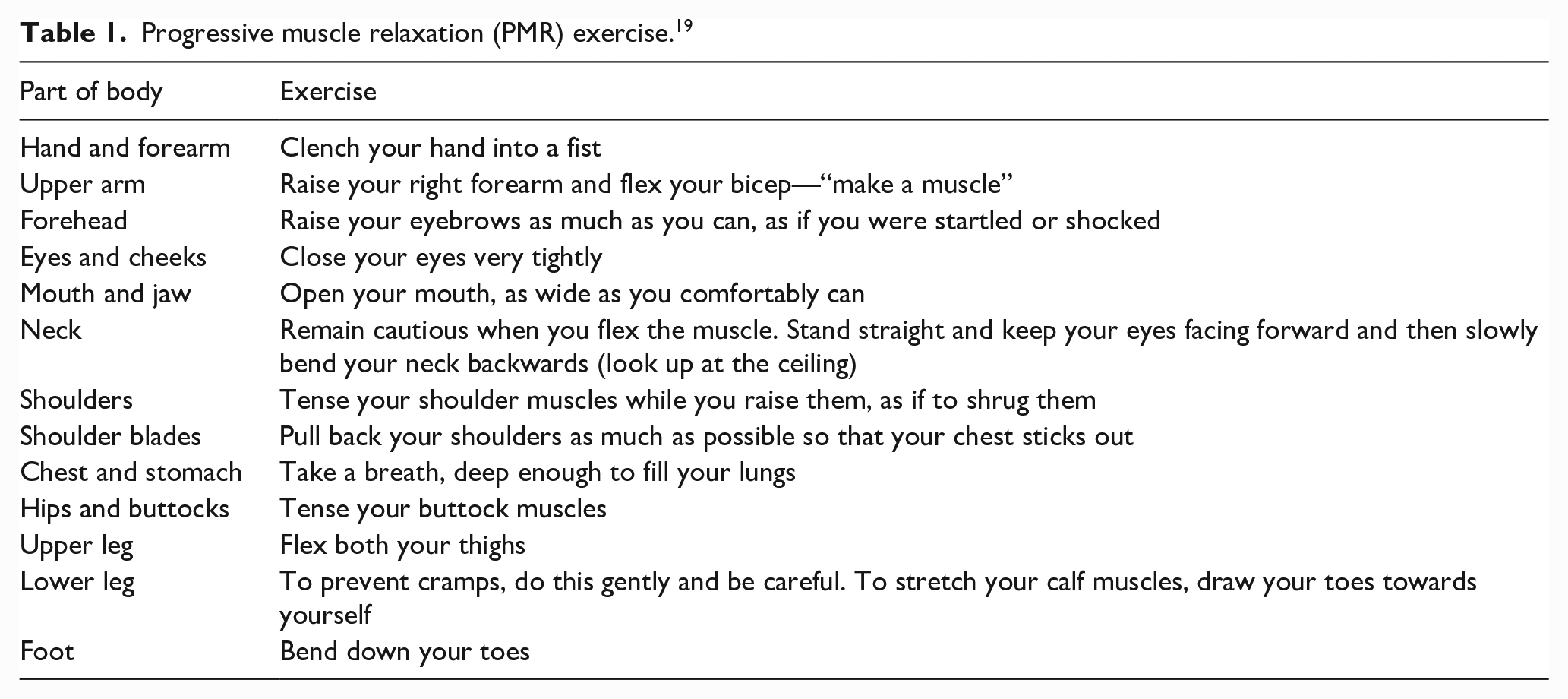
Jacobson’s PMR exercise has been employed in various studies.17,18 This exercise was performed on 40 participants in a five-person experimental group across five consecutive 45-minute sessions each week for 2 weeks. The researcher highlighted to the students at the start of the first session that the objective of the exercise was to help them reduce muscle stress. He also informed the students that they would not be late or miss any appointments and that they would attend all sessions. In the following sessions, the researchers applied the PMRE exercise. Muscle groups should be contracted and released in the order specified in this exercise (Table 1). 19 While the researcher was conducting this exercise, the students felt comfortable on the ground. Students had been advised ahead of time to dress comfortably in order to avoid anxiety. Furthermore, the students were instructed to perform each training session at home for 10–15 min every day. At the end of each session, students were urged to continue practicing relaxing exercises at home. On the day they entered the clinical environment, they completed the STAI questionnaire for the second time.
Progressive muscle relaxation (PMR) exercise. 19
Instrument
The instrument included
Part one: Demographic characteristics of the participants as age and gender
Part two: State-trait anxiety inventory (STAI)
The STAI questionnaire, developed by Spielberger et al., 20 provides independent measures for measuring state (S-scale) and trait (T-scale) anxiety. In this study, only the S-anxiety scale (STAI Form Y-1) was employed. Each of the 20 items on the questionnaire measured how the participants felt at the time they answered it. Items (3, 4, 6, 7, 9, 12, 13, 14, 17, 18) were associated with anxiety-present, while items (1, 2, 5, 8, 10, 11, 15, 16, 19, 20) were related to anxiety-absent. The participants’ feelings were graded on a four-Likert scale as (not at all, somewhat, moderately, and very much so). The anxiety present items were scored from (1 to 4), with higher scores indicating a higher level of anxiety. 20 Nonetheless, the anxiety-free items were scored on a (4-to-1) scale. The overall score for the STAI Form Y-1 ranged from 20 to 80 points. The questionnaire’s reliability varied from 0.86 to 0.95. 20
Ethical consideration
All participants signed written informed consent forms after obtaining formal approval from Arab American University (IRB2021/1015). The study was registered and accessible on the American Economic Association’s registry for randomized controlled trials (AEARCTR-0011058). The purpose of the study, as well as the risks and advantages of participation, were also explained to the students. They were also informed that they might opt out of the study at any moment. Furthermore, confidentiality was considered in this study, and all participant information was kept in a locked file cabinet with limited access. In addition, each participant was given a code number.
Data analysis
Statistical analysis was performed using the Statistical Package for Social Sciences (SPSS) version 23. Frequency, percentage, mean, and standard deviation were used to present descriptive statistics. An independent t test and paired t test were used to compare between the groups. The statistical significance of this study was set at p < 0.05.
Results
Sample description
A total of 80 participants completed the study. The intervention group and the control group were similar according to age and gender at pretest (p > 0.05) (see Table 2). Also, anxiety was similar between the two groups at pretest (p > 0.05) (see Table 3).
Demographics characteristics of the participants (N = 80).

Significant at p < 0.05.
Anxiety scores for intervention group and control group (N = 80).

Significant at p < 0.05.
For the intervention group, the mean post intervention state anxiety score (M = 1.15, SD = 0.43) was lower than the mean pre-intervention state anxiety score (M = 2.86, SD = 0.38). A paired-sample t-test for the intervention group indicated a significant decrease in the State Anxiety Scale score (t (39) = 19.9, p < 0.01). When comparing the two groups, the intervention group had a significantly lower level of anxiety than the control group after the 2-week intervention (t (78) = 18.06, p < 0.01), as seen in (Table 3).
Discussion
The study aimed to investigate the effect of progressive muscle relaxation exercise on anxiety among nursing students in intensive care unit prior to clinical training. The anxiety score was compared between the intervention and the control groups. The results showed a significantly decreased anxiety score among the nursing students in the intervention group. It is also well known that there are several stress-reduction techniques, one of which is PMRE. According to our findings, the PMRE program had a favorable influence on the average anxiety score of nursing students in intensive clinical training. Despite the fact that there are just a few studies in the literature that used PMRE as an intervention to reduce stress in nursing students, their findings are congruent with ours. In one of these studies, Pelit-Aksu et al. 21 found that clinical stress decreased in students who completed PMR exercise for 3 weeks. Kim 22 also instructed nursing students to undertake PMRE for 8 weeks before beginning clinical practice and showed that PMR was useful in lowering clinical stress symptoms. In addition, Gangadharan and Madani 23 found that PMRE was significantly helpful and most of the participants stated that their negative emotions were reduced and their emotional state turned back to normal. Alhawatmeh and Ross 24 found that conducting PMR twice a week for 3 weeks decreased stress in Jordanian nursing students.
According to Veiga et al., 25 a relaxation program lowered psychological and physiological stress indicators in nurses. Also, two studies on nursing students conducted by Toqan et al.26,27 found that that Progressive Muscle Relaxation Therapy can help nursing students in reducing their stress levels in pediatric course and in initial clinical training.
Relaxation is the most efficient and effective therapy for psychosomatic disorders such as anxiety.28,29 This is due to the body’s attempt during the relaxed state to repair damage and eliminate toxins by generating natural chemicals. Furthermore, relaxation increases useful output by nurturing internal abilities and increasing the capacity to think and innovate via the empowerment of psychological and mental strength, as well as an increase in self-confidence. 30
The major goal of PMRE is to educate the people how to actively restrict their muscular tension and, as a result, lessen their anxiety. Convenience, cost-effectiveness and independence of practice are the primary benefits of this strategy in anxiety control. Nursing is demanding for nursing students, and the quantity of instructional content they must study, as well as the intense clinical situations, add to their anxiety. Individuals’ perceptions of their capacity to cope with daily pressures may change, and PMRE can be utilized to lower students’ anxiety.
Limitations of the study
This study has some limitations that may have influenced the study’s results. This study relied on self-reported questionnaires, which may increase the possibility of reporting bias due to personal interpretations of questionnaire items. Also, only age and gender from socio-demographic data were used and this was limiting factors.
Conclusion
The current study found that PMRE had an effect on anxiety reduction in intensive care units during clinical training among nursing students. As a consequence, it is recommended that this approach be taught to nursing students at nursing schools prior to the start of critical care clinical in order to reduce anxiety. Also, the study recommended for further studies on correlation between demographic variables and as attendance of students, and class performance as these are the factors which need to manage along with any exercise program.
Footnotes
Acknowledgements
The authors would like to express their thanks to the critical care nursing students who participated in the study.
Declaration of conflicting interests
The author(s) declared no potential conflicts of interest with respect to the research, authorship, and/or publication of this article.
Funding
The author(s) received no financial support for the research, authorship, and/or publication of this article.
Significance for public health
Stress is a public health problem and also contributes to a variety of other mental and physical health problems. Intensive care units (ICUs) are considered stressful and emotionally risky situations by both professionals and patients and their families because of the intricacy of patient health problems, complex patient care demands, and quick changes in patients’ circumstances. The purpose was to assess the effect of progressive muscle relaxation exercise on anxiety among nursing students in intensive care units prior to clinical training. The study confirmed the effect of progressive muscle relaxation exercise (PMRE) on anxiety reduction among nursing students during their clinical training in intensive care units.
