



Abstract
Background:
This study aimed to assess perceptions and attitudes toward COVID-19 vaccines among medical students.
Methods:
A consecutive convenient sample of 2100 university students representing the student’s union network were included using an electronic self-administered questionnaire. About 12 items were used to assess attitudes and acceptance of COVID-19 vaccines.
Results:
A total of 2100 volunteers responded to the survey. All ages ranged from 18 to 25 years, 69% were females, and 57.3% were from urban residences. According to their willingness to receive the COVID-19 vaccine, 49.7% accepted, 38.5% hesitated, and 11.8% refused vaccination. Out of 60 scales measuring their attitudes, a median total score of 46.0 (42.0–49.0) differed significantly in relation to genders, residence, and vaccine decision-making groups. Logistic regression analysis showed that participants who consented that COVID-19 mass vaccination could prevent the spread of infection in the community and stop the pandemic have 1.9 higher odds of accepting vaccination (p = 0.003). Additionally, the participants who believed that the vaccine had no severe infection or side effects were 3.1 and 2.8 higher folds for vaccine acceptance, respectively (p = 0.001). Moreover, participants who thought it was not too early for clinical trials were 4.3 times more likely to take the vaccine (p = 0.001). Individuals who agreed that information about vaccine side effects better to discuss openly with the authorities were 2.8 times more likely to accept vaccination than other hesitating/ refusing groups, p-value < 0.001.
Conclusions:
Understanding students’ perspectives of the COVID-19 vaccine and supporting their health engagement and awareness may help plan an adequate response.
Introduction
COVID-19 is the pandemic in which the entire world is allied and armed with knowledge and discipline to battle. Despite global preventive efforts (physical distancing facemasks, travel restrictions, and quarantine) to contain the COVID-19 pandemic, COVID-19 continues to have deleterious effects on health, life, and economy. 1 Vaccination is one of the most cost-effective preventive strategies available in combating a pandemic. 2
Different trends, views, and attitudes exist concerning COVID-19 vaccines is due to vaccine diversity. Governments and public health specialists will face challenges due to these variations. Individual and group factors are arising from the personal perception of the vaccine, beliefs, or attitudes toward vaccination, such as efficacy or perceived benefits of vaccines, safety concerns or side effects, and the social/peer environment, are also contributing. 3 COVID-19 related vaccination studies have found a link between some of these characteristics and vaccine uptake.3,4 Vaccine hesitancy impacts the reluctant individuals, and thus the entire community, because a high coverage rate is required to provide herd immunity, which is necessary to flatten the epidemic curve. 5
Vaccine hesitancy was defined by the WHO Strategic Advisory Group of Experts as “delay in acceptance or refusal of vaccination despite the availability of vaccination services.” 6
WHO declared vaccination hesitancy as one of the top 10 obstacles to global health. 7 The reported COVID-19 vaccine acceptance rates have varied worldwide, 3 but a recent global report illustrated that nearly 30% of the investigated individuals would refuse or hesitate to take a COVID-19 vaccine when it is available. 8 The Middle East is among the regions with the lowest vaccine acceptance rates globally. 3 Vaccine acceptability is determined by three factors: confidence, convenience, and complacency. 9
Due to their belief in their invulnerability, young individuals, particularly college students, are at risk of contracting COVID19 and transmitting it to others. 10 Medical students’ ability to volunteer in health care assistant positions that can significantly benefit healthcare systems during times of emergency has been demonstrated by experience with the current pandemic. 11
Furthermore, medical students can serve as immunization role models for the general public and shield against misleading and confusing information. Therefore, their attitude will influence their health and others’ health as future healthcare providers and major influencers in their lives and communities. In this study, we target medical students to explore the level of COVID-19 vaccine hesitancy and to measure their perception and attitudes toward COVID19 vaccines.
Materials and methods
Study design and settings
We conducted an online electronic survey on a sample of medical students from 12 Egyptian Universities (Cairo, Tanta, Fayoum, Assuit, Mansoura, El mina, Aswan, Kafr El-Sheikh, Suez Canal, Damitte, Helwan, Egyptian Russian University) who are distributed through the Faculties of Medicine, Pharmacy and Nursing representing the student union networks coalition of the Egyptian youth initiative (EYI). Data were collected using an online electronically self-administered questionnaire during February–May 2021. We conducted the study following the checklist for reporting results of internet E surveys (CHERRIES) guidelines. 12
Study participants and data collection
Among the 6000 union volunteers students, a consecutive convenient sample of 2100 medical students responded to the online survey during February–May 2021. Students represented the student union networks alliance using a purposive sampling technique by researching social networks. Once the groups were located, they disseminated announcements about the study to these groups and provided a link to the study page.
Electronic data collection form
The development of the questionnaire is based on the guidebook associated surveys, and qualitative interview guides that were developed by a multidisciplinary group of experts and global partners (WHO and UNICEF) 13 as a branch of existing expert group to develop similar tools for measuring behavioral and social drivers (BeSD) of childhood vaccination. These tools for COVID-19 vaccination are based on the overall BeSD group expertise and current research on vaccine uptake. The objective of BeSD is to boost the availability, quality and use of local and global data on vaccine acceptance and uptake. It has been adapted to suit current research objectives.
Most of the questions were in binary responses “yes and no” except for a few, where the option “I don’t know” was added, one to five-points rating scale question, and a few open-ended questions for participants to express their reasons in detail. The questionnaire covered the following parts:
The IT specialist at UNICEF developed the application on Google drive, and the electronic form was designed to accommodate multiple response questions. After tool development, the application was tested by the EYI executive team at the national population council (NPC) and UNICEF to verify and ensure skip patterns and follow them to guarantee the accuracy of data collection. To ensure the validity and accuracy of the obtained data, the investigators gave all student counselors who submitted clear questionnaire instructions regarding the study objectives to the subjects. Before submitting the survey, the survey tool automatically validated that all questions must be completed and cannot be submitted twice.
Data processing and analysis
Data were analyzed using the “Statistical Package for the Social Sciences” SPSS 22.0 software (IBM Microsoft). 14 For quantitative variables, mean and standard deviation (±SD) were used to express the results and Mann Whitney test was used for comparison between groups when applicable. For qualitative variables, percentages and proportions were used to express the results. The binary logistic regression model was utilized to predict attitudes (independent variables), which affects vaccine acceptance decision (dependent variable) among respondents. Independent variables were dichotomized (0 = strongly disagree/disagree/neutral; 1 = agree/strongly agree) and vaccine acceptance decision was coded as (0 = refusing/hesitant; 1 = accepting). Odds ratios and 95% confidence interval were used to express the results of the regression model. p-Value of <0.05 was considered statistically significant.
Ethical considerations
The executive board of the Egyptian youth initiative (NPC & UNICEF) approved the study as a part of the project framework activity. Study participants provided electronically signed informed consent after being informed of the purpose of the study and prior to data collection. Those who agreed to participate completed the submission process, and those who declined were excluded from the study by submitting an empty form after answering “Not willing to participate.” The data have been maintained confidentially under the revised Helsinki deceleration of biomedical ethics. 15
Results
The COVID-19 pandemic and characteristics of the study participants
Out of the total members representing the student union networks coalition of the Egyptian youth initiative from 12 Egyptian Universities, around 2100 volunteers responded to the survey. The individuals’ ages ranged from 18 to 25 years, 69% were females, and 57.3% were from urban communities. The majority of students (97.2%) agreed that COVID-19 is a dangerous disease. Concerns about pandemic and infection, commitment to get sufficient information about the vaccine, and to change their lifestyle to be healthier, were significant in relation to genders. Governmental websites/international organizations (35.4%), social media (28.7%), and health care providers (17.7%) were the credible sources of information. Meanwhile, mass media and friends were the least.
Participant characteristics and attitudes in relation to the vaccine decision
The acceptance group represented 49.7% of students (1044 out of 2100), the hesitant group was 38.5% (808 out of 2100), and the refusal group made up only 11.8% (248 out of 2100). Gender, residence and getting sufficient information about the COVID-19 vaccine were significant factors that governed the acceptance of vaccination, with p-values of 0.002, 0.001, and 0.001, respectively. Participants who showed a high level of trust for COVID-19 as a protective measure (on a scale from 1 to 5) were significantly more among the acceptance group (p < 0.05) (Table 1). Barriers to implementing public health measures and vaccination as one of the most important protective measures are presented in Figure 1. The most commonly mentioned reason for acceptance was to stop the pandemic (30.4%) followed by decreasing risk of infection (24.6%), while the least mentioned reason for vaccine acceptance was safety, as mentioned by (13.4%) of the study participants. Reasons for vaccine hesitancy and refusal among respondents, as mentioned by the study participants, were related to vaccine safety and effectiveness (26.4%, 23.1%, respectively). About 15% mentioned that there was no risk of infection. The most mentioned places for vaccination were hospitals and health centers, and the least mentioned were pharmacies and private sectors (Un-tabulated results).
Participants’ vaccination decisions of COVID-19 in relation to their background characteristics (N = 2100).

OR: odds ratio; 95% CI: 95% confidence interval.
Chi-square test of significance, statistically significant at p < 0.05.
Perceptions and concerns toward COVID-19 vaccines among university students (N = 2100).

OR: odds ratio; 95% CI: 95% confidence interval.
Chi-square test of significance, statistically significant at p < .05.

Public health constraints and social measures for COVID- 19.
COVID-19 pandemic, vaccine acceptance, and hesitancy among respondents
Regarding vaccine, perception and concern, a good percentage of acceptors (83.2%) believed that the way to overcome the pandemic is mass vaccination. Nearly half of them had concerns regarding the vaccine’s safety (41.8%) and its efficiency to decrease the risk of infection (44.5%) with a p-value of 0.001). A significant proportion of the acceptors disagreed that the vaccine would cause serious side effects (80%), and it is not early in clinical trials (65.1%). Nearly half of them (47.9%) could not believe that the vaccine had many side effects (p-value 0.001). When asked if the information on side effects was better discussed publicly with the authorities, the majority went to “Agree” (92.3%), with a p-value of 0.001.
Table 3 shows that the median attitude score differs significantly regarding gender, residence, and vaccine decision of the participants with p-value less than 0.05.
Total attitude score and relation with participant characteristics and vaccine decision.

Mann-Whitney test.
Statistically significant at p < 0.05.
Interquartile range.
As a reflection of participants’ expected perceptions toward COVID-19 vaccines, Table 4 displays the logistic regression analysis results of vaccine decision determinants in the acceptance group compared to the hesitating/refusing group. Participants who agreed that COVID-19 mass vaccination could stop the pandemic were 1.9 times more likely to accept the vaccine [95% CI (1.26–3.07), p-value 0.003]. Participants who showed trust in vaccine and believed that it could not cause a serious infection or have many side effects were 3.1 and 2.8 times more likely to accept vaccination [95% CI (2.27–4.35), p-value 0.001] and [95% CI (2.03–3.91), p-value 0.001], respectively. Those who believe it is not too early to conduct clinical trials have higher odds 4.3 times of vaccination acceptance [95% CI (3.13–6.16), p-value 0.001]. Participants who agreed that data about the side effects better openly discussed with the authorities were 2.8 times more likely to accept vaccination than other hesitating/ refusing groups [95% CI (2.03–3.91), p-value 0.001].
Predictors for COVID-19 vaccination acceptance decision among university students.
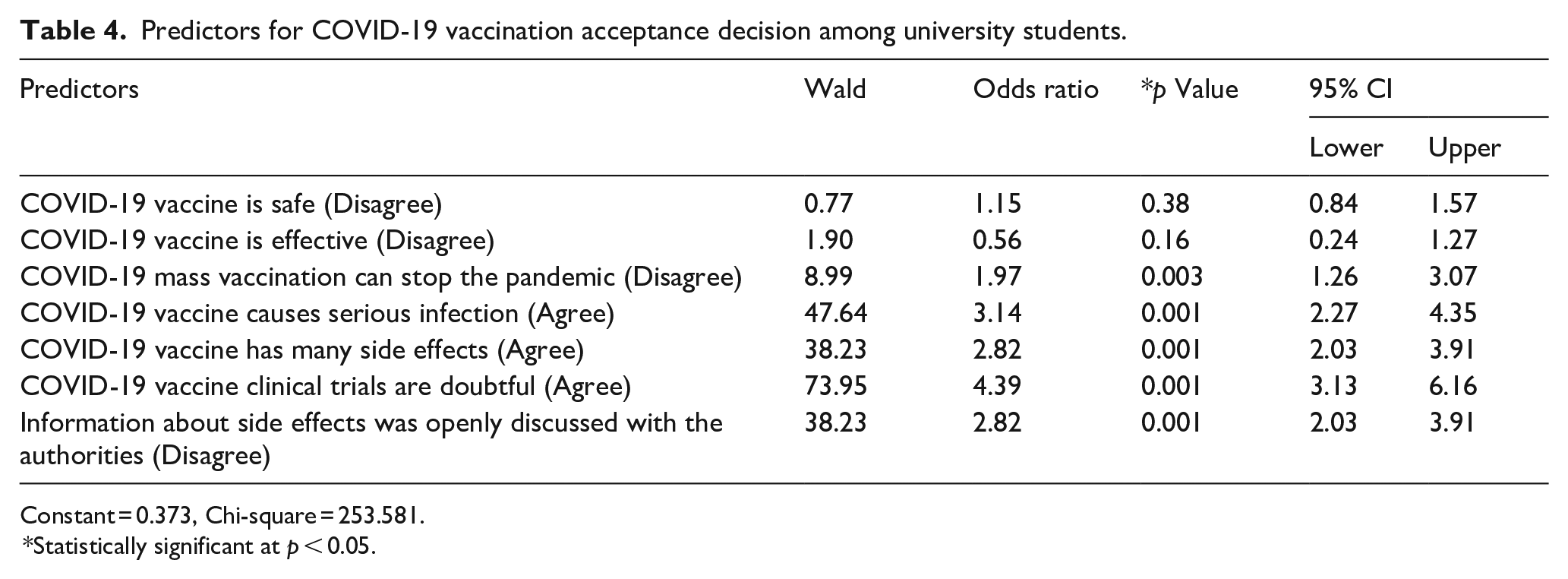
Constant = 0.373, Chi-square = 253.581.
Statistically significant at p < 0.05.
Discussion
In the current study, we targeted medical students to explore the level of COVID-19 vaccine hesitancy and to measure their perception and attitudes toward COVID19 vaccines. About half of the participants (49.7%) agreed to get vaccinated against COVID-19, while 38.5% were hesitant, and only 11.8% disagreed. This agrees with the results of other studies that enrolled medical students as participants. Both of the two studies reported that vaccine acceptance is lower than in Western countries but higher in African countries.16–20
In contrast a study in France, 21 reported that 77.6% of participants “probably agreed” to be vaccinated, which is also incompatible with other studies.9,17,22,23 The Middle East is among the regions with the lowest vaccine acceptance rates globally.8,18 Among the barriers reported in these studies toward vaccination is not knowing, “The vaccine type and distrust in healthcare policies.”
Stopping the pandemic was the most common reason for acceptance among the studied students who chose to receive the vaccine. The most common cause for vaccine refusal and hesitancy was a lack of awareness about its safety and effectiveness, which is supported by many studies that investigated COVID 19 vaccine apprehension.21,24,25
In the current study, students demonstrated different attitudes regarding COVID-19 and their confidence level regarding the protective measures, vaccine perception and attitude that differed significantly among the different groups. Our findings are supported by other studies.23,25,26
In the present study and other studies,19,26 most respondents (66.7%) believed that they did not get sufficient information about COVID-19 vaccines. Study participants reported that governmental websites/international organizations, social media, and healthcare providers are the most extensive sources to obtain their COVID-19 vaccine information. Like other studies, health care providers, social media, and published scientific articles, respectively, were the most common sources of information in these studies.8,9,26 In contrast, COVID-19 vaccine acceptance among college students in South Carolina is affected by the information resources. Most of them trusted scientists (83%), followed by healthcare providers (74%), and then health agencies (70%), they do not trust information disseminated by pharmaceutical companies. 16
According to Harapan et al., 27 most information about COVID19 is spread through social or online media. This information shapes perceptions because of the public misunderstanding. These sources are not desirable knowledge sources (conspiracy theory). As a result, greater vaccine information has increased vaccine adoption. 28
A quarter of them had concerns regarding the vaccine’s safety (41.8%) and its efficiency to decrease the risk of infection (44.5%) with a p-value of 0.001).
In this study, nearly half of the acceptors reported vaccine effectiveness and safety concerns. This agrees with results reported by other studies,3,19,20 in which respondents postponed vaccination before the safety of the vaccine was ascertained, which indicated their doubt regarding vaccine safety. Concerns regarding vaccination safety, effectiveness, duration of trials and testing have been common findings in many studies.26,29,30 All findings suggest that public education on the efficacy and safety of the COVID-19 vaccine is important for the future widespread use of the vaccine. 31
During the COVID19 epidemic, people learned about the disease from a variety of sources, including television, radio, newspapers, social media, friends, coworkers, healthcare practitioners, scientists, governments, etc. 32
Because these sources of information have the potential to influence people’s acceptance or rejection of COVID-19 vaccinations, it is critical to broadcast accurate information about vaccine safety and efficacy to gain the trust of the public, particularly the undecided. 33 As a result, identifying the sources of information about COVID-19 vaccines that people trust the most is crucial to the success of any future national immunization program.
Communities should be included early to inform them of concerns, respond to questions, and correct misconceptions. 34 Due to low public trust in vaccination, COVID19 immunization campaigns can only function if everyone believes that the offered vaccinations are safe and effective. 35 The World Health Organization has issued a warning that the world is facing a new sort of disease known as an “infodemic,” in which fake news, misleading information, and false scientific claims are spread quickly. 36
The current study, and Lucia et al., 23 stressed the importance of transparency to address concerns about vaccine development speed and its safety. It is critical to support COVID19 immunization through public statements, press releases, monitoring, and countering false news.
A high level of vaccine acceptance among the studied participants was significantly associated with a high level of attitude score. Public health science should carefully consider the need to implement target and cultural-specific actions for university students, as influencing attitudes at an earlier stage of life can be more advantageous. People’s participation around vaccines should be broad and multifactorial, with participation at multiple levels. 37 These levels include policymaking, designing sensitizing programs, development of risk communication strategies and psychosocial research aimed to understand people perspectives on vaccination behaviors to dialog with them appropriately.
Conclusion and recommendations
This study concluded that the main barriers to COIVD-19 vaccine acceptance are concerns regarding safety and effectiveness. Alleviating these concerns and enhancing public confidence in COVID-19 vaccines is crucial to future vaccination strategies and immunization programs against the COVID-19 pandemic.
Consequently, further efforts targeted to improve students’ understanding of the critical role of individuals’ engagement in protecting their health and the health of others through vaccination should be supported by a public health information campaign. Students are an excellent target for instructional advertising because they are still in school and are willing to change their habits. Understanding the student’s perspective about the future COVID-19 vaccine and supporting their health engagement and awareness may be useful in planning adequate response and management strategies in the post-pandemic period.
Furthermore, it is critical to provide evidence-based information on COIVID-19 vaccines, as well as effective and aggressive initiatives to combat misinformation. In the same vein, educational initiatives are certainly an important step to ensure appropriate awareness of individuals and communities about the value of preventive behaviors as right and responsibility.
Limitations of the study
The current study findings should be interpreted because of the following limitations: First, this study is a cross-sectional study. This research was conducted to explore the current situation in a new area of inquiry and generate reasonable hypotheses because there is no information regarding the current research topic among medical students in Egypt. Second, using an online survey may result in sampling bias, but this was the available method in current situations.
Strength of the study
Up to our knowledge, the current study was the first study in the Egyptian area to survey COVID-19 vaccine perception; thus, it can be used for the government to develop new strategies to tackle the hesitancy.
Footnotes
Acknowledgements
The authors would like to acknowledge the student union volunteers who participated in the current study.
Author contributions
All authors have contributed significantly, and all authors agree with the content of the manuscript: Shaimaa Baher Abdel-Aziz: primary data collection of the questionnaire, writing the manuscript, and helped in data acquirement, analysis, and interpretation. Marwa Rashad Salem: helped conceptualize the focus of the study, development of study materials and tools, and drafting and reviewing the manuscript. Salah Hassan Al Hanafy: contributed to conceptualization and study design, with major inputs in designing the questionnaire and drafting and reviewing the manuscript. Sherry Sayad Ayad: development of study materials and tools, helped in data acquirement, analysis & interpretation. Ahmed T. Bayad: designing the questionnaire, helped in data acquirement, analysis and interpretation. Dina Samy Shaheen: helped in data acquirement, analysis, and interpretation. Also drafting and writing of the manuscript. Tarek Tawfik Amin: contributed to the concept and design of the study, helped in data acquirement, analysis, and interpretation. He also helped in drafting, reviewing, and finalizing the manuscript.
Declaration of conflicting interests
The author(s) declared no potential conflicts of interest with respect to the research, authorship, and/or publication of this article.
Funding
The author(s) disclosed receipt of the following financial support for the research, authorship, and/or publication of this article: UNICEF - Egypt
Ethics approval and consent to participate
The Executive Board of the Egyptian Youth Initiative (NPC & UNICEF) approved the study as a part of the project framework activity. Study participants provided electronically signed informed consent after being informed of the purpose of the study and prior to data collection. Those who agreed to participate completed the submission process, and those who declined were excluded from the study, by submitting an empty form after answering “Not willing to participate.” The data have been maintained confidentially in accordance with the revised Helsinki deceleration of biomedical ethics.
Significance for public health
This current study revealed that the main barriers to COIVD-19 vaccine acceptance are concerns regarding safety and effectiveness. Alleviating these concerns and enhancing public confidence in COVID-19 vaccines is crucial to future vaccination strategies and immunization programs against the COVID-19 pandemic.