




Abstract
Despite an increase in research on sustainable human resource management (HRM) and its practice, this relatively new research approach still lacks unified concepts and practices. We argue that more qualitative research is needed to discover the practical relevance of sustainability thinking in HRM. In this comparative case study of three Finnish companies, we aim to increase the understanding of this phenomenon by using a practice-based model of sustainable HRM as a theoretical foundation. We investigate why and how the companies implement sustainable HRM and what kinds of results they have achieved. We identify not only similarities but also differences among the companies. Therefore, our study contributes to the practice-based model of sustainable HRM by presenting the outcomes of the implemented HRM practices, as well as the importance of contextual issues. Our study enriches the sustainable HRM discussion by stressing the organizational context, content and process elements, thereby indirectly lending support to the ‘soft’ HRM model, which is more developmental and employee oriented. The results support the idea that the employer, society and employees can benefit from sustainable HRM in the long term. The positive outcomes of sustainable HRM include employee wellbeing related issues, such as long careers, low turnover, low absence rate and late retirements.
Introduction
Many companies are committed to integrating sustainability into their operations due to the growing demands and challenges of sustainable development (e.g., climate change, overpopulation, environmental problems and social inequities) facing the world overall. These also require attention from businesses and their management systems. Sustainability in business means that a company adopts the so-called triple bottom line perspective that focuses simultaneously on the organization’s environmental, social and economic performance (Elkington, 1997). So far, research and discussion concerning sustainability in organizations have mainly focused on the environmental aspects of sustainability. Therefore, sustainability has received relatively little attention from human resource management (HRM) researchers to date (e.g., Ehnert, 2009; Heikkinen et al., 2021; Pfeffer, 2010). Sustainable HRM seeks to develop sustainable business organizations and create sustainable HRM systems in those organizations. According to Stahl et al. (2020), HRM practices can be perceived as sustainable if they contribute to social wellbeing, environmental protection and long-term economic prosperity. In contrast, the practices are unsustainable if they have harmful social, environmental or economic effects.
Recently, there has been growing research interest in defining and developing the concept of sustainable HRM (Lopez-Cabrales & Valle-Cabrera, 2020). For example, recent systemic literature reviews on sustainable HRM have aimed at conceptualizing this relatively new field (Anlesinya & Susomrith, 2020; Chams & García-Blandón, 2019; Macke & Genari, 2019). The reviews show a convergence between strategic HRM and sustainable HRM. Hence, it seems that sustainable HRM builds on some of the ideas of the so-called soft Harvard model of strategic HRM (Beer et al., 1984; Beer et al., 2015). The soft HRM perspective is more oriented to employees and development, emphasizing the role of the HRM system in an organizational and broader societal context and stressing both short-term and long-term goals. Although the Harvard model represents rather idealistic goals for HRM (organizational effectiveness, individual wellbeing and societal wellbeing), it ignores environmental goals, and its main concern is still shareholder value. To conclude, both the Harvard model and sustainable HRM are context-sensitive and stress the importance of several internal and external stakeholders, diverse goals, and short-term and long-term outcomes of the HRM system (Järlström et al., 2018). However, the traditional shareholder and performance-oriented approach in strategic HRM has faced criticism for neglecting the employees’ perspective and their wellbeing (e.g., Beer et al., 2015; Boxall & Macky, 2009; Guest, 2017; Van De Voorde et al., 2012). Thus, it seems that the sustainable HRM paradigm has taken this soft HRM perspective to a new level because the traditional HRM practices ‘are not sufficient for sustaining a company’s human resource base in the long run’ (Ehnert, 2009, p. 420).
Owing to the inadequacy of the sustainable HRM concepts and even some confusion about them (Aust et al., 2020), there is a need for further qualitative studies to find the practical relevance of sustainable HRM. For example, it seems impossible to create an exhaustive list of sustainable HRM practices (e.g., Stankevičiūtė & Savanevičienė, 2018) because these may be very context-specific. Furthermore, some HRM practices may be sustainable even if they are not specifically labelled as such (see Guest, 2017; Van De Voorde et al., 2012). Therefore, it is essential to identify the drivers and objectives, perhaps even the principles and values, behind these practices (e.g., Ehnert, 2009). HRM practices and activities are still the concrete actions taken by a company to build a sustainably operating organization.
In this comparative case study, we aim to investigate why and how different kinds of companies implement sustainable HRM, as well as what types of outcomes they have achieved with these actions. As shown in Figure 1, the theoretical base of our study relies on the practice-based model of sustainable HRM (Ehnert, 2009, p. 228), which is constructed with the elements of overall sustainability objectives at the corporate (or business) level, HR-related sustainability objectives and HR-related activities at the HRM level. Our study contributes to this model by also presenting the outcomes of the implemented HRM-related activities. Furthermore, our study enriches the sustainable HRM discussion by including the organizational context, content and process elements and in that way, indirectly supporting the soft Harvard model (Beer et al., 1984, 2015).
We continue this article with a brief literature review of sustainable HRM, followed by the Methodology section. The results are then presented case by case, and our discussion ends with our study’s limitations and further research possibilities.
Literature Review of Sustainable HRM
Sustainable HRM is a relatively new field of study to which many research areas and disciplines aim to contribute (Ehnert et al., 2014; Macke & Genari, 2019). Multiple topics bring important humane elements to the sustainable HRM discussion, such as sustainable HRM (Ehnert, 2009; Zaugg et al., 2001), socially responsible HRM (Cohen, 2010; Hartog & Muller-Camen, 2008), green HRM (Jabbour & Santos, 2008; Jackson & Seo, 2010; Jackson et al., 2011; Renwick et al., 2008) and strategic environmental HRM (Egri & Hornal, 2002). Despite numerous attempts to define sustainable HRM, there is still no common agreement on what it means.
In this article, we utilize the commonly used definition of sustainable HRM:
the adoption of HRM strategies and practices that enable the achievement of financial, social and ecological goals, with an impact inside and outside of the organization and over a long-term time horizon while controlling for unintended side effects and negative feedback. (Ehnert et al., 2016, p. 90)
Hence, HRM strategies, policies and practices may have a positive effect on employees’ mindsets and actions in reaching the sustainability goals of the company, or sustainability can be built into the HRM system that fosters the employees’ long-term physical, social and economic wellbeing (e.g., Ehnert, 2009). Our broader viewpoint here is to perceive sustainable HRM as an extension of strategic HRM (Ehnert, 2009), especially of the soft Harvard model (Beer et al., 1984, 2015).
Sustainable HRM has been described in several models or frameworks (see De Prins et al., 2014; Ehnert, 2009, p. 172; Ehnert et al., 2014; Kramar, 2014). In these frameworks, HRM practices are mainly linked to the broader corporate sustainability framework. Typically, the sustainable HRM models describe the stakeholders, elements, practices and outcomes, not to mention the potential paradoxes or tensions between or among the outcomes. Our theoretical base (see Figure 1) relies mainly on the practice-based model of sustainable HRM (Ehnert, 2009, p. 228).
Prior research has sought to specify what practices or characteristics differentiate sustainable HRM from the mainstream strategic HRM (e.g., Kramar, 2022; Stankevičiūtė & Savaneviienė, 2018). Therefore, an HRM system may play a major role in enhancing an organization’s sustainability. Sustainable HRM practices may develop trust between employees and managers (e.g., Bowen & Ostroff, 2004; Guerci & Pedrini, 2014). Examples of this type of practices include collaborative HR development, open communication, organizational design facilitating employee participation, work roles, and performance evaluation focused on building employee strengths and facilitating performance (Browning & Delahaye, 2011; Donnelly & Proctor-Thompson, 2011; Ehnert, 2009; Guerci & Pedrini, 2014; Wells, 2011). Some sustainable work system scholars (see Docherty et al., 2002, 2009) are interested in the development of HRM practices that facilitate the work–life balance, which may result in positive human or social outcomes. HRM bundles (i.e., HRM practices that occur in fairly complete sets, such as high-commitment HRM practices or high-performance work systems) have also been related to sustainable HRM discussions, and specific sustainable HRM bundles have been sought as well (Kramar, 2014; Van De Voorde et al., 2012).
Recently, Esen and Süral Özer (2020) presented their conceptual model of sustainable HRM. In their model, sustainable HRM covers selection and recruitment, training and development, performance evaluation and rewarding, human rights, and occupational safety and health. The model also presents outcomes of sustainable HRM in four integrated categories: individual outcomes (e.g., satisfaction, motivation and wellbeing of HR, quality of life, employability), organizational and economic outcomes (e.g., profitability, productivity, customer satisfaction, sustained competitive advantage), social outcomes (e.g., long-term employability, voluntary work, quality of life, public health, social justice and equality) and ecological outcomes (e.g., energy and paper consumption, green products and services, reduced travel for work). As shown above, sustainable HRM has mainly been linked to positive outcomes, neglecting the potential negative ones (Mariappanadar, 2014).
Hence, as presented by Stahl et al. (2020), sustainable HRM practices may facilitate value creation and preservation (economic), the efficient use of energy and eco-friendly practices (environmental), and creating a positive work environment and contributing to community development (social). According to Stahl et al. (2020), the social dimension of sustainable HRM covers both internal (how people are treated as an internal stakeholder group) and external elements (how the needs of external stakeholders are considered). The social dimension could also include social projects in the home country and consider people-friendly practices in joint ventures abroad. The transparency of HRM practices has also been stressed as a quintessential element of sustainability (Järlström et al., 2018), which could help employees to evaluate the fairness of HRM practices and organizational justice. The economic and environmental dimensions of sustainable HRM cover both internal and external elements as well. Regarding the internal element, employees are perceived as a key stakeholder group because HRM practices mainly target them. In contrast, the external element includes the legal aspects and several regulations that are followed by external stakeholders, such as trade unions or tax administration (Järlström et al., 2018). A manager’s rewarding system could include long-term value creation that appreciates the organization, its employees and society.
The practice-based model helps in structuring the sustainable HRM elements at the organizational level. According to the model (Ehnert, 2009, p. 228), the internal and the external drivers will lead each firm to have a customized sustainability strategy. The sustainability strategy then includes corporate-level objectives that guide the HRM-level sustainability objectives and HRM-related activities through which the strategy is executed. The model seeks to report the concrete practices that would lead to sustainable HRM.
The practice-based model (Figure 1) originates from empirical data about sustainable HRM, available on the companies’ webpages (Ehnert, 2009). The model provides examples of corporate-level goals of sustainability (e.g., achieving long-term success, enhancing the company’s reputation, improving the employees’ quality of life), HRM-level goals of sustainability (e.g., attracting and retaining talent and being recognized as an employer of choice, maintaining a healthy and productive workforce; investing in the skills of the current and future workforce), and HR-related activities and practices (e.g., good employee relations, work–life balance, and lifelong learning and career development). However, this model neglects the outcomes of the HR actions, which are important for evaluating the HRM system and its link to sustainability. The main categories are shown in Figure 1.
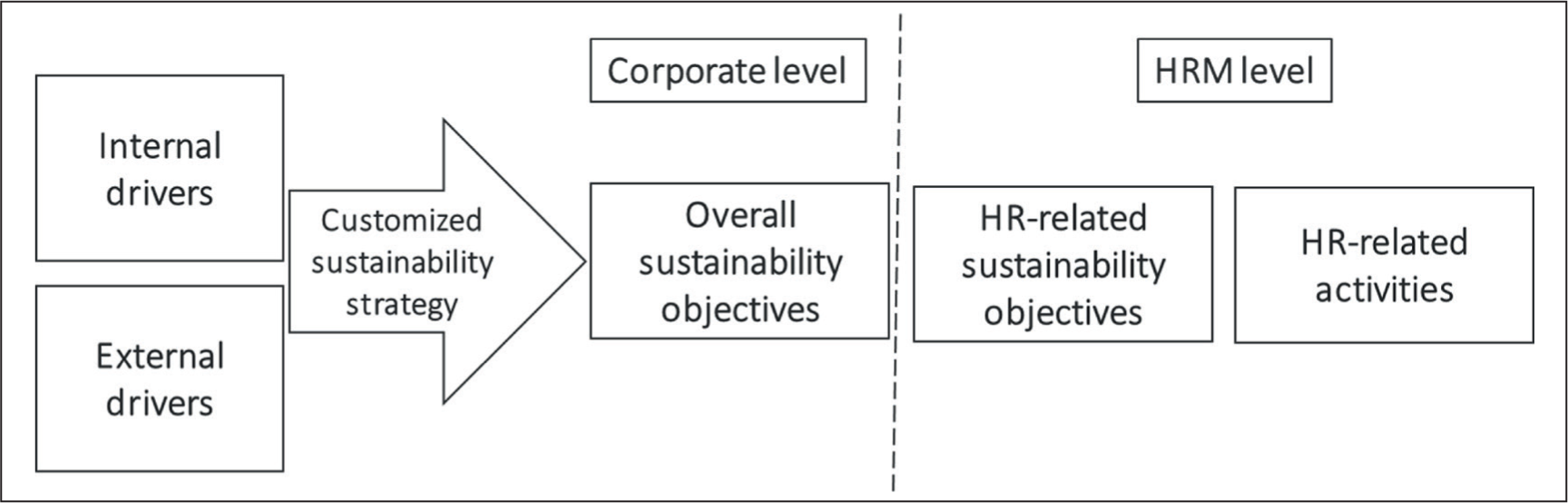
This model draws together our theoretical framework and will be utilized in our data analysis and as a basis for our findings and discussion. Our study’s context, data collection and methods of analysis are described in the next section.
Methodology
Since sustainable HRM as a phenomenon is still quite new and unstructured, our qualitative case study aims to gain an understanding and explore the meaning of this new phenomenon (Eisenhardt, 1991). This research method allows greater possibilities to investigate specific contexts and to deal with a variety of evidence (Miles & Huberman, 1994). The approach is particularly useful when the researcher seeks to understand some kind of a process (Zalan & Lewis, 2004). Hence, we have chosen a case study approach (Yin, 2003) because our interests are related to not only the process but also the content and context of sustainable HRM. This is also a comparative case study, which helps us identify similarities and differences among the cases.
The institutional context of our study is Finland, which, along with the other Nordic welfare countries, ranks high in surveys of equality, social welfare and corporate social responsibility-oriented activities (Strand et al., 2015). Finland is known for generous social benefits that are available to all citizens, its population’s high level of happiness and wellbeing, equality in gender relations, and a corporatist system of employment relations characterized by close co-operation among labour unions, employer organizations and the state. Previous studies (Heikkinen et al., 2021; Järlström et al., 2018; Riivari et al., 2019) in the Finnish context have demonstrated that sustainability thinking is topical there. Economic and institutional situations affect how highly ethical thinking is valued in organizations—especially historically during economic downturns, it has been more about survival than ethical thinking (Riivari et al., 2019). The organizations’ environment and the institutional context also have an effect on the organizations’ HRM practices and should therefore not be excluded in any case (Riivari et al., 2019). For example, Heikkinen et al. (2021) bring forth the importance of work–family practices and show how these are relevant in terms of ensuring social responsibility and can be interpreted as either helpful or unhelpful by the employees. The discussion on finding a balance between work and family is topical in the Finnish context. The national social support system aids children’s daycare or homecare so that mothers and fathers are able to work equally. This system helps organizations in planning their family-support practices and long-term thinking in sustainable HRM. This institutional system also extends the organizations’ stakeholders to include society as well. In their study, Järlström et al. (2018) highlight the latter point and present how top managers in Finnish companies perceive sustainability and its relations to different stakeholders. Based on this study, sustainability is constructed around four elements in the managers’ thinking: justice and equality, transparent HR practices, employee wellbeing and profitability. The salience of different internal or external stakeholders differs in each of these four elements. Therefore, Finland offers an interesting context for studying sustainable HRM because people in Finnish companies are familiar with sustainability-related thinking.
This case study was conducted among three Finnish companies (anonymized as Case A, Case B and Case C) of the five that were originally contacted. Access to these companies was the main selection criterion, but we (the authors) were aware of the highly context-dependent characteristic of HRM. Thus, it was known that the differences in sector, industry and institutional arrangements would have effects on HRM (e.g., Kroon & Paauwe, 2014; McDuffie, 1995). Therefore, the selected companies represent different sectors and types of organizations. Case A is a state-owned energy company, operating internationally and employing 20,000 people in 10 countries. Case B is a family-owned food processing company, operating mainly domestically and employing over 1,000 people. Case C is a customer-owned co-operative in the retail and the service sectors, operating mainly in Finland, with almost 40,000 employees. Co-operatives are enterprises operating in accordance with the principles of co-operative activities. The owners are also the customers or co-op members. These three companies represent different forms of ownership, industries and sizes, allowing potential differences to be found and comparisons to be made.
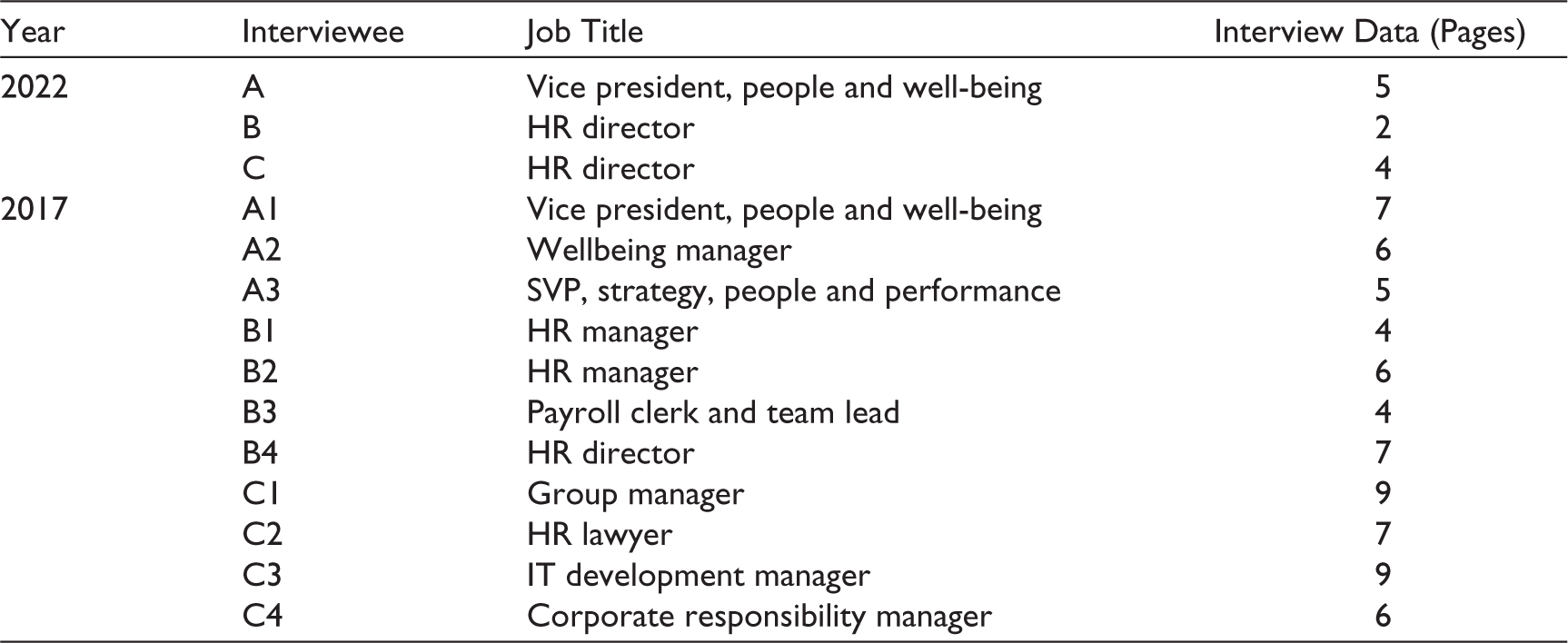
The data were collected through semi-structured theme interviews held in 2017 and 2022 (see Appendix A for details of the interview in 2017). In 2017, in each of these three companies, the HR Director was interviewed in addition to two or three other professionals (e.g., HR/personnel manager, group manager, sustainability manager, employment lawyer). In 2022, the same companies were contacted, and more interviews were conducted. In 2022, we were able to interview two of the same interviewees as in 2017. In Case C, the HR director had changed, and we interviewed the current HR director. In Case B the former HR manager had become the HR director during this time period. As shown in Table 1, the data include four interviews from Case A, five interviews from Case B and five interviews from Case C. Lasting from 25 to 45 minutes each, the interviews were first audio recorded and later transcribed. The interview transcripts, each comprising two to nine pages of written data, formed the raw data for subsequent analysis. In 2022, the interviews dealt with the interviewees’ views on what sustainability meant, how their organization had implemented sustainable practices in their HRM, and what outcomes they had already discovered. To ensure anonymity of the interviewees, they were assigned codes, which we use when citing direct quotations from the data.
Description of Interviewee Data in the Case Companies.
One author conducted the interviews, but all authors read the full transcripts to obtain an overview of the data and participated in the analysis process. The data analysis began with a thorough reading of the transcripts one case at a time to obtain an overview of the issues that were discussed and to begin coding the contents. The coding process was first data-driven to allow the data to speak and to identify the issues that the interviewees themselves linked to sustainability. The second round of analysis was theory-driven; we utilized the practice-based model of sustainable HRM and looked for the objectives and the activities that were discussed. We also added the outcomes of sustainable HRM to evaluate the progress that these organizations had made and to find out how they themselves saw what the outcomes of sustainability were. Through this coding and content analysis, the data were given a clearer structure to enable us to draw conclusions (Yin, 2003).
The Findings section is divided into four parts accordingly. In the first part, we cover the corporate level and report the overall sustainability objectives of the case companies. In the second and third parts, we cover the HRM level and report the companies’ HR-related sustainability objectives and HR-related activities. In the fourth and final part, we deal with the outcomes of sustainable HRM to highlight what has been achieved in these companies when they have invested in sustainable HRM. This structure is based on the practice-based model of sustainable HRM (Ehnert, 2009). With a case-by-case presentation of the empirical results, we highlight the differences and the similarities among these three cases, which vary in size, industry and internationalization.
Findings
Case A
Overall Sustainability Objectives
In Case A, its corporate strategy is the main driver of its sustainability goals. Its corporate values—responsibility, creativity, integrity and honesty—comprise the cornerstone of all its activities, and the same values guide its HRM. The company has a long history of building a sustainably operating organization, with clear rules and instructions on how it should operate to ensure consistency and transparency in all its actions. This company operates in the energy field, which explains its long history, especially in environmental sustainability.
The interview in 2022 has made it clear that even more emphasis is now placed on what the company does in regard to overall sustainability, which has both internal and external drivers. The Vice President (A, 2022) describes the company’s desire that its employees can proudly say that they work for this company and that the internal employer brand is good. The external employer brand is also perceived as highly important in enabling the company to acquire the best talent from the market, as expressed by the Vice President:
We need to be able to communicate this to ensure that people know that we are a good place to work in. (A, 2022)
This highlights the importance of external stakeholders throughout the supply chain, in terms of not only sustainability but also the whole business.
HRM-related Sustainability Objectives
The HRM-related sustainability objectives are linked to the corporate strategy whose aim is to ensure that the corporate strategy can be executed. The emphasis is on ensuring work safety and employee well-being and the best possible use of knowledge and resources. The company recognizes that sustainable HRM refers to good basic HRM. The Vice President says:
When we have good corporate values as the basis for HRM, then people management will happen sustainably. (A, 2022)
As people management is value-based, the vice president sees that everything they do has to be considered in relation to these questions: ‘Have we done everything right?’ ‘Is this based on our values?’ The line managers and the team leaders have the greatest responsibility for ensuring that the company operates in a sustainable way.
As an outcome of the systemic sustainability work, different types of leadership training are highlighted in the 2022 interview. The Vice President explains that the main objective for leaders’ training is to ensure that the organization operates sustainably and that the employees are able to perform well and produce the best possible business results. Good performance and results cannot be expected unless the ability to work well is ensured. Thus, there are tough business aims for working but with the human aspect of caring for the safety and wellbeing of employees.
HRM-related Activities
As Case A is an internationally operating listed company, several sustainability indicators for HRM-related activities are measured by means of employee surveys and reported on a monthly basis. A distinct benefit offered by this company is its in-house occupational health service, which illustrates the value that this company places on its employees’ health. The company has put extra effort in creating cozy and ergonomic workspaces, possibilities for remote work, flexible work times and facilities for leisure activities. All these are examples of putting employee wellbeing in the centre.
Equality in recruitment decisions is also monitored closely, as well as equal pay. This reflects the corporate aim for equal opportunities for all, despite gender, for example:
In our recruitment policy, every applicant is equally considered and the best one selected. (A1, 2017)
The equality aspect has gained even stronger emphasis by the time of the new interviews in 2022. Equality has then been discussed in relation to different cultures and international operations. The institutional differences even within European countries challenge the objective of offering equal opportunities for everyone. For example, the Vice President describes a situation with dual-career couples who have small children. In these families, women might not have equal opportunities to pursue their careers, for example, if the country’s daycare system does not support this objective. This challenges the company’s aim to have more women in leadership positions and therefore attain its diversity and equality goals. In Finland, the daycare systems support working women but for this internationally operating company, it can be difficult to provide the same support for women elsewhere. Overall, the element of care is even more visible in this company’s activities now than previously. It reports having multiple and different physical and mental health programmes offered for employees (including workouts and exercise classes). The war situation in Ukraine has emphasized the need for considering the employees’ mental health and the possibilities to discuss their fears or anxieties with someone. The company’s care for its employees is visible in many different forms, as the Vice President describes:
I believe that the employees recognize our efforts to take care [of them] and ensure [their] safety. (A, 2022)
HRM-related Outcomes
The outcomes of the HRM-related activities become visible, for example, through the employees’ long careers in this company. It is rather atypical in the industry overall:
We have employees with very long careers, and the retention rate is high. (A2, 2017)
This outcome can be interpreted as the result of the systemic work done to promote wellbeing at work and good work conditions. This can also be observed in the low numbers of early retirements and of missed work days due to sickness. These outcomes could be linked to the caring culture, good and ergonomic workspaces, and positive image of the employer overall.
In the 2022 interview with the Vice President (A, 2022), the employee survey was mentioned as a relevant tool used to measure the outcomes of the sustainability objectives. The survey now includes a diversity section as a new element to test how the company objective of diversity, equity and inclusion is perceived among its employees. The quite recent application of hybrid work has also been added to the survey. The pandemic (COVID-19) has changed the ways of working, and the manager recognizes that now is the time to find out how working is going. The results are also reviewed by the company’s board of directors to highlight their importance and perhaps put a strategic emphasis on them. Over the five-year period (2017–2022), the emphasis on diversity and inclusion has become stronger, but otherwise, the developments are minor nuances of past achievements.
Case B
Overall Sustainability Objectives
Case B is a family-owned food processing company that operates mainly in Finland. Its sustainability objectives are based on the company mission to provide people with a possibility for a better long-term job. The mission puts emphasis on a good atmosphere and good leadership, as well as trust between the individual employees and the organization. The organization strives to provide possibilities for both personal development and participation in organizational development. The Christian value of ‘Treat people like you would like to be treated’ guides the overall operations of the company. This humane view on individuals and the idea that ‘everyone is equally valuable as a human being’ are the strongest guiding principles of the company. It employs people of many different nationalities, making it even more relevant for highlighting the equality element. Sustainability is perceived as covering responsibilities, not only for one’s own family, one’s company and its employees, but also more broadly, for society and the environment. The societal sustainability objective is visible in the company’s efforts to offer employment to people who have difficulties in finding a job otherwise, such as people with disabilities:
We aim at employing people from our local society and doing business sustainably. We have recruited people with disabilities who would otherwise not cope with the working life. We can find different tasks for them.… Through corporate responsibility, we are able to support local people and offer job opportunities for the underprivileged. (B1, 2017)
These basic values of the company have remained the same throughout this data collection period. In the 2022 interview, sustainability objectives more specifically targeted people, nature and animals (this is a food processing company; therefore, animal wellbeing is relevant). These objectives were being developed and reviewed right at the time of the interviews, providing information about the corporate aim to constantly develop these sustainability principles further. ‘We do, we dare, we care’ are the basic driving forces that also include sustainability elements.
HRM-related Sustainability Objectives
HRM-related objectives are based on the overall goal of the company, that is, to place a heavy emphasis on people and their equality. Ensuring employees’ wellbeing is a priority, both at work and outside work, to support their long careers, despite their hard physical work. Focusing on employees’ wellbeing, particularly outside work, is unique to this company. It invests in its employees’ opportunities for physical activities outside work (including boxing, exercise classes and wellness lectures) and even has the so-called sleep school that helps employees with sleeping problems to have a good night’s rest. The HR manager explains that the goal is for employees to be able to work without physical restrictions and to retire after a long working career in good physical condition.
Similar to the overall objectives of the company, with these HRM-related objectives, the basic humane and caring attitude still guides the company in 2022. Sustainability means taking care of the basic HRM activities and building trust in the system (e.g., pay policies or work safety), alongside the grander societal challenges of mitigating climate change and reducing carbon footprint.
HRM-related Activities
The basis for HRM-related activities is compliance with the laws, but sustainability goes beyond this basic requirement. The company offers support for any of these elements when needed—so it is not solely work-related support but also financial support, family support services, physical activities, and so on, outside work. In the company, the managers have even begun discussing if they could have their own daycare centre for the employees’ children. Safety regulations, ergonomic workstations and the lunch cafeteria are concrete examples of activities in place to support the employees’ overall wellbeing.
The company’s large number of employees presents a challenge in supporting everyone equally. The same services are not suitable or acceptable for everyone—partly because of the multicultural workforce. The HR manager (B1, 2017) explains that managers feel that the more they are able to expand the variety of services, the more the employees are able to find something suitable for just themselves. There are challenges in leading the company’s large multicultural workforce, which are also recognized.
In 2022, the HR director (B, 2022) described the company’s investment in management training through coaching and inclusive leadership during the five-year period (2017–2022). There are still challenges because the workforce is scattered in different locations and it is difficult to reach everyone equally. As a more concrete activity and as a new addition to the previous ones, a part-time retirement plan has been included, which allows employees to benefit from it during the last three years of work and makes it easier to work until the full retirement age.
HRM-related Outcomes
This case company has realized that it is difficult to measure the results of sustainable HRM. Overall, if employees feel well and are able to perform their jobs, that is one indicator of success, but equally important is the indicator of mental health:
How does it feel to be working? If they feel good, they also want to do their best and are proud of their accomplishments. (B1, 2017)
Again, the feelings of respect and dignity emerge when managers consider the outcomes of their style of leading people. It also includes the merciful thinking that employees are allowed to make mistakes and learn from them.
In 2022, a general increase in mental health problems has been observed in the company. The HR director (B, 2022) emphasizes that HR people not only monitor employee wellbeing and absences closely but also want to find additional ways to be more active in taking care of the personnel and their general wellbeing. The annual job satisfaction survey is an important tool for such monitoring, as are personal development discussions, where individual employees can more freely talk about their work and private lives. Overall, the monitoring of employees has increased over the years. The food industry typically has a lot of sick leaves among its employees due to the physical nature of the work. However, in this company, the HR director and manager feel that with the close monitoring, they have been able to tackle part of this problem. The turnover and the competition for labour can also be high, but fortunately, the company does not find this issue a huge problem yet, and there have been good applicants for the open positions. Compared with Case A, this company’s sustainability challenges are related to the nature of the work and ensuring especially the physical wellbeing of its workers. As a family business, it also regards its employees as family and extends its responsibility beyond work. Both companies share the same ideology of being value-based and striving for long careers and committed employees.
Case C
Overall Sustainability Objectives
The third case is a customer-owned co-operative in the retail and the service sectors. Case C is a large company by Finnish standards, employing approximately 40,000 people. Its sustainability programme is based on the slogan ‘The best place to live’. This programme originates from the grand global challenges (e.g., ecological deficit, social globalization, financial deficit and changing social structures), which have then been identified as elements hampering the company’s operations and therefore defined as issues that need solutions. Overall, the goal of this sustainability programme is to make it concrete enough to be understandable and feasible. It is strongly based on the values of the company.
In 2022, the HR director also brought up the link between sustainability and the company strategy, for example:
It [sustainability] includes many different aspects; it is in our strategy, but I do not recognize more detailed descriptions of it.… But our mission is to make a better place to live and work, and our sustainability programme puts this mission into practice. (C, 2022)
This means that sustainability is not separate from the company’s overall strategy but is considered a main element of it. This company also has three sustainability programme themes:
Towards the new normal of sustainable consumption together, one step at a time; Towards sustainable growth while respecting natural resources; Towards an equal world, eliminating inequality. (C, 2022)
The aim of these themes is to steer attention towards the sustainability elements that are relevant for this organization. Overall, the sustainability objectives are widely visible in the company strategy and guide the activities towards many stakeholders.
HRM-related Sustainability Objectives
From the HRM perspective, the guiding principles for sustainability are related to living by the HRM policies, obeying the laws, and treating people with respect, equality and no discrimination. These came up in all interviews, which indicate that these are well established in the company and guide the overall objectives of people management. It is also generally hoped that in this company, the employees would take responsibility for their own work and be interested in developing and learning new things.
In the 2022 interview, the HR director (C, 2022) mentioned that the guiding principles for HR work entailed the development of leadership and culture to support the corporate strategy, values and co-operation. Sustainability is a core value in this development. Nonetheless, achieving the business goals is also important since this industry is personnel intensive and it is a huge challenge to ensure the right number of competent employees to be able to reach the business goals.
HRM-related Activities
Similar to the other cases, in this company, HRM-related activities highlight the wellbeing aspects in a broad sense. The basic things in everyday work are important, especially one-on-one discussions with the employees’ own supervisors. When the roles and responsibilities related to one’s work are clear, and the job can be done within reasonable work hours, then these form the basis for wellbeing at work. The interviewees also bring up the point that wellbeing is everyone’s responsibility, and all should evaluate how they themselves contribute to the overall atmosphere at work (with negativity or positivity) and how they treat their colleagues. Basically, they talk about normal human relations but highlight the fact that when one learns to know one’s colleagues and to build trusting relations, teamwork also becomes easier.
Based on the co-operative nature of this company, many of the concrete activities bring forth the effects of the company’s actions on the surrounding society as well. As shown in the 2022 interview, one concrete example is that the company offers a huge number of summer jobs for teenagers or young adults every year and gives them the possibilities to gain their first work experience. Compared with the other two companies, this opportunity is unique to this company or any other operating in the retail sector. Moreover, employing people with disabilities and taking responsibility for creating welfare for society at large are viewed as broader societal effects. These are also linked to the company’s overall sustainability objectives and to the grand challenges in society. Within the organization, support for mental health is raised as an important issue since there are challenges with that. Supervisors and team leaders are perceived as central actors in taking action; therefore, they need training and support in that role. Mental health issues are similarly highlighted in the other two cases.
HRM-related Outcomes
An important outcome of these sustainability activities is the increased overall awareness of sustainability issues. The outcomes of such consciousness are probably more visible inside than outside the organization. Within the organization, the sustainability element and leading the company based on its values have increased the employees’ motivation to work. There seem to be more possibilities to have a voice in one’s work, which is a basic building block for motivation. When an individual is motivated, one wants to do the best in one’s own work, which is then reflected in the company results as well, as an interviewee describes: ‘I can only see a win-win situation in this’.
In 2022, the concrete HRM activities highlighting sustainability were related to the time of the pandemic. During that time, many employees were in danger of being laid off because there was no work anymore (e.g., for hotel and restaurant staff); however, they were retrained to be able to work elsewhere, for example, in grocery stores. This was a highly sustainable solution to a difficult situation, and the outcome was notable in the lives of individual people. As another outcome of this solution, the company sees that its reputation has improved and it is perceived as a trustworthy, responsible, caring and good employer. In a sense, this highlights the overall change that is visible in sustainability discussions. The managers observe that the expectations become increasingly higher, and irresponsible behaviour is not tolerated anymore. All company operations need to be transparent, and the human way of doing things is valued, as the HR director says:
I am confident that since our company’s story began with the idea of ‘against unreasonability’, therefore, this [sustainable way of thinking] comes very naturally for us. (C, 2022)
The meanings of values and responsibility have been under discussion in the company, especially now, because of the war in Ukraine.
Comparison of the Cases
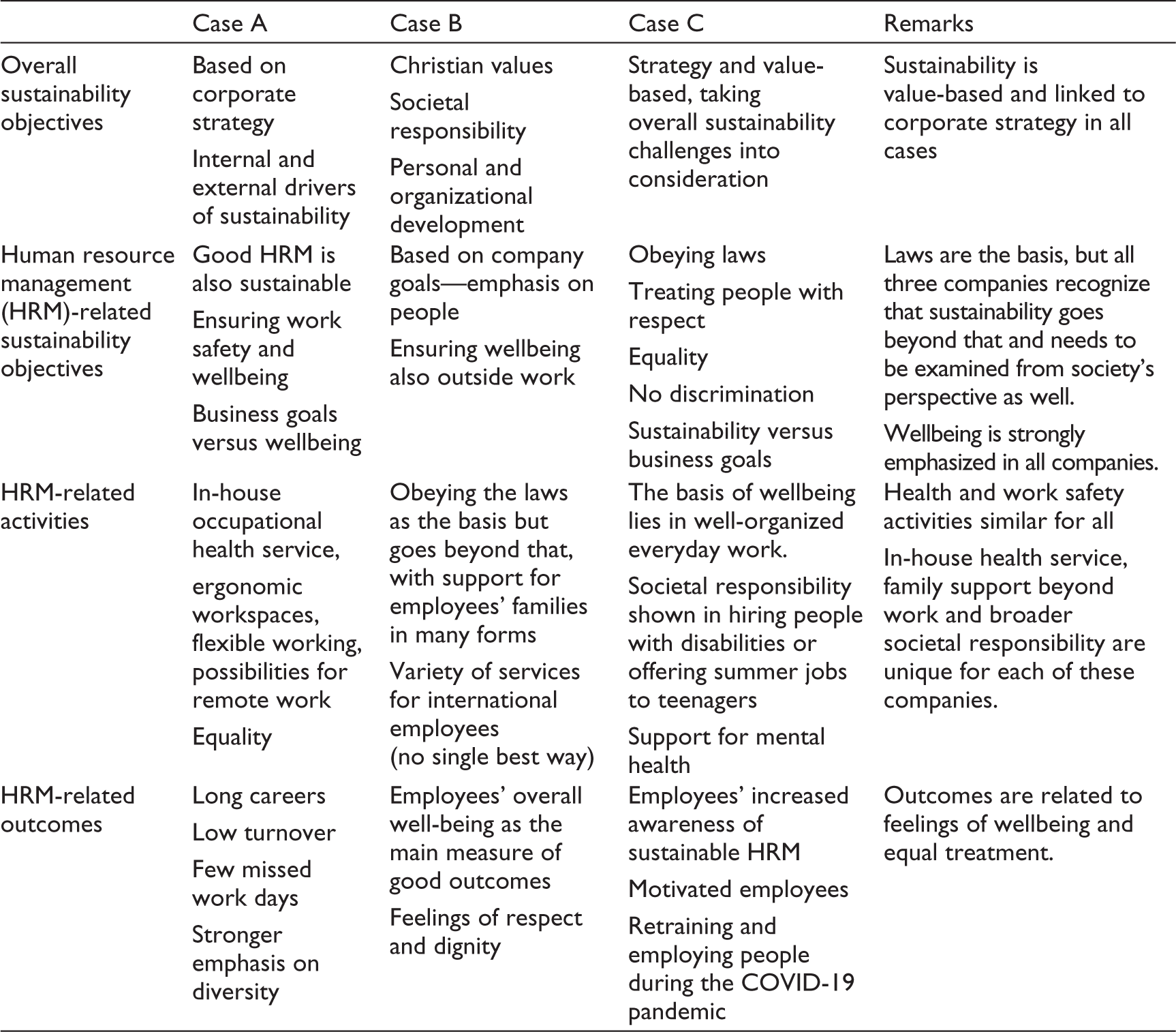
To draw together the main differences and similarities in these cases, we now compare them according to the themes (Table 2). The case companies differ in size, internationalization, ownership and industry. Their common characteristic is that their activities and the whole existence of each company are strongly value-based. Values guide their operations, and they recognize that values form the cornerstone of sustainability as well. The differences in the companies allow us to compare them and bring forth the contextual explanations for these differences.
Comparison Among the Cases.
Corporate-level Sustainability Objectives
The institutional context of the case companies creates the basic framework within which these organizations operate. Northern European welfare society aspects are reflected in the company-level goals that emphasize the responsibility for the ‘triple bottom line’ (Elkington, 1997). The differences or special features of these companies are related to their areas of operation: Case A is an energy company, so environmental sustainability is important. Case B is a food company, which belongs to a labour-intensive industry, so finding labour is essential. Case C operates in the service and the retail sectors, so its broad responsibility for the surrounding society can be observed.
By comparing the contextual elements of the companies, we can observe that they do not differ in the sense that they all perceive themselves as responsible for the society in which they operate. In particular, Cases B and C state that they employ young people or people with disabilities and offer job opportunities to those who otherwise would not have the chance to find employment. For its part, Case A takes into account environmental aspects to a greater extent, and as an international company, it must also consider human rights and child labour issues to a greater degree. Major global challenges seem to at least partially guide the sustainable development thinking of these companies (Aust et al., 2020).
Organization-level, HRM-related Sustainability Objectives
Overall, HRM goals are strongly related to company-level goals in each case. The representatives of Cases A and C tell us that they have a specific goal for leadership development because supervisors are viewed as key people in how employees perceive their work and how they generally act. In contrast, Case B struggled a bit to find goals and the right path towards sustainable development, but an external consultant assured the company that it was already on the right track. Compared the objectives with Ehnert’s (2009) model, these goals are not as concrete yet, but they target to attracting and retaining talent, maintaining a healthy workforce and investing in skill development of the workforce.
HRM-related Activities
In Ehnert’s (2009) model, HRM activities are versatile and related to the three main goals mentioned above. All our case companies uphold the same value in taking care of their employees, and their HRM activities also reflect this value. We now compare the case companies, based on each of the three objectives:
Maintaining a healthy and productive workforce The wellbeing aspects are emphasized in every case company, which shows that the employees are well taken care of. They agree that there are both business and humane reasons to invest in the wellbeing of their employees and ensure occupational safety. This finding shows the importance of HRM practices related to wellbeing (e.g., Guest, 2017), which Guest (2017) has also claimed to be sustainable. The studied companies have also been successful financially, which supports the mutual benefits of HRM (both the employer and its employees can benefit from sustainable HRM). As in Ehnert’s (2009) model, our case companies strive to find ways to balance work and life and invest in ergonomic workplaces. On one hand, Case A seems to identify business reasons more strongly than the others, but it is a listed company, which increases the pressure on it to perform well financially and show results to its stakeholders. On the other hand, Case B represents a unique example of extending the employer’s responsibilities beyond work. It recognizes the value of taking care of its employees even in their free time, offering many tangible benefits (spillover effects). The company’s values are strongly Christian, which could be an explanation for this very strong caring and humane way of thinking and acting. Investing in the skill development of the workforce Since finding competent employees and retaining them is a key element for the long-term sustainability of the companies, all of them indicate that they want to take good care of the workforce and invest in it. Case A highlights its responsibility to provide training and coaching to its managers and employees. It also trains its employees to ensure their future employability. Case B also highlights competence development and tries to train its managers so that they can be active in their work, for example, via early intervention, and avoid long sick leaves among employees. Case C uses co-operation as a training method. Attracting and retaining talent There is scarcity of competent workforce in each of these companies. Talented employees are difficult to find; therefore, creating a good employer brand is essential. Case C sees that it has been able to improve its employer brand during the COVID-19 pandemic through its efforts to avoid the outbreak’s negative outcomes on individual employees. This activity has helped the company retain its valuable workforce. Case A operates internationally, so it must ensure that its subsidiaries or factories also operate sustainably. It is also part of the employer’s reputation and compliance with ethical guidelines, as well as with the UN’s sustainable development goals.
The companies want to support long careers. Case B particularly emphasizes its hope that its employees can have long careers in the company and retire in good physical condition. Case A also reports that it has very low turnover and employees with long careers in the company. Case C reorganized its workplaces during the pandemic so that the employment relationship could continue without layoffs. All of these activities show evidence that the companies have recognized the value of committed and talented employees.
HR-related Outcomes
Already in 2017, several positive outcomes of sustainable HRM were highlighted. To name a few, in Case A, a good employer brand, a low number of sick leaves, a low turnover and fewer early retirements were highlighted. In Case B, trust in the workplace, positive well-being results, business growth and low turnover were the most visible outcomes. In Case C, a good work atmosphere, gender equality, giving voice to employees and increased motivation and innovation among employees were observed as positive outcomes.
A striking difference between the two data collection points is that mental health issues were raised in all interviews conducted in 2022. The pandemic could be one possible explanation for this, but in these case companies, it is not so obviously a work-based problem. For example, Case C managed to relocate its employees and to avoid most of the redundancies. The pandemic also did not affect the other two case companies so strongly that it would be the only explanation for the malaise. For this reason, mental health problems can also arise from causes other than just work-related ones. However, the pandemic may have affected the employees’ families, which is also reflected in their working life. Increasing work intensification, efficiency and general changes in work can also be some causes of mental health problems (see Mariappanadar, 2014). The studied case companies report that special attention has been paid to the health of their employees, and now, mental health problems are also on the table for discussion and resolution.
This matter emphasizes more employee-oriented thinking and the fact that even a difficult issue can be discussed, and it is understood that overall well-being is based on physical, mental and social wellbeing (Guest, 2017).
Discussion
Our comparative case study has aimed to increase the understanding of sustainable HRM by using Ehnert’s (2009) practice-based model as a theoretical basis. We have investigated why and how different kinds of companies implement sustainability at the corporate and HRM levels, as well as what kinds of outcomes they have achieved with these actions. We have identified both similarities and differences among the companies. Our study contributes to the model by also presenting the outcomes of the implemented HRM activities and the importance of contextual issues. Furthermore, our study enriches the sustainable HRM discussion by including the organizational context, content and process elements, indirectly supporting the soft Harvard model (Beer et al., 2015). Our findings support the idea that employers, society and employees may all benefit from sustainable HRM in the long term. The positive outcomes of sustainable HRM include employee wellbeing related issues, such as long careers, low turnover, low absence rate, and late retirements, which has social and economic meaning as well.
Theoretical Contributions
Our findings support the practice-based model of sustainable HRM (Ehnert, 2009), which combines contextual, context and process elements. Hence, our findings also provide indirect empirical support to Harvard’s model (e.g., Beer et al., 2015), which is widely known in strategic HRM and stresses the effects of multiple stakeholders (e.g., employee groups, management), contextual issues (e.g., workforce characteristics, laws and societal values), HRM actions (e.g., work systems), HRM outcomes (e.g., commitment) and longitudinal effects (individual well-being, organizational effectiveness, societal well-being). In the practice-based model it is integral to take the context into account and understand that the practices that make up sustainable HRM (the content) may be different in different contexts. Therefore, our cases demonstrate that emphasis may be more on the internal or the external stakeholder interest depending on the sector or other contextual elements of the company. Especially the size of the company affects the importance of the different practices when considering sustainability. Further, the process links HRM to the organizational level. The sustainability strategy includes corporate-level objectives that guide the HRM-level sustainability objectives and activities through which the strategy is executed. Hence, understanding the context, content and process elements of sustainable HRM explains also the outcomes of sustainable HRM. Therefore, the practice-based model is integral for gaining further knowledge on what sustainability in HRM means.
Our findings also resemble Stahl et al.’s (2020) argument that HRM practices can be perceived as sustainable if they contribute to social well-being, environmental protection and long-term economic prosperity. The cases highlight that the ultimate goal for the companies is the long-term economic prosperity while taking into account the environmental effects of the operations. Environmental protection—meaning climate change, carbon footprint or resource preservation—is integral for every company and society and environmental awareness is also seen as employee training theme in our cases. The concept of sustainable HRM has elevated the meaning of social sustainability and therefore from the HRM perspective the social wellbeing is emphasized in our findings. This can be explained by the overall development in society that employee wellbeing is a significant factor in economic prosperity and both can be achieved simultaneously as also Guest (2017) argues.
HRM strategies, policies and practices may have effects on employees’ mindsets and actions in attaining the sustainability goals of the company, or sustainability can be built into the HRM system that fosters the employees’ long-term physical, social and economic wellbeing (e.g., Ehnert, 2009). Our findings support both of these to some extent but aid the latter a little more. The guiding principle seems to be to avoid harm (Stahl et al., 2020) to employees or the surrounding environment and society, and by doing good, it is possible to achieve the goals of sustainability and invest in employees’ overall wellbeing—psychologically, physically and socially (Guest, 2017).
Practical Implications
Work life is hectic, and work demands have increased, which may have detrimental impacts on several employee-level outcomes, including stress at work, health problems, and difficulties in balancing work and private life. Our findings show the importance of integrating sustainability into HRM, which may help reduce potential negative effects of work intensification.
We have identified concrete drivers of sustainability at the corporate level, as well as sustainable goals, practices and outcomes at the HRM level that may also enhance the organizations’ overall aim for sustainability. The findings may help other companies relate sustainability to their HRM system and plan their HRM policies and practices accordingly. Educators in schools, HR professionals and consultants may also use such knowledge in their work.
Limitations and Future Directions
Our study has several potential limitations. First, although case studies typically include only a few cases (Yin, 2003), the three cases make it difficult to draw conclusions that would be more widely applicable. Likewise, although the case companies differ from others, they are all Finnish in origin. Furthermore, start-ups or small companies might have different HRM practices and outcomes and could be fruitful research targets. Second, we used sustainable HRM as a concept in our interviews. Hence, the interviewees might have stressed some HRM practices over others. For example, they might have stressed the ones related to well-being (people) rather than those associated with performance (profit) or the environment (planet). Third, none of the HRM practices was mentioned as harming employee wellbeing; thus, the interviewees seemed to relate mainly positive outcomes to sustainable HRM (see Mariappanadar, 2014). Less is known about the potential negative effects, if any, of sustainable HRM. Fourth, although we had two interview rounds, with a five-year interval, the effects of HRM practices are less clear without concrete measures. Finally, the HRM practices might have changed over that period; thus, their impacts might take more time to be revealed, and quantitative studies may also need to be conducted several years later to be able to obtain more generalizable results.
Nonetheless, it would also be interesting to find out how the sustainability efforts were developed in these same companies and to conduct another round of interviews in the same organizations later. Then, it could be relevant to include employee viewpoints and determine whether the intended elements of the sustainability strategy and activities would also be perceived in the same way. Likewise, the research field would benefit from longitudinal or comparative quantitative studies to observe the effects of contextual issues (e.g., country, industry, size) on sustainable HRM practices and their outcomes.
Footnotes
Declaration of Conflicting Interests
The authors declared no potential conflicts of interest with respect to the research, authorship and/or publication of this article.
Funding
The authors have received no financial support for the research, authorship and/or publication of this article.
Appendix A. Interview Guide (2017)
Name, age, job title and duties in the company, length of employment in the current organization
What kind of HRM department do you have?
What kinds of goals have been set for HRM in the company?
What kinds of values guide HRM in the company?
How transparent are the HRM practices?
What does sustainability mean (in this company)?
What kind of sustainability department do you have if it is separate?
When did sustainability start gaining more attention in the company?
Why has the theme of sustainability come up?
What issues does sustainability concern today?
How does sustainability demonstrated in the company’s everyday life/functions?
What are the company’s values?
Do social responsibility and sustainability differ from each other?
How are social responsibility and HRM related?
Regarding sustainability, what is reported and how is it done?
What kinds of responsibilities do the company management, supervisors and HR professionals assign to employees?
How do you understand or define the concept of sustainable HRM?
Is sustainable HRM defined in the company? If so, how is it defined?
Do you talk about sustainable HRM out loud? Why or why not?
How is sustainable HRM implemented in practice? Could you give some examples?
In which matters or practices is sustainable HRM not visible?
Since when has sustainable HRM been brought up?
How has sustainable HRM developed over the years?
What kinds of outcomes has sustainable HRM had?
What kinds of problems are associated with sustainable HRM?
Do you think that the employment contracts are clear in all respects for both parties, also in terms of sustainability?
What methods are used to ensure the wellbeing of the company’s employees?
How could the well-being of the employees be improved/promoted?