



Abstract
The need for collaborative leadership to advance knowledge sharing, novel ideas, inclusion and employee engagement has increased in modern organizations, with the aim being to make organizations more effective and responsible. Yet, an interesting question arises about how this kind of leadership model, which is arguably of Western origin, is understood and whether it can be applied in sociocultural contexts where top-down leadership tends to be exercised. This study addresses this question and explores the meaning of collaborative leadership from a cultural viewpoint in Pakistan, where collaborative relationships across hierarchical levels are not common. The applicability of collaborative leadership in the study context is also highlighted. The qualitative instrumental case study was conducted in a higher education institution in Pakistan, where the data were gathered with the help of open-ended interviews. Thematic analysis was used to analyse the data. Two central themes were explored: the tradition of leadership collaboration and the exclusion of some groups from collaboration. The study shows that the traditional cultural attribute called Otaq lays a foundation for understanding collaborative leadership in the study context. Similarly, it was discovered that several cultural features place limits on specific people’s opportunities to participate in leadership collaboration. Cultural features and how they are linked to the inclusion of the studied organization members in collaborative leadership efforts are highlighted. It is concluded that more contextually sensitive knowledge about collaborative leadership activities is needed in the future.
Keywords
Introduction
Over the past few decades, the need for cooperation and knowledge sharing, especially in knowledge-intensive organizations, has increased. As a result, industries and academia have advocated the idea of collaborative leadership (CL) as a useful alternative to the more traditional top-down leadership approach (Kramer & Crespy, 2011). CL refers to leadership with less of a traditional hierarchy. Instead of hierarchical relationships, the collaboration of people representing different tasks and positions is stressed (Mendenhall & Marsh, 2010). Responsibility for leadership is shared among people, and features such as mutual respect, shared aims and values, interdependence, mutuality, open communication and appreciation of diverse people’s ideas are seen as important (Lawrence, 2017). Previous studies (e.g., Hsieh & Liou, 2018; Kramer & Crespy, 2011; Raelin, 2006, 2016) have shown that CL has several benefits for individuals and organizations, such as better communication, novel ideas and improved employee engagement. CL advances responsibility in leadership by advancing an inclusive work environment and strengthening ethical values in leadership (Archer & Cameroon, 2009; Burns & Mooney, 2018; Hallinger & Heck, 2010).
Much of the research on CL, as with leadership studies in general, has been done in Western societies, especially in Anglo-Saxon societies (e.g., Ahmad, 2018; Guthey & Jackson, 2011; Hamlin & Patel, 2020; Jones, 2005; Yukl, 2012; Zhang et al., 2012). This may constrain contrasting understandings of CL in other cultural contexts where people are used to top-down leadership and where collaborative relationships across hierarchical levels are not common. Thus, an interesting question arises about how CL is understood and whether it is relevant––or even possible—in this kind of cultural context. This study addresses the question and focuses on CL in the Pakistani sociocultural context, where hierarchical relationships and a top-down leadership model are typically followed.
According to Guthey and Jackson (2011), previous studies on leadership from a cultural viewpoint can be divided into two main approaches. First, the cross-cultural approach aims to compare leadership between countries (e.g., Hofstede, 1980, 2001; House et al., 2004). These studies have produced knowledge of how leadership differs in different national cultures. Second, various researchers (e.g., Guthey & Jackson, 2011; Hamlin & Patel, 2020; Nie & Lämsä, 2015; Zhang et al., 2012) claim that it is crucial to go beyond the cross-cultural approach and adopt an insider perspective. According to this perspective, leadership needs to be studied from the viewpoint of the culture where the leadership occurs. To better understand the complex relationship between culture and leadership in the context of this study, the second perspective is adopted here.
Drawing on the previous literature, we assume that broader socio-culturally shared ideas of leadership shape leadership in organizations (Chang & Lee, 2007; Guthey & Jackson, 2011; Hofstede, 1980, 2001; House et al., 2004; Jones, 2005). This study takes a cultural viewpoint on CL in the Pakistani sociocultural context. With the help of a qualitative case study approach, the study sheds light on the topic by generating knowledge in response to the following research questions: How do the members of a higher education organization in the Pakistani cultural context understand CL? How are the cultural characteristics of Pakistan reflected in the way CL is understood? Moreover, we discuss of the applicability of CL in the organization in this context.
The field of higher education was selected because higher education institutions (HEIs) are knowledge-intensive organizations. They require cooperation between and the participation of a diverse range of people to be successful and to be able to promote the development of their own activities and society in general (Altbach, 2013; Kezar, 2014; Komatsu, 2009). To face increasing challenges, more highly educated people, internationalization and sustainable development, as well as navigating and successfully handling many changes in technology and social norms, collaboration and knowledge sharing between different actors is claimed to be important to HEIs in Pakistan and elsewhere (Burns & Mooney, 2018; Khalida et al., 2017; Mangi et al., 2012). In Pakistan, there is high gender inequality (The Global Gender Gap Report, 2021). According to the UN Sustainable Development Goals 2015 (
In this article, we localize the meaning of CL and contribute to extending the body of knowledge concerning the complex relationship between leadership in organizations and societal culture, especially by conceptualizing CL in the Pakistani sociocultural context, where the culturally embedded ideas of leadership may contradict Western understandings of CL. We think that this contrasting setting has the potential to reveal information that can contribute to developing culturally sensitive CL in the studied HEI. The study also offers information to leaders and managers in the studied HEI, and possibly to other HEIs in Pakistan, to make their work more effective. This study provides an intensive exploration of CL in a single case organization and offers an opportunity to generate culturally contextualized knowledge of CL.
Theoretical Background
Collaborative Leadership
In general, leadership can be understood as an influence process that emerges within a social system and is shared among the members of the system (Denis et al., 2012; Yukl, 2012). With CL, people work together and learn to coordinate their activities to achieve common goals and solve problems related to their work (Raelin, 2006, 2016). This means that individuals are not understood as separate entities but instead form a social site of multiple relationships. In such an arrangement, leadership is shared among participants in their everyday social relationships and interactions and does not rest on the shoulders of a single individual (Carroll et al., 2008; Denis et al., 2012; Lawrence, 2017).
In the model of CL by Raelin (2006), the importance of action learning in CL is stressed. According to this model, CL learning can occur when relevant needs and issues arise in an organization that need to be handled and solved. Some person takes the initiative to start an activity, and other members become committed and share leadership with the initiator (Raelin, 2006). Raelin sees the following principles as necessary (p. 155). First, collaboration based on a discussion without a stance of judgmental inquiry is important. Participants submit their ideas and opinions to the critical reflection and examination of others. Group members participate in discussion with the aim that something novel or unique can arise from a mutual inquiry that can reconstruct the participants’ view of reality and advance organizational performance. Power sharing is important in CL, and it signifies that all members of an entity are operating in tandem with a position leader. Compassionate collaboration is also a key feature of CL. It refers to accepting and promoting a diversity of viewpoints, including those that do not conform to current relationships and ideas within the culture of a community. This condition also stresses sensitivity toward less-privileged perspectives and not just a promotion of dominant perspectives (Raelin, 2006).
According to Archer and Cameroon (2009), CL can bring together diverse people’s potential within an organization in such a way that leaders and followers raise one another’s levels of inspiration and responsibility, which then leads to interdependencies among multiple parties.
Otter and Paxton (2017), who also stress a learning viewpoint to CL, mention that although CL needs a culture of collaboration between people, it is significant that people undergo an individual transformation in their mindset and action—especially, a change from the mindset and role of understanding him/herself as one leader in charge: a person in a leadership position must see him/herself as part of a community.
CL is crucial for advancing especially the success of knowledge-intensive organizations, such as the success of HEIs, and for promoting knowledge-based societies in general (Komatsu, 2009). However, how CL operates can be problematic in contexts where traditional masculine ideas of patriarchy and hierarchy, even a heroic leader-centred approach, have typically been adopted precisely because such leadership marginalizes women and some other groups (Lawrence, 2017). Lawrence says that being responsible in leadership means being naturally inclusive. Moreover, Fletcher (2004) stresses, using the concept of post-heroic leadership, that collaboration among a diverse group of people is an important leadership model in modern organizations.
Pakistan: A Sociocultural Context
According to a theory proposed by Sahlins (1999) and Jones (2005), people experience the world through broader cultural norms and conventions that give meaning to their experiences and direct their understanding and actions. Considering this viewpoint, organization members’ meaning-making with respect to CL is guided by a broader sociocultural context, and yet they are not entirely determined by the context. So, culture—standard norms, values, conventions, and habits—are learned, not discovered, by people (Jones, 2005). Thus, cultures change, albeit very slowly, and so do the meanings that people in organizational life give to their experiences.
Although CL in the Western cultural context has been shown to be a positive leadership approach (Hallinger & Heck, 2010; Kramer & Crespy, 2011) understanding and applying CL can be challenging in other cultural contexts (Zhang et al., 2012). For example, in low-trust contexts, where managers and employees do not greatly trust one another, autocratic leadership is the norm, and organization members are likely to prefer hierarchy and control to CL (Mangi et al., 2012; Pučėtaitė & Lämsä, 2008).
Pakistan, the sociocultural context for this study, is a modernizing country located in the Southeast Asia region. After being part of the British empire for 100 years, Pakistan became independent in 1947. Religious beliefs, various Indian traditions and the British colonial system are all characteristic of the country’s cultural heritage (Shah et al., 2016). Nadeem and de Luque (2020) have studied Pakistan’s culture and related organizational life, relying on the GLOBE’s cultural leadership theory (House et al., 2004). According to them, high-power distance, high in-group collectivism, low gender egalitarianism and high assertiveness are all key cultural values evident in leadership in Pakistani organizations.
Nadeem and de Luque (2020) suggest that high-power distance in social relationships refers to authoritative managers who follow the transactional leadership model. This means that influence and power are based on an individual’s hierarchal position, and strict rules and regulations define social relationships in working life (Dorfman et al., 1997; Memon, 2007; Shah, 2010). Moreover, Nadeem and de Luque (2020) stress that high in-group collectivism is valued in Pakistan. Obligation, loyalty, self-sacrifice and obedience to the family, especially to elderly family members, is the key feature of this kind of collectivism (Ahmad, 2018).
Nadeem and de Luque (2020) have also found that Pakistan exhibits low gender egalitarianism. In Pakistan, women have a lower status than men, making it difficult for them to achieve equality at work and in society. According to the Global Gender Gap Report (2020), published by the World Economic Forum, Pakistan ranks 151st in gender equality among 153 countries. Social disapproval of women taking a more active role in Pakistan characterizes every sub-sector of the economy, including HEIs. The general belief is that women should assume domestic roles at home instead of pursuing a professional career (Ayman & Korabik, 2010; Mehmood et al., 2018).
Finally, high assertiveness among men is valued in Pakistan (Nadeem & de Luque, 2020). Men are expected to assert their dominance, be aggressive and maintain the upper hand in relationships, all characteristics primarily associated with traditional masculinity. According to Islam (2004) and Nadeem and de Luque (2020), the social setup in Pakistan follows the tradition of paternalistic leadership and centralized, male-dominated decisions that allows for low levels of employee autonomy and low levels of cooperation in decision-making. Therefore, individuals and organizations tend to be less reactive to inequalities in working life. Hamlin and Patel (2020) argue that, in general, such leadership tends to be practiced more generally in South Asian societies, where traditional ideas about masculinity and male power are adhered to more than collaboration among diverse groups of people.
Methodology
To intensively explore the topic, we conducted a qualitative single case study following a phenomenological approach. Such an approach is useful because it emphasizes exploring and interpreting the study participants’ experiences in relation to the investigated phenomenon from the standpoint of their social world (Sanders, 1982). This approach acknowledges the importance of theory in research but similarly emphasizes the importance of the actor’s experiences and perceptions in exploring phenomena in the social world (Aspers, 2009). According to Gill (2014), people construct their understanding of their social world through experiences and perceptions, and the construction is shaped by social environment and interactions, which are embedded in cultural and historical tradition and context. From this point of view, it can be said that the understanding of CL is contextual and historical.
An instrumental case study was adopted, meaning that we used the case, a public-sector university in the area of Sindh in Pakistan, as a means of exploring the topic under investigation (Bell et al., 2015, p. 64). This case organization was selected because it is one of the largest and oldest public-sector universities in Pakistan and is considered an influential HEI in the province of Sindh. The total number of universities in Sindh province recognized by HEC and chartered by the Government of Sindh is 65, including public and private; 25 universities are public sector universities (The Higher Education Commission, 2022). Traditional cultural norms are followed at the university; thus, the institution serves as a useful case for this study when applying the adopted cultural viewpoint.
The empirical data were collected via open-ended, face-to-face interviews in 2019. Using the qualitative interview method, we aimed to generate rich, in-depth data that shed light on our understanding of the complex societal, behavioural, and educational issues shaping respondents’ real-life experiences with respect to the research phenomenon (Bell et al., 2015). The following topics were included in the interview guide: respondents’ background information, the general idea of leadership, societal possibilities and hindrances to CL, and learning about and developing collaborative forms of leadership (see Appendix A). The interview guide was pre-tested to help us adapt its relevance to the local environment (Yeong et al., 2018). Four participants, including two managers and two employees from the targeted organization, pre-tested the protocol. As a result, several minor points of clarification were made to the guide. One of the authors in our research group has lived most of her life in the region where the university is located. During the data-gathering phase, she, when needed, had the required language skill to communicate with the participants in their native language. This provided an added comfort level for the study participants to share their lived experiences in the local language.
Purposeful sampling was used during the interview data collection phase (Patton, 2015). Our criteria included finding people who represented various positions in the case organization and who were of different ages, with different levels of experience, and different educational levels to produce rich and in-depth information. Moreover, both women and men were included in the sample. Email contacts were used to find potential study participants. In total, 23 emails were sent to various faculties and disciplines in the university. Fifteen people agreed to participate in this study and written informed consent was received from each participant to guarantee the confidentiality of the data. A summary of the research participants’ data is presented in Table 1.
Research Participants.
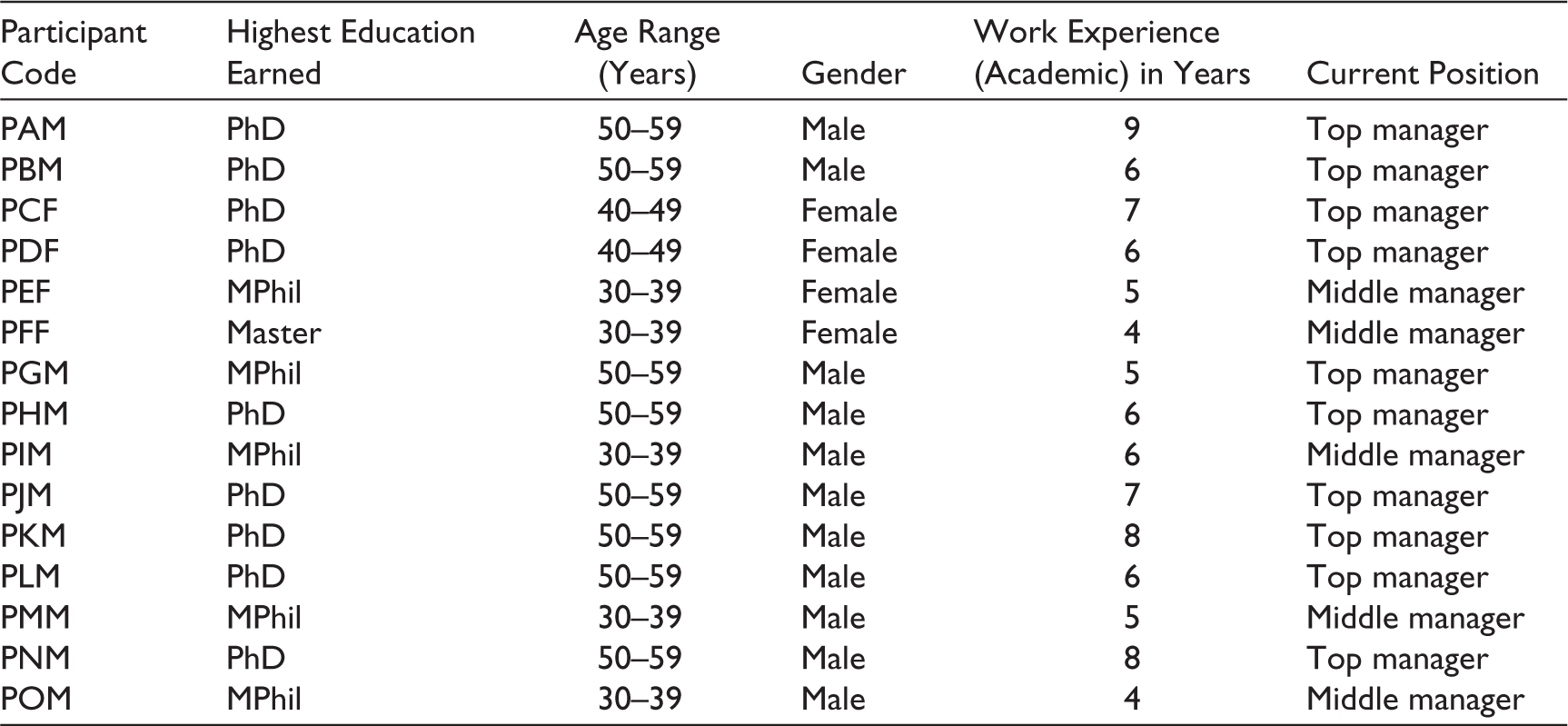
To guarantee anonymity, the respondents were assigned only a letter code in alphabetic order ranging from PA to PO (15 people). Moreover, gender identification was added to the end of the code: M means male and F means female. For example, the participant code PAM means that this person is a male and was interviewed first, whereas PCF denotes a female participant who was interviewed third. All the interviews were recorded and transcribed word by word. The interviews lasted from 60 to 90 min. Research participants used both English and Sindh languages in the interviews. The local language was carefully translated into English.
Thematic analysis (Clarke & Braun, 2017) was applied to analyse the data. The NVivo application (version 12.6.0) was used to support the analysis and interpretation. We followed the protocol of thematic analysis suggested by Braun and Clarke (2006). First, we familiarized ourselves with the data by reading the textual data carefully several times and listening to the recordings of the interviews. We grouped the pieces of text based on shared meanings and created codes for the groupings. We generated codes for the same meanings in a bottom-up approach. Next, we sorted the initial groupings into potential themes using our theoretical background more explicitly as a resource for the interpretation phase. A short example of the analysis process is presented in Table 2.
Example of the Data Analysis Process.
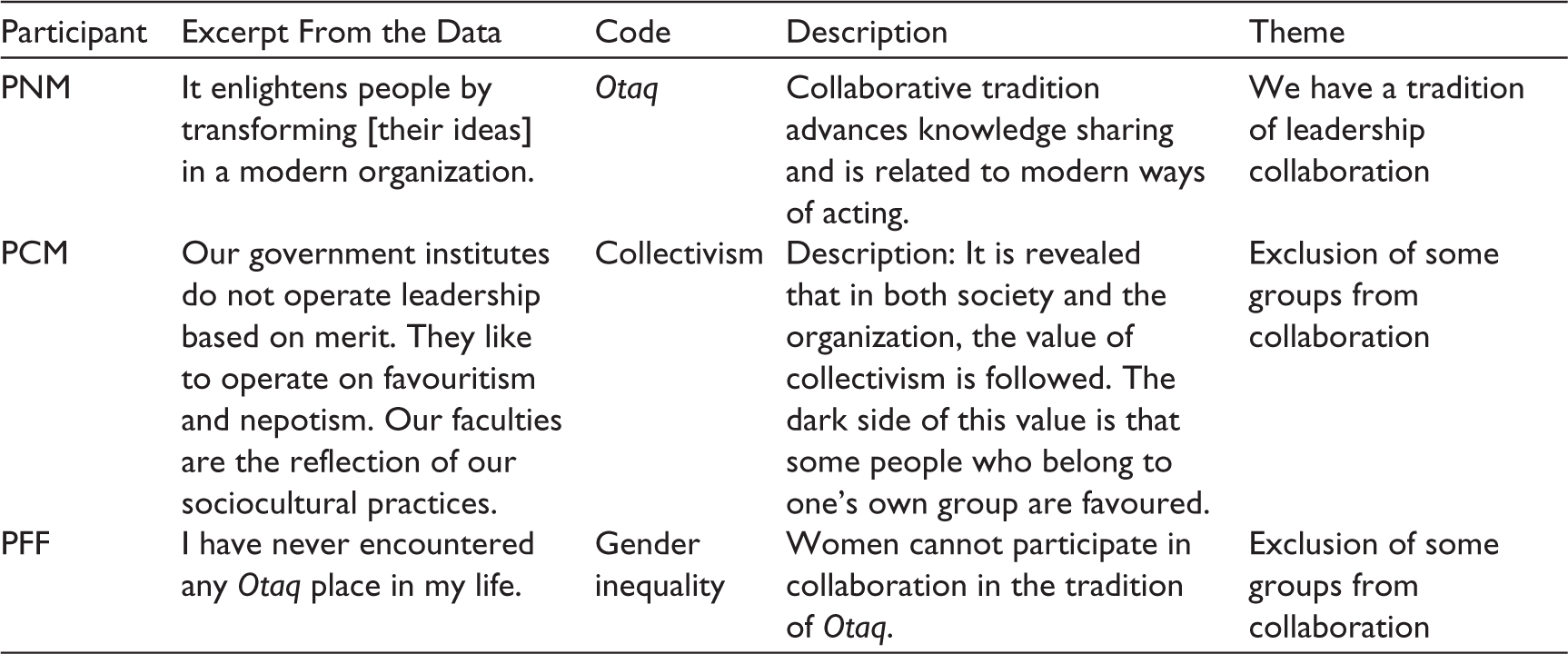
On the left-hand side of Table 2, a participant’s letter code is given, followed by a quotation from his/her interview data. In the third column, based on the quotation, an illustrative verbal code was given to the quotation. Next, the code is described in summary. Finally, after several discussions in our research group, we decided on two themes throughout the data and named them: ‘We have a tradition of leadership collaboration’ and ‘Exclusion of some groups from collaboration’.
Findings
We labelled the central themes as follows: tradition of leadership collaboration and exclusion of some groups from collaboration. Next, we present and discuss the themes.
We Have a Tradition of Leadership Collaboration
The respondents generally defined CL as a joint discussion of problems occurring within a group. The problems are made visible among group members, and group members then arrive at a solution through dialogue and discussion. The interviewees emphasized that with CL, participants gather in learning teams to talk with one another about the topic at hand. The following comment offers an example: ‘It is a flexible learning space to share knowledge, build social relationships, and seek guidance’ (PNM). The study participants argued that the collective nature and importance of joint learning through dialogue is crucial in the successful CL. The respondents recognized the idea of CL and stressed that such leadership is essential to their organization’s success.
Although interviewees recognized the idea of CL and its benefits, most emphasized that CL has been imported from Western countries and rooted is in the Western leadership tradition. For example, one interviewee had the following to say: ‘Western society focuses on individual professional identity for collaboration in leadership’ (PCF). The respondents said that, for example, for this reason the acceptance and applicability of CL as a leadership model may not be so easy in their local organizational environment. Despite the recognized benefits of CL, interviewees noted that people in Pakistani organizations in general as well as in their specific workplace are more used to autocratic leadership based on positional power. One Participant described it in the following way: ‘Leadership style mainly entails command and control to keep workers focused on their duties and in line with management decisions’ (PGM).
High-power distance in social relationships is a commonly accepted cultural value in Pakistan and in organizational life (Nadeem & de Luque, 2020; Shah et al., 2016). In general, it means that organization members reluctantly accept change in hierarchical positions and related uses of power (Guthey & Jackson, 2011). Although the interviewees reportedly view CL as a Western leadership model, some mentioned that their local Sindhi cultural heritage had for a long time included the tradition of collaboration in leadership. This tradition is called Otaq. One respondent described it in the following way:
CL reflects the concept of Otaq; being the eldest son and inheritor of my family’s prestige and business, I have more pressure and responsibility to continue my father’s traditional practices of Otaq. A good place to practice a voice of power and paternalism with different social and intellectual skills in various problem-based situations. (PAM)
Another respondent highlighted Otaq as follows: ‘With Otaq, experienced and influential people resolve conflicts and take responsibility for the agreed-upon solution’ (PFF).
Moreover, the following comments highlight the tradition:
Otaq does not provide only academic skills, but we strongly develop relationships with the community and guide each other to face unpredictable challenges and competitions in work life. Usually, Otaq starts in the evening, where students and professionals from different age groups willingly participate with unique leadership skills and experiences to discuss different academic problems and solutions. It’s a flexible learning space to enjoy life, and it yields maximum benefits [together] with many other social activities. (PMM) After experiencing Sindhi culture since birth, CL is somehow very close to Otaq, my favourite place to build new social relationships, share knowledge skills and thoughts, and seek guidance. The Otaq participants warmly welcome various groups of individuals in informal settings and allow participants to share leadership experiences and serve others with creative social skills. (PNM)
The participants stressed similarities between CL and Otaq and many tended to use the terms interchangeably. According to them, the cultural tradition of Otaq refers to an informal place where people gather together to discuss problems and seek advice from one another. The respondents mentioned that people practicing Otaq make collective decisions and solve problems concerning the community in question. In Otaq gatherings, the participants share views and experiences informally and meet face to face to share and discuss problems and other issues.
The Otaq tradition can represent the value of in-group collectivism, a prominent feature of Pakistani culture and its organizational life generally (Nadeem & de Luque, 2020). According to the interviewees, loyalty, respect, and cooperation with close acquaintances, those participating in Otaq, are essential in the Otaq tradition. Overall, this theme reveals the importance of the traditional cultural attribute in responding to the meaning of CL, which lays a foundation for the respondents to understand and apply CL in their organization.
Exclusion of Some Groups From Collaboration
The interviewees brought out the fact that despite its collaborative nature, the tradition of Otaq causes the exclusion of some groups from collaboration.
Many experienced that women are excluded from leadership collaboration. According to the interviewees, women encounter problems when seeking to participate in decision-making and leadership roles within an organization. They said that particularly young women are excluded from such discussions. The participants described the problem in the following ways:
Unfortunately, girls and women of all ages are forbidden due to sociocultural taboos and religious practices called Pardah (Hijab). Otaq is a male-dominated informal place where people with authoritative minds support each other and favour those they like the most by showing power and pride. (PFF) Pakistani females are honoured with good education, but their voices are not recognized, appreciated, or acknowledged in the public sphere. Unfortunately, women do not have the same opportunities and prospects as men in this society. Most probably, families respect and protect young girls and women (mothers, daughters, sisters and wives) due to the institution of pardah and the segregation of sexes, which confines women to the domestic sphere and men to the public sphere. (PAM) The family’s patriarchal system and conservative Islamic pose certain constraints and hindrances. Here, the interaction between men and women is always misinterpreted and restricted to avoid sexual harassment or pre-marital relationships. In academia, most probably, staff and students belong to shallow middle-class families who do not have the right to raise their voices for better infrastructure and other resources in this university (e.g., we do not have computer or projector facilities and other resources) for students or staff to increase advanced knowledge in exercising various skills in leadership and delivering quality education. (PMM)
Most interviewees reported that the exclusion of women is problematic. It can lead to an immoral leadership environment and inefficiency within the organization, as highlighted in the following comment:
CL requires sincerity towards people, problem, knowledge and rules which provide equality in work by law. Unfortunately, here people are not used to working according to the rule of law. Handling different leaders in collaboration with powers in the local context is challenging and time-consuming. I have often experienced those in my workplace basing decisions solely on nepotism and/or political and societal pressure. I understand personal relationships or the inclusion of favourite people to support social wellbeing, but paradoxically, it discourages [being judged on] merit and hinders fair participation of qualified people in CL (PCF).
Another acknowledged ‘Many challenges [emerge] for qualified teachers and researchers to collaborate with students and staff in creating a collaborative culture for effective leadership’ (PNM).
Although educated women in Pakistan are increasingly interested in participating in working life outside the home and in pursuing a career, for example, in the university sector (Bashir et al., 2012), the Global Gender Gap Report (2021) shows that gender inequality prevails in Pakistan—as also underlined by the respondents in this study. A similar finding has been reported in a study by Nadeem and de Luque (2020). Their research found that, of 62 societies studied, gender equality is the lowest in Pakistan. The researchers argue that organizational cultures in the country are still quite male-dominated, although the goal of creating more opportunities for women is increasingly recognized nowadays.
In general, it can be said that the interplay of specific cultural values effectively hinders women’s participation in leadership in the case of a specific organization and Pakistani organizational life generally. Favouritism towards men means that undesirable habits are embedded in the organization and in the society’s culture, resulting in a fragile and inconsistent perception of CL. This behaviour limits the rights of deserving people in CL and further confines women and other lower social classes from leadership opportunities (Shah, 2010). Mehmood and colleagues also stress that a patriarchal leadership model in both families and working life, as well as the conservative interpretation of religious norms (if applied), which subscribes to the ideology that women are not permitted to associate with any men without the supervision of their family (Mehmood et al., 2018), create boundaries to women participating more in working life.
For example, men’s privilege and women’s exclusion from leadership collaboration were highlighted as follows:
Many of us belong to the traditional family system where co-education is forbidden. The main benefit of the co-education system is to encourage and support gender equality, confidence and equal rights in education and career. Here, unnecessary rigid sociocultural boundaries make youngsters rebellious and cause anxiety that distracts many students’ and adults’ attention from their education, collaborative activities, teaching and learning, potentially leading to an immoral environment where potential skills and abilities are undervalued and can end up in major crime. (PDF)
Another respondent replied to this statement as shadows: ‘Ultimately, women’s participation in CL is not perceptible’ (PLM). One respondent justified such exclusion by stressing in the following way:
God has created men and women differently with different thinking and learning capabilities, and they are not equal in presenting their duties. When they are educated, they must be acknowledged and privileged with a different mindset (e.g., if men are devoted to war, simultaneously women cannot participate in war by leaving families). Men are tough breadwinners, and women are expected to be great caretakers for children and families with nonstop 24/7 labour. Besides their excellent education, talent, and interpersonal skills, they (women) cannot provide complete dedication to work and an organization because their minds are fully occupied with unpredictable social and family problems. (PLM)
Some mentioned that in addition to gender and age, other diversity dimensions, such as social class, language, geographical background, and the institutional background of a person’s education, are also reasons for being excluded from leadership collaboration in the HEI workplace, as highlighted by one interviewee:
I belong to a very lower-middle-class family. It was not easy to afford the private education system because it was costly. I moved away from my hometown for a good job and worked hard for what I needed. I did not know that my social exclusion had begun. Unfortunately, the head of the department was not in favour of my posting because I came from another province; ultimately, dissatisfaction and chaos spread, which put me under psychological pressure, and I felt excluded from my social and friendship network and hesitant to collaborate with peers, resulting in social isolation. (PMM)
A crucial reason to include specific people in leadership collaboration and benefit from such collaboration is that the value of collectivism is in-group by nature within a specific organization and Pakistani organizational life in general (Nadeem & de Luque, 2020). In-group collectivism excludes those who are not members of the group. Those not considered to belong to the in-group face difficulties in having an equal voice and participating in collaborative activities in their workplace. For example, one interviewee spoke of in-group exclusion in this way: ‘This practice further marginalizes women and other talented people from leadership opportunities’ (PCF). So, compassionate collaboration, a key feature of CL (Raelin, 2006), seems to be the privilege of the people in the in-group within an organization.
Discussion
In the studied cultural context, the top-down leadership model, male dominance, high-power distance, and an assertive leadership style tend to be standard (Bashir et al., 2012; Islam, 2004; Nadeem & de Luque, 2020). Therefore, based on previous suggestions (e.g., Ahmad, 2018; Guthey & Jackson, 2011; Hamlin & Patel, 2020; Yukl, 2012; Zhang et al., 2012), we assumed that the understanding and application of CL could be challenging in the investigated cultural and organizational context. Yet, this study shows that collaboration is a part of leadership understanding and application in the studied organization. This relates to the key idea in the CL approach that people operate, interact and work together to produce leadership and learn from one another (Carroll et al., 2008; Denis et al., 2012; Lawrence, 2017; Raelin, 2016). The study found that collaboration draws on a local unique cultural tradition called Otaq. This tradition emphasizes close collaboration among its participants in so-called Otaq gatherings (Mangnejo et al., 2015).
In prior research, it is claimed that Western leadership models are primarily not universal (e.g., Guthey & Jackson, 2011; Hamlin & Patel, 2020; Nie & Lämsä, 2015; Pučėtaitė & Lämsä, 2008; Zhang et al., 2012). However, the findings in this study have revealed similarities in the respondents’ understanding and application of the Western leadership model of CL and the local tradition of Otaq. Engaging in mutual learning, interaction and dialogue to find solutions to problems and topics under reflection are similar in both approaches. The interviewees mentioned knowledge sharing, networking, mutual respect, guidance, and commitment as positive features of both CL and Otaq. This implies that the cultural tradition of Otaq can provide a regular and appropriate basis for understanding CL and its application in the case organization, and perhaps in other HEIs in Pakistan as well, at least in the studied Sindh region, where the Otaq tradition is familiar.
In our exploration, also differences between the Otaq tradition and CL were found. Although Otaq was experienced to have many advantages in the study context, we found that the tradition follows some principles which are not similar to CL. The study findings imply that the principles are harmful to genuine collaboration, thus also problematic for CL to be understood and applied.
First, as shown here, Otaq is understood not to be meant for all organization members. It was experienced to exclude people based on their gender (women, especially young women), and also social class, language, region of origin and educational background. This means that sensitivity to and the potential for a diversity of perspectives, knowledge, and competencies—key features of CL (Archer & Cameroon, 2009; Burns & Mooney, 2018; Kramer & Crespy, 2011; Lawrence, 2017; Raelin, 2006, 2016)—are lost. It has been argued in previous studies that such loss is a problem for the success and prosperity of HEIs, other organizations and society (e.g., Archer & Cameroon, 2009; Burns & Mooney, 2018; Mangi et al., 2012; Raelin, 2006; Shah et al., 2016; The Global Gender Gap Report, 2021). Moreover, the exclusion of some specific groups is a moral problem related to difficulties in following the principles of fairness and equality in organizational leadership. For example, Raelin (2006) says that developing fair policies is essential for CL to be realized. It is possible that the exclusion of women and other specific groups from leadership collaboration negatively affects leadership results, makes it challenging to show responsibility in leadership, and worsens an organization’s employer reputation. This, in turn, may cause problems and limitations, such as an inconsistent recruitment process, thus narrowing the organization’s competency pool.
Seen from the cultural viewpoint, especially in-group collectivism (Nadeem & de Luque, 2020) and the existence of high gender inequality (Nadeem & de Luque, 2020; The Global Gender Gap Report, 2021) are the characteristics in the study context that were experienced significantly to exclude women and other specific groups from leadership in the HEI organization. When the value of in-group collectivism is accepted and exercised, undue favouritism generally tends to mark leadership and social relationships (Bashir et al., 2012; Nadeem & de Luque, 2020). One’s own group—in leadership typically consisting of (elderly) men with a specific background in the study context—is favoured and included in close collaboration, while other groups are excluded. According to Islam (2004), strong in-group collectivism means that individuals tend to take advantage of their ability to exercise power to advance interpersonal relationships and personal advantages due to their membership in the group. The members of the in-group are more loyal and obedient to their co-workers in the group compared to other workers in the workplace environment. Moreover, when a conservative interpretation of Islam (Shah, 2010) is followed, it increases the exclusion of women from leadership practice. It is also worthwhile to note that, in general, a robust bureaucratic setup still prevails in Pakistan, which can be problematic from the standpoint of CL. This setup is based on old history developed from the British colonial and caste systems, which also causes inequality and favouritism of some specific groups (Shah, 2010).
Second, based on the study findings we suggest another noticeable difference between CL and the tradition of Otaq. CL is a modern leadership model meant to be exercised continuously (Raelin, 2006, 2016). In other words, it is a leadership approach embedded in the overall leadership of an organization’s everyday life. However, our findings imply that the study participants understood Otaq gatherings as an informal and specific place and an activity that is exercised separately from everyday leadership. The participants seemed to connect everyday leadership in their organization to a more autocratic and hierarchical approach. The collaborative gatherings meant for them privileged and particular places where not only some groups of people have a chance to gather, but also where questions and problems under discussion are reflected on informally in collaboration at a specific time.
We believe that a crucial change in people’s social and power relations in both the case organization and society generally is needed before more of a CL-type approach can be adopted in the study context. Collaboration in leadership should include more a diverse range of people than is currently the case. Since ultimately culture is learned (Jones, 2005), a transformation in cultural values would be necessary. Although such change tends to be difficult and slow, the increasing international competition of HEIs and increasing expectations for HEIs in Pakistan to engage in international cooperation (Khalida et al., 2017) might trigger such change. All people’s knowledge and talents are needed in this kind of an environment in order for HEIs to be successful (Altbach, 2013; Kezar, 2014; Komatsu, 2009). Moreover, international research and educational projects between HEIs typically emphasize the need to adhere to principles of equality and equity. Thus, such a request might advance awareness of the importance of inclusion in the study context.
This study provides some practical ideas to the leadership in the studied HEI, and possibly also to other HEIs in Pakistan. A crucial challenge is how to extend the participation of women and other excluded groups in leadership collaboration. Top managers in the HEI, whose actions are followed closely in any organization but particularly in the system of top-down leadership that is typical in Pakistan (Nadeem & de Luque, 2020), should become aware of this challenge and committed to making this change. One potential argument to convince them of the importance of the issue might be to appeal to the loss of competencies in the increasingly competitive situation of Pakistani HEIs, as well as to the reputational problem in international cooperation (Khalida et al., 2017). Quality management systems in which uniform processes, for example, in recruitment and promotion, are stressed and which are of growing importance for the HEIs to be successful in international cooperation can be useful. We also recommend organizing training and mentoring for both men and women in the HEI. Overall, the requirements to change the situation are both attitudinal and behavioural in the organization’s culture. To be successful, such change requires many activities at all levels of the organization.
Limitations and Future Research
Our research has certain limitations that should be accounted for in future research studies. The study focused on one HEI in a specific region in Pakistan. Although we could provide an intensive description of the topic, future studies would merit a broader sample. For example, differences between leadership in private and public universities tend to occur in Pakistan, so a comparative case study between them could be useful. Moreover, HEIs from other regions than the studied Singh region would allow for a broader perspective on the topic. It would be interesting to explore the types of collaborative cultural activities in leadership pursued in other regions in Pakistan and also compare them.
Considering the case investigated here, another conceivable limitation might be that our sample of interviewees was relatively small. Yet, in qualitative research, which is interested in meaning-making, as was the case here, a numerical number is not as relevant as providing a new understanding of the topic under investigation (Bell et al., 2015). Instead of increasing the number of interviewees to shed greater light on the exclusion problem explored in this study, a relevant idea would be to focus more intensively on the experiences of those groups found to be excluded from leadership collaboration in the case organization. Their strategies for coping with the exclusion would merit further research, as also would the in-group members’ strategies to legitimize and maintain their privileged status. Finally, we assumed here that a sociocultural context affects leadership in organizations. However, culture is also produced by organization members and their leadership. This aspect needs clarification in the studied context in the future.
Conclusion
This study concludes that sociocultural tradition, such as the local tradition of Otaq, is linked to how leadership is understood in organizational life. It has shown that the Otaq tradition of collaboration in leadership was experienced similarly to include people in and exclude people from collaboration. So, this tradition can be said to be paradoxical by nature because, on the one hand, it allows for a fruitful and inclusive leadership model to exercise collaboration in leadership. On the other hand, the tradition excludes some groups from collaboration, such as female staff and organization members with a particular background. In our opinion, CL literature may be too optimistic in its attempts to argue that this leadership model is readily applicable globally. It is suggested here that more contextually sensitive knowledge of CL is needed in the future because the relationship between culture and leadership is complex.
Footnotes
Declaration of Conflicting Interests
The authors declared no potential conflicts of interest with respect to the research, authorship and/or publication of this article.
Funding
The authors have received no financial support for the research, authorship and/or publication of this article.