




Abstract
We explore how generative artificial intelligence (GenAI) affects leadership in knowledge-intensive environments, examining both short- and mid-term impacts. Drawing on findings of an in-depth case study within a large insurance company, we identify that short-term impacts mirror traditional technology adoption challenges while mid-term impacts require significant shifts in leaders’ role, leadership style, and skills due to changing work content and organization. Leadership can no longer be understood solely through human-centered lenses. Instead, it must be extended to account for the interdependencies between humans and GenAI, requiring a shift in the nature of leadership to navigate and orchestrate teams rather than to manage and control them. Leaders must evolve from functional experts to orchestrators of human–AI collaboration, ensuring the best fit between human employees and GenAI and embodying employee-centric leadership. Our results provide empirical evidence to help managers proactively recalibrate their leadership practices to realize the promised efficiencies of GenAI sustainably. Based on this, we emphasize the need for future research exploring the GenAI-driven recalibration of leadership.
Keywords
Introduction
Having understood the significant effects of generative artificial intelligence (GenAI) on operational efficiency (Cui et al., 2024; Mayer and Schwehn, 2025; Wessel et al., 2023), organizations strategically focus on deploying and providing GenAI in their work processes. 72% of employees and managers now routinely and increasingly interact with GenAI to reduce highly repetitive tasks and focus on higher-level cognitive duties (Beauchene et al., 2025), with 88% of users coming from non-technical professions (De Smet et al., 2023). As the proliferation of Artificial Intelligence (AI) in general and GenAI in specific continues in roles and functions previously reserved for humans (e.g., Information Technology, Human Resources, Finance, or Customer Service and Support), GenAI interactions will likely become even more common (Banh and Strobel, 2023; Şahin and Karayel, 2024). In this context, estimations of the World Economic Forum indicate that until 2030, automation by AI in general and GenAI in specific will augment or take over up to two-thirds of all work tasks (Di Battista et al., 2025), envisioning a shift in how (knowledge) work is performed (Willcocks, 2020).
The use of GenAI brings implications for the working environment that are important both today and in the foreseeable future (Dwivedi et al., 2023; Feuerriegel et al., 2024). With GenAI as a type of AI being increasingly embedded in collaborative processes, it challenges the understanding of digital technology itself (Anthony et al., 2023; Larson and DeChurch, 2020; Seeber et al., 2020), traditional notions of teamwork (Richter and Schwabe, 2025; Tabata et al., 2025), and—most importantly—intragroup processes (Zercher et al., 2023, 2025). In particular, challenges for leaders and leadership itself are estimated (Madanchian et al., 2024; Van Quaquebeke and Gerpott, 2023), highlighting the critical role of leadership for successful implementation, adoption (Mayer et al., 2025), and management of AI in general in the organization (Berente et al., 2021; Peifer et al., 2022). Based on the taxonomy of human-automation teaming of Zercher et al. (2023), GenAI-equipped teams can be understood as a “concept of team-AI collaboration” that describes “a set of two or more humans [who] interact with an [Gen]AI system dynamically, interdependently, and adaptively toward a common and valued goal, object or mission and who have each been assigned specific roles or functions” (Zercher et al., 2023: 4). In line with this, Seeber et al. (2020) and Feuerriegel et al. (2024) raise multiple research questions in the context of human–AI collaboration, highlighting the role of leaders in integrating AI successfully into the workplace. Current literature in digital transformation and technology adoption also stresses the essential role of leadership action for AI (e.g., Berente et al., 2021; Kumar et al., 2025; Pinski et al., 2024) as well as GenAI initiatives in particular (e.g., Bockelmann and Grashoff, 2024; Höhener, 2024).
While the evaluation of the impact of GenAI integration in team and organizational processes enjoys high attention due to its peculiarities (e.g., Banh and Strobel, 2023; Weisz et al., 2023; Wessel et al., 2023), the call for understanding how leadership itself is affected by and how it needs to adapt to GenAI remains unaddressed. Recognizing the known role of leadership in socio-technical environments, for example, within Information Technology (Landles, 1987; Li et al., 2016), as well as in envisioning, designing, imposing, and routinizing new ways of working in the domains of digital transformation (Markus and Rowe, 2021; Soh et al., 2023; Vial, 2019; Wessel et al., 2021) and technology adoption (Dong et al., 2009; Shao et al., 2016; Wang et al., 2022), a thorough understanding of the emergent phenomenon of leading GenAI-equipped teams is needed due to two major reasons. First, from a theoretical point of view, existing leadership theories remain grounded in a human-centered perspective. They implicitly assume that leaders guide teams of human members (and human members only). This assumption may not be valid anymore as GenAI becomes an active participant in teams. Second, from a practitioner´s point of view, if leadership does not account for the idiosyncrasies of GenAI-equipped teams, organizations might miss high efficiency expectations although showcasing rising investments in GenAI (Fabbri et al., 2025; Maslej et al., 2025). Therefore, our study focuses on the recent developments of GenAI and aims to explore the impact of GenAI usage in the context of GenAI-equipped teams. To elaborate on the shifting nature of leadership, to challenge established leadership understanding, as well as to guide respective further investigations on the emerging real-world phenomena of leading GenAI-equipped teams, we ask the following research question:
To answer this research question, we opt for a qualitative case study of a German insurance company. The company has provided an in-house GenAI platform for more than 2 years, with multiple teams in this knowledge-intensive work environment relying on it. We evaluate short-term impacts and indicate mid-term impacts on leadership holistically based on Von Rosenstiel’s (2011) conditions of leadership success. Rather than approaching this study through a conventional gap-spotting lens, we adopt a problematization approach (Alvesson and Sandberg, 2013) to challenge established assumptions in the leadership and digital transformation literature. Our goal is to develop a more reflexive and imaginative understanding of leadership in the emerging context of GenAI-equipped teams.
With this study, we respond to the research avenues depicted by IS and management scholars in particular in regard to (Gen)AI´s impact on leadership (Feuerriegel et al., 2024; Raisch and Krakowski, 2021; Tabata et al., 2025) and the evolvement of “hybrid teams” (Dwivedi et al., 2023; Larson and DeChurch, 2020; Richter et al., 2025). We present empirical evidence for the need for a recalibration of leadership to achieve the efficiency promise of GenAI by supporting team members to achieve optimal synergies between human employees and GenAI. Extending the IS literature on leadership and future of work, our study advances leadership theory by indicating that GenAI changes the underlying leadership assumption about teams built exclusively around human team members. Our findings hint that these human-centered assumptions lose explanatory power once GenAI becomes an active counterpart in team processes. The in-depth analysis of the case suggests shifts in leadership, particularly in the leader role, leadership style, and skills due to significant changes in the leadership situation in the mid-term. Leadership can no longer be understood solely through human-centered lenses; instead, it must be extended to account for the interdependencies between humans and GenAI, requiring a shift in the nature of leadership to navigate and orchestrate teams rather than manage and control.
The remainder of the paper is structured as follows. We begin by outlining the theoretical foundations of GenAI and its implications for socio-technical systems, human–AI collaboration, and leadership. Building on this foundation, we describe our problematization approach and case study design that enable a focused examination of GenAI-equipped teams. The results then trace how GenAI shapes leadership in the short-term and drives deeper structural and behavioral shifts in the mid-term. These insights feed into a discussion that reframes established assumptions in IS leadership research and highlights the new capabilities leaders require as GenAI becomes embedded in work. Moreover, we acknowledge the study’s limitations and outline future research needs. We close with a short summarizing conclusion.
Theoretical background
Generative artificial intelligence and its organizational impact
The introduction of GenAI has been one of the most significant developments in the decades-long evolution of AI. As an umbrella term, AI designates different computational algorithms capable of performing tasks that typically require human intelligence, for example, understanding natural language, recognizing patterns, making decisions, and learning from experience (Castelvecchi, 2014). In contrast to traditional AI systems, which primarily focus on analyzing and predicting outcomes from predefined data, GenAI refers to AI algorithms with generative capability that, according to a specific input prompt, generate novel content in the form of images, text, audio, or video as a synthesis of the data it has been trained with (Banh and Strobel, 2023; Wessel et al., 2023). By generating creative outputs, GenAI is entering domains of knowledge work that were formerly seen as exclusive to human inventiveness (Schmidt et al., 2023), including work processes that are primarily cognitive, non-routine, and creativity-driven (Hislop et al., 2018) as well as requiring intellectual complexity, domain-specific knowledge, and problem-solving capabilities under uncertainty (Lacity and Willcocks, 2016). Altering the balance between human expertise and machine-generated insights (Brynjolfsson et al., 2023), it contains the potential to transform and disrupt the way people create and consume knowledge (Banh and Strobel, 2023; Richter et al., 2025; Wessel et al., 2023). In regard to using technology, GenAI applications embody characteristics differing from the traditional perspective of information technology as a tool or a medium (Anthony et al., 2023). By design, the outputs of generative AI models are probabilistic and not replicable compared to traditional deterministic systems (Weisz et al., 2023). A GenAI application generates varying outputs based on the same exact input prompt where results still remain valid. Both design aspects lead to specific interaction behavior, where GenAI “users continuously and iteratively specify their desired tasks as input prompts to generate outputs until their task is solved” (Banh and Strobel, 2023: 62). GenAI featuring non-deterministic, interaction-based and human-proxy outputs comes with a shift in the perspective of how technology is understood in the work environment: from technology as a tool to technology as “counterpart” (Anthony et al., 2023) or “teammate” (Larson and DeChurch, 2020; Seeber et al., 2020).
Understanding GenAI as a counterpart in a system of work (Anthony et al., 2023), the use of GenAI being a form of AI is also changing the way of working, challenging traditional notions of teamwork (Richter and Schwabe, 2025). Interpersonal collaboration in teams is being influenced as GenAI is used alongside human colleagues for monitoring, coordination, and operational work (Schmidt et al., 2023; Zercher et al., 2023, 2025). Focusing on GenAI in general, current studies indicate a multi-layered effect of GenAI use on individual team members and the team as a whole: On the one hand there are positive effects of GenAI on team performance (Cui et al., 2024), complex problem-solving (Bruhin et al., 2025) and task efficiency (Mayer and Schwehn, 2025). On the other hand, studies also present harmful effects in the context of working with GenAI. As an example, after a bot or agent conversation, people judge others more harshly (Tey et al., 2024), causing isolated work patterns with the potential to inhibit informal and spontaneous exchanges between team members (Mayer and Schwehn, 2025), losing group-wide creativity (Candelon et al., 2023) or critical judgment skills (Bruhin et al., 2025). With these aspects, teams leveraging GenAI experience not only efficiency gains, but also face significant (negative) effects that require respective consideration and mitigation at the workplace.
Leadership in the era of generative artificial intelligence
The proliferation of GenAI has a significant impact on socio-technical work systems that are typically led, steered, and supported by managerial actions (Dong et al., 2009; Li et al., 2016; Markus and Rowe, 2021; Vial 2019). The responsibility of leadership is to “improve the performance of people and machines, increase quality, increase output, and at the same time give people pride in their work. […] The aim of leadership is […] to help people to do a better job with less effort.” (Deming, 2018: 248). Thus, the critical role of leadership is to guide socio-technical systems, including the beneficial integration of GenAI in the organization, to strengthen competitiveness (Mayer et al., 2025).
Focusing on the organizational context, Vroom and Jago (2007) define “leadership as a process of motivating people to work together collaboratively to accomplish great things” (Vroom and Jago, 2007: 18). In line with situational theories of leadership, Von Rosenstiel (2011) argues that given the different effects of leadership behavior on subordinates, “there is no ideal leadership style: What kind of effect leadership behavior has on the subordinate depends on the given leadership target and on the situational conditions.” (Von Rosenstiel, 2011: 362). Summarizing the relevant perspectives of leadership research of the last 50 years, Von Rosenstiel (2011) postulates four conditions (the leader themself, e.g., personality, attitude, intelligence; leadership behavior, e.g., style, interpretation of leadership role; leadership situation, e.g., organizational culture and structure; led follower, e.g., job satisfaction, commitment) that determine leadership success (e.g., productivity, sales). In contrast to popular leadership theories leveraged in Information Systems Research that set focus on a single facet such as specific leadership styles, for example, transformational leadership (Bass, 1985; Bass et al., 2003) or the relationship between a leader and a teammate, for example, leader-member exchange theory (Gerstner and Day, 1997; Liden et al., 1993), von Rosenstiels theory displays a holistic perspective on the leadership process presented in Figure 1. As introduced by Peifer et al. (2022) in Information Systems Research, it emphasizes not only the multi-faceted understanding of leadership, but also the deterministic role of the situation and the context having an influence on all facets (or so-called “conditions”) of the explanatory role of leadership behavior to achieve success (Pettigrew, 1987). Conditions of leadership success based on Von Rosenstiel (2011).
Contemporary research highlights ways technology is transforming the basic nature of teamwork, with implications for leadership (Larson and DeChurch, 2020) on all the outlined leadership facets. In understanding “digital technology as creation medium” (Larson and DeChurch, 2020), literature stresses the criticality of leadership action for digital transformation and technology adoption success: from top executives owning and driving (Dong et al., 2009; Plattfaut and Borghoff, 2023), but also (in)formally advocating and promoting the transformation through acts of motivation (Shao et al., 2016; Singh et al., 2020; Wang et al., 2022) over to lower managerial levels, influencing (un)desired responses, for example, trust, resistance (Dong et al., 2007; Weber et al., 2022), innovation behavior (Agarwal et al., 2011; Bunjak et al., 2022) as well as technology-driven performance (Huang et al., 2023; Rezvani et al., 2017). Here, Argyris (1997) criticizes the overly rational approach of leaders in the context of information systems and emphasizes the human environment, which requires charismatic (Ergün and Plattfaut, 2025; Neufeld et al., 2007) and “people-centric” leadership (Weber et al., 2022) behavior, next to task-oriented, to meet expected beneficial understanding, acceptance, and long-term adoption of digital technologies by employees at the workplace. Furthermore, Gonciarski and & Swiatkowski (2018) identify the change in leadership, stating that “for decades, the task of managers was to control the structures they managed. In the digital era, however, the task of managers is not to rule, but to accompany, attend and listen” (Gonciarski and & Swiatkowski, 2018: 341).
In the emergent working landscape of understanding “Technology as a Counterpart” (Anthony et al., 2023) or “Technology as a Teammate” (Larson and DeChurch, 2020; Seeber et al., 2020), leaders face a two-parted challenge in the context of leading teams comprised of human and (Gen)AI-powered agents working independently in pursuit of a common goal (Larson and DeChurch, 2020): (1) to foster functional, affective and cognitive states and behavioral processes among human and synthetic team members so that human–AI teams can perform effectively, and (2) to ensure that team members have a shared understanding of the limits of AI and when control needs to be taken back by human team members.
Contemporary literature stresses not only the traditional leadership responsibility in AI-driven work environments to be more ethical in terms of addressing employees’ concerns related to job security and privacy (Uddin, 2023), but also shaping work around the human more purposeful where AI serves to augment rather than replace employees (Richter and Schwabe, 2025; Seeber et al., 2020; Uddin, 2023). Although current studies argue that AI does not replace leaders; rather, it augments their capabilities, enabling smarter, more adaptive, and effective decisions in complex and rapidly evolving environments (Jarrahi, 2018; Madanchian et al., 2024), there are estimations that AI technologies will not only affect but potentially substitute human leadership altogether (Van Quaquebeke and Gerpott, 2023). As Van Quaquebeke and Gerpott (2023) illustrate, “let’s face it: Very likely, we will need fewer human leaders, particularly at the lower and middle management levels because their leadership functions can easily be taken over by AI” (Van Quaquebeke and Gerpott, 2023: 269). To really grasp the emerging shift in the current leadership paradigm and its effectiveness for GenAI-driven environments, research into how (Gen)AI impacts leadership and management in real-world contexts is needed (Raisch and Krakowski, 2021). In this line, we focus on the exploration of the emerging phenomenon of leading GenAI-equipped teams.
Method
Our research approach is inspired by the problematization research methodology by Alvesson and Kärreman (2007), which has been called an alternative to conventional gap-spotting in existing research (Kautz, 2023). This approach requires researchers to participate in “a more active construction of empirical material in ways that are interesting, and not just waiting passively for data to show us the route to something interesting, as is typically the case in more conventional research” (Alvesson and Sandberg, 2013: 146). Here, research is motivated by the investigation of a “mystery,” that is, a discrepancy between an expectation and an actual, empirical experience. By that, problematization advocates new theoretical insights and theories, develops new and innovative research questions, and breaks out of established research boxes (Alvesson and Kärreman, 2007; Alvesson and Sandberg, 2011, 2013; Kautz, 2023).
This approach is particularly well-suited to our research objective to critically explore how leadership will and must evolve in response to the proliferation of GenAI in knowledge-intensive work and team environments. While prior literature examined leadership’s role in driving technology and AI adoption, there has been limited attention to how leadership itself is affected in increasingly human–AI collaborative work settings, that is, GenAI-equipped teams. The assumption that leadership remains conceptually stable amid GenAI-driven disruption serves as our motivational foundation and our “mystery.” Our application of the problematization approach has been highly iterative as we moved back and forth in our engagement with the different empirical and theoretical materials. For clarity and simplicity of reading, we present our research in the following linear form as one dialectic account. To gain deeper insights into the mystery at hand, we conducted an in-depth case investigation in an organizational context, focusing on the analysis at the team level in order to explore and fully grasp the impacts of GenAI proliferation on leadership.
Case selection and description
The organization studied is a large German insurance company with over 5000 employees, over 15 million contracts, and over 5 billion Euros of gross written premiums per year, being one of the biggest insurance companies in Germany. Due to the longstanding history of the organization, it is characterized by its traditional values and structures, resulting in employee loyalty of 16 years on average, and in parallel by its ambition to stay market-leading due to high customer satisfaction and innovation capabilities. The organization’s portfolio offers insurance packages for private and business customers, ranging from all material damage-related insurances (e.g., property, motor vehicle) to life-related insurances (e.g., occupational disability, retirement planning). Distributed geographically in various locations in Germany, all locations share common IT governance and infrastructure, providing all employees with the same technological opportunities.
When selecting our case organization, we took several aspects into consideration. First, to investigate the impact of GenAI on leadership, the implementation of GenAI must have already been completed and provided to the entire organization, allowing for grasping GenAI-related experiences and changes within their work environment. Our case organization offers a centrally governed GenAI platform for more than 2 years, provides multiple web-based training on successful GenAI usage (e.g., prompting, AI policies, use cases), and reports on >3000 active daily users. Second, having the characteristics of GenAI in mind, the case must portray the usage of GenAI in knowledge-intensive work processes, making the application of GenAI relevant, beneficial, and of added value to indicate any impacts. Third, the organization needs to be large enough to allow for the inclusion of multiple independently operating teams to capture insights from different team dynamics, tasks, and different applications of leadership practices. With over 5000 employees, the case organization is large enough and offers diverse perspectives from different teams. Fourth, GenAI usage needs to mirror various use cases in different knowledge-intensive teams. Due to the high proliferation (i.e., >3000 active daily users) of GenAI in the case organization, as well as proven use cases in different departments, this requirement is also fulfilled. Furthermore, we had two last issues: availability and affiliation. The case organization was available to our study, and none of the authors is affiliated with the organization.
Due to the enormous impact of the use of GenAI on the working environment of employees, the insurance company has agreed to a comprehensive regulation with the works council. The works council is involved in all AI-related activities, including GenAI, on an ongoing basis. It was also informed about this case study and approved it.
Data collection
Overview of interviewed participants.
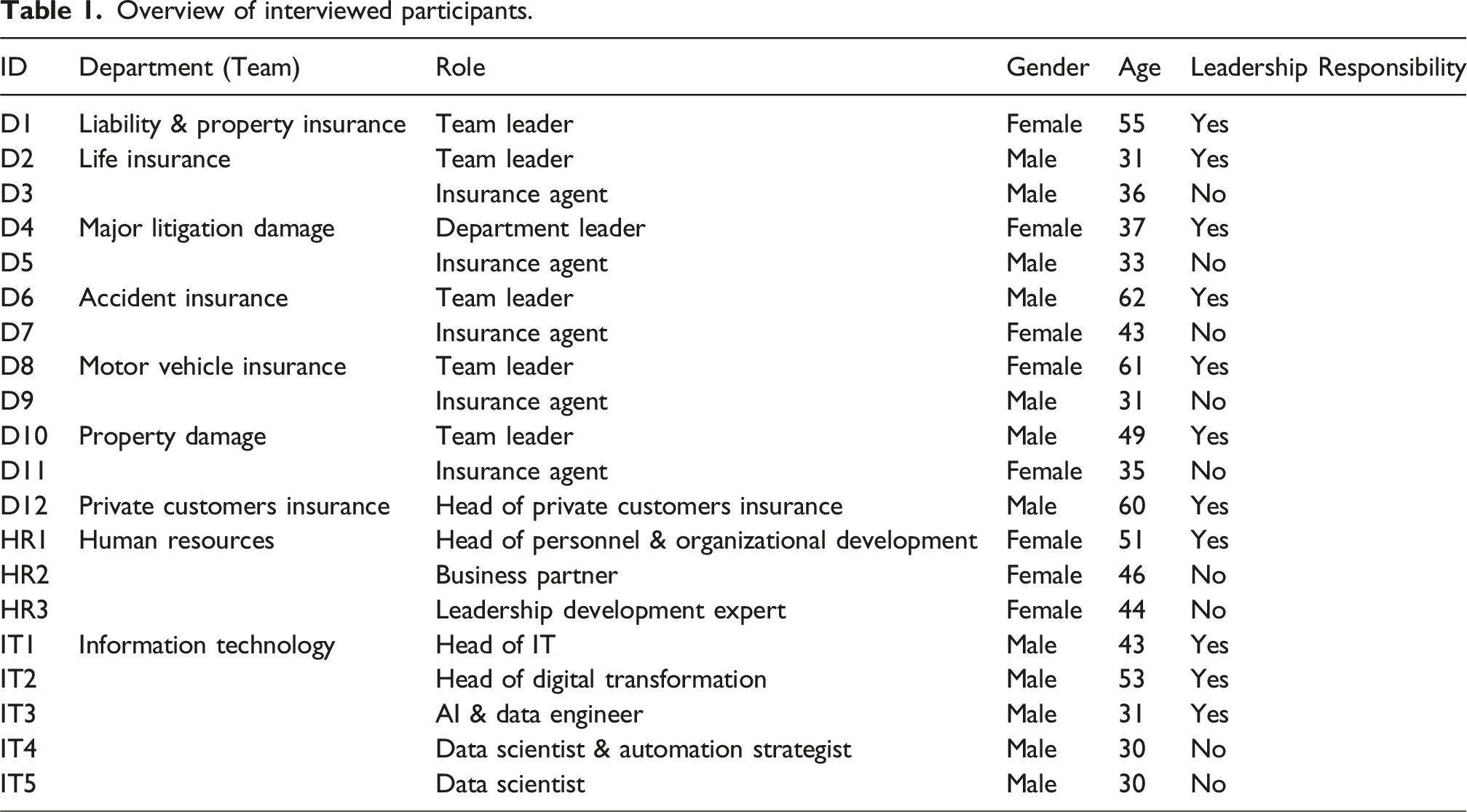
Our interviews followed a semi-structured approach (Schultze and Avital 2011), focusing on the use of GenAI and its influence on the team and leadership within the respective team on the short and mid-term (see Appendix A for the interview guide). Due to the first three participants’ challenge to elaborate on GenAI’s impact in the mid-term, we included an artificial scenario in line with speculative foresight (e.g., Hovorka and Mueller 2025; Selin et al., 2015) that speculates on one of many possible futures in which leaders lead a more automated and augmented team (see Figure 2 as an excerpt of the interview guide). Artificial scenario and questions 17 to 20 to capture mid-term impact of GenAI on leadership.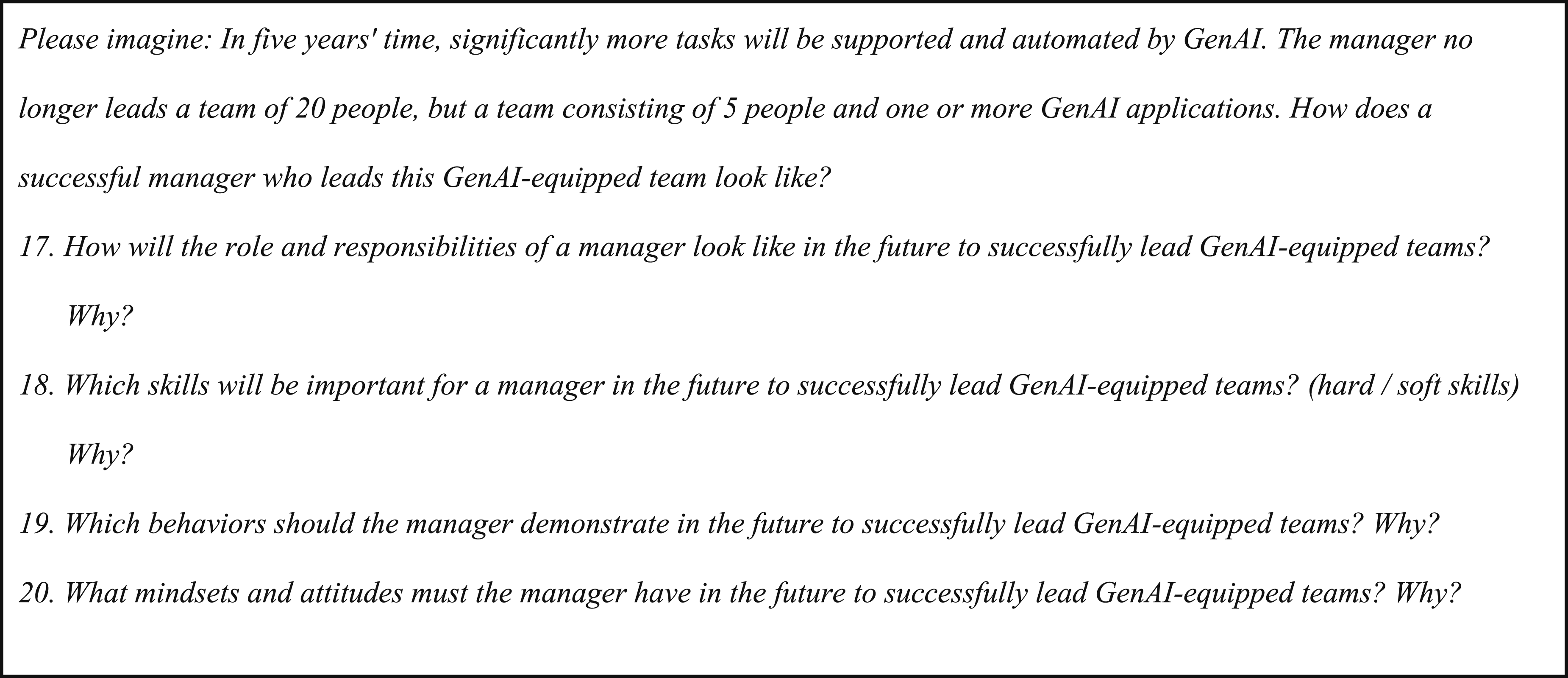
All interviews were recorded and transcribed verbatim with the consent of the interviewees to allow for further analysis. All information that can be used to identify a person or organization has been anonymized. This step allowed interviewees to respond without the fear of leaking confidential information. In the following, we refer to the interviews by abbreviation, for example, D1 refers to interview number 1 with a representative of a business department (see column ID in Table 1).
Moreover, the first two authors had multiple virtual meetings between November 2024 and July 2025 with the Head of Digital Transformation as well as the Head of Personnel & Organizational Development to plan and select suitable participants for this study but more importantly to gain deep insights into the strategic ambitions, current benefits and concerns regarding the in-house GenAI as well as to discuss (intermediary) results in line to practical implications of GenAI’s impact on the organization in short and mid-term.
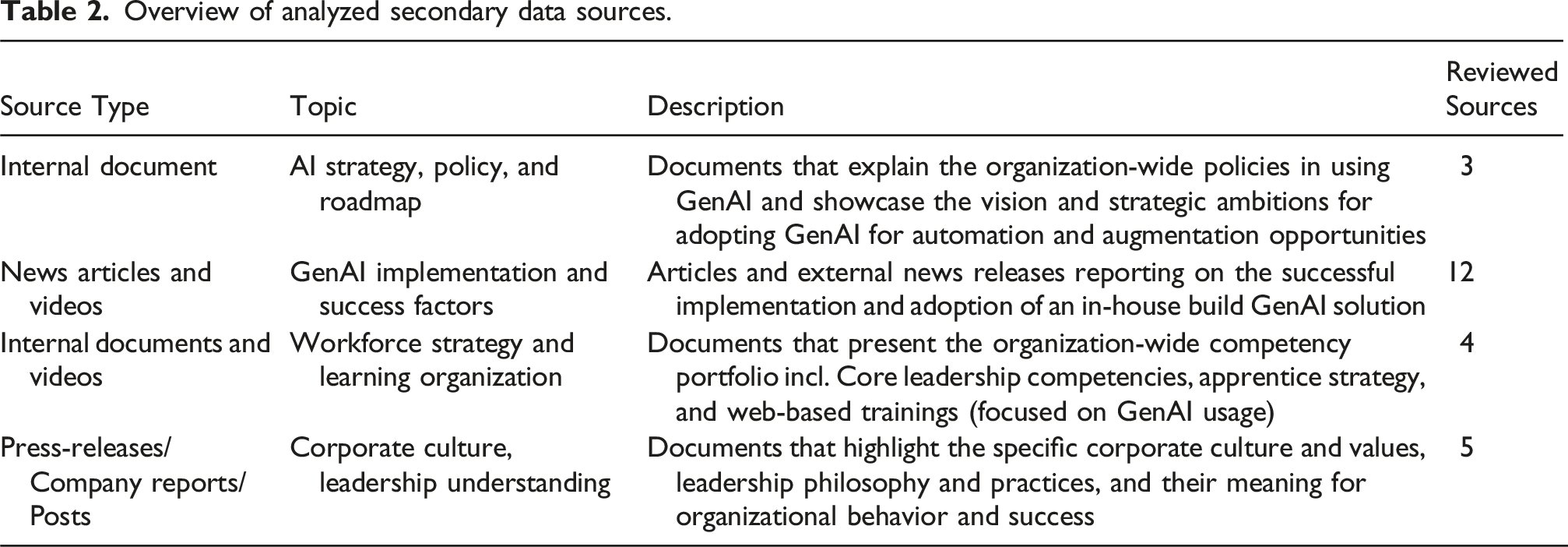
Overview of analyzed secondary data sources.
Data analysis
In data analysis, we followed the approach suggested by Alvesson and Kärreman (2007) and started to analyze the data in two temporal perspectives (short- and mid-term). To this end, we engaged in MAXQDA-based coding as a means of “more systematic work to develop our new understanding” of the phenomenon (Alvesson and Kärreman, 2007: 1272). Following Alvesson and Sandberg (2024), we triangulated our findings between theory, empirics, and our pre-understanding in the form of personal scientific and practical experience in the domain. The theoretical perspective was brought in using existing theoretical understanding from leadership literature (e.g., Müller et al., 2024; Pettigrew, 1987; Von Rosenstiel, 2011).
The data from the interviews was read by the three authors. The first two authors coded all interviews, distinguishing short and mid-term insights based on the interview structure separately to ensure rigor within the codes. Each statement in the interviews was analyzed for its underlying meaning (open coding, see e.g., Charmaz, 2006). With this approach, we ensure theoretical relevance from the beginning of the coding process but allow for data-driven research (Fereday and Muir-Cochran, 2006). During the analysis, we constantly compared each line of coded text with other lines of already-coded text and their respective codes. Next, we abstracted from the individual codes and derived higher-order themes and constructs (axial coding). These emerging themes and constructs guided the subsequent data collection and analysis. This was supported by the creation of analytical memos and diagrams, which were continuously discussed among all authors (Charmaz, 2006; Urquhart and Fernández, 2013). After the first coding cycle, all results were discussed and compared between the authors, allowing for a true discourse with the empirical data (Alvesson and Kärreman, 2007). In case of conflicting codes, the respective section was discussed within the group of researchers. To this end, each researcher re-read the corresponding text and reframed their position, intending to take inconsistencies and contradictions seriously (Alvesson and Kärreman, 2007).
Through this coding and subsequent analysis, several observations and dimensions related to the peculiarities of leading GenAI-equipped teams emerged. Such occasions were taken as “signs of mystery that stand up to scrutiny” (Alvesson and Kärreman, 2007: 1271) that were used to create and describe the phenomenon (Alvesson and Sandberg, 2024). In order to shed more light on this phenomenon, discourse within the authors’ team was facilitated, where all levels of code were re-read and iterated, now specifically in relation to the secondary data available. Here, we looked for causalities but also incoherences in the data that could be explained through already known theoretical perspectives. By that, we iterated between theoretical structures, empirical evidence, interpretation, and critical analysis (Alvesson and Kärreman, 2007). Appendix B displays the complete code structure. Quotes shown below are a translation from the German interviews.
Results
In line with the depicted research question, this investigation presents findings organized in two temporal perspectives, that is, short-term and mid-term, exploring the impact of GenAI usage on leadership at a team level. The results show that the short-term effects on leadership are rather moderate and are basically similar to those of conventional, demanding IT projects. In the medium term, however, the proliferation of GenAI comes with serious consequences for managers requiring different skills, an adjusted leadership style, and a change in attitude due to major changes in the work environment.
Short-term impact of GenAI usage on leadership
The exploration of GenAI’s short-term impact on leadership reveals four aggregated dimensions (see Appendix B for full code structure) “Strategic Level,” “Organizational and Cultural Level,” “Boundaries and Barriers,” and “People and Leadership Level,” representing leaders’ responsibilities, tasks, and roles in the successful implementation of GenAI technology in the organization.
On a Strategic Level, a leader’s task to integrate GenAI is two-fold: On the one hand, all participants emphasized the need for a leader to understand the technology and respective integration opportunities. So, D3 clearly states that “managers are faced with the challenge of first developing a fundamental understanding of [Gen]AI,” while especially participants from IT emphasize the complexity in integrating this technology into work patterns due to GenAI’s input-driven and non-deterministic response behavior in comparison to traditional technology. On the other hand, participants D4, D6, D7, D8, D9, and IT1 mainly mentioned the importance of achieving strategic and economic objectives, like operational efficiencies in the form of reducing the workload of team members, especially in processing bulk work. Both aspects require not only the understanding of GenAI itself, but also its impact on business processes from a structural as well as the affected people’s point of view.
From an Organizational and Cultural Level, GenAI usage demands leaders to facilitate the necessary organizational and emotional conditions. Leaders facilitate organizational conditions by freeing up team members for organization-wide (in)formal training opportunities on GenAI, that is, web-based training on prompting and possible use cases (D3, D5, D8, D10, D12, IT3; secondary data), but especially by allowing for department-specific pilots, best practice-sharing, and innovation competitions (D5, D9, D11, IT4) as well as designating informal GenAI roles within the team who act as enthusiastic peers and contact persons (D1, D4, D5, D9, IT2, IT5; secondary data). D1 describes such roles as “employees who are now much more involved with [Gen]AI in order to make life easier for the rest, […] by [testing] some simple processes in collaboration with [Gen]AI.” Looking at emotional prerequisites, leaders need to emotionally accompany GenAI usage by fostering trust and openness to work with the technology. HR1 emphasizes the organization’s defined values as a constructive foundation to support employees in working with GenAI, stating, “We say [Gen]AI is here and we have confidence in the legal framework, we are courageous, we try things out and we are ambitious.” Additionally, frequently outspoken support to engage with GenAI as well as the organization-wide AI policy are organizational levers leaders make use of to foster GenAI usage (D2, D3, D4, D12 HR1, IT1, IT2).
Besides enabling conditions on an organizational and cultural level, the need for a reduction of Boundaries and Barriers by the leadership is broadly discussed in the empirical material. From an emotional point of view, employees show anxieties from two directions that are prominent in all interviews: to be replaced or left behind by automation technology like GenAI, and to be overwhelmed or disappointed by GenAI technology. Here, interviewee HR2 explains the “worry that the expertise you have may no longer be needed to the same extent due to [Gen]AI,” and with that, the emerging task of leaders to positively meet these emotions in redefining purposeful jobs and portray an optimistic future. Furthermore, the loss of sense of achievement is widely mentioned by team members, highlighting the rise in task complexity when simple tasks are automated, leading to delayed or less feelings of achievement (D1, D7, D8, D9, D11), as D7 describes, “I don’t just want the difficult, complicated, time-consuming cases only, because I can´t make progress that quickly. That sense of achievement, you´ve done something, can be missed.” From an organizational point of view, the lack of integration of GenAI in IT architecture as well as departmental workflows seems to be a barrier that leaders need to solve to support integration into daily work routines (D2, D3, HR2, IT5). As interviewee D2 indicates, “Some of the existing applications are 50 years old, so the technologies are really clashing, which might also be a challenge.”
From a People and Leadership Level, the team needs to be guided in line with three identified dimensions: employee motivation, communication, and leading by example. All participants emphasized the need for transparent, positive, and continuous communication regarding GenAI usage. This communication captures not only the promotion of GenAI but also entails a positive narrative for efficiency wins and job improvements in comparison to the elimination of jobs, indicating the challenge for leaders. Due to the sensitive context, employees expect to be individually and transparently accompanied during the change, hoping for clear and tangible benefits demonstrated by the leader (D4, D5, D6, D7, D8, HR2, HR3, IT2, IT4). This is closely linked to the role model function of leaders: almost all interviewed leaders indicate having “a pioneering role” (HR1) or “to set a positive example” (D10) in leading-by-example in the context of GenAI adoption. Furthermore, participants mentioned many times that a playful interaction and learning with GenAI helped them to positively experience the technology, describing the positive influence of leadership that encourages experimentation and a positive culture of error (D2, D9, D10, D11, HR1, HR3, IT2, IT5).
Mid-term impact of GenAI usage on leadership
The exploration of GenAI’s mid-term impact on leadership reveals six aggregated dimensions “Strategic Level,” “Social Level,” “Work Organization Level,” “Leadership Attitude,” “Leadership Style,” and “Leadership Skills” representing shifts in leaders’ responsibilities, tasks, and role in the successful management of GenAI-equipped teams in the future. Figure 3 presents an excerpt of the code structure for mid-term impacts of GenAI proliferation on leadership (see Appendix B for full code structure). Excerpt of code structure for mid-term impacts of GenAI proliferation on leadership.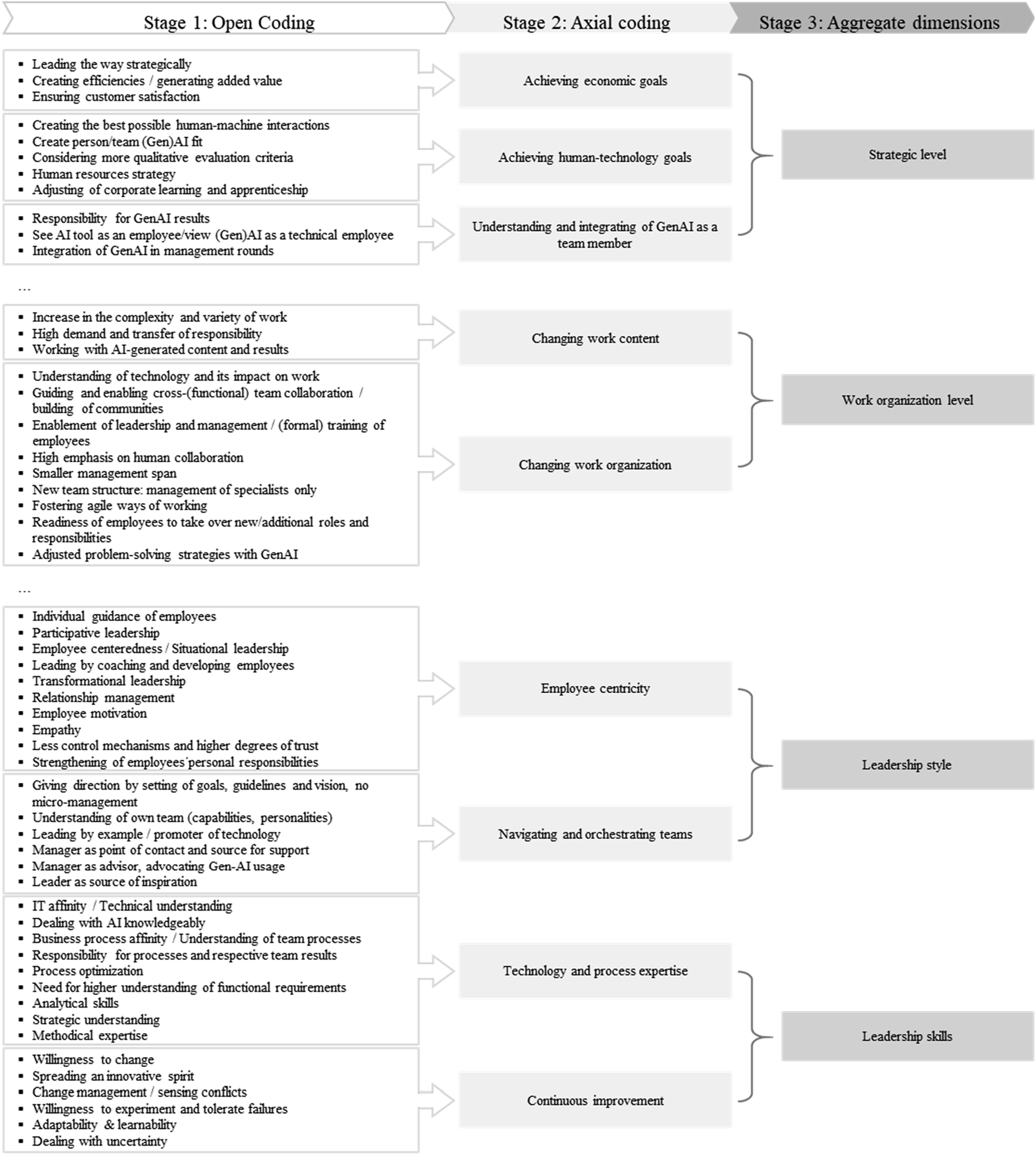
While leaders’ responsibility for economic objectives (e.g., operational efficiency, sales, and financial growth) stays as of today, interviewees underline two additional levers on a Strategic Level: First, the consideration of human-technology objectives, for example, human-GenAI collaboration and workforce planning for a GenAI-equipped team. Here, most participants agree that leaders will more and more have the responsibility to design value-adding human-machine interactions consciously and to facilitate the best fit between human employees and GenAI. Being one of many voices, HR3 declared, “Exploiting the greatest possible potential between the employee and this [Gen]AI tool will certainly be the art of finding the right fit so that the work can be done in the best possible way.” Ensuring this comes with new demands in performance metrics of the team, the intentional development of the team structure as well as team capabilities, considering GenAI as a stable part of the team (D1, D2, D5, HR1, HR3, IT3, IT4). Second, to understand GenAI as an artificial team member who also needs to be led efficiently (D6, D8, D9, D10, HR3). Particularly, a change is indicated by participants outside the IT department on how GenAI will be perceived and therefore integrated continuously in hierarchy-overarching decision-making, for example, in management rounds, as D6 puts it, “I would now equate the [Gen]AI tool with an employee.”
On a Social Level, leaders must continue to shape and design an open culture that fosters experimentation and failures in working with GenAI on the one hand (D4, D10, D12, HR2, IT1, IT4). On the other hand, they further need to maintain trust, psychological safety, and reduce anxieties towards technologies on an emotional level. While interviewees underline that a learning and failure culture, as well as trust and psychological safety, are not significantly different from short-term impacts, they highlight the increase in magnitude and importance of these cultural and emotional conditions in the mid-term perspective (D1, D4, D5, D9, HR1, HR2, HR3, IT2, IT3). HR1 describes, for example, “it is extremely important to have an appreciative approach to successes and a culture of error.” When GenAI is strongly integrated in the work routines, experimenting and independently engaging, testing, and playing with GenAI becomes essential in leveraging GenAI for current and new use cases (D2, D9, D11, HR1, IT4, IT5).
On a Work Organizational Level, interviewees highlight that leaders will face two changing aspects concerning their area of responsibilities: changed work content, for example, increased complexity and variety of topics (D1, D3, D4, D6, D7, D8, HR1, IT1, IT2, IT3), and changed organization of work, for example, set-up of teams being cross-functional, specialists only, and smaller (D2, D3, D5, D8, D12, IT2, IT3, IT4, IT5). Whereas simple tasks will shift to GenAI, “in fact, the demanding business transactions remain, where you have to make decisions on a case-by-case basis, because there is no right or left that you can somehow program into the [Gen]AI” as indicated by interviewee HR2. Similarly, D2 declared that “there is probably also a need for controlled discussion on complicated issues that the [Gen]AI may not be able to solve now and in some cases.” In this context, working with and managing GenAI-generated content and results will be the usual business, enabling employees to process insurance cases faster and more efficiently, but also requiring a more sensitive and responsible handling of GenAI results by all employees. Due to increased task complexity, variety, and process speed, responsibilities will shift from the leader more towards highly specialized employees since leaders won´t be able to control, check, and evaluate tasks in this highly frequent and complex environment. With this change in tasks, almost all interviewees postulate the shift in team set-up or work organization towards more agile and cross-functional teams. Whereas “there will be fewer people, more [Gen]AI and more specialized tasks” (IT3), the future collaboration model “consists of agile teams, so that [team members] can adapt their tasks as quickly as possible and act very flexibly” (D10). Here, two major changes are indicated for how work is organized as of today, especially from the perspective of business departments: to work cross-functionally in the future, in comparison to clear areas of business functions today, and the decrease in management span with higher proximity between employees in comparison to big(ger) teams with less proximity today.
All interviewees indicate a shift in what successful leadership will look like, declaring changes in attitude, style, and skills of a leader managing GenAI-equipped teams in the future. Having a mid-term perspective on Leadership Attitude, less technicality of leaders is required. The changing work content and work organization as described above need more managers who can “lead and guide people” (D4) and are “less of domain experts” (IT3). Almost all participants agree that leadership by functional experts, as well as the role of managing and controlling tasks, will be eliminated in the mid-term. As D4 puts it clearly, “We move away from being the first best insurance clerk to actually becoming a leader,” requiring leaders a shift in understanding their role as a team coach, people developer, and technology promoter who ensures the necessary requirements and guidelines the small team of specialists can thrive in. Many participants (D1, D3, D4, D5, D8, D10, D11, D12, HR1, IT1, IT5) emphasize that this leader is characterized by specific beneficiary personality traits, such as risk-taking, ambitious, perseverant, positive, approachable, curious, and creative.
Moving forward, in line with the changes on a work organization level (e.g., small teams of specialists), a more employee-centric Leadership Style is referred to by all participants, which navigates and orchestrates teams rather than commanding and managing them. In mid-term, managers need to lead less by control mechanisms but by establishing higher degrees of trust within the team due to an empowering, coaching, participative, and relationship-oriented style of leadership. Describing more proximal team settings, leaders will be successful when they are “very relationship-oriented” (HR3), “willing to get involved in the individual subject areas, […] and to pick up employees where they stand” (D10). Moreover, many interviewees stress leaders’ ability to inspire, provide vision, overall goals, and a frame, called out by D4 as “you give people orientation and point out guard rails, and let people work within the guard rails,” becomes essential in the mid-term. This comes with the expectation of employees to have a manager as an advisor and source of support, who genuinely understands the capabilities and personalities of the team (D1, D3, D7, D8, D10, IT4), and by that is able to motivate the team of specialists by inspiration, remove impediments, and foster self-determination towards the common business goals (D4, D12, HR1, HR2, HR3, IT1, IT2).
In line with these aforementioned shifts in leadership, all interviewees postulate the rising change in Leadership Skills with the necessity of leaders to have technological and processual expertise as well as to highly develop continuous improvement. Due to the increasing interaction with technology, especially GenAI, affinity to information technology as well as AI knowledge in general, is stated as essential by all interviewees. Being the basis for any form of automation, business process affinity, the understanding of team processes, and how results are achieved, is declared to be imperative in order to identify and optimize human-machine interactions and generate the best synergies between employees and GenAI (D2, D5, HR1, HR2, IT2, IT3, IT4, IT5). Indicating the increase in competition as well as the increasing market dynamics on technology, interviewed leaders and IT participants argue the rising challenge for leaders for continuous improvement. Therefore, leaders need to display high degrees of change-willingness and an innovative spirit, explained as an “out-of-the-box thinking, in terms of processes, structures, and topics” (IT1). Motivating and pushing for change and improvement is as important as presenting the ability to manage and accompany the team in times of change, demanding adaptability and learnability from the leader in the first place (D1, D4, D5, D8, D9, D12, IT1, IT3).
Discussion
Summary of the main contributions regarding the research question
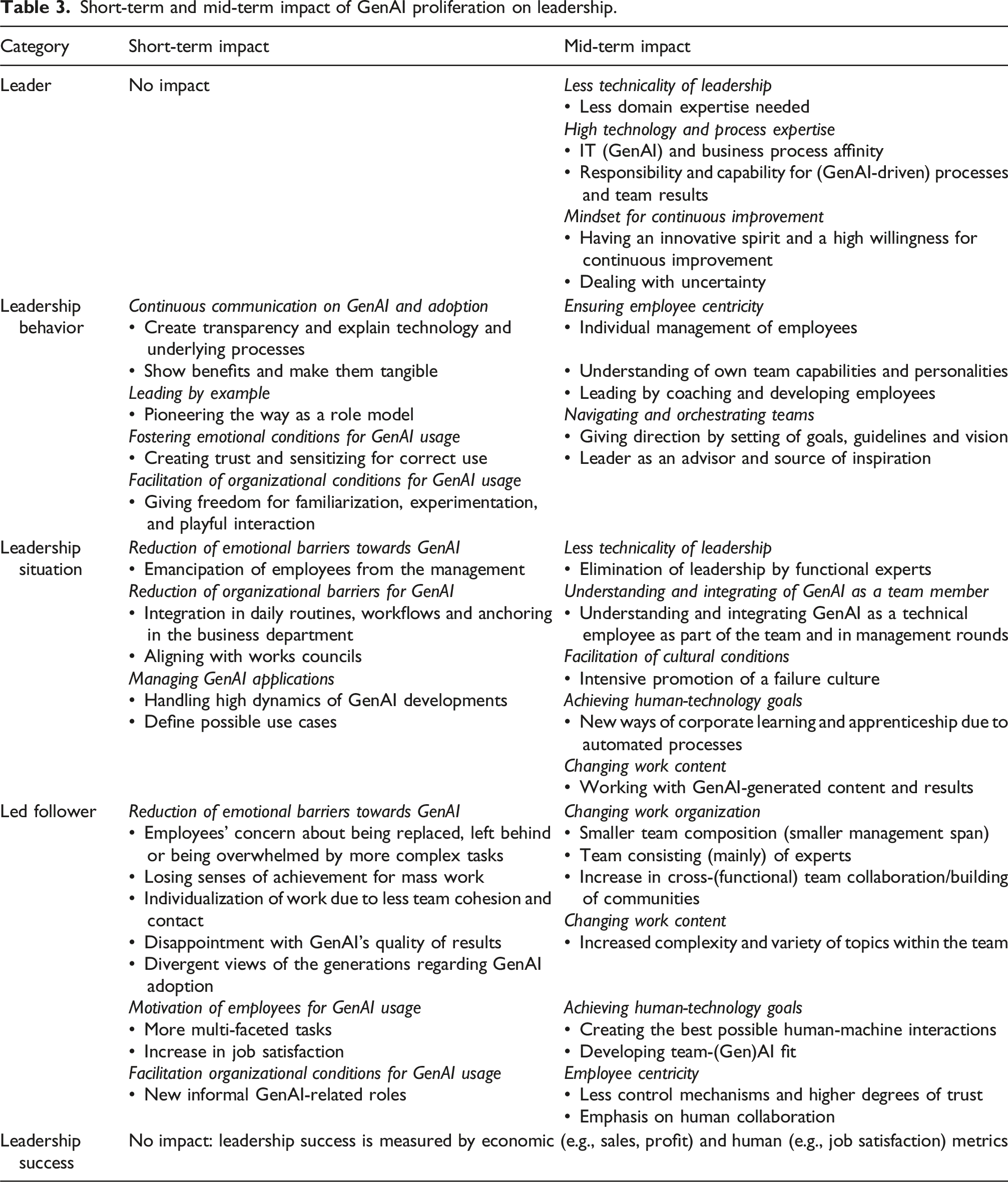
The results of this case study have three main contributions to scholarly literature. First, as discussed in the literature on managing AI in general (Berente et al., 2021; Daly et al., 2025; Larson and DeChurch, 2020; Peifer et al., 2022; Pinski et al., 2024) and GenAI in specific (Bockelmann and Grashoff, 2024; Höhener, 2024; Kumar et al., 2025), leaders need to own and guide GenAI adoption in the organization in the first place. As such, the impact of GenAI proliferation on leadership in the short-term mimics the impact of any technology-induced transformation with two GenAI particularities discussed by Banh and Strobel (2023), Brynjolfsson et al. (2023), and Weisz et al. (2023): GenAI being a non-deterministic as well as a high automation technology negatively affects employees, in particular regarding disappointment with GenAI’s results quality, anxieties about being replaced or left behind by GenAI and losing senses of achievement for mass work. Hence, leaders need to foster emotional conditions for their beneficial understanding and successful integration in daily work routines, as argued by Larson and DeChurch (2020), Feuerriegel et al. (2024), Richter and Schwabe (2025), Seeber et al. (2020), and Uddin (2023) from a general AI point of view.
Second, in contrast to this short-term perspective, our analysis suggests that leadership will (need to) change in the mid-term. Mapping our findings in accordance with our interview guide to the leadership facets theorized by Von Rosenstiel (2011), GenAI will have a significant impact on the leadership situation and with that on the leader itself, leadership behavior, and the led follower. The leader will require less domain expertise and a higher affinity to technology and the increasingly automated processes. Moreover, as team composition will change (with a smaller number of human team members who are largely experts), leadership behavior needs to change as well. The manager will act more as an advisor, navigating and orchestrating successful human-machine interaction and being strongly employee-centered as well as knowledgeable about the team with its capabilities and personalities to further strengthen it with AI, particularly GenAI. However, our results do not suggest changes in the way leadership success is evaluated. Leaders will still be measured by existing metrics.
As argued by contemporary research by Richter and Schwabe (2025), Feuerriegel et al. (2024), and Seeber et al. (2020), this initial result indicates the need for a recalibration of leadership and the management of teams equipped with GenAI. In this context, we were able to address our research question and extend the discussion on Information Systems-based transformation of work by emphasizing that due to GenAI, there is no significant change in the short term, but a major shift in the leader, leadership behavior, skills, situation, and led follower in the medium term.
Third, our results also underline the importance of human leaders in GenAI-equipped teams. While the team will also consist of non-human agents, the remaining humans will require (more) human leadership. As outlined above, this human leadership will need to change significantly with regard to skills, behavior, situation, and so on. However, in line with Jarrahi (2018) and Madanchian et al. (2024) and in contrast to Van Quaquebeke and Gerpott (2023), our data does not suggest that the role of the leader will be less important or taken over by artificial GenAI-powered agents; rather, process and technology-savvy leaders who guide, develop, and empower a smaller composition of expert teams that are in charge of higher work complexity.
Short-term and mid-term impact of GenAI proliferation on leadership.
Theoretical implications
Our case study expands the theoretical understanding of leadership in the context of GenAI in two ways: First, our work extends situational theories of leadership, particularly building on Von Rosenstiel’s (2011) multi-facetted framework of leadership success conditions, for teams consisting of human and synthetic team members. While our empirical results indicate that GenAI proliferation affects nearly all facets of this framework, we theorize that GenAI alters the “leadership situation” (e.g., workflows, team structure), which in turn require a recalibration in leader’s role, behavior, and skills: On the one side, leaders mediate the human–AI collaboration relationship, having process and employee responsibilities in order to balance between controlling technology efficiencies but also fostering employee satisfaction and trust; on the other side, the changing nature of the team setting (deskilling of routine roles; small team sizes with high degrees of expertise, increase in dynamism and complexity) requires specialized leadership competencies for GenAI-augmented contexts. Leaders who are employee-centered, for example, being able to motivate, empower, coach, develop, empathize, and individually engage with specialized team members, and who bridge team (human and artificial) capabilities to overall department or corporate strategy, are needed rather than leadership by domain or technical expertise as lived today. This puts the leader strongly in the importance of more human motivation, interaction and connection in an increasing digital work environment for team success, and the leaders’ role as an enabler and driver of these aspects being in line with “people-oriented” leadership theories, such as servant (Greenleaf, 2008), charismatic (Shamir et al., 1993) or transformational leadership (Bass, 1985).
Second, we extend the literature on leadership in digital transformation and socio-technical systems by highlighting that GenAI is not merely another IT implementation challenge as presented by many studies (Anthony et al., 2023; Larson and DeChurch, 2020; Tabata et al., 2025). Mid-term implications call for a transformation of team composition and collaboration driven by (Gen)AI technology, demanding intentional design, conceptualization, and strategic planning of teams consisting of human and synthetic team members being not only a simple automation project. As stressed by the arguments of Anthony et al. (2023), Bies et al. (2024), Larson and DeChurch (2020), and Seeber et al. (2020), GenAI is increasingly perceived not as a passive digital tool but as a technical counterpart or team member. This perspective challenges and expands the boundaries of existing team and leadership theories, which have traditionally focused on human-to-human interactions, where leaders must consider GenAI in task allocation, coordination, and performance evaluation. In this context our results support arguments of Marimon et al. (2025), Koponen et al. (2025), and Johnson et al. (2025), for the conscious design of future of work, where leaders are significantly challenged to continuously optimize their work and team processes as GenAI advances, and in parallel to assess, understand, and proactively manage impacts on the human workforce to keep positive outcomes—economically and human-related—and prevent negative ones. By empirically demonstrating the emergence of new leadership tasks, such as managing GenAI-generated content, orchestrating GenAI-driven workflows, and fostering trust in algorithmic systems, this study presents empirical evidence for leadership theories that entail human and artificial team members. As postulated by Müller et al. (2024), adaptive leadership frameworks entailing leadership competencies in flexible and stable digital ecosystems contribute to the management of the emerging phenomena of GenAI-equipped teams.
Practical implications
From a practical point of view, our study indicates implications for knowledge-intensive work environments embedding GenAI in their work processes from a leadership and an organizational perspective: First, leaders are and stay essential in driving successful adoption of GenAI and, respectively, efficiency wins in their areas of responsibilities in the short and mid-term. In mid-term teams equipped with GenAI require employee-centered, empathic, and charismatic leaders to thrive with the technology. Considering the anxieties of employees to be replaced, overwhelmed, or losing expertise and competency, leaders must engage more in the redefinition of work, providing purpose, vision, and sense-making for adjusted team settings. Second, with domain expertise becoming less important, leaders need to have higher process expertise in combination with IT affinity to be able to drive GenAI-driven optimizations in their own areas of responsibility. Third, along with this, leadership positions need to be filled significantly with people who have leadership skills in comparison to people who perform best or have the highest domain expertise. HR departments and managers themselves can deal with these indications at an early stage. They can form the basis for adapting existing management strategies and guidelines, and update the existing criteria for the selection and development of current and future managers to meet the requirements of GenAI-equipped teams. Fourth, GenAI-driven changes at the workplace are expected to increase in quality and quantity. Here, an open, empowering failure and learning culture is essential to enable playful and experiment-based interaction of employees with GenAI to fearlessly experience, test, and learn to adopt, integrate, and leverage GenAI advantages for themselves. Organizational development initiatives, as well as leaders on all levels, need to foster and support this culture of continuous improvement to avoid change fatigue and support fast learning and adoption cycles in the organization to meet hoped-for efficiencies.
Limitations
As a case study, our work also has some limitations. We have focused on the deep analysis of one organization in the insurance industry, which is heavily regulated by German and European law. In this context, we identified that the investigated organization is characterized by its traditional values and structures due to its longstanding history, which has an impact on the organization’s speed and readiness to work with state-of-the-art technology. A broader inclusion of more organizational departments or the involvement of multiple organizations from various industries with different corporate cultures could lead to additional insights, but also eliminate culture-based (dis)advantages related to GenAI-based work organization. Moreover, the derivation of codes and dimensions is a creative research process. While we paid attention to avoid potential researcher bias, it is possible that other researchers would have come to different codes, dimensions, or resulting impacts on leadership. Furthermore, while our findings are based on the current implementation and adoption of GenAI within our case company, our case data also includes estimations and expectations of organizational members for the near future. Therefore, mid-term results indicate a possible scenario of many and need to be investigated when GenAI impact is (more) tangible in the future.
Indications for future research
While this study offers insights into the shifting nature of leadership in GenAI-equipped teams, the investigation of the case offers several future areas that merit systematic elaboration in the future: First, witnessing a substantial hype in the public discourse around GenAI, its integration into organizations’ core business departments and workflows remains limited. As we see in this pioneer case, it is expected to be fully integrated in the near future where the impact of GenAI technology is directly tangible in how people work. An analysis of organizations that have integrated GenAI fully is needed to holistically grasp its impact on work practices and leadership processes over time. Longitudinal studies are particularly needed to capture the evolving nature of this integration and its systemic effects. In this line, this explorative study describes an isolated view of short and mid-term where temporal relations remain undressed. Future research should elaborate on these relations and indicate, for example, requirements or practices to evolve from short-term situation to mid-term. Second, being able to derive shifts in leadership requirements, intrapersonal and interpersonal dynamics of GenAI-equipped teams need to be understood by exploring how such technologies affect, for example, communication and collaboration patterns, but also feelings of trust and psychological safety within teams. These insights will allow us to derive leadership practices that address the unique challenges and opportunities presented by GenAI-equipped teamwork. Third, building on our findings, future research should aim to identify key success factors for effective leadership in GenAI-equipped team settings. In particular, leadership attitude, style, and skillset appear to be central variables. Ethical considerations as well as motivational aspects should also be examined in depth. Experimental research designs could advance our understanding of how various leadership styles influence the performance of GenAI-equipped teams. For instance, future studies might contrast charismatic and servant leadership styles to determine which are most influential in conducting and sustaining team performance in highly automated environments. Here, further research is beneficial to understand how GenAI’s “dark sides,” for example, overreliance or social isolation, might be mitigated through human-centered leadership approaches. Fourth, research is needed to develop new frameworks for evaluating the performance and outcomes of GenAI-equipped teams, especially in terms of performance definition as well as how the results of GenAI-equipped teams should be evaluated in the future.
Conclusion
Many organizations are currently in the process of introducing GenAI. Against this background, we studied the emerging phenomena of leading GenAI-equipped teams, investigating an insurance company that offers a centrally governed GenAI platform for more than 2 years. Our work has shown that the short-term impacts on leadership are rather moderate and are basically similar to those of conventional, demanding IT projects. In the medium term, however, comprehensive GenAI applications have serious consequences for team structures and dynamics, indicating the need for recalibrating leadership. This comes with the high demand for an adjusted understanding of leadership, demonstrated in different skills, a change in attitude, and an adaptation of employee-centered leadership style. Leadership can no longer be understood solely through human-centered lenses; instead, it must be extended to account for the interdependencies between humans and GenAI, requiring a shift in the nature of leadership to navigate and orchestrate teams rather than manage and control. Our study thus provides a foundational step in exploring and theorizing leadership as a socio-technical practice, situated within increasingly dynamic team environments shaped by the positive and negative influences of GenAI on the team.
Supplemental material
Appendix A: Interview guide and questions
Supplemental Material for Leading GenAI-Equipped teams: Recalibrating leadership in the age of generative artificial intelligence by Ali Ergün, Manfred Baer, Ralf Plattfaut in Journal of Information Technology.
Supplemental material
Code structure for short-term and mid-term impacts of GenAI proliferation on leadership
Supplemental Material for Leading GenAI-Equipped teams: Recalibrating leadership in the age of generative artificial intelligence by Ali Ergün, Manfred Baer, Ralf Plattfaut in Journal of Information Technology.
Footnotes
Acknowledgments
The authors would like to thank the many informants for their time and engagement, especially the Head of Digital Transformation and Head of Personnel and Organizational Development for their ongoing support of this study. Moreover, the authors would like to express their gratitude to Dr. Carolin Vollenberg for her valuable feedback on an earlier version, and the editors for their ongoing support in the review process.

Funding
The authors received no financial support for the research, authorship, and/or publication of this article.
Declaration of conflicting interests
The authors declared no potential conflicts of interest with respect to the research, authorship, and/or publication of this article.
Supplemental material
Supplemental material for this article is available online.