




Abstract
This study investigates the presence and magnitude of hot hand and cold hand effects in professional golf, utilizing PGA Tour data from the 2021–22 through the 2024 seasons. Prior research has yielded mixed results regarding streakiness in golf. To refine these findings, we estimated logistic regression models with fixed effects for both player-seasons and season-tournament-round, controlling for individual ability as well as tournament-specific factors such as course setup and weather. Our results indicate that while a cold hand effect exists and is statistically significant, it is substantially less pronounced than previously reported when additional controls are applied and a larger dataset is used. In contrast, we find minimal evidence supporting a hot hand effect, suggesting that birdie streaks are largely attributable to random variation rather than genuine momentum. Our results align with prospect theory and the principle of loss aversion, implying that golfers may exert greater effort to avoid losses (bogeys) than to pursue gains (birdies). Practically, this insight can inform mental training strategies aimed at promoting consistency and resilience following negative outcomes, thereby mitigating the risk of performance decline across successive holes.
Introduction
The concept of the “hot hand” has long captivated sports analysts and fans, who often perceive streaks in athletic performance as indicators of momentum or psychological confidence. However, research by Gilovich et al. (1985) argued that such streaks may be more a product of cognitive bias than genuine patterns, coining the term the “hot hand fallacy.” This phenomenon, based on Tversky and Kahneman's (1971) concept of the “law of small numbers,” suggests that individuals mistakenly perceive order in random sequences, leading to the belief that recent success increases the likelihood of continued success. While subsequent research has attempted to validate or refute the existence of hot and cold hands across different sports, including basketball, baseball, and golf, the evidence remains inconclusive.
In professional golf, the search for hot and cold hand effects has yielded mixed results. Livingston (2012) conducted one of the earliest in-depth investigations into streakiness in golf but focused on a limited dataset of individual tournaments across four different tours, employing probit models that did not fully capture tournament-specific variability. Due to the limited size of his datasets and the lack of control for player or round effects, he was unable to detect any statistically significant cold hand. Similarly, Arkes (2016) found evidence of a cold hand effect on the PGA Tour but relied on grouping holes into blocks, potentially masking micro-level patterns of momentum. More recently, Elmore and Urbaczewski (2018) examined birdie and bogey streaks on the PGA Tour during the 2013–14 season using random effects models, identifying a statistically significant cold hand effect but concluding that the hot hand was largely absent. While their use of random effects accounted for within-player correlation, it remains unclear whether this approach fully captured unobserved heterogeneity at the player and tournament levels, highlighting the importance of exploring alternative modeling strategies to assess robustness.
This study builds on and refines prior analyses by leveraging a comprehensive dataset spanning three PGA Tour seasons (2022–2024), thereby increasing both the sample size and the variability of play conditions. We employ two sets of logistic regression models with fixed effects to predict the likelihood of either a birdie or better (BoB) or a bogey or worse (BoW), based on whether the player recorded a BoB or BoW on the previous hole, respectively. The models control for individual player ability using player-season fixed effects and account for common shocks—such as course setup and weather—through round-level fixed effects. By introducing fixed effects specifications as a complementary approach to the random effects models used in previous research (e.g., Elmore and Urbaczewski, 2018), our analysis aims to control flexibly for unobserved, time-invariant characteristics at the player and event-round levels and to provide a more comprehensive understanding of hot and cold hand dynamics in professional golf.
Recently, researchers have explored latent-variable approaches—particularly state-space and hidden Markov models (HMM) —as effective tools for modeling a player's latent and evolving form over time, which may underlie streaky performance. Sun (2004) offered an early contribution in this direction, proposing an alternative model that uses an HMM to detect transitions between “hot” and “cold” states, modeling latent changes in player ability over time in basketball. More recently, Mews and Ötting (2023) applied a continuous-time state-space model, specifically an Ornstein-Uhlenbeck (OU) process, to free-throw data in the NBA. Their approach allowed them to account for irregular timing between shots and detect modest but persistent hot-hand effects. Similarly, Ötting and Andreas (2022) used a regularized hidden Markov model to examine “hot-shoe” behavior in the Bundesliga (association football), finding weak evidence for a hot shoe effect. Sandri et al. (2020) applied Markov-switching models to capture latent hot and cold performance states in NBA players, allowing them to analyze shooting variability and the influence of teammate interactions. In the context of professional golf, (Baker and McHale, 2022) applied an OU model to distinguish between short-term “form” and long-term “class,” finding that hot-hand effects in golf can persist across multiple consecutive tournaments. Finally, Du et al. (2025) proposed a momentum-detection framework based on entropy-driven change-point analysis and neural networks to analyze momentum in professional tennis.
These latent-state models offer flexible tools for capturing time-varying momentum, especially when observations are unevenly spaced or behavioral data are available. In contrast, our study employs fixed-effects logistic regression to estimate within-player changes in performance based on prior-hole outcomes, without making assumptions about hidden states. This modeling framework prioritizes clarity and interpretability while offering strong control for both player-level and round-specific variation in professional golf.
Beyond addressing methodological gaps, this study also explores behavioral decision-making and loss aversion as potential explanations for the observed asymmetry between hot and cold hand effects in golf. A hot hand effect implies that prior success intrinsically increases the likelihood of future success, independent of underlying skill or context. Conversely, a cold hand effect suggests that a previous failure, in and of itself, increases the likelihood of subsequent failure. Drawing on prospect theory (Pope and Schweitzer, 2011), we hypothesize that professional golfers may exert greater effort to avoid losses (bogeys) than to pursue consecutive gains (birdies), leading to a stronger cold hand effect. Through a rigorous application of statistical models and power analyses, we provide new insights into the dynamics of streaks in golf and contribute to the ongoing discourse surrounding the validity of the hot hand phenomenon.
By incorporating these methodological advancements and theoretical considerations, our study offers a more nuanced understanding of the psychological and statistical underpinnings of momentum in professional golf, while addressing key gaps in the existing literature.
Background literature
As data on athletes’ performance became more comprehensive and accessible, the application of sports analytics has become increasingly influential in training machine learning models to comprehend the likelihood of outcomes and explain players’ patterns (Corcoran, 2019). Efforts to predict future actions or performance outcomes based on historical data have long been pursued, highlighting variables such as emotions, perceptions, and behavioral shifts as influential factors (Taylor and Demick, 1994). Various studies have attempted to explain phenomena like momentum or the “hot hand” in sports. For example, Den Hartigh et al. (2016) demonstrated a significant relationship between athletes’ perceived momentum and self-efficacy across multiple sports. Furthermore, McCarthy et al. (2022), through semi-structured interviews, explored athletes’ interpretations of behavioral momentum, focusing on their responses to unexpected events, perceptions of control, temporal dynamics, and pressure situations. However, individuals’ emotional perceptions remain inherently inconsistent and complex (Lazarus and Folkman, 1984). As professional athletes increasingly rely on objective, data-driven approaches to enhance and maintain performance (Wacker, 2019), recent research continues to utilize statistical methods and machine learning techniques to better explain and quantify player momentum (Noel et al., 2024).
While prior studies have examined the hot hand in golf, our study is unique in leveraging three full seasons of PGA Tour scorecard data. We employ logistic regression models with player-season and tournament-round fixed effects, allowing us to control for both player-specific ability and round-level common shocks. In contrast, Livingston (2012) used ordered probit models without player fixed effects and based his PGA Tour analysis on a single tournament. While he found no consistent evidence of hot or cold hand effects among PGA Tour players, this may be attributable to limitations in both data scope and model specification. By not controlling for unobserved player heterogeneity or variation across tournaments and playing conditions, his analysis likely understated any momentum effects due to omitted variable bias. Arkes (2016) identified evidence of a cold hand but based the analysis on sets of holes rather than a hole-by-hole approach, as used in our study. Similarly, Elmore and Urbaczewski (2018) found evidence of a cold hand effect using a methodology broadly comparable to ours. However, their study relied on random effects to control for player ability, did not include fixed effects for tournaments or rounds, and was limited to the 2013–14 PGA Tour season. Our study improves upon this approach by incorporating player-season and tournament-round fixed effects. By incorporating both player-season and tournament-round fixed effects, our study complements and extends previous research by allowing for arbitrary correlation between unobserved player characteristics and explanatory variables, thereby offering improved control for potential omitted variable bias.
Continuous efforts to identify hot hand effects have yet to yield clear evidence, even in analyses of team sports (Noel et al., 2024). However, as McCarthy et al. (2022) observed in their real-time study, amateur golfers experience psycho-behavioral momentum during competitive golf matches. This phenomenon warrants further investigation, but it necessitates precise yet diverse techniques to uncover players’ cognition, affect, and arousal levels during games. These factors are theoretically and scientifically linked (Taylor and Demick, 1994). The purpose of this study is to provide a more comprehensive assessment of hot and cold hand effects among PGA Tour players by leveraging a larger dataset and employing more robust statistical models than previous research.
Methodology
Using PGA Tour data from the 2021–22 through the 2024 seasons, we developed a series of logistic regression models to evaluate the “hot hand” and “cold hand” effects in golf. These models predict the likelihood of a player scoring either a birdie or better (BoB) or a bogey or worse (BoW), based on their performance on the previous hole. Specifically, the key predictor variable indicates whether the player previously scored a BoB or a BoW, respectively. Additional covariates include the par of the hole and the number of strokes above par (average_strokes_above_par) for that hole during the specific round of the tournament. These covariates are similar to those used in previous research (Elmore and Urbaczewski, 2018).
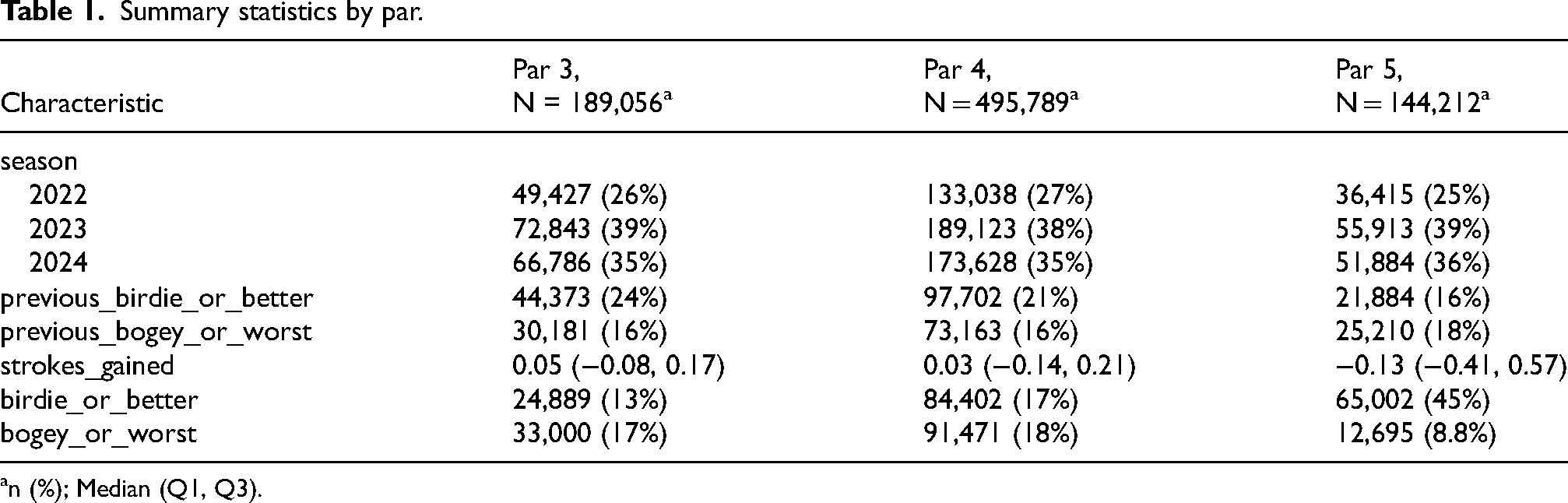
The 2024 season returned to a calendar-based schedule for the first time since 2012, starting in January (PGA Tour, 2023). As a result, our dataset includes the 2021–22, 2022–23, and 2024 PGA Tour seasons. Under the new structure, what would traditionally have been the start of the 2023–24 season in late 2023 was instead reclassified as the conclusion of the 2022–23 season. These tournaments were incorporated into the newly created FedEx Fall Cup, which now extends into the calendar-based 2024 season and beyond. We present a summary of the data in Table 1.
Summary statistics by par.
n (%); Median (Q1, Q3).
To account for the hole's performance in a specific tournament, the average hole score was calculated for that particular tournament. The course hole number was identified separately from the order in which the player played the course. For instance, in many tournaments, half of the players begin on hole 1, while the other half commences on hole 10, which is known as split tees. The hole average will be based on the order of the holes on the course, but when determining the performance of the previous hole for a player, it will be based on the player's specific order. For example, for players who started on hole 10, the performance of the previous hole doesn’t exist, but for hole 1, the previous hole is hole 18.
The general form of our models takes the following form: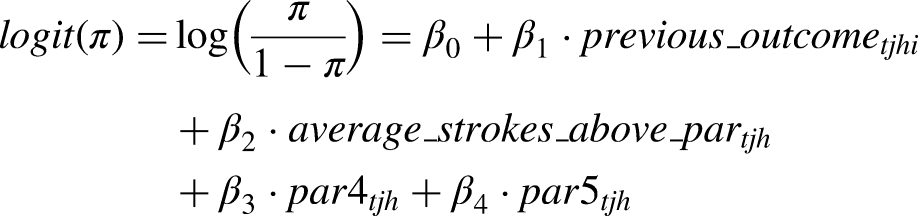
Where π = probability of the outcome of interest, i = player, j = round, t = tournament, and h = hole. There are two sets of models, one where the dependent variable is the binary outcome of birdie or better (BoB), and the other where the dependent variable is the binary outcome of bogie or worse (BoW). The BoB models’ previous_outcome is the binary BoB outcome of the previous hole, and the BoW models’ previous_outcome is the binary BoW outcome of the previous hole. The average_strokes_above_par variable represents the field's average performance relative to par on a given hole, during a specific round of a specific tournament. This metric accounts for hole-level variation due to factors such as weather, pin placement, and course setup on that particular day. The par four and par five are fixed effects, where the reference holes are par 3 s.
We use fixed effects (FE) specifications at the season–tournament–round level to account for potential common shocks—such as weather, course layout, or course setup—that may affect all players similarly within a given round. For example, if one round of a particular tournament is played easier than another due to weather conditions, these fixed effects absorb that variation, ensuring that comparisons are made within consistent competitive environments. To implement this, we specified a set of season–tournament–round fixed effects by interacting the season, tournament identifier, and round number. Each of these fixed effects was treated as a categorical variable (i.e., factor), allowing the model to control for non-linear and arbitrary differences across levels.
For controlling player performance, we use player fixed effects, as our data includes the entire population of those who played in the PGA Tour during our targeted seasons. We estimate fixed effects models to control for unobserved, time-invariant player characteristics—such as psychological resilience or baseline skill—which are likely correlated with our independent variables. These stable traits might influence both the predictor variables (e.g., higher-skill players might have more prior birdies or fewer prior bogeys) and the outcome variable (e.g., whether a player exhibits hot or cold hand effects). By introducing player-specific intercepts, fixed effects specifications absorb these unobserved characteristics and enable estimation based on within-player variation over time.
We further refine this approach by including player-season fixed effects, which account for changes in player-specific factors across seasons, such as form, fitness, or confidence. This further mitigates omitted variable bias and enables more precise identification of within-player-season dynamics. To implement this, we specified a set of player-season fixed effects by interacting the player and season categorical variables, similar to the season-tournament-round fixed effects. Although the number of fixed effects incorporated in our model is very computationally complex, we estimated our models using fixest version 0.12.2 (Bergé, 2018) within R 4.4.1 (R Core Team, 2024), which is orders of magnitude faster than alternative R-based model packages (Bergé, 2020).
Additionally, our analysis explicitly targets inference solely about PGA Tour players, and our dataset encompasses the entire population of PGA Tour participants and official tournaments during the studied seasons. Because we are not seeking to generalize beyond this defined population, we believe that using fixed effects to measure player performance differences offers a powerful complement to previous approaches. To assess the robustness of our findings, we also estimate random effects models - similar to those used in a previous study (Elmore and Urbaczewski, 2018) - and report these in Appendix A1. This provides a complementary perspective on the presence and magnitude of hot and cold hand effects.
For power analysis, a simplified model using the par fixed effects was used to estimate a Monte Carlo simulation involving 1000 simulations per effect size. This simulation revealed an approximate effect size of 0.003 or greater, which would have an 80% probability of being detected at α=0.05. This approach is similar to Elmore and Urbaczewski's (2018) study, which found that using a single PGA Tour season's worth of data would have an 80% probability of finding an effect size of 0.008 or greater at α = 0.05.
While the logit models were separated to assess hot hand effects (birdie or better, BoB) and cold hand effects (bogey or worse, BoW) at the hole level, we also estimated round-level models to combine performance into a single specification. In this approach, a player's performance in one round is used to predict their performance in the subsequent round within the same tournament. This serves as a robustness check for our hole-level logit models. If either a hot or cold hand effect exists, we would expect the previous round's performance to be a statistically significant predictor of the next round's performance.
As before, valid inference requires controlling for unobserved heterogeneity. We achieve this by including fixed effects for player-season (e.g., player skill, resilience) and round-level common shocks (e.g., weather, course layout, course setup). These controls are essential because a player's prior round score may be correlated with unobserved characteristics, such as skill or consistency, which could bias the estimate if left uncontrolled.
The general form of the round-level model is specified as:
Where
Results
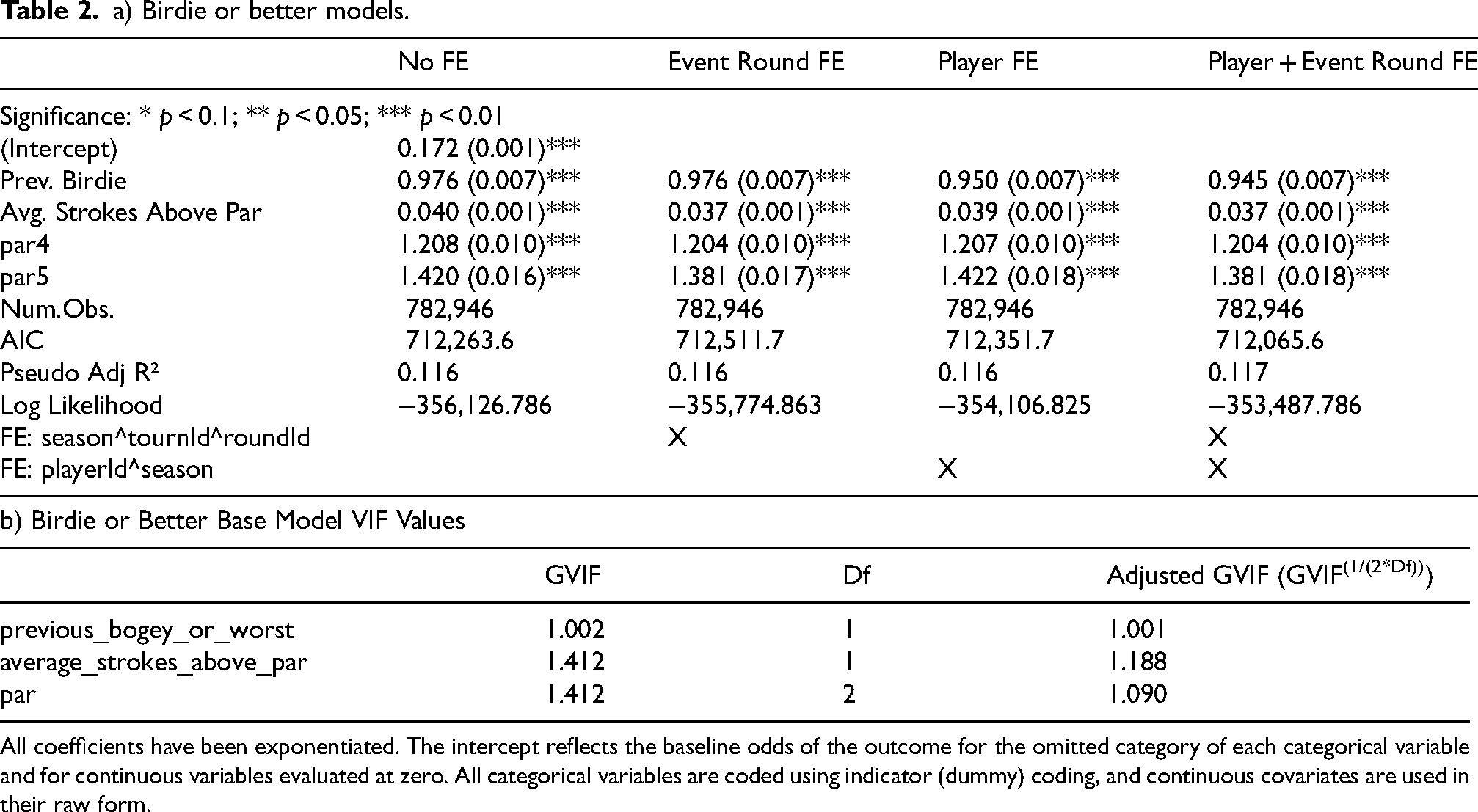
For birdies or better (BoB), the results are presented in Table 2a, and the generalized variance inflation factors (GVIFs) values for our most basic (no fixed effects) model are reported in Table 2b. This is consistent with best practices, as we use fixed effects to control for player seasons and common shocks instead of for inference. We find that the so-called “hot hand” effect is actually negative, with an odds ratio less than 1, indicating that the likelihood of consecutive birdies or better decreases. This effect becomes more pronounced after controlling for hole par and difficulty. In our fully specified model, which includes fixed effects for both tournament round and player-season, we estimate an odds ratio of 0.945 for scoring a birdie or better following one on the previous hole. This corresponds to approximately a 5.5% decrease in the odds of a consecutive BoB, after accounting for differences across players and rounds. All adjusted GVIF values are below 2, indicating that multicollinearity among predictors is not a concern in this specification.
a) Birdie or better models.
All coefficients have been exponentiated. The intercept reflects the baseline odds of the outcome for the omitted category of each categorical variable and for continuous variables evaluated at zero. All categorical variables are coded using indicator (dummy) coding, and continuous covariates are used in their raw form.
To illustrate these results using probabilities rather than odds, the exponentiated log-odds intercept of 0.172 yields a baseline probability of scoring a BoB of 0.172 / (1 + 0.172) = 14.7% when the previous hole was not a BoB. Applying the estimated odds ratio of 0.945 for having made a BoB on the prior hole reduces the odds to 0.163, corresponding to a probability of 14.0%.
A coefficient estimation plot for this model is presented in Figure 1. These findings indicate that players tend to adopt a more conservative approach after scoring a birdie or better on the previous hole, reducing their likelihood of repeating that success. Previous studies have not found statistically significant results for such a phenomenon (Elmore and Urbaczewski, 2018; Livingston, 2012). The average_strokes_above_par's odds ratio of 0.036 suggests that players are more likely to score birdies on easier holes.
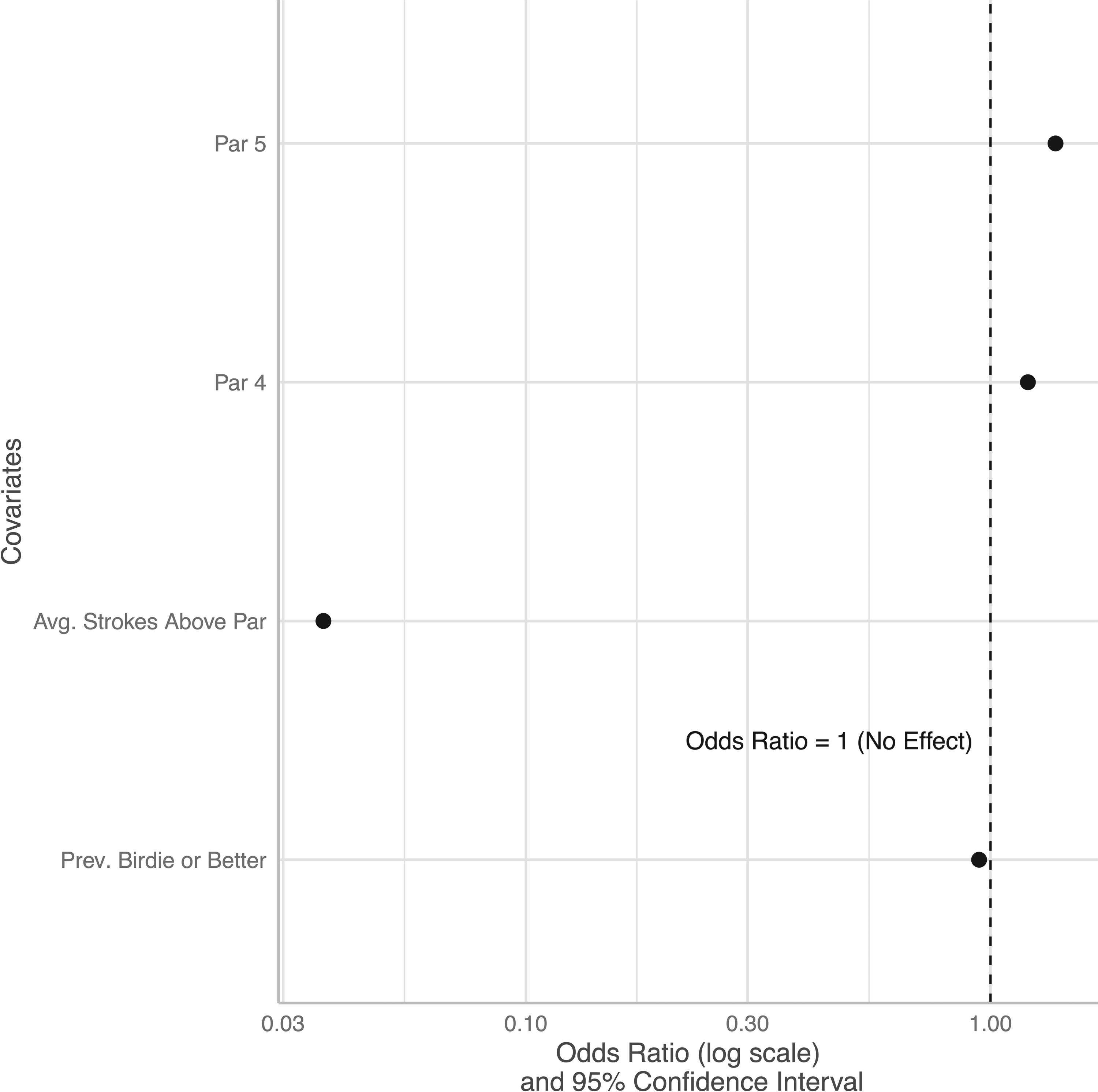
Birdie or better player + tournament round FE model coefficient estimates plot.
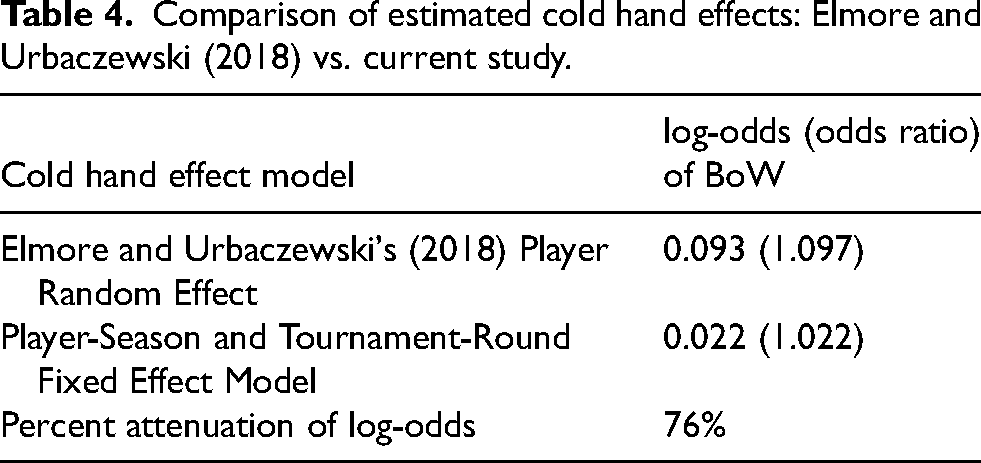
For bogeys or worse (BoW), the results of the models are presented in Table 3a, and the generalized variance inflation factors (GVIFs) values for our base model are reported in Table 3b. We find that the odds ratio of scoring a BoW after previously scoring a BoW consistently remains above 1, indicating a potential “cold hand” effect. When controlling for player season and tournament round, we estimate an odds ratio of 1.022 when previously scoring a BoW. A coefficient estimation plot for this model is presented in Figure 2. Elmore and Urbaczewski's (2018) previous work found an odds ratio of 1.097 (reported as log-odds of 0.093). A comparison of our results with those from Elmore and Urbaczewski (2018) is presented in Table 4, which shows an attenuation of approximately 76% in the log-odds coefficient associated with the cold hand effect. Similar to our BoB fully controlled model, all adjusted GVIF values are below 2 for our most controlled model, indicating that multicollinearity among predictors is not a concern in this specification.
a) Bogey or worst models.
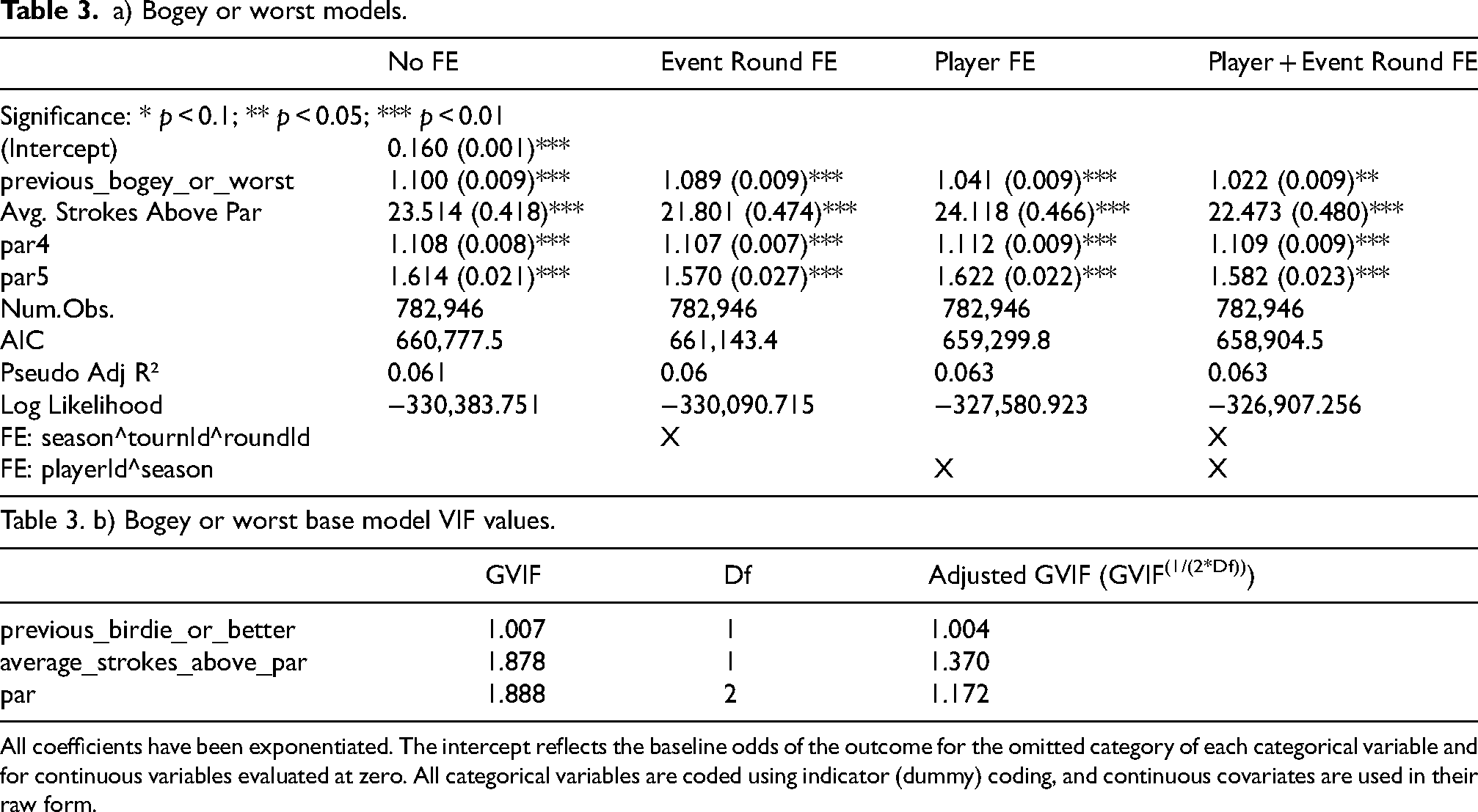
All coefficients have been exponentiated. The intercept reflects the baseline odds of the outcome for the omitted category of each categorical variable and for continuous variables evaluated at zero. All categorical variables are coded using indicator (dummy) coding, and continuous covariates are used in their raw form.
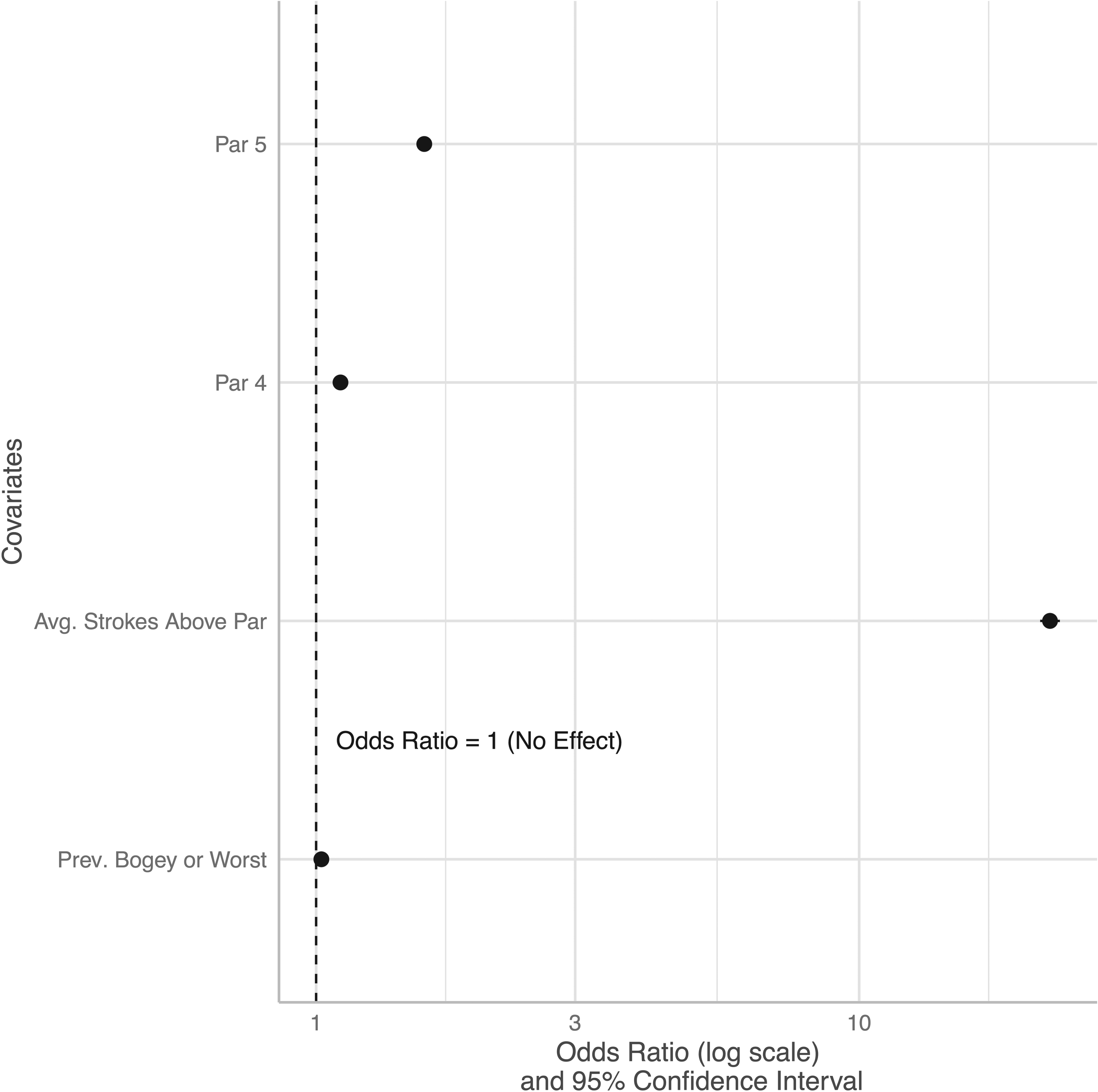
Bogey or worst player + tournament round FE model coefficient estimate plot.
Comparison of estimated cold hand effects: Elmore and Urbaczewski (2018) vs. current study.
To illustrate these results using probabilities rather than odds, the exponentiated log-odds intercept of 0.160 corresponds to a baseline probability of 13.8% for scoring a BoW when the previous hole was not a BoW. Applying the odds ratio of 1.022—estimated after controlling for player and tournament-round fixed effects—increases the odds to 0.164, which corresponds to a slightly higher probability of 14.1%.
As a robustness check, we also estimate a set of continuous models at the round level to assess overall performance momentum. These results are presented in Table 5. When fully controlling for player-season and tournament-round fixed effects, we find that a player's score from the previous round is not a statistically significant predictor of their score in the subsequent round. This suggests that, at the round level, there is no evidence of meaningful hot hand or cold hand effects once unobserved heterogeneity is accounted for.
Round-level strokes models.
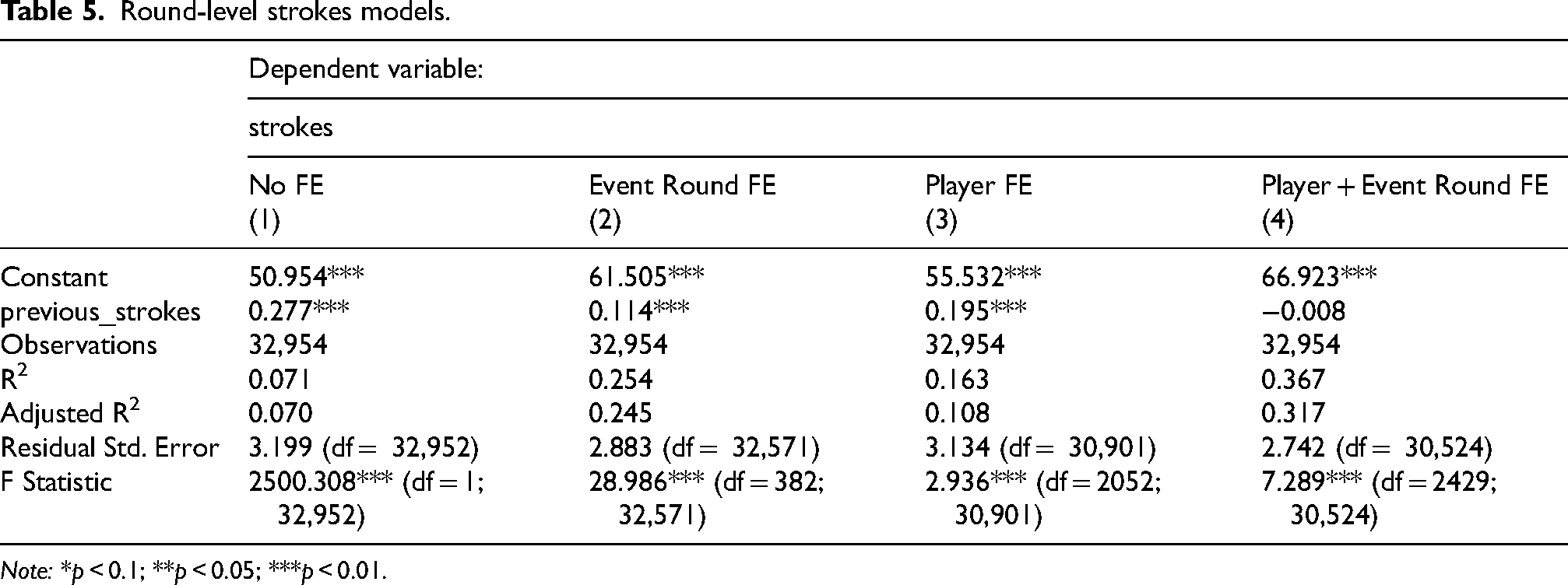
Note: *p < 0.1; **p < 0.05; ***p < 0.01.
Discussion
Our findings offer a more nuanced perspective of the existence of hot and cold hand effects in professional golf. While previous research by Elmore and Urbaczewski (2018) identified a statistically significant cold hand effect during the 2013–14 PGA Tour season, our analysis suggests that this effect is substantially attenuated when controlling for player-specific and tournament-round fixed effects. We estimate fixed effects models because they control for unobserved, time-invariant player characteristics—such as psychological resilience and baseline skill level—that may influence both performance and the likelihood of hot or cold hand patterns. Fixed effects eliminate this source of bias by enabling within-player comparisons over time.
By accounting for these factors across three full PGA Tour seasons (2022–2024), we show that much of the previously observed cold hand effect may have been overstated due to omitted variable bias. A comparison of the effect of a prior bogey or worse (BoW) on the likelihood of another BoW is presented in Table 4. Elmore and Urbaczewski (2018) reported a log-odds coefficient of 0.093 (odds ratio = 1.097), while our fixed-effects model yields a log-odds coefficient of 0.022 (odds ratio = 1.022), representing a 76% attenuation in the estimated effect. Although our result remains statistically significant (p < 0.01), the practical impact is modest: an odds ratio so close to 1 suggests only a slight increase in the likelihood of a bogey or worse following a previous poor outcome. This implies that, while cold hand effects can still be detected with sufficient data and controls, their magnitude is substantially smaller than previously reported.
Conversely, and consistent with prior research, we find little evidence of a hot hand effect. The BoB (birdie or better) odds ratio of less than 1 suggests that consecutive birdies are more likely the result of random variation than sustained momentum. Likewise, the fully controlled round-level model finds little evidence for hot or cold hand effects when evaluating overall performance momentum from one round to the next within the same tournament. Our findings align with the principles of prospect theory and loss aversion, suggesting that professional golfers may be more motivated by a desire to avoid losses than to pursue gains (Pope and Schweitzer, 2011; Sachau et al., 2012). To contextualize the cold hand effect within broader behavioral economics theory, we draw upon Prospect Theory (Kahneman and Tversky, 1979; Tversky and Kahneman, 1992).
According to Prospect Theory, outcomes are compared to a reference point, which can lead to loss aversion. In golf, a par serves as a natural reference, with bogeys representing losses. Pope and Schweitzer (2011) demonstrated that golfers exert greater effort and are more accurate when putting for par compared to birdie, a behavior consistent with the diminished cold hand effect observed in our study. The cold hand effect may thus reflect players’ shifts in risk preferences under perceived loss conditions, consistent with theoretical predictions. This connection aligns with broader empirical evidence that decision-making under pressure is shaped by reference-dependent evaluations and asymmetric loss sensitivity (Barberis, 2013).
In contrast, the absence of a hot hand effect may be explained by strategic conservatism—the tendency for players to adopt more risk-averse strategies following a birdie. Rather than trying to extend a scoring streak, players may prioritize preserving the gain by minimizing mistakes. Behavior of this manner could stem from what Thaler (1985, 1999) described as mental accounting. Originally described as it relates to money and resources, it was found that people treat money and resources differently depending on their source. This could be prevalent here, as players may behave differently when they have the lead (or are in a very favorable position in the standings) and do not wish to lose it. This also aligns with Sachau et al. (2012), who found that golfers report playing more conservatively when a par or birdie is perceived as likely, compared to when a bogey is anticipated. These behaviors may suppress any potential positive momentum, as players deliberately avoid aggressive targets or club selections that could lead to higher variance outcomes. The resulting drop in risk-taking may explain the observed BoB odds ratio below 1.
Hickman et al. (2019) found that players near the top of the leaderboard often perform worse relative to the rest of the field, likely because they focus on maintaining their position, adopt more conservative strategies, and are aware of the gap between themselves and trailing competitors. In the behavioral literature, this could correspond to the peak-end rule (Kahneman et al., 1993; Redelmeier and Kahneman, 1996), where individuals are found to remember experiences based on their most intense point and ending, not the average. Getting the lead due to great shots may stay in the memory, and players may not wish to diminish that by becoming more risk-averse following favorable outcomes. This could avoid the memory being replaced by a poor hole and losing in dramatic style, having that negative memory persist in the player's mind.
In a similar manner, Balsdon (2013) showed that players’ decisions near key tournament thresholds—such as the cutline or top five—reflect calculated “risk-reward” tradeoffs. For example, players chasing the leaders are more likely to take risks, as evidenced by a higher “going for it” percentage and a lower two-putt rate. In contrast, players already in strong positions tend to minimize risk to preserve their standing. Paradoxically, this conservative behavior can lead to higher average scores, as it limits scoring opportunities while guarding against major mistakes.
Behavioral evidence suggests that golfers adjust their risk preferences in response to recent outcomes. For example, Corcoran (2019) observed in Golf.com that players often reduce aggression after a successful hole, aiming to protect their score rather than extend a streak. This anecdotal insight is supported by empirical studies: McFall and Rotthoff (2020) found that risk-taking in golf tournaments varies dynamically with player standing, while Brown (2011) demonstrated that competing against dominant players influences performance and strategic effort. Together, these findings underscore the importance of reference points, perceived gains, and tournament context in shaping golf decision-making, all consistent with predictions from behavioral economics.
Unlike prior studies that relied on simplified models (e.g., Arkes, 2016; Livingston, 2012), our approach mitigates the risk of omitted variable bias and accounts for intra-player correlation over multiple seasons. By incorporating player and tournament-round fixed effects, we provide more precise estimates of streakiness in professional golf, offering a refined perspective on how prior performance influences subsequent hole outcomes.
In addition to improving the modeling framework, we conducted robustness checks using continuous round-level models. These models evaluated whether a player's previous round score predicted performance in the next round of the same tournament. Our fully controlled specification found no evidence of performance momentum, reinforcing the hole-level findings. These refinements contribute to a more reliable and interpretable evaluation of the presence—or absence—of hot and cold hand effects in golf.
For further comparison, we also estimated random effects models, presented in Appendix A1. Although the attenuation of the log-odds coefficient for bogey-or-worse (BoW) outcomes was smaller (45%) than in our fixed effects model (76%), the resulting odds ratio was still substantially closer to 1 than that reported by Elmore and Urbaczewski (2018). This likely reflects both the use of player-season random effects and the substantially larger dataset used in our analysis.
Our findings suggest that while psychological momentum may play a role in influencing performance after a poor hole, the practical implications for player strategy and coaching may be modest. Nevertheless, these findings could inform the development of mental training programs aimed at helping golfers maintain composure and resilience after encountering setbacks, minimizing the risk of compounding errors over consecutive holes. Golf coaches may benefit from encouraging players to adopt a consistent mental approach that reduces the psychological impact of previous hole outcomes, particularly in high-stakes situations.
Conclusion
This study significantly advances the understanding of hot and cold hand effects in professional golf by leveraging a comprehensive dataset covering three full PGA Tour seasons (2022–2024) and employing fixed effects models to control for player-specific and tournament-round variability. Our results challenge previous findings by demonstrating that the cold hand effect, while statistically significant, is less pronounced than previously reported when accounting for intra-player and tournament-specific factors. Conversely, we find minimal evidence to support the existence of a hot hand effect, suggesting that streaks of birdies are more likely a product of random variation rather than sustained momentum.
Our findings align with prospect theory and the concept of loss aversion, reinforcing the idea that golfers exert greater effort to avoid losses (bogeys) than to achieve gains (birdies). This behavioral asymmetry may help explain the persistence of the cold hand effect even after controlling for individual and tournament-level variability. Practically, these insights can inform the development of mental training programs aimed at helping golfers maintain a consistent approach after experiencing poor outcomes, reducing the likelihood of compounding errors over successive holes. Specifically, for the cold hand effect, training protocols that simulate high-pressure scenarios following bogeys, such as structured pre-shot routines or mindfulness exercises, may help mitigate the psychological spillover of negative outcomes. In addition, coaches and sports psychologists can stress to golfers to emphasize consistency in risk assessment rather than chasing consecutive birdies, as strategic conservatism after success appears to be a dominant behavioral pattern.
Future research
While our models account for a wide range of player- and tournament-level factors, certain contextual variables—such as course difficulty, round-specific weather conditions, and player fatigue—may still influence performance and warrant further investigation. Although fixed effects control for individual player abilities, the study period included changes to the tour's talent pool, such as rookie debuts and retirements, which were not explicitly modeled. Additionally, player-level heterogeneity in psychological resilience and strategic tendencies may contribute to unexplained variation in streakiness.
To address these limitations, future research could incorporate methodological innovations such as dynamic panel models or state-space frameworks to examine momentum effects across multiple consecutive holes. These approaches would allow for the modeling of long-term performance dependencies and dynamic within-player variation more effectively than static models.
Further, interdisciplinary integration with cognitive and physiological science could help uncover unobserved drivers of momentum. Incorporating real-time psychological and physiological indicators—such as heart rate variability, pre-shot routine duration, and self-reported confidence—may provide deeper insight into the emotional and cognitive processes underlying streakiness. Embedding these variables within decision-tree models could help identify behavioral or neural correlates of loss aversion and distinguish between gain-seeking and loss-avoidant responses during high-pressure situations.
Context-specific analyses also present a promising avenue for future work. Examining momentum effects in high-stakes situations—such as playoff holes or final rounds of major championships—could clarify how contextual stressors affect decision-making and shot execution. Additionally, analyzing streakiness using more granular metrics, such as strokes gained, approach shot proximity, or putting distances, may reveal nuanced performance patterns not captured by traditional birdie/bogey outcomes.
Finally, while our analysis is limited to PGA Tour players, future research could extend this work across tours. Cross-tour comparisons—including the LPGA, LIV, and DP World Tours—may reveal structural or gender-based differences in momentum dynamics, contributing to a broader understanding of performance variation across professional golf.
Footnotes

Funding
The authors received no financial support for the research, authorship, and/or publication of this article.
Declaration of conflicting interests
The authors declared no potential conflicts of interest with respect to the research, authorship, and/or publication of this article.
Appendix A1
We estimated the fixed effects models presented in Tables 2a and 3a using nested random effects to control for the hierarchical structure of the data. Player-season effects were modeled by nesting seasons within players, allowing for player-specific variability across seasons. Round-level effects were specified by nesting rounds within tournaments, and tournaments within seasons—thereby capturing variability of round-specific or tournament-specific conditions.
We report the results from the random effects models in Table A1 (corresponding to Table 2a) and Table A2 (corresponding to Table 3a). In the hot hand model (Table A1), the estimated odds ratio is 0.962, which closely aligns with the fixed effects estimate of 0.945. Both values are below 1, suggesting a slight negative association between consecutive birdies or better, and providing no evidence in support of a hot hand effect.
In the cold hand model (Table A2), the estimated log-odds coefficient for a prior bogey or worse (BoW) was 0.052, compared to 0.093 in Elmore and Urbaczewski (2018), representing a 44% attenuation. While this reduction is smaller than that observed in our fully controlled fixed effects model (log-odds = 0.022), it still reflects meaningful shrinkage. This attenuation is likely attributable to both our substantially larger dataset and the use of nested random effects, which account for player-season-level variation.