




Abstract
The evaluation of player performance is an important topic in sports analytics and is used for team management, scouting, and in sports broadcasts. When evaluating the performance of ice hockey players, many metrics are used, including traditional metrics such as goals, assists, and points and more recent metrics such as Corsi and expected goals. One weakness of such metrics is that they do not consider the context in which the value for the metric was assigned. Other advanced metrics have been introduced, but as they are not easily explainable to practitioners, they may not make it into the hockey discourse. In this paper we introduce new goal-based metrics that (i) are based on traditional, well-known metrics, and thus easily understandable, (ii) take context into account in the form of time, manpower differential, and goal differential and (iii) add a new aspect by taking into account the importance of goals regarding their contribution to team wins and ties. We describe the intuitions behind the metrics, give formal definitions, evaluate the metrics and show correlations to the traditional metrics. We have used data from seven NHL seasons and show which players stand out with respect to the number of goals and the importance of goals.
Introduction
Sports analytics is a field that has increased in popularity in recent years. One particular component of sports analytics that has seen a large increase in research is performance evaluation, both for teams and players, as it provides more insight into how we view and value the aspects of a sport. In team sports, such as ice hockey, soccer, and basketball, team performance can be analyzed from the perspective of team success, e.g., wins and total points earned. For player performance, the emphasis is instead on how an individual player contributes to the team (Singh, 2020).
The metrics used for evaluating performance have also changed drastically over time. Historically, the most available and basic statistics have been used to evaluate and compare players (Nandakumar and Jensen, 2019). In ice hockey, metrics such as goals, assists, points, and
Although some metrics take context into account for goals, e.g., the location of the shot, few consider the importance of goals. For instance, a goal scored when the team is in the lead with 5–0 at the end of the game, is most likely not crucial for winning. In contrast, scoring a goal when the score is tied at 1–1 with some seconds left of the game, is of more importance for winning. Furthermore, some players have a reputation for often scoring important goals, while others may have a reputation for mainly scoring when the team is playing ‘easier’ games. For instance, during the 2013-2014 season the Washington Capitals’ Alexander Ovechkin ranked the highest regarding game-tying and lead-taking goals while he only ranked 29
In this paper, our aim is to introduce new goal-based metrics for evaluating the performance of ice hockey players. The metrics should take into account context and provide new insights. For this work we have chosen to focus on the importance of goals in the sense of having important contributions to winning or tying games. Further, the metrics should be easily understandable and based on well-known traditional metrics. To achieve these goals, we introduce the notion of goal importance. We introduce variants of the traditional goals (G), points (P),
1
assists (A) and
The paper is organized as follows. In Section ‘Related work - measuring performance in ice hockey’ we discuss previous work on measuring performance of players and player pairs in ice hockey. Then, we discuss a method for defining a new metric in Section ‘Defining a metric’ and the data we use in Section ‘Data’. We follow the different steps in the method by showing the intuition behind the metric (Section ‘Intuition behind metric’), and defining the importance of goals and the new metrics for the regular season (Section ‘Metrics definition’). We evaluate the metrics using the eye test (Section ‘Eye test for GPIV metrics’), and by computing the correlations between the new metrics and traditional metrics (Section ‘Correlations of GPIV metrics with traditional metrics’ and appendix A). We also look at whether data from an ongoing season can be used to predict the end-of-season values for the new metrics in Section ‘Prediction of GPIV metrics’. Finally, we show how our approach can be used to evaluate performance of player pairs (Section ‘Player pairs’). The paper concludes in Section ‘Conclusion’. In the appendix we discuss issues related to the stability of the metrics over different seasons (appendix B), whether we can use data from previous seasons, and if so, how much data, to compute an approximation of the metrics for an ongoing season (appendix C), and give results for the playoffs (appendix D).
Related work - measuring performance in ice hockey
When evaluating the performance of ice hockey players, it is most common to use metrics that attribute a value to the actions the player performs (e.g., scoring a goal for the goals metric or giving a pass that leads to a goal for the assists metric) and then compute a sum over all those actions. Some extensions to these traditional metrics have been proposed, e.g., for the
The importance of scoring the first goal in the NHL is investigated in Brimberg and Hurley (2009), where it is reported that the win probability is approximately 70% if the first goal is scored in the first period. This analysis assumes an equal win probability at the start of the game. The importance of a two-goal lead is analyzed in Brimberg and Hurley (2012) while Gill (2000) examines late-game reversals. Teams who have taken a two-goal lead win in 83% of games, while having the lead after two periods leads to a win in 84% and 80% of games for the home and away team, respectively. The work most similar in spirit to our work in taking the importance of goals into account is (Pettigrew, 2015), where first a probability is computed for the home team winning the game (but not tying the game as we do). The probability takes into account the remaining time in the game, the goal differential and the manpower differential. It is then used for introducing the added goal value metric for a player. This metric measures the difference between the change in win probability that occurred from each of the player’s goals (similar to the GPIV we introduce in Section ‘Defining an importance value’), and the expected change in win probability based on league average. In our work, we additionally use such a metric to define variants of traditional metrics.
We note that the introduction of new metrics may change the way the game is played. For instance, in Johansson et al. (2022) it was shown that team play transitioned first to taking more shots (high Corsi, shot-based), and then to taking high-quality shots (high expected goals). This point is also highlighted in Nandakumar and Jensen (2019), and similar trends have also been observed in, e.g., soccer (Van Roy et al., 2021).
New metrics can also be used ‘behind the scenes’, where coaches, managers, and GMs may use data-driven approaches for decision-making. An analytical approach has been proven successful for NBA, NFL, and MLB teams as they were able to select players with a far greater future value than the players selected prior. However, the analytical approaches present in, e.g., the NBA and NFL are less utilized in ice hockey, leaving a knowledge gap of what impacts the value of a prospect (Farah and Baker, 2020; Tingling, 2017). One way to increase this knowledge is the development of new methods and metrics to evaluate players. In Chaikof et al. (2022), an automatic scouting framework is proposed to identify player habits and possible developmental areas, which may be a time-consuming task. It has also been reported in Farah and Baker (2021) that drafting well in the NHL is only accurate for the first two rounds, leaving the remaining five rounds as more of a gamble. Due to the salary structure of the NHL, where entry-level contracts given to drafted players can have a monetary value far less than the production a player provides, drafting the correct player may be the difference between success and failure (Nandakumar and Jensen, 2019). Performance metrics applicable to potential draftees can thus also impact the way decisions are made, and recent work by Kumagai et al. (2022) presents one method for predicting the estimated ability of prospects and illustrates how it can be used to construct a draft ranking.
As ice hockey is a team sport, it is not enough to only look at the performance of individual players. Lineup management, for instance, can benefit from identifying pairs of players that perform well when sharing the ice. One of the most frequent metrics for determining what happened when a player was on the ice is
Defining a metric
When defining a metric, several questions must be addressed. First, there are some questions regarding the purpose of the metric and its definition.
What are the intuitions behind the metric? It is important to know why a new metric is introduced. Usually, interesting observations regarding the game, that are not addressed by existing metrics, lie at the base of introducing new metrics. Therefore, a new metric should measure something that is not already measured by other metrics. How is the metric defined? Once the intuitions and purpose of the new metric are clear, a formal definition of the metric is needed that allows us to compute the values for the metric.
Further, we need to evaluate the metric. This is not a simple task as we usually do not have a gold standard against which to evaluate. Therefore, the metric’s behavior is usually considered from different points of view, including passing the eye test, finding correlations with existing metrics, and looking at a metric over different seasons.
Does the metric pass the eye test? Although there is no gold standard, based on the intuitions behind the metric, experts may expect a certain ranking of the players based on the new metric. The eye test checks whether the actual ranking according to the new metric makes sense according to the expectations of the experts. Are there correlations with existing metrics? A perfect correlation to existing metrics would mean that these metrics essentially measure the same thing. This could be interesting as an insight or in the case that it is easier to measure the new metric than existing metrics. However, as the intuitions behind the new metric usually deal with aspects that were not taken into account by existing metrics, there will not be a perfect correlation and this is what we would want. However, it is still interesting to check the correlation between the new metric and well-established metrics. A high correlation would show that the metric behaves in a similar way to a well-established metric, but still brings something new. Is the metric stable? The values for metrics will differ from each other over different seasons. However, unless for good reasons, they should not change too drastically.
Finally, it is interesting to look at whether the value of the metric can be predicted.
Can one predict the value of the metric at the end of a season based on data for part of the season? For some traditional metrics the value of a metric after half of the season gives a good indication of the value at the end of the season. Therefore, it is interesting to check whether data for part of the season would allow predicting the value of the metric at the end of the season.
Data
We have used play-by-play data from the NHL, seasons 2007-2008 to 2013-2014. The data was generated for the work in Routley and Schulte (2015). It is available at https://www2.cs.sfu.ca/∼oschulte/sports/.
Intuition behind metric
The observations on which our new metrics are based are the following. First, we investigated when goals are scored. We did this for different time intervals from seconds to minutes. Figure 1 shows the results of goals per minute for the 2013-2014 season and this is representative of all seasons and most time intervals. We note that few goals are scored in the first minute of the game. Further, during the last minute of the game, at least three times as many goals are scored than for any other minute in the game. A possible explanation is the higher frequency of 6 on 5 situations at this time of the game, in which a team’s gamble to pull their goaltender often results in either them scoring a goal (in part helped by their extra attacker) or the other team scoring an empty-net goal. We also note that power-plays more often result in goals and that shorthanded goals are not that common. A team’s strategy may also shift depending on the current score. Our metrics, therefore, take time, goal differential, and manpower differential into account.
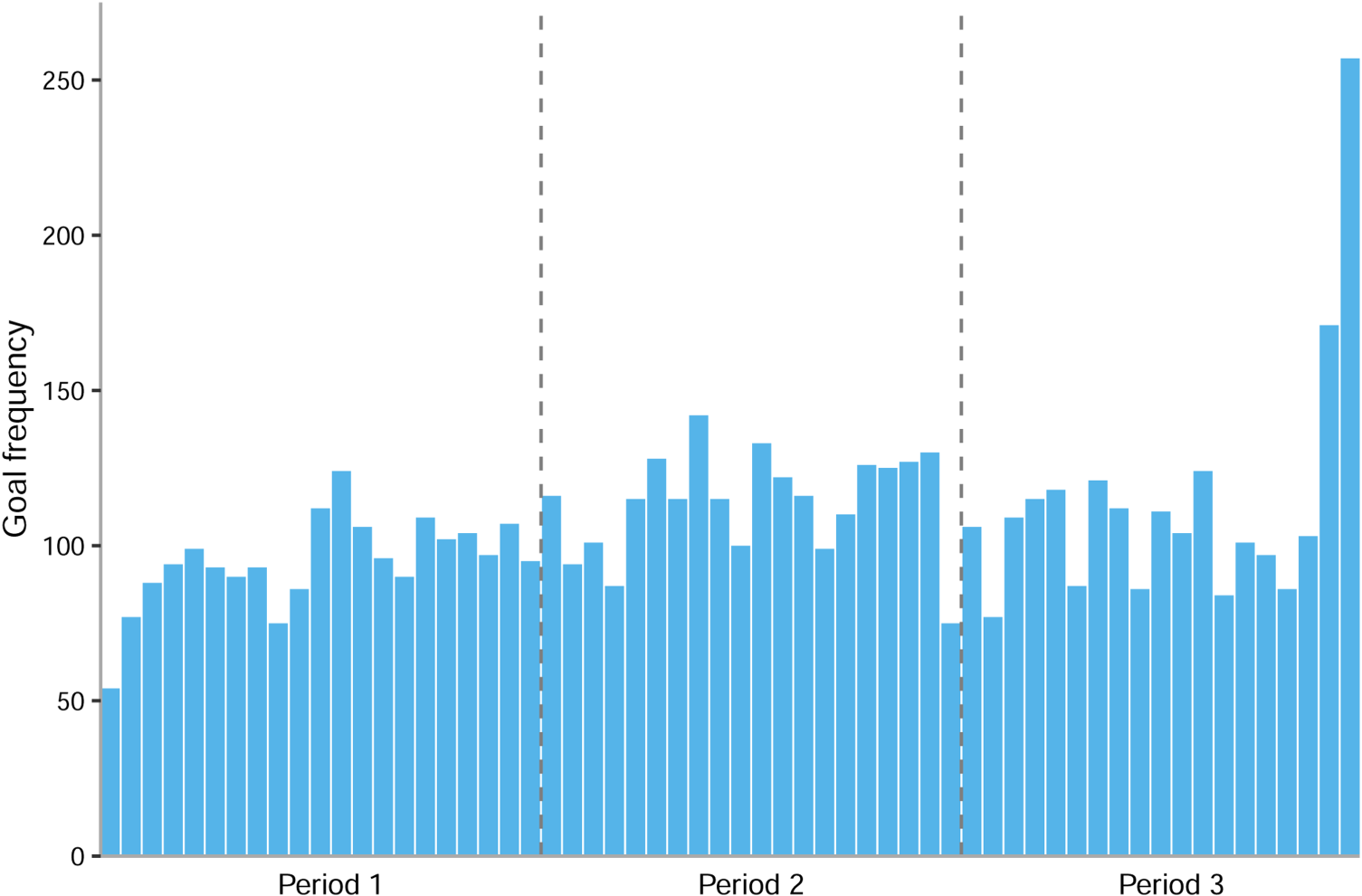
Goal frequency for each minute of regulation time in the NHL during the 2013-2014 regular season.
Another observation is that not all goals are equally important for producing game points, i.e., 2 PTS for a win, 1 PTS for an overtime loss, and 0 PTS for a regular time loss in the NHL. For instance, scoring the 6th goal for the team when already leading 5-0, will most likely not be contributing much to obtaining 2 PTS. The team would most likely win anyhow. However, a goal that ties the game in the last second of the game normally secures 1 PTS (while just before the goal the team would have 0 PTS) and therefore is an important goal. Our new metrics take the importance of a goal for producing PTS into account.
Metrics definition - GPIV-weighted performance metrics
In this section, we define our new metrics. The game outcomes are different for the regular season (win, overtime loss, regulation time loss earning 2, 1, and 0 PTS respectively) and the playoffs (win or loss in best-of-seven format). In this section we focus on the regular season. Playoffs are discussed in the appendix D.
Game Points Importance Value (GPIV) - regular season
Defining an importance value
As a basis for our new metrics, we need to formally define the importance of a goal. Our intuition is that the importance of the goal represents the change in the probability of the team taking points for the game (PTS) before and after the goal has been scored. 2 Further, as discussed earlier, we take into account time (t) for which we choose one-second intervals, goal differential (GD), and manpower differential (MD). This we call a context. 3
We next define the probability of an outcome of a game given a context. For regulation time, the outcome of a game can be a win, a tie
4
and a (regulation time) loss. For overtime, the outcome of a game is an overtime win or an overtime loss. We define the probability of an outcome of a game given a context, as the ratio of the number of occurrences of the context that have resulted in the outcome and the total number of occurrences of the context in our dataset:

In regulation time, when a goal is scored, the context after the goal (context AG) has the same time as the context before the goal (context BG), but the GD is changed by one and the MD may (minor penalty power-play goal) or may not change (even strength, short-handed, or major penalty power-play goal). Based on this intuition, we define the GPIV for regulation time in the NHL as follows:


GPIV with accounting for rare goals in regulation time
As the robustness and quality of the computed GPIV for regulation time depends on the number of occurrences of the context, some consideration should be given to goal contexts that are deemed rare. In general, when the number of occurrences of a context increases, the impact of an individual occurrence on GPIV decreases. In this paper, we define a rare goal context as a goal context that has less than ten occurrences across all three possible outcomes for regulation time (i.e., win, tie, or loss), for the state before and/or after the goal.
The choice of ten occurrences was motivated by a noticeable decrease in the point-wise variance of GPIV for goal contexts that had ten or more occurrences, compared to those that had fewer occurrences. Most rare goal contexts occur when GD is large (
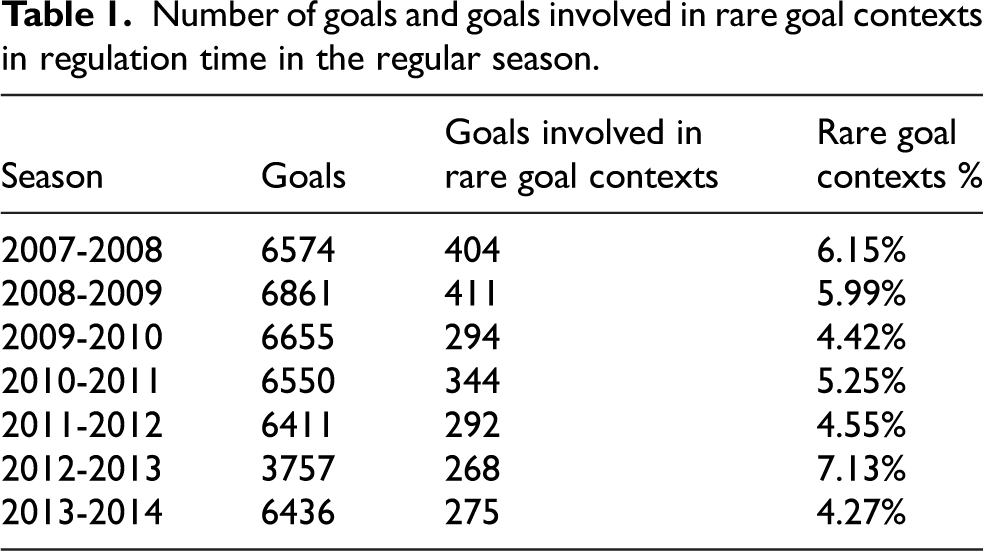
In Table 1 we show the number of occurrences of goals involved in rare goal contexts according to our definition. For instance, in the 2013-2014 season 275 of the 6436 regulation-time goals, i.e., approximately 4.27%, were involved in rare goal contexts. Among these goals, 133 had a rare before-goal context, 90 had a rare after-goal context, and 52 had both a rare before-goal context and a rare after-goal context.
Number of goals and goals involved in rare goal contexts in regulation time in the regular season.
To mitigate the volatility of these rare goal contexts, we raise the number of occurrences of these contexts in an artificial way by taking into account the neighboring contexts and their occurrences. A neighboring context of a given context is a context that is close in time, GD, and MD to the given context. Formally, we use a weighted Manhattan distance to account for the different units in time, GD, and MD. We define the distance between context (t
We call the contexts with the smallest distance to a given context, the neighbors of that context. We use these neighbors to augment the number of occurrences of rare goal contexts. Specifically, a rare goal context (i.e., with less than ten occurrences) is ‘padded’ with occurrences from the neighboring states, such that the total number of occurrences is at least ten. This padding is made by retaining the proportion of each outcome from the before/after occurrences of the neighboring states and adding this to the rare goal state. As an example, in the game between the New Jersey Devils and Boston Bruins on October 26, 2013, the Devils tied the game at 3-3 with 68 seconds left while having a two-player advantage. The before-goal context with this specific combination of time, MD, and GD (t = 3532 s, GD =
For the 2013-2014 season, where 275 goals were involved in rare goal contexts, 116 had an unchanged GPIV when using padding. 189 goals had a GPIV change of less than 0.1 which drops to 135 goals that had a GPIV difference of less than 0.01. The main benefit of the rare goal context adjustment is the correction it provides for goal states with extreme GPIV, where 32 of the 40 lowest and 3 of the 40 highest GPIV values were adjusted. Without using the adjustment the range of GPIV is between
Characteristics of GPIV
In Figures 2 and 3 we show representative visualizations of the characteristics of GPIV in regulation time. From Figure 2 we note that the value of GPIV is high when the GD is
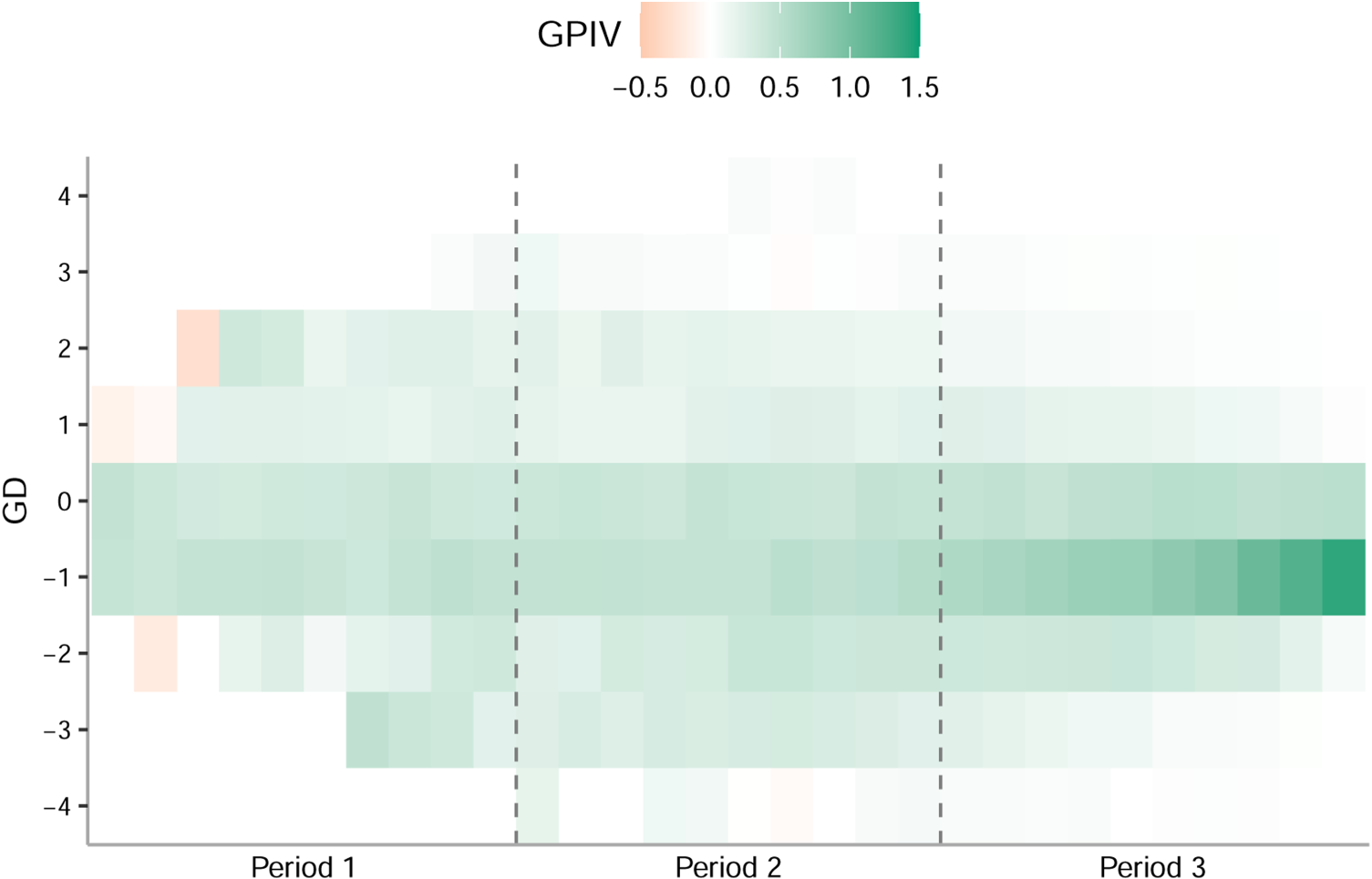
GPIV versus GD for the 2013-2014 season. Each bin is two minutes. Bins with less than two observations are left out.
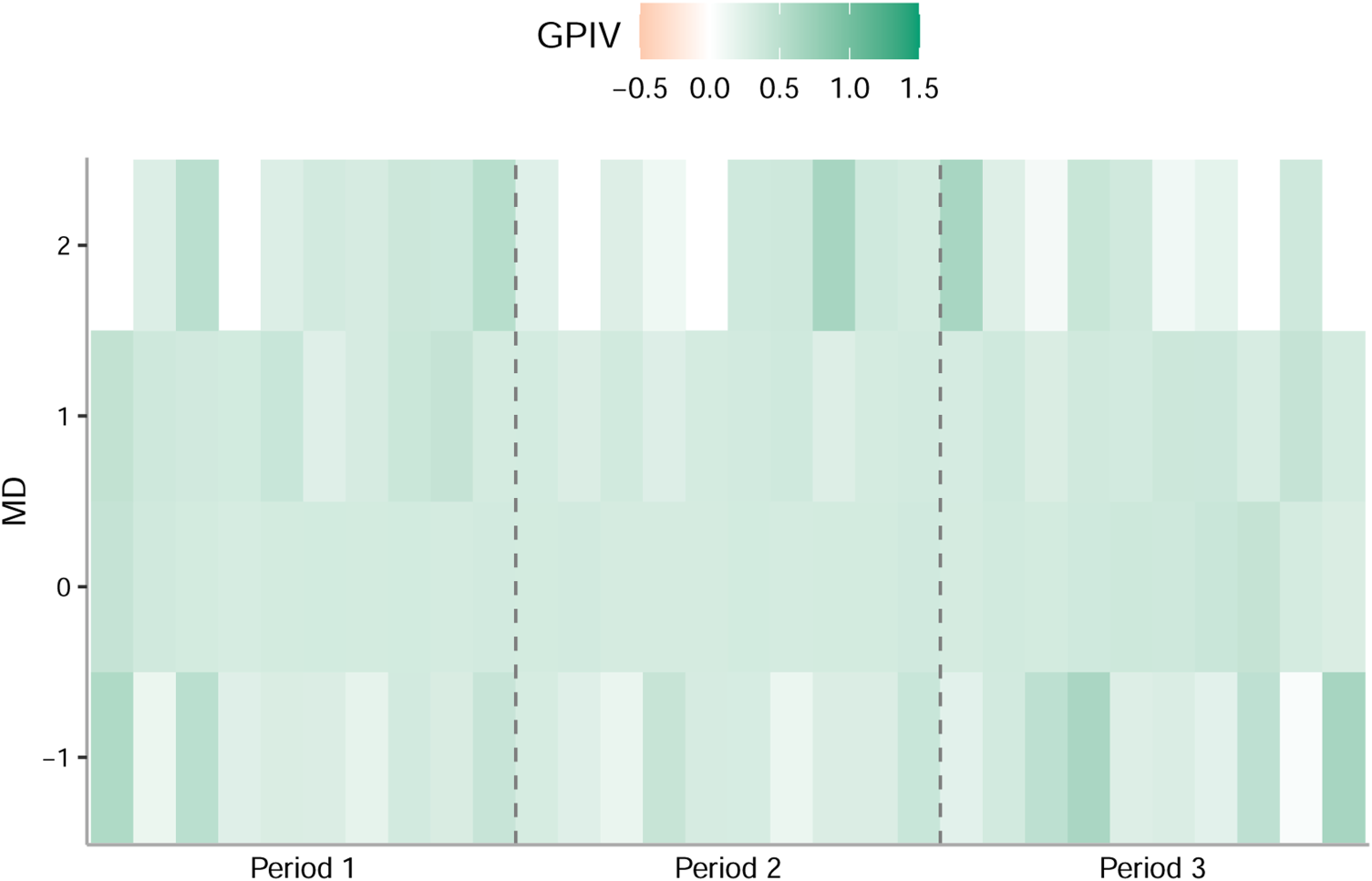
GPIV versus MD for the 2013-2014 season. Each bin is two minutes. Bins with less than two observations are left out.
Scoring goals is not always positive for the probability of earning PTS. We observed that, although this situation rarely appears, taking a 3-goal lead early in the game may have negative consequences. This could be explained by the possibility of the leading team becoming too complacent with a comfortable lead. In general, negative consequences were limited to the first period.
Figures 4 and 5 shows the characteristics of GPIV in regulation time with respect to GD when computed over the data for all seasons in the data set. We note that the change of values for GPIV from a bin to a neighboring bin is slightly smoother than when the values are computed for one season and thus may be more intuitive. 7 However, as there does not seem to be a large difference between the results for different seasons, in our work, we have chosen to compute values based on one season. The advantage is that the data set used for computation is smaller and that only recent historical data is needed.
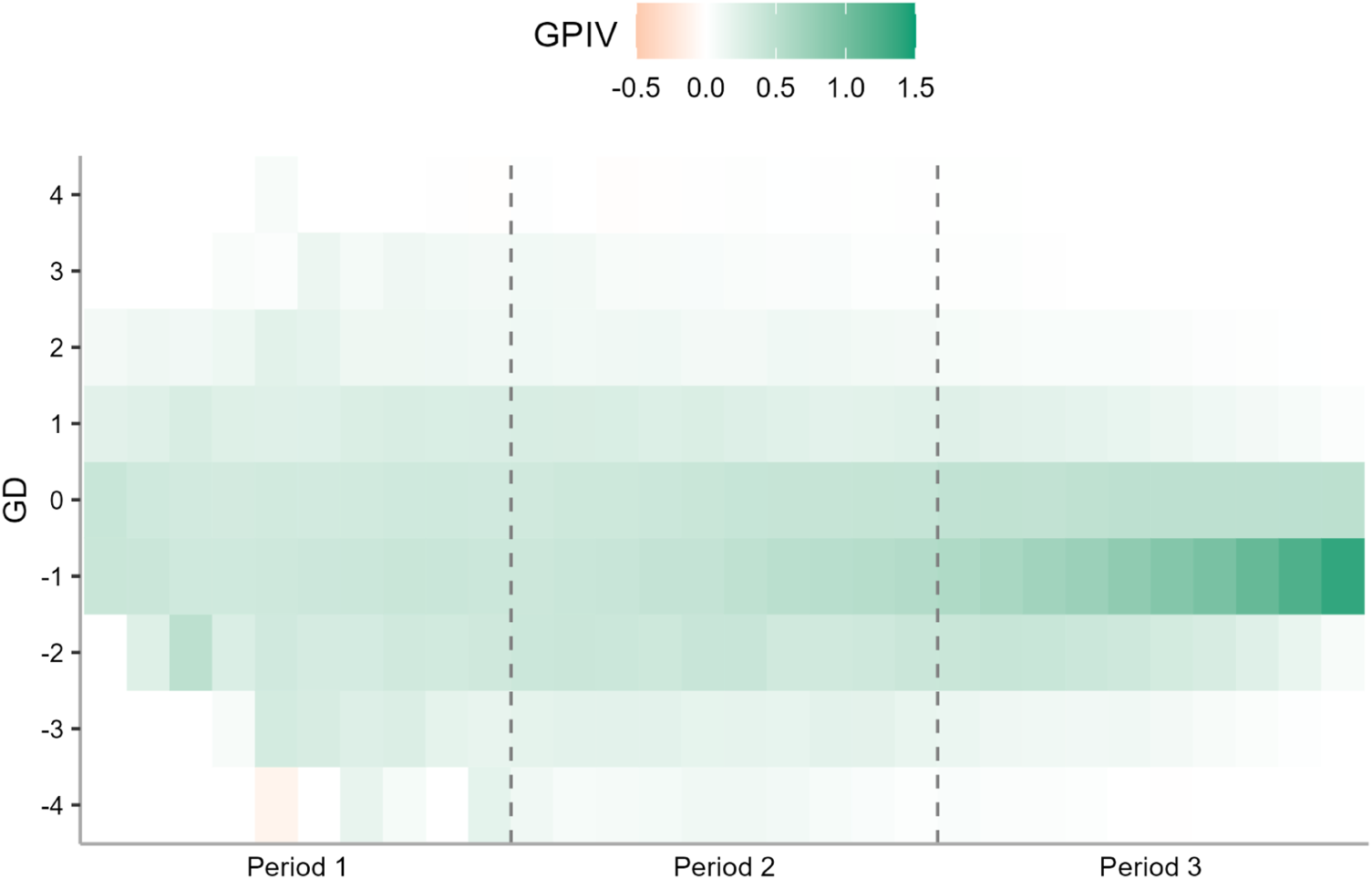
GPIV versus GD computed over all seasons in the data set. Each bin is two minutes. Bins with less than two observations are left out.
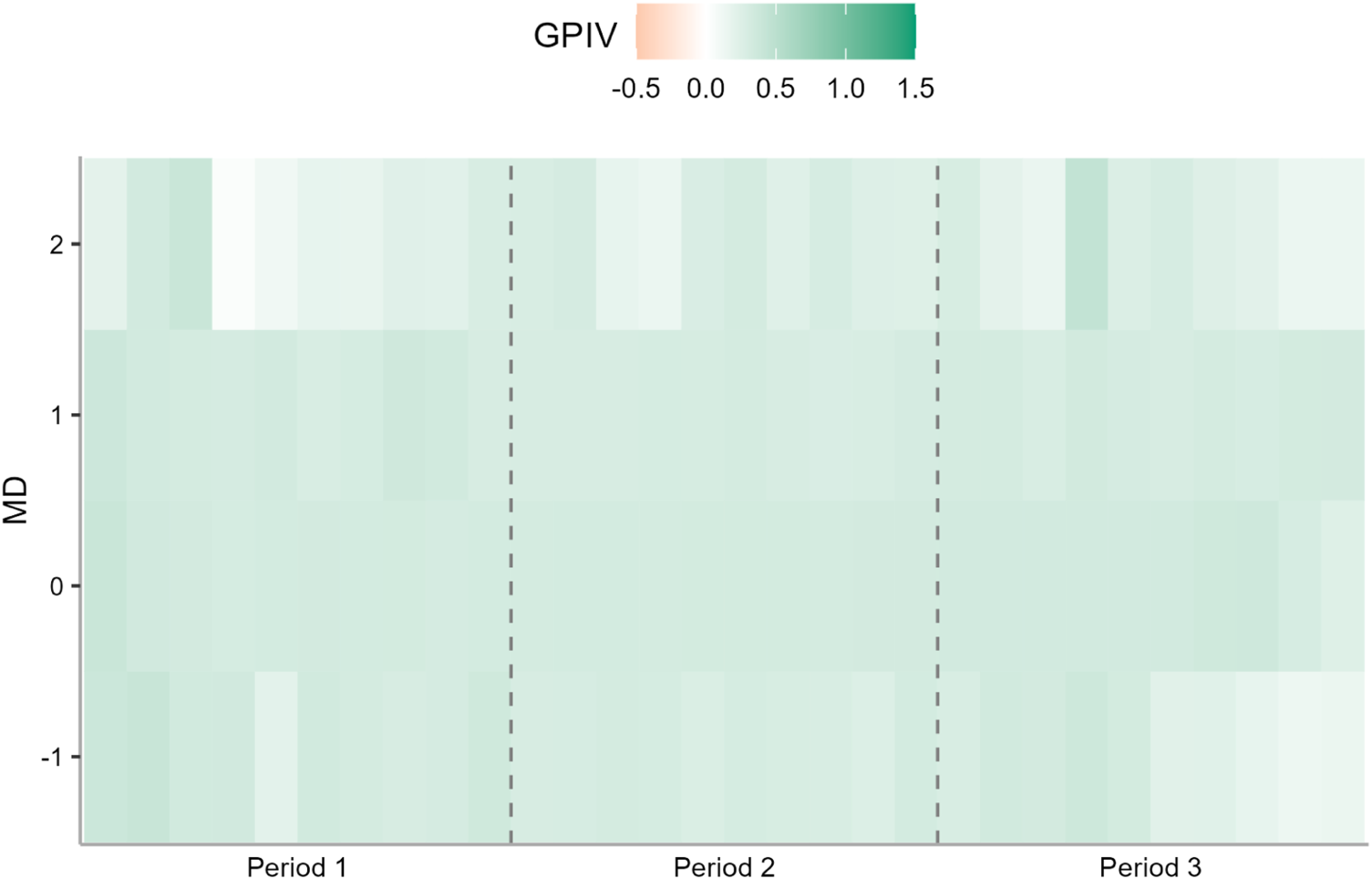
GPIV versus MD computed over all seasons in the data set. Each bin is two minutes. Bins with less than two observations are left out.
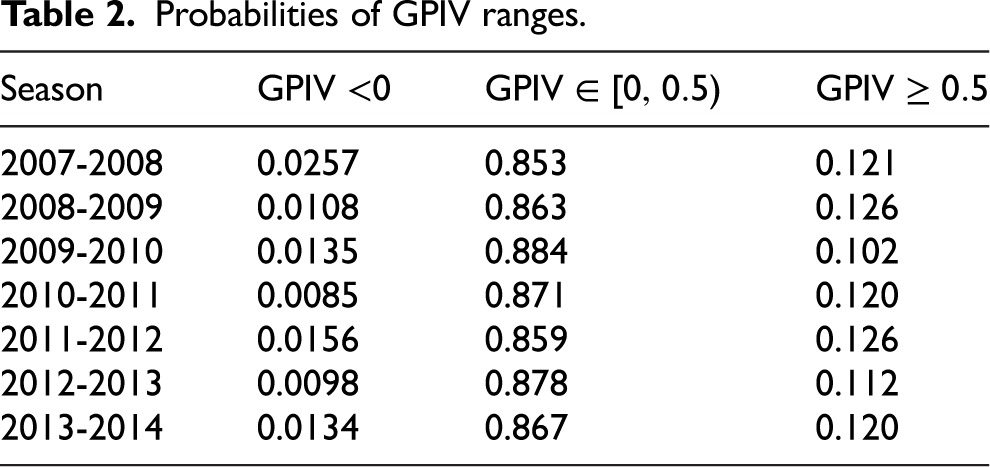
In Table 2 we show the probabilities for negative GPIV, GPIV between 0 and 0.5, as well as GPIV higher than 0.5. What is interesting about this last group, is that they have the same or greater GPIV as overtime goals (0.5). As an example, for the 2013-2014 season, the probability of a negative GPIV is 1.3%. Approximately 86.7% of the GPIV range from 0 to 0.5. Furthermore, 12.0% of the GPIV range from 0.5 to 1.5. In general, the probabilities are relatively stable over different seasons.
Probabilities of GPIV ranges.
New metrics
We define new variants of the traditional metrics goals (G), assists (A), points (P), and
Further, it may be interesting to look at the average importance of the goals in which a player is involved as scorer, assist giver or both. This importance can be obtained by dividing the new metrics by the old metrics. For instance, GPIV-P/P is a measure of the average importance of the goals in which a player is involved with respect to points (as scorer or as assist giver). Similarly, GPIV-A/A is the average importance of the goals in which a player is involved as assist giver, and GPIV-G/G is the average importance of the goals a player scores. We note that for a traditional metric X, as GPIV-X = (GPIV-X/X) * X, it means that GPIV-X is the traditional metric X for a player weighted by the average importance of the goals contributing to X in which that player was involved.
We note that team situation is an issue for most metrics. Better teams score more goals. Therefore, it is easier for players in the better teams to obtain higher values for traditional metrics such as G, A, and P, as well as for the new counterparts GPIV-G, GPIV-A and GPIV-P. However, the new metrics reduce the influence of this issue somewhat. First, although good teams score more, the importance of the goals is reduced when the team is leading. Therefore, for the GPIV-based metrics the addition of not so important goals does not raise the relative value of the metric as much as for the traditional metrics. Secondly, GPIV-X/X shows the average importance of the goals contributing to X, and thus even in worse teams, a player can have a high value for this metric (by e.g., often being involved in tying and lead-taking goals).
In the following sections, we look at the characteristics of the new metrics and show how players and player pairs performed according to these metrics.
Eye test for GPIV metrics
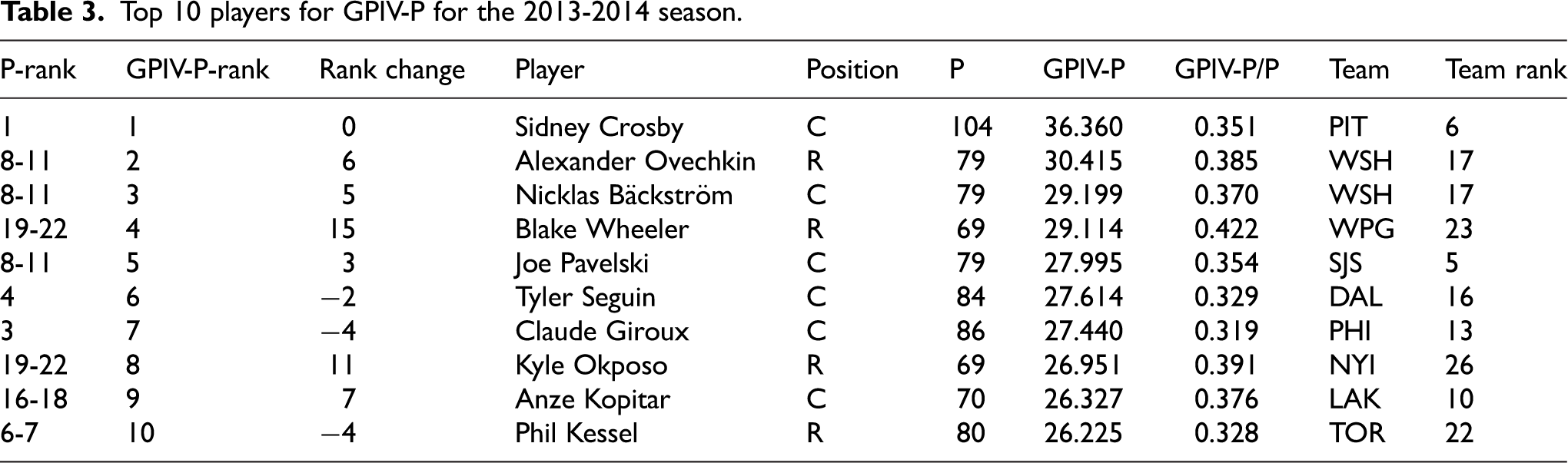
In this section, we check whether the metrics pass the eye test. We discuss the 2013-2014 season as a representative season with a focus on GPIV-P, GPIV-A, GPIV-P, the team they played (most) for and the final team rank after the season.
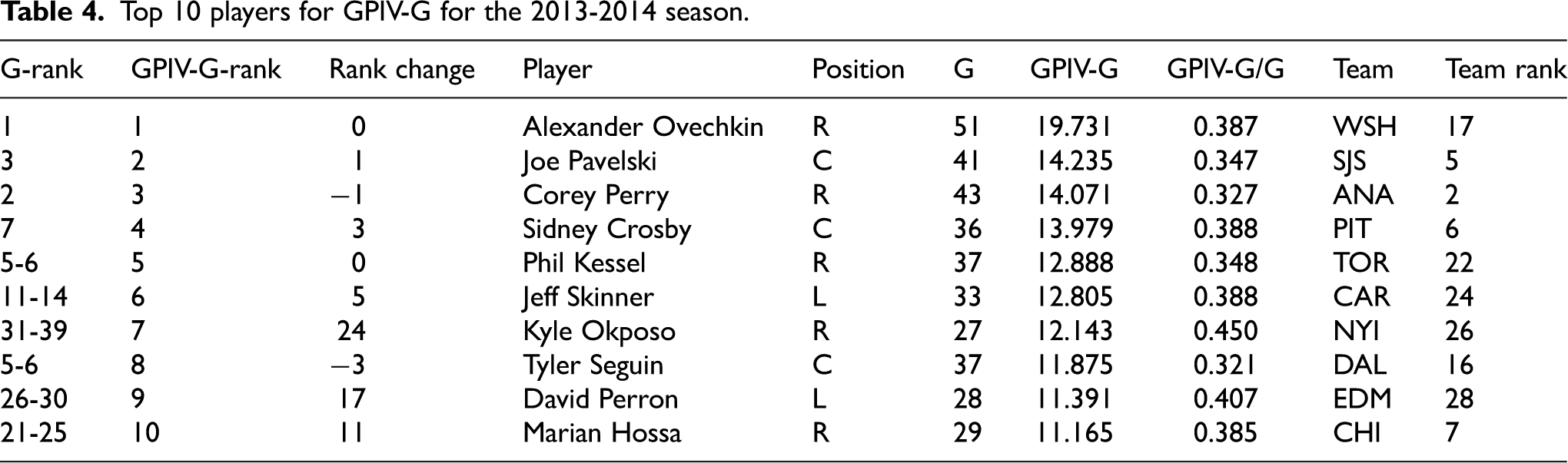
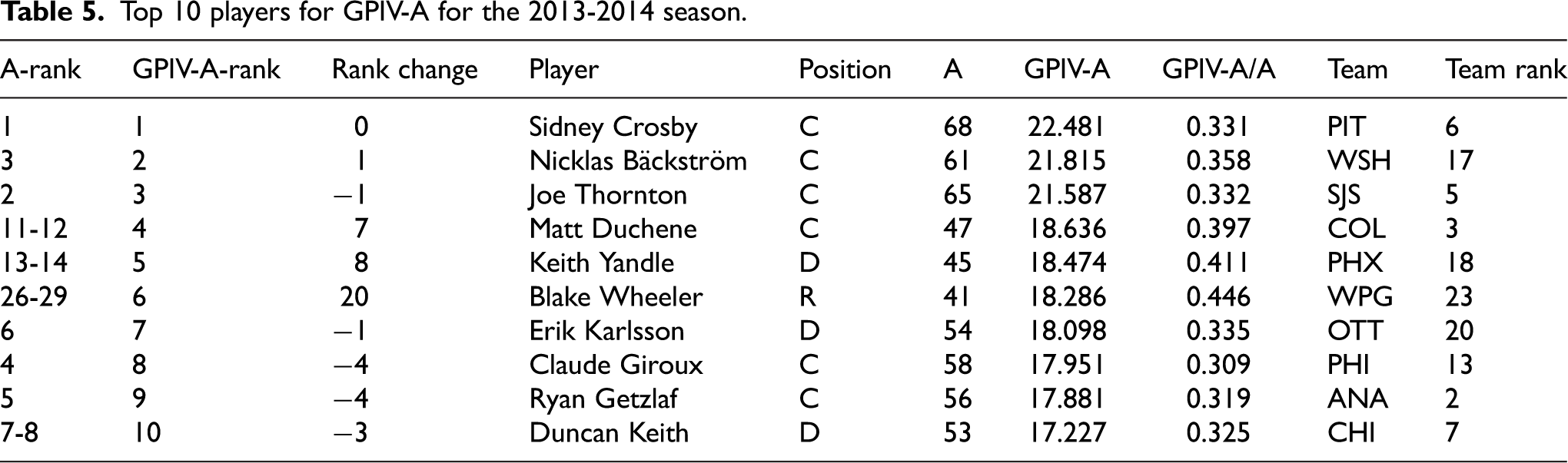
The tables in this section contain the following information: rank according to the traditional metric, rank according to the new metric, rank change (old rank minus new rank), player name, player position, old metric value, new metric value, and new metric value divided by the old metric value (representing the average importance of goals that the player is involved in for this metric). Further, there is information about which team the players played for as well as the team rank at the end of the season.
Tables 3, 4, and 5 show the top-ranked players for GPIV-P, GPIV-G, and GPIV-A during the 2013-2014 season, respectively. Regarding GPIV-P several players stand out. First, Alexander Ovechkin had a rank of 8-11 for P but had a rank of 2 for GPIV-P. This is a considerable difference in rank but can be explained by the many important goals he scored that season. For example, as mentioned already in the introduction, Alexander Ovechkin had the most game-tying and lead-taking goals while he only ranked 29
Top 10 players for GPIV-P for the 2013-2014 season.
Top 10 players for GPIV-G for the 2013-2014 season.
Top 10 players for GPIV-A for the 2013-2014 season.
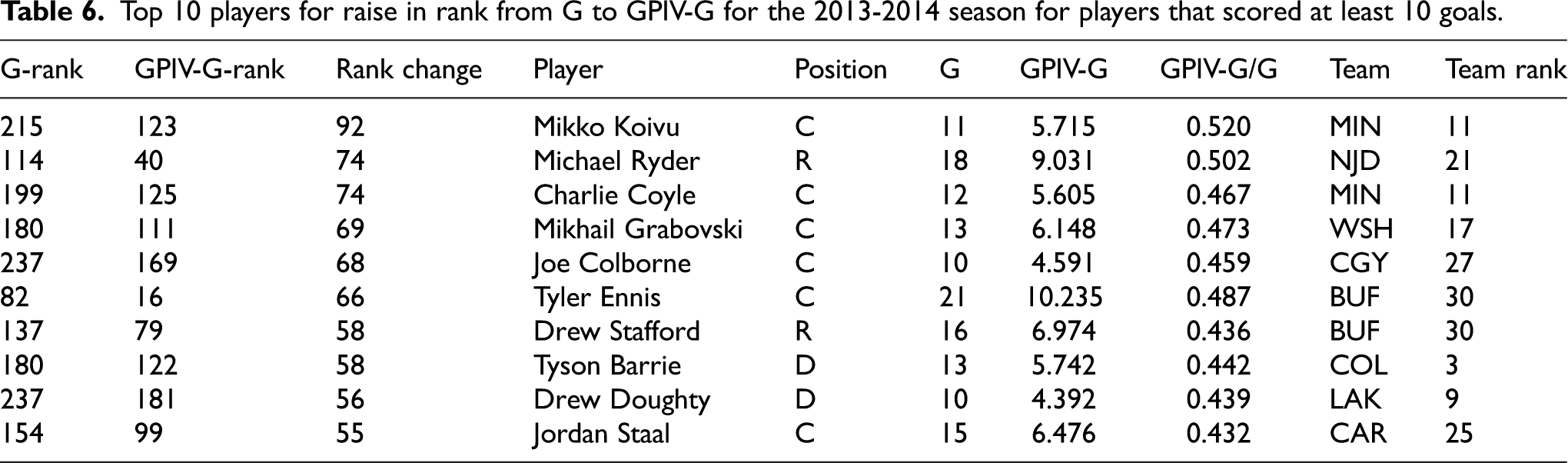
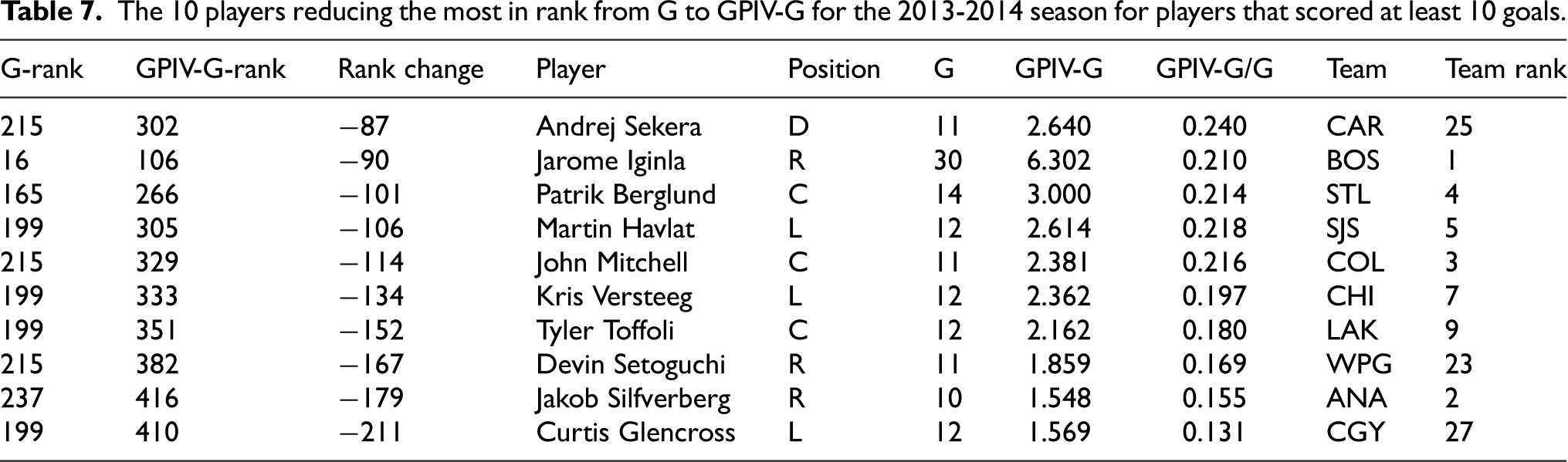
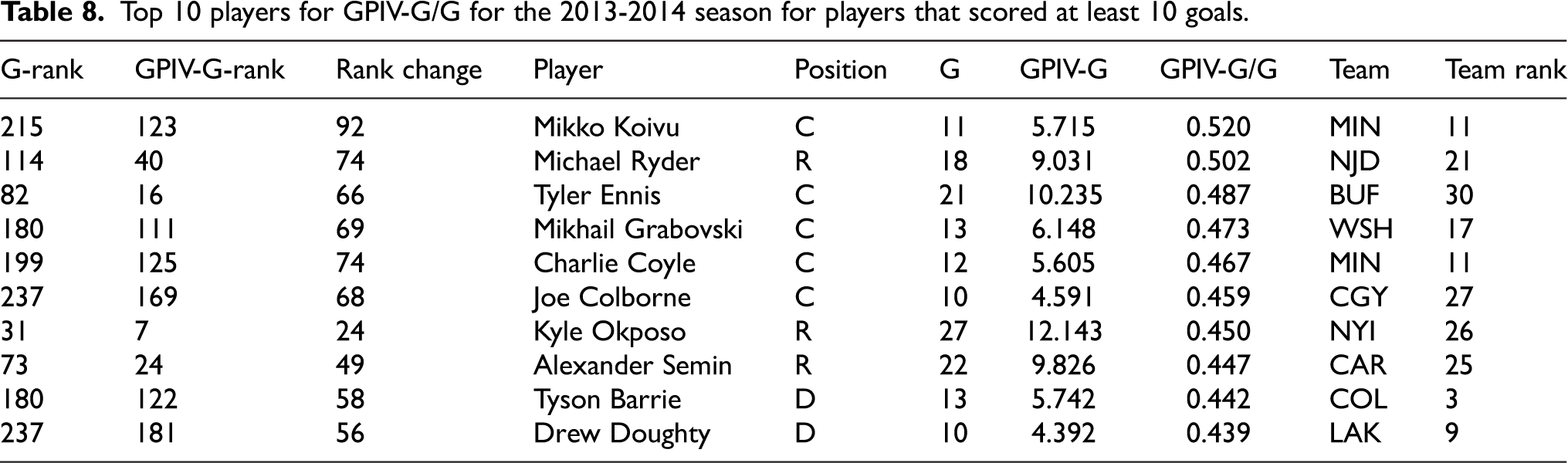
Tables 6 and 7 show the highest absolute changes in rank for goals (GPIV-G vs G) in positive and negative direction, respectively, where we filtered out the players that scored less than ten goals during the season. We note that, in general, in the lower ranges of goals scored, more players have the same rank for G and smaller differences in the number of goals can have a large effect in rank. Therefore, larger jumps in the rank changes can be expected. Further, players with high positive changes in rank have, as expected, a high average importance of the goals in which they are involved (which is reflected in the overlap of Tables 6 and 8), while large negative changes indicate a low average importance of the goals in which they are involved.
Top 10 players for raise in rank from G to GPIV-G for the 2013-2014 season for players that scored at least 10 goals.
The 10 players reducing the most in rank from G to GPIV-G for the 2013-2014 season for players that scored at least 10 goals.
Top 10 players for GPIV-G/G for the 2013-2014 season for players that scored at least 10 goals.
The traditional metrics focus on the number of goals a player is involved in, while the GPIV-based metrics additionally take the importance of the goals into account. Dividing the values of the new metrics with the value of the traditional metrics shows the average importance of the goals in which the players were involved. For points, we see that Blake Wheeler had the highest GPIV-P/P among the top ten GPIV-P players at 0.422 while Claude Giroux had the lowest with 0.319, which aligns with the facts that Wheeler gained ranks and Giroux lost ranks from the traditional to the new metrics. Similarly, Kyle Okposo had the highest GPIV-G/G while gaining 24 ranks from G to GPIV-G, while Blake Wheeler also gained the most ranks from A to GPIV-A with the highest GPIV-A/A among the top ten GPIV-A players.
Table 8 shows the highest average importance values for goal scored (GPIV-G/G) for the players that scored at least ten goals during the 2013-2014 season. The highest average importance for goals as a goal scorer is for Mikko Koivu (0.52) for the 11 goals that he scored during that season. This also explains his raise in rank from 215 to 123 from G to GPIV-G. Of the top ten players regarding GPIV-G, only Kyle Okposo makes it in the top ten for average importance of the goals he scored. The next top 10 player for GPIV-G, David Perron, is on place 24 for the average importance of the goals he scored.
Tables 3 to 7 do not show any obvious correlation between the ranking of players in the different GPIV-based metrics and the ranking of the teams they played for. They contain players for both highly-ranked and lower-ranked teams. Table 8 shows examples for the fact that players in non-top teams can have a high average importance of the goals they are involved. For instance, the top five players in Table 8 played for Minnesota Wild ranked 11 (Mikko Koivu and Charlie Coyle), New Jersey Devils ranked 21 (Michael Ryder), Buffalo Sabres ranked 30 (Tyler Ennis) and Washington Capitals ranked 17 (Mikhail Grabovski). We also do not find any obvious correlation between being involved in empty net goals and the raising or falling in the rankings. As examples, we take the players in Tables 6 (highest raise) and 7 (largest loss) in 2023-2014. The player with the highest rank raise (Mikko Koivu) scored no and conceded 3 empty net goals. The player with the largest rank loss (Andrej Sekera) scored no and conceded 2 empty net goals. Regarding the other players with high rank raise in Table 6, no player scored empty net goals and some conceded empty net goals (Tyson Barrie: 2, Drew Doughty: 4, Jordan Staal: 1). Regarding the other players with high rank loss in Table 7, Jarome Iginla scored 4, Kris Versteeg no, and the other players 1 empty net goal. Jarome Iginla and Patrik Berglund conceded 2, John Mitchell and Kris Versteeg conceded 1, and the other players conceded no empty net goals. 8
Table 9 shows the top-ranked players for GPIV-G (as in Table 4) and adds information regarding the metrics when the game is close (-1
Top 10 players for GPIV-G for the 2013-2014 season.
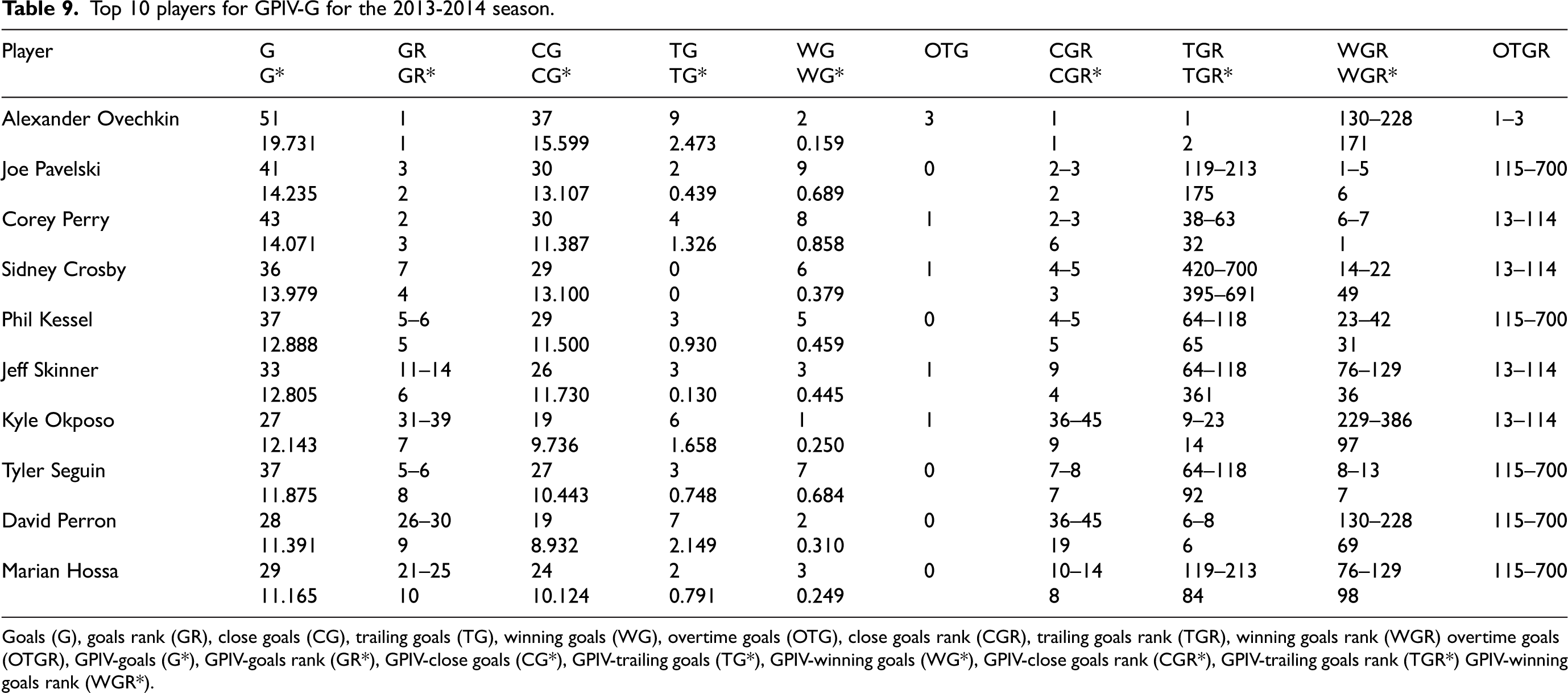
Goals (G), goals rank (GR), close goals (CG), trailing goals (TG), winning goals (WG), overtime goals (OTG), close goals rank (CGR), trailing goals rank (TGR), winning goals rank (WGR) overtime goals (OTGR), GPIV-goals (G*), GPIV-goals rank (GR*), GPIV-close goals (CG*), GPIV-trailing goals (TG*), GPIV-winning goals (WG*), GPIV-close goals rank (CGR*), GPIV-trailing goals rank (TGR*) GPIV-winning goals rank (WGR*).
Correlations of GPIV metrics with traditional metrics
In this section, we investigate the correlations between the GPIV-based metrics and their traditional counterparts. As noted before, GPIV-based metrics are a weighted variant of the traditional counterpart where the weight represents the average importance of the goals in which a player was involved and that contribute to the traditional metric. Therefore, we expect high correlations.
In Table 10 we show the Pearson correlation, the Spearman correlation, and the maximal information coefficient (MIC) between the traditional metrics and their respective new GPIV-based metrics.
Correlation between traditional and GPIV metrics during regular season.
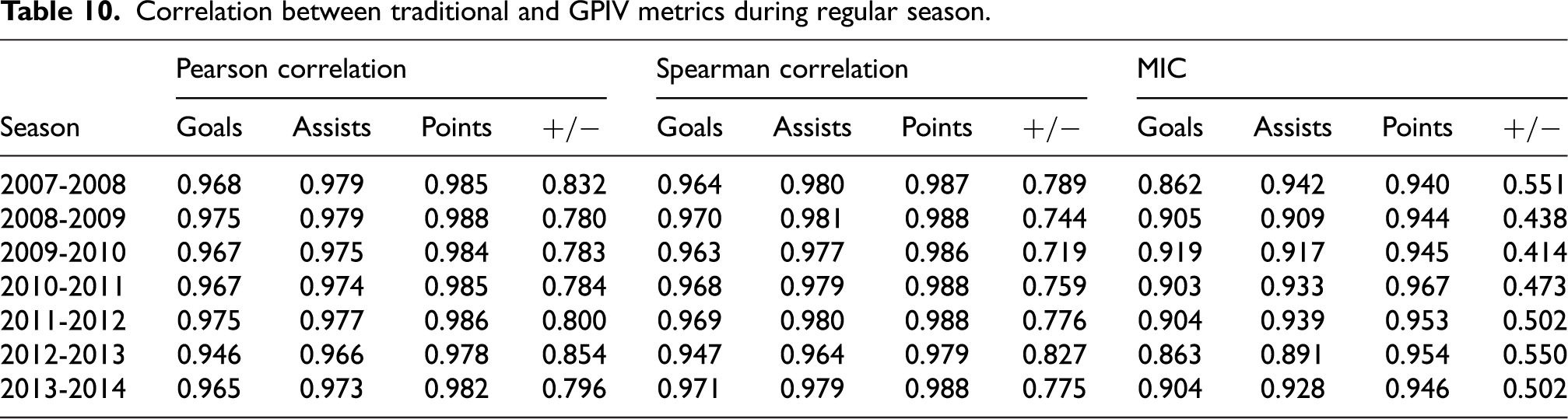
For the Spearman correlation, for goals the correlation is between 0.947 and 0.971, for assists between 0.964 and 0.981, and for points between 0.979 and 0.988. These are high correlations, indicating that the new metrics have similar behavior as well-accepted traditional metrics, but they do introduce new insights.
For
In appendix A we show rank comparisons for the top-30 players in the GPIV-based rankings, and we visualize the Spearman correlation as a representative as the observations are similar for the different correlation measures.
Prediction of GPIV metrics
As described in appendices B and C, for the seasons used in our experiments, it seems that using data from earlier seasons leads to a good approximation of the GPIV-based metrics for the current season. In this section, we investigate whether data from part of a season can be used to predict the value of the metric at the end of that season. We do this by dividing the data into partitions. For
Figure 6 shows for different seasons and different numbers of partitions, the Spearman correlation between final-season metrics and values obtained by using only the smaller partitions to predict the end-of-season value of the same metric for all players.
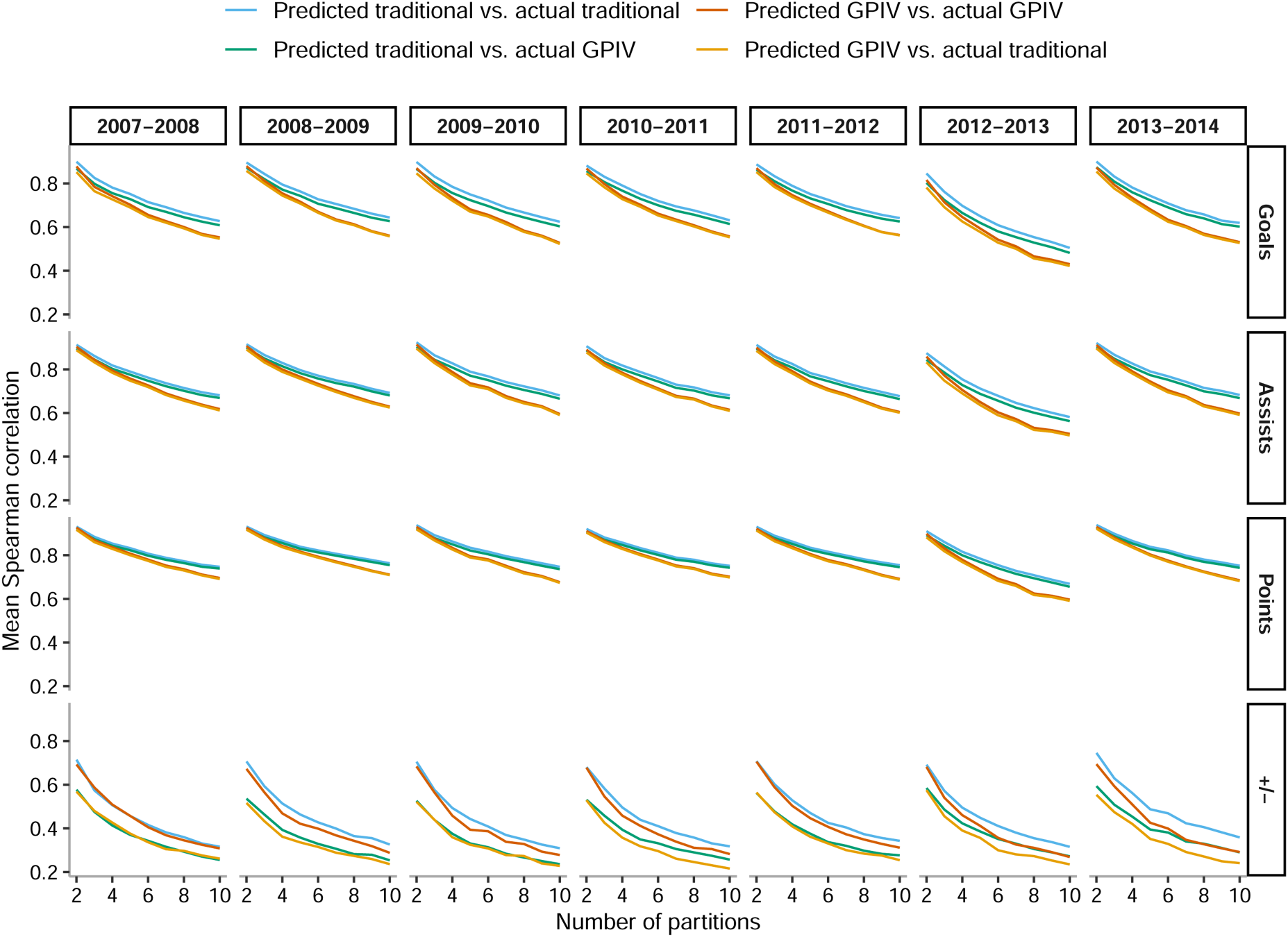
Correlations for partitions for different metrics.
We note that for all metrics, the more partitions, the lower the correlation. This is as expected. For instance, after half of the season (
Further, for traditional metrics (in blue) as well as the new metrics (in red) there is a high correlation between the final value and 2 times the value after half of the season. When we have less data, i.e., the number of partitions becomes higher, there is a slightly higher correlation for the traditional metrics than for the new metrics. This can be seen as the gap between the two lines increases with an increasing partition count. In general, the two lines for a given metric also follow a similar trend.
The other colors (green and orange) show predictability between traditional metrics and new metrics, which relates back to the correlation between the metrics. Here, the correlations for the predicted traditional metrics show a higher correlation than for the predicted GPIV-based metrics, with the exception of
Player pairs
As an input to building successful teams, it is not only interesting to evaluate the performance of individual players, but it is also important to investigate how well players play together. In this paper, we investigate pairs of players. We have chosen to use pairs as in 5-5 play for each team (i) there are two defenders on the ice and (ii) although there are usually three forwards, there is more data available for pairs as the forward lines do change regularly due to, e.g., team strategy or injuries. Using the GPIV-based metrics, we can identify player pairs that share the ice during important goals. We exemplify the method and show results for the 2013-2014 season.
First, we analyze the most prominent player pairs that are directly involved with goals, by either scoring or assisting the goal. The pairs are referred to as a direct pair (DP). In Table 11 we show the sum of the GPIV for all goals for which one player in the pair scored the goal and the other assisted (GPIV-G-DP) together with the number of such goals (G-DP). Further, we divide these goals into goals for which the first player in the pair was the goal scorer (GPIV-G-DP-1 and G-DP-1) and goals for which the second player in the pair was the goal scorer (GPIV-G-DP-2 and G-DP-2).
Top 10 direct pairs for the 2013-2014 season. Player position in parentheses (L for left wing, R for right wing, C for center).
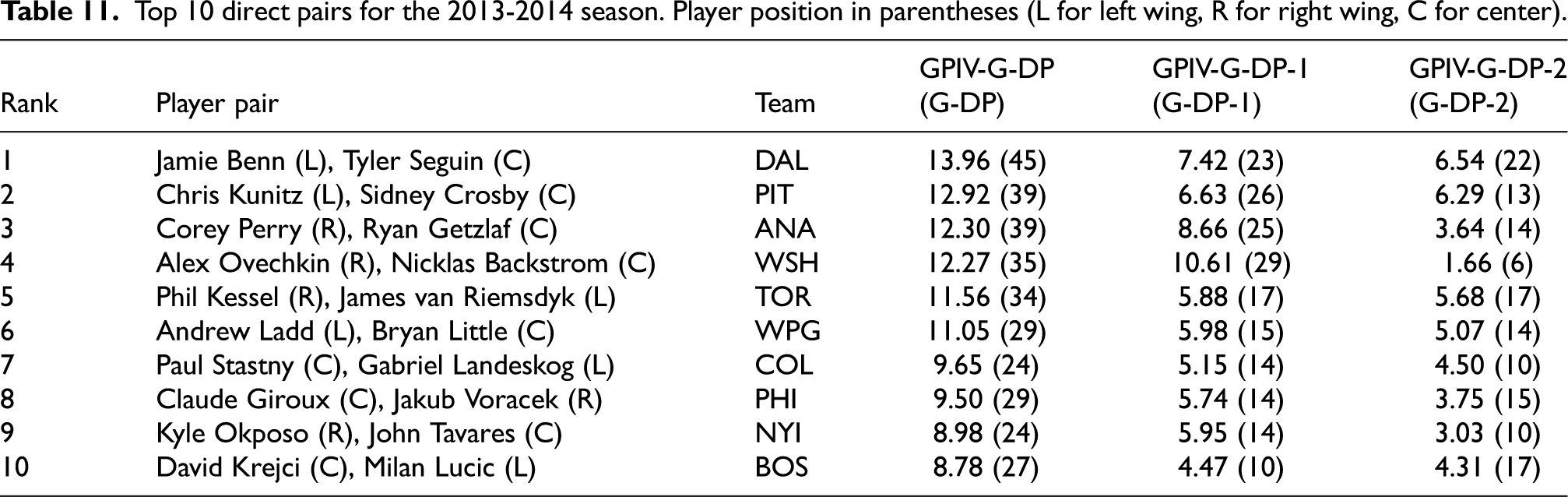
The DPs ranked top ten according to GPIV-G-DP are shown in Table 11. Among these ten pairs, the pair tends to consist of a center and a wing, with the exception of the wing pair Phil Kessel and James van Riemsdyk. Another noteworthy observation is that the most productive pair with respect to GPIV-G-DP-1 or GPIV-G-DP-2 is Alexander Ovechkin and Nicklas Bäckström with Ovechkin the goal scorer and Bäckström providing the assists (in the table GPIV-G-DP-1). For this pair the distribution of these roles is quite clear as the impact according to GPIV-G-DP-2 for this pair is low.
As the direct involvement with a goal does not reflect who was on the ice during the important goals, we also investigate the pairs of players that were on the ice when a goal was scored. These pairs are denoted as indirect pairs (IP) in Table 12. We look at the number of goals scored by the team (GF-IP), conceded by the team (GA-IP), and the goal difference for the team (GD-IP) when both players of the team are on the ice. We also introduce the GPIV variants of these metrics, i.e., GPIV-GF-IP, GPIV-GA-IP, and GPIV-GD-IP, respectively.
Top 10 indirect pairs for the 2013-2014 season. Player position in parentheses (L for left wing, R for right wing, C for center).
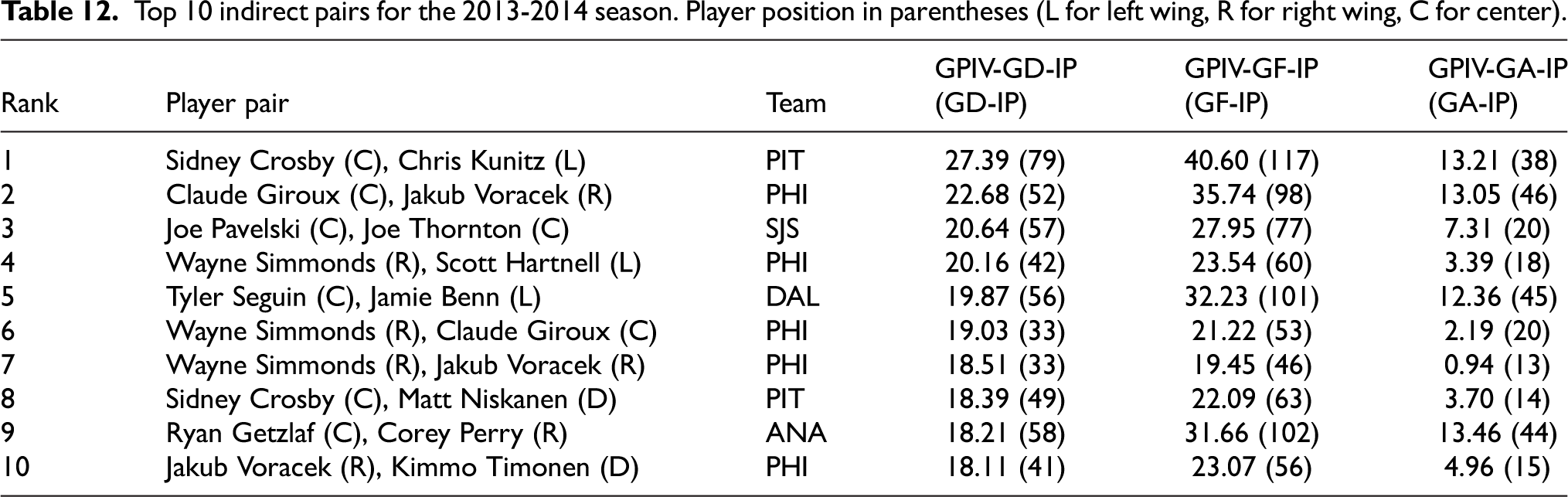
In Table 12 we show the top ten pairs according to GPIV-GD-IP. Among these ten, three pairs also rank within the top ten for direct involvement: Sidney Crosby and Chris Kunitz, Jamie Benn and Tyler Seguin, as well as Claude Giroux and Jakub Voracek, which indicates their importance for offensive production in crucial moments. When considering the teams the players represent, the Philadelphia Flyers stand out with five out of ten pairs (ranks 2, 4, 6, 7, and 10). 9 Another detail that can also be discerned is that some player pairs conceded few important goals when playing together, e.g., Sidney Crosby and Matt Niskanen, as well as Wayne Simmonds and Jakub Voracek. There may be different reasons for this, ranging from high defensive skills to players mainly being used in offense and often starting in the offensive zone. We note that similarly to the case of single players, the rankings for the GPIV-based metrics for player pairs may be different from the rankings for the traditional metrics. For instance, the pair with Wayne Simmonds and Jakub Voracek is ranked seventh with respect to GPIV-GD-IP but has a lower GD-IP than the pairs ranked 6 to 10.
Conclusion
In this paper, we have introduced new metrics that are variants of the well-known traditional metrics G, A, P, and
Footnotes
Acknowledgements
Thanks to Rabnawaz Jansher, Sofie Jörgensen, Min-Chun Shih and Jon Vik for implementations in the early stages that were used to decide on the current versions of the metrics.
Funding
The author(s) received no financial support for the research, authorship, and/or publication of this article.
Declaration of conflicting interests
The authors declared no potential conflicts of interest with respect to the research, authorship, and publication of this article.