




Abstract
This article investigates the research influence (as indicated by citations and the SCImago quartile classification of target journal of publication) as per Global Western standards of foreign and Chinese academics in mainland China. The focus on research influence echoes the policy shifts in Chinese research from quantity to quality. This study analyses Scopus publications by foreign academics working in 15 research-intensive Chinese universities, comparing them with publications by Chinese colleagues in the same meso-institutional level (departments, schools, institutes) with same sex and academic rank, but with a doctoral degree attained in China. Findings show that foreign academics’ publications attract more citations, and, once checking by covariates, they are also more likely to publish in first quartile Scimago journals. Chinese academics’ publications, in comparison, tend to be in journals with higher Scimago quartile ranks on average. The study also reveals that foreign academics have more international co-authorships than their Chinese counterparts, despite this latter point being not necessarily conducive of more influent research.
Keywords
Introduction
Academics with non-domestic passports are a specific type of staff in higher education institutions. Many medium and large countries have both inflows and outflows of foreign academic staff. Attracting foreign academics or “foreign talents” is considered pivotal to many countries, gaining increasing scholarly interests (Altbach et al., 2017; Huisman, 2022). The performance of the inflow of foreign academics is as important as the number of them. Previous research has explored this issue in various countries of destination, revealing an overall higher level of research performance by foreign-born academics (Huisman, 2022; Lepori et al., 2015; Mamiseishvili & Rosser, 2010; Shin et al., 2014).
China is of particular interest to this question. China’s research growth in recent decades, increased number of international academic staff, legal and cultural challenges for foreigners, and geopolitical instabilities make this context specific (Xu et al. 2022,). Furthermore, China’s international research influence (if defined by metrics derived by citations, accepting the respective limitations – see discussions in following sections) in many disciplines is not yet comparable to its research productivity (number of publications) (US National Science Board, 2022).
The interplay between research quantity, quality and influence have been key debate in China’s research policy. Since the early 2000s, Chinese government has been issuing policies to shift the focus from research quantity to research quality (Li et al., 2012; Xu, forthcoming), but also from international publications to domestic ones (e.g., General Office of the CCP Central Committee & General Office of the State Council, 2018). In 2020, the central government issued a series of policies to firmly abolish the ‘supremacy of SCI [Science Citation Index]’ (SCI zhi shang, SCI至上), highlighting domestic research and impact on Chinese society, and requiring universities not to use metrics related to SCI, SSCI (Social Sciences Citation Index) or CSSCI (Chinese Social Sciences Citation Index) as bases for research evaluation (Ministry of Education, 2020; Ministry of Education & Ministry of Science and Technology, 2020).
Qian et al. (2020) critically examined the pros and cons of recent policy shifts. In particular, they pointed out that one of the threats China is facing derives from the consequence of its own success, with an increasing domestic capacity to pursue research that might lead to, for instance, deleterious domestic rent-seeking networking (Qian et al., 2020). However, although Chinese research has successfully “opened up” to the world in many aspects, how far its international influence will enhance remains unanswered.
Academics based in Mainland China (hereafter China) with inclinations towards internationalisation might be key to maximising China’s international research influence. They include both China-born and foreign academics. Furthermore, expectations about foreign academics in Chinese universities is likely that of enhancing institutional international reputation and yielding high research productivity (Huang, 2022). However, to what extent are foreign academics achieving these expectations remain less explored, especially if questioning the respective influence.
This paper, drawing on a study of foreign academics in China (Marini & Xu, 2021), addresses the following research question: how do foreign academics in China perform in terms of research influence (citations and the SCImago quartile classification of journals they publish in – as per metrics released by Scopus), as compared to their Chinese counterparts? The study focuses on the Global Western definitions, which is the aspect foreigners are more likely to contribute to.
Literature Review
Foreign Academics’ Research Careers and Research Influence
This study uses “foreign academics” as a synonym of “international academics” and in a narrow sense (“Type I” as per Xu et al. 2022). In the Chinese context, it refers to academics of non-Chinese nationality and non-Chinese ethnicity, working with long-term and full-time academic positions with more than one responsibility in research, teaching and administration. This type of foreign academics excludes postdoctoral researchers, visiting scholars or academics with short-term or honorary posts.
The inflow of foreign academics needs to be assessed in numbers and general career conditions first. The world leading country in science, the US, has an increasing number of tenure-track academic staff from abroad, and largely diversified across disciplines (Kim et al., 2012). Kim and colleagues’ (2012) study also revealed strong intentions of foreign academics to leave the country. In comparison, to what extent do foreign academics tend to stay or leave China is still a nascent topic, arguably because China has a shorter history of hosting a substantial number of foreign academics than, for instance, the US or the UK.
Once a country secures foreign talents to come and to stay, which has been seen as an advantage by some countries from a zero-sum perspective, their productivity is a next step of analysis. Research found that foreign academics’ productivity is reckoned higher by self-reported staff sources in the US (Kim et al., 2012). Nevertheless, self-reported information could be biased. In the case of Mexico, authors identified the difficulty in assessing any difference in terms of research productivity (Aupetit, 2016).
It is important to distinguish between research productivity (such as measured by number of outputs per unit of time, and also by possible units of co-authors and/or funding at disposal) and research influence (such as measured by citation indicators and publication channels). Albarrán et al. (2017) provided a thorough analysis among economists worldwide, finding a possible cohort bias at parity of age, experience and rank that may overcome, or at least mitigate, foreign academics’ performance. Once this effect is taken into account, productivity between foreigners and locals is consistently different among all academics. However, when the investigation is focused on elites in the US (both as individuals and institutions), the effect is that “the higher the quality threshold considered, the closer the average productivity of foreign academics and stayers is expected to be” (Albarrán et al., 2017). This fine-grained evidence suggests that being foreigners may yield advantages for the hosting institution only under certain conditions, at least for the case of US universities (Albarrán et al., 2017). Research also found that in Italy, a more similar country to China in terms of percentage of foreigner academics, foreign academics demonstrated better research performance (Abramo et al., 2019).
Although 10 or 20 years ago there was still a gap between China and Global West countries in terms of research influence (Zhu et al., 2014), China’s global research influence is in a different position now. Chinese universities were aware of the necessity to recruit foreign academics, aiming at improving their international research influence (Cheng et al., 2021; Postiglione & Ailei, 2016). Nonetheless, these studies could not yet appreciate respective performances.
International Collaboration and Research Influence
Research influence, usually measured from international repositories, is generally associated with multiple international affiliations (e.g., articles published by more academics based in different countries) and the number co-authors irrespective to affiliations (Abramo et al., 2011; Kwiek, 2020). For the case of Chinese social sciences and the humanities (Cheng et al., 2021), the more international co-authors the paper has, the higher its impact (typically a synonymous of influence) is. There have been similar findings from recent research (Fan et al., 2022). Nevertheless, there are some caveats to be explained.
Overall, research has found that international co-authorships are associated with higher productivity at parity of other conditions, with more citations, and more prestigious journals as per international rankings (e.g., Scimago, which is computed from Scopus data). However, the following factors should also be taken into consideration for international collaborations: organisational costs; selection costs for discerning the best options rather than any option provided it is “international”; and hidden cultural costs. These costs need to be met and assessed to achieve a net gain in international research co-authorships (Zhu et al., 2021).
Researchers born in different countries, or those having education or research experience abroad – the returnees – are likely to be in a favourable position in international collaborations due to higher likelihood of global connectivity and thinking from a different perspective (Erlenbusch, 2018).
Foreign academics also face challenges of cultural adaption, exemplified by findings about South Korea, Japan and the US (Berzins, 2017; Huang et al., 2019; Shin, 2021). Nonetheless, non-US-born academics are found to be consistently more active in funding activities and in indicators measuring academic social capital, which is in turn associated with productivity (Berzins, 2017). This study highlights a gap between foreigners and locals in terms of support that the former group manages to compensate. Foreigners’ experience of hiring is as well specific. Different criteria, practices, and arrangements may play a decisive role according to country patterns (Laufer, 2020). From the former point of view, Mainland China appears to opt for special tracks for foreigners, assuring for them a secure, stable, and protected track, which includes some endowments (Marini & Xu, 2021). Yet, despite ambitious initiatives like the Belt and Road Initiative, the still tiny percentage of foreigners suffers adaptability problems (Rezaei & Mouritzen, 2021).
Gender has a specific perspective in this niche of research. Despite having a large corpus of literature about gender (meaning usually biological sex) and careers in science, the intersectionality with being from abroad is less investigated. Some studies highlighted the extent to which women are in a more estranged situation (Skachkova, 2007; Strauβ & Boncori, 2020), as being a foreigner showed similar effects to that of belonging to other minorities, which is added on top of the other. Women are also found to attract fewer citations when in the position of first author at parity of other conditions, a discrepancy that can be interpreted by unjustified biases (Paphawasit & Wudhikarn, 2022). Issues on gender in international academic mobility, and its associations with research influence, are worth investigating, since women foreign academics are becoming a larger cohort rather than a tiny tokenistic presence (Altbach et al., 2017, referring to “isolated ghettos”). This also establishes a possible new marker of difference (Marini, 2022). Notwithstanding, in the case of China a large proportion of foreign academics are men (Marini & Xu, 2021).
To contextualize China’s international research collaboration and its role in global research, one important dimension to note is its relationship with the US. Although China has surpassed the US in terms of the total number of science publications, its research influence as measured by citations has not surpassed the US yet (US National Science Board, 2022). Intriguingly but not surprisingly, the US and China are the top collaborators in science for each other. According to Nature Index, the US shares 45% of China’s co-authored scientific publications, and China shares 30% of international co-authorships from the US (Nature, 2022). Lee and Haupt (2020; 2021) showed that amid the increasing “new Cold War”, scientific nationality is not lessening international co-authorships between US and China. China is also the only country substantially expanding international collaborations, outscoring any other possible competitors in this category (Shashnov & Kotsemir, 2018). China in fact enacted policies to seek, according to ex-post evaluations based on bibliometrics, co-authorships with the US (Lee & Haupt, 2020). The net advantage in sustaining these collaborations is manifest. This also means that although China is challenging Global West metrics and standards, it is still playing successfully this game. To what extent do foreign academics working in China contribute to thrive international collaborations is unknown and part of our study.
Data and Methodology
Dataset
The total number of foreign academics working in mainland China universities is unknown, mostly due to different possible definitions and a lack of centralised databases. Some attempts to survey the population of foreign academics in China have led to different figures (Xu et al. 2022).
In this study, we collected information of foreign academics from 15 research-intensive universities in 12 Chinese cities. All these universities are enrolled in the Double-First Class University Programme – an influential national programme in Chinese higher education for enhancing the quality of top-tier universities in China.
At each university we collected the information of foreign academics from the staff directories of all departments or schools, and from all disciplines. In total, we identified 323 foreign academics. Most of these academics are men (77%), professors and associate professors (36% and 31%), with a PhD from OECD countries (73%), and working in STEM and social sciences areas (47% and 30%). We collected their publication records across all years in Scopus.
To make comparisons between these foreign academics and their Chinese counterparts, we collected from the same meso-level institution (e.g., Department, School, College, Institute) up to three names of Chinese colleagues who are of the same sex and academic rank, and attained a PhD in China. Since we collected from the same staff directory at the meso-level institutions, they belong to the same disciplines to an acceptable extent. This level of comparability is consistent with literature demonstrating the necessity to go beyond the macro-level institutions to reduce biases (Albarrán et al., 2017). Nonetheless, since many foreign academics benefit from a reduced teaching load and since there are very few teaching-only foreign academics, our strategy also has comparability risks known in literature about research/teaching loads (Yuan, 2021). Furthermore, foreign academics and Chinese academics with the same sex, academic rank and institutional affiliation could have differences. Despite that, this matching strategy guarantees maximum comparability about research performances between foreign and Chinese academics.
The outputs of Chinese academics are individuated within the collective repositories single foreign academics were in. For instance, if an international academic is affiliated with the School of Economics at University X, we first extracted all publications authored by anyone with the same affiliation, and then extracted respective publications by the aforementioned up to three Chinese colleagues identified in the earlier step. As a result, we have up to three Chinese academics against one international academic. Since it was not always possible to identify three Chinese academics fulfilling our requirements for comparison, in some cases we only collected the information of two Chinese academics. In other cases, we found more than one foreigner at the same meso level. In these cases, we ended to have two foreigners and three locals. At the end of this process, we identified 39 valid matches with 6507 publications in total.
In some cases, Scopus did not allow to download all publications from a meso affiliation (threshold is maximum 2000 publications). In these cases, which is more probable for large units in STEM disciplines, we used the most recent publications. In these few cases, international and Chinese academics’ productivity are comparable in single years, such as last two years only. This problem only marginally affects indicators of influence.
Variables
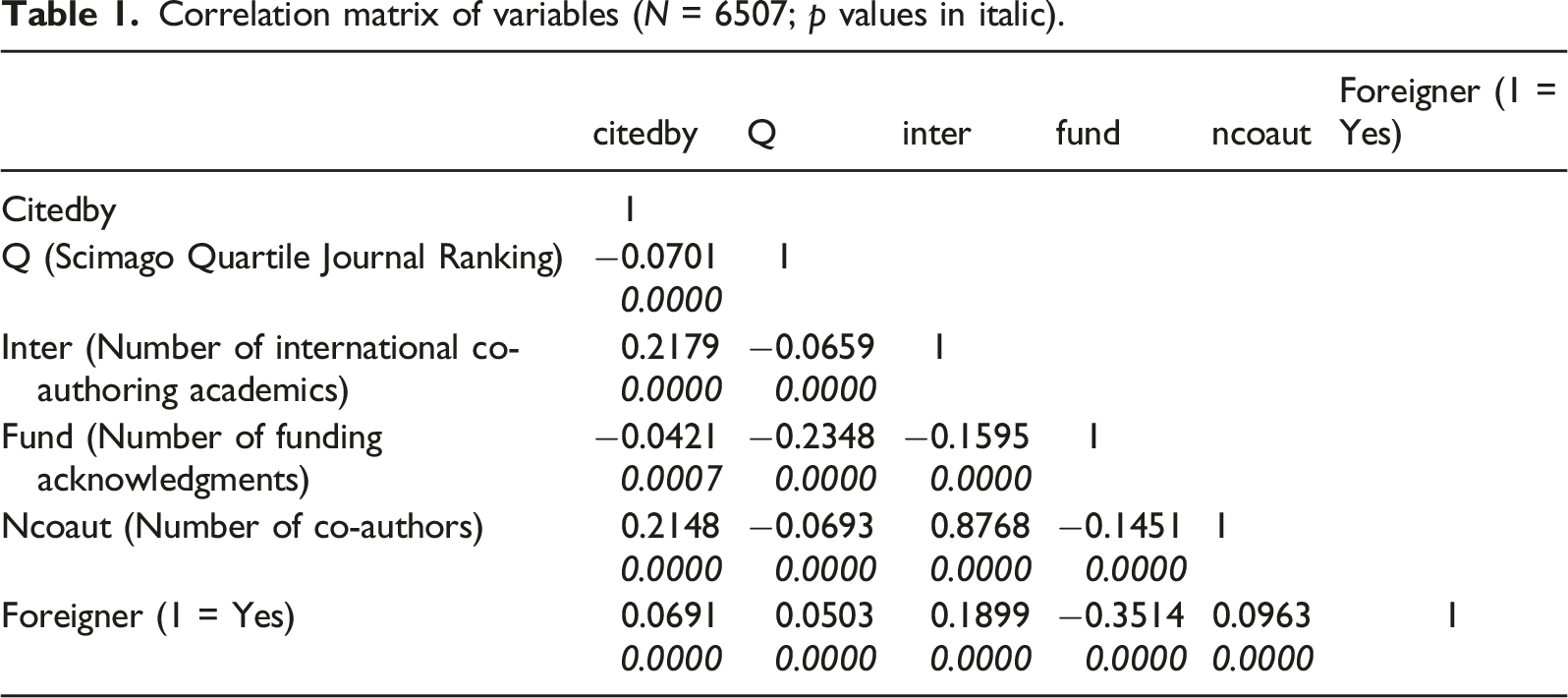
Correlation matrix of variables (N = 6507; p values in italic).
Gross Number of Citations
This count is dependent on time. Typically it needs year of publication to reduce this time effect. A relevant transformation is to distinguish papers with at least one citation from papers without citations. This latter option is still dependant on time, though to a much lesser extent and solely for the most recent years. The use of citation indicators as a proxy for research influence has been critically investigated in many fields (Aksnes et al., 2019). There has been a growing concern over the use of citation indicators to judge research quality in research evaluations, along with proposals to move away from the sole reliance on such metrics, as evidenced by initiatives like the San Francisco Declaration on Research Assessment (DORA) and the Leiden manifesto (Hicks et al., 2015). A comprehensive review of the literature found that “citations reflect – with important limitations – aspects related to scientific impact and relevance, but there is no evidence that citations reflect other key dimensions of research quality” (Aksnes et al., 2019, p. 12). Our study acknowledges these limitations, applying citation counts as indicators of research influence with caveats. In particular, research influence measured in this study is based on citation counts of publications indexed by Scopus, an international, yet Euro-American dominated, database in terms of its coverage (Marginson and Xu 2023). For instance, a large proportion of journals published by Chinese publishers or in Chinese language are not indexed by Scopus. The limited coverage of Chinese language publications in Scopus means it does not represent the full picture of research influence. Thus, the research influence investigated in this study refers only to “international” research influence that can be biased based on language, discipline, culture, etc. Research influence of domestic Chinese research would deserve a different research design.
Scimago quartile classification
The second variable for grasping research influence is Scimago quartile classification, which can be accessed through the list of journals. The quartile classification is considered and widely used as proxy of influence of journals. Similar caveats may apply for this variable. Nonetheless, Scimago quartile classification is more consistent than Scimago Ranking Index, which is biased by discipline, typically downgrading social sciences and humanities. Among the publications collected, 18.7% of them did not fall in any quartile. This was because some of them were not journal publications (e.g., book chapters), or published in journals not classified (yet) by Scimago quartile classification. Considering the prestige associated with journals in the first quartile ranks, we also used a dummy variable splitting first quartile from any other publication.
Number of (international) co-authors
From the list of authors, we counted the number of co-authors, which is highly skewed. For this reason, we use a dummy variable also for this value. The gross count is relevant although it may have double-sword effects (Dubois et al., 2014). List of authors also provides information about respective affiliations, which shows whether co-authors are based in overseas institutions or not. In this respect, we computed whether publications are co-authored with anyone from abroad, and, if yes, from how many different countries. This latter aspect measures the heterogeneity of international collaborations. International co-authorships are disentangled from any co-authorship as per discussion in the previous section. Similar to other studies focusing on the same topic (Berzins, 2017), we selected the gross number of co-authors to avoid issues about homonymous identities in Scopus.
A look at observational data from this original dataset is helpful. Publications co-authored by a larger number of researchers have more citations (correlation is 0.2148, see Table 1). At the same time, also at parity of number of co-authors (the two measures are the only ones that are highly correlated to each other – see Table 1), having international co-authors may help attracting citations. There is also another angle to look at this dynamic, that of social capital. Academics with more co-authors have arguably a higher degree of academic social capital for being in touch with more colleagues. This last point is conducive of more research influence dependant on other covariates such as the prestige of institutions and single authors. Therefore, it is not clear-cut to define internationally co-authored research as necessarily beneficial to all partners. Presumably, heterogenous research by nationality of affiliation could be a plus, though a tempered plus, for those fields Chinese universities are already leaders or quasi-leaders in. Within the dataset, there was no notable differences between STEM (Science, Technology, Engineering and Math) and non-STEM disciplines in terms of the publication patterns.
Funding Information
This is usually a scraping from funding acknowledgements included at the end of publications. For the purpose of this study, we counted the number of funding sources each article listed. This information is increasingly reliable, as for many countries it has become mandatory to list funding agencies and specific projects. The rationale for using this variable is nested in an efficiency argument: those acknowledging funding received more opportunities to do research, whereas those listing fewer funding or no funding at all have worked with fewer opportunities and, in principle, are more worthy of consideration at parity of similar outputs.
Analyses and Findings
International and Chinese Academics’ Research Outputs
Descriptive Statistics (N = 6507).
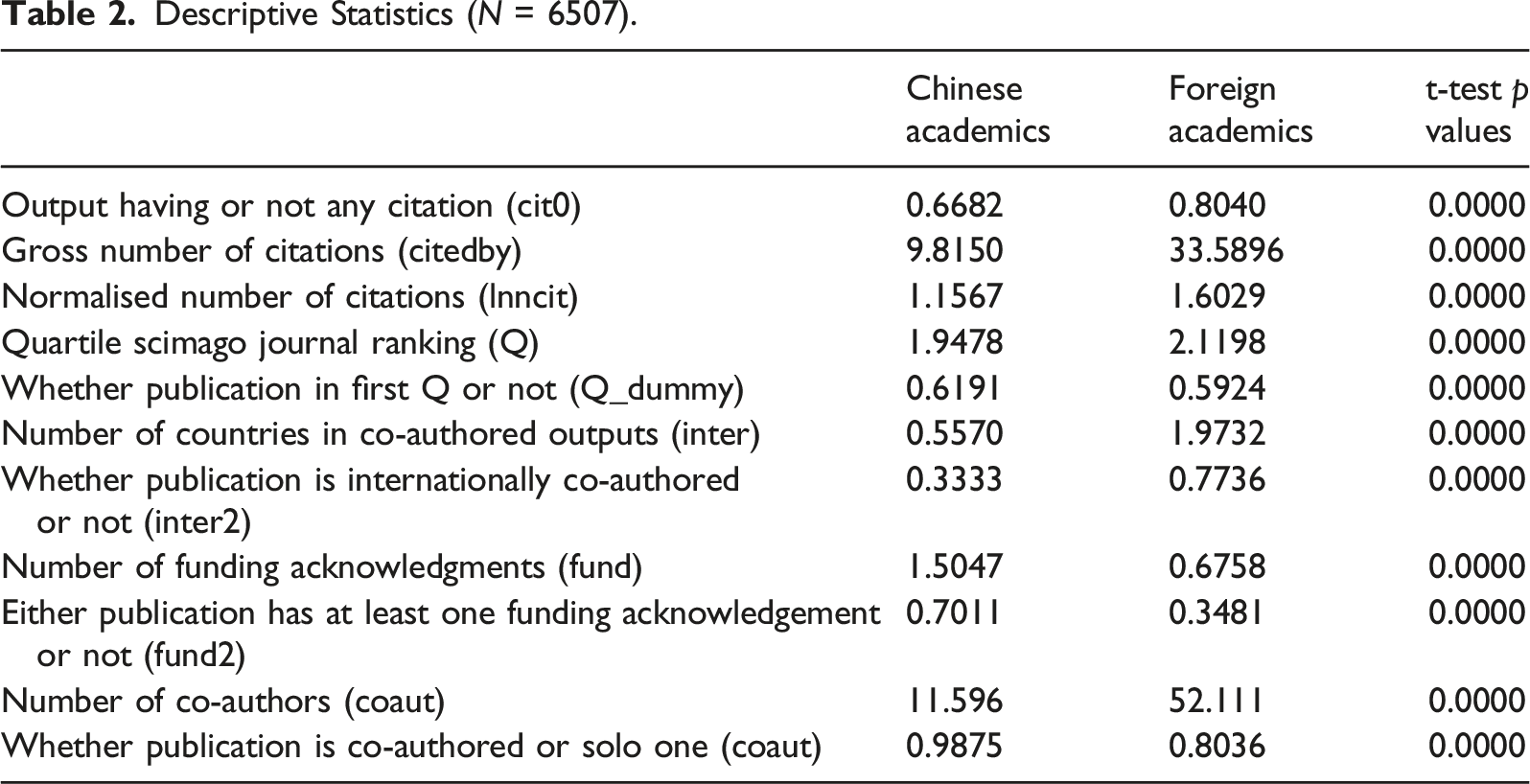
In terms of citations, foreign academics have more than 80% of their publications cited at least once. Chinese academics have a much lower percentage of cited publications, which is 67%. The gross number of citations is consistently different: 33.5 citations per scientific output on average for foreign academics, and less than 10 for Chinese nationals.
Citations are time sensitive, and the gross count of citations can be influenced by year of publication. This factor is mitigated with a logarithm of normalised citations (lnncit variable). First, we normalised citations by dividing the citation with the natural logarithm of years elapsed from the present, and secondly, we computed its own natural logarithm, which is consistent with works about non-seminal works (Cano & Lind, 1991). This latter transformation prevents missing values for articles with no citations by adding one to all citations as per common practice. This operation brings to the designed goal to approximate a normal distribution if articles with no citations are excluded. For this variable, foreign academics (1.6 citations on average) perform better than their Chinese counterparts (1.2 citations on average).
Scimago Quartile (1: first quartile; 4: fourth quartile; 5: not in ranking) shows an opposite figure: the average quartile of journals Chinese academics publish in is better (1.9) than the ones foreign academics publish in (2.1). Chinese academics also publish more often in first quartile journals (62% of the times) than foreign academics do (59% of the times).
Regarding internationally co-authored publications, foreign academics publish, on average, with researchers affiliated with two different countries. The figure is 0.55 for Chinese academics. The respective dummy variable shows that 77% of publications by foreign academics are co-authored internationally, whereas 33% of publications by Chinese academics are co-authored internationally.
The total number of funding acknowledgement is on average 1.5 for Chinese academics, and 0.67 for foreign academics. Funding acknowledgement is reported 70% of the times in Chinese academics’ publications, and only 35% of the times for foreign academics.
Last, the gross average number of co-authors is 52 for foreign academics per publication and 11.5 for Chinese academics. Interestingly, the respective dummy variable shows that foreign academics publish only 80% of the times with any co-authors (hence 20% being solo publications), whereas Chinese academics almost never publish by themselves (98.7% of publications are co-authored).
In general, these prima facie averages about research influence are mixed for the highly comparable groups of international and Chinese academics. Chinese academics tend to publish in journals with higher ranks than foreign academics, but their publications received fewer citations. In terms of research networks, foreign academics tend to have more co-authors, especially international ones. The larger size of international co-authors by foreign academics is consistent with the literature, especially when locals received their PhD in home country (Berzins, 2017). In terms of research funding, Chinese academics also reported more funded research than foreign academics.
Predicting research influence
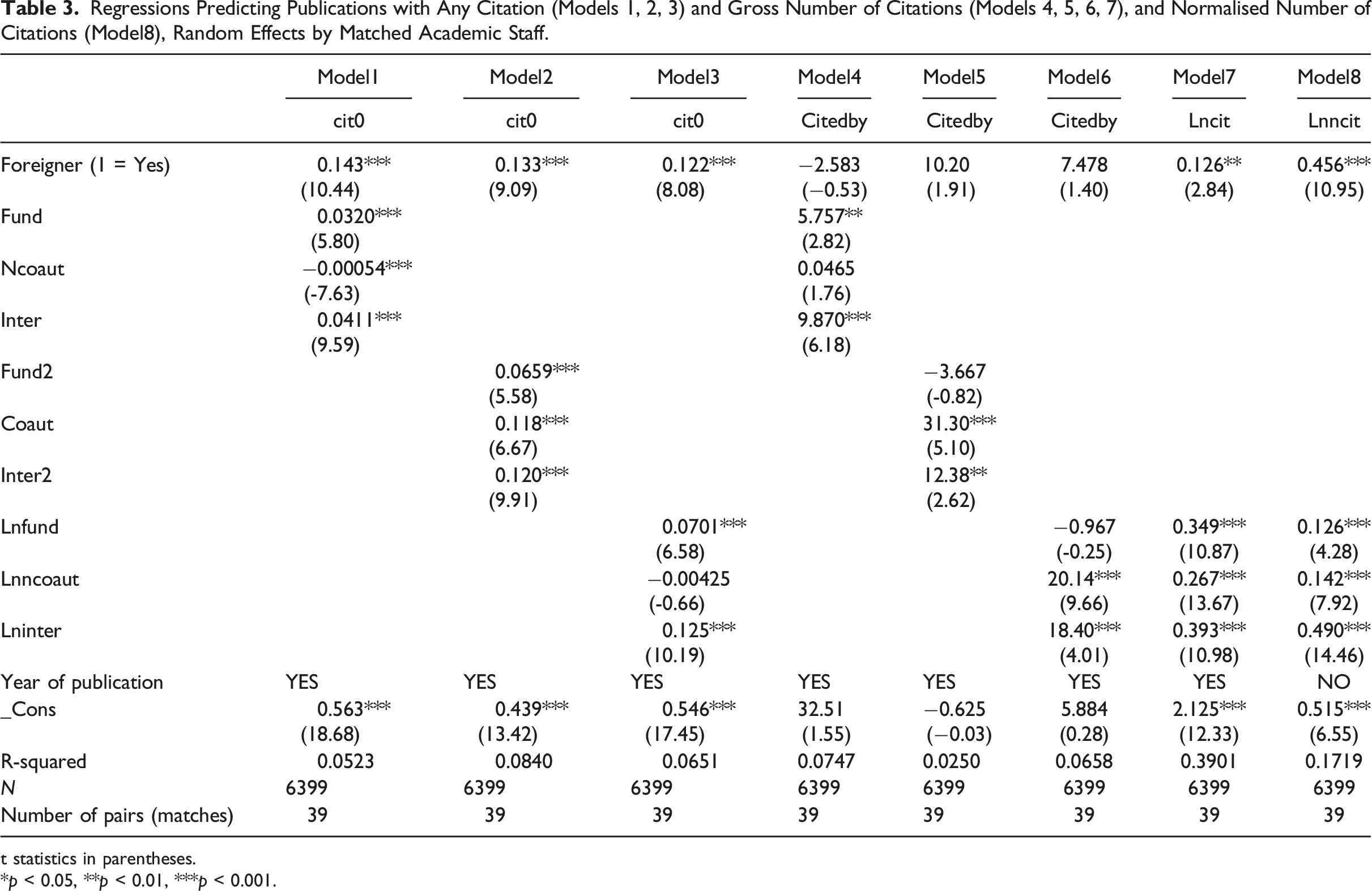
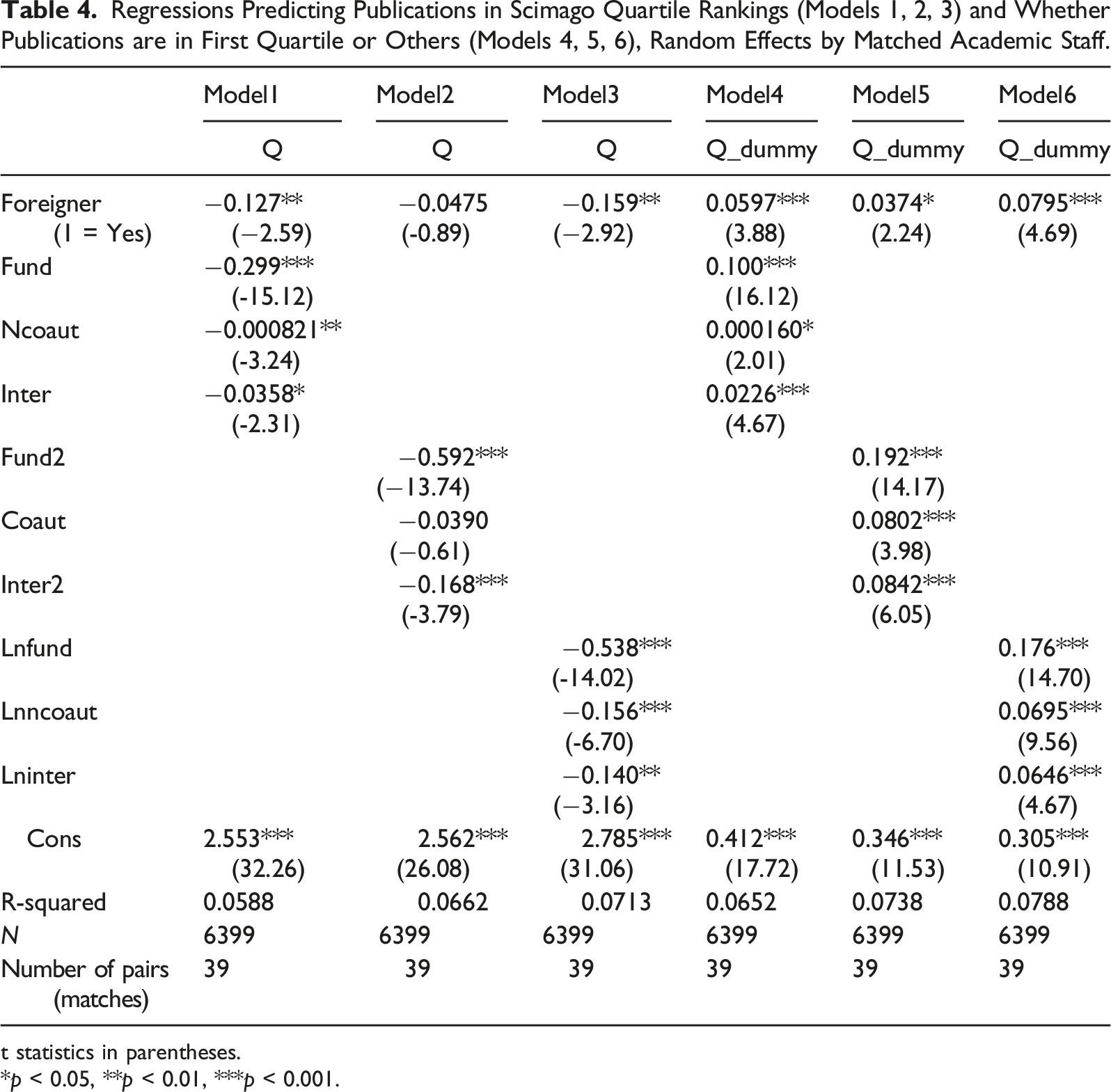
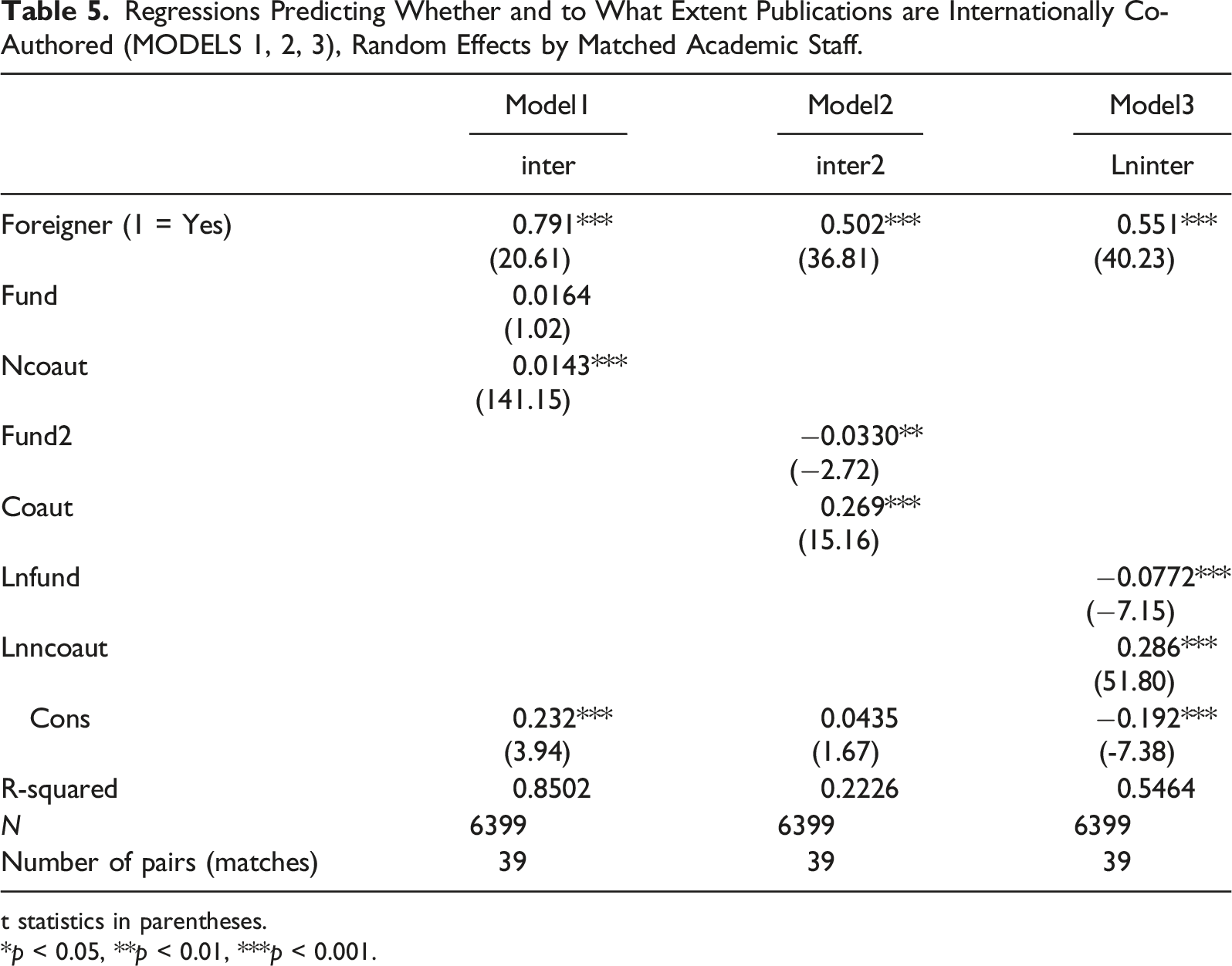
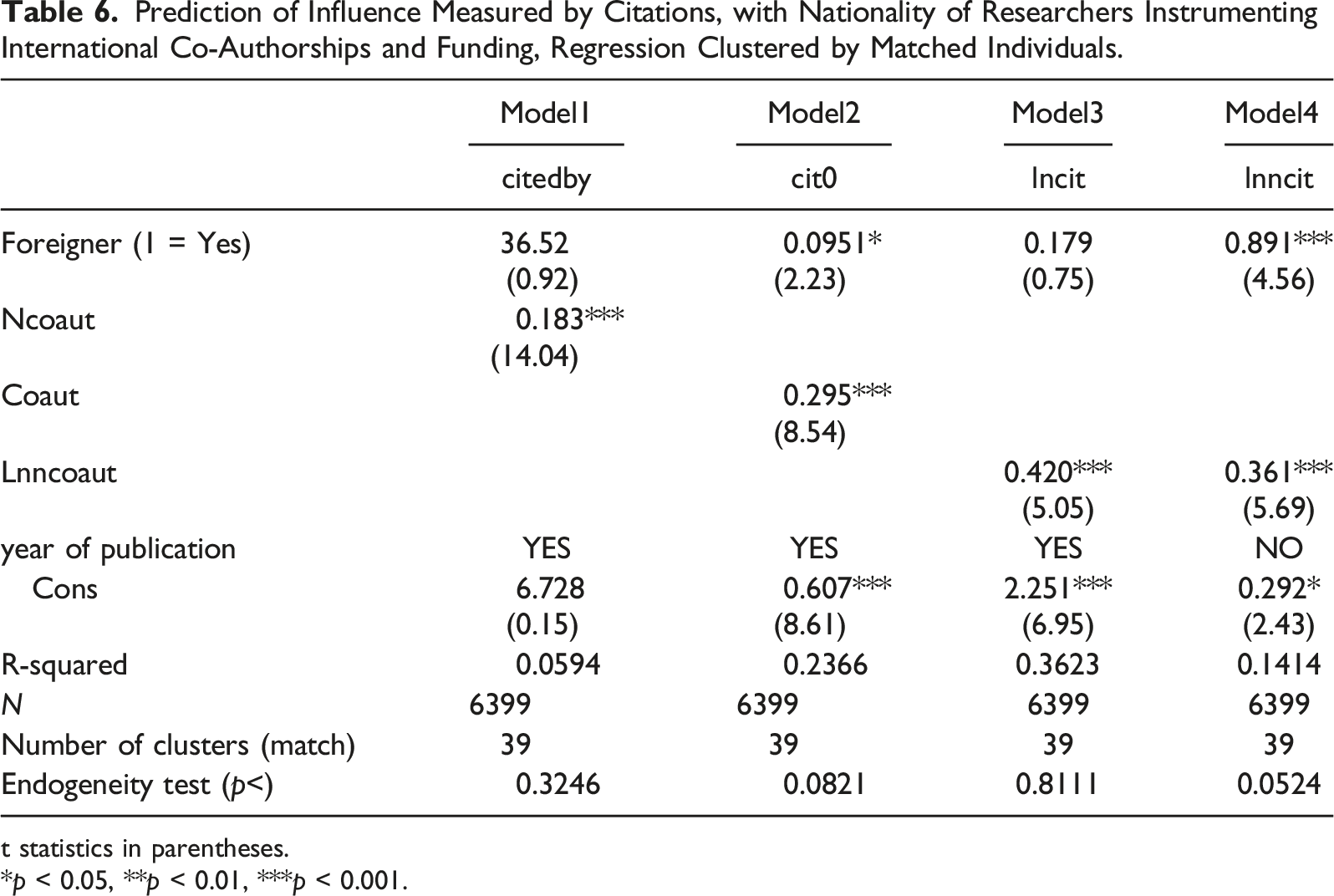
We formulate hypotheses about the extent to which academics by nationality can contribute to research influence. Operative hypotheses are as following: (1). Foreign academics’ publications attract more citations, accounting for funding they receive and the number of co-authors, and the extent to which such co-authorships are international (Table 3). (2). Foreign academics publish in journals that are highly ranked by the Scimago, accounting for the same factors as per Hp1 (Table 4). (3). Foreign academics publish more internationally co-authored outputs, accounting for funding and the gross number of co-authors (Table 5). (4). Research influence measured by citations is explained by higher capacity by foreigner academics to publish internationally co-authored publications, and accounting for funding (instrumental variable regression) (Table 6). Regressions Predicting Publications with Any Citation (Models 1, 2, 3) and Gross Number of Citations (Models 4, 5, 6, 7), and Normalised Number of Citations (Model8), Random Effects by Matched Academic Staff. t statistics in parentheses. *p < 0.05, **p < 0.01, ***p < 0.001. Regressions Predicting Publications in Scimago Quartile Rankings (Models 1, 2, 3) and Whether Publications are in First Quartile or Others (Models 4, 5, 6), Random Effects by Matched Academic Staff. t statistics in parentheses. *p < 0.05, **p < 0.01, ***p < 0.001. Regressions Predicting Whether and to What Extent Publications are Internationally Co-Authored (MODELS 1, 2, 3), Random Effects by Matched Academic Staff. t statistics in parentheses. *p < 0.05, **p < 0.01, ***p < 0.001. Prediction of Influence Measured by Citations, with Nationality of Researchers Instrumenting International Co-Authorships and Funding, Regression Clustered by Matched Individuals. t statistics in parentheses. *p < 0.05, **p < 0.01, ***p < 0.001.
Each of these four hypotheses can be tested with different versions of same variables, accounting for non-normal distribution (i.e., natural logarithms and binary variables). Notably, dependent variables are supposedly connected to each other to some extent. For this reason, we also tested variance inflation factors (VIF) out of each regression. The results showed the necessity to cope with is variable “citedby” (gross number of citations), possibly due to feeble quadratic effect. Polynomial analyses may be able to test it further, especially for different research projects aiming at predicting excellence.
For the first three hypotheses we used random fixed effects at the level of individual matching. Random fixed effects are efficient at individual level because with a single action we accounted for differences by disciplines, sex, academic ranks, prestige of institution, including the meso-one (i.e., Department, School, College). The fourth hypothesis clusters the matching variable attempting several models to investigate possible endogeneity problems.
Table 3 provides eight models testing whether foreign academics attract more citations accounting for random effects and for a number of covariates. Results show that being a foreigner is consistent with receiving at least one citation (Models 1, 2, 3), and also for predicting the number of citations, once adjusted with “lncit” and “lnncit” variables (Model 7 and 8). Models 4, 5, 6 show that being a foreigner is not associated with the gross number of citations at any conventional statistically significant level.
Table 4 presents results regarding the quartile rankings of journals. First three models have the ordinal dependent variable treated as continuous for convenience. Results show that Chinese academics are more likely to publish in journals with higher quartile rankings. Model 2 nevertheless gives no statistically significant results, showing that funding, co-authorships and international co-authorships are likely to explain some differences between foreigners and locals. Notably, foreign academics are more likely to publish in first quartile journals, also at a higher significance level and for all three models, when accounting for these relevant covariates.
Table 5 shows that foreign academics are consistently more likely to produce more internationally co-authored research, regardless of whether international research is computed as its gross number of different co-authoring countries, as a dummy variable, or as a natural logarithm to account of possibly biased skewed distribution (covariates mirror respectively those choices in terms of transformations).
Table 6 presents an attempt to use instrumental variables (IV) to investigate whether research influence is a by-product of both internationally co-authored publications and funding, which in turn could be a by-product of being foreigner or not. It used citations as dependant variable, and tested four models that reflect the gross indicators, the dummy of either publication is cited at least once or not, the natural logarithms which may account marginal gains or reducing the possible quadratic effects reported in literature, and the normalised measure of citations (Zhu et al., 2021). These first three models accounted for year of publication. The last Model (4) does not require this as per time-scaling transformation. However, endogeneity tests showed that these four Models are not justifiable, although the fourth model is close to statistically significant conventional thresholds.
Conclusions
This study compares research influence of publications as per a notable Global Western repository by foreign academics in China and by their Chinese counterparts. Results show that foreign academics’ publications attract more citations. Foreigners also have a higher level of internationalization in terms of co-authorship, but this latter point is unclearly related to research influence. Foreigners’ publications are more likely to be published in first quartile journals ranked by Scimago. Chinese academics’ publications, in comparison, tend to be in journals with higher Scimago quartile ranks on average, showcasing higher research influence in this aspect.
The outlook for Chinese higher education sector, and of research in general, is that of having growing number of academic staff (Shashnov & Kotsemir, 2018). Nevertheless, foreign academics’ mobility to China faces challenges like the Covid-19 pandemic and geopolitics (EURAXESS China, 2021). The growth of foreigners’ presence and respective pace of growth are uncertain, but arguably their presence and contribution will remain one of key aspects for research-intensive universities in China. Findings of this study have implications on policymaking at national and institutional levels, particularly for developing more tailored policies to attract and retain foreign academics in the first instance, and allowing them to thrive in a second stage. This is particularly relevant in terms of funding support and arrangements. Specific qualitative research upon the issue found that while foreign academics in China may access specific funding tracks and allowances, some of which included in hiring packages, they cannot apply to certain research grants limited to Chinese nationals (Marini & Xu, 2021). The lack of leadership in these grants and participation is confirmed to have some role in this study when trying to predict research performance.
While the contribution of foreign academics on enhancing international research influence is undeniable, we also pose cautions against over-valuing these findings. Our main caveats are three-fold. First, this study found that Chinese academics also publish in high ranking journals, and, in some respects, Chinese nationals assure a more solid standard of publications, on average (average of Scimago ranking of journals). Second, this study only examined research influence based on publications indexed by Scopus, focusing on the Global West metrics. The research influence of foreign and Chinese academics in domestic arenas was not included, and arguably it is not irrelevant also for Global West standards. This point paves the way for future research about research policies in China. Third, as research influence was measured by (derivations of) gross number of citations, there might be decreasing margin of gain once co-authoring networks becomes larger, which is consistent with recent literature (Cheng et al., 2021; Fan et al., 2022; Zhe et al., 2021). Overall, if we see global research field as a huge pond and each national research system as individual ponds within it, it looks like both types of fishes (the foreigners and the locals) are big (meaning well performing) in the big pond of Chinese research, albeit being different (meaning having different patterns of publication).
Thus we acknowledge further directions. First, there could be further investigation on the possible effect of the first author affiliation and its respective impacts on research influence (Paphawasit & Wudhikarn, 2022). Second, future research could examine the type of funding acknowledged in publications, such as the countries of funding sources and possibly respective magnitude. Third, future research could examine institutional and disciplinary differences: although universities and respective sub-units included in this study are all research-intensive ones, they can be further stratified in terms of prestige and resources. Fourth, the study examined the “international” research influence using the Scopus database, comprising mostly English-language publications; further studies could explore also research influence based domestic/Chinese publications. Finally, this study only selected Chinese academics without a doctoral degree abroad. Future research could compare foreign academics and Chinese returnees.
Footnotes
Acknowledgment
The authors thank all participants of the project this paper draws on. We also thank the editors of this special issue and International Journal of Chinese Education for their kind invitation and support, and the anonymous reviewers for their constructive and helpful feedback.
Declaration of Conflicting Interests
The author(s) declared no potential conflicts of interest with respect to the research, authorship, and/or publication of this article.
Funding
The author(s) disclosed receipt of the following financial support for the research, authorship, and/or publication of this article: This work was supported by the Society for Research into Higher Education (SRHE) (Transnational Academic Mobility to Global South: A).
