



Abstract
As a border-transcending discipline, the advancement of international management research depends on collaboration between scholars, universities, and nations to account for the diversity and complexity of management phenomena. Yet, relatively little is known about how international management has evolved as a field of research. We address this gap by examining the evolution of collaboration patterns on three levels of analysis, applying the concepts of cumulative advantage, preferential attachment, and isomorphic behavior in a diachronic network analysis. Based on 6,874 articles published between 1990 and 2016 in eight international management journals, our analysis shows that collaboration is driven by a few key players on each level. Although the US and UK still represent hubs, semi-peripheral actors from Europe and Asia enter the landscape. Nevertheless, non-western actors are still underrepresented. We tie this effect to the expertise-based hegemonic status of American and British business schools and dynamics of cumulative advantage on country-level.
Keywords
Introduction
International management as a research field is considered a multidisciplinary endeavor and depends on global scientific collaboration. International management as field of study emerged in the US around the mid-1950s as a recognized research field when institutions and organizations increasingly internationalized their activities in the context of globalization (Liesch et al., 2011; Wright, 1970). It covers all areas of cross-border business activities and is concerned with understanding strategies, structures, systems, and cultures both within and between multinational companies. As part of international business studies, international management research addresses business practices in different countries, internationalization processes of corporations and problems arising in the international context for which it seeks explanations and solutions (Brannen & Doz, 2010; Buckley & Lessard, 2005; Cantwell & Brannen, 2016; Kothari & Lahiri, 2012; Liesch et al., 2011; López-Duarte et al., 2016, 2019; Zhou & Kwon, 2020).
According to literature, research collaboration helps to address increasingly complex research questions (Acedo et al., 2006; Zhang et al., 2018), but entails the centralization of knowledge production and opportunities for scientific collaboration to a limited number of actors (Guédon, 2008), institutions (Li et al., 2018), or countries (Gui et al., 2019; Heiberger & Riebling, 2015; Pohl, 2020). These are the forces that contribute to the stabilization of international management as a field of study but may lower the diversity of perspectives necessary to solve problems revolving around strategies, structures, and cultures within and between multinational companies.
It is therefore even more surprising that there have been only a few studies dealing with the development of international management research from the perspective of collaboration networks (Acedo et al., 2006; Henriksen, 2016; Koseoglu, 2016). Even though, scientific collaboration patterns have been studied comprehensively across disciplines (Beaver, 2001; Bellotti et al., 2016; Cugmas et al., 2020; Liu & Xia, 2015), institutions (Li et al., 2018; Mohammadamin et al., 2017), and nations from a scientometric point of view (Choi, 2012; Coccia & Bozeman, 2016; Coccia & Wang, 2016). To address the gap, we examine the evolution of collaboration patterns in authorship in international management. More specifically, we raise the following two research questions:
To answer the two research questions, we expect a mixture of network-effects and disciplinary effects at work. To address the former, we apply the theoretical constructs of cumulative advantage (Allison et al., 1982; DiPrete & Eirich, 2006; Merton, 1968, 1988), and its formalization as a preferential attachment (Newman, 2005; Perc, 2014) in section 2.1. We furthermore apply institutional isomorphism (Fligstein & McAdam, 2011) to address the latter in section 2.2. Additionally, we link these theoretical concepts with previous literature in international management and the evolution of research fields discussed in scientometrics (e.g., Coccia, 2018, 2020; Sun et al., 2013).
In section 3, we provide an overview of our methodology and the data used in our study. We base our analysis on data from eight international management journals with 6,874 articles extracted from the SCOPUS database. We examine scholarly collaboration networks in three periods between 1990 and 2016 among international management scholars, academic institutions and countries. We present our findings in section 4 along the three levels of analysis and discuss our findings in section 5 by linking the emergence of the structure of international management to the literature and theoretical concepts.
Theoretical Foundations
Network-Effects: Cumulative Advantage and Preferential Attachment
In general, the concept of cumulative advantage (also called Matthew Effect) describes a process of growing inequality over time which is attributable to (1) differences in resource endowment between actors, and (2) different accumulation rates depending on the level of resource endowment at the beginning of a study period (DiPrete & Eirich, 2006). In academia, this means that scientists with higher reputation obtain access to resources more easily and have higher chances to accumulate assets compared to other scholars with less reputation (Merton, 1968, 1988). The same holds true for universities and countries (Bozeman & Youtie, 2017; Bozeman et al., 2013; Münch & Schäfer, 2014). Regarding scientific collaboration, cumulative advantage is defined as an exponential growth in inequality regarding the number of collaborations between scholars, universities, or countries as well as their centrality over time. The rate of growth is associated with the number of collaborations at the beginning of the observation period (Siler et al., 2018; Watts & Gilbert, 2011).
Preferential attachment differs from cumulative advantage insofar as it is defined as the tendency of scholars to collaborate with eminent colleagues who are typically central to a research community (Barabási et al., 2002; Perc, 2014). This development entails a growing concentration of research collaborations on a few researchers in addition to the preference of the latter to collaborate with equally eminent scholars. This, in turn, should entail a clustered network structure. As Vlegels and Huisman (2021) show for the domain of higher education and Eckl et al. (2019) for social work, this includes the development of a dense core of highly connected scholars, but also a high fragmentation between different research clusters. That also applies to scientists, institutions, and countries that do not appear in the cooperation network from the beginning (Zhang et al., 2018).
At the same time, geographical and cultural distance can impede scientific cooperation. For example, Pohl (2020) investigates the change of international collaboration using Sweden and Indonesia as examples. Based on Scopus publications, the findings indicate that collaboration with countries in close geographical proximity grow particularly stronger than these with larger geographical distance. Choi (2012) provides evidence for a persistent core-periphery structure of international scientific collaborations between 1995 and 2010 with developed nations at the core and developing countries on the periphery. However, she shows that peripheral countries are increasingly collaborating among each other. Furthermore, geographic proximity and sharing a language facilitate transnational collaboration. The latter was substantiated by a study on Islamic economics and finance, which uncovered particularly strong collaborations among countries in close geographical proximity (Handoko, 2020).
In terms of international management research, this implies the emergence of a center-periphery structure, which would lead to a stronger networking of previously more peripheral researchers, universities, and countries with similar cultural backgrounds. These would then be complemented by relatively few connections to the densely interconnected center of the network in which cooperation numbers increase disproportionately.
These developments are reflected in previous research on the field of international management research. For example, Acedo et al. (2006) identify prominent players with abundant collaborations in the international management community. Koseoglu (2016) investigates author collaboration in the Strategic Management Journal between 1980 and 2014, reports increasing collaboration in six periods, and names the core authors per period. Henriksen (2016) shows that, according to data provided by the Social Science Citation Index, the share of co-authored papers in the category “Management, planning and geography” rose from 34.5% to 49.8% in 1980 to 62.6% to 88.4% in 2013. Although there is a rise in international collaborations in general, the study reveals that most published articles are still produced by authors stemming from the same country.
We therefore assume the following to emerge from the data regarding international management research: Firstly, scholars entering the collaboration network as part of already established international management research clusters accumulate more collaborations than their peripheral colleagues (Torres-Olave et al., 2020). The same holds true for universities and countries entering the scene. Secondly, we expect to witness the emergence of local clusters within an overall growth of the collaboration network, as some scholars, institutions or countries might form local hubs due to their cultural or geographical proximity (Choi, 2012; Pohl, 2020). Therefore, even if the overall size of the network grows, some parts are expected to get more densely knitted together than others.
Disciplinary Effects: Isomorphism and the Evolution of Scientific Disciplines
Beside the effect of the network structure itself, we assume effects of the disciplinary culture of international management to be at work. Following Coccia (2018, p. 1268), we understand a disciplinary culture as “a system of organized and systematized norms, theories and principles, established and developed by specific methods of inquiry directed to solve problems and explain phenomena in nature and society.” Disciplinary cultures are characterized by shared paradigms, research collaborations, publication outlets, professional associations and ties to departments, business schools, and universities (Bellotti et al., 2016, p. 786; Kronegger et al., 2015; Schwemmer & Wieczorek, 2020). Their evolution depends on collaboration, competition and specialization, and is path dependent on the distribution of eminence among scholars and outlets (e.g., Siler et al., 2018), as well as knowledge provided and exchanged in research collaboration and via publication in outlets such as the European Management Review. Thus, a few key players (e.g., elite business schools) might be able to shape the overall structure of the collaboration network. This has been exemplified for the case of COVID-19 research by Kim and Jeong (2021). Their findings indicate a clustering of research collaborations around a few dominant Korean scholars and institutions as well as strong collaborative relationships with dominant universities in the United States.
As international management is a field of research that was developed in the Anglo-American research area, scholars from the anglophone world as well as eminent universities had long-lasting opportunities to shape the views on how to conduct research. These scholars and institutions provide role-models and define the rules by which research is conducted in international management. Therefore, scholars situated in different countries and institutions tended to mimic their institutional culture inscribed into the international management field of research and help to produce isomorphic pressures (DiMaggio & Powell, 1983). Isomorphism relates to the adoption of norms, research topics and preferences for collaborations due to (1) the dominance of law-giving institutions (coercive isomorphism), whereas (2) new actors that enter the field mimic established and influential actors to overcome their insecurities (mimetic isomorphism), and (3) try to conform the standards (topics and ways to conduct research) set by eminent scholars to be successful (normative isomorphism).
Regarding academic institutions such as universities and business schools, they follow mostly standardized international publishing guidelines from the Anglo-American model (Durand & Dameron, 2011; Murphy & Zhu, 2012) and adapt normative rules about professional behavior to meet quality standards. In many disciplines, one important normative rule is to enhance the publication rate. One effective way to achieve this is to increase the number of co-authorships. Due to the limited number of colleagues in their own faculty or institution, it becomes more likely and necessary that scholars start inter-institutional collaborations. Less central institutions presumably wish to profit from the reputation of their collaboration partners and constitute a “halo effect” (Torres-Olave et al., 2020). They may certainly do so, though only if the more prestigious scholars choose among the potential collaborators with new ideas those that are also connectable to the international management discourse.
The construct of isomorphism sees to it that the United States as a country and institutions that were dominant at the beginning of our observation period will show the highest growth rates with countries and institutions on the periphery of the collaboration network. Furthermore, these peripheral institutions and countries will then become more localized clusters and thus a focal point for the development of research collaboration and the field of international management, as described by Choi (2012). Consequently, Heiberger and Riebling (2015) identify international collaboration clusters in the field of economics and stress the domination of the USA and other English-speaking countries.
Based on these studies and the theoretical construct of isomorphism, we assume to see three patterns emerge from the data. Firstly, we expect a dominance of Anglo-American scholars, universities, and countries throughout our observation period. This is in line with the history of international management research and its emergence in the USA from the 1950s onward. Secondly, we expect that the collaboration network unfolds from a few central scholars, universities, and countries. Finally, we expect Asian countries (e.g., China, Japan) to emerge from our data as a second center for studies in international management research.
Data and Methods
We apply social network analysis to analyze the evolution of the international management research community in terms of scientific collaborations. The main building blocks of a network are nodes and edges. In our case, a node is a scholar, institution, or country on the respective level, while edges represent scientific collaboration stemming from a co-authored paper in an international management journal. The totality of nodes and edges (and their absence) defines the network topology and accounts for properties of the nodes, local structures (e.g., clusters) and overall structure at the same time (Albert & Barabási, 2002; Breiger, 2010; Burt, 2004, 2015). The number of edges (collaborations) of one node is the degree of a node. Nodes with a high number of degrees are called hubs (Moody, 2004). Finally, a cluster is an accumulation of well-connected nodes, and an isolated node is a node without any connections (see Figure 1 for an overview of these concepts).
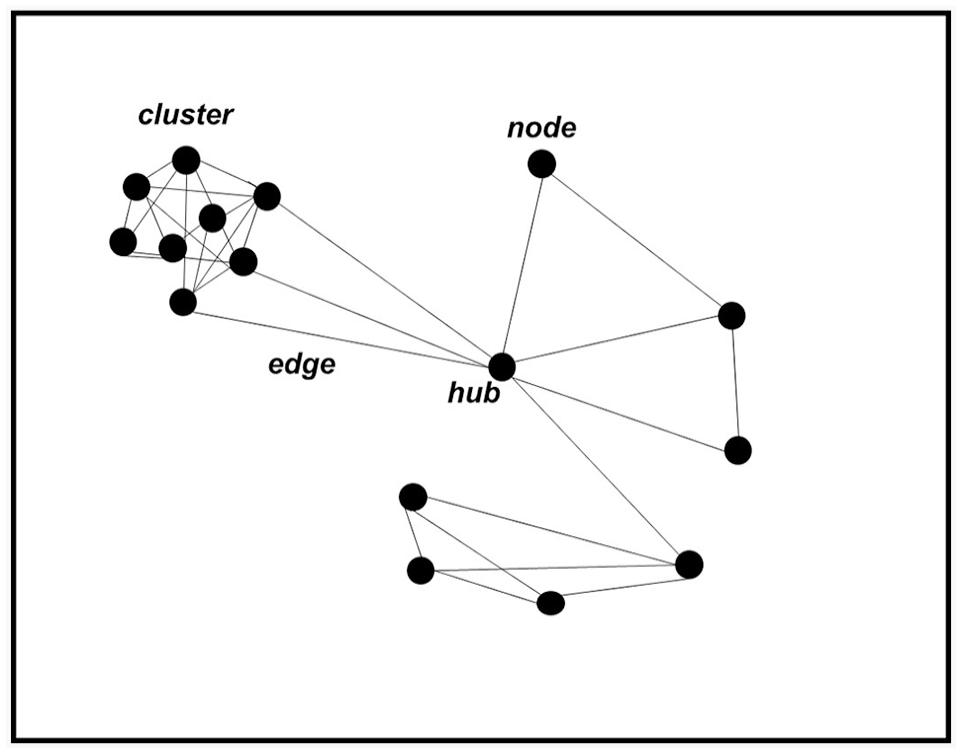
Relevant concepts of network analysis applied to our analysis.
We construct our collaboration network from author-collaborations who published in English-language international management journals. As the research field of international management is widely based in the US and Europe, we included eminent US- and European based journals. To establish the networks on author-, university-, and country level, we extracted author names, year of publication, title, journal name and author affiliations from the SCOPUS database. The affiliation includes name and nationality of the institutions.
Four criteria guided our journals selection: First, the thematic focus on international and European business and management; second, international authorship had to be represented in all journals to ensure that the authors are situated in countries all over the world, and distinct academic institutions; third, the chosen journals are highly ranked; fourth, the journals must be covered by the SCOPUS database.
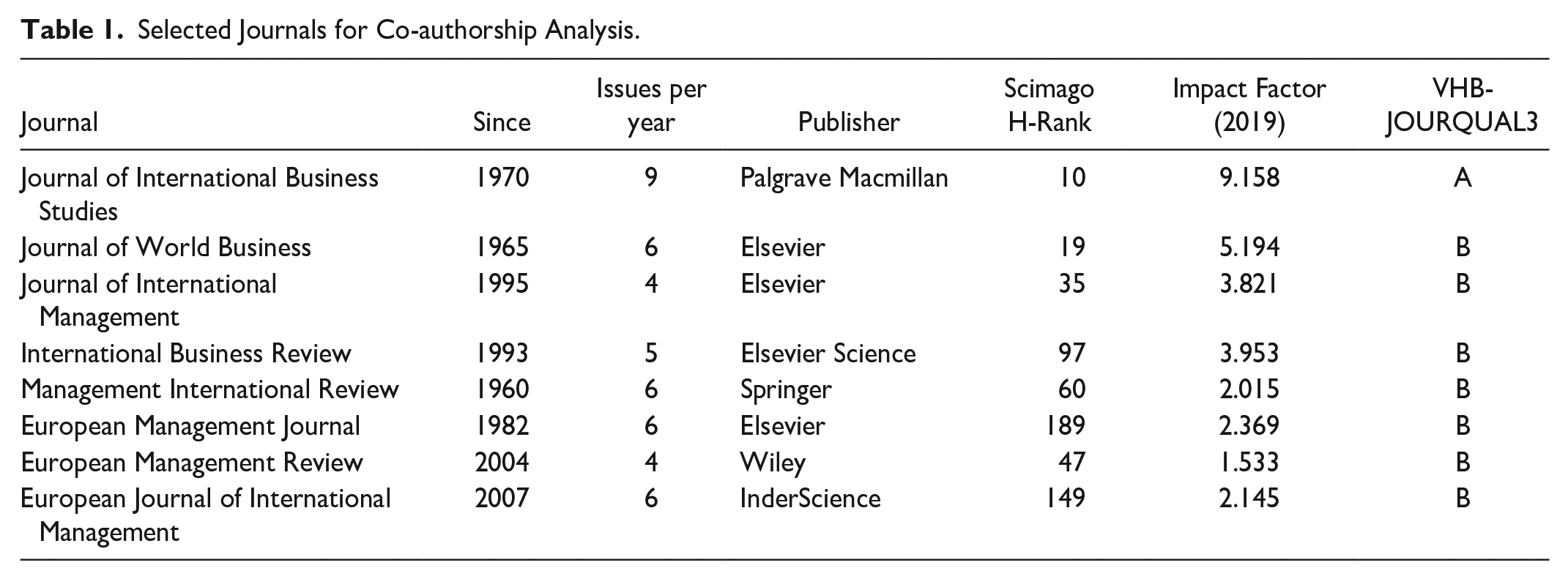
We rely on journal rankings to ensure impact and relevance for the scientific community. To select the most impactful journals with a focus on international management, we followed Harzing’s (2007) approach and evaluated dozens of international business journals in different rankings. Due to deviations and different ranking scales (Adler & Harzing, 2009), three rankings were finally considered in the selection of the journals: Scimago H-Rank; the Journal Impact Factor provided by the ISI Web of Knowledge; and the JOURQUAL3 ranking by VHB (German Academic Association for Business Research). With this in mind, we selected eight journals for further analysis – five in international business and three in European management—containing a total number of 6,874 articles. Table 1 details the journals and their characteristics.
Selected Journals for Co-authorship Analysis.
We applied cleaning procedures after downloading the bibliographic information of every article. Affiliations with different or wrong spellings were disambiguated (different spellings were amalgamated). About one-third of author names were manually disambiguated. For the rest, we applied a semi-automated algorithm developed by our team especially for this purpose. 1 After cleaning procedures, our dataset includes the names of the authors, the institutions, and nations per article.
The network on the respective levels were based on the collaboration between (1) scholars, (2) universities, and (3) countries. We excluded articles with only a single author on the micro level, a single institution on the meso level and countries on the macro level. Based on the growth of international management research and the changes in the collaboration structure, we identified three periods in the evolution of the field of international management in our data: 1990–1997, 1998–2008, and 2009–2016. Table 2 summarizes the statistical properties of our data for each period.
Statistical Characteristics of the Three Time Periods.
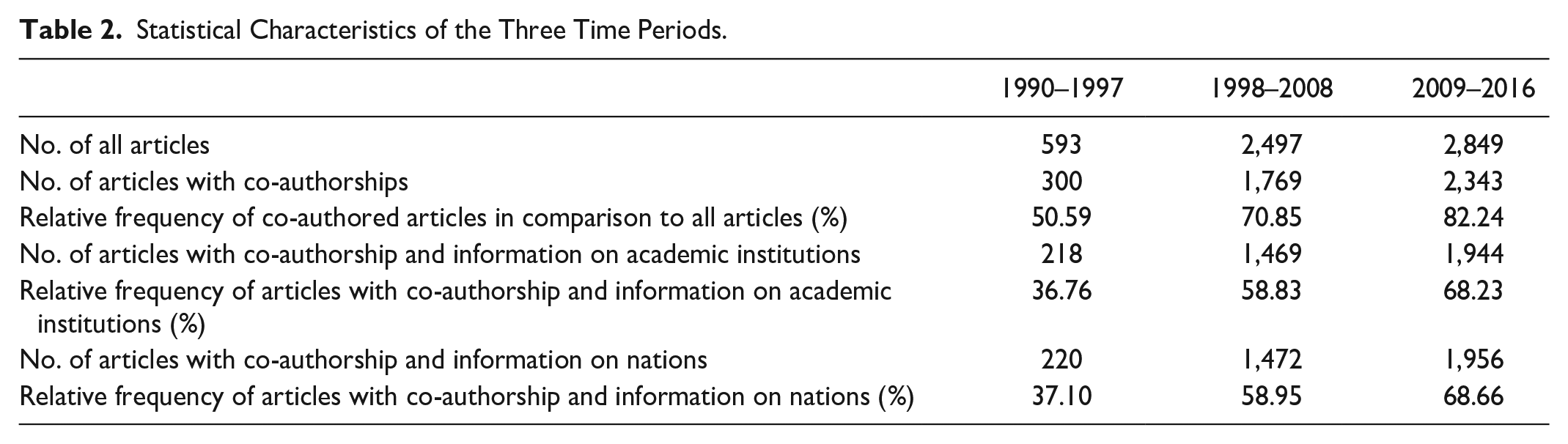
The first period shows steep growth in the proportion of co-authored articles. By 1993, co-authored papers exceed single-authored papers for the first time. After this period of growth, we observe a period of consolidation at a high level. In the last period, between 2009 and 2016, a new rise is observable. Based on this, we constructed and investigated nine networks: three on the level of individual international management scholars, three on university level and three on country-level. 2
To explore the evolution of international management on every level of the network, we measured cumulative advantage, preferential attachment, and growth of the network. We measured cumulative advantage as inequality of the degree distribution among scholars, institutions, and countries. To determine inequality in collaboration over time, we applied the arithmetic mean, the 98% quantile, the power law alpha and the mean number of co-authors of the 10 most central scholars, universities and countries in our sample. 3
To account for the changes between the three time periods for the different length (in years) of each period, we calculated the arithmetic mean and the 98% quantile for every year in a period in a first step. In a next step, we normalized the average mean of the values for every period by calculating the mean of means per period. We then calculated the power law distribution of the number of collaborations for each period to make the extent of inequality in collaboration numbers visible similar to the Pareto principle (Newman, 2005). Higher values over time imply a growing concentration of co-authorships on a small number of scholars, institutions, and countries.
We measured preferential attachment by different growth rates in collaboration numbers depending on the degree of the nodes under consideration. Accordingly, we expect the hubs (authors, academic institutions, or countries) to increase their number of collaborations disproportionally, whereas the growth rates of other nodes would be considerably lower in every period or stay consistently low. For the sake of a better comparison, we used the normalized mean value for each period as described above. As our last measure, we analyzed whether the network and the structures within grow proportionally, which we calculated by the normalized growth rate of nodes and edges over time. We used Gephi to detect network clusters in our data and to provide a visual overview on the evolution of the international management field on the three levels of analysis. Gephi is an open source network analysis and visualization program. We used it exclusively for the visualization of the networks (Bastian et al., 2009).
Results
Micro-level: Collaboration Between Scholars
As far as collaborations between international management scholars are concerned, our results show a growing number of co-authored articles and shares of collaborations for each period under investigation (see Table 3). The highest growth rate of nodes and edges is seen in the first period (between 1990 and 1997). In this period, we observe an average annual growth rate of 41.49% of scholars entering the field and an average annual growth rate of 49.41% for collaborations among scholars. In the second and third periods, the growth rate for the number of authors entering the network and newly established collaborations are significantly lower. Figures 2 to 4 depict the change of the collaboration network of international management scholars for each respective period.
Description of Co-author Networks.


Center and periphery of the co-authorship network 1990 to 1997.
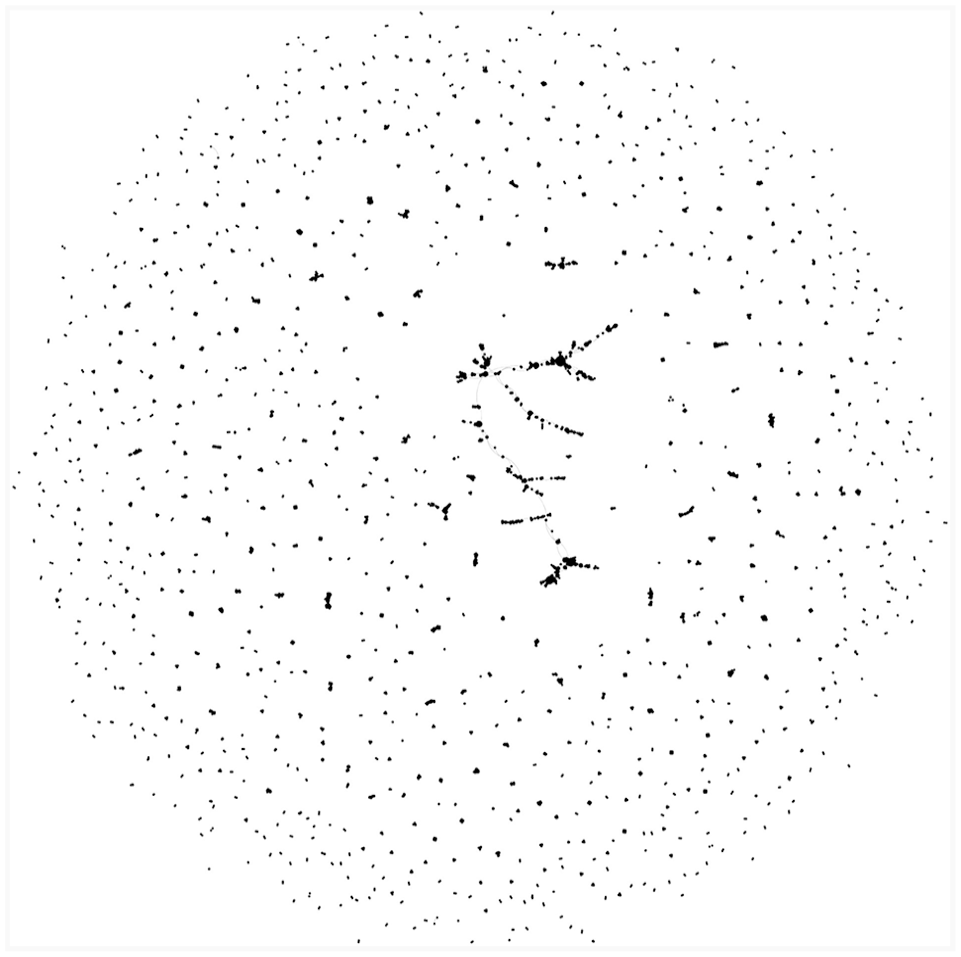
Center and periphery of the co-authorship network 1998 to 2008.

Center and periphery of the co-authorship network 2009 to 2016.
The power law alpha calculated for each period reveals values higher than 1, indicating high levels of inequality of collaboration numbers over time. In all periods, the degree distribution is significantly right-skewed as indicated by the normalized arithmetic mean of the degrees compared to the normalized 98% quantile and mean degree of the 10 most central nodes in the network. In the first period, 98% of all authors do not have more than four degrees to other scholars. Overall, the slow increase of these two measures shows that most authors have a relatively low number of collaborations, whereas the mean degree of the hubs is significantly higher in every period than the normalized mean degree. These values combined indicate that growing inequality is an indicator of preferential attachment (Barabási & Albert, 1999; Perc, 2014). Table 4 reveals the 10 most central scholars in all periods under scrutiny who are hubs and thus represent the culmination point for larger network structures.
Top 10 Authors Holding most Co-authorships.

Turning to the evolution of international management research as depicted in the Gephi graphs, our results indicate that despite the growth in absolute numbers of international management scholars entering the field, a center-periphery structure emerges, and they show that only a few authors profited from the growth of the international management community. Beginning in the first period (1990–1997), there is no distinction visible between the network’s center and periphery (Figure 2). Indeed, there is only a small number of scholars with more than two collaborations. The situation changes during the second period (2000–2008) when the differentiation becomes stronger and a center with a relatively high number of collaborations emerges (Figure 3). Apparently, this center does not have any ties to more peripheral actors. This trend intensifies during the third period (2009–2016) and reveals three relatively large clusters in the center and many disconnected research groups on the periphery (Figure 4).
Thus, although it is not possible to identify a strongly connected community until the beginning of the millenium, a group of scholars started to intensify its cooperation. This development intensifies in the second decade of the 21st century. This core consists of hubs and appears as catalyst for the collaboration network of the international management research community. This is in line with our assumptions regarding the development of the collaboration network and indicates that a relatively small group of scholars drive the emergence of collaboration network in international management and indicate both preferential attachment and cumulative advantage of a small number of scholars.
Meso-level: Academic Institutions and Cooperation
The results of the network analysis of collaborations among universities are listed in Table 5. The first line shows the share of inter-university collaborations among all collaborations between universities. Our analysis reveals that in the first period, 72.30% of co-authoring collaborations included at least one collaborating scholar from a different university. The share of collaboration between universities among all collaborations then grew to 82.47% in the second period and up to 92.51% in the last period.
Description of Inter-institutional Cooperation Networks.

Parallelly to the micro level, the collaboration network on university level shows considerable growth. We observe a high average annual growth rate in the first period (66.57%), followed by consolidation in the second and third period (16.12% and 7.06% normalized growth rate per annum respectively). Especially, the mean degree of the top 10 institutions reveals high growth rates over time. Moreover, many universities show only little collaboration with other universities in every period. The power law alpha is greater than 1 and the arithmetic mean is relatively low in every period, which indicates that the network consists of only a few strongly connected academic institutions (hubs) that are getting progressively better connected, whereas the majority of institutions remain only sparsely connected.
Turning to the 10 most central universities in the field of international management, a relatively unstable top 10 of institutions in the first period indicates that, in the 1990s, there were only a few institutional centers specializing in the international management research field. This pattern changed in the second and third periods. Six to eight institutions constituted themselves as permanent participants in the field (see Table 6). Six out of the ten most central universities are US or UK based, and therefore located in English-speaking countries, which hints at isomorphic pressures marking them as drivers of the evolution of collaboration patterns in international business. The other four universities are based in non-anglophone countries, with Copenhagen Business School (Denmark) ranked first, Chinese University of Hong Kong (China) ranked third, WU Wien (Austria) ranked fifth, and Erasmus University Rotterdam (Netherlands) ranked sixth. Except for China, these universities are located in developed countries, marking the dominance of western institutions over institutions in developing countries despite the fact that international management is seen as a transnational endeavor (Buckley & Lessard, 2005; Cantwell & Brannen, 2016; Liesch et al., 2011; Zhou & Kwon, 2020).
Top 10 Academic Institutions Holding Co-authorship (1990–2016).

Macro-Level: International Cooperation
In line with the micro and meso levels, our analysis reveals a growth in the relative frequency of international collaborations in international management research in every period (Table 7). Over the selected time span, scholars and universities in further countries have become involved in the community of international management: 32 in total in the first period; 65 in the second, and 79 in the third period under investigation. As on the previous two levels, our analysis signals a significant growth in international collaboration in the first period and a consolidation in the years that followed.
Description of International Cooperation Networks.

However, the power law distribution as well as the growing distance between the normalized mean degree of the 10 most central countries and the normalized average mean node degree indicate preferential attachment and the emergence of elite nations driving the evolution of international management as a research field. The arithmetic mean and the 98% quantile also demonstrate the inequality of degree distribution. Even though the arithmetic mean of the degrees grows rapidly between the first and second time periods, the growth rate of the top 2% and top 10 countries increases, consistent with previous studies on cumulative advantage and preferential attachment in collaboration networks (Bozeman & Youtie, 2017; Coccia & Wang, 2016; Sun et al., 2013; Vlegels & Huisman, 2021). Figure 5 shows the number of degrees of the top 10 countries from 1990 until 2016.

Degrees of top 10 nations over time.
The graph reveals an unequal degree distribution for the depicted nations. The US and UK show considerably more international collaborations at any time compared to all other countries. However, nations such as China, Australia or Germany have rapidly gained ground in the international management research community since the early 2000s thus creating a differentiation of the field of international management in line with Choi (2012). Table 8 shows the number of co-authorships across nations and across the three periods. Five of the top ten countries with the most international collaborations belong to the EU. The US and European nations show a large amount of international cooperation compared to other countries.
Top 10 List of Countries in International Co-authorship (1990–2016).
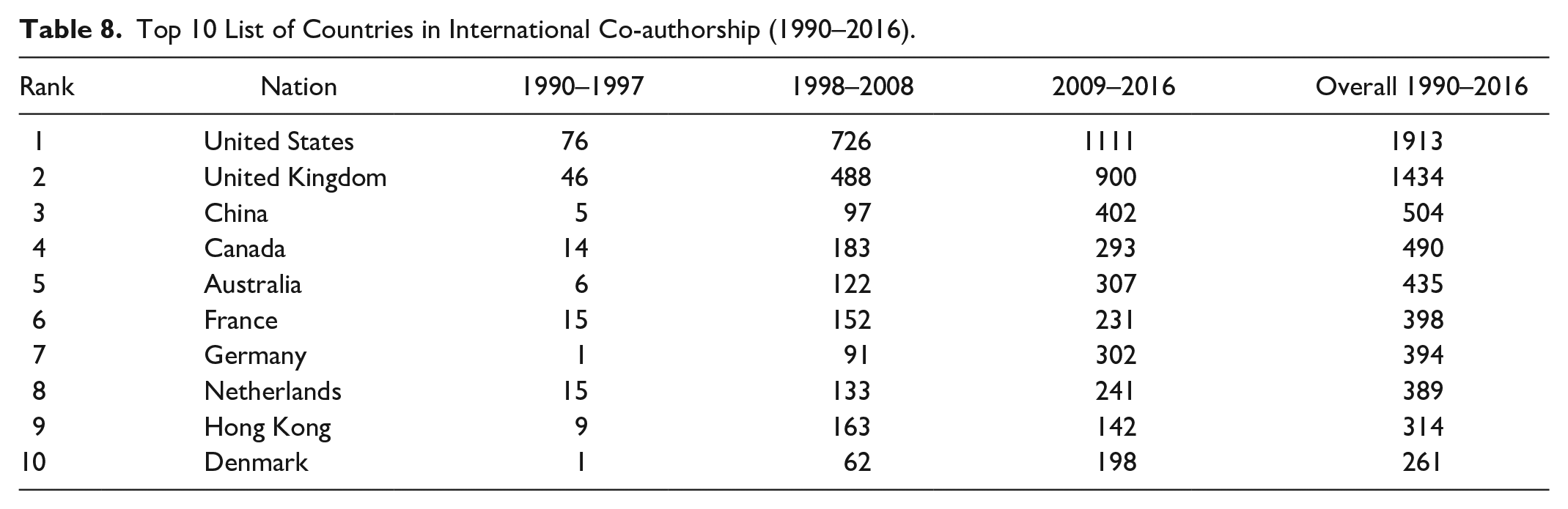
Additionally, Figures 6 to 8 depict the international collaboration network for all periods. Along with Table 8, the visualization of the networks for each period mirrors the dominant position of the US and UK and their high connectivity with other nations between 1990 and 1997 (Figure 6). This dominant position remains unchanged during the other two periods. However, we see that the US and the UK intensify their collaboration with European countries but also with China, India, Canada, and South Africa. Those countries increased their connectivity most visibly over the last two periods. Finally, the network structure reveals a relatively densely connected semi-periphery of mainly European countries in the second period under investigation, which consolidates in the third period. Concerning the Matthew effect, the network’s structure reveals that anglophone countries disproportionally profited from the consolidation of the international management research field in terms of collaboration. Nonetheless, there are competitors such as China and a number of European countries that started to blur the borders among the center and periphery over time and may challenge the dominance of the US and UK within the research field in the future. In sum, these findings support our assumptions that rather peripheral countries are integrated into the collaboration network, but that geographical proximity also seems to be a driving force of collaboration, as emphasized by Pohl (2020).
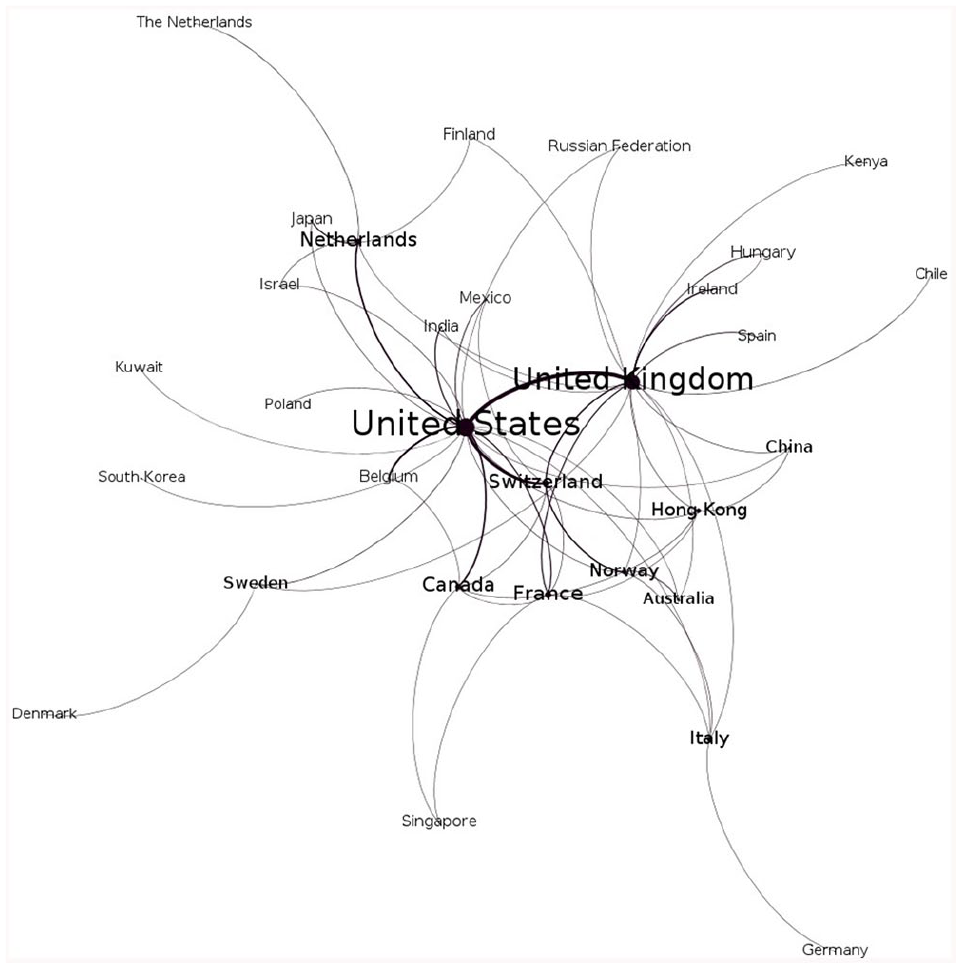
International cooperation network 1990 to 1997.

International cooperation network 1998 to 2008.

International cooperation network 2009 to 2016.
Discussion and Conclusion
In our paper, we investigated how collaboration patterns in the field of international management research evolved over time and how these patterns distributed among scholars, universities, and nations. This indirectly raised the question of how global and local structures of the accompanying collaboration network emerged and changed over time. Across all levels, there is no indication that scholars, universities, and countries become equal in the form of their publication output. On all levels, we observed growing inequalities in the number of collaborations and identified only relatively few authors, institutions, or countries. To answer the research questions, we applied the theoretical concepts of cumulative advantage and preferential attachment to account for network dynamics and isomorphism to account for effects linked to the discipline of international management research that enable or impede research collaboration. Empirically, we constructed a collaboration network based on 6,874 articles published in eight international management journals.
Our study shows that collaborations between scholars, universities and countries have grown considerably between the first (1990–1997) and second (1998–2008) periods and to a lesser extent between the second and third (2009–2016) periods. The increase of collaboration over time is consistent with former co-authorship analyses (Acedo et al., 2006; Bozeman & Youtie, 2017; Eckl et al., 2019; Glänzel & Schubert, 2005; Silva et al., 2019; Wagner et al., 2017; Youtie & Bozeman, 2016) and indicates that international management went from a phase of emergence as a field of research to an era of consolidation and contestation. As such, academic collaboration is increasingly guided by a few centers of research that appear to be the drivers of the evolution of international management. For the most part, our findings show that albeit international management aims to explain strategies, structures, systems, and cultures both within and between multinational companies, there is scope for non-western scholars be become more central. This can be attributed to the mechanisms of cumulative advantage, preferential attachment, and isomorphism, albeit with different nuances on the micro-, meso-, and macro level of our analysis.
On a micro level, scholars located at elite business schools and universities occupy dominant positions within the network. Taking a closer look at the author names in Table 4, it is apparent that most of the prestigious authors possess long-standing experience in academia and editorial competencies. They are members or heads of committees (e.g., Association of Business Schools) or fellows of academic groups (e.g., British Academy of Management). Some show practical experience in business as managers, consultants, or trainers. Common topics among these authors are the internationalization of firms, international joint ventures and cross-border mergers and acquisitions, human resources (especially expatriation) and knowledge flows and spillovers. In this sense, our findings back our assumptions regarding isomorphism (DiMaggio & Powell, 1983) and conform with the theoretical assumptions concerning cumulative advantage and preferential attachment (DiPrete & Eirich, 2006; Merton, 1968; Perc, 2014).
On the meso level, we provide evidence that universities from Denmark, China, Austria, and the Netherlands have entered the academic world stage despite the centrality of many prominent US and UK institutions. They are listed on the top 10 of institutions holding co-authored publications. For example, with more than 2,000 employees, Copenhagen Business School is a large university specializing in business studies and economics, and therefore possesses vast economic capacities and competencies for research publications and networking. 4 Some universities reveal a high rate of co-authorship because of the affiliated authors: for example, S. T. Cavusgil is assigned to Georgia State University; P. Buckley to the University of Leeds. Moreover, the supremacy of these universities might be due to the excellent English-language skills of the affiliated authors, who bring along the necessary language skills to publish in Anglo-American journals. Language must not be undervalued in analysis as it plays a crucial role when it comes to being accepted in an Anglo-American journal. So, most of the top business schools and universities that are strong in collaboration are usually settled in countries where English is common and spoken well, such in the case of Northern European countries such as Denmark or the Netherlands. In this sense, our findings support Pohl (2020) and Choi (2012). We highlight that the cultural distance between European and Anglo-American Universities and scholars on the one hand, and Asian as well as other nonwestern scholars and universities on the other hand impede scientific collaboration in international management.
Considering collaboration between countries, we observed that although the US and the UK still represent hubs on the landscape, further countries entered the stage of international management research, particularly after 2000. We identified China and Hong Kong in Asia, France, Germany, Denmark, the Netherlands, and Spain in Europe, but also Australia and Canada in the English-speaking world as increasingly important countries. All these countries form part of the G20 states, that is, the industrialized countries and emerging economies. These nations afford to spend large quantities of money on their academic systems.
In line with Guédon (2008) and Münch and Schäfer (2014), we identify effects of cumulative advantage for countries. We attribute this effect to the expertise-based hegemonic status of American and British business schools and faculties. The outstanding position of China in the second and third period can be traced back to the vast economic development that the country has experienced over the past 30 years, entering the stage not only in business but also in academia. As early as in 2006, China has been recorded as the second largest nation with regard to the number of publications (Leydesdorff & Wagner, 2009). This, in turn, might be aligned with the financial and structural support program of the “Big Plan 2025.” With respect to international management, we assume that business expenditure leads to an exponential growth of publications for practical advisory. At the same time, the outstanding position of the US and the UK might be traced back to their long-standing expertise in contrast to other nations in the field if international management research. Moreover, most of the highly ranked journals stem either from the US or the UK.
In this regard, our assumptions regarding the development of collaboration networks in international management are partly confirmed. Asian countries, especially China, appear on the landscape of international management research. Furthermore, we uncover that peripheral countries become more visible in our analysis. However, since these countries are mainly G20 states and located either in Europe or in developed regions in Asia, there appears to be a sort of geographical and cultural clustering, as suggested by Zhou and Kwon (2020) and Pohl (2020). Based on our findings and in line with our assumptions, we would expect Arab countries as well as African and South American nations appear in the community collaborating first if all with either Anglophone countries or Chinese universities before building their own clusters of research similar to the Asian countries.
As international management research is considered a multidisciplinary field of research, this might either entail an increasing clustering of the discipline around a number of centers aligned to schools of thought, which ultimately may compete to steer the development of the field, as indicated on smaller scales by the findings of Liesch et al. (2011), López-Duarte et al. (2016, 2019) and Zhou and Kwon (2020) in the case of international management research, and scholars focusing on other disciplines (Bellotti et al., 2016; Coccia, 2018, 2020; Sun et al., 2013). These hubs and their collaborators produce a prestige hierarchy in the field of international management, which becomes a point of reference for scholars entering the field. This in turn might exclude perspectives on relevant topics such as the global business environment, joint ventures, or knowledge transfers from which the international management research community could benefit.
At the same time, our study meets four limitations that should be considered in further research. First, our sample consists of eight international management journals only—a basis that must be considered quite small in quantitative network analysis. Future research should enlarge the data sample, adding more prestigious journals to the analysis. However, as many journals in business administration cover both international business and management topics, a classification of articles belonging explicitly to international management research should be done. Secondly, our sample is biased toward US and European based journals. Unfortunately, we could not consider journals located in other regions due to a lack of coverage in the SCOPUS database and low reputation of these journals. However, the study proves that there are increasing contributions from other nations all over the world, which are not well covered in databases such as SCOPUS or Web of Science. To provide a representative picture of the current structure of the global international management community, journals from all over the world and in different languages should be considered in future research. Thirdly, although the quantitative analysis offered an insight into the structural development of the network, the analysis remains on a rather descriptive level. Underlying mechanisms and reasons for collaboration could be further examined, applying qualitative hermeneutical research methods and contextualization for understanding and interpretation. For example, case studies and/or interviews with the hubs of the network (authors) could provide more information about why and how these authors and academic institutions hold central positions in the co-authorship network, or why some nations are better connected than others. Additionally, we encourage the application of network regression techniques to account for the evolution of networks and to include the theoretical concepts outlined above. Fourthly, it seems necessary to examine whether our results are specific to international management research, or if cumulative advantage, preferential attachment, and isomorphism take different shapes in different disciplines and on different levels.
Despite these limitations, our study highlights that isomorphic pressures and central scholars, institutions and nations drive the development of scientific disciplines. At the same time, there are tendencies for peripheral institutions and countries to strengthen their collaboration and to become competitors in the long run. As a transnational discipline, we therefore expect to see two tendencies emerge, which could be studied in the future. Firstly, the peripheral countries of today might interconnect, creating own hubs with own approaches on the subjects of international management. For example, China or India could increase their collaboration with other Asian and African countries to conduct research on multinational companies profiting from China’s ambitious foreign and economic policy. The same applies for countries in South America, which are at the periphery of international management at best. From there, we expect, secondly, new collaboration networks to unfold. The shift towards digitalization following the Covid-19 pandemic may intensify this development, since scholars from institutions and countries with lower travel resources can now increase their global intercontectedness due to new technology development. Understanding the nature and development of digital co-authorship collaborations would therefore be of interest for future studies. However, since isomorphic pressures are still existent and the main international management journals and hubs are located either in the US or the UK, the intellectual dominance will continue to spread throughout the international management community, effectively shaping the intellectual content of the newcomers to the research community. As we did not focus on this content, future studies should also aim at linking our analysis of the persistent and growing inequality in the collaboration network with the intellectual content of international management to provide a more complete image of the evolution as a scientific field.
Footnotes
Authors’ Contribution
Declaration of Conflicting Interests
The author(s) declared no potential conflicts of interest with respect to the research, authorship, and/or publication of this article.
Funding
The author(s) received no financial support for the research, authorship, and/or publication of this article.
