



Abstract
Teachers in rural China are considered disadvantaged compared to their urban counterparts on several measures, including working conditions, remuneration, and access to professional development opportunities. We argue that teacher wellbeing plays a crucial role in teacher quality because quality teachers require optimal functioning and wellbeing to teach well. This study reports on the qualitative element of an exploratory sequential mixed-methods research design investigating Chinese rural teachers’ attitudes towards wellbeing. The results of this study confirmed that remuneration, access to professional development opportunities and social status of rural teachers are behind those of urban teachers in China. However, several rural teachers excelled in the profession, showing a passion for teaching that transformed the lives of rural students. This study discovered a gap in the current research on the wellbeing of rural teachers in China and suggested that policymakers should promote the unique positive aspects of rurality, including teachers’ passion for optimal outcomes for their students, rather than focussing on the negative aspects of rurality.
Keywords
Introduction
The attitude of teachers towards wellbeing is an under-researched topic. In China, there are around 5.8 million teachers, and approximately 65% of these teachers work in rural areas (National Bureau of statistics of China, 2015). This paper investigates teachers’ wellbeing via the theoretical framework of positive psychology, and offered a potential fresh angle to tackle rural teacher shortages. The exploration of teacher wellbeing has become a priority area of positive psychology in social and psychological science (Brunzell et al., 2021), however, there is no qualitative research on teacher wellbeing in rural China through the theoretical lens of Positive Psychology which focuses on human strengths and what makes life worth living (Stavros, 2018). Although a previous study by McCallum et al. (2017) reported that teaching is stressful and complex and Tehseen and Hadi (2015) showed an increasing prevalence of emotional and physical exhaustion in teachers. McCallum and Price (2012), Kern et al. (2014, 2015), and White and McCallum (2020) argue that wellbeing is more than a personal trait, with the community often being essential to individual wellbeing. Song et al. (2020) observed that ‘teaching is larger than a job’, thus the wellbeing of rural teachers ‘entails much more than emotions and happiness’ (pp. 22 and 25). However, divergent perspectives exist in the literature regarding the relationship between rurality and wellbeing. For example, Murray et al. (2004) found that the accessibility of the rural residence was positively associated with subjective wellbeing, whereas Gilbert et al. (2016) discovered that a lack of accessibility to a rural residence indicated lower life satisfaction and was not associated with eudaimonic wellbeing.
The wellbeing of teachers is important because teaching is often considered a caring profession that requires emotional work (McCallum, 2020a; 2020b). Therefore, teachers need to provide emotional and social support to their students (Lam, 2019). Rural teachers in China are viewed as moral agents under the influence of Confucianism and they shoulder collective responsibilities for their students (Kim, 2019; Mingren & Shiquan, 2018). However, this has become challenging in concurrent China, as society is changing and the social and emotional needs of students are becoming more complex (Peng et al., 2014).
Teacher wellbeing is critical for teaching quality and the learning outcomes of students (M. White, 2020a, 2020b; M. A. White & McCallum, 2020). Kern et al. (2014, 2015), McCallum and Price (2010), White and McCallum (2020), Roffey (2012), and Harding et al. (2019) contend that teacher and student wellbeing are closely associated and teacher–student relationships play a key role in teacher wellbeing. Teacher wellbeing influences students’ wellbeing as well as their academic performance. Furthermore, according to Allen et al. (2018), a teacher’s sense of connection to a school is an essential component of the teacher’s wellbeing and can predict a student’s sense of belonging, with the teacher–student relationship significantly influencing the latter.
Teaching in rural China is not an easy task and rural teachers play a crucial role in students’ learning (Hazel & McCallum, 2016). Although rural society does not care about school education, rural teachers are energised towards ethically and morally appropriate behaviour (Arvanitis, 2017). Therefore, rural teachers have a strong sense of responsibility to improve the outcomes of rural students. In China, rural teachers are poorly trained and have limited professional development opportunities, which contribute to teacher attrition and shortages (Zheng et al., 2018). For many rural teachers, the subjects they teach do not align line with the major they studied at university (Mingren & Shiquan, 2018). In addition, demotivation is found in teachers in lower-income rural regions (Wolf et al., 2015). There is growing concern about the decline of students’ performance due to quality rural teacher shortages.
To understand the phenomenon of teacher wellbeing, Wolf et al.’s (2015) study embraced three dimensions to conceptualise the professional wellbeing of teachers under a deficit model that emphasised risk factors contributing to the turnover of teachers. The first dimension is motivation, which refers to the underlying mental processes that affect individual behaviour regarding workplace tasks (Pinder, 2014). The second is burnout, characterised as a negative psychological status in response to work-related stress, and the third, job dissatisfaction, is related to teacher attrition (Wolf et al., 2015). The present study explored qualitative perspectives of rural teacher’s wellbeing of an exploratory sequential mixed-methods study of 10 teachers from Jilin Province in rural China. This study used appreciative semi-structured interviews to explore the best stories (Cooperrider, 2008) which elicited narratives informing teachers’ healthy wellbeing in rural China based on the following research questions: Research Question 1: What are the attitudes of teachers towards wellbeing in rural China? Research Question 2: What are the motivations of teachers for teaching in rural China?
The appreciative interviews are to explore the best stories, and thus the discovered narratives can become a community’s identity (Cooperrider, 2008). Thus, in our study, the appreciative interviews elicited narratives informing teachers’ healthy wellbeing.
Teachers’ Wellbeing
McCallum et al. (2017) contended that the extant definitions of teacher wellbeing are influenced by contextual characteristics. Echoing the uniqueness of the teaching profession and based on a review of the teacher wellbeing literature, wellbeing is defined as:
Diverse and fluid respecting individual, family and community beliefs, values, experiences, culture, opportunities and contexts across time and change. It is something we all aim for, underpinned by positive notions, yet is unique to each of us and provides us with a sense of who we are which needs to be respected (McCallum & Price, 2016, p. 17).
This definition guides the present study on teacher wellbeing because of its focus on three main points: (1) wellbeing is fluid and ever changing, (2) wellbeing is culturally embedded and (3) wellbeing is positive. However, the importance of teacher wellbeing has contributed to high rates of teacher turnover, particularly in rural areas and resulted in the difficulty of maintaining quality teachers (Margolis et al., 2014, p. 392). Although rural teachers are often not as well trained as urban teachers in China, the wellbeing of rural teachers can play a key role in student success.
Methods
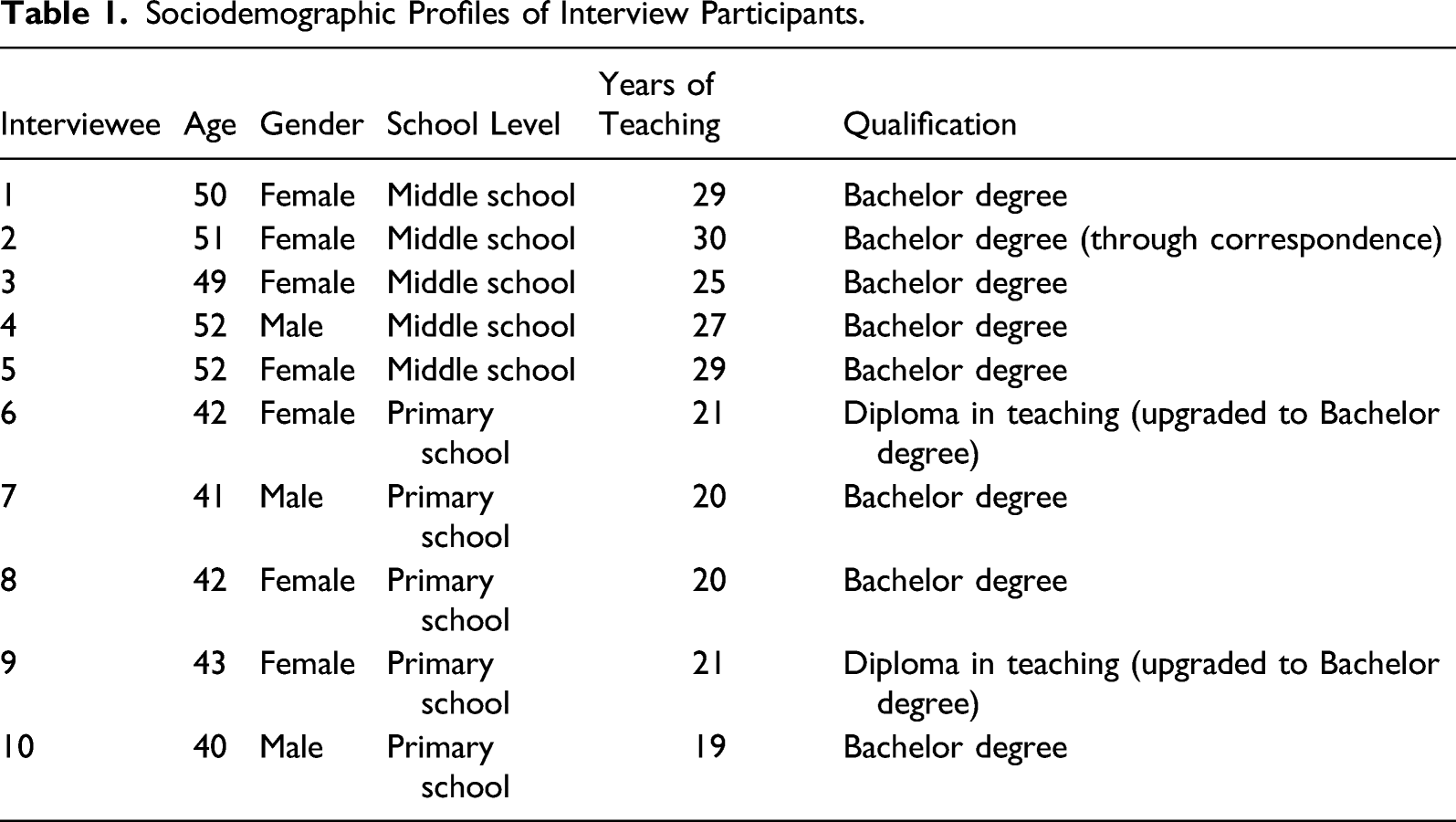
As suggested by Gillham (2000, p. 21), the length of a semi-structured interview in a mixed-methods study should be kept to 30 minutes due to the work and cognitive burden on both interviewer and interviewees. Participants were interviewed in person in Jilin Province, China, for 30 minutes and used semi-structured interviews based on purposeful sampling of 10 rural teachers. The criteria for selection were as follows: (1) the local educational administrators nominated teachers who were passionate and effective at teaching, (2) teachers had at least 5 years’ experience teaching at rural schools and (3) teachers had been teaching at their current school for at least 1 year.
Working in the teaching profession for 5 years assumed that teachers had adequate exposure to a variety of work experiences (both negative and positive) to be able to share what sustains them in a rural teaching career. This echoed the objectives of the appreciative interviews, which was not to suppress the negative experiences of teachers but to determine how teachers re-engaged those negativities and thrived. The present study aimed to explore rural teachers’ optimal level of wellbeing; thus the sampling method maximised the inclusion of flourishing teachers in the sample.
Interview Questions
• How do you feel about your current wellbeing (compared to 5 years ago)? • Do you feel happy teaching at the rural school and why? • Could you describe your students’ (academic/social/emotional) outcomes? • What unique features at the rural school/home/community positively affect your wellbeing? • What makes you go to work at this school every single day? • What did you gain from your rural teaching experience? Could you tell me a story about your best experience? • If you/your students/school were at its/their best, what would it look like?
Ethics
This article reported on stage one (of mixed-methods study) qualitative interviews that involved teachers; therefore, careful consideration was given to ethical issues to assure the highest standard of integrity of the research. This has been approved by the university’s Research Ethics Committee.
Data Analysis
Thematic analyses following the semi-structured interviews were used to analyse the qualitative data to identify themes of life experiences, ideologies, values, beliefs and other living resources that informed rural teachers’ work in ways that aided their flourishing and wellbeing. Themes from the key messages in the stories emerged from the data that captured the implicit meanings underneath; thus, the thematic analysis approach has the ‘potential to highlight shared meaning’ (Clarke & Braun, 2018, p. 108).
Ten teachers were interviewed until data saturation was reached. This occurred while interviewing the ninth participant because the responses to the interview protocol were becoming repetitive. Therefore, the recruitment of further interview participants was ceased.
Results
Sociodemographic Profiles of Interview Participants.
Themes
Research themes were identified through coding of each interview transcript and broad themes and sub-themes were based on general and specific categories. Using the open coding method, the initial themes were analysed by constant re-reading and three main themes appeared from the data. Some of these themes/sub-themes were not evident in recent literature, except for Chinese rural teachers’ wellbeing related literature (e.g. Kim, 2019; Mingren & Shiquan, 2018; Tang, 2018; Tang et al., 2018).
Figure 1 shows the relationship between the three steps involved in analysing the data. To reach Step 3 the broad themes of ‘joy and ease of rural teaching’, ‘pressure and stress as a rural teacher’ and ‘teacher perception of student’s outcomes’ were based on the categories derived from Step 2 of ‘positive attitudes towards rural teaching’, ‘negative perceptions of rural teaching’ and ‘students’ outcomes’. These categories were extracted from Step 1 based on open-ended codes, which were ‘contributors to positive experiences of rural teaching’, ‘factors negatively contribute to rural teachers’ perception of positive experiences’ and ‘teachers’ positive comments and concerns of rural students’ outcomes. Process of themes extraction from semi-structured Interviews.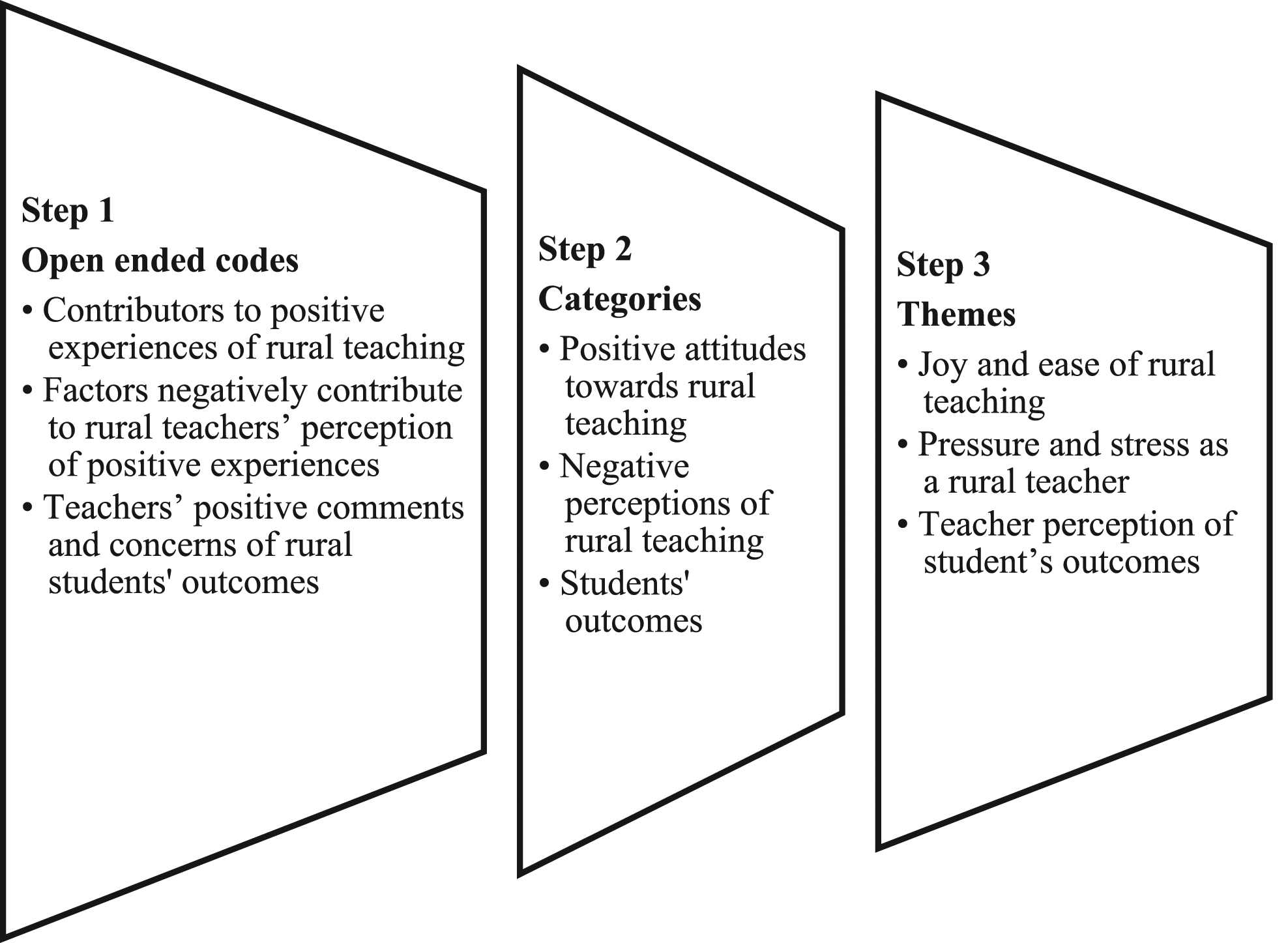
Theme One: Positive Experiences of Rural Teachers
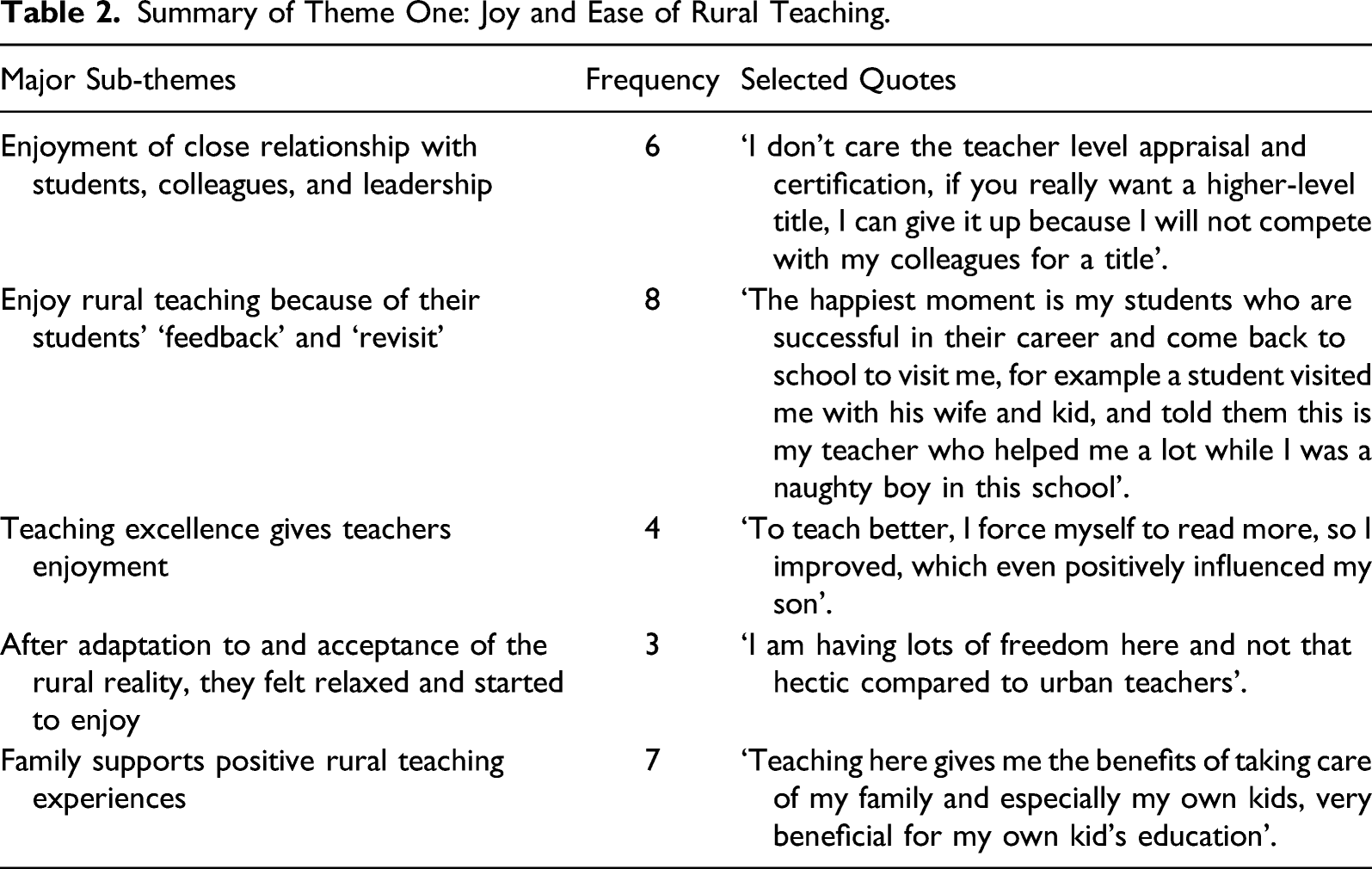
For all participants, the rural teaching experience was considered rewarding and enjoyable. Several patterns reflected the enjoyment of rural teaching. First, five out of 10 teachers reported that they were happy because they were from a rural region. Participant 8 who was female, 42 years old, a primary school teacher, and with 20 years of rural teaching experience mentioned: ‘I am very happy, because I am from here, my family is close by, I am so familiar with the place and people here’.
The majority (eight out of 10) of participants enjoyed rural teaching because their students returned to visit them. Participant 3 who had 25 years of rural teaching experience, explained how happy she was when her students came back and hugged her while telling her the exciting news that they had been offered a place in a university a long distance away in a metropolitan city. She used the word ‘hug’; in Chinese culture, a ‘hug’ is rarely given and only if in an extremely happy situation. Participants 9, 8 and 4 gave similar examples.
For example, participant 9, a female primary teacher with 21 years of rural teaching experience said,
‘I deeply feel if a student can come across a great teacher it is his or her luck for whole life, your students visited you after many years since graduating, and you know they really appreciate your teaching all those years ago’.
Participant 8 stated,
‘Students still remember you when they lead a successful life, it really makes you happy, such as a student was offered a place in a university, he phoned me and asked me to come over to have drinks and dinner with him at his home to celebrate’.
Similarly, participant 4, a male middle school teacher with 27 years of rural teaching experience said, ‘The happiest moment is my students who are successful in their career and come back to school to visit me, for example a student visited me with his wife and child, and told them this is my teacher who helped me a lot while I was a naughty boy in this school’.
Male teacher number 5 was recollecting this experience with tears in his eyes. This quote revealed that rural students showed gratitude towards their rural teachers: ‘If my students can go to the university, I am really happy for them, if not, I am still very happy, such as one of my students who was not good at his academic performance, after a decade of graduation from the school, I came across him on the street, he is a painter, he said “teacher, if you need any painting in your apartment, let me know, I will do it for you for free”, I am really happy for him’.
Summary of Theme One: Joy and Ease of Rural Teaching.
Theme Two: Negative Experiences
The interviews aimed to explore the complete picture of rural teachers’ wellbeing so adverse experiences were provided. The present study revealed that alongside their ease and enjoyment, rural teachers had challenges and many experienced stress and pressure.
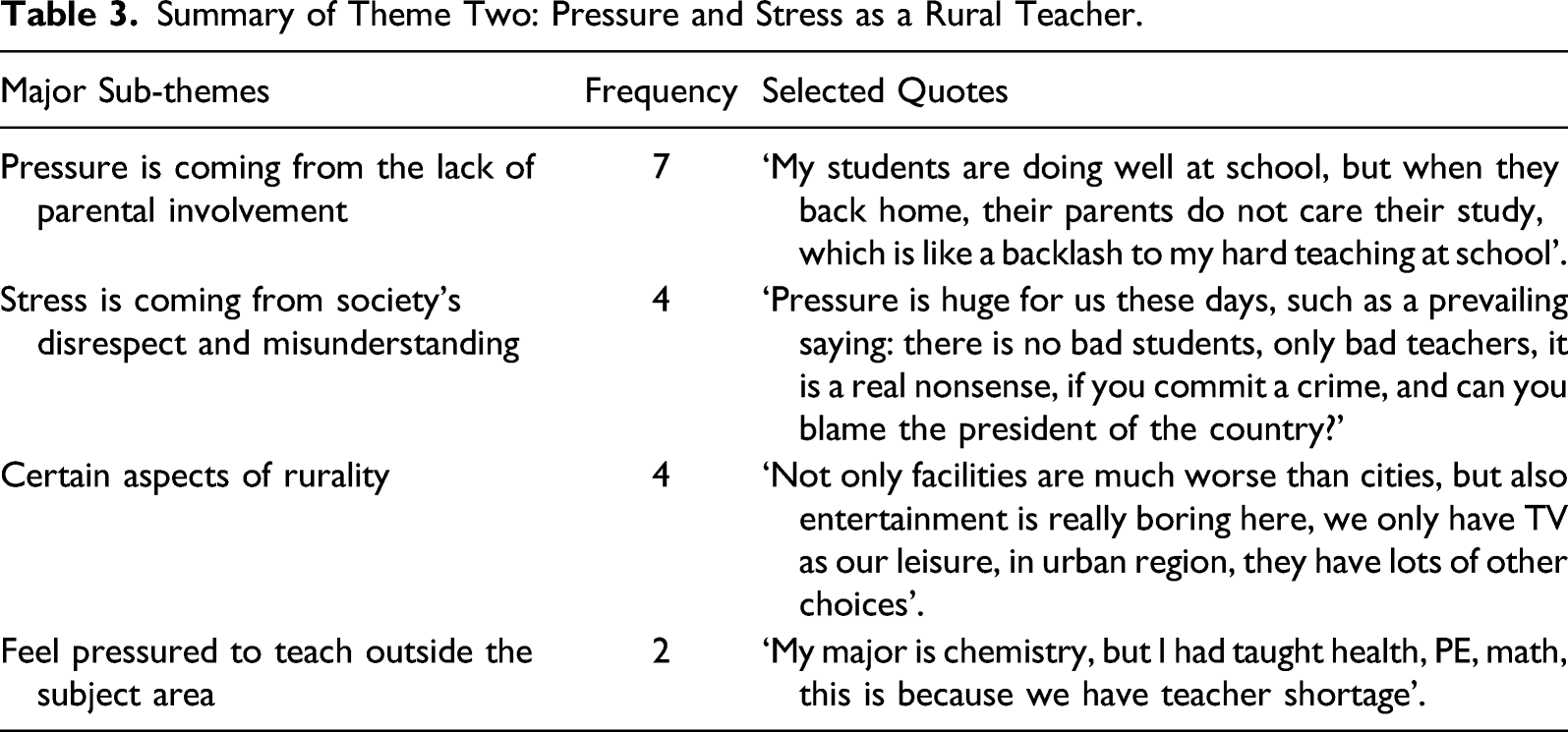
A main theme of teacher stress indicated by seven out of 10 participants was the lack of parental involvement in supporting the students. For instance, Participant 5 declared, ‘My students are doing well at school, but when they back home, their parents do not care about their study, which is like a backlash to my hard teaching at school/.
Another theme mentioned by four out of 10 teachers was the disrespect they received from the general public, for example, Participant 1 stated that ‘even though our salary range is the same as urban teachers, I think they (urban teachers) are more respectable than us, you know, sometimes, I call parents to talk about their kids, they even do not bother to pick up the phone’. However, Participant 5 further added, ‘we do not feel privileged as the urban teachers because we are not as respected as the urban counterparts’.
Participant 3 stated that overall there was a lack of respect,
‘Nowadays is harder to become a rural teacher, because we are government employees now, but our society still do not pay enough attention to us, although this is much better than before, such as when I just became a rural teacher around 20 years ago, I visited a student family, the student’s parents said, we do not expect too much from our kid, if he can be a “little” teacher (like you) in the future, then we will be really satisfied’.
Summary of Theme Two: Pressure and Stress as a Rural Teacher.
Theme Three: Motivations to Teach
The interview data revealed that student outcomes are crucial for teachers’ wellbeing, which showed that teacher and student wellbeing are inextricably related. A majority of the teachers (nine out of ten) positively commented on how well rural students met learning outcomes. For instance, Participant 10 said, ‘Their (my students’) eager eyesight for knowledge is my real motive to stay here teaching’. Participant 5 added, ‘I love these kids, they are very simple, not complicated at all, they love labour, such as willing to clean the classroom’. Participant 3 enjoyed the generosity of the students and said, ‘The students here are lovely, such as when they are eating candy, they offer me to have a try, very genuine’.
The teachers believed that the advantage of being a rural student was being close to nature, for example, Participant 7 said, ‘they (rural children) have the opportunity to be so close to the nature, when they need some fruits or vegetables, they know where to pick them up in the field’.
However, most of the participants (7 out of 10) believed that the ‘left-behind’ children needed special attention. Participant 7 described how, ‘They (left-behind children) have various problems, so I told their parents when they talk to their kids, let them know when you will be back home, what kind of gifts do your kids want from you, let your kids know you care about them a lot’.
Participant 7 also commented that, ‘Left-behind children really gives me headaches, they are so hard to manage, because they are very self-centred and some of them lack of confidence, so I asked them to send some videos to their parents who are away working in the city to foster the communication with their parents’.
‘Deal with left-behind children is not easy, the reason is complicated, such as they seem to be self-contemptuous, because they realise their parents are not around, also some of them are very self-centred, this is because their caretaker, normally their grandparents, really spoil them. But it is rewarding to teach left-behind children, because when we build up solid rapport, they open their hearts to me, I feel very happy about it, for example, after I talked to them (left-behind children), they came back to me the other day, told me what I said is correct and good for them, and will follow my suggestion, this kind of feedback makes me really happy as I know they really listened to me and understood my good intention.’ Table 4 Summary of Theme Three: Teacher Perception of Students’ Outcomes.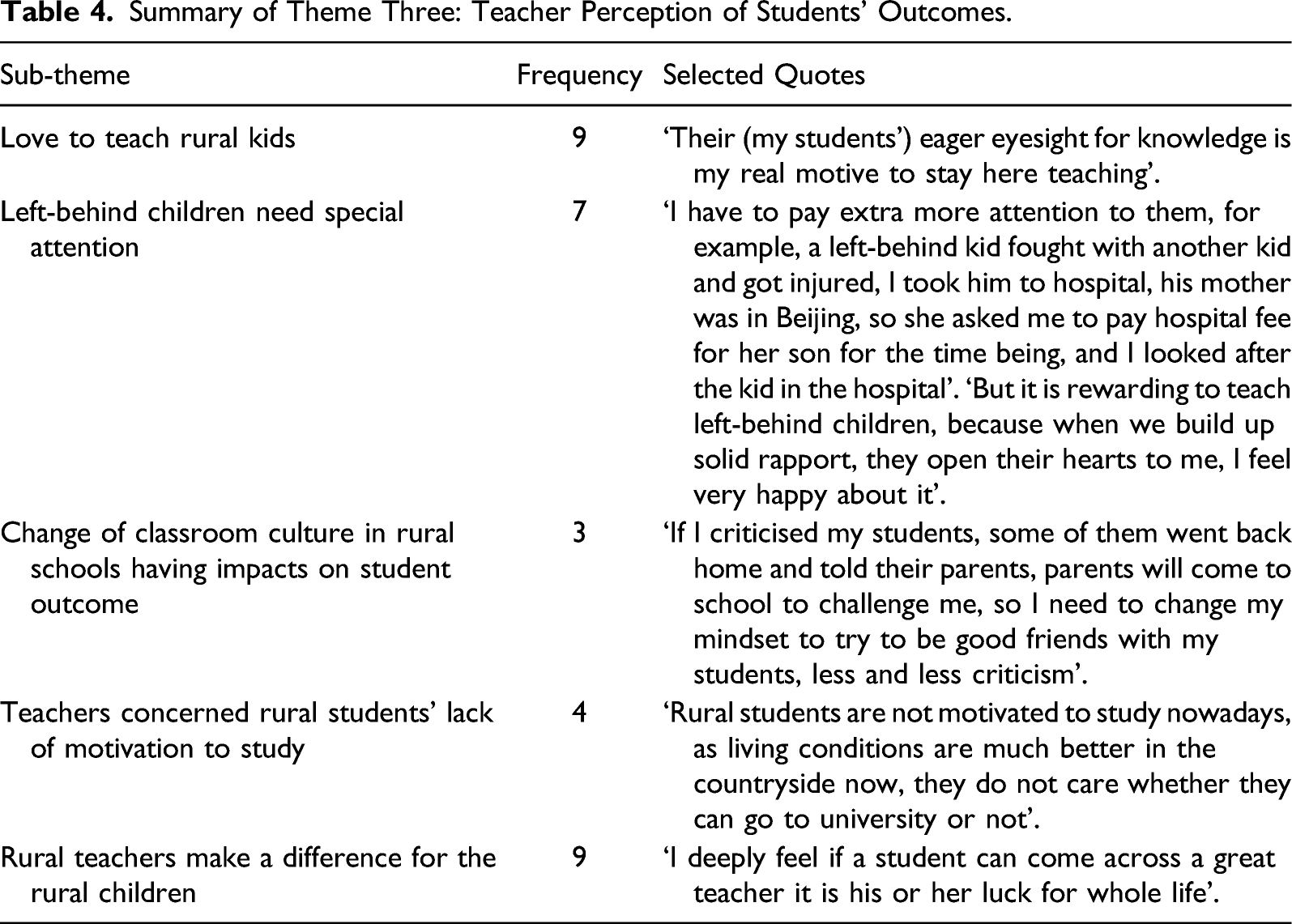
Discussion
The findings of the present study identify the perspectives of Chinese rural teachers regarding their wellbeing. Three key findings emerged from this research. First, data analysis indicated that the majority enjoyed teaching because of positive feedback from former students. Second, although rural teachers had challenges and many experienced stress and pressure, they remain in the rural teaching profession. Third, rural teachers were motivated to teach because they have a strong passion for educating and improving the lives of rural students. Thus, the data further revealed that the perceptions of rural teachers regarding the outcomes of their students were closely related to their own wellbeing.
Interviews revealed that the living standards and conditions for teachers have improved in rural China. Teachers no longer belong to the poor working class. For example, four of the 10 teachers mentioned they drive their own cars to work; one teacher mentioned she has two housing properties, one in the countryside, one in an urban town, so that she can enjoy the country’s fresh air in the summer (at her rural property) and the 24-hour heating system at her urban unit in the winter. This is significant because Lin et al. (2012) concluded that Chinese teachers stay in poorer living conditions in rural regions because they do not prioritise the material side of life and they remain to teach out of altruistic motivations to help poor rural children. Although inadequate resources still constrain rural areas in comparison to urban areas, living standards have improved since the economic reform in China, therefore, such altruistic motivations may no longer solely explain rural teachers’ wellbeing (Kim, 2019).
The present study also revealed that rural teaching is not especially stressful. This finding is different from previous literature that emphasised rural teaching in China as being stressful. Rural teaching gives teachers the autonomy to look after their families and interact with their students. It implies strong family and community ties in rural areas and teachers feel the genuine folk culture in the countryside and want to contribute to rural communities, which fosters rural teachers’ wellbeing. This is in line with previous literature that rurality has a close link with wellbeing.
International research on the rurality of the teaching profession has focused on a deficit model, stressing poverty, disease, marginalisation and entropy (Moletsane, 2012; Roberts & Cuervo, 2015). The deficit model in rural China ‘essentializes rural educational disadvantage’ (Moletsane, 2012, p. 765). However, according to Roberts and Cuervo (2015, p. 84), focussing on a deficit model may not be informative on teacher wellbeing, as teacher wellbeing is an ‘important resilience-related outcome’. The present study identified this gap in the current research on rural teachers’ wellbeing in China. Nevertheless, rural teachers’ remuneration, access to professional development opportunities, and social status are behind those of their urban counterparts in China. However, many rural teachers excel in the teaching profession because of the unique positive aspects of rurality such as fresh countryside, naïve rural students, close relations with colleagues, and a strong passion for changing the lives of rural students.
Thus, policymakers should promote this unique positive rurality in China and Chinese rural teachers’ passion for optimising the outcomes of rural students, rather than focussing on the negative side of rurality. This can offer a productive direction for researchers and policymakers to tackle teacher shortages in rural regions.
Conclusion and Implication
The findings identified three main themes of (1) positive experiences of joy and ease, (2) negative experiences of stress and pressure and (3) motivations to teach. The present study revealed an unexpected result that rural teachers’ living standards and conditions have improved dramatically; teachers no longer belong to the poor working class. This resonates with earlier research, which showed that offering higher remuneration to rural teachers is not effective on teacher wellbeing and retention (Tang, 2018). In conclusion, this study offered a fresh angle for policymakers to tackle rural teacher shortages. Based on the three main themes revealed in this study, many rural teachers choose to stay and excel in the teaching profession because of the unique positive rurality in China, that is, a better environment in the rural area of China, lovely and naïve rural students, close relations with colleagues, and a strong passion for changing the lives of rural students. These may further foster the optimal functioning and wellbeing of Chinese rural teachers.
Limitations
The sample of rural teachers in the semi-structured interviews did not include teachers who were teaching in high poverty rural schools. There are no poverty rural regions in Jilin Province, China; however, there are still villages below the poverty line in rural China. High poverty rural school teachers possess idiosyncrasies, such as they need to perform farming duties and an important part of their working load is managing rural drop-out students (Roberts & Green, 2013). As such, the research findings of the present study cannot be applied to rural schools in poverty areas of China.
However, the present study reflects its strength from another angle because much of the research on the wellbeing of rural school teachers in poverty regions in China, the ‘not so poor’ rural teachers who are the majority of rural teachers on the Chinese government’s poverty elimination initiatives that aim to wipe out poverty by 2020, research on their wellbeing has been overlooked.
Footnotes
Declaration of Conflicting Interests
The author(s) declared no potential conflicts of interest with respect to the research, authorship, and/or publication of this article.
Funding
The author(s) received no financial support for the research, authorship, and/or publication of this article.