




Abstract
The teaching profession has been characterized as having high levels of stress and record rates of burnout and attrition. Language teaching is no exception to this global trend. Indeed, it could be argued that it is subject to additional specific stressors such as high intercultural and linguistic demands as well as the frequent use of energy-intense methodologies. Generally, language teacher psychology has been relatively neglected in research; however, those working in the private sector have almost exclusively been ignored. In terms of wellbeing, this is especially problematic given concerns about their working conditions. Therefore, this study takes an ecological perspective to investigating the wellbeing of teachers of English language teaching (ELT) working in the private sector in Malta. Eight volunteer teachers took part in a series of two semi-structured interviews assisted by visual prompts and journal entries. The data were analysed using a grounded Interpretative Phenomenological Analysis (IPA) approach and presented in line with the ecological perspective. The main findings revealed how the teachers’ wellbeing is defined by the business model character of the private sector in particular in terms of working conditions and status of the ELT profession in Malta. For the teachers, this very often means precarity in terms of the job and future prospects. However, the study also revealed aspects of positivity. For example, teachers reported enjoying their teaching, positive relationships with colleagues and students, and a positive work climate, which varied across institutions. The findings suggest implications for good practice in the field and directions for further research.
I Introduction
Teacher burnout and attrition rates are at record highs across the globe (Borman & Dowling, 2008; Montgomery & Rupp, 2005). Teaching has become a profession frequently characterized by high levels of stress and low professional wellbeing (Johnson et al., 2005; Kidger et al., 2016). Yet, research has shown that teachers who experience high levels of wellbeing teach more effectively and more creatively with fewer discipline issues, leading ultimately to higher levels of learner achievement (Klusmann et al., 2008; Kunter et al., 2013; Roffey, 2012). Quite simply, teacher wellbeing is desirable for teachers themselves as well as for their learners.
In the domain of language teaching, there is an array of domain-specific stressors which may exacerbate the levels of stress experienced by this group of educators such as high intercultural demands, low linguistic self-efficacy, high emotional labour, and energy-intense methodologies (e.g. Borg, 2006; Bowen, 2013; Gkonou & Miller, 2017; Horwitz, 1996; King & Ng, 2018; Mercer, Oberdorfer, & Saleem, 2016; Mousavi, 2007; Nayernia & Babayan, 2019). In addition, particularly in language education, a large number of teachers are employed in the private sector where difficult conditions prevail including unstable working conditions, lack of collective voice/union, and low prestige (e.g. Bowen, 2013; Walsh, 2019; Wieczorek, 2016); all of which can negatively affect wellbeing (D’Souza et al., 2005; Lewchuk, 2017).
Maslach and Leiter (1999, p. 303) conclude that, ‘the most valuable and costly part of an education system are the people who teach. Maintaining their wellbeing and their contribution to student education should be a primary objective of educational leaders.’ As such, it is critically important that educator wellbeing is placed high on research and policy agendas in all subjects across the globe. This study aims to understand the wellbeing of language educators working in the private sector.
II Literature review
To define wellbeing, Ryan and Deci (2001) distinguish between ‘hedonic’ and ‘eudemonic’ approaches. Hedonic approaches are typically those which define wellbeing as gaining pleasure and avoiding pain with the aim to maximize happiness; an approach implied in the use of the term Subjective Wellbeing (Diener et al., 1999). Eudemonic approaches, on the other hand, focus more on meaning and self-actualization. This refers to when an individual is able to utilize their personal resources and strengths in ways which give meaning to their lives and offer the chance for growth. Such approaches recognize that individuals may achieve their desires, but this may not necessarily lead to lasting wellbeing (Ryan & Deci, 2001). As Jayawickreme, Forgeard and Seligman (2012, p. 328) explain, ‘eudemonic well-being measures assess the extent to which individuals are “doing well” (rather than merely “feeling good”).’ One example of a eudemonic approach is the PERMA model of flourishing proposed by Seligman (2011), which has been employed in a number of studies in respect to teachers (e.g. Goodman et al., 2018; Kern et al. 2015; MacIntyre et al., 2019). PERMA stands for: Positive emotions, Engagement, Relationships, Meaning, and Accomplishment (Seligman, 2011). In reality, wellbeing is unlikely to be either/or hedonic and eudemonic. Rather, it is likely to emerge from an integration of both dimensions with experiences of positive affect in the moment as well as a sense of doing well in life more broadly over time (e.g. Compton et al., 1996; Jayawickreme et al., 2012).
An important dimension that is missing from many wellbeing models is a consideration of the social context of wellbeing. In other words, wellbeing is not only subjective and individual, but it is also objective and social (La Placa et al., 2013). A valuable model in this regard is the one offered by Knight and McNaught (2011 cited in La Placa et al., 2013). ‘The framework perceives wellbeing as dynamically constructed by its actors through an interplay between their circumstances, locality, activities and psychological resources, including interpersonal relations’ (La Placa et al., 2013, p. 118). This model is important in positioning the individual as an agent in their own wellbeing with ‘the power and consciousness to design their wellbeing’ (La Placa et al., 2013, p. 118). Yet, the model does not assign all the responsibility for wellbeing to the individual but recognizes that systems, cultures, contexts, and policies can impact on individual wellbeing. This is important to appreciate for intervention programmes to promote wellbeing and ensure this happens on both an individual and systemic level. As Leiter and Cooper (2017, p. 4) state: wellbeing does not reside solely within individuals but is a quality of social relationships, workgroups, organizational units, and entire organizations. The process of designing, implementing, and evaluating interventions needs to appreciate the essential role of context for any intervention process.
For this study, I have concluded that an ecological systems perspective to understanding wellbeing would be best suited to capturing its socially embedded and dynamic character (Bronfenbrenner, 1979). An ecological perspective implies a focus on context and how an individual interacts with their environments (van Lier, 2004). This positions the individual as an agent who actively and consciously relates to their socio-political, institutional, cultural, personal and interactional ecologies. For wellbeing, this perspective enables both its individual and social nature to emerge.
1 Factors affecting teacher wellbeing
There have been a number of studies taking a hedonic or eudemonic perspective in respect to teacher wellbeing. From a hedonic perspective, the emphasis is on the emotional experience of being an educator (e.g. Day & Gu, 2010; Frenzel, 2014; Schutz & Zembylas, 2009), especially the notion of ‘emotional labour’, which refers to how teachers manage the expression of their emotions in line with contextual expectations in the job (Frenzel, 2014; Isenbarger & Zembylas, 2006). It has been shown that having to engage in emotional labour and its subsequent emotional dissonance can significantly contribute towards burnout in teachers (e.g. Kinman, Wray, & Strange, 2011; Näring, Briët, & Brouwers, 2006; Näring, Vlerick, & Van der Ven, 2011). From a eudemonic perspective, the social dimensions are highlighted in work on Positive Organizational Scholarship (POS) (Cameron & Spreitzer, 2012). POS covers individual strengths as well as social aspects of the workplace including relationships, human resources practices, leadership, and organizational culture (Cameron & Spreitzer, 2012). Especially in education, leadership behaviours have been found to be connected to teacher burnout and job satisfaction (Bogler, 2001; Blase, Dedrick, & Strathe, 1986; Cerit, 2009; Nguni, Sleegers, & Denessen, 2006) as has the workplace culture of a school (e.g. Grayson & Alvarez, 2008; Malinen & Savolainen, 2016; Skaalvik & Skaalvik, 2009). Teachers also draw on social relationships in the workplace to help them to flourish (e.g. Ju et al., 2015; Roffey, 2012; Van Droogenbroeck, Spruyt, & Vanroelen, 2014). This means any examination of teacher wellbeing must also look at organizational variables, the quality of social relationships, especially with school leaders, and the various forms of social capital that teachers can potentially draw on. Importantly, teachers are known to have ‘blurry boundaries’ (Day & Gu, 2010) between their personal and professional lives suggesting the importance of a more holistic perspective to capture any possible tensions or harmonies in crossing the boundaries between the two domains of their professional and personal lives and managing the ‘spillover’ for the relationships in both domains (e.g. Bakker & Demerouti, 2013; Desrochers & Sargent, 2004).
2 Language teacher wellbeing
In respect to wellbeing, language educators may be of particular interest as there may be additional stressors at play that are less prevalent in teaching other subjects. For example, language teachers typically have to manage intense intercultural demands in their work (King & Ng, 2018; Mercer et al., 2016) and may suffer from low linguistic self-efficacy in interactions with students (Horwitz, 1996; Mousavi, 2007). For example, Nayernia and Babayan (2019) show how self-perceived linguistic proficiency among language teachers is a predictor of burnout implying the importance of boosting the linguistic capital of language educators. King and Ng (2018) argue that language and self are so closely interconnected, that teaching a language may involve more and deeper emotional connections compared to teachers of other subjects. Gkonou and Miller (2017) also illustrate the extensive emotional labour inherent in language teaching, especially when working with students who themselves may be anxious in using the language. In terms of classroom behaviours, language teachers are typically expected to create communicative encounters between learners and maximize active student participation, which can require considerable effort and creativity from teachers using diverse, energy-intense methodologies (Borg, 2006).
A particular context of interest for language educator wellbeing is those language teachers working in the private sector, often on zero hours contracts (e.g. Wieczorek, 2016). The reason this group is especially important to understand is that they often have very little practical, structural or union-type support. Their working conditions are often very intense, with a high turnover of students and limited perspectives for promotion, professional development, or job security. Their status as educators and professionals is often more precarious than for those working in the state sector and they are typically employed without any medical care, paid sick leave, holiday leave, or pension provision (see, for example, Sun, 2010; Wickham, 2015). Furthermore, the motives for becoming a teacher of English language teaching (ELT) in the private sector are often more pragmatic than an intrinsic calling to education, which can affect work engagement and job satisfaction (Richardson et al., 2014; Target, 2003). In addition, there may be a risk of a mismatch in their personal vocational motives and prosocial attitudes, and the managerial style and profit-driven context of a private language school (Skinner et al., 2019). Finally, the status of ELT teachers globally and especially in the private sector can be perceived as relatively low compared to other disciplines and professions (Johnston, 1997), including in terms of respect afforded by students (Bowen, 2013).
At present, it would appear that there is no published empirical work available on the wellbeing of language educators working in the private sector. Indeed, with only a limited number of exceptions, research on language teacher wellbeing remains relatively rare (for exceptions, see, Bowen, 2013; MacIntyre et al., 2019; Mousavi, 2007) and language teacher psychology more broadly has only recently become the focus of more intensive empirical study (Mercer & Kostoulas, 2018).
III Methodology
This study seeks to create a situated understanding of the individual and systemic factors contributing to or detracting from the wellbeing of language teachers working in the private sector. In order to do this, the following research questions were proposed:
Research question 1: How do language educators working in the Maltese private language school sector experience their wellbeing?
Research question 2: From an ecological perspective, what do the teachers perceive as being factors affecting their wellbeing?
Wellbeing is a highly subjective and individual perception (e.g. Lucas & Diener, 2015). As Herman, Hickmon-Rosa and Reinke (2018, p. 98) conclude, ‘not all teachers experience stress and burnout in the same fashion.’ As such, it is important to collect data that allows individuality and personal subjectivities to emerge such as in qualitative research, which ‘has an unrivalled capacity to constitute compelling arguments about how things work in particular contexts’ (Mason, 2002, p. 1; italics in the original).
1 Data collection tools
Data in this study were generated through a basic biodata questionnaire, a series of two in-depth, semi-structured, informal interviews per participant supported with additional prompts. In the first interview, a visual artefact prompt was used, and in the second interview, journal notes were employed (see Appendix 1).
A defining feature of this study’s design was the inclusion of two interviews spaced approximately one week apart (see Table 1). Polkinghorne (2005, p. 142) argues that, ‘The typical qualitative interview has been a one-shot occurrence lasting about 1 hour. However, one-shot interviews are most often not sufficient to produce the full and rich descriptions necessary for worthwhile findings.’ This was felt to be the case in this study, especially in respect to the complex topic of wellbeing. Another key reason behind the multiple, sequential design in this study was the desire to capture details of language teacher wellbeing across different timescales. In the first interview, an overall, general impression of their wellbeing and situation was generated. The participants were then asked to keep a journal for a week so that in the second interview, we could discuss the specifics of actual events that they perceived as affecting their wellbeing during one regular week. This generated a richer and more nuanced perspective on their wellbeing across different timescales. The total data corpus is 173,542 words.
Summary of interview data.
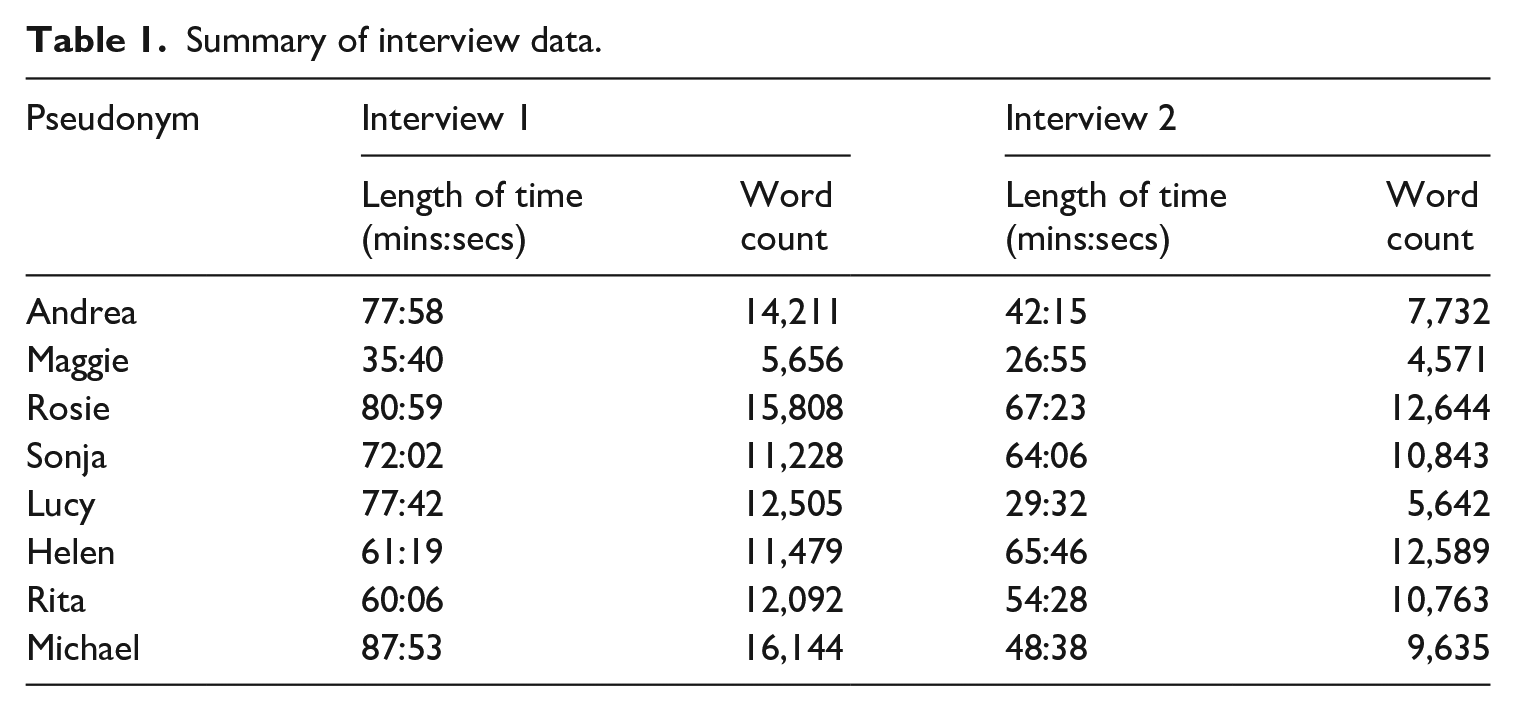
Each interview followed an interview protocol and was conducted via Skype. In interview protocol 1, the questions were grouped into seven main sections: autobiographical background, the Maltese context of English as a foreign language (EFL), the current institutional context, current self, future selves, visual artefacts, and conclusion. Interview protocol 2 was shorter and grouped into four main sections: past week, follow-up to interview 1, being an EFL teacher in Malta, and conclusion.
In the first interview, participants were asked to bring along a visual artefact. The rationale was twofold: First, to get participants already reflecting on the topic before we met for the initial interview; second, this is an approach which allows the participant to take the lead and direct the inquiry towards aspects of their life about which the researcher might not have asked as I was simply unaware, unable to see, or unclear about its role or even existence (Mannay, 2016). As an additional visual tool, it took us beyond the limits of researcher knowledge and prior interview boundaries and provided a richer, individualistic perspective on the topic. For ethical reasons, the visual artefacts themselves were not utilized as visual data but merely served as a prompt to a richer discussion in the interview guided by the participant.
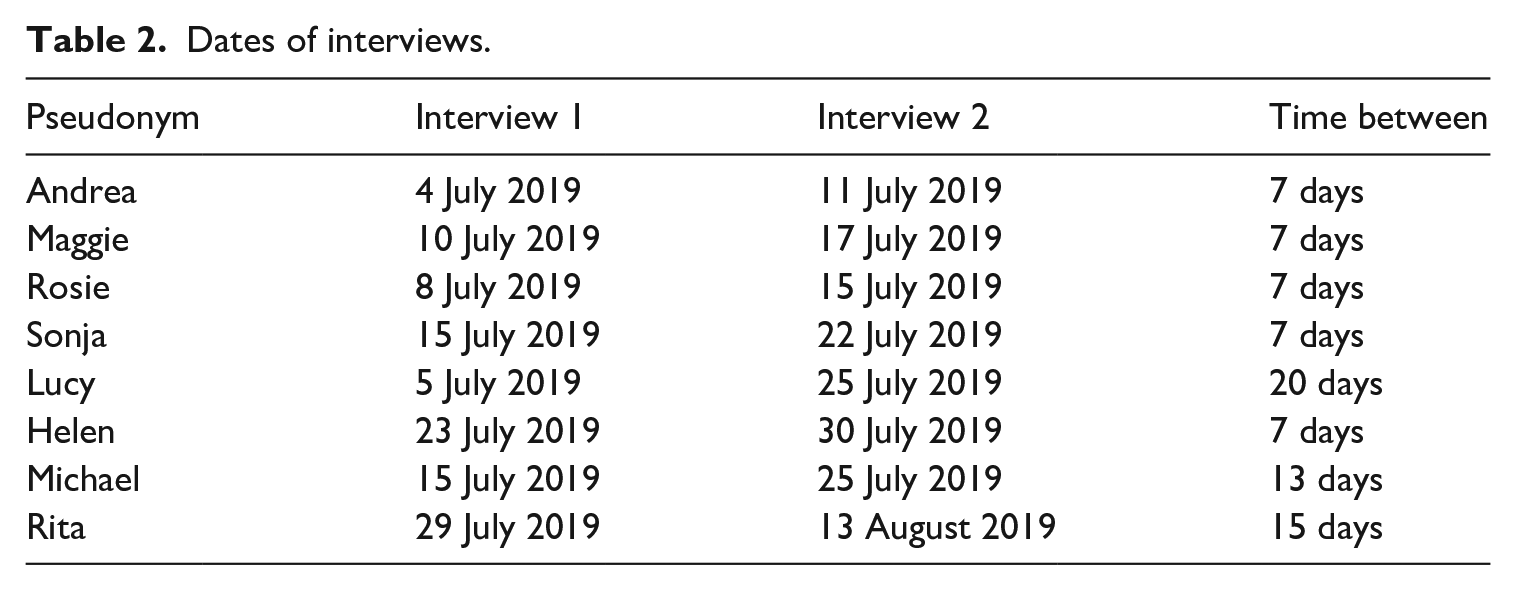
For the second interview, participants were asked to make some ‘brief notes every day of things that happen which affect your wellbeing positively or negatively’. Doing this supported participants’ memories of daily events and so reduced the amount of detail forgotten, enabling an insight into participants’ wellbeing in respect to their daily lives. Once again, these data were considered private for participants to reduce the amount of intrusiveness of the study and were merely used as a prompt and aide-memoire within the second interview. Nevertheless, three participants shared their notes with me but they have not been included as data for analysis. For details of the interview dates, see Table 2.
Dates of interviews.
2 Research context
Data were generated with English language teachers working in the private sector in Malta. A notable part of Malta’s economy is dedicated to English language teaching (ELT) (ELT Council Malta, 2018). In 2018, the Maltese statistics office (2019 Press Release) reported that 87,112 foreign students attended local licensed ELT schools. The report states that 1,028 teachers worked in the private sector industry. Malta presents a unique ecology with a significant private ELT community, which is ideally suited to exploring diverse types of schools and institutions within a similar national language teaching ecology.
3 Participants
In order to recruit participants, an email was sent to the Maltese ELT Council, which is a monitoring and support body for all private language schools in Malta. They forwarded the request for participants to heads of schools. In sum, eight teachers opted-in by contacting me and all volunteered to take part in the study. Naturally, this population is skewed by their willingness to participate and by the fact their school did indeed forward the email. During the interviews, it became apparent that some participants had suggested participation to each other. This means that a degree of criticality must be maintained about the specific sample involved in this research, and it is clear that they are not representative of the population as a whole given their ‘opt-in’ status. However, as Stake (1995, p. 4) argues in respect to the selection of a case, ‘The first criterion should be to maximize what we can learn.’ I believe the reliability and willingness to reflect and share their thoughts and experiences made these participants ideal candidates to help me understand their wellbeing and the situation of language teachers working in the private sector in Malta.
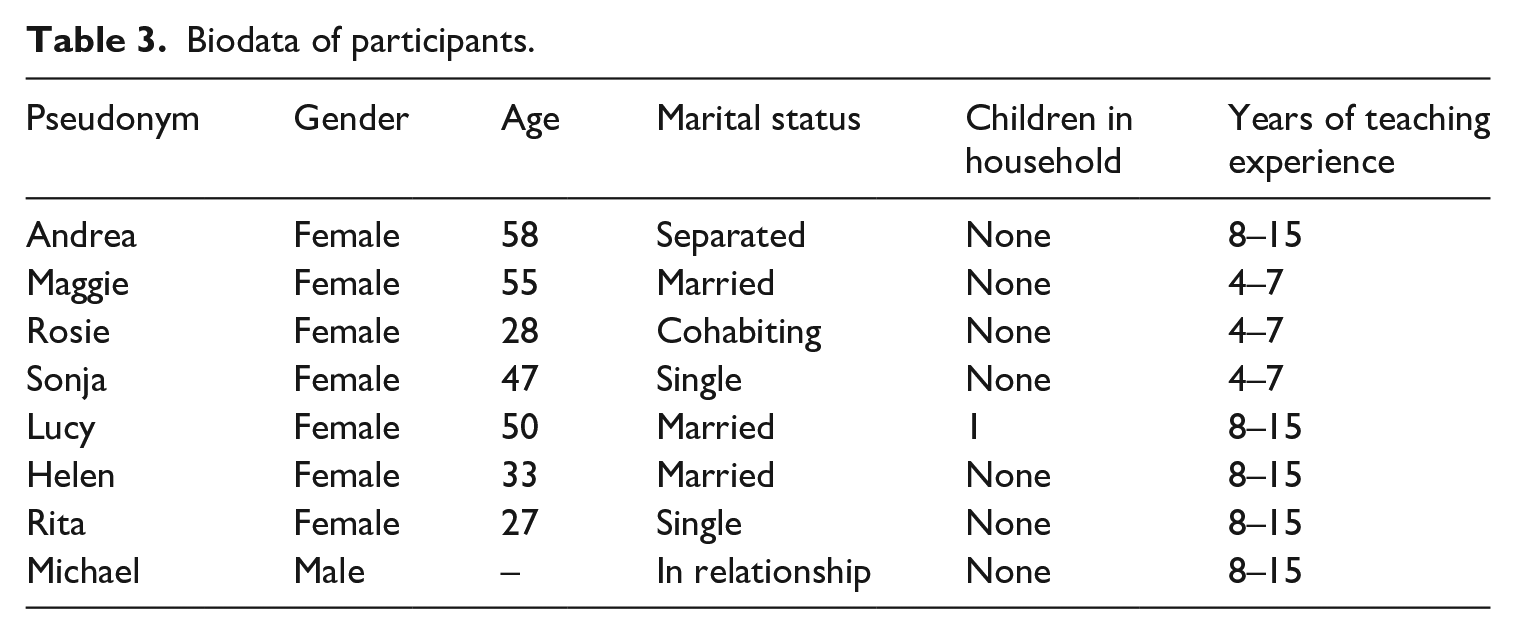
Before the first interview, participants were asked to complete a basic biodata questionnaire to help understand the context of their work and personal factors, which might affect their wellbeing as language teachers. Table 3 shows the basic information about the teachers.
Biodata of participants.
4 Coding and analysis
Data were recorded and transcribed for content. The transcripts were uploaded to Atlas.ti as one hermeneutic unit, with each case’s interviews organized sequentially and kept together, albeit in separate primary documents. This enabled the data to be examined case-by-case, across time, and as a data set as a whole.
The data are analysed following an Interpretative Phenomenological Analysis (IPA) approach, which is especially well suited to ‘the detailed exploration of personal meaning and lived experience’ (Smith & Osborn, 2015, p. 25). It acknowledges that, ‘the researcher has to interpret people’s mental and emotional state from what they say’ (Smith & Osborn, 2015, p. 26). Although there is an interpretative cycle in IPA which involves ‘intensive engagement with what the participant is saying’ (Smith & Osborn, 2015, p. 29), I chose to combine it with a line-by-line coding process to ensure a more critical analysis, which remains even closer to the participant’s perspective and actual words (Charmaz, 2015). Before analysis began, I re-checked the transcriptions and read all the data several times to ensure I was fully familiar with it. Next, Following the IPA format, the analysis began by looking at one case in depth through multiple waves of coding before moving on to the next case. Then multiple waves of coding and extensive memoing was conducted for each case beginning with line-by-line coding and with gradual increasing levels of thematic abstraction until all cases were analysed individually. This was repeated until the ‘point of saturation’, which means no notable new lines of thinking or codes could be applied (Charmaz, 2006). Finally, the whole data set was re-examined with the creation of clusters of themes drawing on the themes and superordinate themes from across all of the individual cases.
5 Ethics
This study raises several ethical concerns given the time commitment it requires from participants at two separate points, the possibility of generating feelings of discomfort given its focus on wellbeing, and the potential to produce sensitive data about the individual’s workplace and colleagues. To counter these concerns, data has been treated confidentially, stored securely and anonymized immediately at the point of transcription (BPS, 2009). This meant assigning pseudonyms and changing names of institutions. Obviously, it was not possible to disguise the location of the study (Malta) and participants were made explicitly aware of that in the initial information sheet. Participants were provided with detailed information about the study beforehand and the opportunity to ask questions so that their written consent was as informed as possible (Oliver, 2010). They were also cautioned that if they had or were suffering any mental health issues or feared that talking about their wellbeing would be unduly uncomfortable, then they were advised not to take part.
IV Findings
In line with the ecological perspective underlying this article, the findings are organized according to the ecologies in which the teachers live and work. I have chosen not to use the terminology as employed by Bronfenbrenner (1979) but wanted to make the findings as explicit and concrete as possible although these contexts do reflect the same levels of ecologies. Under each ecological heading are subheadings representing the main themes, which emerged from the analysis. To illustrate the findings, extracts from the interviews are used. These are chosen on the basis of their conciseness and suitability for illustrating the issue under consideration. Each data extract is labelled describing the name of the participant and whether it was from their first interview (I1) or second interview (I2).
1 Ecology of the (Maltese) ELT industry
In these data, the teachers referred to aspects relevant to their wellbeing which connected to the ELT industry globally and, in some cases, specifically in Malta. This distinction is made explicitly when relevant.
a ELT as an industry
A key issue to understand for the wellbeing of these educators is that these teachers are working in companies that are run on a for-profit basis. Linguistically, this is notable in the kind of language that the teachers use to talk about their jobs. For example, Andrea talks about courses offered as ‘products’ (I1) and three of the teachers (Maggie, Rosie, and Lucy) talk throughout about their ‘clients’. Helen, Sonja, and Michael also discuss issues with ‘bookings’ and the tension between what customers’ expectations are when they book a course (or product) and the reality that the teachers have to deliver.
This tension between a business model and teachers’ values as invested educators was a notable concern for both Helen and Rita. Rita describes the competing priorities (business versus teaching) as being in a stressful ‘push–pull’ relationship (I1). She explains, ‘I hate when we keep, uhm, the priority based on the, the school and the money we make as opposed to what the students need’ (I2).
b The status of ELT teachers
A problem that all of the teachers except Lucy explicitly referred to is the status of ELT teachers. Some refer to this status globally but the focus is very specifically on ELT teaching in the Maltese context. Michael outlines the problem: I think, um a key reason is that here in Malta for many people, teaching is not really seen as a career, but more as a sort of stepping stone, or something on the side, as you work towards your main thing. (I1)
Rita describes having to explain her career choice and seemingly defend a job that people look down upon or do not take seriously, especially in light of the qualifications it took to be in this position: The main problem with that is that, as I said, it’s considered to be a summer job. And so, when you’re actually that person who wants to do it throughout the year. You know, most people don’t really get it. And that can be a bit demotivating, because, you know, in order to get to where I’ve gotten, there were six years of education. (I1)
However, Andrea was optimistic that, ‘It is getting more respected than it was’ (I1), and Maggie too has perceived a change in how people perceived the profession over time.
This issue of the status of ELT teachers is inextricably linked with the problems of teacher recruitment and retention. In Malta, in the summer months, the student population explodes and there is a need for temporary ELT teachers to cover the influx. This leads to teachers who just come to work those months and whose level of qualifications and commitment to the profession are variable. Helen describes how such teachers can end up giving all teachers ‘a bad name’ (I1).
The poor working conditions, lack of union representation, zero hours contracts, lack of job security, and low pay are cited by all the teachers as contributory factors to the poor perceived status of the profession. These factors are also listed as frustrations, disappointments, and stressors for all of the teachers to varying degrees. Indeed, this coding category was the second largest and a salient theme across the data. For example, Sonja states, ‘It’s the lack of a union that backs people up, in case there’s some kind of labour dispute’ (I1), and she explains how the zero hours contracts leads to many teachers, for example, being unable to take out bank loans.
Specifically in Malta, the rising living costs combined with the low levels of pay have further exacerbated the financial problems faced by many language teachers on the island. Rita explains that, ‘it’s becoming exceedingly difficult to live on the kind of money that’s being made in the – in the industry’ (I1). Lucy elucidates how subsequently many teachers are leaving the profession to work in the gaming industry which generally has better pay and working conditions (I1). It is notable that four of these teachers (Rita, Sonja, Helen, and Michael) have an additional job to make ends meet. Sonja explains the toll this can take on her; ‘I have two jobs, and so, and so I don’t have a lot of time for socializing’ (I1).
c Maltese regulations
To counter the problem of the poorly qualified, temporary staff, the Maltese authorities have introduced a number of measures to ensure quality and protect the professionalism and reputation of their ELT industry. One regulation is that teachers must be licensed. This licence is renewed every four years, but to do this, teachers must prove that they have attended at least eight hours of Continuing Professional Development (CPD) training per year (32 in total).
On the whole, these teachers were generally supportive of this measure. As Andrea said, ‘this is a great place for growth’ (I1). Indeed, the potential to continue learning and growing as an educator was a positive theme for all the teachers. Given that these teachers volunteered to take part in this study, it is perhaps not surprising that they were especially dedicated and keen on professional development with most of them (except Maggie, Sonja, and Andrea) taking some sort of further qualification at present or planning one in the near future.
However, the crux of the CPD issue was whether teachers were given time off to attend this and whether it was paid for by the institution or had to be self-funded. Andrea greatly appreciated the situation in her context and explains that, ‘Other schools, you have to pay for your CPD hours. This school provides it free of charge, I do the training. Plus, the teachers get paid at admin hours – admin rates to attend’ (I1). This was not always the case across the schools. Lucy explained her reasons for leaving her previous job as follows: ‘this school mentality where they don’t believe in CPD. You know, they don’t believe in teacher development. And I couldn’t go any further with them’ (I1). She also noted how much personal money she had spent over the years on CPD.
2 Ecology of the school
The school itself was defining for how these teachers described their wellbeing. Although this focus is doubtless due in part to the interview protocol, teachers frequently compared their school with other schools, which may be due to the high mobility with teachers frequently switching schools if a better offer or improved working conditions are presented elsewhere on the island.
a School culture
All of the teachers talked about the atmosphere, culture, or ‘vibe’ in the school they worked. The defining features of this culture varied. At larger schools, there were explicit corporate policies such as a ‘core values’ charter (Andrea, I1). In smaller schools, such as Maggie’s, the size was perceived as being beneficial for forming a strong sense of belonging and connectedness among staff. At all the schools, how staff felt they were treated, valued and communicated with appeared to be especially impactful for their wellbeing.
A key aspect of the culture in a school stems the quality of staff relationships. Sonja described the positivity in her school in terms of, ‘how accommodating some people are . . . the atmosphere’s convivial and friendly’ (I1). Rita too felt the ‘vibe’ in her school came from the colleagues: ‘I feel that our colleagues are – are all pretty much, you know, we’re willing to help each other’ (I1). Indeed, the notion of sharing materials with each other and supporting each other in teaching preparations was a key part of collegial rapport. Michael also contrasts his experiences across different schools and stresses the criticality of good staff relationships: the kind of morale and the mood and the atmosphere in the staffroom is always positive. We don’t get these cliques and, you know, groups forming and and, you know, there’s, everybody gets on with everybody. People help each other out. And it’s just a really friendly place to be which is not, has not always been the case in the schools where I’ve worked in the past. (I1)
b Relationship to boss/management
Naturally, a key figure, who made a considerable impact on the school culture, was the head of school (Director of Studies, or DOS). As Michael explained: the current DOS that I have is the best one that I’ve had and I feel that she, she sets a good example, and, um, she’s very fair and consistent with all of us [. . .] She’s (very) hard-working as well, so I, I appreciate that and that’s a big reason why I stay. (I1)
The bosses enacted this relationship through small daily encounters as well as through bigger gestures, most notably, support for staff CPD as well as attitudes towards scheduling and planning. Rita highlights how positive it can be when the staff feel listened to and treated with respect, especially regarding schedule planning, which was cited as an issue for at least four of the teachers (Sonja, Rita, Rosie, and Lucy): So I always feel like the positive vibe . . . there is an element of respect which goes both ways, that if you give us enough time in advance, we can make exceptions and work around this – you – your schedule. Whereas for previous schools I felt very much like you were a number. You go in. You go out. And that’s that, so. (I2)
In addition, the importance of feeling appreciated was mentioned explicitly by all of the teachers except Andrea. Rita explains her experience of this: We aren’t as appreciated as I think we should be. In the sense that there’s – there’s no element of the school doing anything, or any increment given to us, for like, you know, ‘Good job! Well done for – for you know, doing summer time, for being available to us.’ So I guess that sometimes tends to be a bit demoralizing.
c Scheduling
One of the greatest stressors for those who were teaching and in various administrative roles (Andrea, Maggie, Helen, and Rita) was the extreme short notice at which they might be called on to cover for absent teachers. All of them (plus Michael who had done this in the past) referred to this problem. Helen explains how she experiences it: I really – I really really – really like being in the classroom. So, but – but I also – I also dislike being called on. To drop in. That really st – I find it very stressful. It doesn’t – I don’t think it matters. How long you’ve been teaching. Being told to go into a class. And what you weren’t expecting it. And you got fifteen minutes. Five minutes, even sometimes, you know, less. I find it highly stressful. (I1)
This practice is a consequence of the bigger problem of a shortage of staff at many schools in the summer months.
d Physical space and resources
The final aspect of the school that was notable for wellbeing across the data is the physical setting and the resources available for staff. Rosie in particular reported working in a building of poor quality, which is not well maintained and in which repairs are not immediately (if at all) attended to, and with very little space or staffroom to speak of. She feels that these poor physical conditions communicate a disregard for the staff as professionals (I2). Sonja too outlined the poor conditions at a previous school she worked at and how this contributed towards her ultimately leaving that position.
Similarly, Michael describes the very poorly stocked staff library and how he feels this is an expression of disrespect for the professionalism of the educators: And really, it – I think it’s just the same sad collection of books. That’s – that’s been used every summer for the past fifteen years [. . .] And for me that’s just completely symptomatic of the attitude that I’ve sort of detected in a lot of language schools which is one of complacency really. (I2)
In terms of resources, a key issue appears to be technology. Although Andrea and Lucy took pride in describing the technology used in their schools, others were less fortunate. Helen was working partially in management and found that the old age of the computers and system as a whole made her work even more frustrating and time-consuming than it needed to be (I1). The lack of technology for teaching was also frustrating for Rita, who interpreted this lack of investment from management, as another sign of disrespect for teachers and their professionalism: And, uhm, so I probably get angry at my own school for not investing in it because for me that should be one of the main priorities that our school should invest money in and we’re a language school over and above everything, as we offer, and this is also sort of sending a message to other teachers: ‘Listen, you aren’t worth the investment.’ (I2)
Another resources theme concerns the use of prepared materials. All the teachers except Maggie and Sonja explicitly explained that materials and projects were pre-prepared or coursebooks had to be followed in their teaching. For the most part, this seemed to be a positive thing alleviating stress, reducing preparation time, and helping when a teacher had to cover another class at short notice. However, Michael noted how with several years of teaching experience, the rigidity of following a set coursebook felt like an infringement of his autonomy and frustrating in not being allowed to use his own creativity.
3 Ecology of the teaching experience
All of the teachers taught in part. However, at present, Maggie and Helen only taught when they needed to substitute, and their primary roles were now in administration. The teaching and professional roles for all of the participants were simultaneously sources of both positivity and stress.
a Working hours and pace
Across the data, perhaps the most notable problem is the sheer amount of time that is spent at work (including for those in a management role) or in contact hours in the classroom and the relentless pace of work. This is especially acute in this context given the seasonality of the work with very intense summer months (note: the data were collected in July). Andrea discusses her incredibly long working hours and the lack of any break for coffee or lunch and concludes, ‘I cannot work at this pace much longer’ (I1), ‘I just want – need to slow down a bit’ (I1). In a previous position, Rosie had reached such a point of exhaustion, which led her ultimately to quit her job: In the bone exhaustion of ‘I don’t actually care.’ I’m walking into my classroom thinking ‘I don’t care. I don’t care why you’re here, I don’t care who you are, I just want to go back home and go to sleep.’ (I1)
Maggie was one exception as she actually reports enjoying the fast pace in the summer months and feels a bit of a dip in energy when the winter months approach. Rita too also noted that the fast pace was in part enjoyable; yet, she also notes exhaustion which was an explicit key theme for the majority of the teachers working full-time (Andrea, Rosie, Lucy, Helen, and Rita).
b Relationship to learners
All of the teachers reported drawing positivity from their relationships to their students whether language learners or teachers. Four of them (Rosie, Lucy, Rita, and Michael) commented on how even when they were in low spirits or a bad mood, after being in class for some time, they found they felt more positive. As Michael expresses it, ‘even on the very worst days, somehow whenever I go into class and start teaching, teaching has this incredible ability to help you forget your problems temporarily’ (I1).
A specific source of positivity in respect to learners was seeing them make progress and being able to help them to achieve their goals. ‘But the main thing that made me happy was that they all said that they felt they were improving and that they were learning a lot. And that for me is the key thing’ (Michael, I1). Rosie explains that no teacher in their position does the job ‘for the money’ (I1), but rather they appreciate doing something meaningful, seeing students enjoy language learning and make positive progress, and being able to help them.
A problem three teachers (Andrea, Sonja, and Lucy) noted was starting with a class and then for scheduling reasons being moved from the group. Sonja explained how this feels for staff and students: It affects me, because it affects the learners so much. They build – you know, you – you build rapport, build rapport, build rapport. They’re starting to trust the teacher, starting to get my style . . . and then, you know, you work the rug out and you lose somebody new and you have to warm that new person all over again. It’s – it’s demoralizing and frustrating for teachers and – or for – for students. (I2)
c Critical incidents
Although relationships with learners were a key source of positivity, they could also potentially be a source of stress. Several teachers (Rosie, Michael, Lucy, and Helen) cited specific critical incidents with students. For example, Michael found it difficult without any training or preparation to be working with a student who seemed to have an anxiety disorder. Lucy explains how some students ‘drain’ her: Mentally – I feel mentally drained. When I come home. You know, with teaching. I have – I really give a lot of energy. But some students take more than necessary. (laughs) You know? So they deplete me. (I1)
A particular difficulty with students appears to stem in part from the character of the private sector. The teachers felt that sometimes the student expectations were hard to meet and did not always match teacher expectations. Sonja describes this situation: This is the expectation of students, like a bunch of baby birds in a nest. This doesn’t matter if it’s teen-learners, beginners, adults, whatever, they always think if I pay money to go to a language school, this is exactly what’s going to happen. They’re just going to feed this stuff into me and all of a sudden I’ll be able to ((snaps fingers)) learn English, no problem. And I think that this is the misconception that a lot of for pay, you know, there’s an expectation. (I1)
In addition, as paying customers, the students also often complained, not only about the school and classes but about issues with their trip more generally. The teachers or administrators bore the brunt of these complaints. In particular, Helen described feeling exhausted and frustrated with student complaints, and Rita, who straddled a teaching and administrative role, described the stress of dealing with staff complaints, ‘it’s always the same kind of complaints, they sort of run me down’ (I1).
V Discussion
The findings in this study were surprisingly homogenous in terms of themes, although the individual experiences varied. It was reassuring that, despite problems in the context, there were also many positive experiences reported and aspects of the context which boosted the teachers’ wellbeing. In this section, I will discuss four main themes for wellbeing emerging from the findings: The consequences of working as an ELT teacher in a profit-driven industry; the notion of status; the issue of time; and the personal variation and individuality across the data.
1 ELT industry versus ELT profession
Perhaps the most pervasive issue across the data for wellbeing concerns the profit-driven agenda of the schools and industry as a whole. Many of the problems teachers face appear to stem from the drive to maximize profits, potentially at the cost of teacher job satisfaction and wellbeing. This was reflected in a number of issues including low pay, poor working conditions in terms of job security, sick pay, or pensions, lack of investment in teachers and their resource needs, understaffing, and untenable working hours.
A term that has appeared in the literature is ‘precarity’, which Walsh (2019, p. 1) defines as, ‘a condition resulting from an employment regime in which deregulated labour markets give rise to various types of insecure work; in which social protections are minimized; and in which the ability to plan a coherent future is compromised.’ This term would most certainly apply to the conditions reported by many of these teachers, although the situation is clearly not only applicable to Malta. For example, some of the conditions reported by these teachers were also present in a survey conducted in France with 800 teachers in the private ELT sector. They found, for example, that teachers were also poorly paid, had no job or financial security, and were not entitled to holiday pay or unemployment benefits (Wickham, 2015). Only 57% of the French teachers had experienced any CPD in the last two years and a third of all French teachers had no qualifications at all (Wickham, 2015). In contrast, all the teachers in Malta were generally positive about CPD opportunities and they all had various levels of professional qualifications. However, a caveat is that if CPD comes at the teachers’ own costs in terms of finances or time, then the attempts to strengthen the professionalism of the community may unintentionally be aggravating the precarious financial situation of the teachers.
In contrast to some other ELT settings and possibly some of those who maybe just come to teach for the summer in Malta (see Copley, 2019), none of these teachers voluntarily embraced any aspect of the job precarity. On the contrary, these factors were considerable sources of dissatisfaction across the participants and possible reasons many of them may ultimately leave the profession. In addition, for at least two of the teachers, the mismatch between their personal educational values and the business model and ethos of the school appeared to be having a negative effect on their wellbeing (Skinner et al., 2019).
In terms of the effects of such working conditions on staff wellbeing, Baines et al. (2014) show that precarity in the non-profit sector appears to be linked to higher levels of stress, burnout and health-related problems; a finding reiterated by Fanelli et al. (2017) who emphasize the emotional toll that workplace precarity places on individuals. The precarity of the teaching profession more broadly has been noted by Codd (2005, p. 193), who has argued that ‘economic rationalism and managerialism, combined with commercialization and globalization, have produced an erosion of trust and a degradation of teaching as a profession.’ It is possible that precarity and lower status in the teaching profession are becoming more commonplace, not only in the private sector but beyond more broadly as a result of neoliberal education policies (see Bullough, 2016; Fanelli et al., 2017).
Finally, there has been extensive research which shows that long working hours and excessive workload are key contributory factors to teacher burnout and teacher attrition directly and indirectly through emotional exhaustion (e.g. Kokkinos, 2007; Näring et al., 2006; Skaalvik & Skaalvik, 2011). Given that exhaustion was one of the most frequently assigned codes across the data, this was clearly an issue for many of these educators; a situation perhaps exacerbated by the widespread understaffing in the critical summer months.
2 Status
Across the data, the teachers engaged in all kinds of social comparison processes across perceived hierarchies including across individual schools, the type of courses taught, the level of qualifications held, age/experience, and whether core/peripheral staff. For example, there was an implicit hierarchy in terms of the types of courses taught and level of learners worked with as Maggie outlined: ‘I think yes, there’s a big scope of going from um, the junior school up to the adults up to business, up to the Cambridge exam preps and things like that’ (I1). Michael also suggested that moving from teaching language courses to teacher training was a step up the perceived hierarchy: ‘I do feel a little bit unhappy saying that I’m a teacher. And I try and kind of embellish by saying “Well I’m a teacher trainer” ’ (I1). Stemming from social comparison theory (Festinger, 1954), it is possible that engaging in downward comparisons may buffer these teachers’ self-esteem by focusing on their own ranking within the school hierarchy and thereby countering the overall low perceived status of the ELT profession (see Fiske, 2011). The positive effect of such social comparisons in the workplace was found, for example, by Brown et al. (2007) who showed that downward social comparisons were positively related to job satisfaction and affective commitment. Buunk and Ybema (1997) also stress the importance of professional status and prestige for wellbeing, and they highlight how the lack of career prospects threatens wellbeing by making it impossible for people to gain more prestige and higher status. Indeed, the absence of career progression opportunities seemed to be a contributory factor to several of these teachers leaving or planning to ultimately leave the profession.
However, the findings were not all bleak and individual schools showed that they could counter industry trends and problems at the global and national level by providing a positive school environment and work climate. The importance of school culture on staff wellbeing, job satisfaction, and rates of burnout has been evinced in a number of studies (e.g. Burns & Machin, 2013; Grayson & Alvarez, 2008; Malinen & Savolainen, 2016). It highlights the importance of schools ensuring that staff are listened to, respected, given autonomy, and provided with appropriate professional spaces and resources. In addition, as was the case for these teachers, a notable body of research has shown the role of teacher–student relationships for teacher wellbeing and job satisfaction (e.g. Collie, Shapka, & Perry, 2012; Spilt, Koomen, & Thijs, 2011; Veldman et al., 2013), and thus allowing teachers to teach their preferred groups of students (five of the teachers expressed such a preference) would be one possible way to strengthen and boost teacher wellbeing.
3 Time
The feeling of time pressure caused by long working hours and the intense seasonal character of the work was a notable theme across the data. All the participants felt that they were under a strain to find sufficient time to enjoy non-work activities such as hobbies, socializing with friends and family, or doing exercise, especially in the summer months. Sullivan (2014 referring to Coser, 1974) talks about ‘greedy institutions’ making competing demands on employee time and energy to the extent to which it impinges on family, free time, and leisure threatening wellbeing and risk of burnout. Although referring to higher education, she makes an impassioned plea for workplaces to become more family-friendly and work-life balanced. Indeed, research by Seidman and Zager (1991) shows how engaging in a hobby can be an effective coping strategy for teachers to help to prevent burnout.
VI Conclusions
This study took an ecological perspective to investigating the wellbeing of ELT teachers working in the private sector in Malta. It revealed how the working conditions and status of the ELT profession in Malta are defined by its business model character. For the teachers, this very often means precarity in terms of the job and future prospects as some schools focus on profit at the cost of teacher wellbeing. Yet, research suggests that higher staff wellbeing leads to improved workplace performance and lower rates of turnover, which together are good for overall organizational health and collective wellbeing (e.g. Cotton & Hart, 2003; Page & Vella-Brodrick, 2009; Wright & Cropanzano, 2000); a message that school owners and upper managers need to understand.
Small steps are being taken to tackle some of the precarity issues in the field such as the establishment of the TEFL union in London and the attempts in Malta to regulate the profession; however, on a global scale, the wider profession needs to be engaging more proactively in critical discourse and holding ‘the industry’ side of the field to account. The effects of the practices in the private sector are felt across the profession. To understand this, Pennington and Hoekje (2014) describe the interaction of the different levels on which ELT is represented as a form of instruction, a disciplinary field, a profession, a business, and a service. They conclude that, ‘ELT as a field and individual programs where English language teaching takes place can be viewed not as unitary enterprises but as an ecology’ (Pennington & Hoekje, 2014, p. 172). As such, the whole ELT community including school owners, policy makers, academics, and all types of teachers need to be engaged in the debates around the working conditions across contexts, the status of ELT, notions of professionalism (Vu, 2016), and key related topics such as social justice and native speakerism. Systemic change can only happen when all stakeholders and levels of ecologies work together to better the quality of the professional lives of language educators and their students.
Footnotes
Appendix 1
Investigating the wellbeing of teachers of English as a foreign language (EFL) working in private language schools.
Acknowledgements
This article is based on a thesis that was successfully submitted for an MSc in Psychology at Roehampton University, London, online. I would like to take this opportunity to thank the anonymous Language Teaching Research reviewers for their valuable feedback. I would also like to thank especially Dr. Penny Cortvriend from Roehampton University for her kind support and encouragement, and Dr. Daniel Xerri from the Maltese ELT Council for his wonderful assistance in helping me to connect with the ELT teaching community in Malta.
Funding
The author received no financial support for the research, authorship, and/or publication of this article.
