




Abstract
Robotic pipetting stations are becoming increasingly popular to perform a variety of different laboratory analyses, including use of biochemical, chemical, and molecular biology reactions. As molecular diagnostic (MDx) analyses are adapted to pipetting stations, their need for additional resources on the pipetting stations such as heating and cooling will also grow.
We designed and constructed small (< 150 cm2) accessories for use on a popular pipetting station. Both have small footprints and were built using readily available components. The microplate heater could achieve set point temperature within 10 minutes of activation and exhibited minimal temperature variation. The cooler was designed to be a passively cooled resource that could contain up to 15 Eppendorf tubes and maintain the temperature at least 20 degrees below ambient for at least two hours. Both units have been used to automate a coupled series of molecular biology reactions that yield RNA aptamers.
We believe these two devices can be widely utilized with minor modifications of any pipetting station that requires heating or cooling capabilities on the pipetting station's deck.
Keywords
Introduction
The use of popular pipetting stations to perform more complex chemical and biochemical reactions is well recognized since these units can be used for a number of different reactions (1-5). There is a growing awareness that controlled temperature environments existing above and below ambient temperature will be needed if pipetting stations are to fully achieve additional testing capability.
Most pipeting stations units capable of providing a temperature control environment use accessories that heat various size tubes, bottles, microplates, and other laboratory disposables. Some of these utilize heated metal blocks (6,7) while others use recirculating air as the heat transfer medium (2). While these integrated heating devices are readily available for full featured pipetting stations, most are quite expensive and provide only limited capability since they accommodate a limited geometries of disposables.
By contrast, there has only been a very small market demand for cooling capability since most reactions are heated to facilitate completion. Indeed, there are currently only a few examples reported where samples/tubes are actively cooled on a dedicated instrument (8,9) and none exist for use on pipetting stations. Moreover, development of these devices has likely been hampered by the perceived need to use a refrigerant for cooling. While an electrical mechanism which could be used to provide cooling (e.g., Peltier) is well known, actual cooling devices using this approach are not readily available. A third alternative is to use a passively cooled storage unit that gradually increases in temperature with absorption of heat.
Automation of molecular diagnostic (MDx) methods is rapidly evolving as equipment develops (8,10). Early reports of pipetting stations used for automating molecular biology reactions focused on assembly of PCRs (6) and creation of dot blots (11). More recently, pipetting stations have been used for dialysis of PCR products prior to capillary electrophoresis (12) and to set up ligase chain reactions (13). The adaptation of newer reactions such as NASBA (14) onto pipetting stations will impose a need for cooling as well as heating since several components are temperature labile (e.g., enzymes, sample nucleic acid, etc.) and therefore need to be cooled while positioned on the pipetting station. As use of pipetting stations to perform MDx methods become more popular, their requirement for cooling will likely stimulate the development of these accessories.
During the course of automating a multistep MDx procedure, we recognized the need for inexpensive heating and cooling capabilities on a simple pipetting station. It was also apparent to us that due to rigid space restrictions, these heating/cooling device(s) needed a small footprint. We therefore sought to design and build devices with less than 150 cm footprint which could be constructed quickly using simple components. Because the design and construction of the heating and cooling units differs significantly, each will be discussed separately.
Materials and Methods
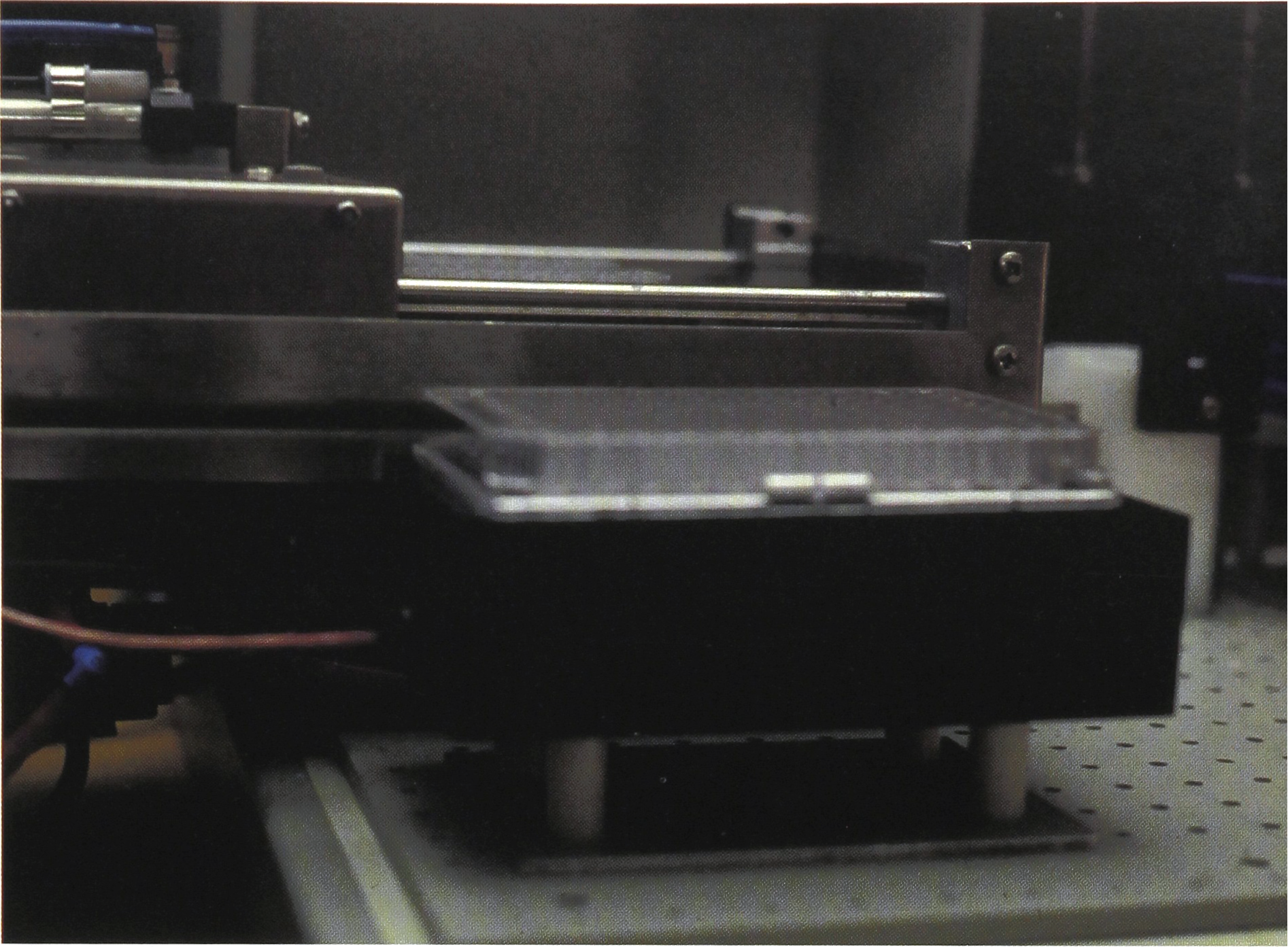
In order to utilize the 104DT's registration pin system, a 104DT micro/small pipet tip rack holder, single (Packard # 7601471) was dismantled to utilize the lower plate with the nylon registration pins. The heater block's rubber mounting feet were removed and the unit dismantled. We next drilled 4 holes for 8–32 flathead bolts (11/2″, 4 cm) within 1/2″ (1 cm) of each comer of the heater's bottom chamber to coincide with the four holes in the rack holder plate. Finally, the pinned registration plate was bolted to the heater chamber using 1″ (2.5 cm) hollow spacers. The heater was then reassembled and connected to the controller unit (Figure 1A).
Thermal heating accessory
Modified Thermal Lok heating block mounted on a the deck of the Packard 104DT. Connecting cord extends from left of heater to Controller (not visible).
One inch spacer dowels were used to elevate the heater closer to the surface of the other devices already on the deck. Use of these spacers was optional and did not affect the unit's operation. Assembly of the completed unit took about two hours including drilling and reassembly.
Cooling Unit. We had a limited requirement for cooling capability on the 104DT's deck. As such, we selected a passive cooling device which was capable of maintaining the temperature of up to 15 1.5 (and 0.6) mL Eppendorf tubes below freezing (minimum of 20 °C below ambient) for only several hours. Warming of the tubes' contents was acceptable after the reaction was completed.
We selected a portable benchtop cooler (“Continental Cooler Minus 20″,# 3593, Continental Laboratory Products, San Diego, CA) because of its minimal footprint (e.g., 100 cm2) to adapt to the 104DT's deck. In addition, several other components were obtained as well from a local hardware store, including a one quart round polyethylene food storage bowl (diameter 7″ (18 cm)), liquid insulating sealant foam (“Great Stuff”, Flexible Products Co, Joliet, IL), and solid 1″ sheet insulation foam.
The base was removed from a 104DT micro/small pipet tip rack holder, single (Packard # 7601471) and attached to the bottom of the plastic bowl using 3/4″ 8–32 flathead bolts and self locking nuts with the nylon registration pins pointed AWAY from the bowl. (The flathead screw heads did not protrude below the registration plate's surface where the nylon pins are located.) Four pieces of 1″ (2.5 cm) foam insulation board were cut to cover the sides and ends of the cooler and glued in a square around the cooler unit using epoxy cement. (Insulation board was NOT glued to the to COOLER!)
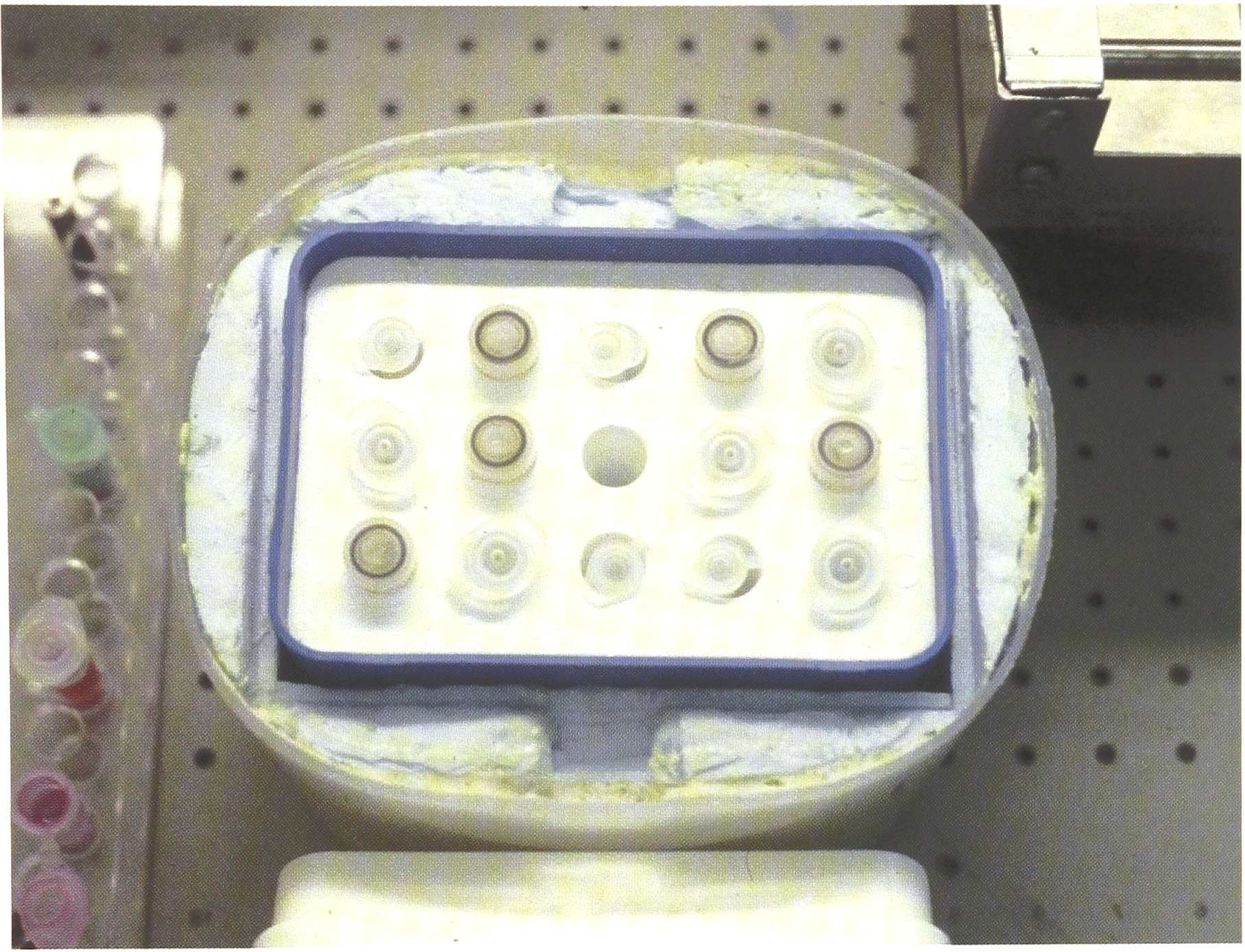
After the glue dried, the exterior of the foam board hollow square was roughly shaped using a file (or band saw) to conform to the interior contour of the plastic bowl. Plastic insulating foam was then squirted around the inside circumference of the plastic bowl, the foam box was inserted into the bowl and positioned at the bowl's bottom. Excess foam was removed after it had hardened. A check was made to determine the Cooler fit snugly into the foam box. Finally, a series of 1/2″ (12 mm) diameter holes (coincident with the 1.5 mL Eppendorf tube holes in the Cooler) were drilled into the Cooler's insulated removable lid (Figure 2). These holes allowed the 104DT's pipet tips to gain access into the 1.5 and 0.6 mL Eppendorf tubes located within the Cooler's chilled environment. After placing the Minus Twenty Cooler in the freezer overnight, the unit was ready to use.
Thermal cooling accessory
Thermal insulating environment for minimizing heat flux to CLP Minus Twenty Cooler. Note modified lid with holes drilled for access by 104DT's pipetting mandrels with disposable tips.
Validation of Thermal Performance
We validated the thermal performance of both devices using a NIST-traceable bead thermistor (# 15-176-48, Fisher Scientific, Pittsburgh, PA) that was connected to a digital readout thermometer capable of ±0.1 °C precision and ±0.2 °C accuracy (# 15078–1, Fisher Scientific).
To evaluate the heater's performance, we used a NUNC 96 well Immulon™ flat bottom microplate filled with 200 uL of room temperature Type I water/well. The filled microplate was placed on the heater, the desired temperature on the Controller selected, and temperatures from selected wells recorded after the Controller was turned on. Heating curves similar to those observed in Figure 1B were observed for these microplates.
To evaluate the cooler's performance, several 1.5 and 0.6 mL Eppendorf tubes filled with 200 uL of 20% glycerol/each were placed into selected wells (e.g., B1 and C3) of the cooler which was then positioned inside the freezer compartment of a combination refrigerator/freezer overnight (temperature = −14 °C). Following storage, the Minus Twenty Cooler was placed into the foam cooler and the temperature of selected vials monitored periodically (Figure 2B).
RESULTS AND DISCUSSION
The ability to provide a controlled temperature environment on a pipetting platform has numerous applications besides those associated with performing molecular diagnostic assays. Our objectives were to develop accessories that could dependably produce suitable thermal environments for our applications and to validate their performance.
As shown on Figure 1B, the heater produces a temperature rise that is quite rapid with the interior wells (e.g., E6 and C9) reaching within 1 °C of set point temperature after 10 minutes of activation. The exterior well (H1) temperature trailed the temperature of the interior wells, however, and never achieved the set point temperature, even though the block temperature had stabilized within 8 minutes (See Fig 1B). Further adjustments of the heater's calibration might have minimized the difference between the interior and exterior wells, although the interior wells E6 and C9 had already achieved the desired set point (e.g., 37 °C).
The temperature performance of the modified cooler is illustrated in Figure 2B. The absence of the insulated lid clearly diminishes the capability of the unit to maintain the contents of the tubes below freezing for an extended period of time. There is an almost immediate influx of heat when the lid is absent as represented by the circle symbols. Regardless of the tube's location (interior or exterior position), heat influx occurred rapidly and resulted in the Cooler's temperature rising above freezing within about an hour after the unit was removed from the freezer.
By contrast, retaining the insulated lid on the unit minimized the heat flux into the unit and delayed the cooler's Eppendorf tubes from achieving 0 °C for almost three hours. This latter performance was deemed acceptable for the cooler unit. The manufacturer's data suggest (results not shown) that beginning with an even lower starting temperature, the Minus Twenty Cooler might be expected to maintain this subzero temperature even longer, although we have yet to determine that time limit.
Literature reports of biochemical procedures configured for pipetting stations suggest that temperature controlled units (mostly above ambient) are an essential element in performing molecular biology procedures (2,5,6). The pipetting stations which were used by the authors in these reports were, however, of more sophisticated design and capability. By contrast, there are virtually no reports of heating or cooling units being used on the simpler pipetting stations. Hence, we chose to construct and evaluate thermal accessories which could inexpensively provide these capabilities.
Recently we mounted both of these thermal accessories along with an onboard thermal cycler (“Progene”, Techne Instruments, Princeton, NJ) onto a 104DT to automate an integrated series of molecular biology reactions (e.g., reverse transcription, polymerase chain reaction (PCR), and RNA transcription). By automating this group of coupled reactions, we have demonstrated that they can generate RNA aptamers (results not shown) which are of interest in therapeutics and other reaction applications (15).
SUMMARY and CONCLUSION
We conclude that these thermal accessories provide the desired temperature control and thermal capacity that is suitable for performing a variety of molecular biology reactions on a simplified pipetting station. These reactions would include restriction digests, ligations, DNAse digestions, RNA transcriptions, some isothermal amplification reactions such as NASBA, and RNA aptamer generation.
These units can be easily constructed from simple components and are capable of providing acceptable thermal control above and below ambient temperature.