




Abstract
The aim of this study is to investigate whether the electromagnetic fields associated with mobile phones and/or laptops interfere with blood cell counts of hematology analyzers. Random blood samples were analyzed on an Aperture Impedance hematology analyzer. The analysis was performed in four ways: (A) without the presence of any mobile phone or portable computer in use, (B) with mobile phones in use (B1: one mobile, B4: four mobiles), (C) with portable computers (laptops) in use (C1: one laptop, C3: three laptops), and (D) with four mobile phones and three laptops in use simultaneously. The results obtained demonstrated a statistically significant decrease in neutrophil, erythrocyte, and platelet count and an increase in lymphocyte count, mean corpuscular volume, and red blood cell distribution width, notably in the B4 group. Despite this statistical significance, in clinical practice, only the red blood cell reduction could be taken into account, as the mean difference between the A and B4 group was 60,000 cells/µL. In group D, the analyzer gave odd results after 11 measurements and finally stopped working. The combined and multiple use of mobile phones and computers affects the function of hematology analyzers, leading to false results. Consequently, the use of such electronic devices must be avoided.
Introduction
It has long been recognized that laptop computers and mobile phones are associated with electromagnetic field emission.1,2 Nowadays, an excessive use of such electronic devices in the laboratory is observed. Consequently, humans and laboratory equipment are exposed continuously to large amounts of electromagnetic radiation.
The harmful effect of electromagnetic radiation on blood cells has been thoroughly studied.3–7 Nevertheless, apart from a study by our laboratory, 8 there are no other bibliographic data concerning the effect of electromagnetic radiation on the measurements of hematology analyzers. The only relative reference concerns the effects of electronic noise on the function of hematology analyzers. According to these studies, electronic noise is a source of error in blood cells count,9–11 but it still remains uncertain whether electronic noise comprises electromagnetic radiation.
The aim of this study is to investigate whether the electromagnetic fields associated with mobile phones and/or laptops interfere with the blood cell counts of hematology analyzers.
Materials and Methods
Eighty random blood samples were collected in 3-mL BD Vacutainer tubes (Becton Dickinson, Crowley, UK) containing 5.4 mg dipotassium EDTA anticoagulant. The samples were processed in their fresh state. All samples were taken in the morning to control circadian rhythmic influences on the counts. All samples were analyzed on the aperture impedance hematology analyzer Mindray BC 3200. The analysis was performed in four ways: (A) without the presence of any mobile phone or laptop in use (control group) and (B) with mobile phones in use (B1: one mobile, B4: four mobiles). In addition, 50 of these samples were analyzed: (C) with portable computers (laptops) in use (C1: one laptop, C3: three laptops) and (D) with four mobile phones and three laptops in use simultaneously. During the measurements, the distance between the hematology analyzer and the electronic devices (portable computers and mobile phones) was less than 30 cm.
The following hematologic parameters were studied in all blood samples:
White blood cell count (WBC)
Neutrophil count (NEUT)
Lymphocyte count (LYMPH)
Median population count (MED)
Red blood cell count (RBC)
Hemoglobin (Hb)
Mean corpuscular volume (MCV)
Red blood cell distribution width (RDW)
Platelet count (PLT)
Mean platelet volume (MPV)
Platelet distribution width (PDW)
Statistical Analysis
Data were analyzed using SPSS 16 software for Windows. Normality of continuous data was determined. For comparison among groups, a paired-samples t test or Wilcoxon signed ranks test was used for parametric and nonparametric tests, respectively. To study the possibility of gradual alteration of the parameters, a one-way analysis of variance test was used. A two-tailed p value <0.05 was considered statistically significant for all comparisons.
Results
Mean values of the previous mentioned hematologic parameters are shown in
Tables 1
Mean values of hematologic parameters in groups A and B (n = 80).
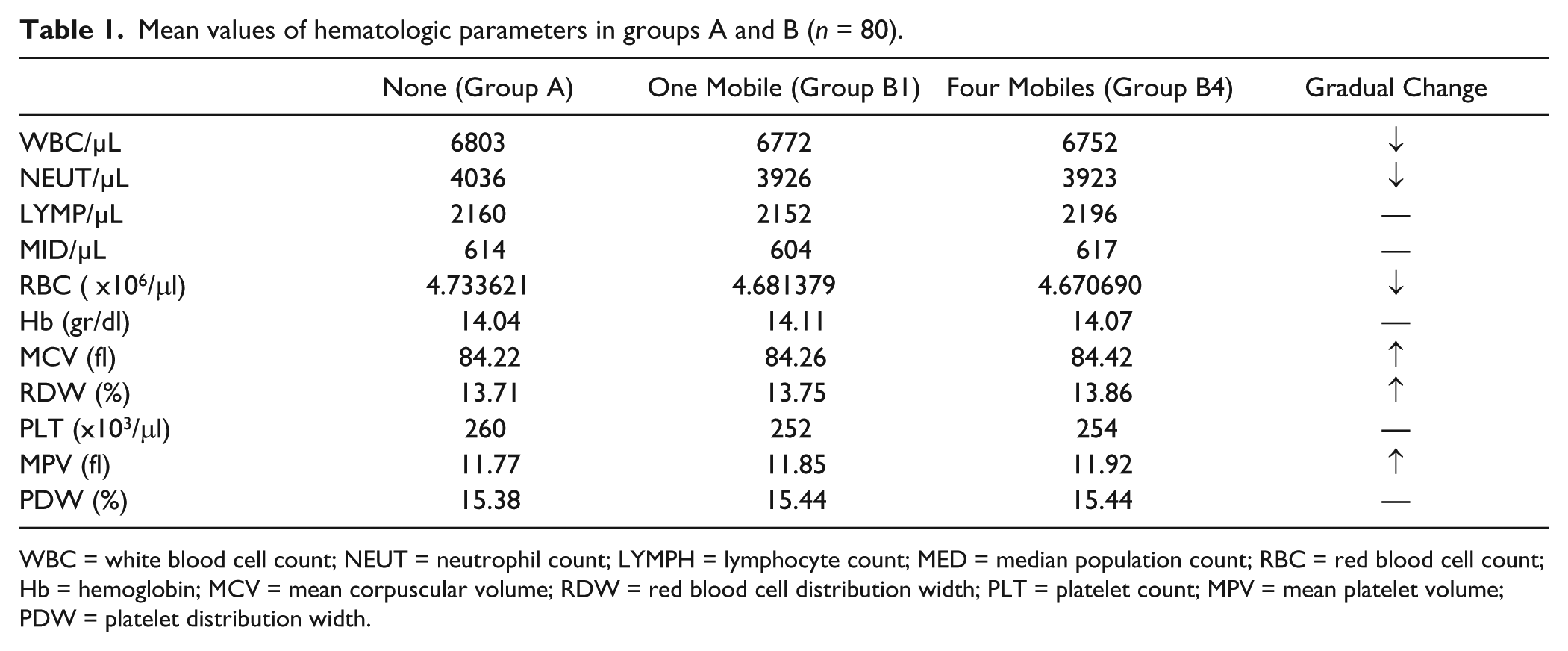
WBC = white blood cell count; NEUT = neutrophil count; LYMPH = lymphocyte count; MED = median population count; RBC = red blood cell count; Hb = hemoglobin; MCV = mean corpuscular volume; RDW = red blood cell distribution width; PLT = platelet count; MPV = mean platelet volume; PDW = platelet distribution width.
Mean values of hematologic parameters in groups A and C (n = 50).
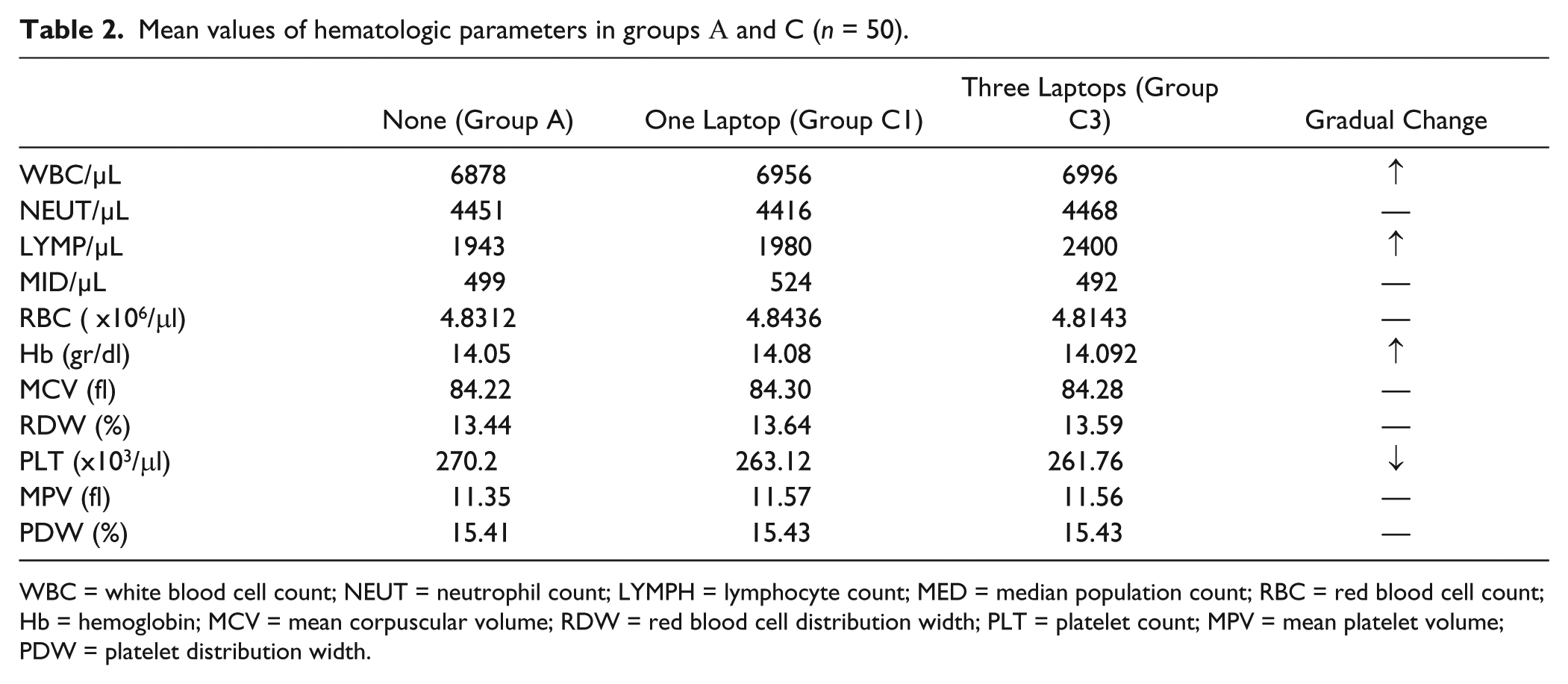
WBC = white blood cell count; NEUT = neutrophil count; LYMPH = lymphocyte count; MED = median population count; RBC = red blood cell count; Hb = hemoglobin; MCV = mean corpuscular volume; RDW = red blood cell distribution width; PLT = platelet count; MPV = mean platelet volume; PDW = platelet distribution width.
In group D (simultaneous use of mobile phones and laptops), after 11 measurements the analyzer gave odd results and finally stopped working. Thus, blood cell counts in this group did not continue.
The results of groups B1 and B4 were compared between them, as well as with those results of group A. Similarly, the results obtained from groups C1 and C3 were also compared between them as well as with those of group A. The following results were observed.
There was not a statistically significant change in the counts of white blood cells, median population, Hb, MPV, and RDW.
In contrary, the following were observed ( Table 3 ):
Group B4 (use of four mobiles phones simultaneously) was the only group in which a statistically significant decrease in neutrophil count (p = 0.028) and in RBC (p = 0.012) and an increase in lymphocyte count (p = 0.018) was observed.
There was a progressive increase of MCV values with the use of mobile phones. The most significant increase has been shown in the B4 group (p = 0.000).
A gradual increase of RDW values has been demonstrated with the use of mobile phones. The most significant changes were observed in the following groups: B4 (p = 0.018), C1 (p = 0.001), and C3 (p = 00.003).
A statistically significant decrease has been observed in PLT count in the following groups: B1 (p = 0.001), B4 (p = 0.001). In contrary, there was an important increase in PLT enumeration in the C1 group (p = 0.022) and in the C3 group (p = 0.005).
Statistically significant comparisons of blood count parameters between groups.
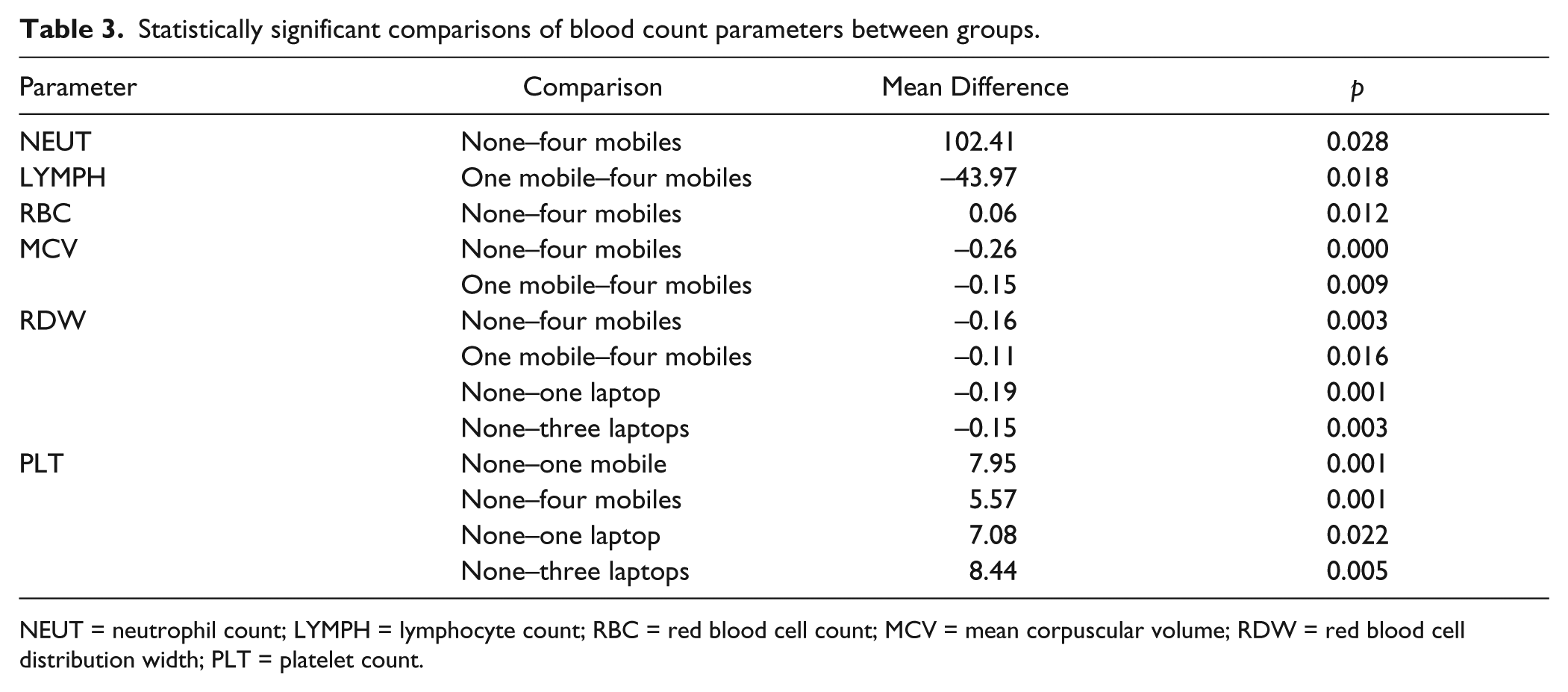
NEUT = neutrophil count; LYMPH = lymphocyte count; RBC = red blood cell count; MCV = mean corpuscular volume; RDW = red blood cell distribution width; PLT = platelet count.
In Figure 1 , the gradual decrease of RBC is shown (which is significant in clinical practice).
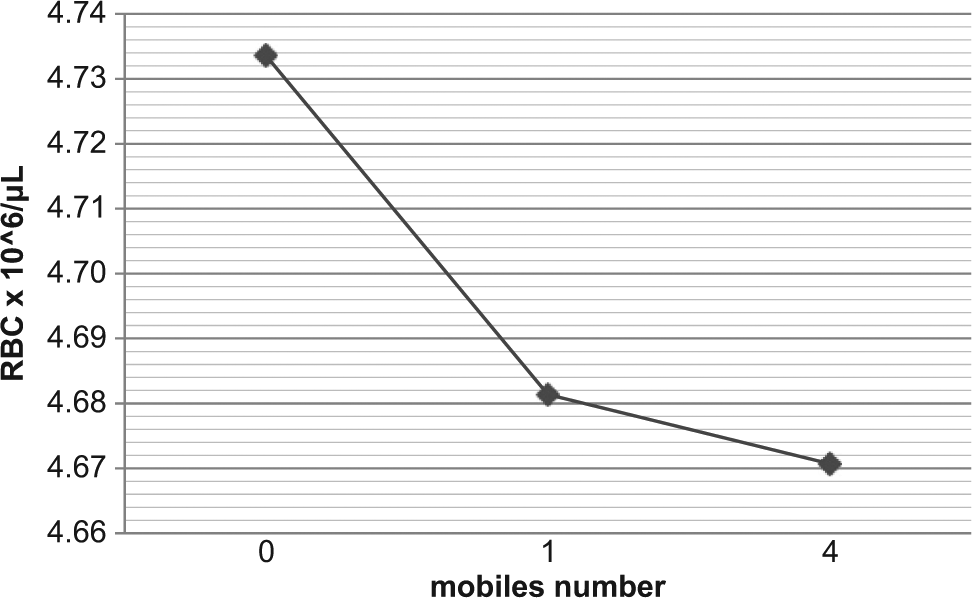
Gradual decrease of red blood cell count.
Discussion
It is already known that electronic noise is one of the sources of error of hematology analyzers that interferes with whole blood counts.9–13 Electronic noise is considered the electric interference or voltage fluctuation or external noise contamination (e.g., from other electrical equipment).
Hematology analyzers using multiparameter analysis perform white blood cell scatterplots, and electronic noise is classified in the cluster of “nonwhite cells.” Furthermore, electronic noise interferes in red blood cells and notably in platelet counts (which are usually measured using impedance technology), falsely increasing their measurements. In hematology analyzers using only impedance technology, electronic noise interferes in all populations counts.
It still remains uncertain whether electromagnetic radiation is composed of electronic noise. Our study shows that electromagnetic radiation influences in an opposite way RBC and PLT measurements. As we observed, their counts were decreased, whereas their mean volume was slightly increased.
Sebastián et al. 14 have demonstrated that erythrocytes form rouleaux under polarized electromagnetic fields. Although our samples were not examined for rouleaux formation, this could explain the decrease in RBC and the increase in WBC, while rouleaux were not counted in the RBC population but in WBC and more precisely within lymphocytes.
The results of our analysis demonstrated that all parameters of the whole blood count were mostly influenced by the radiation of mobile phones and to a lesser degree by the radiation of portable computers. It is noteworthy that the simultaneous use of both mobile phones and portable computers resulted in hematology analyzer dysfunction.
Although the observed differences in our measurements were statistically significant, they have no significance in clinical practice, apart from the change noted in RBC counts, in which the mean difference between the B1 and B4 group was 60,000 cells/µL. Taking into account that the values of all our samples were within normal range, we can assume that these differences may be significant in clinical practice in abnormal samples with elevated blood cells counts.
In conclusion, the combined and multiple uses of mobile phones and computers affect the function of hematology analyzers, leading to false results. Consequently, the use of such electronic devices during their function should be avoided.
Footnotes
Declaration of Conflicting Interests
The authors declared no potential conflicts of interest with respect to the research, authorship, and/or publication of this article.
Funding
The authors received no financial support for the research, authorship, and/or publication of this article.