




Abstract
Reflectance spectrometry is a fast and reliable method for the characterization of human skin if the spectra are analyzed with respect to a physical model describing the optical properties of human skin. For a field study performed at the Institute of Legal Medicine and the Freiburg Materials Research Center of the University of Freiburg, a scientific information repository has been developed, which is a variant of an electronic laboratory notebook and assists in the acquisition, management, and high-throughput analysis of reflectance spectra in heterogeneous research environments. At the core of the repository is a database management system hosting the master data. It is filled with primary data via a graphical user interface (GUI) programmed in Java, which also enables the user to browse the database and access the results of data analysis. The latter is carried out via Matlab, Python, and C programs, which retrieve the primary data from the scientific information repository, perform the analysis, and store the results in the database for further usage.
Keywords
Introduction
There is no doubt: Electronic laboratory notebooks (ELNs) are a state-of-the-art technique for collaborative research in science, especially if the project involves a large quantity of data.1–3 One can think of an ELN as a kind of digital library that also realizes a security framework and allows for the storage, management, and sharing of scientific data and results. 4 Therefore, an ELN is an implementation of a knowledge repository that improves the quality of data. 5
For interdisciplinary projects, which deal with large amounts of data, overcoming the bottleneck of communicating the different kinds of data sets between the research groups in a concise way is a well-known problem. Although general-purpose ELNs are able to map the classical laboratory notebook to a digital form, they cannot cope with the large quantity of scientific data any more than their analogous models. 6 The concept of ELNs can be enhanced to so-called scientific information repositories (SIRs), 7 which resemble structured collections of scientific data from different information sources. In correspondence to the data-information-knowledge-wisdom hierarchy, 8 SIRs store not only experimental parameters and measurement data but also the results of subsequent (e.g., statistical) analysis. We present in this article the implementation of a SIR for an interdisciplinary project between the Institute of Legal Medicine and the Freiburg Materials Research Center. The central idea of the presented project is the characterization of postmortem human skin by means of reflectance spectrometry and the analysis of the resulting spectra with respect to a physical model describing the optical properties of human skin.9,10 Starting from this experimental idea, we have developed a light-weight SIR that assists in the acquisition and management of reflectance spectra and acts as a research platform for the analysis of reflectance spectra and communicating the results.
Materials and Methods
Reflectance Spectrometry
For modern medicine and biomedical sciences, it is important to have fast, noninvasive techniques for differential diagnosis or fundamental research at hand. One successfully applied method is reflectance spectroscopy. In dermatology, this approach is used for the differential diagnosis of malignant melanoma, the most serious form of skin cancer, as well as icterus (yellowish hue), 11 whereas in legal medicine, it has helped to confirm that the discoloration of livor mortis due to cooling is caused by reoxygenation of hemoglobin. The color qualities of pink livores seen after exposure to a cold environment and in carbon monoxide (CO) poisoning are very similar. Nevertheless, by means of spectrometric measurements and statistical data analysis based on a physical skin model, it is possible to distinguish between the two possibilities. The qualitative change of the reflectance curve occurred in the wave range between 530 and 580 nm.10,12,13
If one looks at an unknown material, one important property being recognized is the color. This intuitive material characterization can be used by so-called reflectance spectrometry, in which the material is irradiated with a white light source of a known intensity spectrum, and the intensity of the reflected light is measured for each wavelength. This spectral reflectance reveals a lot of subtle information about the microstructure of the material, such as the concentration of light-absorbing substances or the size distribution of light-scattering structures. To gain this not directly accessible information, one has to relate the mesoscopic material properties to the optical properties of the material and furthermore model the dependency of the reflectance on the optical material properties. The latter can be parameterized by the scattering coefficient, the absorption coefficient, and the anisotropy factor. Although the absorption coefficient is determined by the concentration and the extinction spectrum of the light-absorbing substances (e.g., Hb, O-Hb, and CO-Hb), the scattering coefficient and the anisotropy factor can be modeled in terms of the Mie theory14,15 if one assumes the shape of the light-scattering structures (e.g., mitochondria) to be spherical. Now the dependency of the reflectance on the optical material parameters can be determined by a Monte Carlo model simulating the light transport in turbid media. Given this correlation, the microscopic parameters can be estimated from a measured reflectance spectrum by least squares or regularization methods.12,13
Measuring Computer
The measuring computer is located at the Institute of Legal Medicine (ILM). A scientist at the ILM, over the course of many hours, measures a series of reflectance spectra that show the postmortem change of skin. This is done at a special measuring station as described below. Measurements are performed with the diode array spectrophotometer MCS 400 (Carl-Zeiss-Jena GmbH, Jena, Germany) and a halogen bulb as light source (standard illuminant D65). The spectral resolution is 0.8 nm within the wavelength range of 188 to 1018 nm. The measuring head allows recording of the directed surface reflection of a 5-mm-wide measuring spot (measuring geometry 45°/45°). Compressed barium sulfate is used as white standard according to ISO 7724-2. 16 Furthermore, the measurements are controlled and evaluated via the control software ASPECT+ running on a personal computer. Both the measuring computer and the spectrophotometer form a mobile measuring station for recording reflectance spectra of the skin. The acquired data are transferred to a personal computer in the office of a scientist at the ILM by means of a physical medium. The ASCII data file consists of two columns: the wavelength in nm and the reflectance value given in percent.
Personal Computer ILM
The saved reflectance spectra as well as their respective metadata, such as case number, age, and gender, are uploaded via the Web-frontend (“Data input”) to the SIR (see Fig. 1 ).
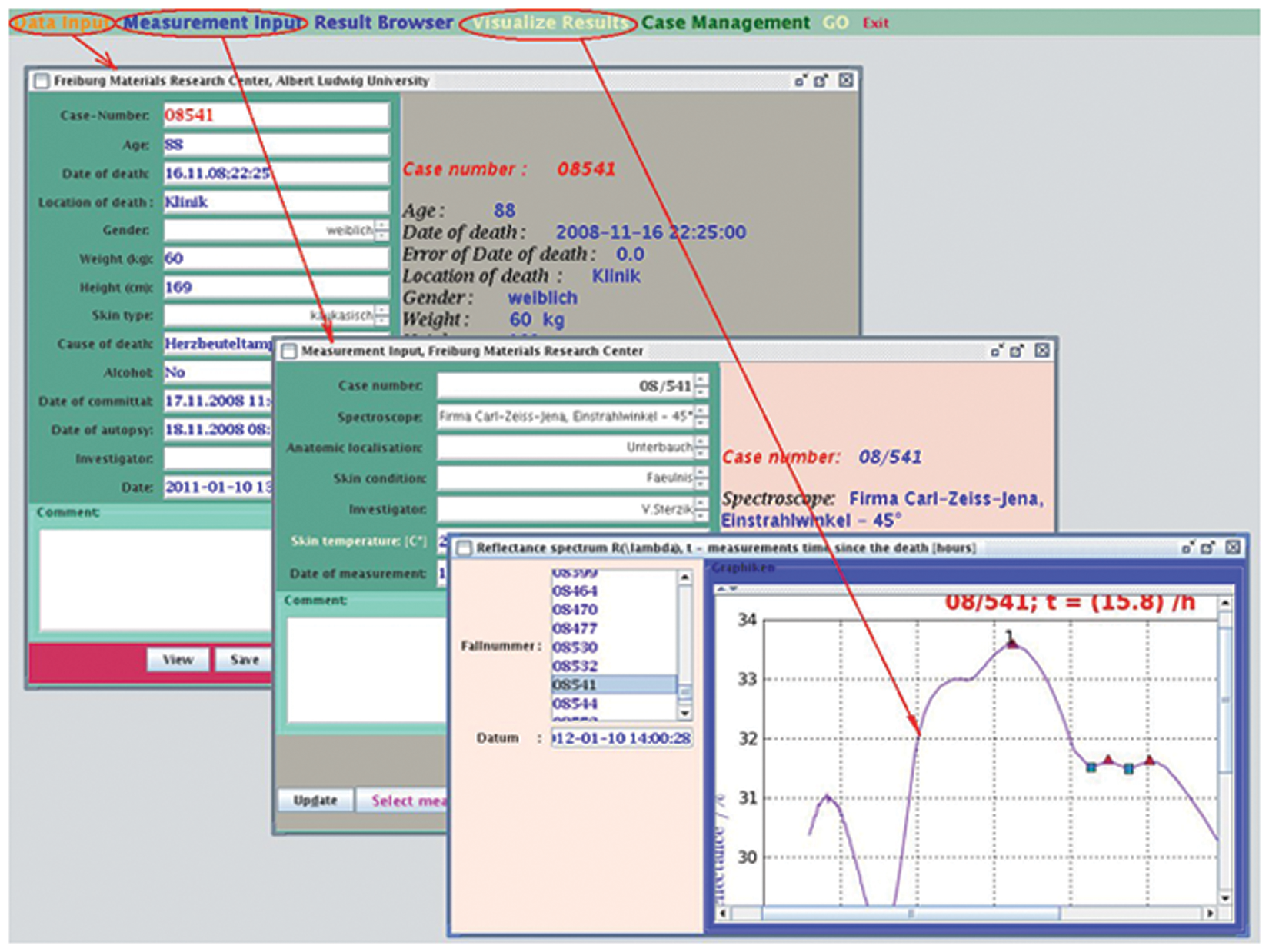
The graphical user interface (GUI) via the input menus gathers the metadata and primary data (reflectance spectra) and, via the menu “Visualize Results,” visualizes the reflectance spectra.
Personal Computer FMF
The processing steps necessary for the integration into the information base are performed at the Freiburg Materials Research Center (FMF). The information stored in the database is identified and read at computer FMF ( Fig. 2 ) and then analyzed with a software package (see Fig. 2 , “Analysis Software Package”) composed of Python, MatLab, and C programs, which query the MySQL database and perform the data-mining and visualization tasks. For example, running the program Tminv 17 via the graphical user interface (GUI; Fig. 3 ), the inverse problem of estimating the microscopic skin parameters from reflectance spectra is solved. The documented results themselves are stored within the SIR again in the database and are accessible at the computers ILM as well as FMF via the result browser of the GUI. At this stage already, a first evaluation of the work can be done in close collaboration between the two groups. Furthermore, SIR (see Fig. 3 ) converts the above-mentioned data to the self-documenting text file format Full-Metadata-Format, 18 which, for example, enables the analysis via the Pyphant Information Analysis Framework. 19
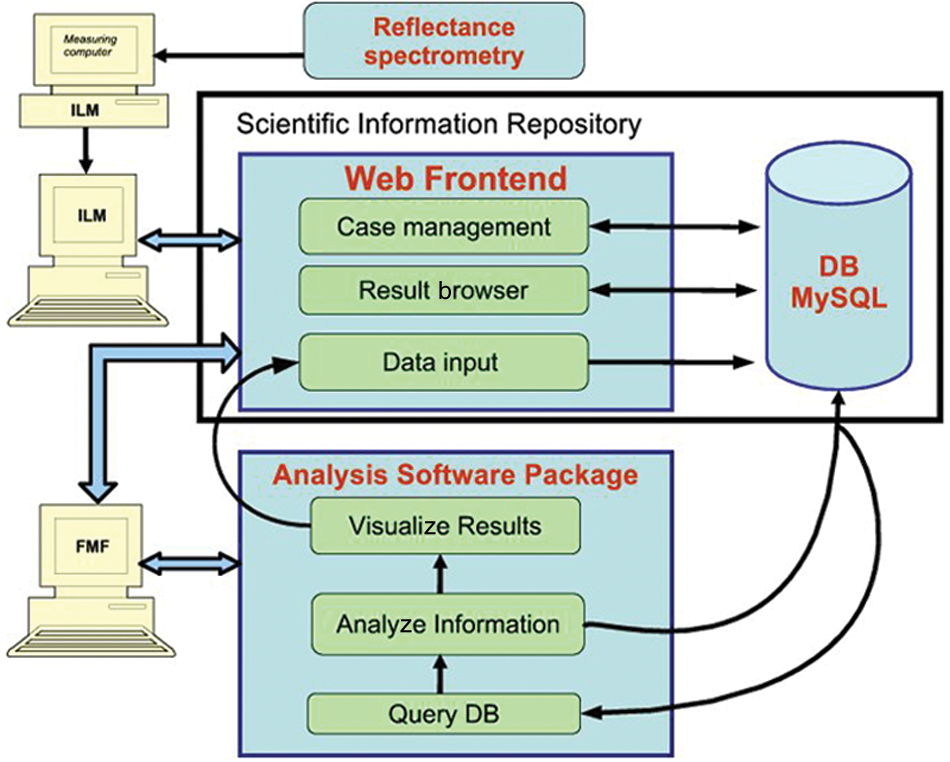
Data flow diagram of the scientific information repository (SIR). The measuring computer located at the Institute of Legal Medicine (ILM) controls the spectrophotometer and records the measured reflectance spectra. Via the Web-frontend (graphical user interface [GUI]), these primary data are stored together with their respective metadata in the MySQL database. This information is analyzed at the Freiburg Materials Research Center (FMF). The inferred information and the documented results are stored within the SIR and are accessible via the GUI. In addition to the data input and browsing capabilities, the SIR also features a case management system assisting the scientists in keeping track of the running measurement campaign. Diagram adapted from Belenkaia et al. 20
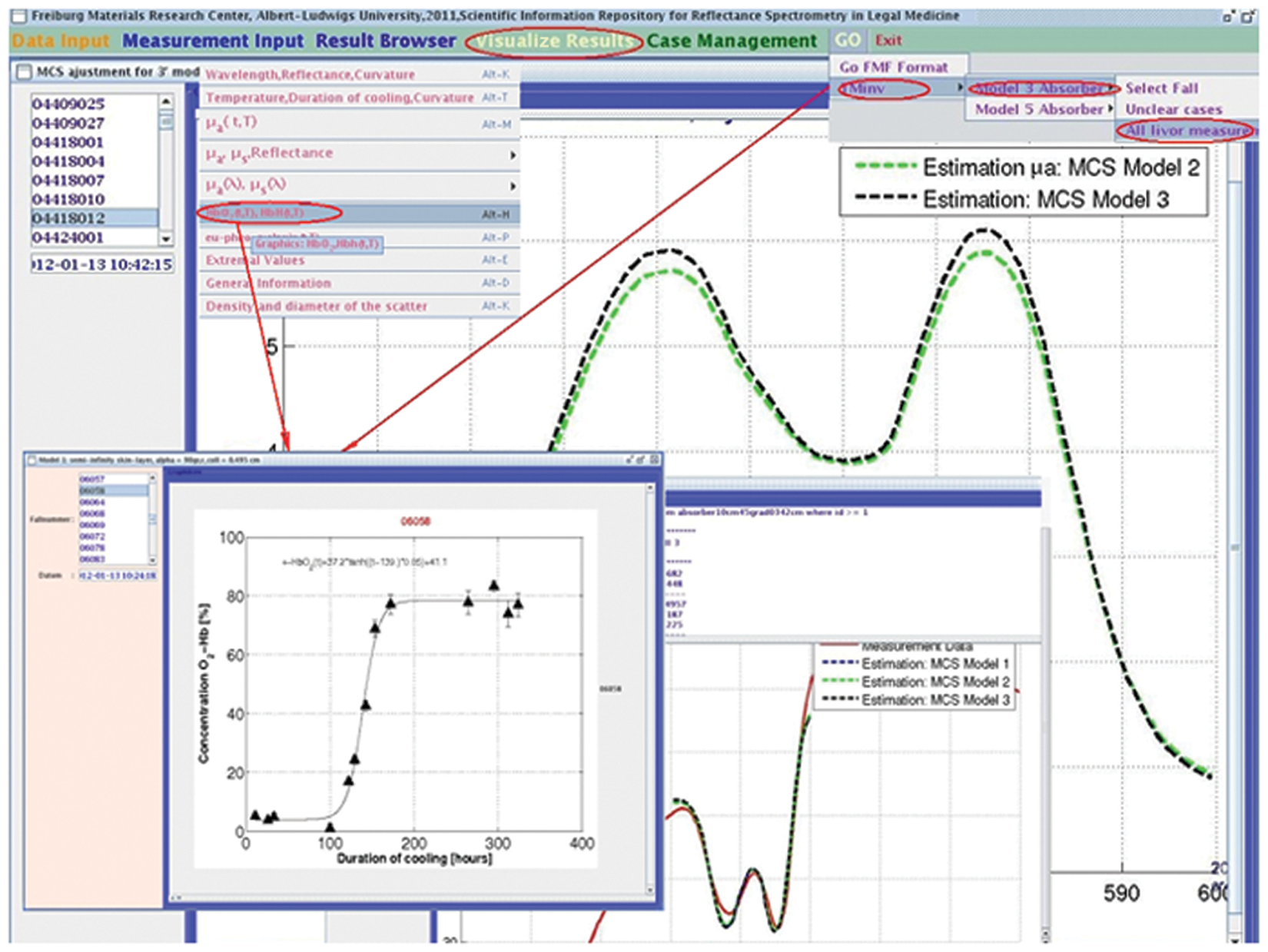
Running the program Tminv 17 via the graphical user interface (GUI; menu “GO”), the inverse problem of estimating the microscopic skin parameters from reflectance spectra is solved. The documented results themselves are stored within the scientific information repository (SIR) again in the database and are accessible at the computers Institute of Legal Medicine (ILM) as well as Freiburg Materials Research Center (FMF) via the result browser (Menus: “Result Browser,” “Visualize Results”).
Up to now, we have only described the analysis of individual pieces of information. However, the aggregation of all measured and derived quantities in the SIR fosters further analysis. Techniques known from data mining can be applied. Here the SIR lends itself well to comprehensive, collective studies, as has been shown in other studies.9,10
One challenge that we had to overcome was the amenability of the SIR. Domain experts cannot be expected to also be IT experts. Therefore, the GUI offers all important features in an easy-to-use fashion ( Fig. 4 ). All relevant information can be retrieved from the database management system (DBMS) via menu items calling predefined SQL queries and is presented to the user as the various tables or diagrams ( Fig. 3 and 4 ). In addition, within the SIR, the primary data as well as the results of the analysis are stored in the self-documenting binary data format as the Network Common Data Format (netCDF). 21
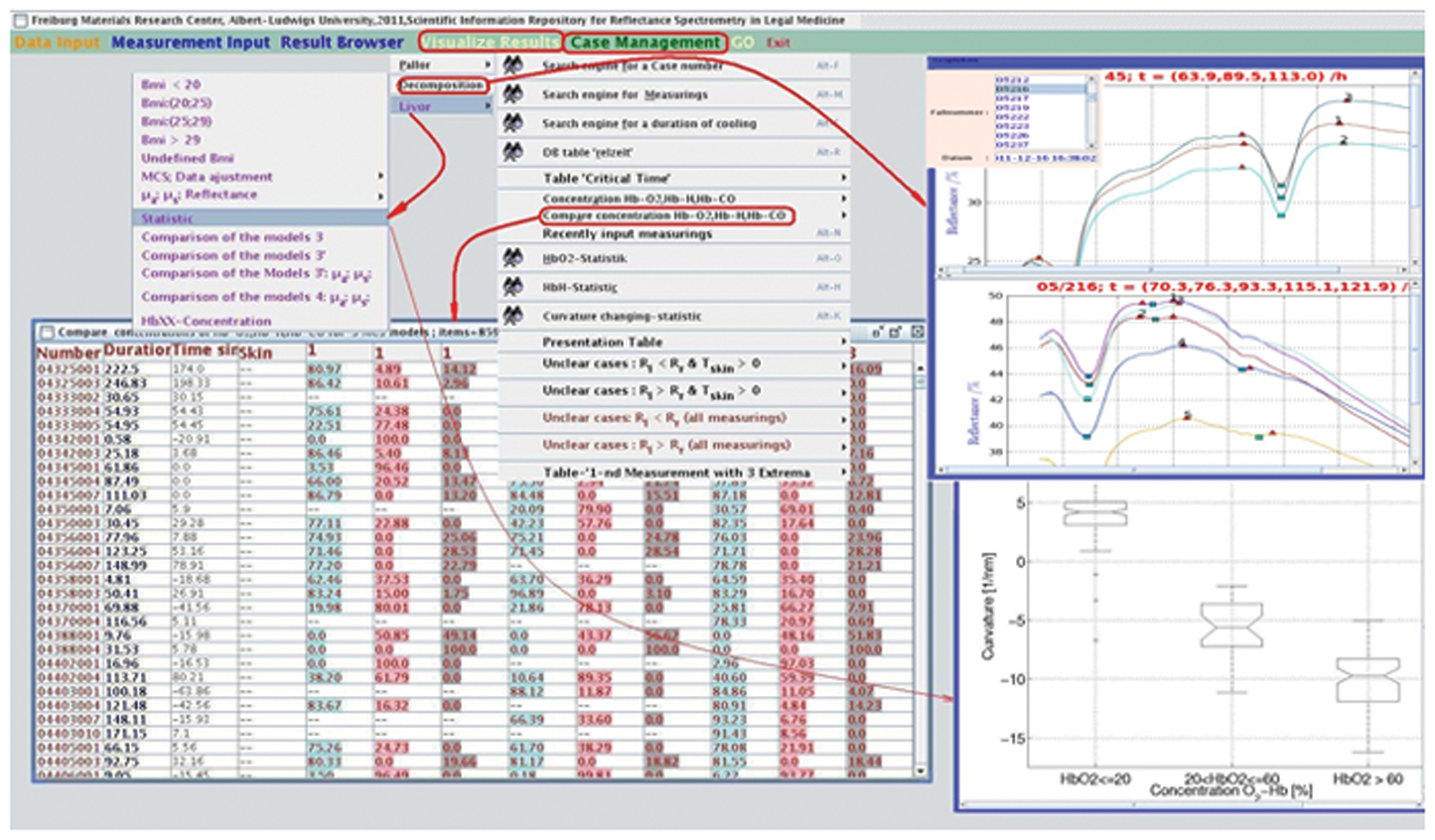
The Web-frontend offers extensive functionalities for the result analysis and results in visualization as well as various search functions. All relevant information can be retrieved from the database management system (DBMS) via menu items calling predefined SQL queries and is presented as tables or graphs to the user.
Results
Scientific Information Repository
In many fields of modern science, digital data play an increasingly important role. The relevant information includes data of digital origin (e.g., from modern laboratory equipment as well as results from scientific information processing). This generates new challenges for the long-term preservation of scientific knowledge, where the publishing of mere articles may no longer be adequate. It also necessitates new ways in the analysis. For an effective treatment of such large quantities of data, considerable knowledge in information technologies is needed. That level of proficiency cannot always be expected from domain experts. Therefore, collaboration with information-processing experts is often a good choice. This adds to the aforementioned challenges in the distribution of workflow. In a typical case, this distribution is in three directions:
There are several people involved, coming from different fields.
There is often spatial separation, where, for example, the acquisition is performed in some laboratory, whereas the analysis is done at another institute.
There are typically different requisites on the involved equipment: At the acquisition stage, safety is a critical aspect, but not much processing power is needed. In the analysis, the processing demands are much higher.
In the project presented here, the environment of acquisition places even more restrictions on the process. Because of its secluded nature, the refrigerator at the Institute of Legal Medicine does not offer network access directly. Also, privacy plays an important role in the handling of the data.
To allow for the effective collaboration between the domain experts at the Institute of Legal Medicine and the processing experts at the Freiburg Materials Research Center, a scientific information repository was created. This offers a central hub not only for data exchange but also for the ongoing analysis and preservation of results and original data. We now describe the typical workflow for the integration of new measurements into the database.
The scientific information repository implemented at the Freiburg Materials Research Center basically consists of two major parts ( Fig. 2 ) namely, the DBMS and the graphical user interface (GUI, Web-frontend). The DBMS is realized as a MySQL database 22 running on a local server of the FMF, being part of the intranet of the University of Freiburg. Access to the database is restricted via the user management of the DBMS and software firewalls covering the database server and the external network entry point. The Web-frontend is realized as a Java applet with restricted accessibility via the project’s homepage. The GUI of the Web-frontend is built with the Swing library of the Java Standard Edition (J2SE). The aim of the GUI is to gather primary data and metadata of the investigated cases, to allow for the browsing of documented results, and to organize the case management.
Conclusion
Altogether via SIR, more than 2000 reflectance spectra have been recorded and analyzed. The SIR allowed us to overcome domain boundaries in an interdisciplinary project. It opened the possibilities of modern high-performance computing methods in scientific information processing for a field that is traditionally not close to information technology. Furthermore, the long-term preservation of data is a step into the direction of publishing the data themselves. This seems advantageous, particularly in light of the comprehensive studies that were successfully performed after the initial analysis.
Our current research in the field of legal medicine focuses on modeling the dynamics of the reoxygenation process and on the estimation of the time of death based on the reflectance spectra on postmortem skin. This is of a certain relevance because the approach of analyzing the reflectance spectra of human skin with respect to a physical model potentially can also be applied for the diagnosis of skin cancer. 11
Footnotes
Acknowledgements
The authors acknowledge K. Schulz for fruitful discussions on the useability of the SIR.
The authors declared no potential conflicts of interest with respect to the research, authorship, and/or publication of this article.
The authors disclosed receipt of the following financial support for the research and/or authorship of this article: This study has been supported by German Research Foundation (file number Bo 1923/2-2, Li 1799/1-2).