



Abstract
Energy citizenship (EC) is a concept that has received little attention in psychological research. However, citizen participation and engagement in the energy system play an important part in the EU’s vision of a low-carbon economy. The expectation is that EU citizens take an active role in a decentralized energy market and become ‘energy citizens’. Psychologically, it remains unclear who is likely to support this transition. In this paper, we investigate which psychological factors predict support for EC and might motivate individuals to become active in the energy transition using an online questionnaire. Results from Austria (n = 272) show that personal norms predict support for an EC scenario in a multiple linear regression, whereas biospheric values, ecological attitudes, awareness of adverse consequences, as well as ascription of responsibility do not. Further unique variance is explained by right-wing authoritarianism, a concept understudied but important for the massive societal changes involved in the energy transition. We highlight the importance of feeling personally responsible and obliged and being open to overcome conventions for the transition towards EC.
A sustainable energy transition is essential to overcome the global climate crisis. The EU energy system accounts for 80% of all carbon emissions in the EU (European Commission, 2018). Recently, the EU Renewable Energy Directive 2018/2001/EU entered into force, as part of the ‘Clean energy for all Europe’ package. According to this directive, EU citizens are expected to become so-called ‘energy citizens’ in a decentralized energy market. They shall be enabled to play an active role in the EU’s future energy system instead of being passive energy consumers. The expectation is that energy citizens will claim the right to fair and just energy and participate not only in its consumption but also in its production and trade (Lennon et al., 2020). However, the directive gives no definition of energy citizenship or what exactly is to be expected from citizens from a psychological perspective (be it certain actions, attitudes, values, norms or societal aspects). What does it mean for an individual to be or become an energy citizen? What motivates them, which attitudes are the basis for their actions? What and who supports individuals in committing to the transformation of the current energy system into a sustainable, social and locally organized system?
Energy citizenship as a concept
Energy citizenship as a concept has so far received little attention in psychological research. Devine-Wright (2007) gave a first idea on what ‘energy citizenship’ might involve psychologically and sociologically. He argues for an understanding of ‘energy as a social necessity’ when it comes to energy citizenship, calling for public engagement and participation of individuals, and highlighting topics, such as responsibility, equity and justice. With energy citizenship, a transition emerges that leads from a centralized, large-scale, automated, institutionalized energy system to a decentralized, smaller-scale, user- and community-centric, sustainable energy system. Thereby, communities would gain independence from energy-producing corporations and predetermined energy prices, which would benefit the community as well as the environment (Devine-Wright, 2007). This vision seems to be attracting increasing attention both in politics and in civil society (European Commission, 2018; Kampman et al., 2016).
From a psychological perspective, energy citizenship represents certain personal attitudes, moral concepts and behaviours of individuals related to the energy transition. It is important to understand how these attitudes, moral concepts and resulting behaviours are formed to better understand the emergence of energy citizenship. The Value-Belief-Norm theory (VBN theory, Stern et al., 1999) provides one potential explanation, because this model describes the emergence of specific behaviours, such as participation and support of social movements. According to VBN theory, personal norms guide this type of behaviour and two central elements of specific beliefs determine personal norms: awareness of adverse consequences (AC: an individual’s belief that the core contents of their values are under threat) and subsequently the ascription of responsibility (AR: a perceived responsibility to mitigate this threat). These specific beliefs are influenced by more general beliefs (about the human impact on the environment and climate change) and by people’s general values. Values, as they are described by Schwartz (1992), constitute people’s beliefs, refer to desirable goals and motivate action, but transcend specific situations and behaviour. This universal value system distinguishes 10 values on the two orthogonal axes ‘self-enhancement to self-transcendence’ and ‘openness-to-change to conservation’. Within VBN theory, hedonistic, egoistic and altruistic values appear most crucial, and a new type of self-transcendent value was added: biospheric values. Research has shown that (elements of) VBN theory predict not only pro-environmental behaviours (Nordlund & Garvill, 2003) but also environmental citizenship (here signing a petition, taking part in protest or a demonstration, giving money to an environmental group; Oreg & Katz-Gerro, 2006) or aspects related to energy consumption, such as the acceptance of energy policies (Steg et al., 2005) and the intention to use green devices (Fornara et al., 2016). These altruistic and biospheric values also seem to be of particular importance in connection with the social and environmental component of energy citizenship. However, since energy citizenship involves many different behaviours and the VBN theory is found to be most predictive of specific environmental behaviours, it seems important to also consider more general antecedents. Van der Werff and Steg (2016) proposed the Value-Identity-Personal norm (VIP) model for exactly this purpose. Here, identification — and not beliefs — is the central variable. Identification is a relevant characteristic of activists (Stern et al., 1999) and active energy citizens. Even though the VBN theory conceives identification processes as inherent in beliefs and personal norms, it never explicitly integrates them. The VIP model therefore constitutes a more efficient and less specific alternative that might be able to detect broader and more intensive forms of activism. However, research based on both VBN theory and the VIP model has often focused on specific norms of sustainable behaviour, and therefore neither might be sufficient to explain energy citizenship support.
The concept of energy citizenship constitutes a systemic approach based on the assumption of responsibility by citizens on their own initiative, which has an impact on different societal levels. An energy citizenship regime would result in significant changes disrupting existing hierarchical structures in energy supply and distributing power from authorities (such as political actors, big companies, etc.) to the community. A certain will to change existing norms and guidelines is necessary (and extends VBN theory and VIP model). An attempt to get a clearer picture of the reasons to oppose such developments towards a citizen-based energy regime is the concept of right-wing authoritarianism. Right-wing authoritarianism (RWA, Altemeyer, 1981) is conceptualized as a construct with three covarying orientations: authoritarian submission, authoritarian aggression and conventionalism. Individuals with high RWA values tend to subordinate themselves uncritically to existing authorities, approve of authoritarian exclusion and oppression of outgroup members, and tend to accept perceived social conventions strictly and want to maintain them (Altemeyer, 1998). Therefore, RWA might be helpful to understand who are the ones who do (not) support energy citizenship.
Several studies have found relationships between RWA and environmental constructs. A (strong) negative correlation between RWA and the NEP (New Ecological Paradigm, Schultz & Stone, 1994), the morality of green behaviours (Currie & Choma, 2018), general environmental attitude (Milfont & Duckitt, 2010), pro-environmental beliefs (Reese, 2012), as well as environmentalism and the willingness to act on climate change (Stanley et al., 2019) was found. Moreover, RWA was shown to be positively correlated to perceived environmental threat (Hoffarth & Hodson, 2016). Authoritarians seem more likely to perceive threats in everyday situations that affect their in-group and less likely to perceive global, collective risks that might affect mainly others to a higher degree (Choma et al., 2013). Therefore, the perceived threat from environmental activists directly influencing authoritarians’ personal lives is perceived as stronger than the global and collective threat from climate change. Regarding energy citizenship, RWA covers different aspects than the environmental attitudes described above, such as devaluation and demarcation of systemic change and the need for security (e.g., Duckitt & Sibley, 2010). However, in both VBN theory and RWA, the perception of threat is central. Whereas the perception of threat in AC causes people to try to counteract climate change through adapted behaviour, authoritarian people are more afraid of the threat of imminent changes in the reality of their lives. Energy citizenship involves major changes, not only in individual behaviours but also in the entire energy system. Since radical changes endanger the perceived security of authoritarians, RWA should be opposed to supporting energy citizenship and result in the rejection of change in general as well as energy citizens in particular. Individuals with high RWA scores should have a negative attitude towards energy citizenship. This negative correlation should be complementary to VBN theory and the VIP model, as RWA affects fear of change and disassociation from the unknown (conventionalism, conformity and security), whereas VBN theory and the VIP model affect concern for the environment (biospherism), fellow human beings (altruism) or constraints on the self (egoism, hedonism).
Purpose of the current study
The current study aims to better understand who supports energy citizenship. A preregistered study (https://osf.io/wkqvb/?view_only=e8090a06f9744ce3802c62e12dbf1c1b) was conducted in Austria. Based on the literature, we assumed that the concepts of the Value-Belief-Norm Theory and Value-Identity-Personal norm model as well as right-wing authoritarianism predict support of a future scenario based on energy citizenship. Our hypothesis was as follows:
H1: Values, general environmental beliefs (NEP), awareness of adverse consequences (AC), ascription of responsibility (AR), personal norms (PN), environmental self-identity (SI) and right-wing authoritarianism (RWA) predict the rating of an energy citizenship scenario.
To test this hypothesis, three scenarios of possible future visions of energy production and consumption were developed. Scenario 1 and scenario 2 describe the traditional, current energy system including either both renewable and fossil energy sources or exclusively renewable energy sources. A third scenario, based on energy citizenship, depicts a local and social energy system relying on sustainable energy production and active individual support (EC scenario).
The contents of VBN theory (values, beliefs and personal norms) as well as ecological self-identity as a component of the VIP model and RWA were introduced as potentially related factors. So far, energy citizenship could not be linked to any of these factors. Thus, the question arises of how strongly these factors are related to energy citizenship and how much variance in the willingness to support energy citizenship can be explained by the respective variables.
Method
Participants
In sum, 285 individuals from Austria answered the questionnaire. Although no exclusion criteria were implemented before, some cases were excluded for several reasons (very short completion time, leaving too many items unanswered). This resulted in a total of 272 participants. Participants gave their informed consent to the anonymized collection of data.
Participants’ age ranged between 18 and 77 with a mean age of M = 30.92 (SD = 20.88). 79 participants declared themselves as being male, 189 as being female, and five persons chose not to answer the question. Regarding education, 123 participants (45.1%) named a secondary school degree, 12 participants (4.4%) a final apprentice exam and 135 participants (49.5%) a university degree as their highest educational level.
Instruments
The study was conducted online via Unipark. In addition to socio-demographic data, the questionnaire collects a total of 10 predictor variables (see below), as well as the criterion variable support of the EC scenario. All scales except the Schwartz Value Survey were administered as five-point Likert-scales.
Biospheric, altruistic, egoistic and hedonic values were assessed using the German translation of the Schwartz Value Survey (Schmidt et al., 2007). Two items from the original scale that were not presented in the German translation were included again, since they were found to be related to environmental attitudes. In sum, the scale consisted of 16 items (four items for biospheric, e.g., ‘Unity with nature (living in harmony with the natural environment)’, four items for altruistic, five items for egoistic and three items for hedonic values) with a seven-point Likert-scale response format and a Cronbach’s alpha between αegoistic = .69 and αbiospheric = .86.
General environmental beliefs were assessed using the New Ecological Paradigm (NEP, Dunlap et al., 2000); German version by Schleyer-Lindenmann et al., 2018), which reflects participants’ beliefs of a negative human influence on the planet and its ecosystem. The scale consists of 15 items that form a global score with a Cronbach’s alpha of α = .68.
Specific beliefs in problems related to energy and the environment were assessed with 14 items translated and adapted from different studies (De Groot & Steg, 2008; Fornara et al., 2016; van der Werff & Steg, 2016) to capture the specific aspects of energy citizenship. Six items focus on an awareness of adverse consequences (Cronbach’s alpha of α = .55) and eight on ascription of responsibility (Cronbach’s alpha of α = .69). AC refers to the impact of one’s own activities on the natural environment (e.g., ‘Centralized and profit-oriented energy production promotes social injustices’). AR relates to the perception of one’s possibilities to mitigate or ward the negative consequences of individual actions (e.g., ‘If we were to promote local initiatives for sustainable electricity production and consumption, this would be good for our environment’).
To assess personal norms, one item was adopted and translated from Stern et al. (1999) (‘I feel a personal obligation to do whatever I can to prevent climate change’). Seven other items were developed for the present study, targeting specific behaviours related to energy citizenship. Items aimed at different aspects, such as political activism, sustainable energy consumption, a critical questioning of energy production, openness to technological innovation and social aspects of energy supply (e.g., ‘I feel a responsibility to promote the local production of renewable energy so that my community and the environment benefit’). Cronbach’s alpha was α = .80.
Two of the four items assessing ecological self-identity were adopted from van der Werff et al. (2013) and van der Werff and Steg (2016). The other two items were developed for the present study to cover more concrete aspects of energy citizenship in particular: ‘I am a person who critically questions our energy production and consumption’, intended to cover a fundamental attitude of energy citizens, and ‘I see myself as a person who is committed to local, sustainable and community energy production’. Cronbach’s alpha of the scale was α = .80.
The German version of the right-wing authoritarianism (RWA) scale was adopted from Funke (2005) and consists of 12 items in the three subscales submission (e.g., ‘Obedience and respect for authority are the most important virtues children should learn’), aggression (e.g., ‘It is important to preserve the rights of radicals and dissenters in all respects’) and conventionalism (e.g., ‘Turning away from tradition will one day turn out to be a fatal mistake’). These subscales can be considered individually; the sum score (Cronbach’s alpha of α = .79) represents how much a person tends to support authoritarian structures and thinking.
The three energy scenarios specifically developed for the present study are intended to represent an initial conception of energy citizenship. The scenarios describe possible future visions of a society that either lives according to the principle of energy citizenship (EC scenario) or continues to maintain the established energy system (scenarios 1: traditional/non-sustainable, and scenario 2: traditional/sustainable). They are based on the models Devine-Wright (2007) described as soft path and hard path, with the hard path model divided into the two traditional scenarios 1 and 2. In scenario 2, the energy system also is based exclusively on renewable energy sources, but the description of the EC scenario emphasized the additional aspects of energy citizenship to allow for a differentiation between the scenarios.
The three scenarios were formulated as consistently as possible and varied only in the crucial points that should account for the differences between them. The varied aspects included the location of energy production, the energy sources, the stability of the energy supply, possible influences on the labor market, commitment of society and a possible price development (see Table 1 for an overview).
Description of energy scenarios.
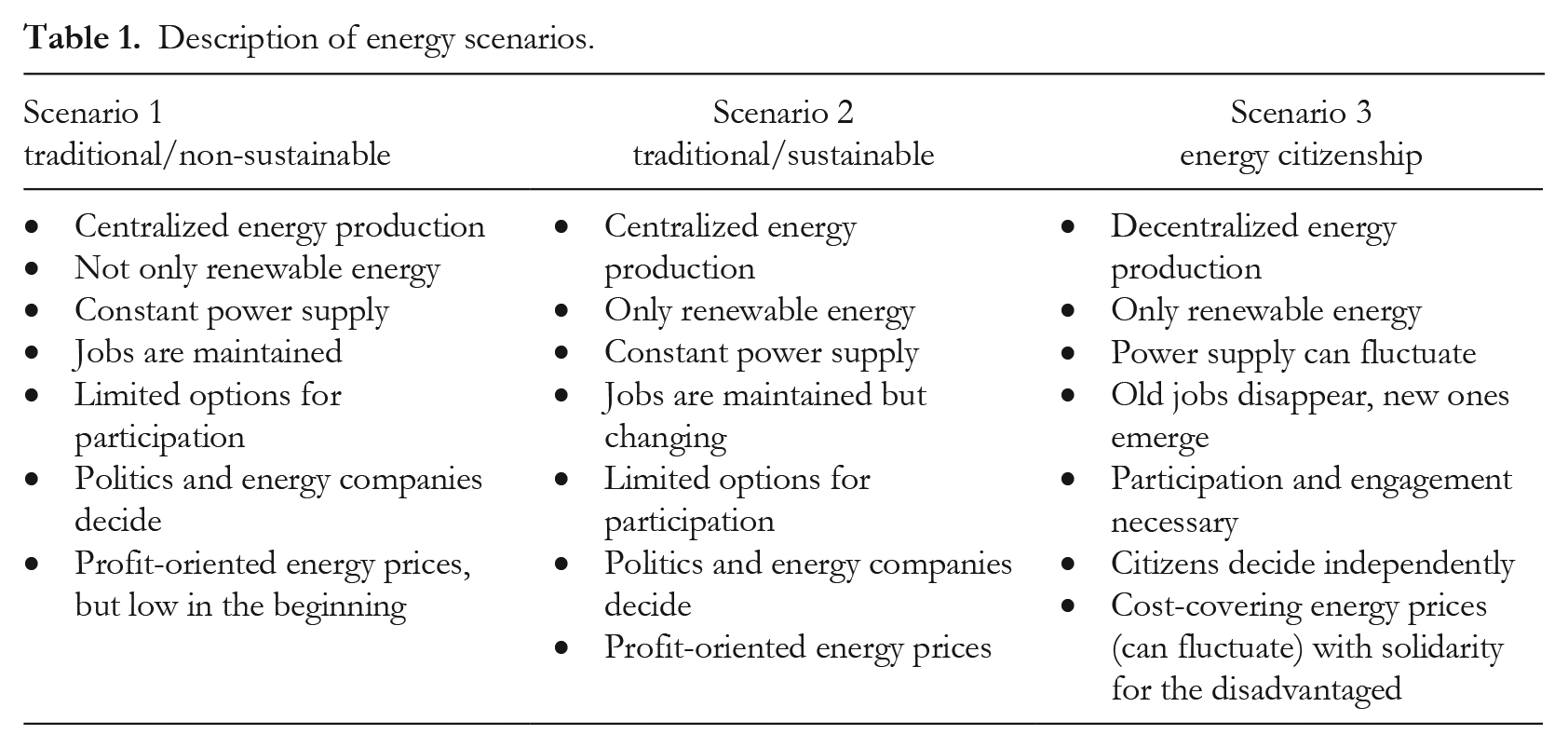
Participants read the three scenarios describing different energy systems, starting with the current and therefore probably most familiar scenario (see Appendix B). Then, the gist of the scenarios was presented simultaneously in a table (see Table 1) on a new page of the online questionnaire to minimize potential order effects. Participants indicated on this page their willingness to support each scenario in principle on a five-point Likert-scale. Afterwards, they were asked to choose the most favorable scenario for the future.
Data collection and procedure
The data analysis presented here was part of a larger study including confirmatory hypotheses on the VBN theory and the VIP model, as well as on general environmental behaviour assessed with the General Ecological Behaviour Scale (German version by Arnold et al., 2018), which are not reported here (more information in the pre-registration).
The required sample size was determined with a power analysis using g*Power 3.1 (Faul et al., 2009). A multiple linear regression with 10 predictors, an estimated effect size of f² = .085, a Bonferroni-corrected alpha error of α = .017 and an estimated power of .80 yielded a required sample size of 250 participants.
Data were analysed using a multiple linear regression with 10 predictor variables and one criterion variable, the evaluation of the EC scenario 3. Assumptions for multiple linear regressions were tested beforehand and were all fulfilled.
Results
In total, three persons (1.1%) selected scenario 1 as the most favorable for their future, 117 persons (42.7%) chose scenario 2 and 154 persons (56.2%) preferred the EC scenario 3.
Before undertaking hypothesis-testing calculations, correlations were analysed to get an overview of the relationships between the independent variables and the scenarios (see Table 2). It is noticeable that scenario 2 has no significant correlations with any of the independent variables investigated in this study. A full correlational table can be found in Appendix A.
Pearson correlations between predictor variables and support for each of the scenarios.
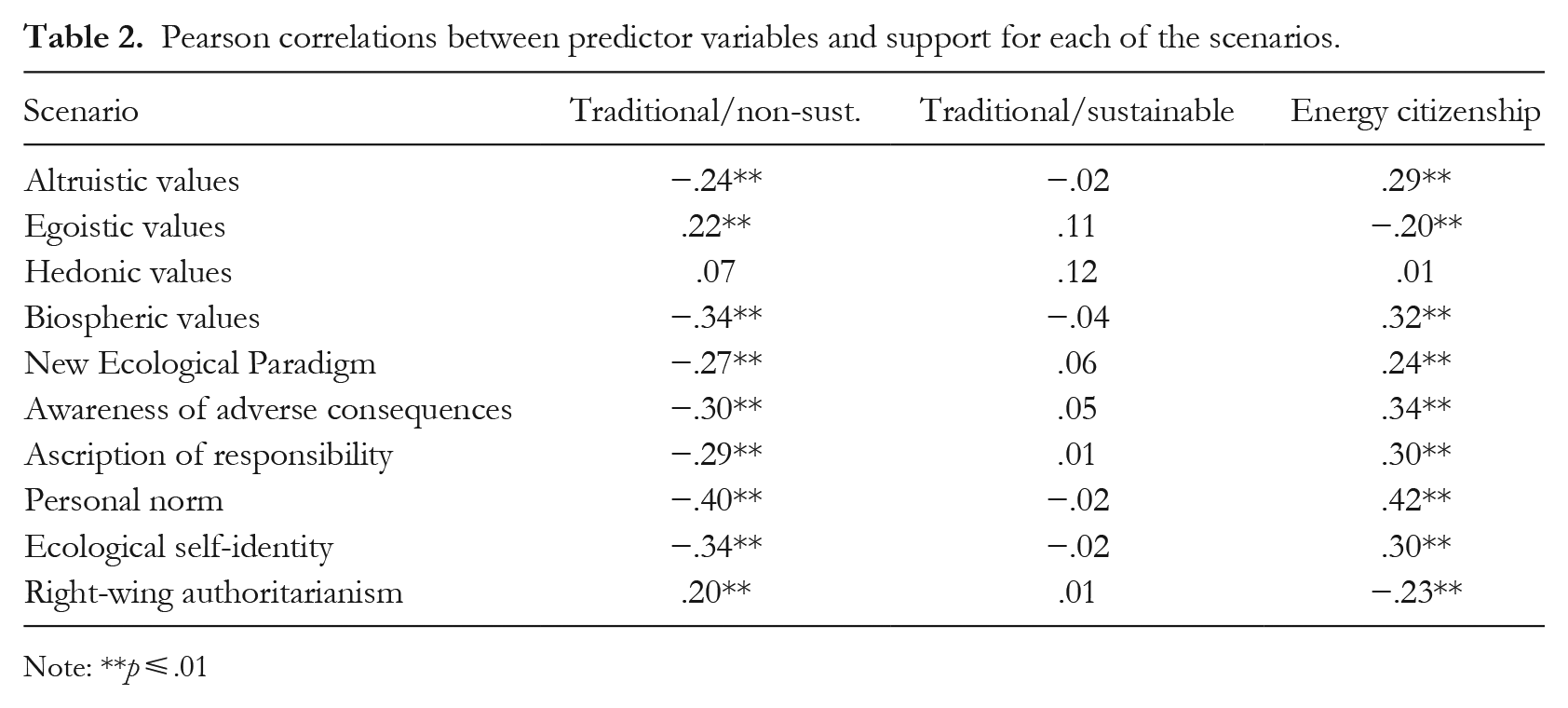
Note: **p ⩽ .01
The regression model with 10 predictors (values, beliefs, personal norms, ecological self-identification and right-wing-authoritarianism) and a criterion variable (support for the EC scenario) explained 23% of variance (R2 = .23, R2 adjusted = .20) in support for the EC scenario (F(10, 261) = 7.61, p ⩽ .001 (see Table 3). However, only personal norms were found to be a significant predictor in the model (β = .24, t(261) = 2.57, p = .011).
Predictor values in support for the EC scenario.
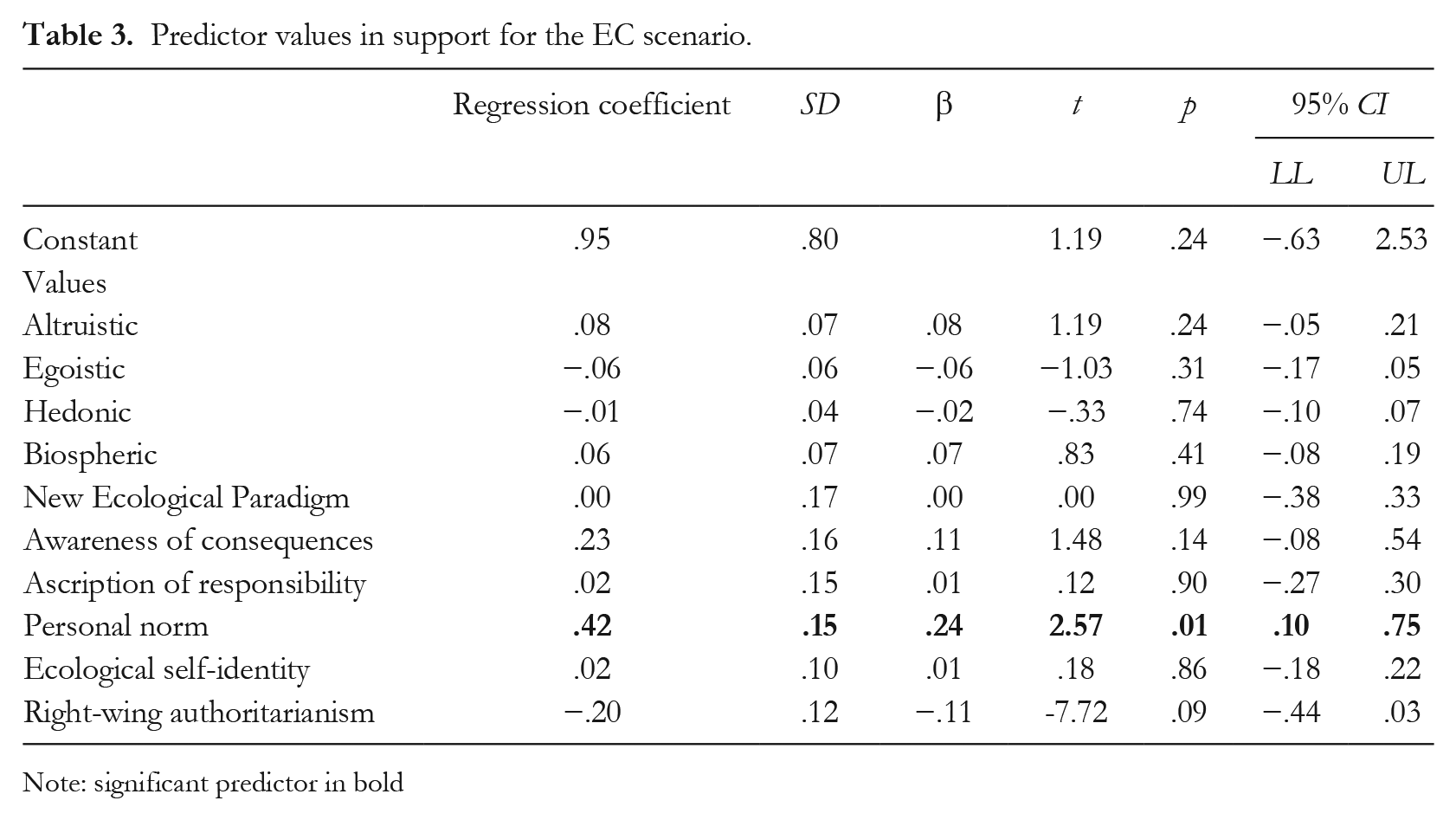
Note: significant predictor in bold
In an exploratory multiple linear regression analysis, a model with only two predictors was calculated, including PN and RWA as the two predictors with the highest β-values. This model also explained a statistically significant amount of variance in support for the EC scenario (F(2, 269) = 34.36, p ⩽ .001, R2 = .20, R2 adjusted = .20). The 10-predictor model could not explain significantly more variance than the 2-predictor model with PN (β = .39, t(269) = 7.10, p ⩽ .001) and RWA (β = −.18, t(269) = −3.22, p = .001). If including the three RWA subscales instead of the RWA sum score, the model was significant (F(4, 267) = 19.43, p ⩽ .001, R2 = .23, R2 adjusted = .21). However, apart from PN, the RWA subscale Conventionalism was the only predictor explaining unique variance in support of the EC scenario (β = −.23, t(268) = −3.55, p ⩽ .001).
Discussion
In the present study, we investigated energy citizenship from a psychological perspective in order to understand who supports an energy system based on energy citizenship. Based on previous findings, we selected several variables, attempting to estimate how strongly these variables are related to energy citizenship and how much variance in the willingness to support energy citizenship can be explained by them.
The multiple linear regression analysis revealed that only personal norms significantly predicted support for an energy citizenship system independently from the other predictors. Furthermore, right-wing authoritarianism explained further unique variance. Thus, the higher a person’s personal norms and the lower their score on the RWA scale, the more likely they were to think the described energy citizenship future was worth supporting. Taken together, both factors could explain 20% of variance in support for the EC scenario, which can be interpreted as medium effect according to Cohen (1988). Values, general and specific beliefs (NEP, AC, AR) as well as ecological self-identity could not explain further variance but correlated with the support for an energy system based on energy citizenship. Interestingly, they did not correlate with the support for a sustainable but otherwise traditional energy system. This might be linked also to the presentation of the three energy scenarios. All scenarios were read one after the other and rated afterwards. Therefore, these rating were not independent, which might force a decision between future energy systems and thereby distort the correlations.
The transformation of the energy system is to be achieved through the commitment and the assumption of responsibility of energy citizens. Understanding the processes of attitude formation towards energy citizenship enables the targeted promotion of energy citizenship on a political and pedagogical level. Our results suggest that focusing on personal norms might be particularly promising. VBN theory as well as the VIP model both emphasize the role of personal norms on predicting specific attitudes and behaviours. This relationship could further be underpinned with regard to energy citizenship. In fact, many prior studies found personal norms to be the strongest predictor of specific belief- and behaviour-related variables (Fornara et al., 2016; Stern et al., 1999; van der Werff & Steg, 2016) or even the only predictor for acceptance of energy-related policies to limit CO2 emissions of households (Steg et al., 2005). The high importance of the feeling of personal obligation and responsibility for supporting an energy system based on energy citizenship is also highlighted by an understanding of energy citizenship as ‘people’s rights to and responsibilities for a just and sustainable energy transition’ (Hamann et al., 2023). Even though other variables, like an awareness of climate change, are also related to energy citizenship, they might be more distal predictors. Therefore, in order to strengthen energy citizenship, educational interventions should not only focus on personal norms but also evaluate if these norms were properly addressed.
A concept less causally linked to environmental behaviours, and therefore with less overlap to the other constructs, is right-wing authoritarianism. Energy citizenship is based on the assumption of responsibility by proactive citizens with a certain will to oppose existing norms and standards. People with high scores on RWA have a lower urge to act against existing standards (subscale Submission) and do not take responsibility for change on their own initiative. However, previous studies have shown that it is possible that authoritarians might act pro-environmentally if the dangers posed by climate change directly affect these individuals or when the assumption of responsibility is more intensively promoted and demanded by the authorities (Reese, 2012). In line with these findings, our study indicates that individuals with high scores on RWA are often motivated by egoistic considerations (see correlational table in the Appendix A). Appealing to egoistic motives, such as focusing on a personal security gain through energy autonomy, could reduce the rejection of an energy citizenship future and thus at least indirectly support the ecological and social movement.
Limitations
A limitation of our study refers to our sample, which was rather young, female, well educated and not representative of the Austrian general population. Therefore, generalizations from this study are not possible. However, it gives valuable insights on predictors of support for a future energy system based on energy citizenship.
Another limitation is that the data rely on mere self-reports; no actual behaviour was measured in our study. Energy citizenship could potentially consist of many different behaviours, such as installing solar panels on one’s own roof or signing a petition to increase taxation on fossil fuels. In our EC scenario, we display only one version of a decentralized sustainable energy future, but, of course, many further specifications are possible.
Also, future studies should assess the broad spectrum of values, including the dimension openness to change — conservation. Tradition, conformity and security all seem highly relevant in further investigating energy citizenship as a form of environmental activism. Relating energy citizenship with the concept of right-wing authoritarianism as a generalized attitude (Funke, 2005) based on specific beliefs (Cohrs et al., 2005), mainly in connection with the value dimensions conservation and openness to change (Feather & Mckee, 2012), is a first step in this direction.
Taken together, these results confirm the importance of personal norms as proximal predictor for ecological social innovations. But an energy transition towards energy citizenship implies broader social changes, and it will be important to know if society in general will support this process. The transformation towards a sustainable, social and locally organized system is based on massive behavioural changes and needs the support of many. People who endorse authoritarian ideologies and conventionalism might oppose such innovations. For a successful transition, we need to be aware of opposing societal tendencies, figure out how to include those who are not (yet) convinced, overcome such barriers and bring more people on board.
Footnotes
Appendix A
Pearson correlations for all predictor variables and support for each of the scenarios.
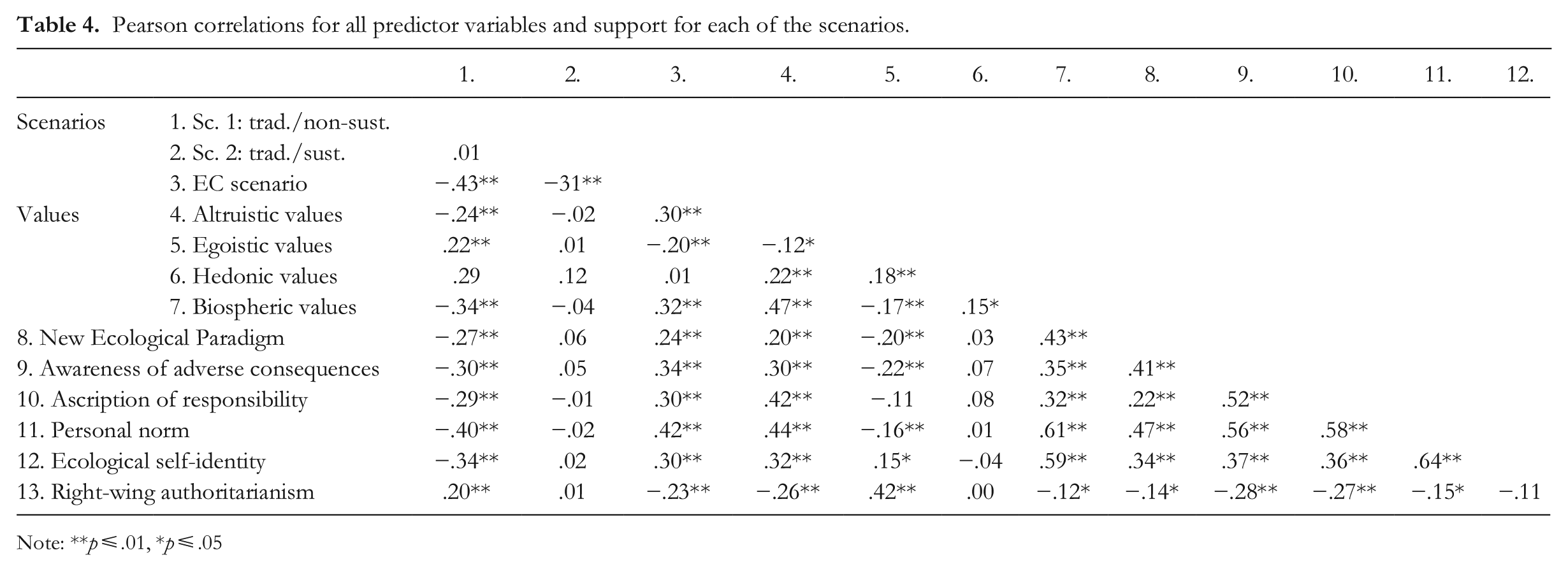
| 1. | 2. | 3. | 4. | 5. | 6. | 7. | 8. | 9. | 10. | 11. | 12. | ||
|---|---|---|---|---|---|---|---|---|---|---|---|---|---|
| Scenarios | 1. Sc. 1: trad./non-sust. | ||||||||||||
| 2. Sc. 2: trad./sust. | .01 | ||||||||||||
| 3. EC scenario | −.43** | −31** | |||||||||||
| Values | 4. Altruistic values | −.24** | −.02 | .30** | |||||||||
| 5. Egoistic values | .22** | .01 | −.20** | −.12* | |||||||||
| 6. Hedonic values | .29 | .12 | .01 | .22** | .18** | ||||||||
| 7. Biospheric values | −.34** | −.04 | .32** | .47** | −.17** | .15* | |||||||
| 8. New Ecological Paradigm | −.27** | .06 | .24** | .20** | −.20** | .03 | .43** | ||||||
| 9. Awareness of adverse consequences | −.30** | .05 | .34** | .30** | −.22** | .07 | .35** | .41** | |||||
| 10. Ascription of responsibility | −.29** | −.01 | .30** | .42** | −.11 | .08 | .32** | .22** | .52** | ||||
| 11. Personal norm | −.40** | −.02 | .42** | .44** | −.16** | .01 | .61** | .47** | .56** | .58** | |||
| 12. Ecological self-identity | −.34** | .02 | .30** | .32** | .15* | −.04 | .59** | .34** | .37** | .36** | .64** | ||
| 13. Right-wing authoritarianism | .20** | .01 | −.23** | −.26** | .42** | .00 | −.12* | −.14* | −.28** | −.27** | −.15* | −.11 | |
Note: **p ⩽ .01, *p ⩽ .05