



Abstract
The success of right-wing populist parties (RPPs) is often attributed to their deployment of the rhetoric of fear that capitalizes on societal crisis and corresponding anxieties. However, empirical evidence on the relationship between anxiety and support for RPP (RPP support) remains inconclusive. We argue that right-wing authoritarian (RWA) and populist attitudes imply contradicting views on authority. Anti-elitism, a subdimension of populist attitudes, implies rebellion against established authorities; however, RWA submission relates to the inclination to obey authorities. These contradictory attitudes may account for the mixed results. In relation to anxiety, both rebellion and submission are conceived as defensive responses, but their relation to RPP support is different because the reactions to authority they induce are antithetical. Moreover, we differentiate between two forms of anxiety as sources of RPP support, which are often conflated in empirical studies: situational anxiety arising in response to specific threats and diffuse anxiety or a general sense of anxiety. We draw on mass survey data, including a survey experiment, that examines how anxiety drives support for the German right-wing populist party Alternative für Deutschland (Alternative for Germany, AfD) via attitudes toward authority. The path analyses support our hypotheses and reveal that anti-elitism mediates the positive relationship between anxiety and voter support for the AfD. At the same time, authoritarian submission increases with anxiety, but—unlike anti-elitism—it is negatively associated with AfD support. Furthermore, the two paths are confirmed for situational and diffuse anxiety, with the relative importance of authoritarian submission and anti-elitism varying according to the form of anxiety.
Keywords
Introduction
Right-wing populist parties (RPPs) combine populist rhetoric with nationalist, anti-liberal stances (Rydgren, 2007) and successfully capitalize on real or perceived societal threats to gain electoral support (Nai, 2021; Wirz, 2018). Building on the idea that portrayals and perceptions of a societal crisis promote RPP support, there is growing consensus that emotions such as anger and anxiety may be vital in understanding the relationship between societal threat and RPP support (Rico et al., 2017; Salmela & von Scheve, 2017; Verbalyte et al., 2025 in this Special Issue, Part One). Recent studies have emphasized the role of anger. In contrast, the relationship between anxiety and RPP support remains theoretically contested and empirically inconclusive. This study—which is part of the Triple Special Issue “The Emotional Side of Populist Support: Key Affective Mechanisms at Test”—addresses this conundrum of why higher levels of anxiety may not necessarily engender added RPP support by investigating the relationship between RPP support and anxiety.
To better understand the connection between anxiety and RPP support, we focus on the ideological mindset of RPP supporters, which is characterized by populist attitudes as well as right-wing authoritarianism (RWA; e.g., Gründl & Aichholzer, 2020). We argue that the subdimensions of RWA and populist attitudes are crucial to understanding why the link between RPP and anxiety has remained empirically inconclusive because some unique elements of the subdimensions, namely anti-elitism and submission, imply partially contradicting views on authority. While anti-elitism, a subdimension of populist attitudes, indicates rebellion against established authorities, RWA submission implies voter inclination to obey any established authority. Importantly, unlike anti-elitism, authoritarian submission is at odds with the anti-establishment rhetoric of most RPPs.
How do authoritarian submission and anti-elitism relate to anxiety? The literature in social psychology highlights the importance of attitudes toward authority for dealing with societal threats and anxiety. In general, individuals are motivated to overcome the aversive state of anxiety, amongst others, through submission to or rebellion against authority. On the one hand, strong and conservative authorities promise not only protection but also means to reinstall a sense of control in times of societal threat. To alleviate their anxiety, individuals may therefore idolize such authorities (Oesterreich, 2005). On the other hand, blaming authorities for societal crises and rebelling against them is also an effective means of reducing anxiety. Providing a simple explanation of the cause of the crisis may restore a sense of predictability and control (Landau et al., 2015).
This study focuses on the mediating roles of authoritarian submission and anti-elitism and contributes to the ongoing scientific debate on the emotional and motivational bases for political preferences. We propose that delving further into the two opposing responses to authority induced by threat perception and anxiety—submission and rebellion—are essential for understanding RPP support. Zooming in on the subdimensions of RWA and populist attitudes, we argue that contradicting attitudes toward authority weaken or even conceal the existing connection between anxiety and RPP support in empirical analyses. Furthermore, we differentiate between two forms of anxiety that are often conflated in empirical studies as sources of RPP support, namely situational anxiety generated in response to specific threats and diffuse or general anxiety. Both novel perspectives help to reconcile contradicting findings on the relation between anxiety and RPP support (Rico et al., 2017).
Anxiety and Right-Wing Populist Party Support: A Contested Relationship
Grievances and societal threats are prominent explanations for the success of RPPs. From a supply-side perspective, scholars have contended that RPP leaders capitalize on societal crises, using escalating and emotionalized language to promote threat perceptions (Aytaç et al., 2025 in this Special Issue, Part Two; Nai, 2021; Widmann, 2021). Prominent theoretical accounts have echoed this notion from the demand-side perspective, such as Taggart’s (2004) diagnosis of a “sense of crisis” or the “losers of modernization/globalization” thesis (Betz, 1994; Kriesi et al., 2006). However, recent findings that subjective experiences and emotional reactions are more directly related to RPP support than objective resentments increasingly cast doubt on objective grievances’ predominant and unconditional role in explaining RPP support (Elchardus & Spruyt, 2016; Rooduijn & Burgoon, 2018). In line with these advancements, the focus shifted toward the emotional underpinnings of right-wing populism, emphasizing anxiety (or fear) 1 and anger (Demertzis, 2006; Rico et al., 2017; Salmela & von Scheve, 2017; Spruyt et al., 2016).
Although the empirical evidence linking anger to RPP support is robust (Lüders et al., 2020; Lytkina & Reeskens, 2025 in this Special Issue, Part One; Magni, 2017; Marcus et al., 2019), the relation between anxiety and RPP support is theoretically contested and empirically inconclusive. Advocates of affective intelligence theory propose that anxiety decreases the influence of preexisting convictions on RPP support. Anxious individuals are less inclined to think and act according to their convictions since anxiety makes them more attentive and susceptible to new information (Marcus et al., 2019). Following this reasoning, anxiety may increase RPP support only if the far right is more persuasive than other options.
In contrast, the conservative shift hypothesis claims that anxiety generally increases the appeal of conservative ideas vis à vis liberal ideas (Jost & Amodio, 2012; Jost et al., 2003). The values inherent to the conservative, authoritarian ideology of RPPs reduce anxiety and contribute to the satisfaction of psychological needs, such as the need for self-esteem, certainty, and structure. Empirical evidence cannot solve this theoretical puzzle as some studies show a positive relationship between anxiety and RPP support (Jetten & Mols, 2021; Nguyen, 2019), and others find a negative (Lüders et al., 2020; Marcus et al., 2019, Study 3) or no relationship (Magni, 2017; Marcus et al., 2019, Study 2).
Despite heated arguments on how anxiety relates to RPP support (Jost, 2019; Vasilopoulos et al., 2019), both theories agree on the basic idea that anxiety affects political attitudes and policy preferences, which in turn influences vote choice. Moreover, they assume that individuals’ convictions can be mapped onto a unidimensional continuum distinguishing between liberal and conservative ideology. Although we agree with the first notion, we challenge the latter and argue for a more complex relationship between anxiety, political ideology, and RPP support.
RPP supporters do not share a unidimensional, self-contained worldview. Instead, right-wing populism must be understood as a conjunction of related but distinct ideologies, namely right-wing orientation on the one hand and populism on the other (Mudde, 2007; Rydgren, 2007). Both populism and right-wing orientation may be rooted in anxiety, but the conflation of these ideologies may veil contradicting stances toward authority and RPPs, respectively. Disentangling the ideological underpinnings of RPP support and associated attitudes toward authority may contribute to a better understanding of the relation between anxiety and RPP support.
The Ideological Underpinnings of RPP Support: Populist Attitudes, RWA, and Contradicting Views on Authority
To better understand the emotional foundation of RPP support, it is helpful first to analyze its ideological underpinnings as they are direct drivers of RPP support (van Hauwaert & van Kessel, 2018). According to the ideational approach, the populist ideology builds on the antagonism of the good, homogeneous people against the corrupt, liberal political elites. The elites are accused of pursuing their own interests rather than following the will of the people. Based on the alternative ideal of majority rule, followers of the populist ideology demand the disempowerment of the political elite for the benefit of popular sovereignty in democratic processes (Mudde & Kaltwasser, 2012). Accordingly, anti-elitism, demands for the sovereignty of the people (people centrism), and a Manichean outlook (i.e., the rigorous distinction between “evil” elites and “good” people) lie at the heart of the populist ideology and can be understood as subdimensions of populist attitudes. 2 While anti-elitism can target any group considered “elite”—for example, politicians, scientists, media people, billionaires, or people in business—politicians are the most openly attacked group by RPPs and their voters. Thus, anti-elitism connotes a “revolt” against the ruling political authorities, calling into doubt their legitimacy. Beyond the critique of the functioning of democracy, populism is described as a “thin” ideology that claims few substantive political positions of its own. This ideological gap may be filled with any desired ideology and gives populism its “chameleon-like nature” (Mudde, 2004; Taggart, 2004).
In Western Europe, populist parties are primarily located on the right of the ideological spectrum, implying that right-wing orientation comprises a second important component in the ideological mindset of RPP supporters (Bonikowski, 2017; Rooduijn et al., 2019). Right-wing orientation closely maps onto the concept of RWA. 3 Building on the work of Adorno et al. (1950) and Altemeyer (1996), RWA is understood as a relatively stable ideology composed of authoritarian aggression (i.e., the rejection and degradation of “societal deviants”), conventionalism (i.e., preference for conserving values and traditions), and authoritarian submission (i.e., obedience to established authorities). Studies revealed high correlations between RWA and political right-wing or social conservative ideology (Fasce & Avendaño, 2020; Hiel et al., 2006). Accordingly, RWA is an important predictor of RPP support (Gründl & Aichholzer, 2020; Mayer et al., 2020; but see Rothmund et al., 2020).
While most previous studies combine the respective subdimensions of populist attitudes and RWA to explain RPP support, research suggests a conceptual distinction concerning both populist attitudes (Schulz et al., 2017) and RWA (Duckitt et al., 2010; Funke, 2005) is warranted and justifiable. A closer look at the subdimensions of populist attitudes and RWA reveals that the implied views on authority are contradictory: anti-elitism predicts rebellion against the ruling authorities qua definition, whereas authoritarian submission suggests a general tendency to obey authorities because “[i]t is moral to obey all authorities, and perhaps also non-authorities, regardless of the targets’ political ideologies” (Mallinas et al., 2020, p. 134).
Contradicting Views on Authority as the Missing Link: Obedience and Rebellion as Defensive Responses to Anxiety
Both obedience and rebellion may function as so-called defense mechanisms to an aversive anxiety state. Defense mechanisms “protect individuals from the emotional consequences of adversity” (Cramer, 1998, p. 920) and can occur without conscious effort, awareness, or intentionality. Previous research has identified a wide array of defense mechanisms (for an overview, see Jonas et al., 2014), such as increased government support, heightened belief in conspiracies, and scapegoating (Landau et al., 2015). Although the range of defense mechanisms is not limited to obedience and rebellion, they constitute prominent responses. Understanding their potential contradiction may explain why the overall association between anxiety and RPP support is relatively weak. We argue that anti-elitism and authoritarian submission affect RPP support differently although they are both defensive responses to anxiety. Anti-elitism enhances RPP support (qua definition since anti-elitism is central to RPP’s rhetoric and agenda), whereas authoritarian submission suppresses it (because RPPs agitate against the established authorities).
Emphasizing the idea of obedience as a defensive response, Oesterreich (2005) has described authoritarian submission as a “flight into security” and uses the metaphor of children seeking shelter with their parents in overwhelming situations. This notion blends in with the well-established “rally-round-the-flag” effect (i.e., the increased popularity of the governing party and its representatives in times of societal threat; Hetherington & Nelson, 2003). Accordingly, studies suggest that anxiety-inducing societal crisis increases support for the government (Dietz et al., 2023; Erhardt et al., 2021; Schraff, 2021) as well as institutional trust (Lytkina & Reeskens, 2025 in this Special Issue, Part One). Focusing specifically on the subdimensions of RWA, a recent cross-national study (Filsinger & Freitag, 2022) showed that COVID-19-related anxiety was associated with authoritarian submission. However, there was no association between COVID-19-related anger and authoritarianism. Correspondingly, studies have shown that the preference for authoritarian leadership rises in times of aversive societal circumstances (McCann, 1997; Miller, 2017). Providing direct support for the impact of anxiety on submission, experimental studies have shown that feelings of uncertainty increased the preference for autocratic leaders among individuals with low self-esteem (Schoel et al., 2011). Furthermore, individuals who experienced anxiety due to threats to personal control showed more support for their government than individuals who were not threatened (Kay et al., 2009).
Threat and anxiety may fuel not only obedience but also defensive attacks and rebellion (Blanchard & Blanchard, 2008). In the context of societal threat, elites often become viable scapegoats, and anti-elitism rather than submission are construed as virtuous, acceptable reactions (Rothschild et al., 2012; Sullivan et al., 2010). Individuals who are overwhelmed by the complexity of societal threats and seek simple explanations may blame the so-called elites for the perceived threats in order to regain their sense of certainty and reduce the anxieties they experience (Landau et al., 2015). Correspondingly, research has shown that blaming economic elites for financial crises has the effect of abating feelings of helplessness and strengthening the perception of being in control (Bukowski et al., 2017). Further studies underline the direct correlation between societal threat perceptions and anti-elitism (Elchardus & Spruyt, 2016; Spruyt et al., 2016) as well as RPP support (Giebler et al., 2021; van der Bles et al., 2017; but see Lytkina & Reeskens, 2025 in this Special Issue, Part One). However, direct evidence for the impact of anxiety on anti-elitism is mixed, particularly when anger and anxiety were considered simultaneously. Some studies found no relation between anxiety and populist attitudes (Rico, 2025 in this Special Issue, Part Three; Rico et al., 2017); others have identified a positive connection (Abadi et al., 2025 in this Special Issue, Part One; Hartwich & Becker, 2019).
Hypotheses
As shown in Figure 1, we derived two mediation hypotheses and tested them for the German case. The Alternative für Deutschland (Alternative for Germany, AfD) constitutes the only clear-cut populist party in Germany and is also a typical right-wing populist party (Arzheimer, 2015; Lewandowsky et al., 2016). As a typical political outsider, the AfD combines populist stances against ruling parties with right-wing ideology, which is mirrored on the demand side. Thus, similar to RPP support in other European countries, support for the AfD is driven by the mutual reinforcement of populist attitudes and right-wing positions (specifically for the AfD, see Loew & Faas, 2019; van Hauwaert & van Kessel, 2018).
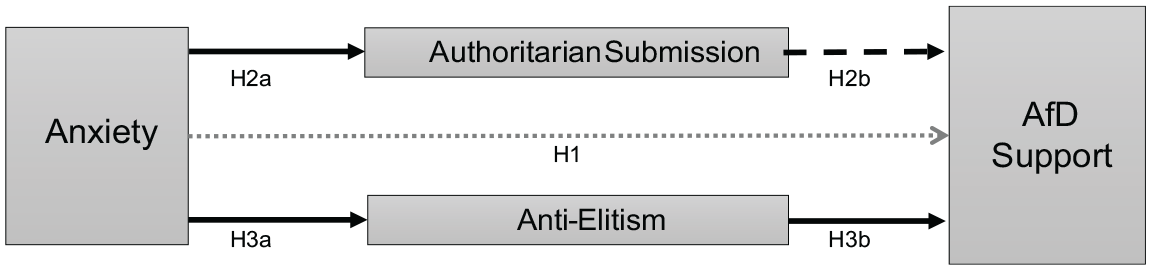
Theoretical Model and Hypotheses.
As indicated, the findings of previous studies on the relationship between anxiety and RPP support are partly contradictory, but the majority of studies find a positive relationship (Jetten & Mols, 2021; Jost, 2019; Nguyen, 2019). Following these studies, and consistent with the view that RPP politicians deploy a rhetoric of crisis, we, therefore, expect to find an overall positive relationship between fear and RPP support:
H1: The total effect of anxiety on AfD support is positive.
In addition, we assume that anxiety can trigger different defensive responses involving opposite attitudes toward authority, which relate to AfD support in opposite ways. More precisely, submission to authority predicts attenuation of the positive association between anxiety and AfD support because the strategy of seeking protection from strong authorities in response to anxiety conflicts with the anti-establishment rhetoric of the AfD:
H2: There is a negative path from anxiety to AfD support via authoritarian submission.
H2a: Anxiety correlates positively with authoritarian submission.
H2b: Authoritarian submission correlates negatively with AfD support.
Moreover, anti-elitism is expected to mediate the relationship between anxiety and AfD support because the anti-establishment rhetoric resonates with resentment toward elites.
H3: There is a positive path from anxiety to AfD support via anti-elitism.
H3a: Anxiety correlates positively with anti-elitism.
H3b: Anti-elitism correlates positively with AfD support.
Investigating obedience and rebellion as reactions to anxiety and opposing forces in how they impact RPP support, we aim to reconcile the contradicting evidence for the link between anxiety and RPP support. Evidence for this link may be inconclusive also due to diverging conceptualizations of anxiety. Experimental studies often measure anxiety in response to threatening stimuli, such as reminders of economic competition or loss of personal control (Hartwich & Becker, 2019; Kay et al., 2009). In contrast, correlational studies measure a diffuse feeling of anxiety, that is, the general tendency toward anxiety, in the absence of an immediate or direct experience of threat (Abadi et al., 2025 in this Special Issue, Part One; Lüders et al., 2020; Rico et al., 2017). Given that these different research traditions are rarely considered in the same study, the question of how the two different forms of anxiety relate to attitudes toward authority and support for RPP has not yet been explored. To gain even more nuanced knowledge on the relation between anxiety and RPP support, we include both situational anxiety (i.e., anxiety in response to threatening stimuli) as well as diffuse anxiety (i.e., the general tendency toward anxiety). Our aim is to explore potential differences in how they relate to defensive reactions of submission and obedience as well as RPP support.
Data, Measures, and Method
Data Collection and Sample
We conducted an online survey in Germany in mid-December 2020 to test our hypotheses. Respondents were drawn from an online access panel using high-quality quota sampling of the German electorate based on age, gender, education, and geographic region. 4 To ensure data quality, we excluded participants with a high number of missing values or implausibly short survey completion times. Due to missing information for variables of interest, the final sample size was 1,879 respondents. While the survey also covered several other topics, all information used in this study was collected at the beginning of the survey to prevent biases and fatigue. This study was not preregistered.
Measures
As our outcome variable, we measured support for the AfD using the Propensity to Vote (PtV) for the party (van der Eijk et al., 2006). Respondents were asked to indicate how likely they would ever vote for the AfD on a scale of 1 (would definitely not vote for this party) to 11 (would definitely vote for this party). 5 PtV not only provides a continuous and non-ipsative measure, which is especially well suited to operationalize party support, but it also allows the inclusion of non-voters, and it constitutes a superior estimate for party competition in multi-party systems (Wagner & Krause, 2023). In addition, the measure correlates highly with voter choice or intention but is unbiased regarding issues such as strategic voting (van der Eijk et al., 2006).
Authoritarian submission was assessed based on three items. Complemented by authoritarian conventionalism and aggression, it comprises the well-established construct of RWA. For the German translation of the items, we adopted the work of Beierlein et al. (2014). Participants indicated their agreement with the statements on a seven-point scale.
Anti-elitism was measured as part of the larger construct of populist attitudes. We adopted the nine-item populism scale developed by Castanho Silva et al. (2017), which allocates three items to measure anti-elitism, while also tapping into variables such as people centrism and Manichean outlook. A study comparing different adaptions of populism (as attitudes) has shown a very high-construct validity for this approach and its subdimensions (Castanho Silva et al., 2020).
To be able to explore the differences between situational anxiety (arising in response to a threat) and diffuse anxiety (a general tendency to resort to anxiety), we included a survey experiment that manipulates exposure to threatening stimuli. The threat manipulation was based on the work of Fritsche et al. (2012). Respondents were randomly assigned to a societal crisis treatment or control treatment (see Section B in the Supplemental Material). They were repeatedly presented with either threatening or relatively neutral statements and pictures covering such societal topics as the environment, the pension system, housing, crime rates, and the job market. Anxiety was measured immediately after the threat manipulation using a three-item battery adapted from the state-trait anxiety inventory (Spielberger, 1983). Respondents were asked to indicate on a scale of 1 to 7, ranging from “not applicable” to “fully applicable,” how they feel “thinking back to the several statements and images”: “I feel insecure (concerned or anxious, respectively).” Being confronted with threatening information is assumed to elicit anxiety related to the specific threats. In the treatment group, we, thus, measure situational anxiety that is centered on the threatening stimuli. In the absence of threatening information, individuals may still experience anxiety. However, in this case, anxiety is not due to the experience of a specific threat; rather, it reflects diffuse anxiety, that is, a general tendency to resort to anxiety. We aim to explore how, depending on experimental conditions, inter-individual differences in anxiety relate differently to authoritarian submission and anti-elitism. 6
As controls, we included age (measured in years), gender (0 = male, 1 = female), education (1 = low, 2 = medium, 3 = high), region of residence (0 = East Germany, 1 = West Germany), and subjective wealth (measured on a scale of 1 to 7, where higher values indicate a higher standard of living). All non-categorical independent variables have been standardized following Gelman (2008), which enables direct comparison of effect sizes of all variable types.
Estimation Method and Model
We used confirmatory factor analysis to extract the underlying construct as factor scores for all latent concepts mentioned above. We then estimated path models using the extracted factor scores and some controls following the presentation above (see Figure 1). Based on this approach, we could test all our hypotheses in a mediation framework. 7
In addition, we use group-comparison tests to estimate potential differences between the control group and respondents for whom we experimentally increased situational anxiety. More precisely, we allow for variances between the two groups regarding the impact of anxiety on authoritarian submission, anti-elitism, and PtV for the AfD. The group-comparison model also estimates different coefficients for the relations of authoritarian submission and anti-elitism with the PtV for the AfD. This procedure allows more nuanced insights into potential differences in the relations between anxiety and RPP support due to different modes of anxiety (i.e., situational and diffuse).
We also specified paths that are not of specific interest to our research question but are necessary for methodological reasons. We allowed the error variances of the subdimensions of RWA and populist attitudes to covary. For the sake of completeness, we have included all remaining sub-dimensions of populist attitudes and RWA as well. Finally, we considered the controls as independent variables in the regressions with the PtV for the AfD as the outcome variable.
Findings
How, indeed, does anxiety correlate with support for RPP? The upper panel of Figure 2 depicts the main results from our path model. The complete results, including the control variables’ effects, are presented in Supplemental Table S7. We start by looking at the general relationship between anxiety and RPP support. We found a significant total effect (btotal = 0.19, p < .01) of anxiety on support for the AfD, confirming what we term as Hypothesis 1 (H1). 8 However, the included mediators substantially explained this total effect (bindirect = 0.10, p < .001). With the inclusion of these mediators as well as the remaining sub-dimensions as additional controls, the direct effect vanished (bdirect = 0.09, p = .12). Regarding Hypotheses 2 and 3 (H2; H3), our findings provide an initial confirmation for our argument that sentiments toward the so-called elites matter in how anxiety influences AfD support.
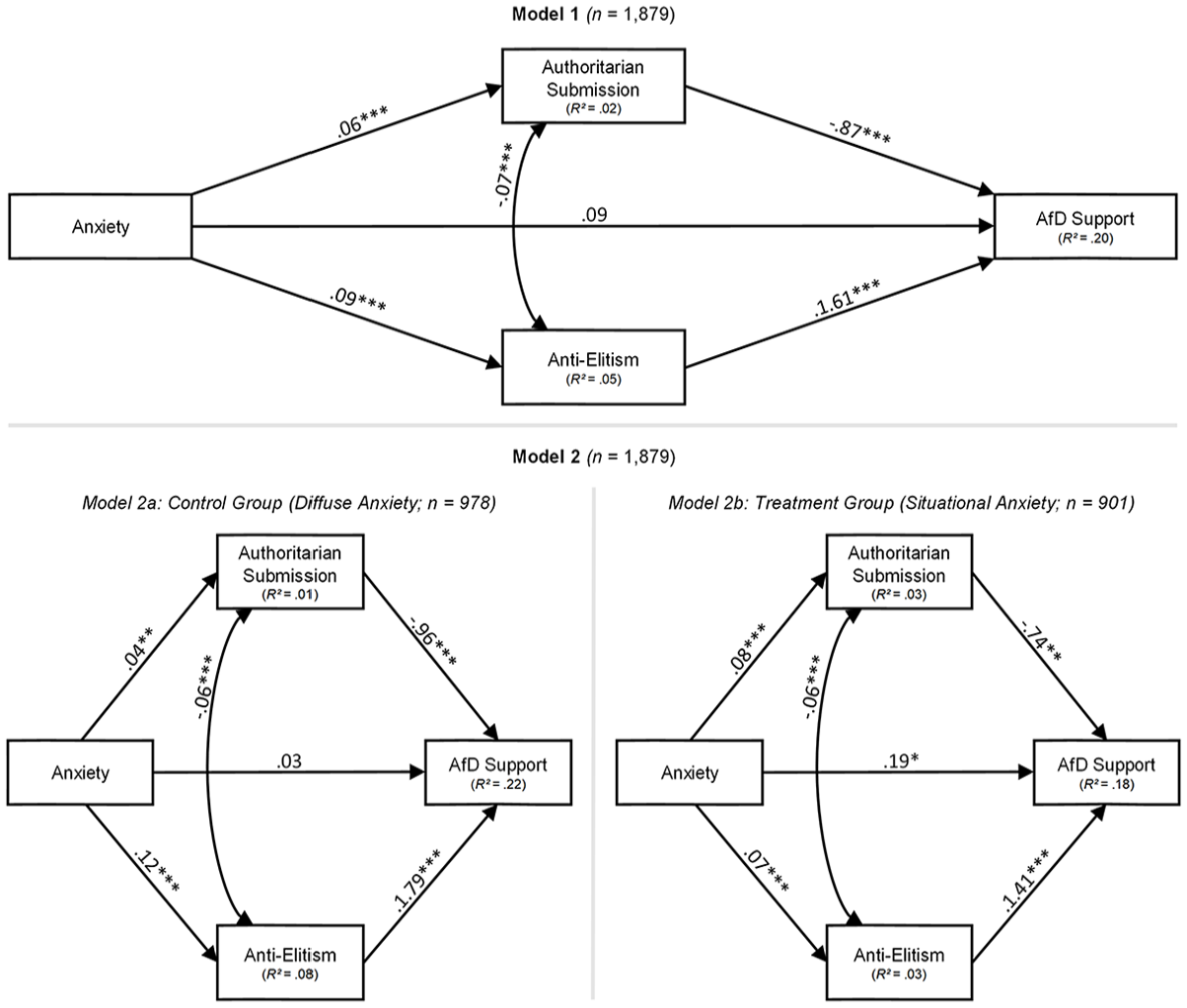
Path Model for the Propensity to Vote for the AfD (Alternative for Germany).
Even as anxiety seemed to affect AfD support through the proposed ideological underpinnings concerning the so-called elites, the question remained: How precisely did anxiety relate to the two subdimensions? As expected, we found that higher anxiety levels were associated with stronger authoritarian submission (b = 0.06, p < .001) and anti-elitism (b = 0.09, p < .001). Thus, authoritarian submission and anti-elitism seem to represent relevant defense strategies against anxiety, confirming H2a and H3a, and the relationship between the two subdimensions and support for the AfD further reinforces our argument. Concerning H2b, submission negatively correlated with RPP support (b = −0.87, p < .001). In contrast, but following H3b, anti-elitism was associated with increased support for the AfD (b = 1.61, p < .001). The findings confirm our argument that authoritarian submission and populist attitudes are both defense mechanisms against anxiety and predictors for RPP support.
As the type of anxiety influences the extent of support for the AfD—via authoritarian submission and anti-elitism—Table 1 accordingly portrays the magnitude of each of these indirect paths for Model 1. Anti-elitism was the more important mediator (bindirect = 0.15, p < .001). The contrary effect via authoritarian submission was also statistically significant but much smaller in magnitude (bindirect = −0.05, p < .001). Hence, while authoritarian submission dampened the largely positive effect of anxiety, the defense mechanisms under analysis indicated that, overall, increasing levels of anxiety lead to more support for RPP such as the AfD. While anxiety correlates with tendencies to rally around the flag—meaning less support for political outsiders like the AfD—it also coincides with anti-elitism, which proves favorable for RPP support. As expected, these contrary effects were underlined by a significant, negative correlation between the two mediators.
Direct, Indirect, and Total Effects of Anxiety on AfD Support.
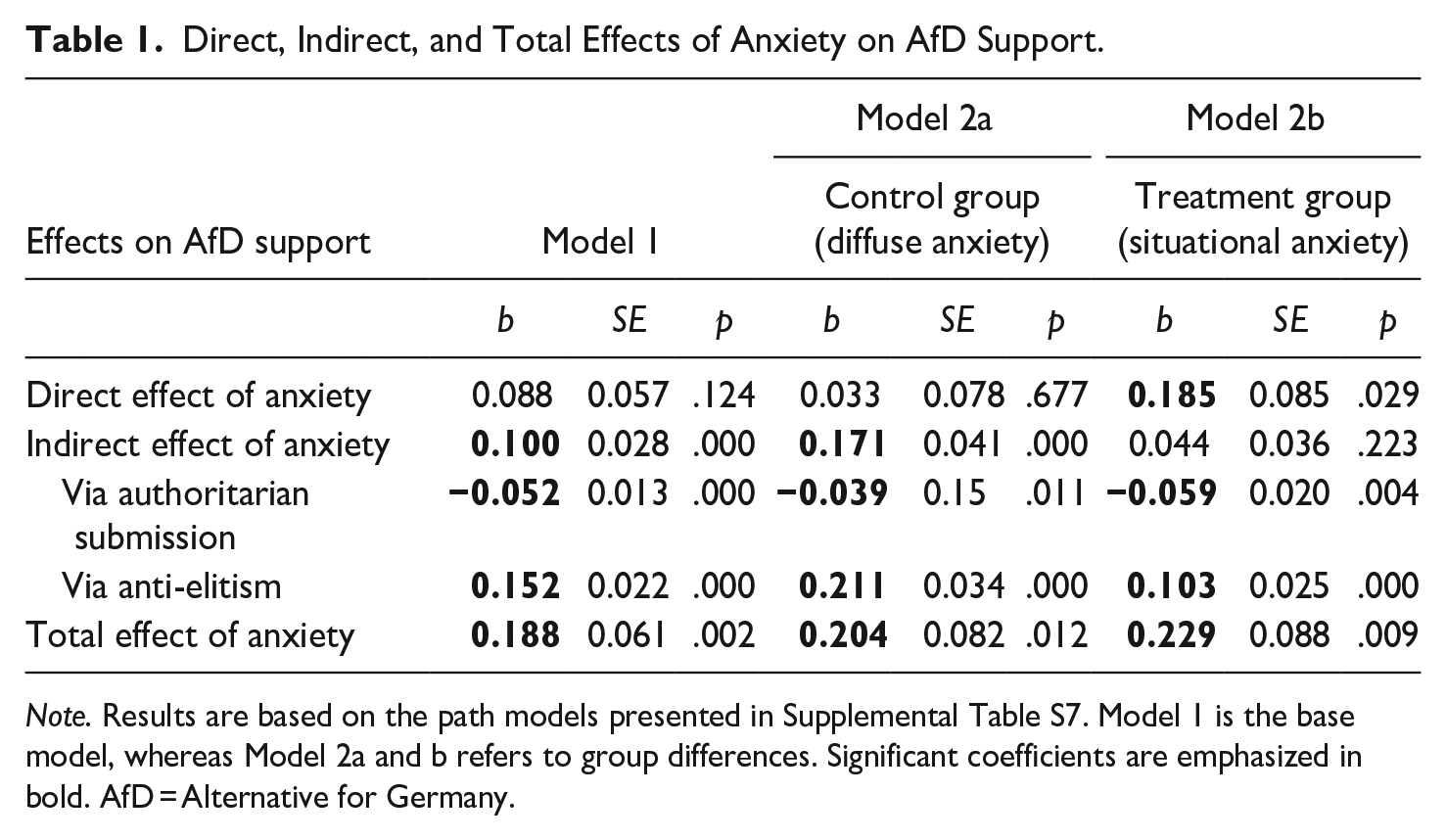
Note. Results are based on the path models presented in Supplemental Table S7. Model 1 is the base model, whereas Model 2a and b refers to group differences. Significant coefficients are emphasized in bold. AfD = Alternative for Germany.
Finally, and in addition to our specific hypotheses, we argued above that an even more nuanced approach to investigating the relationship between anxiety and RPP support might be necessary. Thus, Model 2 explores different forms of anxiety, more precisely, situational anxiety in response to threat and diffuse anxiety in the sense of a general tendency toward anxiety. The lower panels of Figure 2 present this model, a group-wise comparison with the left-hand figure showing the results for the control group (diffuse anxiety) and the right-hand figure for the treatment group (situational anxiety).
All in all, the patterns were similar with two exceptions: First, the effect of anxiety on the two mediators differed significantly between the two groups (p < .05). Being confronted with threatening stimuli (vs. neutral stimuli) strengthened the relationship of anxiety with authoritarian submission while it weakened the effect on anti-elitism. 9 Second, the direct effect of anxiety on AfD support remained significant for the treatment group (bdirect = 0.19, p < .05), with the direct effect of situational anxiety being weaker compared to a model without mediation. However, this effect of situational anxiety was not fully mediated by sentiments toward authorities. This is further underlined by the results presented in Table 1. Overall, there was no significant indirect effect of anxiety for the treatment group as the two mediating paths canceled out each other (Model 2b). Although the results of our experiment are not the focus of this study, they clearly underscore the relevance of an even more differentiated approach that examines different effects not only for different mediators but also for different forms of anxiety at work.
Conclusion and Discussion
RPPs capitalize on threat perceptions and the resulting negative emotions such as anxiety (Nai, 2021; Wirz, 2018). However, from a demand-side perspective, empirical findings are inconsistent and often highly imprecise as they fail to explain the underlying mechanisms. This study addresses that gap of inconclusiveness by linking anxiety to two ideological core predictors of RPP support: populist attitudes and RWA. More precisely, we argue that subdimensions of these concepts—anti-elitism and authoritarian submission—provide citizens with potential defense strategies for dealing with anxiety. While anti-elitism increases RPP support, authoritarian submission is supposed to have a decreasing effect. Because of this contradiction, we aim to go beyond examining the relationship between anxiety and the conglomerate of right-wing populist ideology. In fact, we provide insights into the ideological mindset of RPP supporters by showing how anxiety fuels and dampens RPP support via obedience (authoritarian submission) and rebellion (anti-elitism).
We tested the respective model using observational data collected in Germany to explain support for the AfD. In line with our reasoning, we find that anti-elitism mediates the positive relationship between anxiety and AfD support. At the same time, authoritarian submission weakens this relation. Although authoritarian submission increases with anxiety, it is negatively associated with AfD support. These conflicting dynamics may explain the mixed findings of prior studies regarding the valence and strength of the association between anxiety and RPP support on the one hand (Lüders et al., 2020; Nguyen, 2019) and between RWA and RPP support on the other (Rothmund et al., 2020). The importance of distinguishing between the different subdimensions of RWA cannot be overstated for that reason. By highlighting the ambiguous impact of anxiety, our study contributes to the scientific debate on the emotional underpinnings of right-wing populism.
Previous literature often linked populism in general, and anti-elitism in particular, to a general sense of societal crisis and decline (Elchardus & Spruyt, 2016; Taggart, 2004; van der Bles et al., 2017), which may reflect a rather diffuse feeling of anxiety. In contrast, so-called rally effects tend to occur during specific incidents of threat (Dietz et al., 2023; Hetherington & Nelson, 2003), suggesting that support for authorities may be driven by situational anxiety. Our survey experiment allowed us to explore the consequences of these different forms of anxiety for RPP support and its ideological underpinnings. Compared to diffuse anxiety, situational anxiety in response to threatening stimuli is strongly related to authoritarian submission and less so to anti-elitism. As a result, the opposing forces of these two pathways tend to cancel each other out, leaving no significant indirect but a direct effect of situational anxiety on AfD support. This finding suggests that RPP’s rhetoric of fear can backfire when frightened voters seek shelter with established parties in the face of salient threats instead of rebelling against them and, therefore, that empirical studies should be careful about what form of anxiety they measure.
Our findings highlight a potential shortcoming in the initially discussed theories of affective intelligence and conservative shift. Although the theories make rather contradicting predictions on the relation between anxiety and RPP support, they both neglect the role of populist attitudes assuming a uniform relation between (preexisting) ideology and RPP support. In line with the idea of right-wing populism as a conjunction of distinct ideologies (Mudde, 2007), our findings stress the importance of unpacking the ideological underpinnings of RPP support. In contrast to what is suggested by the conservative shift hypothesis, the relation between anxiety and RPP support is not only driven by a heightened endorsement of conservative ideas, as some citizens seem to become more rebellious. They develop stronger anti-elitist sentiments, leading to a deepening distrust of established status relations, and strive for change rather than preserving the status quo.
Assuming that anger is a consequence of anxiety (Jonas et al., 2014; Jost, 2019), our findings can be reconciled with earlier research highlighting the importance of anger for explaining RPP support (Rico, 2025 in this Special Issue, Part Three; Rico et al., 2017). According to the threat and defense model, anger is a response to anxiety: threatening stimuli elicit anxiety, but individuals will, after some delay, “mute anxiety and restore subsequent equanimity” by activating approach-oriented states, including anger and hostility (Jonas et al., 2014, p. 229). This reasoning is supported by research showing that anger mediates the link between anxiety and RPP support (Abadi et al., 2025 in this Special Issue, Part One; Jost, 2019; Lüders et al., 2020). Unfortunately, we could not empirically test this notion since we did not measure anger in our study. Future studies might draw on longitudinal data or develop experimental designs investigating the temporal dynamics between societal threat, different forms of anxiety, and anger for driving RPP support. Examining the role of anger as a distal response to anxiety also provides an opportunity to scrutinize affective intelligence theory, which posits that the two emotions are independent.
While we can shed light on different defensive responses to societal threat and anxiety, the individual, situational, and societal determinants of the different defensive responses are still more or less a black box—and thus a promising avenue for future research. Is the relation between anxiety and RPP support weak on average because individuals are torn between rebellion and submission (Passini & Morselli, 2010)? Or do individuals simply vary in their default response to threats and anxiety? Interindividual differences imply that societal threats may reinforce attitudinal polarization. While societal threats may trigger some individuals to become more obedient to political authorities, others may be motivated to become more rebellious. Consequently, the public may be divided between “followers” and “rebels.” Consistent with this notion, the COVID-19 crisis in many Western countries revealed an increasing divide between those who are highly supportive and compliant with governmental measures and those who doubt government measures and actively oppose them (for Germany, see, e.g., Grande et al., 2021). Future research could focus on interindividual differences in defensive responses and explore the factors determining whether individuals become “obedient followers” or “rebels.”
Related to the idea that anxiety can trigger very different types of defensive responses, future research could also examine hostility toward minorities, such as immigrants, as an additional driver in the relationship between anxiety and RPP support. In fact, research has shown that anxiety increases nativism (Jonas et al., 2014) and that nativism is a core predictor of RPP support (Gründl & Aichholzer, 2020; Mayer et al., 2020). Given the computational limitations of path analyses and the high correlation between RWA and nativism, we decided to focus on views on authority and to leave aside nativism as an additional mediator.
Moreover, we must critically admit that we did not measure attitudes toward authority independent of the ideological underpinnings of RPP support but rather refer to previous studies that have shown how anti-elitism and authoritarian submission are related to submission and rebellion. Future studies might fill this gap by explicitly investigating attitudes toward authorities as defensive responses to anxiety and predictors of anti-elitism and authoritarian submission.
This universal approach and instrumentation, as well as the fact that the AfD constitutes a prototypical RPP, underscores the robustness of our findings. Nonetheless, validating our findings for RPPs in other countries seems a reasonable step for future research. The AfD’s ceaseless attacks on the established parties and its radical positions make the party an outsider in the German political system, which is the case for many RPPs in Europe (Wagner & Meyer, 2017). This outsider status should be kept in mind, as expectations may differ for parties that have moved more into the political mainstream—or have even become part of coalition governments—and thus have softened their attacks on the governing elites (Bernhard, 2020). When RPPs are in power or well-established, the otherwise opposing attitudes of anti-elitism and authoritarian submission may no longer contradict but rather reinforce each other, particularly if RPP leaders succeed in discrediting other political authorities as corrupt. Extending the research to different party families could also be very interesting. Conservative parties, for example, also benefit from RWA attitudes but will lose support if anti-elitist attitudes are strong. Given the central position of conservative parties (due to frequent government participation or substantive vote shares) in most party system in Western democracies, such studies could help to better understand the emotional underpinnings of support for authority in general and party support in particular.
Supplemental Material
sj-docx-1-abs-10.1177_00027642241240717 – Supplemental material for Submission or Rebellion? Disentangling the Relationships of Anxiety, Attitudes Toward Authorities, and Right-Wing Populist Party Support
Supplemental material, sj-docx-1-abs-10.1177_00027642241240717 for Submission or Rebellion? Disentangling the Relationships of Anxiety, Attitudes Toward Authorities, and Right-Wing Populist Party Support by Susanne Veit, Magdalena Hirsch, Heiko Giebler, Johann Gründl and Benjamin Schürmann in American Behavioral Scientist
Footnotes
Acknowledgements
We would like to thank Arne Carstens and Niklas Stoll for their help with setting up the survey as well as preparing the analyses and the manuscript.
Declaration of Conflicting Interests
The authors declared no potential conflicts of interest with respect to the research, authorship, and/or publication of this article.
Funding
The author(s) disclosed receipt of the following financial support for the research, authorship,and/or publication of this article: Heiko Giebler and Susanne Veit received financial support from the Social Science Research Center Berlin (WZB) for the research project “Against Elites, Against Outsiders: Sources of Criticism of Democracy, Criticism of Immigration and Right-Wing Populism”, on which this article is based.
Supplemental Material
Supplemental material for this article is available online.
Notes
Author Biographies
References
Supplementary Material
Please find the following supplemental material available below.
For Open Access articles published under a Creative Commons License, all supplemental material carries the same license as the article it is associated with.
For non-Open Access articles published, all supplemental material carries a non-exclusive license, and permission requests for re-use of supplemental material or any part of supplemental material shall be sent directly to the copyright owner as specified in the copyright notice associated with the article.
