



Abstract
Despite growing awareness of loneliness among emerging adults, the taboo and stigma surrounding loneliness remains poorly understood. The present study, based on 22 semi-structured interviews with emerging adults in the Netherlands, investigates how taboo and stigma shape their experiences of loneliness and the strategies they use and suggest to overcome them. Findings reveal that while emerging adults are increasingly open about their feelings within close networks, loneliness remains a sensitive and stigmatised topic in broader societal contexts. Participants suggested that solutions to reduce stigma and taboo lie within personal environments and educational settings, though they did not view the workplace as a significant place to address taboo and stigma. The study highlights the need for further research to explore the underlying causes of loneliness in emerging adults and calls for interventions that address personal and societal aspects of taboo and stigma.
Introduction
Loneliness among emerging adults is quite a common phenomenon with a recent health monitor in the Netherlands showing that 27% of emerging adults aged between 16 and 25 years old feel very lonely and that 63% experienced some loneliness (RIVM, 2022). Furthermore, a study from the UK showed that 23–31% of respondents aged 18 reported experiencing feelings of loneliness some of the time and 5–7% strongly so (Matthews et al., 2018). In the United States, loneliness also appears to be an increasing concern in emerging adulthood, with loneliness increasing linearly between 1973 and 2009, over a 0.56 standard deviation (Bland, 2024; Buecker et al., 2021). Loneliness is a subjective feeling in which the individual is dissatisfied with both the quality and quantity of social relationships (Perlman & Peplau, 1981). Next to that feeling of loneliness is an unpleasant experience, loneliness is known to have a large impact on physical and mental health, as emerging adults with feelings of loneliness are more likely to develop depression, cardiovascular disease, sleep problems and get elevated blood pressure (Cacioppo & Hawkley, 2003). In addition, young people are more likely to suffer from stress and suicidal thoughts (Hawkley & Capitanio, 2015) and loneliness has also been experienced as a loss or as an abandonment, caused by societal undermining or a invalidation of people’s social identity (Malli et al., 2023).
Previous research has shown that the number of young people experiencing loneliness has increased globally over the past two decades (Bland, 2024; Buecker et al., 2021; Surkalim et al., 2022). The studies cite increased fragmentation of social relationships, greater geographic mobility, and changes in communication technology as possible reasons for the rise in loneliness among emerging adults. Although the research on loneliness among emerging adults has thus received attention lately, there has been limited scientific research on the taboo and stigma attached to loneliness. Previous studies show that the taboo and stigma surrounding loneliness can be problematic for identifying and addressing these symptoms. Some studies suggest that loneliness can be seen as strange, wrong or shameful (Dahlberg, 2007). As a result, young people may be discouraged from talking about loneliness, whereas having a conversation about experiencing loneliness can be a first step in overcoming the feelings of loneliness (Schoenmakers, 2020). Furthermore, other research suggests that people with loneliness are viewed negatively and can be seen by others as weak, passive and socially incompetent (Lau & Gruen, 1992). This makes people without feelings of loneliness believe that young people themselves are responsible for the factors that led to the experience of loneliness (Kerr & Stanley, 2021). In addition, existing interventions do not yet adequately look at taboo and stigma as a way to reduce loneliness among emerging adults. This is in accordance with a recent discussion arguing that addressing social issues should not only focus on the individual frame, but also consider solutions within society as a whole (Chater & Loewenstein, 2022). As suggested also by Malli et al. (2023) and Bland (2024), much more should be done to normalize loneliness in the public discourse and we should understand more about how society can create and exacerbate loneliness. Rather than solely focusing on individual interventions, this research seeks to understand how systemic and cultural factors such as institutions and organizations such as education and workplaces, and cultural expectations and stereotypes shape experiences of loneliness among emerging adults and how these structures can be modified according to emerging adults themselves to foster greater social connectedness and inclusion.
Next to this, this research also adds to the existing literature on loneliness among emerging adults by providing more insight into the role of taboo and stigma in emerging adults’ experiences of loneliness. Little is known about the role of taboo and stigma related to loneliness in young people’s everyday lives, and many studies to date have focused primarily on providing theoretical definitions and conceptualization of taboo and loneliness instead (Barreto et al., 2022; Dahlberg, 2007). In this study, we first examine the nature and characteristics of taboo and stigma as experienced by emerging adults. Second, we investigate the role that these phenomena play in shaping emerging adults’ experiences of loneliness. Third, we explore the strategies and processes through which emerging adults have navigated and overcome taboo and stigma in relation to their experiences of loneliness.
Loneliness in Emerging Adulthood: Life Phase
Several studies indicate that emerging adults under the age of 30, compared to other age groups, seem to experience a lot of loneliness (Barreto et al., 2021; Hawkley et al., 2020; Luhmann & Hawkley, 2016; Schultz & Moore, 1988; Victor & Yang, 2012). In this regard, a number of studies suggest that loneliness in young adulthood does not seem to derive only from the Covid-19 pandemic. Loneliness in this age group seems to be on the high side even before the Covid-19 pandemic (Luhmann & Hawkley, 2016; Schultz & Moore, 1988; Victor & Yang, 2012). Since less loneliness is experienced among the other age groups except the elderly, the stage of life represents a possible cause for developing loneliness. Emerging adulthood (Arnett, 2000), characterized by an “in-between” feeling between adolescence and full adulthood, can be influenced by societal conditions that either support or hinder identity development, as Erikson (1968) suggested in Identity: Youth and Crisis. It is often characterized by identity exploration, instability, self-focus and feeling “in-between” (Arnett, 2000). For loneliness, this stage can be particularly complex because individuals are expected to become independent, form new relationships, and establish a sense of belonging. Yet, many feel caught between their past (family, childhood friendships) and the uncertainty of forming stable adult connections. In addition, multiple studies confirm that emerging adults’ life stage could play a crucial role in developing loneliness. The life stage of emerging adulthood is in its core described as a time in which many possibilities and directions in life are still open (Arnett, 2000). Young people often graduate from school during this period in their life and want to explore different options regarding work, education, social contacts and intimate relationships (Arnett, 2000, 2004). As a result, the stage of young adulthood is primarily about change, development and experimentation (Arnett, 2000). This makes emerging adults vulnerable to loneliness, as they navigate a phase of life characterized by a strong desire for exploration alongside frequent and rapid social and life transitions. (Arnett, 2000; Sundqvist & Hemberg, 2021). As such, there is a feeling of being in-between where people are starting to take responsibility for themselves, but also do not feel like an adult completely (Arnett, 2000).
Factors such as rugged individualism contribute to the loneliness taboo (Bland, 2024), while social media “liking” (Sherman et al., 2016) but also a focus on likeability due to the importance of social status (Prinstein, 2017) fuels misperceptions about popularity and unrealistic expectations about social connections. Rugged individualistic parenting could potentially foster dependency and intergenerational transmission of insecure attachments and a work-first culture as well as technocracy and increased polarisation could also contribute to increased loneliness in emerging adulthood (Bland, 2024). Additionally, attachment theory (Bowly, 1969) highlights how interpersonal mistrust can lead to avoidance behaviors, further reinforcing loneliness (e.g. Lemay et al., 2024) and shaping broader societal attitudes and stigma. Moustakas (1961) emphasized that fostering genuine and meaningful connections can help individuals find deeper understanding and fulfillment in their relationships. Moustakas contrasts the deep connection of I-Thou encounters with the instrumental nature of I-It relationships. While loneliness is often seen negatively, it can prompt individuals to confront their own subjectivity, making them more open to genuine connections. In this way, loneliness paradoxically fosters deeper, more authentic engagement with others. Creating opportunities for authentic engagement may thus enable individuals to navigate solitude more constructively, allowing them to develop resilience and a greater sense of purpose in the face of loneliness. By embracing loneliness rather than escaping from it, an individual can develop a sense of personal integrity, making their eventual re-engagement with the world more grounded in authenticity. In line with this Buhler (1969) stated that individuals can find meaning and fulfillment despite isolation, but that existential loneliness is also an inevitable part of the human experience and that loneliness can help to find wholeness and connection.
Several studies indicate that the life course transitions that younger adults undergo in different life domains, can constitute a vulnerable period for emerging adults (Sundqvist & Hemberg, 2021). Some examples of transitions include leaving the parental home and starting at a new place of study or university (Carr et al., 2013; Sundqvist & Hemberg, 2021). Although these social transitions can create opportunities to make new contacts, it can also create difficulties in making new friendships and building a social network (Sundqvist & Hemberg, 2021). This is especially likely when people do not succeed in creating new bonds with others in novel environments or the instability due to frequent moves of education, work and housing for example create a lot of volatility. This makes it more difficult to feel integrated socially and create the needed social relationships. The various transitions in multiple domains of life that accompany this life stage, and also the discovering nature that young people assume at this stage of life, indicate that emerging adults may be vulnerable to developing loneliness.
Taboo and Stigma on Loneliness in Emerging Adulthood: What do we know?
When emerging adults experience feelings of loneliness, it is difficult to talk about it. Loneliness is perceived as shameful, which makes it a taboo (Dahlberg, 2007; Killeen, 1998; Tharaldsen et al., 2017). A taboo is defined as a topic that is deliberately avoided, because a person may have the assumption that harm will occur if it is spoken about, it is socially seen as unacceptable to talk about it or it is associated with a strong feeling of shame (Jay, 2009; Traumer et al., 2019). That a feeling of shame can prevent someone from talking about loneliness, is demonstrated by Lewis’ (1971) theory. According to Lewis (1971), people who feel ashamed will fill in another person’s thoughts in a negative way. Other studies also seem to confirm Lewis’ (1971) theory, but argue that the fear of talking about mental health issues stems primarily from the stigma surrounding mental health (Salaheddin & Mason, 2016). Stigma can be defined as a set of culturally shared beliefs that lead to the rejection of specific traits (Barreto et al., 2022), which involves casting an individual in a negative light.
In the present study, a distinction is made between public stigma and self-stigma. A public stigma is defined as the reaction of the general public towards a stigmatized group (Rüsch et al., 2005). Self-stigma is seen as giving stigmatized responses towards oneself. Both public and self-stigma consist of three components. This includes stereotypes, prejudice and discrimination. A stereotype can be seen as a knowledge structure which is familiar to most of the people within a social group (Corrigan, 2004; Rüsch et al., 2005). When someone is stereotyped, certain impressions and expectations are attached to someone. These impressions and expectations are often negative. While not everyone agrees with the stereotypical images of a stigmatized group, some people will develop certain prejudices about the stigmatized group. This can be seen as the next phase in actually stigmatizing a group of people. The third component of stigma is discrimination. In the case of public stigma, this puts the stigmatized group at a disadvantage, because young people who experience loneliness are found to be less optimistic about achieving career goals (Matthews et al., 2018). This shows that both public stigma and self-stigma can get in the way of achieving personal life goals and career goals. In some other studies, slightly different but relatively similar distinction have been made, for example between endorsed stigma—an individual’s own stigmatizing views of a particular identity or attribute—and perceived stigma, which refers to the belief that society stigmatizes that identity or attribute (e.g., Pescosolido & Martin, 2015), as highlighted by Barreto et al. (2022). Framing the distinction as one between self-stigma and public stigma provides a clear foundation for our current study. This distinction captures the sources of stigma we aim to explore.
Moreover, both forms of stigma can also further reinforce the experience of loneliness. It also appears that public stigma makes emerging adults fearful of being negatively labeled (Corrigan, 2004; Salaheddin & Mason, 2016). It seems that people are encouraged by the stigma attached to loneliness to avoid a negative label (Corrigan, 2004). For this reason, stigma is one of the main reasons people do not seek professional help for mental health issues. Moreover, according to research by Tharaldsen et al. (2017), there are many prejudices among young people about having mental health issues, which is likely to also apply to loneliness. Emerging adults are anxious of the negative attitudes peers might have about experiencing mental illness. Hence, also for loneliness, it is very likely that emerging adults are afraid to discuss loneliness with others.
Furthermore, it appears that emerging adults who experience feelings of loneliness may have negative perceptions about their own social skills as the result of stigma (Lodder et al., 2016). This is part of self-stigma in which emerging adults may have certain preconceived notions of incompetence toward themselves. Badcock et al.’s (2020) research highlights that self-stigmatization often results in personal withdrawal as a protective mechanism against perceived rejection, which may further reinforce loneliness and hinder recovery by limiting social engagement and opportunities for support. Another issue related to stigma is the expectations that emerging adults form about social life. Indeed, emerging adults tend to compare themselves to their peers (Kirwan et al., 2023), especially to peers on social media (Kirwan et al., 2023; Sundqvist & Hemberg, 2021). This gives young people the perception that other peers are more social and popular and this might increase the feeling that their social life is not up to par. This can also lead to self-stigma prejudices, because if they feel that the social expectations of people in this age range do not meet their actual social lifes, it can lead to more self-stigma and hence more negative feelings and more experiences of loneliness. Over time, Lemay et al. (2024) found that loneliness fosters increasing mistrust and distorted perceptions of relationship partners’ intentions, which in turn erode the quality of close relationships further. This cycle may reinforce loneliness over time, as individuals struggle to maintain secure and fulfilling interpersonal connections.
Other Causes of Loneliness Among Emerging Adults
As clear from the former sections, loneliness among emerging adults can be caused by several factors, in which social relationships and experiencing support play a crucial role. Friendships are important for identity formation and providing emotional and social support (Wilkinson, 2010), especially in emerging adulthood where they explore independence from the parental family. In the absence of a romantic partner or when leaving the parental home, emerging adults lean even more on friendships for support (Nicolaisen & Thorsen, 2016). However, the presence of friendships does not always guarantee the prevention of loneliness. The extent of satisfaction with the social network plays a larger role in this regard, where dissatisfaction with social contacts can lead to feelings of loneliness (Child & Lawton, 2019). Certain at-risk groups, such as youth within the LGBTQIA + community, family caregivers, and youth living in poverty or with chronic illness, are at increased risk of developing loneliness due to reduced social support and limited access to social activities (Eres et al., 2021; Madsen et al., 2019).
In addition to these risk groups, negative life experiences such as bullying, unstable family relationships, and loss of a loved one also play an important role in the development of loneliness (Korzhina et al., 2022). Adolescents who grow up in unfavorable home situations, such as divorce or frequent quarrels, often have more poorly developed social skills, which complicates their participation in social interactions and reinforces feelings of loneliness (Burke et al., 2012). Moreover, there is a clear link between loneliness and a lack of emotional and social skills. Emerging adults with less well-developed social skills experience less positive interactions and are considered less accessible in conversations, thus perpetuating their loneliness (Lodder et al., 2016; Segrin, 2017).
A third cause of loneliness among emerging adults is repeatedly experiencing social disappointments. This can lead to a negative spiral of loneliness. Failure to make new social contacts or improve existing relationships can reduce motivation to try, leading to long-term feelings of loneliness (Cacioppo & Hawkley, 2009). This process is often accompanied by a decline in self-esteem, which then increases fear of social rejection and makes it more difficult to engage in new social contacts (Sakiz et al., 2021). Thus, negative thinking patterns and low self-confidence can ensure that loneliness is reinforced.
Methods
This study uses a phenomenological research approach. In phenomenological research, individual experiences are examined with the aim of describing a phenomenon (Van der Meide, 2015). Therefore, the researcher engages with individuals who have experienced the phenomenon (Creswell, 2007). The emphasis here is on ‘what' the individuals experienced and ‘how' the individuals experienced it. This makes it possible to create in-depth descriptions of individual experiences, without oversimplifying, explaining or labeling the experiences (Van der Meide, 2015). This enables further insights into emerging adults’ experiences of the taboo and stigma of loneliness. Following the phenomenological approach, the Interpretative Phenomenological Analysis (IPA) is used as a method of analysis. The rationale for using the IPA method is that it emphasizes understanding how individuals make sense of their lived experiences (Smith & Osborn, 2003). Here, the researcher tries to understand the point of view from the respondent’s point of view. Since our research question focuses on how emerging adults experience taboo and stigma, IPA is particularly suitable as it allows for an in-depth exploration of personal meaning-making. Additionally, IPA acknowledges the interpretative role of the researcher (Pietkiewicz & Smith, 2014; Smith & Osborn, 2003). Indeed, a process of interpretive activity takes place. Indeed, the researcher’s own views and assumptions determine the way in which meaning is given to the respondent’s personal world. Furthermore, an idiographic approach was adopted when analyzing the data. This means that each case is analyzed individually before general statements are made about the whole. The reason for adopting the idiographic approach has to do with the respondents' diverse experiences of loneliness and its taboo and stigma.
Data Collection and Participants
For this study, 22 semi-structured interviews were conducted with emerging adults (20–28). This form of interviewing was specifically chosen, because it creates a lot of room for probing questions (Bryman, 2016). This allows the researcher to probe further into emerging adults’ experiences to gain more insight into emerging adults' personal and social worlds. To create this space, a topic list is compiled (see Supplemental file 1). Respondents for this study were obtained through a recruitment exercise at Join Us Foundation. Join Us is a foundation in the Netherlands that aims to address and tackle loneliness among young people. To reduce loneliness among emerging adults, Join Us offers a physical and online group program.
The inclusion criteria to participate in the study were an age between 18 and 30 years, having experience with loneliness and being a volunteer at Join Us. The emerging adults interviewed in this study are aged between 20 and 28 and most are currently volunteering at Join Us. Also, the emerging adults have different philosophical backgrounds. One of the conditions for becoming a Join Us volunteer is participation in one of the Join Us programmes. This may have been at different locations in the Netherlands. Moreover, everyone who decides to participate in Join Us is dealing with loneliness themselves at the time of participation. As a result, all of the volunteers have experience with loneliness. However, all respondents had a different duration of loneliness and the reasons for being lonely varied. Some of the respondents felt lonely for a shorter duration such as one year, while others felt lonely for more than ten years before participating in one of the Join Us programmes. This is conducive to the research because the participants themselves have knowledge of the problem and have a variety of experiences with loneliness. This also means that the results mainly say something about the experiences of a group of emerging adults who have faced it themselves.
If a respondent agreed to participate in the study, after receiving an information letter through Join Us, they received a second letter containing more information about the interview and audio recording. It was also indicated at all times that there is an option to opt out of participating in the study. Anonymisation was also promised in both letters. Respondents were allowed to come up with their own pseudonym in advance of the interview. If they did not know a pseudonym, the researcher assigned one. This ensured the anonymity of the respondents.
There is a gender balance among the participants (12 men and 10 women). This is not the case in many scientific studies on loneliness, where women are often in the majority. Regarding the educational level of the respondents, there is also a lot of variation, from not having a high school diploma to being or becoming university educated. However, respondents with higher education are in the minority. The interviews lasted between 61 and 84 minutes, with the average duration being 72 minutes.
Data Analysis
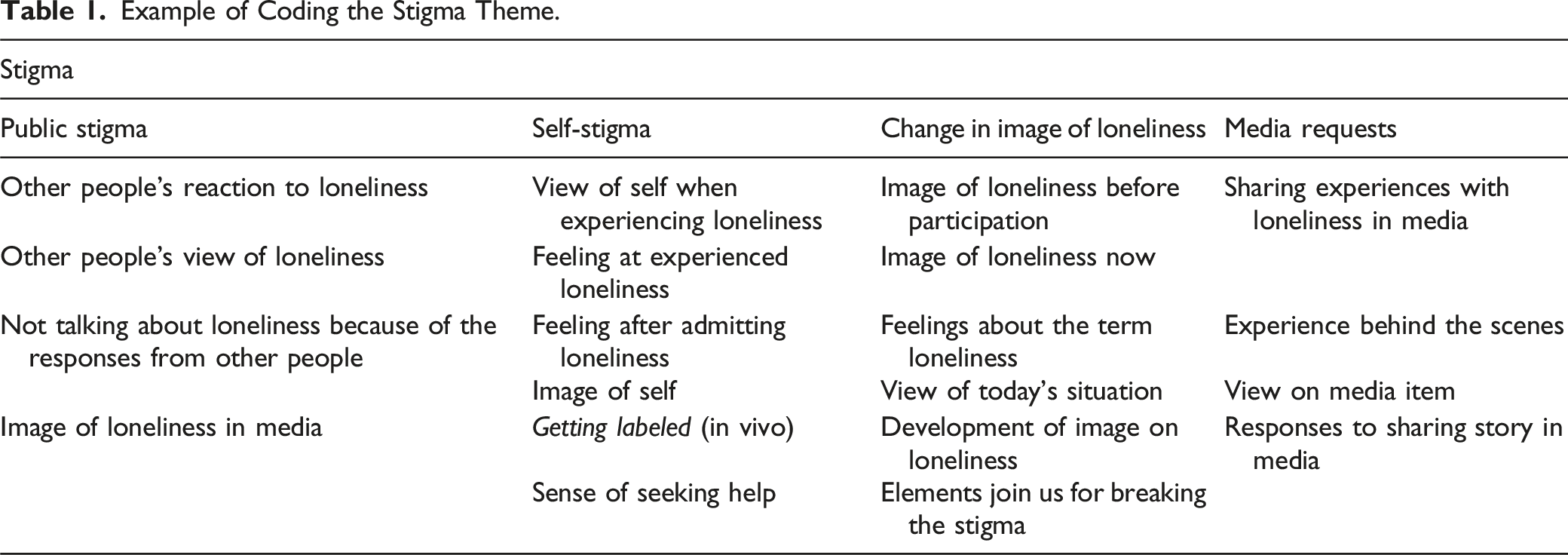
The interviews were all transcribed using the special transcribing software Trint. For the IPA method, it is important that the interviews are transcribed at a semantic level. This means that all spoken words are visible, but all “uh”, significant silences and laughter are also transcribed (Smith & Osborn, 2003). Furthermore, in this method of analysis, transcripts are coded thematically. First, the data is coded in an open way, then themes are clustered and a hierarchy is established (axial coding) and in the third stage the themes are further ordered and the most important themes are distinguished (Smith & Osborn, 2003).
Example of Coding the Stigma Theme.
Ethical Considerations
Research on emerging adults’ experiences of the taboo and stigma of loneliness is seen as a sensitive topic. Although a ‘sensitive’ study is difficult to define, according to Lee (1993), these studies are often associated with taboo topics. To ensure the well-being of respondents, it was indicated that respondents may withdraw from the study at all times. This is possible even if the interview had already been conducted. All respondents were also given the option to pause or stop the interview at any time, without having to explain themselves. This was emphasized again at the beginning of the interview. In addition, a debrief was held after the interview. At the debriefing, respondents were asked how they experienced the interview and this was discussed with them to alleviate burden. In addition, respondents were not promised any resources for participating in this study. Participation in this study was completely voluntary.
The lead author has some ties to the organization as a volunteer at Join Us but has received no monetary compensation, nor are there any actual conflicts of interest or have they been involved in the study design or interpretation of the results. Additionally, the study was not designed to assess the effectiveness of the intervention but rather to explore emerging adults’ perspectives on the stigma and taboo surrounding loneliness from a scientific standpoint. While the author’s involvement in the organization has been instrumental in recruitment, steps were taken to minimize potential bias. Notably, the author only interviewed emerging adults with whom there were no pre-existing relationships, ensuring that prior knowledge did not shape the interviews. Respondents later indicated that the researcher’s affiliation with the organization made them feel more comfortable and reassured about how their information would be handled. The author’s own experiences with loneliness also helped in this respect. This trust fostered openness in discussing their experiences, enriching the depth of the data while maintaining reflexive awareness of the researcher’s positionality. Importantly, the findings reflect the voices of the participants rather than any organizational influence. The organization had no involvement in the design or implementation of the research; this was conducted solely by the two authors.
Results
This section outlines the key findings from the interviews. The results section starts by describing what constitutes taboo and stigma among emerging adults. Accordingly, the role that taboo and stigma play in emerging adults’ experiences of loneliness will be outlined. This will include how the emerging adults broke the taboo and stigma for themselves. Following this, recommendations will be given for the personal environment, education, the workplace and society as a whole to be able to break the taboo and stigma of loneliness among emerging adults.
What Taboo and Stigma on Loneliness Entails
Emerging adults make a distinction in the taboo of loneliness, with discussing it personally becoming less of a taboo due to their own experiences with loneliness, while socially it still remains a sensitive issue. This distinction is based on their experiences with loneliness and how they have broken the taboo. The taboo is experienced twofold: personal and societal. The descriptions provided by emerging adults indicate that these two aspects of the taboo are interconnected and mutually reinforcing. The stigma associated with loneliness on a societal level often reinforces the personal taboo, making it harder for individuals to openly discuss their experiences without fear of judgement or misunderstanding. This intertwining of personal and societal taboos highlights how individual experiences with loneliness are influenced by, and in turn impact, broader social attitudes and stigma.
Stigma of Loneliness
The stigma of loneliness among emerging adults consists of several parts. First, the stigma appears to consist of some influences imposed on emerging adults from society or social media. This can be about negative reactions that emerging adults receive from other people when experiencing loneliness, but it can also be about the image that other people have of someone who is lonely. Indeed, several emerging adults emphasise that the term loneliness often carries a negative connotation. According to emerging adults, loneliness is often associated with older people, having poor social skills and a stereotypical image of those who are lonely. These associations and conceptions may be imposed from society and social media. Indeed, several young people indicate that social media can give the impression that young people should be social and have many friends. For this reason, people’s perception of loneliness is also part of the stigma.
Furthermore, as a result of the experienced loneliness, emerging adults give stigmatised reactions towards themselves, consisting of negative thoughts about themselves and about the experienced loneliness. Many emerging adults appear to have given such stigmatised reactions towards themselves. Kevin tells the following about this: “If you are constantly rejected for initiatives all the time, then you really do think that yes, there is also something about me. Now I really seriously think of, I'm very boring, but I admit that myself. I'm also pretty boring, but I just don’t know how to socialise or anything.” - (Kevin, 28)
By giving stigmatised responses towards themselves, emerging adults make it difficult for themselves to talk about loneliness or to seek appropriate help. This mode of self-stigmatisation and the associations and mindsets imposed from society affect emerging adults’ experiences of the taboo.
Taboo of Loneliness: Societal Impressions
Taking the above into account, it is not surprising that almost all emerging adults state that there is currently a taboo within society on loneliness. Although the emerging adults’ interpretation of the taboo varies, some concordances can be found. First, a number of emerging adults mention that a taboo is visible among young people currently participating in one of the Join Us programmes because they find it difficult to talk about loneliness. In this regard, the emerging adults note that many young people feel ashamed of loneliness in the early stages of participation. Yet young people may also be open because a taboo is perceived within their own personal environment. This is noted by Anne. A number of young people choose to talk about loneliness within the Join Us programme, but not to do so with parents. The fear of being rejected seems to be the decisive factor within this situation for not talking about loneliness.
In addition, one of the emerging adults explains with much conviction that loneliness is a taboo subject within Dutch-Turkish culture, which is more collectivist in nature. As a result, people are expected to end up in a close network and have a lot of contact with each other. This makes loneliness seen as a rarity within Turkish culture. For this reason, it can be difficult for young people from this background to discuss loneliness. Furthermore, several emerging adults get the impression that older people are mainly talked about when it comes to loneliness. Anna also doubted experiencing loneliness, and blamed herself for loneliness because she assumed that it only happens to older people because young people are not talked about. On this, Anna explains the following: “You are young, you can do everything, you are allowed everything. It feels like it's your own fault that you're lonely, because you have every opportunity to make contacts. Which makes it a bit like, yes, it’s your own fault. And with older people it’s more like, yes but they can’t do anything about it, because they're sitting at home.” - (Anna, 27)
In addition, two emerging adults get the impression that there seems to be a male taboo around loneliness. These emerging adults state that loneliness seems to be a bigger taboo among men than among women. The emerging adults say that within society, men are expected to be tough, not talk about feelings and sit around gaming a lot. However, this image is at odds with the needs men have in the social sphere. This finding shows that taboo is not uniformly experienced across all social groups: cultural norms related to gender influence how men experience taboo more and differently than women.
Taboo of Loneliness: Personal Believes
Furthermore, almost all emerging adults have run into the taboo on loneliness themselves. This personal taboo consists of certain thoughts and beliefs that ultimately make the emerging adults decide not to talk about loneliness. This also shows that the taboo and stigma are intertwined. One thought common among emerging adults is the feeling of being the only one experiencing loneliness. Many emerging adults have been under the assumption that other young people would have friends. Many also saw this image in their own environment. This created the idea that there are few, if any, young people who experience loneliness. This thought and the image emerging adults paint is also part of the stigma on loneliness. This thought has also been raised with Niek. Niek talks about the effect this thought has had: “Back then, I didn’t dare talk to anyone about it, because I thought that I was the only one. But once I discovered that this turned out not to be the case, then I dared to talk about it openly.” - (Niek, 22)
Another belief mentioned by several emerging adults is the fear of receiving a negative judgement or label from other people. Emerging adults report being afraid of a negative reaction from family or friends. This prevents emerging adults from discussing their own experience of loneliness. Moreover, this fear is also part of stigma. The thoughts that other people might react badly to experiencing loneliness have the effect of making emerging adults afraid to discuss loneliness. Exactly what the fear of negative judgement entails is explained by Sophie: “Because I’m scared anyway or something. That they then start to see me as another person of, oh hey <<Sophie>> is not who I thought she is after all. Of course, that's still quite, maybe unreal to have that fear. But that's kind of deep with me.” - (Sophie, 23)
It also emerges that several emerging adults feel a certain distrust towards people. The emerging adults say they absolutely do not want colleagues, friends or family members to share the story with other people or to use it against the young person in a negative way. In addition, there are some emerging adults who do not want to talk about loneliness because it is not certain beforehand whether the other person will understand what the young person wants to say. If emerging adults feel that others will not recognise or understand certain feelings of loneliness, they choose not to talk about loneliness. Indeed, because of this thought, young people discourage themselves from talking about loneliness.
Another reason emerging adults cite for the taboo is the worried reactions family members and friends may give. Emerging adults say they do not want family and friends to worry about the young person. Emerging adults like not to bother other family members and friends and are not waiting for extra attention. This is also an important reason for Bas not to talk about loneliness. Bas tells the following about this: “I know that if I told some of the family, they would be at my door six times a day. My mother will then start giving me more attention, when she already has enough on her own. You also don't want them to start worrying about you over things like that.” - (Bas, 24)
The emerging adults’ stories thus show that the taboo of loneliness has two components that interact, personal and social, and are also intertwined with stigma. This shows that the fear of stigma is a very important reason why there is a taboo on loneliness among emerging adults.
The Encountering of Taboo on Perceived Loneliness
Almost all emerging adults have encountered taboo and stigma in everyday life in the past. Emerging adults at this stage have made every effort to avoid the topic of loneliness with family members, colleagues and friends. This includes avoiding anything that might be related to it, which at the same time reinforces the experience of loneliness. Alice also appears not always to be honest with everyone about participating in Join Us and experiencing loneliness. If the subject does threaten to come up with certain friends, Alice responds as follows: “When I’m with friends I’ve met from Join Us, and a friend or I have to explain where we know each other from. Then we never actually say so quite literally of, yes such a group for lonely people. Often it’s more like saying, we know each other from a community centre.” - (Alice, 22)
It also appears that some emerging adults encounter the taboo when it is decided to talk about loneliness. Here, family members, teachers or colleagues do not seem to want to enter into the conversation about loneliness or do not want to believe that someone is actually experiencing loneliness. Isa also has experience of this. Isa indicated to both family members and teachers that she experiences feelings of loneliness. This was responded to as follows: “When I talk to my family about it, it’s really a taboo though. Then they say, you're not lonely at all. Then I say yes, you don't know at all if I’m lonely. I also mentioned it once to a teacher, but he also said, yes, but during the break you are with lots of people. Then I thought okay yes, you know, then you're already finished talking so to speak.” - (Isa, 24)
The reaction of the family and the teacher resulted in Isa not feeling heard and seen. Moreover, Isa had this experience again at a later time with a care coordinator at the mbo. This person gave a similar reaction to the teacher mentioned above. As a result of these experiences, Isa got the impression that loneliness cannot be talked about. For Isa, this adds to the taboo and the feeling of loneliness. For fear of getting these reactions again, Isa kept quiet about loneliness until Join Us participation. In addition, family and teacher reactions are related to stigma. Denying loneliness, shows that other people have a stereotypical image of someone who is lonely. The family and teacher have the expectation that someone who has many people around them cannot be lonely. This stereotypical image is a feature of stigma and can make a conversation about loneliness difficult.
Moreover, it appears that several emerging adults receive unwanted advice from family members when discussing loneliness. Maan also appears not always to get the desired response from family members. The following is told about this: “If you tell your family members or tell certain people, they say yes, but you can still go out? You can still visit people or whatever? But do it yourself. Yeah, some of them just don't happen.” - (Maan, 27)
Furthermore, when things did not go well mentally, Remco raised the alarm with the employer. In doing so, Remco encountered an unwanted reaction. Remco says he has had several unpleasant experiences in the workplace. These included bullying behaviour and certain gossip spread in the workplace. This made it impossible for Remco to socially connect with colleagues. Also, during this period, Remco was already experiencing loneliness. Bullying behaviour was added to this. This was very hard on Remco. Once Remco decided to discuss the bullying behaviour with the employer, he received the following response: “I had called my employer, yeah I'm totally done with it and I don't know what to do. And then the response I got was, hey yo you know, I get that it's annoying, but hey man up, you know, be a man.” - (Remco, 23)
For Remco, the employer’s reaction had far-reaching consequences. As a result of the harassment, Remco has had to stop working for this company. This situation has also created the impression that it still does not always seem to be common for men to talk about certain feelings, especially as men. For Remco, this situation has reinforced perceived loneliness and negative thoughts towards himself.
The above shows that young people can encounter the taboo in different ways. On the one hand, emerging adults choose to conceal loneliness by lying about it. If they do choose to say something about the experienced loneliness, it turns out that other people may give an unwanted reaction to it, partly because the nature of loneliness is not understood. This makes young people feel unheard and so the taboo can reinforce loneliness.
The Encountering of Stigma on Perceived Loneliness
Almost all emerging adults have experienced stigma. Although this is often unconscious due to unfamiliarity with the term, there are several points that highlight the role of stigma on loneliness. One of the most frequently mentioned points that has reinforced perceived loneliness is comparing yourself to others on social media. Many emerging adults report having done this. On the effect of social media on perceived loneliness, Eline says the following: “Then you saw all the people around my age doing fun things, taking pictures with friends, going to parties. And I thought to myself, how come I don’t have this? And how can I not be fun? Why don’t I ever have this? And they don't want to do fun things with me. Am I so boring then? You know, you start getting all these negative images in your head.” - (Eline, 22)
As a result of social media, emerging adults get the feeling of not being good enough, doing something wrong or falling behind in life. Social media thus creates the impression that all young people are expected to be social and have many friends. The thoughts that arise as a result of comparing oneself with peers on social media reinforce the perceived loneliness.
In addition, it appears that most emerging adults have started thinking about themselves in a negative way as a result of experiencing loneliness. There are some emerging adults who, as a result of loneliness, do not dare to undertake certain activities. This has also been the case with Darius. Darius explains what this situation was like: “Then the loneliness just really came up. I also didn't dare to be in a shop or at all outside in front of other people for more than 10 minutes. Then I had a tunnel vision of “I have to get out of here because I am being watched” and that was a really awful feeling.” - (Darius, 26)
For Darius, this has been a difficult period. As a result of thinking that others might look his way, Darius does not dare to be anywhere outside for more than 10 minutes. It also appears that other emerging adults, as a result of being stigmatised towards themselves, do not dare to take up a side job or do other social activities. This seems to reinforce feelings of loneliness, as it interferes with personal life goals. Moreover, this can further reduce new contact moments with others, a vicious circle.
There have also been emerging adults who have tucked away or tried to put feelings of loneliness into perspective. With this, emerging adults try to alleviate the situation or put a positive spin on it. A few have also thought that it is better to be alone, while others have been under the impression that friendship is not for themselves. Looking back on these thoughts, a number of young people indicated that they found these thoughts quite intense.
Breaking the Taboo: Taking the First Step
Most emerging adults have found a way for themselves to break the taboo of loneliness. Although loneliness is still perceived as taboo for five emerging adults, these emerging adults have also taken a first step towards breaking the taboo for themselves. The emerging adults’ stories show that the main reason for talking about loneliness is the feeling that something needs to change about the current situation. This was also the reason for Tim to talk about loneliness for the first time. On this, Tim tells the following: “For my feeling, it was like, before you can do anything about it, you have to tell other people. You can do something about it yourself, but that usually doesn't have much effect. I think I had tried to do something about it myself, only it didn't work very well. So then I really felt like okay, I need outside help. So that was actually the reason for telling me too.” - (Tim, 25)
Tim initially tried to solve his feelings of loneliness on his own, but this was unsuccessful. Eventually, it turns out that Tim's mother saw a television item from Join Us. This prompted both Tim and his mother to start a conversation about loneliness and about Tim’s participation in Join Us. Moreover, several emerging adults tell us that the parents took a first step to bring Join Us to the young person's attention. Initially, the emerging adults do not give an enthusiastic response to the parents' initiative. The first thought is often that parents should not get involved. Nevertheless, in retrospect, all emerging adults are grateful for the parents' initiative.
Breaking the Taboo: Peer Contact
In contrast, most emerging adults eventually took the step to talk about loneliness themselves for the first time. Many of these emerging adults first discussed it with their mother. Furthermore, a few chose to discuss it with a partner and two other emerging adults discussed it with an uncle or aunt for the first time. Almost all respondents said that the main reason for discussing with someone was mainly because of the good relationship the young person had with this person. Following this, there are some young people who have not consciously experienced the taboo of loneliness. This shows that these emerging adults found someone at the right time to share their feelings with. This means that at a certain point, taboo was not as strong anymore as the need and preference to speak up.
Furthermore, the emerging adults’ stories show that Join Us has played an important role in breaking the taboo of loneliness. Moreover, for a number of emerging adults, participation in Join Us was the first time they openly discussed loneliness. Even for those emerging adults who did talk to someone about loneliness prior to participation, participation in Join Us had an empowering effect on further breaking the taboo. The young people name a number of points that make Join Us effective in breaking the taboo. One such point is explained by Julia: ‘That people are just open and also do just be open about it, oh we're in the same boat. Then it's easier to discuss it anyway. And also because you know, oh there are here, other young people also come here for their loneliness.’ - (Julia, 26)
Julia explains that all Join Us participants are in the same boat, as everyone participates because of experiencing loneliness. Moreover, all emerging adults mention that sitting together with peers and finding recognition in each other's stories make it easy to talk about loneliness at Join Us. At Join Us, emerging adults do not feel that others will judge them negatively for experiencing loneliness. This makes many emerging adults take the step to talk about loneliness. Even those young people who appear to be reluctant during participation have started talking about their own experiences of loneliness anyway due to the openness and stories of other young people in the Join Us group. This suggests that talking to peers who also experience loneliness can be effective in breaking the taboo.
Breaking the Taboo: Media
In addition, after participating in Join Us, many emerging adults have shared experiences of loneliness with more people in their personal circles. This is due to the many positive experiences emerging adults have had when talking about loneliness. Participation in Join Us has created a lot of confidence among the emerging adults. As a result, the emerging adults dare to share their own experiences of loneliness with more people. Moreover, some emerging adults have gained so much confidence that the choice has been made to share their experiences of loneliness in the media. Most young people report positive experiences with this. Sander, too, has had good experiences with this. Sander now aims to be able to inspire other young people with his experience story. Here, Sander tells the following about it: ‘My very first article in <<name>>. What I find especially positive is that all the articles are written in positive form. Of course, they also talk a bit about what it did to me, but it stays in the present, with how I'm doing now. And I think that's very important, because it means you can inspire other young people.’- (Sander, 24)
In addition, many emerging adults indicate that reactions to media items are mostly positive. The personal environment responds positively to the young person’s move by engaging with the media.
In contrast, some emerging adults have had a less pleasant experience with media requests. Although these are often events that occurred behind the scenes, two young people report being unhappy with the way the story of their experience was portrayed in the media. One of these young people is Anne. Anne tells the following about it: ‘In that magazine, if you read that story of mine, a lot of things are actually left out, because of course it has to be about loneliness. But if you read that story, I'm put there very sadly. I did get good reactions to that, but also a lot of, oh what I didn't know you had it so hard, while I think yes, I don't have it hard, it was just loneliness. But people already fill in what loneliness is.’ - (Anne, 28)
Anne feels that the experiences of loneliness have been portrayed in a pathetic tone in the magazine in question. This is also part of the experienced public stigma. Anne also does not recognise the reactions other people give about the gravity of experiencing loneliness. Anne sees it more as a period that took place at the time and is now over, so more as a developmental experience. Other people's reactions are also part of the public stigma. Nevertheless, this has had no further consequences for Anne to continue talking openly about loneliness, as Anne broke the taboo for herself before the interview with the magazine took place.
Breaking the Stigma on Loneliness
As with the taboo, all emerging adults were working on breaking the stigma surrounding loneliness for themselves. In the period before participating in Join Us, all emerging adults indicate that loneliness carries a negative connotation. Looking back on this period, the emerging adults state that loneliness brings feelings of insecurity, sadness, failure, hopelessness, emptiness, dejection and gloom. Meanwhile, all emerging adults view loneliness differently. All emerging adults report that their perception of loneliness has changed. The emerging adults now all understand that loneliness is also a phenomenon among young people. All emerging adults also state that they look at loneliness with an open mind. What exactly this open view entails is explained by Frank: ‘I can’t fill in exactly how that is for someone else. But imagine, someone would literally say to me: I am lonely. Then I am curious to know what else is behind that, because it could be that the person has no one around him at all, could also be that he, the person, has many people around him, but still feels lonely.’ - (Frank, 22)
Both Frank and many other emerging adults say they learned at Join Us that loneliness has multiple forms. All the emerging adults have also learned that, in principle, anyone could experience loneliness. Someone can have many people around them and still experience loneliness, but even someone who has no people around them can be lonely. Moreover, some young people say they have been amazed that there are so many young people who also feel lonely. This immediately removes the feeling and fear of being the only one experiencing loneliness, and thus the effect of the stigma of being lonely as a young adult.
Recommendations on Breaking Taboo and Stigma
Based on emerging adults’ own experiences with the taboo and stigma of loneliness, all emerging adults come up with several recommendations on how to break the taboo and stigma of loneliness. The emerging adults stress the need to break the taboo and stigma on loneliness. Indeed, most emerging adults report that there was a need to talk about loneliness earlier on when they experienced it. The recommendations to breaking the taboo and stigma below cover personal environment, education, workplace and society.
Breaking Taboo and Stigma in the Personal Environment
Almost all emerging adults feel that the topic of loneliness among emerging adults deserves much more attention within society. Many of the tips from the personal environment are also relevant for other actors such as in education (teachers, student advisers) or work (managers). The first conversation about loneliness often takes place in the personal environment, so sufficient information for parents and loved ones about loneliness is important. In addition, almost all emerging adults emphasize that when having a conversation, it is important not to jump straight into the solution or to judge the situation. If these judgements do occur, it brings about a negative effect among the young people. Omar explains this negative effect: ‘Preferably just a listening ear and not so much criticism of, yes you shouldn't think like that at all or that doesn’t make any sense at all what you're saying now, because I make an effort to tell what I've experienced. I make an effort to express my emotions, which I already find quite difficult. And then when I get such a reaction back, I often clam up myself. So yes I don’t really feel seen in what I feel and what I think then either.’ - (Omar, 22)
Still, many emerging adults can imagine that giving a desired response can be difficult. For those who do not know what response can be given, Isa has some tips: ‘That someone said okay, we are going to do something about it and we are going to have a conversation with you. Either we are going to talk to that person or we are going to talk to the class. Either way, I hear you. That’s actually what I want to hear. So even if you don’t respond. Even if you just say, I heard you, I don’t know what to say now for a moment, but I hear you. That’s actually what you want to hear.’ - (Isa, 24)
Isa says she did not feel heard for a long time. For this reason, Isa would have preferred someone to name it literally. Being heard within a conversation about loneliness is mentioned most often by the emerging adults. Other tips are also given. Some emerging adults mention that it can be better if young people themselves take the step to engage in conversation. The emerging adults state that if someone is not yet ready to want to do something about loneliness, there is no point in imposing all kinds of things on this person. As a family member or friend, however, it can be very valuable to mention that a young person can always come to you for a chat. Just mentioning this opens a door and allows the young person to choose the moment to start a conversation about loneliness.
Breaking Taboo and Stigma in Education
Emerging adults see education as an important place to break the taboo and stigma around loneliness. Many young people report that they have struggled socially at school and sought help for mental complaints, such as loneliness and bullying. In doing so, they encounter various obstacles in finding appropriate support. Young people mention that teachers or mentors sometimes discuss the situation in a full class, which they find uncomfortable. They advise having conversations in smaller, confidential settings and regularly inquiring how the conversation went. Emerging adults find it difficult to express dissatisfaction with the help provided on their own, but indicate that a simple question from a mentor can help them share their experiences.
In addition, emerging adults state that education needs to show more empathy and understanding and ask more questions during conversations. They indicate that regular one-to-one conversations with a mentor or care coordinator can help identify problems in time. A conversation on a regular basis would make it easier to discuss concerns. Young people also suggest that schools do a better job of educating staff about loneliness, especially since loneliness is not always visible on the outside. In addition, emerging adults stress the importance of good information about help facilities within the school, such as confidential counsellors or student psychologists. Many young people indicate that within educational institutions it is often unclear what help can be offered. To improve information about this, Jayden suggests the following: ‘I didn’t experience it that way. Certainly not at school. So I think it’s something that should really be clear. And if necessary, hang up a poster in the auditorium with this person for this, this person for that, that way you can reach them. That makes it much more accessible than having to go and ask through your mentor.’ - (Jayden, 25)
Furthermore, young people suggest organizing guest lectures on loneliness to break the stigma and make both students and staff better informed on the issue. Within higher education, young people also call for a central place where questions can be asked so that finding help becomes easier. While there is support from higher education, such as student psychologists, a number of emerging adults experience that these are often only focused on study-related problems. Sophie shares that her request for help for loneliness was turned down because the student psychologist only dealt with study-related complaints, such as fear of failure and stress. For this reason, Sophie and many other emerging adults stress that poor mental health can also affect school performance. For this reason, many emerging adults believe that education has a responsibility in discussing loneliness and providing appropriate help. Alice, too, advocates for this and says the following: ‘These are individuals it’s about. It's just a lot of people it’s about and these are not always people you would expect or where it’s down to them. It really is something you have to deal with yourself. You have to approach people yourself. You have to make social contacts, however difficult that may be. But you can't just blame people. We also have to look at it like, okay, do we offer an environment where someone can open up? - (Alice, 22)
Breaking Taboo and Stigma in the Workplace
For the workplace, emerging adults see a less active role than in education. The emerging adults argue that the employer is responsible for everything that happens in the workplace. Regarding mental health or loneliness, the emerging adults would like to see a certain openness. Jacob stresses the importance of this openness: ‘I do prefer the employer to be open to that. I also understand, you have to earn money, work has to be done. I have all the understanding for that too, but if things are not going well for you personally, that can also reflect back on your work. - (Jacob, 26)
Emerging adults do not seem to see the workplace as a place to say something about experienced loneliness for the first time, but if it starts to get in the way of work, it is important to be able to say something about it. Should there be bullying behaviour in the workplace, the young people feel that an employer should act against it. The safe atmosphere makes the young people feel comfortable to say something about experienced loneliness or participation in Join Us.
However, some young people indicate that they do not feel comfortable telling something about loneliness or Join Us. Max does not experience a safe atmosphere in the workplace and therefore does not dare to share anything about loneliness or participation in Join Us. For this reason, it is important that gossiping or making nasty remarks about staff takes place as little as possible. Furthermore, the emerging adults give as a tip that an employer can mention that the door is always open to report problems. The employer can also ask with some regularity how the staff are doing and whether anything is needed to improve a particular situation. Emerging adults indicate that the presence of a company doctor or psychologist could add value.
Breaking Taboo and Stigma in the Society
All emerging adults mention something about using a media campaign to raise awareness about loneliness. This should start to break the taboo as well as the stigma. Different things are mentioned about the form of media campaigns. Emerging adults talk about short films of a few minutes, a documentary, posters, TV series and advertisements in public. Using media has several purposes. First, emerging adults want to show that loneliness is a broad problem. Furthermore, emerging adults think it is important to normalise loneliness among young people. There are also some young people who want to show that loneliness can do a lot to the state of mind. Eloa explains the following about this: ‘If I couldn’t manage to go to day care and I had cancelled again, I really thought of darn, I couldn’t do it again. When I look at my family, they will never understand that. We have to open up more about that too, to show them that I have enough on my mind. So that sometimes I don’t feel like doing things here and there, can be true. And I think we also need to be open about that, of mental state is very exhausting.’ - (Eloa, 28)
Another stigma that needs to be broken is the perception that people experiencing loneliness are often portrayed as pathetic in videos. One youth cites that people who are bullied or experience mental health problems are often portrayed as weak, fat or ugly in videos. Several emerging adults pick up on this point by saying that this stereotypical image should not be portrayed in the media. The young people are keen to show that anyone can experience loneliness and that it cannot be seen on the outside of someone. Even the young people who at first glance have many contacts can be lonely. The emerging adults would like to take this message on board when creating media content.
Discussion
This study examined emerging adults’ experiences with taboo and stigma of loneliness. Although little is known about the role of taboo and stigma related to loneliness in the everyday lives of emerging adults, most studies have focused on identifying determinants of loneliness in this age group rather than exploring lived experiences. This study is among the first to provide insights into how emerging adults experience and navigate loneliness in relation to taboo and stigma and their own ideas about how to tackle it. Within this framework, the emerging adults made recommendations for the personal environment, education, workplace and society to break the taboo and stigma of loneliness.
Our main findings suggest that stigma consists of reactions that other people give to experiencing loneliness, the image people have of someone who is lonely and stigmatised reactions towards themselves. These aspects are in line with the theories of Rüsch et al. (2005) and Corrigan (2004) who argue that both public and self-stigma, consist of different prejudices and stereotypical assumptions. In contrast, this study indicated that taboo consists of personal beliefs and societal impressions. Emerging adults report that discussing loneliness is often perceived as shameful, reinforcing a reluctance to openly address the topic. Additionally, our findings highlight a gendered dimension to both stigma and taboo. Some emerging adults get the impression that in society, men are expected to be tough, avoid discussing feelings, and instead engage in solitary activities such as gaming . This is in line with some findings from Lau and Gruen’s (1992) study which states that loneliness seems to be less acceptable to men and is seen as something that is not masculine. These findings contribute to a deeper understanding of how stigma and taboo shape emerging adults’ experiences of loneliness, emphasizing the need for greater societal awareness and more open conversations on the topic. Erikson (1968) suggested that integrating traditionally masculine and feminine traits fosters psychological health by promoting emotional depth and rational insight. When men are discouraged from developing emotional reflection and relational attunement in childhood, they may struggle with psychological androgyny needed for psychological health, limiting adaptability and well-being. This can hinder their ability to cope with loneliness, while restrictive gender norms may further impede emotional processing, increasing stress, relational conflict, and mental health challenges.
In terms of personal beliefs, it appears that emerging adults have a fear of receiving negative judgements or labels from other people. The studies by Corrigan (2004) and Salaheddin and Mason (2016) show that the possible reactions that other people may give to experiencing mental distress or loneliness can make young people anxious about receiving a negative label. Avoiding a negative label is also evident in the research findings. Indeed, emerging adults choose not to talk about loneliness when experiencing this anxiety. Moreover, these findings are also in line with the study by Tharaldsen et al. (2017) which argues that emerging adults are anxious about the negative attitudes peers may have about experiencing mental distress. In addition, it appears that many emerging adults compare themselves to peers on social media. In this process young people develop negative thoughts and stigmatised reactions towards themselves. These findings are largely in line with the studies by Kirwan et al. (2023) and Sundqvist and Hemberg (2021). Emerging adults get the impression from social media that peers are very social. If emerging adults themselves do not meet these intended social expectations, this leads to negative feelings and experiencing loneliness.
The results also show that as a result of negative thoughts, a few do not dare to undertake certain activities in their daily life. This is somewhat in line with the findings of Corrigan et al. (2009) that emerging adults with mental health problems feel unworthy and therefore struggle to pursue personal life goals. Here, however, we see more broadly that loneliness is a barrier and can lead to a vicious cycle of loneliness and doing fewer and fewer social activities. This link between social activities, social isolation and loneliness needs further investigation.
Furthermore, the research findings suggest that the intervention Join Us has played an important role in breaking taboo and stigma for emerging adults. The elements that make Join Us work well in breaking the taboo are sitting together with peers and finding recognition in the stories of other young people. These findings are partly in line with the studies by Bessaha et al. (2019) and Yildiz and Kardas (2017) and suggest that group interventions and a sense of community can have a positive effect on loneliness. Yet, these studies say nothing about the effectiveness of group interventions on breaking taboo and stigma. But it is clear from the experiences of our participants that group based interventions have advantages for breaking the stigma and taboo on loneliness as there is a safe space to start discussing your experiences with like minded peers. The research also shows that talking about loneliness can be a first step for emerging adults to get out of loneliness. For this, young people often turn to personal environments or educational institutions, but there emerging adults often run into taboo and stigma. Indeed, research shows that the signals young people give about loneliness are not taken seriously or lead to undesirable reactions. This further reinforces feelings of loneliness and emerging adults remain in loneliness for longer.
According to our findings, the solution to addressing loneliness extends far beyond the individual experiencing it. To prevent all the negative consequences associated with loneliness, it is essential to break the taboo and stigma surrounding loneliness at the societal level as well and to build strong communities. This is by no means a new finding, as already in the 1960s Moustakas (1961) stated that fostering genuine and meaningful connections in society can help individuals find deeper understanding and fulfillment in their relationships. The recommendations provided by emerging adults indicate that they want to feel space to talk about loneliness within their personal environment, educational institutions, and the workplace. This space can only be created by these individuals and institutions together, because, as the results show, there are currently many thoughts that hold young people back from engaging in the conversation. To address these thoughts, public stigma, and the taboo, it is important to create an environment where emerging adults feel they can openly discuss loneliness. According to emerging adults, breaking the stigma at the societal level is crucial, and interventions should therefore not only target individual young people (that experience loneliness), but also focus on providing information about loneliness and breaking the taboo and stigma at various levels of society. Additionally, participation in Join Us has played a significant role in breaking the taboo. The elements that allow Join Us to break the taboo include sitting together with peers and finding recognition in the stories of other young people. Interventions like Join Us may help break the taboo around loneliness through group dynamics that create safe spaces for open discussion. However, given our study’s focus on understanding emerging adults’ experiences and proposed solutions regarding taboo and stigma, we present this as a point for future research. To further break the taboo and stigma, emerging adults propose conducting large-scale media campaigns. Therefore, a multi-layered approach ro break the silence on loneliness among emerging adults is necessary.
Strengths, Limitations and Future Research
In addition to providing more insight into the role of taboo and stigma in emerging adults’ experiences of loneliness, and identifying potential solutions for different actors in society, this article also has some limitations. First, the participants interviewed for this study were primarily volunteers who had already overcome loneliness. As a result, when asked about stigma and perceptions, the participants sometimes had to think deeply about how they perceived loneliness during the period they experienced it themselves. For this reason, it may be better not to only interview emerging adults who have already broken the taboo and stigma for themselves, but also to focus more on emerging adults who are still dealing with loneliness. Furthermore, only two male respondents provided insights on the male-specific taboo. The study did not explicitly ask male respondents about their experiences with this taboo. Therefore, it is recommended for future research to focus more on interviewing male emerging adults, as men are often underrepresented in scientific studies, and there is a possibility that they experience a greater taboo and stigma than women. This is also suggested by Lau and Gruen (1992) and Barreto et al. (2022).
Another recommendation emerging from this study is to further explore young people from non-Western cultural backgrounds. One of the emerging adults mentioned that there seems to be a significant taboo around loneliness within Turkish culture. This aligns with findings about the elderly, who believe there is more loneliness among older adults with a migrant background (Ten Kate, 2023). This heightened taboo and stigma may be related to cultural norms, where family and community are more central, and there is an expectation that individuals are already embedded in a close network. This may make it particularly difficult for young people and their families to openly discuss loneliness. For both recommendations, it is essential that the research is qualitative in nature, with an ethnographic approach. To fully understand the male taboo or the Turkish-Moroccan taboo, it is important to gain as accurate a picture as possible of the respondents' lived experiences. This cannot be achieved through quantitative research.
Conclusion
This study, based on 22 semi-structured interviews, explored three questions regarding the taboo and stigma surrounding loneliness in emerging adults. The first question focused on the nature of the taboo and stigma. The stigma consists of reactions from others, the perception of a lonely person, and self-stigmatization, while the taboo stems from societal impressions and personal beliefs that prevent emerging adults from talking about their loneliness. The second question concerned the role of taboo and stigma in their experiences with loneliness. The research shows that taboo and stigma often lead to concealment or intensification of loneliness due to negative reactions from others and self-stigmatization. Finally, the study examined how emerging adults break the taboo and stigma. This is primarily achieved by having conversations with trusted individuals, such as parents, or by participating in peer support groups like Join Us, where recognition and support help to break the taboo. Although we did not examine the effectiveness of the Join Us programmes within this study, the Join Us programmes did prove to be effective in breaking taboos and stigmas, according to respondents. A significant role is seen for the personal environment, education, and media in breaking the taboo and stigma, with a more limited role for employers. Therefore, the taboo and stigma surrounding loneliness must be addressed at the individual, institutional, organizational, and societal levels to reduce loneliness during emerging adulthood.
Supplemental Material
Supplemental Material - Breaking the Silence on Loneliness in Society: Emerging Adults’ Experiences With the Taboo and Stigma of Loneliness
Supplemental Material for Breaking the Silence on Loneliness in Society: Emerging Adults’ Experiences With the Taboo and Stigma of Loneliness by Laura J. W. Hogerwerf and Bianca Suanet in Emerging Adulthood.
Footnotes
Declaration of Conflicting Interests
The author(s) declared no potential conflicts of interest with respect to the research, authorship, and/or publication of this article.
Funding
The author(s) received no financial support for the research, authorship, and/or publication of this article.
Transparency and Openness Statement
This study involves qualitative research. The raw data, analysis code, and materials used in this study are not openly available but are available upon request to the corresponding author. The raw data in this manuscript are not openly available due to the privacy of the respondents. No aspects of the study were pre-registered.

Supplemental Material
Supplemental material for this article is available online.
Author Biographies
References
Supplementary Material
Please find the following supplemental material available below.
For Open Access articles published under a Creative Commons License, all supplemental material carries the same license as the article it is associated with.
For non-Open Access articles published, all supplemental material carries a non-exclusive license, and permission requests for re-use of supplemental material or any part of supplemental material shall be sent directly to the copyright owner as specified in the copyright notice associated with the article.
