



Abstract
Emerging adults frequently report feelings of loneliness and social anxiety owing to changes in their social environment, instabilities, and transitions. One of the risk factors that could contribute to emerging adults’ social well-being is overparenting. We examined the association between overparenting, loneliness, and social anxiety among emerging adults and investigated the potential mediating role of emotion regulation as a mechanism that might account for the association. Overparenting was operationalized as a domain-specific construct comprising various aspects of emerging adults’ lives (i.e., academic, health, financial, and relational). College students (N = 287) participated in a short-term longitudinal study and responded to self-reported measures on overparenting, emotion regulation, loneliness, social anxiety, and demographics. Findings from structural equation modeling suggested that relational overparenting was related to higher levels of loneliness and social anxiety among emerging adults and that this association was mediated by emotion regulation. Implications for future research and practice are discussed.
Introduction
Humans are social beings and having close and meaningful social relationships is beneficial to mental and physical health (such as reduced depression, general anxiety, stress, and increased longevity; Cohen, 2004; Counts & John-Henderson, 2020). Loneliness refers to a subjectively unpleasant experience that includes feeling empty, not in control, and perceived threat (Cacioppo & Patrick, 2008; Weiss, 1973). In recent decades, loneliness has become an increasingly severe issue in the general population (Surkalim et al., 2022). Similarly, social anxiety, or fear of initiating social encounters and engaging in meaningful relationships (American Psychiatric Association, 2013), is also prevalent in contemporary society. For example, a cross-national study has shown that 4.0% of the population suffered from lifetime social anxiety disorder in 13 high-income regions (e.g., the United States, Italy, Japan, and New Zealand) and 6 low-income regions (e.g., Colombia, Nigeria, and the People’s Republic of China) as classified by the World Bank (Stein et al., 2017). Moreover, social anxiety and loneliness are closely related. Prior studies have shown that those who experience social anxiety are more likely to develop feelings of loneliness over time (e.g., Eres et al., 2021; Lim et al., 2016; Ma et al., 2014).
Although feelings of loneliness and social anxiety are commonly experienced by all age groups, they tend to be more prevalent during emerging adulthood due to the unique challenges associated with this stage (Ma et al., 2014). Emerging adulthood (18–29 years, Arnett, 2014a) is hypothesized to be a distinct developmental stage characterized by identity exploration, self-focus, feelings of being in-between, optimism, and uncertainty (Arnett, 2000; 2014a). As emerging adults navigate through the transition from high school to college or the workplace, they encounter changes in their social environment while striving to establish their self-identity through seeking possibilities in career, education, and intimate relationships (Arnett, 2000, 2014a; Barry et al., 2013). In this regard, social anxiety – fears and struggles in navigating various social settings and relationships (e.g., job interviews, seeking help in a college class, or initiating a friendship or romantic relationship) can hinder emerging adults’ self-identity development (Arnett, 2000; Barry et al., 2013). Additionally, the less concentrated peer environment (e.g., not seeing a rather stable circle of friends on a day-to-day basis compared to high schoolers) creates challenges for emerging adults in developing meaningful relationships. This combined with their desire for deeper interpersonal connections contributes to feelings of loneliness among emerging adults (Arnett, 2014a; Ma et al., 2014). Evidence shows high levels of loneliness and social anxiety among emerging adults in college settings (American College Health Association, 2017; Buecker et al., 2021). Given the prevalence and the consequences of these negative social experiences, it is essential to investigate potential factors that contribute to feelings of loneliness and social anxiety during emerging adulthood.
Overparenting, Loneliness, and Social Anxiety
One factor that could contribute to the social well-being of emerging adults is the parenting behaviors they experience during this transitional stage (Counts & John-Henderson, 2020). According to the parental socialization framework, fostering autonomy in children is recognized as beneficial for their emotional and social development (Baumrind, 1991; Grusec, 2002; Maccoby & Martin, 1983). From the theory of emerging adulthood, it is posited that even though the influence of parental socialization usually diminishes as compared to childhood and adolescence, the well-being of emerging adults remains closely related to the influence of their parents (Arnett, 2014b). Parenting practices that hinder autonomy and independence can undermine the development of healthy intimate relationships among emerging adults.
In particular, overparenting has attracted researchers’ attention regarding its harmful effects on emerging adults’ development (e.g., Hong & Cui, 2023; Romm et al., 2020; Schiffrin et al., 2019; Segrin et al., 2012). Overparenting often referred to as “helicopter parenting” during emerging adulthood, is characterized by high responsiveness to a child’s needs, but also high control, protection, and involvement in the child’s life (LeMoyne & Buchanan, 2011; Padilla-Walker & Nelson, 2012; Segrin et al., 2012). Overparenting behavior can occur in any developmental stage, but it is perceived as inappropriate and detrimental, particularly during emerging adulthood, where the individual strives to attain a clear self-concept through autonomy and independence (Arnett, 2000; Padilla-Walker & Nelson, 2012; Segrin et al., 2012). Although other intrusive parenting behaviors, such as parental psychological control, share some features of overparenting, overparenting is distinct in its emphasis on the degree of parental control and its reference to a broader range of parenting behaviors that encompass not only over-control but also overinvolvement (Padilla-Walker & Nelson, 2012). Parents who display overparenting behavior pay extremely close attention to their emerging adult children and tend to make decisions on their child’s behalf. Emerging adult offspring might become over-reliant on parents in making decisions and solving problems so that their opportunities to learn accountability and responsibility are diminished (LeMoyne & Buchanan, 2011; van Ingen et al., 2015).
Previous research has consistently shown that overparenting is associated with negative outcomes in emerging adults (see Cui et al., 2022 for a review). These negative outcomes include poorer psychological well-being (e.g., depression, general anxiety, and stress, Hayes & Turner, 2021; Hong & Cui, 2020), more behavioral problems (e.g., problematic alcohol use and internet addiction; Cui et al., 2019; Love et al., 2022; McGinley & Davis, 2021), and high levels of academic difficulties (Fletcher et al., 2020; Howard et al., 2022; Love et al., 2022). In addition, a few studies have examined the relationship between overparenting and social outcomes. Most have shown that overparenting is related to poorer social outcomes, such as adjustment in college (Darlow et al., 2017; Klein & Pierce, 2010), lower levels of empathy, social skills, and peer attachment and communication, and high levels of mistrust in peers and feelings of isolation (Schiffrin et al., 2021; van Ingen et al., 2015). Overparenting could also be related to poorer attachment with parents and romantic partners and a higher likelihood of seeing singlehood as more advantageous than getting married (Jiao & Segrin, 2021, 2022; Willoughby et al., 2015).
Existing studies on overparenting and emerging adults’ social outcomes, however, tend to focus on specific personal factors (e.g., empathy or attachment styles), but not general feelings regarding their social environment, such as loneliness. As suggested by the parental socialization framework and the theory of emerging adulthood, overparenting hinders autonomy and independence potentially leading to negative attitudes and difficulties in forming and maintaining healthy intimate relationships (Arnett, 2014b; Baumrind, 1991; Grusec, 2002; Maccoby & Martin, 1983; Padilla-Walker & Nelson, 2012; Segrin et al., 2012). It is plausible that emerging adults who experience overparenting may encounter negative social experiences, including feelings of loneliness and social anxiety. Further, the findings are not always consistent in previous research, and several studies have indicated that overparenting was not related to emerging adults’ socially adaptive factors, such as social self-efficacy (e.g., Segrin et al., 2012; van Ingen et al., 2015). It is possible that there are underlying mechanisms explaining the relationship between overparenting and social outcomes. Therefore, in this study, we examine the link between overparenting, loneliness, and social anxiety by exploring potential linking mechanisms.
Emotion Regulation as a Possible Linking Mechanism
According to the theory of emerging adulthood (Arnett, 2014b), in addition to developing healthy relationships with others, another task during this stage is the maturation of self-regulation encompassing emotional, cognitive, and behavioral domains. Emotion regulation refers to “the internal and external processes involved in initiating, maintaining, and modulating the occurrence, intensity, and expression of emotions, especially their intensive and temporal features, to accomplish one’s goals” (Thompson, 1994, p. 27). Emotion regulation is vital for healthy relationship functioning because it can help individuals avoid and manage conflicts effectively and create more pleasurable experiences during social interactions (English & John, 2013). Poor emotion regulation skills are associated with various internalizing problems including depression, distress, social anxiety symptoms, and feelings of loneliness (Eres et al., 2021; O’Day et al., 2019).
Parental influence remains significant in the development of emotion regulation during emerging adulthood (Arnett, 2014b). With positive parenting behavior by their parents, emerging adults are more likely to acquire adaptive emotion regulation skills, coupled with the opportunity to exercise autonomy and independence (Arnett, 2014b). Overparenting, on the other hand, might create emotional distress in emerging adult offspring when they do not have sufficient autonomy and independence in handling their personal relationships (Arnett, 2014a). Emerging adults need opportunities to learn and practice how to regulate emotions in a healthy and effective way through solving problems or attending to responsibilities in independent daily life (Arnett, 2014a). Such opportunities, however, are discouraged by overparenting behavior, and therefore these emerging adults may become over-reliant on parental assistance and fail to develop emotion regulation skills (Love et al., 2022). Prior studies have shown that overparenting is associated with difficulties in managing emotions in emerging adults (Love et al., 2022; Luebbe et al., 2018; Segrin & Flora, 2019; Wenze et al., 2019). Therefore, we propose that emotion regulation could serve as the mechanism that accounts for the association between overparenting and loneliness, and social anxiety among emerging adults.
The Present Study
The present study examines the association between overparenting and emerging adults’ feelings of loneliness and social anxiety. In doing so we operationalized overparenting as a multi-dimensional concept. The rationale is that overparenting behavior in different domains might have different implications for an emerging adult’s life. For example, overparenting in the financial domain has been seen as more normative and less detrimental to emerging adults’ development (Lowe et al., 2015). Further, Love et al. (2022) showed that overparenting in the relational and academic domains, but not in the financial and health domains, was associated with internet addiction. Thus, it is crucial to consider overparenting behavior in a context-specific way to accurately understand its association with emerging adults’ developmental outcomes. In the present study, we assessed overparenting in the academic, health, financial, and relational domains of an emerging adult’s life (Love et al., 2022). Furthermore, in Love et al.’s (2022) study, overparenting in the relational domain was the most salient predictor of emotion regulation compared to overparenting in other domains. Given that overparenting might hinder emerging adults’ ability to attain self-identity in personal relationships (Arnett, 2014a) and that the outcomes investigated fall into the relational domain, we expected that relational overparenting would have the strongest association with loneliness and social anxiety.
In addition, we examined whether emotion regulation plays a mediating role and serves as a potential mechanism that accounts for the association between overparenting and loneliness, and social anxiety. Guided by the theories and studies discussed earlier, we propose that:
Overparenting would be associated with higher levels of loneliness and social anxiety in emerging adults.
Compared to the other overparenting domains, overparenting in the social domain would be most strongly related to loneliness and social anxiety.
The direct associations between overparenting and loneliness and social anxiety would be mediated through difficulties in emotion regulation. In addition to contributing to the literature by examining the direct and indirect associations between overparenting and loneliness and social anxiety, this study also added to the literature in other ways. First, most research on overparenting has been cross-sectional (see Cui et al., 2022 for a review). In this study, we used a two-wave longitudinal design over 12 weeks to better understand the temporal ordering of the associations. A 12-week interval was selected because it has been shown to be a good predictor of relationship development in college students (Hays, 1985). We also controlled for the levels of loneliness and social anxiety at Time 1 (T1) to examine the changes in loneliness and social anxiety when testing the above hypotheses. Second, we used theoretically and empirically informed covariates including gender, race, living arrangement, and family (of origin) structure. Previous studies have suggested that females are more likely to report themselves as feeling lonely than males but males tend to score higher on loneliness levels (Borys & Perlman, 1985); European Americans tend to experience less social anxiety symptoms during college years than their counterparts from minority groups (Lee et al., 2006); living alone might be associated with loneliness (Sundström et al., 2009), and children from divorced families were more likely to report higher levels of loneliness and social anxiety (Johnson et al., 2001).
Method
Participants
Participants were recruited from a large university in a southeast region in the U.S. After excluding those aged 30 years or older (to fit the age range of emerging adulthood proposed by Arnett, 2014a), 547 participants responded to an online survey at T1, and 287 were retained at Time 2 (T2; the attrition rate was 52.4%). Attrition analyses were conducted, and the results showed those who dropped out tended to report higher levels of overparenting in the relational domain at baseline. Moreover, non-White participants were more likely to drop out. Participants who remained and dropped out did not differ in overparenting in other domains (i.e., finance, health, and academic), gender, current living arrangement, and family structure. The final sample consisted of 287 college students who completed surveys at both T1 and T2, with an average age of 19.86 years (SD = 1.24), 92.7% were female, 79.2% were White, 80.4% grew up with two biological parents, and 95.1% not currently living with their parents.
Procedures
Data were collected through an online survey at two time points separated by a 12-week interval in the fall of 2021. Data collection took place after the study procedure had been approved by the local Institutional Review Board. Participants were students in several introductory courses in the college of social and human sciences at a large university in a southeast region of the U.S. Participants were given a brief description of the study and asked to sign an informed consent if they agreed to participate in the study before answering the initial survey. After completing the survey, participants were rewarded with a small number of extra credits in their courses.
Participants were invited to respond to an online survey at T1 regarding their perceptions of their parents’ overparenting behavior and levels of emotion regulation, loneliness, and social anxiety. Demographic information, such as their age, gender, race, current living arrangement, and family structure, was also collected at T1. At T2, which was 12 weeks after T1, a follow-up survey was sent to the participants, and their emotional well-being including loneliness and social anxiety outcomes was again surveyed.
Measures
Overparenting (T1)
A multi-dimensional scale of overparenting (Love et al., 2022) was employed at T1. The measure has four subscales, each with three items, to assess overparenting in various life domains, including the academic, health, social relationships, and finance domains. A sample item for the academic subscale is “My parent tracks my grades” (α = .76), for the health subscale is “My parent regularly checks on my exercise schedule” (α = .72), for the social relationships subscale is “My parent tries to control my personal relationships” (α = .71), and for the financial subscale is “My parent tracks my credit/debit card expenses” (α = .71). The respondents were asked to report the overparenting behavior of their primary parent figure (e.g., biological father, biological mother, stepmother, stepfather) in each life domain on a 5-point Likert scale ranging from 1 = strongly disagree to 5 = strongly agree. The scale demonstrated good reliabilities in other studies (Cronbach’s alphas above .73 for all subscales; Love et al., 2022) as well as in the current study (Cronbach’s alphas above .71 for all subscales). Further, this measure was also significantly correlated with other established overparenting measures (r = .59, p < .01, with scale by LeMoyne & Buchanan, 2011; r = .85, p < .01, with scale by Schiffrin et al., 2019). The sum of the scores in each domain was used in this study with a higher score indicating a higher level of perceived overparenting behavior in the corresponding domain of the emerging adult’s life.
Emotion regulation (T2)
The Difficulties in Emotional Regulation Strategies measure (DERS-18; Kaufman et al., 2016) was employed at T2 to assess six areas of difficulties in managing emotions. These include a lack of awareness of emotions (e.g., “I am attentive to my feelings,” which was reverse coded), a lack of emotion clarity (e.g., “I am confused about how I feel”), a lack of acceptance of emotions (e.g., “When I am upset, I feel guilty for feeling that way”), lack of access to effective emotion regulation strategies (e.g., “When I am upset, I believe that wallowing in it is all I can do”), lack of ability to engage in goal-directed activities during negative emotions (e.g., “When I am upset, I have difficulty getting work done), and lack of ability to control impulses during negative emotions (e.g., “When I am upset, I lose control over my behaviors”). Respondents were asked to rate each statement based on how often they experienced them on a 5-point Likert scale ranging from 1 = almost never (0%–10%) to 5 = almost always (91%–100%). The sum of all items was used in this study to form a DERS score (α = .92) and higher scores indicated greater difficulty in emotion regulation.
Loneliness (T1 and T2)
The short form of the UCLA Loneliness Scale (ULS-8; Hays & DiMatteo, 1987) was used to measure participants’ levels of loneliness at T1 and T2. This scale has eight items and sample items include “I lack companionship” and “People are around me but not with me.” Two items were reverse-coded, which are “I am an outgoing person” and “I can find companionship when I want it.” Participants rated each item on a 4-point Likert scale ranging from 1 = I have never felt this way to 4 = I have often felt this way. After reverse coding, the sum of the scores was used in this study and higher scores represented a higher level of loneliness in participants (α = .84 at T1; α = .85 at T2).
Social anxiety (T1 and T2)
The short form of the Social Interaction Anxiety Scale (SIAS-6; Peters et al., 2012) was used to assess participants’ general anxiety in initiating social encounters and maintaining social relationships at T1 and T2. There are six items in this measure and sample items include “I tense up if I meet an acquaintance on the street” and “I have difficulty talking with other people.” Participants were asked to rate each statement on a 5-point Likert Scale ranging from 0 = not at all characteristic or true of me to 4 = extremely characteristic or true of me. The sum of the scores was used in this study and higher scores indicated greater social anxiety experienced by participants (α = .90 at both T1 and T2).
Covariates (T1)
Participants’ gender (1 = female, 0 = male), race (1 = White, 0 = non-White), current living arrangement (1 = living with parents, 0 = not living with parents arrangement, e.g., living alone/with roommates/with a romantic partner), and family structure (1 = two-biological parents, 0 = others, e.g., step-parents, single parent) were assessed.
Data Analyses
Little’s (1988) Missing Completely at Random (MCAR) test was first conducted in SPSS and yielded a non-significant result suggesting that the data were missing completely at random (Chi-square = 28.510, df = 34, ns). To test H1, correlation analysis was conducted among key variables, to examine whether overparenting domains were related to loneliness and social anxiety among participants. To test H2, two unconstrained path models using social anxiety and loneliness at T2 as two separate outcomes and the four domains of overparenting as predictors were conducted in Mplus. By imposing equality constraints on each path, we examined whether overparenting in each domain had different associations with the outcomes. A significant Δχ2 would indicate that the domains of overparenting are related to the corresponding outcomes with varying strengths. For H3, the mediation hypotheses were tested by using structural equation modeling (SEM) in Mplus. The four domains of overparenting at T1 were used as separate predictors of loneliness and social anxiety at T2. The effects of loneliness and social anxiety at T1 were also controlled in the models. Further, participants’ gender, race, family structure, and current living arrangement were also included in the preliminary model as covariates. Full information maximum likelihood (FIML) was used because it is an effective method to handle missing data as it provides maximum likelihood estimates and standard errors in SEM (Johnson & Young, 2011). The mediating role of emotion dysregulation in the association between overparenting and loneliness and social anxiety was tested using 5000 bootstrapping resamples.
Results
Descriptive Statistics
Descriptive Statistics and Correlation Among Variables.
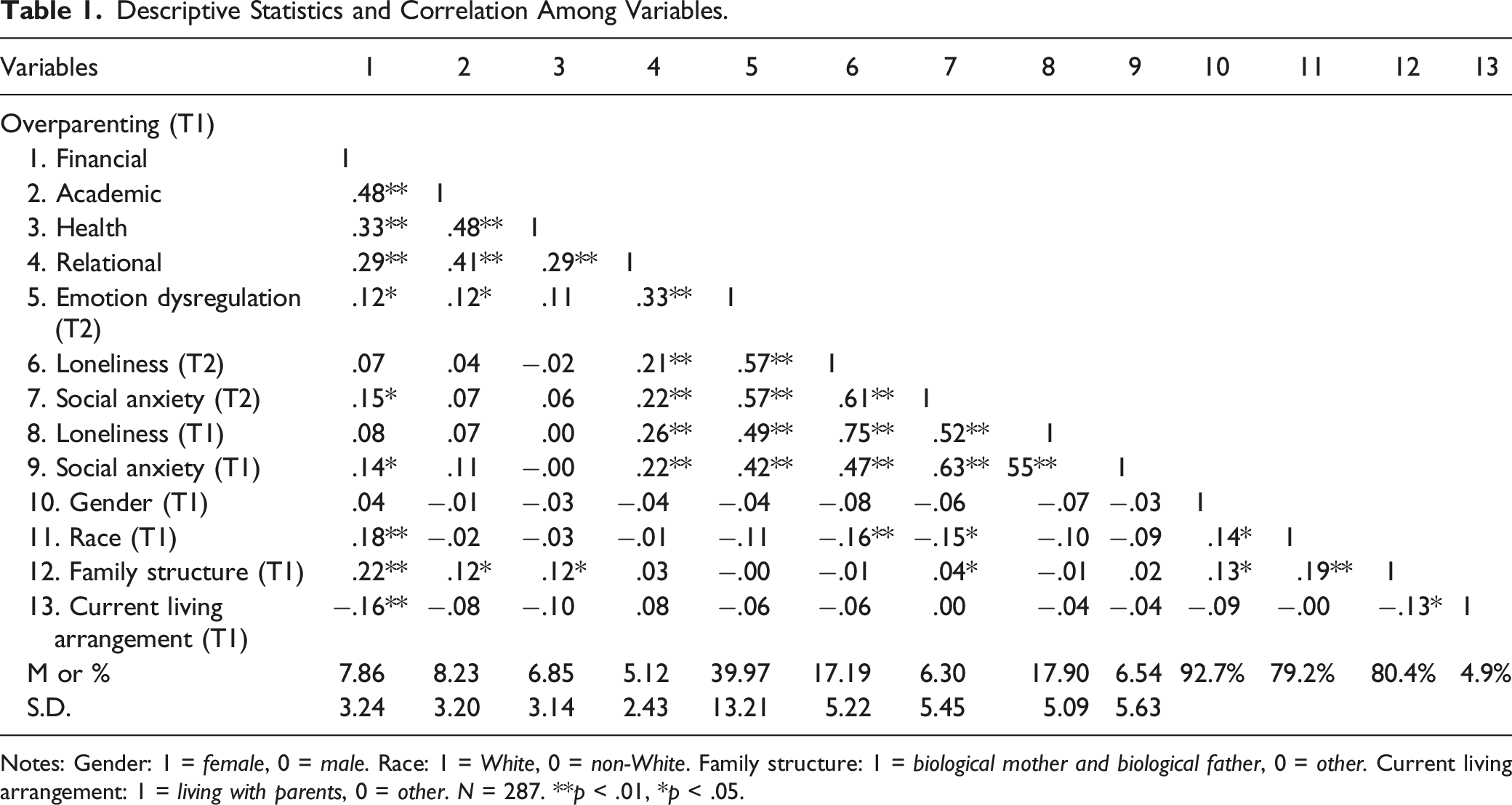
Notes: Gender: 1 = female, 0 = male. Race: 1 = White, 0 = non-White. Family structure: 1 = biological mother and biological father, 0 = other. Current living arrangement: 1 = living with parents, 0 = other. N = 287. **p < .01, *p < .05.
Indirect, Direct, and Total Effects of Overparenting on Emotional Dysregulation, Loneliness, and Social Anxiety.
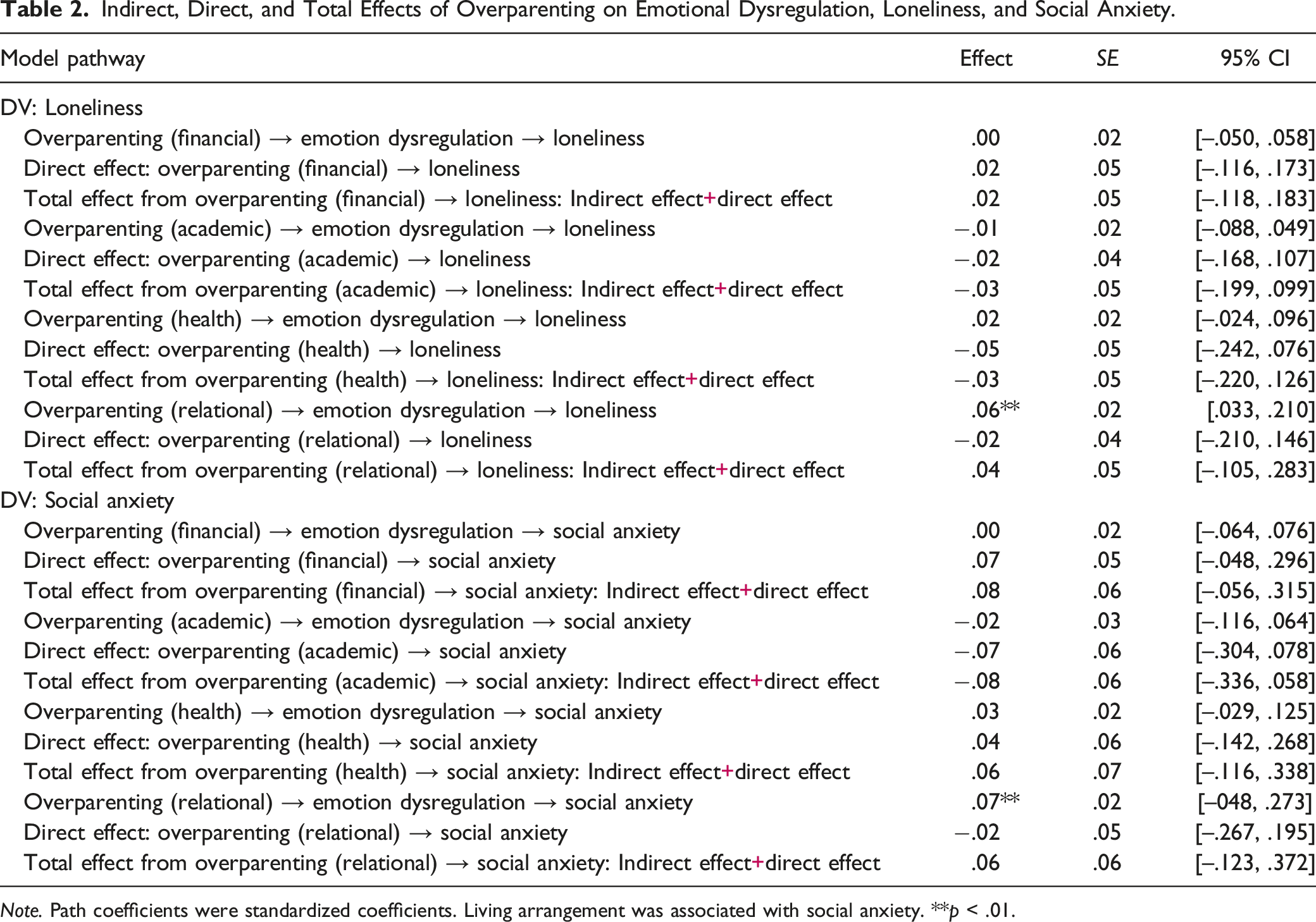
Note. Path coefficients were standardized coefficients. Living arrangement was associated with social anxiety. **p < .01.
The Mediation Model
Covariates (i.e., gender, race, living arrangement, and family structure) were added to the preliminary model (not shown). For parsimony, only the variables with significant paths to emotion dysregulation, loneliness, and social anxiety were included in the final model, so only living arrangement was retained in the final model. Figure 1 shows the results of the final model. The final model fit was excellent (χ
2
= 7.59, df = 4, p = .11, CFI = .994, TLI = .963, RMSEA = .056, SRMR = .016). As hypothesized, overparenting in the relational domain had a significant positive association with emotion dysregulation (b = .19, p < .01). Overparenting in the financial, academic, and health domains, however, were not significantly associated with emotion dysregulation. Model of Overparenting, Emotion Regulation, Loneliness, and Social Anxiety. Note. **p < .01, *p < .05. Dashed lines indicate non-significant paths. The direct paths from overparenting to the outcomes were included in the model but not shown in this figure for clarity of presentation.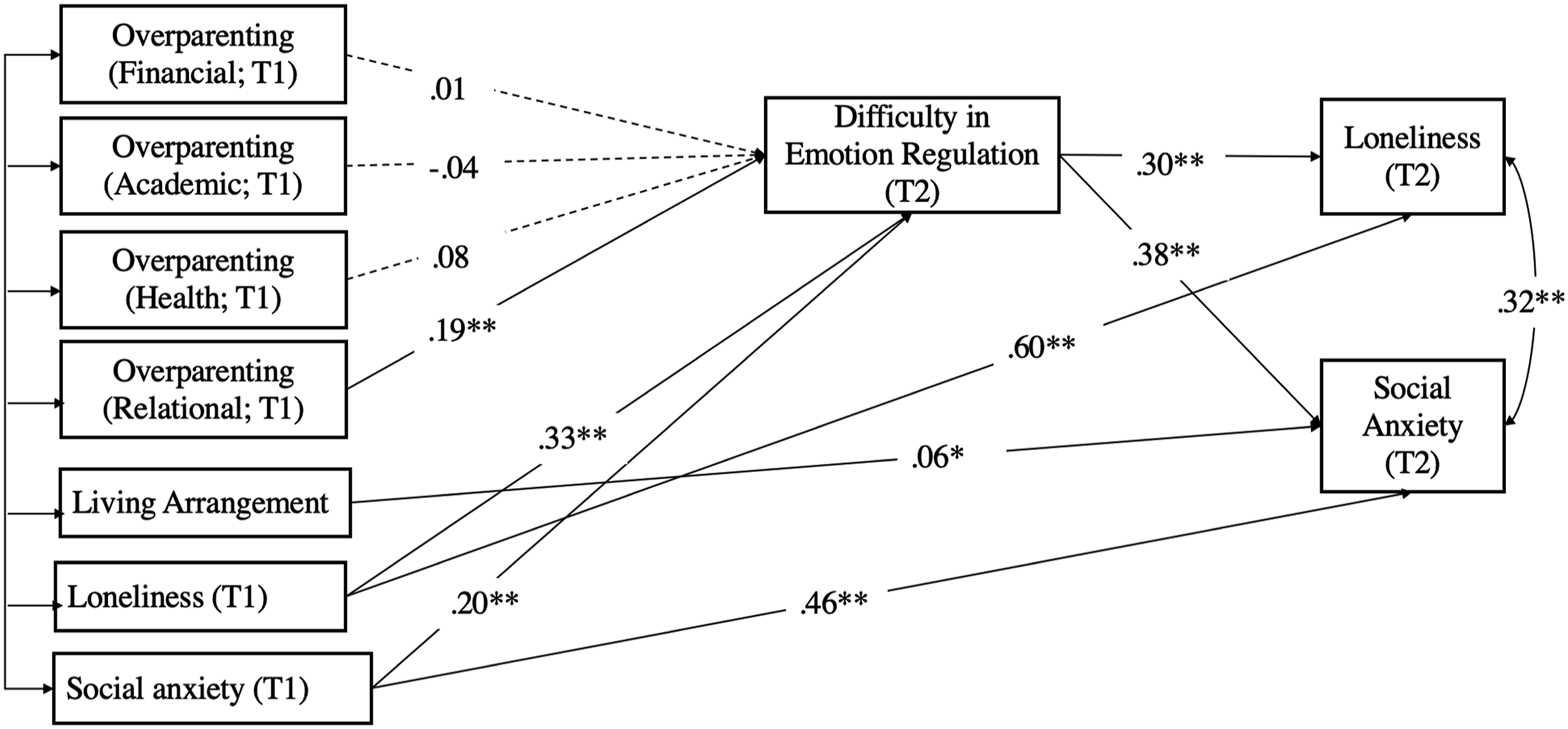
Emotion dysregulation was positively related to loneliness (b = .30, p < .01) and social anxiety (b = .38 p < .01) at T2. The indirect effects of overparenting in the social domain and loneliness and social anxiety through emotion dysregulation were tested using 5000 bootstrapping resamples. Results showed that the indirect effect of overparenting on loneliness was significant (b = .06, se = .02, p < .01, 95% CI [.02, .10]). Similarly, the indirect effect of overparenting on social anxiety was significant (b = .07, se = .02, p < .01, 95% CI [.02, .12]). The direct paths from overparenting to social anxiety and loneliness (included in the model but not shown in Figure 1 for a clearer presentation) were not significant (b’s ranged from −.05 to .07, ns). Therefore, H3 was supported. Emerging adults’ levels of loneliness and social anxiety at T1 were also significantly associated with those at T2, indicating the continuity of such feelings among emerging adults. Lastly, participants’ living arrangement was significantly associated with social anxiety at T2 (b = .06 p < .05), suggesting those who were living with parents tended to experience higher levels of social anxiety Table 2.
Discussion
Guided by theory and past research, we proposed that overparenting would be associated with higher levels of loneliness and social anxiety in emerging adults and that these associations would be mediated through difficulty in emotion regulation. By operationalizing overparenting as a multidimensional construct in four domains (i.e., financial, academic, health, and relational) of emerging adults’ life, the findings supported our hypotheses.
The first important finding of our study is that overparenting in the relational domain was significantly correlated with feelings of loneliness and social anxiety in emerging adults. Consistent with the parental socialization framework (Baumrind 1991; Grusec, 2002; Maccoby & Martin 1983), parenting behavior plays a crucial role in influencing emerging adults’ social well-being. Moreover, this finding is also consistent with the theory of emerging adulthood (Arnett, 2014b), parental socialization continues to influence emerging adults' social well-being during emerging adulthood. Specifically, overparenting is characterized by the limitation of autonomy and independence necessary for the formation of one’s own self-identity. It may therefore contribute to the development of negative perceptions regarding interpersonal relationships and a decrease in the emerging adult offspring’s confidence in initiating and maintaining meaningful connections (Arnett, 2014b). In this regard, feelings of loneliness and social anxiety symptoms might arise. In addition, these findings are consistent with previous studies suggesting the negative role of overparenting in relation to emerging adults’ social adaptive factors, such as prosocial behaviors (McGinley, 2018; Schiffrin et al., 2021) and social competence (Moilanen & Lynn Manuel, 2019). Our findings added to these studies by extending these social adaptive factors to emerging adults’ general feelings about their social environment, i.e., loneliness and social anxiety.
The second notable finding of our study relates to the operationalization of overparenting as a multidimensional construct across four domains: financial, academic, health, and relational. Specifically, our results demonstrate that overparenting in the relational domain, compared to the other domains, had a stronger association with emerging adults’ loneliness and social anxiety. According to the theory of emerging adulthood Arnett (2000, 2014a), establishing intimacy in friendships and romantic relationships is an important developmental task during emerging adulthood. Thus, it is possible that emerging adults’ independence and autonomy are particularly hindered when parents interfere with their personal relationships. In this way, emerging adults are more likely to experience negative feelings (e.g., social anxiety and loneliness) when facing challenging social situations.
Our results also showed that the direct associations between relational overparenting and loneliness and social anxiety could be explained by emotion dysregulation. Consistent with the theory of emerging adulthood (Arnett, 2014b), emerging adults need autonomy and sufficient opportunities to learn and practice emotion regulative skills. Such opportunities can be hindered when their parents have the tendency to solve relational conflicts on their behalf (Segrin & Flora, 2019). In this regard, poor emotion regulation skills and ineffective affection expression might lead to failures in establishing intimacy and meaning in personal relationships (English & John, 2013). This finding also echoes a prior study regarding the association between overparenting and internet addiction through emotion regulation (Love et al., 2022). Our findings further emphasize the negative effects of overparenting in the relational domain on emerging adults’ social well-being, which might be indirect through self-regulatory processes (such as emotion regulation; Love et al., 2022).
Furthermore, emerging adults’ living arrangement was associated with their social anxiety in that those who stayed with their parents tended to report higher levels of social anxiety than those who did not (e.g., living alone/with roommates/with a romantic partner), which is consistent with the parental socialization process during emerging adulthood (Arnett, 2014b). When emerging adults are living at home, they have daily interaction with parents and, therefore, more exposure to parents’ socialization. In this regard, their self-regulation of emotions, thinking, and behavior is more likely to be affected by parents (Arnett, 2014b). Indeed, as found in a recent study (Hong & Cui, 2020), college students’ living arrangement was a moderator of the association between overparenting and psychological maladjustment, and the association was stronger for those who were living at home than those who did not live at home. Moreover, it is also possible that emerging adults with social anxiety might choose to stay in their parents’ house because they want to avoid social situations (such as finding roommates or sharing a space with roommates). Future studies should recruit a more diverse sample regarding living arrangements and examine whether the associations between overparenting and emerging adults’ social well-being differ by living arrangements.
Limitations
Several limitations should be addressed when interpreting the findings. First, the sample consisted primarily of female participants. Even though consistent with a few prior studies regarding the effects of overparenting and emerging adults’ romantic relationship outcomes (e.g., Cook, 2020; Jiao & Segrin, 2022), gender was included as a covariate and was found not to be associated with any of the outcomes; nonetheless, caution should be used when interpreting gender-related findings due to the imbalanced gender composition of the sample. It is important for future studies to recruit a gender-balanced sample and to study emerging adults outside of the college setting.
Second, this study only employed self-report measures and such measures are subject to potential biases (e.g., social desirability bias). Although emerging adult children’s perception of their parents’ parenting behavior may be more meaningful in considering effects on their own social well-being, parents may perceive their parenting differently which could affect these hypothesized associations (e.g., Arnett, 2014b; Segrin et al., 2012). Therefore, more studies are needed from both the parents’ and child’s perspectives, particularly in terms of overparenting in the various domains of the child’s life, to further investigate the impacts of overparenting on emerging adults’ social outcomes and the potential reciprocal influences between them (Cui et al., 2022).
Third, although this study utilized a longitudinal design, the time interval was relatively short (12 weeks). Even though some studies have used similar time intervals (e.g., Charalampous et al., 2018; Love et al., 2022), the short time period does not allow us to capture longer-term changes. Therefore, future studies should employ longer time intervals to assess the long-term effects of overparenting on emerging adult outcomes. Additionally, not all variables were measured at both T1 and T2, which may have influenced the current findings. Therefore, future studies should employ longer time intervals to assess the long-term effects of overparenting on emerging adult outcomes and ensure that all study variables are measured at each time point.
A final limitation of this study is that the attrition analyses showed those who dropped out tended to report higher levels of overparenting in the relational domain at baseline and were more likely to be non-White participants. One explanation could be that those who experience higher levels of relational overparenting were more likely to develop emotional and social problems due to parents’ overparenting behavior in their personal relationships. This may have led to emotional or relational difficulties for them to be less likely to complete this study. Caution should be used when interpreting the generalizability of the results. Future studies should explore how to retain participants in a college setting, particularly those from racial minority groups and those who experience high levels of overparenting.
Implications
Despite these limitations, the findings of this study carry significant implications for intervention and prevention programs aimed at addressing social difficulties among emerging adults. It is crucial to recognize the developmental tasks of emotion regulation and the establishment of meaningful social relationships during emerging adulthood. The current findings highlighted the influence of parental socialization on these developmental tasks (Arnett, 2014b). Thus, professionals working with families and emerging adults who experience loneliness and social anxiety should take into account the long-term influence of overparenting, particularly within the relational domain. In parenting programs, practitioners can identify signs of parental over-involvement and overcontrol in the emerging adult’s personal life and implement strategies to reduce and prevent such practices. Similarly, these study findings can be transferred to therapy sessions in higher education because this study used a sample of college students. Counselors and therapists could address emotional and social difficulties experienced by college students by involving their parents in therapy sessions and providing them with information aimed at reducing overparenting behaviors, particularly within their child’s personal life.
Furthermore, this study has significant implications for future research. It highlights the need to recognize the challenges posed by the social environment during emerging adulthood, as well as the aspirations of emerging adults to form meaningful relationships. It is also essential to consider the potential risk factors associated with these challenges, such as parental overinvolvement and overcontrol in their personal lives and poor emotional functioning. Future research should focus on investigating the potential links between these parenting practices and emerging adults' social and interpersonal relationship outcomes.
Conclusion
In conclusion, the present study makes several contributions to the literature. First, we explored a relatively under-researched area, the associations between overparenting and emerging adults’ general feelings about their social environment, i.e., loneliness and social anxiety, by exploring a linking mechanism – emotion regulation. Second, we acknowledge the domain-specific nature of overparenting and show that overparenting within the relational domain, in comparison to other domains, is significantly linked to higher levels of loneliness and social anxiety. We go on to show that this association is explained by increased levels of emotion dysregulation among emerging adults. Given the high prevalence and negative consequences of loneliness and social anxiety during emerging adulthood, our findings suggest that practitioners, particularly in college settings, should consider the role of overparenting behavior when counseling or treating emerging adults’ difficulties in social relationships and emotion functioning.
Footnotes
Declaration of Conflicting Interests
The author(s) declared no potential conflicts of interest with respect to the research, authorship, and/or publication of this article.
Funding
The author(s) received no financial support for the research, authorship, and/or publication of this article.
