




Abstract
This article takes a communication-theoretical perspective based on Niklas Luhmann’s systems theory to examine the functions of athletes’ participation in communication with coaches and the preconditions for its effectiveness. The theoretical assumption of the study is that participation can increase the success of communication if it is able to achieve mutual understanding, promote cooperative behavior and effectively regulate conflicts. A content analysis of qualitative video and interview data from elite coaches and athletes in Germany illustrates, through three empirical case studies, the functions and preconditions of purposeful athlete involvement in film sessions. The analysis shows that participation can lead to mutual understanding, cooperative behavior, and effective conflict regulation. However, this requires the establishment of appropriate expectations of participation, a specific socio-structural context, and a definition of the coach’s role. Otherwise, there is a risk that participation can lead to communication problems. The results of this study not only provide academic insights but also show practical implications for coaches and athletes in elite sports.
In elite sport, the aim is to optimize sporting performance in order to be as successful as possible in national or international competitions. Since performance levels, professionalization, and commercialization can vary greatly depending on the sport, career stage, or national sports funding system, this article uses the broader term “elite sport” to refer to all coaches and athletes who align their actions with the aim of maximizing sporting success (McAuley et al., 2022). In this context, communication between coaches and athletes is considered to play a central role, as it is only through communication that coaches can only share their expertise with athletes through communication to help them improve their sporting development. Sport communication research has already shown that the way in which coaches and athletes communicate with each other has a vital influence, for example, on the satisfaction, motivation or learning ability of athletes and ultimately on sporting success (e.g., Cranmer et al., 2020; Kassing & Infante, 1999; Turman, 2003b).
In recent years, the public discourse has attributed increasing importance to athletes’ participation in communication with their coaches. Participation means that athletes are actively involved in communicative processes and share their opinions, ideas, views, or even concerns with their coaches. The significance of participation has shifted in this respect, as the public perception of the coach’s role has long been shaped by the idea that it is the central task of coaches to decide on the structure of training and the technical direction in competition, guiding athletes toward maximum success. That this view is now outdated can be observed directly during competitions: Especially in sports like basketball or handball, TV broadcasts often show players actively speaking up to call the next play, for instance. In addition, statements in the media indicate that athletes’ participation in communication is now considered highly relevant. For example, Ashley Prescott, a coach in the Australian Football League, emphasizes his expectation that players be involved in developing successful tactics: “We really work collaboratively to try and get the best outcome that we possibly can. …It’s about creating and building a game plan as a collective group and really empowering the players to be part of that” (ESPN, 2020). And according to Bleacher Report (2024), NBA stars such as Stephen Curry and LeBron James are even consulted by their coaches on roster decisions and starting lineups.
These descriptions therefore show that athletes now participate in communication is now taking place in elite sports, and it therefore necessary to ask whether this makes sense in a system that is success-oriented to such a great extent and what functions are associated with it. Therefore, the central question of this article is: In what way is athletes’ participation in communication with their coaches functional, and what preconditions must be met for this?
For this purpose, I first present the current state of research on the communicative participation of athletes. This is followed by differentiated theoretical considerations in which I define participation from a systems-theoretical perspective and integrate it into Borggrefe and Cachay’s (2013) model of coach–athlete communication to systematically analyze the functions of participatory communication. I then describe the methodological design of this study and present empirical results from three case studies of film sessions, before finally summarizing and discussing the findings.
Literature Review
With regard to the relevance of participation within coach–athlete communication in existing sport communication research, studies, first, support the effects of certain participative communication strategies of coaches on team cohesion (see in general Turman, 2003b). Turman’s (2003b) analysis of qualitative interviews with players from a college football team reveales that purposeful athlete involvement occurred. For example, common goals were set at the start of the season and a unity council was formed to represent the entire team and communicate the players’ concerns to the coaches. These actions fostered greater satisfaction and trust within the team. Second, several studies use the leader–member exchange (LMX) approach to examine the effects of symmetrical communication between athletes and coaches, which emphasizes reciprocal and balanced interaction. Here, an athlete becomes “an equal participant in discourse, shared interests are established, and mutual understanding is developed” (Cranmer & Goodboy, 2015, p. 617). Findings from athlete questionnaires show that communication symmetry emerges primarily through mutual trust, respect, and recognition, rather than through coercive power (Cranmer & Goodboy, 2015; Cranmer & Myers, 2015). Symmetrical communication—or participation—not only positively affects confirmation (Cranmer et al., 2016) but also increases coach commitment and role fulfillment (Czekanski & Turner, 2014). Third, communication scholars consider athletes’ participation in terms of the explicit expression of contradictory opinions using the concept of organizational dissent. Quantitative studies have shown that certain triggers, such as performance issues or perceived injustices, promote athletes’ dissent (Cranmer et al., 2018; Rey & Johnson, 2023), as well as the status of a starting player and coaches’ openness to athlete feedback (Cranmer & Buckner, 2017; Kassing & Anderson, 2014). Shared dissent has proven to be particularly effective when factual arguments are made, solutions proposed, and pressure, deflection, and humor avoided (Cranmer et al., 2018).
Beyond this, coaching research also points to various aspects of participatory coach–athlete communication. Most articles place coach behavior at the center of their investigations and differentiate between leadership or coaching styles that promote participation (democratic, athlete-centered, actively managing, and humanistic) and those that restrict participation (autocratic, coach-centered, less actively managing, and less humanistic) (Chelladurai, 2007; Gomes & Resende, 2014; Grecic & Grundy, 2016; Lyle, 2002, pp. 174–186). Statistically, positive (but sometimes also negative) effects of participatory coaching behavior can be demonstrated on satisfaction (Chelladurai, 1984; Chiu et al., 2016; Mata & Da Silva Gomes, 2013; Riemer & Chelladurai, 1995; Riemer & Toon, 2001; Türksoy et al., 2013), motivation (Amorose & Horn, 2000, 2001; Bekiari, 2014), mental health (Jiménez et al., 2019; Price & Weiss, 2000; Vealey et al., 1998; Zardoshtian et al., 2012), and athletic performance (Ehsani et al., 2012; Keatlholetswe & Malete, 2019; Stornes & Bru, 2002). However it is important to note that participation is just one of many factors influencing coaching behavior in these studies. Furthermore, even coaching styles that restrict participation can have both positive and negative effects, and the identified correlations depend on a variety of contextual factors such as age, gender, nationality, sport type, sporting success, and situational conditions (Beam et al., 2004; Chelladurai & Arnott, 1985; Chelladurai et al., 1988, 1989; Enoksen et al., 2014; Sherman et al., 2000; Terry, 1984). Additionally, coaches adjust their participatory behavior over time, and it is considered more or less effective in terms of appropriate leadership depending on the circumstances (Fletcher & Roberts, 2013; Høigaard et al., 2008; Turman, 2001, 2003a).
Furthermore, social psychological research that examines the coach–athlete relationship highlights the potential of active athletes’ participation to strengthen this relationship in affective, cognitive, and conative dimensions (Jowett & Cockerill, 2003; Jowett & Meek, 2000; Li et al., 2015; Lindgren & Barker-Ruchti, 2017; Antonini Philippe & Seiler, 2006; Rhind & Jowett, 2010) and to promote athlete autonomy (Gilchrist & Mallett, 2016; Mageau & Vallerand, 2003; Pelletier et al., 2001). Statements from interviewed coaches and athletes suggest that participation can enhance mutual perception, understanding, and support; foster attention, respect, trust, and sympathy; and help resolve conflicts. In addition, purposeful athlete involvement can lead to learning and performance effects as well as increase a sense of belonging and motivation (Ahlberg et al., 2008; Hodge et al., 2014; Mallett, 2005; Raabe et al., 2020). However, it also becomes evident that both coaches and athletes perceive certain decision-making processes as the coach’s responsibility and do not consider participation beneficial in such cases (Becker, 2009; Lara-Bercial & Mallett, 2016; Mallett & Lara-Bercial, 2016).
In summary, previous research has already pointed to the positive significance of communicative athletes’ participation (e.g., for increased satisfaction, motivation, or athletic success) and to some supportive prerequisites (e.g., relationship quality, athlete status, and coach openness). However, what is still lacking is a communication-theoretical foundation to explain the specific functions athletes’ participation can have in coach-athlete communication, as well as the particular preconditions needed to enable it. For example, Cranmer (2019, pp. 78–79) notes with regard to athletes’ dissent communication, that the majority of this research relies on classical management approaches, which do not adequately reflect the reality of communication between athletes and coaches and of participation within it: “The organizational perspective of coaching utilizes classical management approaches that are defined by top-down patterns of communication. In reality, athlete-coach relationships are to some extent reciprocal—although rarely symmetrical. Athletes are capable of upward influence and serve important roles within the highlighted organizational processes that determine team functioning, including self-socialization, self-leadership, and autonomy within dissent expression.”
Therefore, this article seeks to examine the functionality of participation processes in the context of coach–athlete communication in elite sport from a communication theory perspective. The aim is to analyze in what way participation can help athletes to understand and implement the coach’s instructions, and how this may avoid or solve communication problems. After all, effective communication with the coach is a necessary condition for achieving high levels of athlete satisfaction, motivation, and athletic development. In particular, the central aim is to explore more precisely how coaches can foster effective athletes’ participation through their communication strategies, why they should do so in the first place, and what specific preconditions must be met. To address this gap, this study builds on existing sociological research that conceptualizes the relationship between coaches and athletes as a communicative process shaped by societal expectations and organizational structures. In this context, the studies conducted by the research group led by Borggrefe, Cachay, and Thiel appear particularly promising. On the basis of Niklas Luhmann’s systems theory, they developed a sociological model of coach–athlete communication (available in English in Borggrefe & Cachay, 2013). In their communication, steering, and conflict-theoretical considerations, they analyze not only the process but also the prerequisites, problems, and requirements for successful communication between coaches and athletes using video-recorded interactions and guided interviews (Borggrefe & Cachay, 2015; Borggrefe et al., 2006; Thiel, 2002). The aim of this study is to extend the findings of these sociological studies by grounding participation in communication theory and transferring it to the social context of coach–athlete interaction in order to explain and empirically analyze the functions of participatory communication and the necessary preconditions for it.
Theoretical Considerations
This article analyzes participatory coach–athlete communication using Niklas Luhmann’s systems theory (1995, 2012). This theoretical approach is not only justified by previous sociological work on coach–athlete communication, but also because this theory understands communication as the constitutive operation of social systems and makes it possible to consider the situation-specific context as well as the effects in the psychological systems of the persons involved as primarily relevant environmental systems. This allows participation to be examined as a social fact within the communication process between coach(es) and athlete(s) and also makes it possible to consider conditions specific to elite sports and the individuality of the participants. On the basis of Hafen’s (2012, p. 303) systems theory considerations, participation within coach–athlete communication can be defined as a specific form of inclusion of athletes that is aimed at achieving certain goals or solving problems within the ongoing communication.
Assuming this functional understanding of participation, the question arises as to what problems can fundamentally occur within coach–athlete communication and to what extent athletes’ participation can prove to be effective in addressing them. From a systems-theoretical perspective, successful communication is inherently uncertain in three ways (Borggrefe & Cachay, 2013). Namely, communication should not be understood as a direct transmission of information from sender to receiver but rather as a reciprocal and contingent process composed of three selections: information, utterance, and understanding. At each of these three selection stages, coaches and athletes make choices—choices that could have been made differently.
First, it seems uncertain in this context that coaches and athletes understand the information communicated in a way that is at least similar (Borggrefe & Cachay, 2013, pp. 14–17). Since the two sides each process a communicated message according to their own criteria and attribute meaning to it, this can lead to the problem of mutual understanding. Participation is likely to increase the probability of understanding, especially if athletes are verbally involved in the communication with their coach. Verbal participation creates opportunities to observe and discuss issues of understanding that might otherwise remain hidden on a non-verbal level (Cranmer & Goodboy, 2015; Lindgren & Barker-Ruchti, 2017; Rhind & Jowett, 2010). For example, a coach can use an athlete’s verbal utterances to check whether they have understood the information correctly. Or athletes can ask explicitly if they are not sure whether they have understood the coach’s instruction correctly so that the coach can explain it again and as clearly as possible. Thus, verbal participation can be used to identify, address, and, ideally, resolve communication problems so that misunderstandings between coaches and athletes can be avoided or eliminated.
Second, there is also uncertainty as to whether coaches can elicit an intended action from athletes through communication (Borggrefe & Cachay, 2013, pp. 17–22). Even if a coach has communicated a request for action and the athletes have understood it accordingly, they can reject it and act differently. Coaches in elite sport are therefore faced with the problem of fostering cooperative athlete behavior. However, participation could increase the athletes’ willingness to cooperate if their coaches involve them in decisions in a constructive way (Amorose & Horn, 2000; Becker, 2009; Czekanski & Turner, 2014). Athletes are likely to demonstrate a stronger personal commitment to decisions that they have actively and purposefully helped to make. For example, if certain rules have been jointly agreed upon within the team through participation, it can be assumed that athletes will be more likely to accept and adhere to them—not least because the coach can remind them of their explicit commitment and sanction deviations due to being in a position of power (e.g., non-nomination, suspension, punitive training, substitution). In addition, participation could promote cooperative athlete behavior if it strengthens trust or positive feelings between coaches and athletes (Ahlberg et al., 2008; Gilchrist & Mallett, 2016; Turman, 2003b). For some athletes, participatory communication can build trust or represent a specific form of appreciation if the opportunity to participate is seen as evidence that the coach is interested in the athlete as a person and believes in their performance or takes their individuality into account.
Third, the success of communication can prove to be uncertain if athletes reject, that is, disagree with and contradict, the information provided by a coach (Borggrefe & Cachay, 2013, pp. 22-25). Therefore, successful coach–athlete communication also has to solve the problem of effectively regulating dissent. It is important to emphasize that dissent and conflicts 1 between coaches and athletes in elite sport are more or less structurally anchored, because there are constant occasions in which these individuals interact with different expectations, and not all expectations can be met simultaneously (Thiel, 2002, pp. 55–64). However, this does not mean that conflicts should be inherently seen as negative, harmful, or destructive, and thus must always be avoided. On the contrary, communicated dissent can trigger further communication, prompting necessary adjustments. Thus, conflicts can have either a destructive character, aimed at harming the other party, or a constructive value, in which an explicitly communicated “no” initiates essential changes. In this respect, Messmer (2003) distinguishes between beneficial factual conflicts and harmful relationship and power conflicts. Athletes’ participation is the condition for enabling beneficial factual conflicts between coaches and athletes. Only when athletes explicitly voice dissent can they communicate their differing perspectives to the coach so that the coach can be persuaded to change his/her mind and give in or continue to defend his/her own position so that the athletes are convinced of his/her point of view (Rhind & Jowett, 2010). Athletes can also be specifically involved in unresolved factual conflicts so that they can, for example, describe their own views in tactical or competition meetings, which may contradict the coach’s position, in order to work out a solution that is supported by everyone (Cranmer et al., 2018). In the case of a destructive relational or power conflict, initially uninvolved athletes can actively enter the situation and participate by mediating, seeking to de-escalate the conflict and moderate the means being employed (Thiel, 2002, p. 188). They could, for instance, encourage both parties to refrain from accusations or threats and guide them toward a resolution to the conflict on a factual level.
In summary, the theoretical considerations show that participation in elite sport can be used to address and ideally solve the three problems of coach–athlete communication described above. The following research questions can be derived to analyze the empirical material with regard to the functions and preconditions of participation in coach-athlete communication:
What role does verbal participation have on mutual understanding between coaches and athletes?
What role does participatory communication have on cooperative athlete behavior?
What role does athletes’ participation have in promoting beneficial factual conflicts or in mediating destructive relational and power conflicts?
Under what preconditions does participation prove to be effective in addressing these three problems?
Methodological Approach
The empirical basis for answering these questions consists of qualitative data from multiple research projects conducted as case studies between 2010 and 2023 with the aim of analyzing the requirements for effective coach–athlete communication in elite sports. 2 A total of 36 teams or training groups in Germany were analyzed, involving coaches and athletes from seven different sports: field hockey (n = 4), gymnastics (n = 7), handball (n = 9), judo (n = 4), table tennis (n = 3), tennis (n = 4), and track and field (n = 5). This sample represent varying degrees of commercialization and professionalization and include both club and federation squads, comprising male and female athletes from youth and adult sectors. Essentially, these are either coaches and athletes who are contractually bound to a club, competing in national and international leagues, or coaches who select athletes for squads to represent their regional or national association in national or international competitions.
The data collected consists of two main components: First, there are over 1,100 hours of video and audio recordings of authentic, elite sport specific interactions, recorded with the objective of analyzing communication between coaches and athletes during competitions, training sessions, and team meetings. The coaches and athletes studied were always informed when they were being recorded with several cameras and microphones. Second, there are guided interviews with 35 coaches and 180 athletes (27 field hockey players, 27 gymnasts, 59 handball players, 17 judokas, 16 table tennis players, 16 tennis players, and 18 track and field athletes). In these interviews, selected sequences from the video and audio material were played, and questions based on the theoretical considerations of Borggrefe and Cachay (2013, 2015) were asked for the purpose of analyzing various aspects of effective coach–athlete communication with regard to mutual understanding, cooperative athlete behavior, and conflict regulation. In the course of the interviews, both the coaches and the athletes described and interpreted any athlete participation that occurred in the selected video sequences. Therefore, a large number of cases that consider different structural and situational conditions assumed theoretically to cause participation are available for the analysis of participatory coach–athlete communication. 3
I re-analyzed these data with regard to the research questions of this article, guided by the theoretical considerations presented above, by combining the transcribed video sequences with the corresponding coaches’ and athletes’ statements in a structured way and evaluating them using content analysis. The combination of video-recorded communications and guided interviews offers the advantage that participation processes can be fixed over time and at the same time assessed in terms of appropriateness and impact through the observations, perceptions, interpretations, expectations, and meta-expectations of the actors involved. The first step involved conducting a descriptive analysis of the participatory process observed in the video sequence and the related behaviors of the coaches and athletes. The second step involved analyzing the interview statements from coaches and athletes on the corresponding sequence and categorizing them on the basis of whether and in what way they perceived athlete participation as functional or problematic for mutual understanding, cooperative athlete behavior, or conflict regulation—and what conditions they attributed this to. I carried out these two steps primarily myself, but received support from discussions with the researchers in the project group to ensure a certain degree of intersubjectivity in the data analysis.
Three case studies from the extensive dataset are presented in the following. These are film sessions in which coaches discuss tactical or technical aspects with their athletes. Although athletes’ participation also took place in other contexts, such as during training sessions or competition breaks, I selected these film sessions specifically because they vividly and insightfully illustrate various functions and preconditions of participation in coach–athlete communication in line with the theory. They therefore contribute best to providing answers to the research questions. In each analysis, I first provide the transcript and a description of the video sequence, before contextualizing the observed participation using quotes from the interviewed coaches and athletes. As these data were originally collected in German, I have translated them as accurately as possible.
Results
Case Study 1
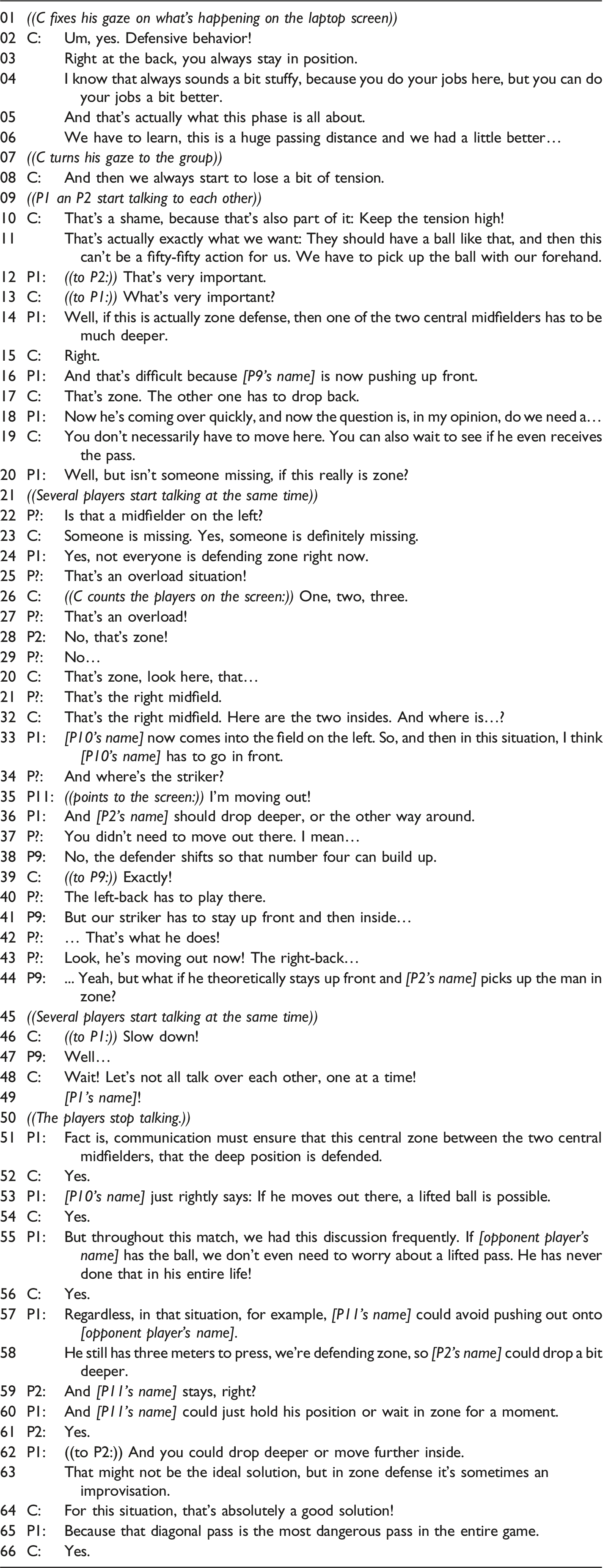
If we consider this film session in terms of participation, we see that player 1 initially disagrees with the coach on the tactical analysis and interpretation of the presented game scene. This dissent is not initially addressed directly to the coach but in conversation with player 2. However, the coach notices this and asks player 1 so that he can present his dissent in a way that everyone can follow. This leads to a discussion in which several players are involved verbally in tactically analyzing and optimizing the defensive behavior shown. After a while, the coach interrupts player 9, who is currently speaking, and asks the players to speak in turn, first giving the word to player 1. Player 1 then explains his suggestion and clarifies it when another player asks questions. Finally, the coach praises the solution presented by player 1.
If we now incorporate the interviewed coaches’ and players’ statements, it becomes clear that this form of participation during this film session leads to a beneficial factual conflict. The players are able to explicitly present their different perspectives, which contradict the coach’s tactical interpretation, in order to work out a joint solution that is accepted by all participants: “I present these scenes and then also criticize behaviour. Sometimes the players defend themselves, sometimes justified, sometimes not. And that’s the kind of confrontation that helps everyone. [...] Now the scene is over and everyone can live with it. That works. And if this consensus or this atmosphere isn’t reached, then you just have to carry on a bit longer at this uncomfortable moment. You can actually tell by the atmosphere.” (C) “The advantage of this type of meeting, where everyone is involved, is simply that many more ideas and much more creativity come together to resolve a certain situation. [...] The probability that most situations will be resolved optimally is simply greater in a meeting where more people are involved than if only one or two people try to resolve the entire situation.” (P2) “Basically, it starts with the presentation of a scene, which—sometimes that happens and isn’t a big deal—may not have been interpreted 100% correctly by the coaches. […] Then, the process is about working out the optimal course of action. And often, this means that many opinions come together, and people try to solve it by talking over each other. Personally, I view this very positively.” (P1)
A further advantage is also seen in the fact that the coach can identify and address potential problems of comprehension on the basis of the players’ participation. It is only through the explicit statements of the players that the coach can understand their tactical perspective and, if necessary, address misunderstandings: “And everyone is working on solutions. And of course that’s ten times better than me telling them something that I don’t know whether will reach them or not. I actually prefer it that way: The less I say, the better.” (C) “We know exactly what was going on inside us emotionally, what we were thinking. And it's also an analysis. So, it’s always easier to do this analysis in dialog so that the coach also knows what was going on inside us.” (P4) “I’m part of the game myself and of course I want to demonstrate my ability to learn, to see what I’m doing wrong, what I’m doing well, how I can improve.” (P2)
Additionally, the interviews suggested that systematic participation can enable players to make the best possible decisions on their own in match situations. For example, active participation at team meetings can help to strengthen players’ independent decision-making in competition. In the process, the coach even accepts the risk of possible wrong decisions in order to promote creativity in finding solutions: “It’s simply better when the players read the situation and make their own decision. And it’s okay if they sometimes make the wrong decision, because only by repeatedly pushing those limits do they actually learn something for themselves as players. If they're just following orders, they might do everything correctly, but that won’t help them win against good teams.” (C)
The players also state that participatory meetings foster their willingness to cooperate and act creatively and independently in games. Discussing tactical matters together gives them the security and confidence to make their own decisions: “You definitely need a willingness for dialogue. There are certain types of coaches who see their own system as the ultimate solution. They want players to essentially switch off their minds and avoid finding individual or creative solutions. Creativity is the key word here. That kind of coach wants the tactics to be executed strictly, no matter the cost. But another type of coach values the player’s creativity, allowing for a certain degree of freedom, which can lead to different game situations.” (P4) “The advantage is that the solutions come from the team, and [...] the coach gets solutions that the team feels more secure with. At the same time, we also feel that he listens to us, which helps us build more trust in him. [...] We know that we have to collaborate actively in order to improve ourselves. It’s pointless if the coach just gives us instructions and we simply accept them without truly believing in them.” (P3) “There’s no point in saying, ‘You should behave according to scheme A,’ and we’ll do scheme B, because we often have a much better feel for the situation on the pitch” (Sp1).
With regard to the preconditions that led to the institutionalization of such a “participation-friendly climate” within this team, the first key factor is that the coach has deliberately encouraged participation over an extended period. He emphasizes that, at first, active involvement felt kind of unfamiliar to some players because they were not used to being included in tactical analyses or taking on the associated responsibility: “It took quite a while. Especially in the beginning, it was very uncomfortable for some players, as they were used to receiving clear instructions from me. [...] Some players loved it from the start, while others struggled with this level of freedom. It also means taking responsibility for the game situation. If I just follow orders, then the coach on the sidelines is responsible. But I'm not playing.” (C)
The players confirm that the coach explicitly encourages them to participate, leading to active player involvement becoming established over time. As observed in this sequence, this even results in contradicting each other or even the coach, because the players have no fear of sanctions: “The coach wants us to communicate with each other. That’s his goal. He deliberately discusses things with us and looks for solutions together. He always emphasizes that he wants interactive video sessions.” (P3) “That developed over time. When the first one starts participating more often, the next one might feel encouraged to do the same. And once that happens, the younger players, who are new to the group, start asking questions and integrating themselves.” (P2)
The players see a second key factor for their purposeful participation in the realization of the coach’s role. They perceive this coach as open and receptive to criticism. So they feel invited by the confidential and respectful interaction to express factual criticism themselves: “I think it really depends on how the coach presents himself. If the coach immediately shuts everything down—like, if someone speaks up and he just says, ‘Quiet, now I’m talking!’—then this definitely wouldn’t come to that.” (P6) “The coach allows it. He also allows the team to find solutions, and—unlike some other coaches I’ve experienced—it doesn’t hurt his ego if the solution comes from the team, as you can clearly see in this situation.” (P1) “Maybe it’s a matter of trust. There are players who tell the coach exactly what they think about certain situations. And in the end, that’s the only thing that really helps us move forward.” (P3) “It certainly works because we feel invited. We have a very respectful relationship with our coach and we never feel like we have to keep quiet because anything we say could be used against us. [...] On the contrary, he wants us to get involved as long as it’s constructive.” (P4)
In this context, the players also highlight the coach’s ability to moderate such discussions. They regard both the allowance of simultaneous small-group conversations and the subsequent consolidation and structuring of the discussion by allocating speaking turns as crucial for developing a shared solution that the group collectively agrees upon: “It’s really important that we solve it together, but that there’s still some level of guidance. So that at some point, he’s like, ‘Okay, let’s settle down a bit. Now one person has the word!’” (P1) “The coach moderates this and usually tries to engage with the different solutions. He gives us the freedom to contribute, and then, one after another, three players might share their opinions on a situation. In the end, he tries to summarize everything. He often does that, and I think that’s really important. It’s also part of the coach’s role to make sure nothing is left unresolved but rather to draw a clear conclusion and say, ‘Okay, we discussed this scene with fifteen different possibilities, but this is the one we’re going to go with.’” (P2) “The coach always insists on that, saying: ‘How do we move forward from this scene? How do we do it if this situation happens again?’ And that’s a very important thing, that everyone knows what has been agreed upon.” (P6)
In summary, this film session demonstrates a culture of participation that fosters mutual understanding and cooperative behavior in the context of a factual conflict. This “participation-friendly climate” that characterizes the meetings of this team can be attributed to two central preconditions. First, the coach has promoted participation over an extended period of time until the players internalized the importance of their involvement for sporting success. And second, the coach encourages the players’ participation by the was he defines his role, which is characterized by a high degree of openness, receptiveness to criticism, and excellent moderation skills.
Case Study 2
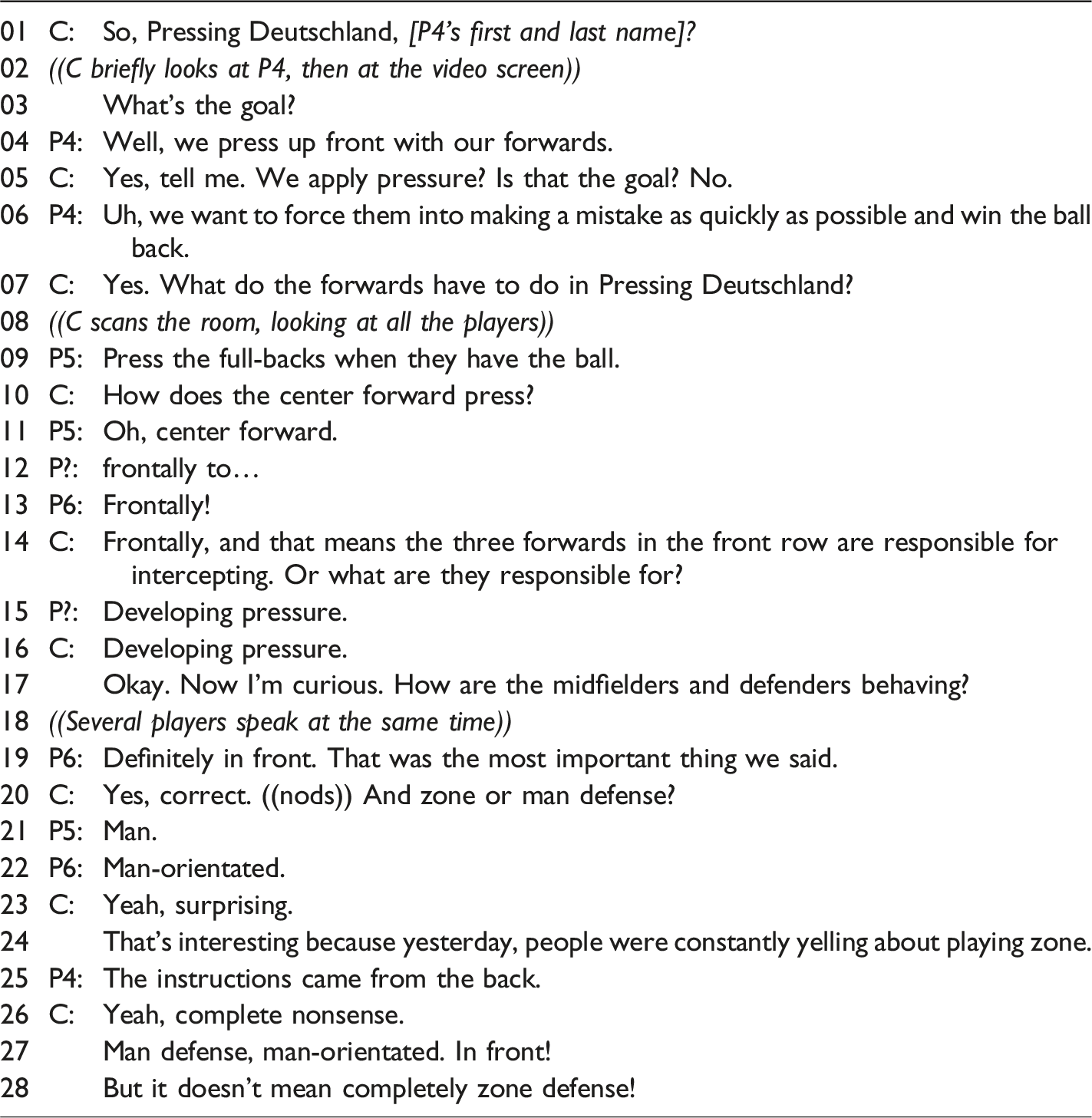
In this film session, the national coach directly addresses player 4 by his first and last name to ask him about the goal of the defensive system “Pressing Deutschland.” The player’s first answer does not seem to satisfy the coach, because he reiterates his question, whereupon player 4 clarifies his answer. Afterwards, the coach addresses his further questions about the behavior of the different sections of the team in “Pressing Deutschland” to the entire group and receives answers from various players.
If we look at the interview statements from the coach and players, it becomes clear that this form of player involvement was primarily intended to enhance mutual understanding regarding tactical errors. The coach’s prompted responses from a central defender helped uncover tactical misunderstandings, which were then addressed and discussed within the group: “It was exactly about identifying who didn’t understand it during the game in order to identify the communication lines at our levels. [...] And that’s why [P4] was addressed. He’s a central defender. He has to understand what is being played and when.” (C) “The direct addressing was the result of a mistake that had happened in the previous game or because something wasn’t executed the way it should have been. It was about confronting the player who made the mistake. And in this case, that was me. By doing this, the coach actively encourages players to think about their mistakes or actions and to reflect on them to the group.” (P4) “This way, the coach can see whether the players have understood what he’s trying to convey. Because if they don’t understand what’s supposed to be played, then there’s a need to talk.” (P5)
Both the coach and the players believe that this participatory approach, in which players are called by name and asked direct questions, is important and effective for internalizing tactical agreements. However, this kind of meeting also reminded them of a “question-and-answer session” in a school setting, in which the coach—like a teacher—tests the knowledge the players have learned: “School instructor! Tested: ‘What else?’ I was really annoyed that clear agreements were not being followed. [...] I don’t think it’s great, but sometimes you just have to ask in this way and say: ‘Now we’re going to have a question-and-answer session!’ (C) “There's something very school-like about it. But it’s about internalizing certain fundamental structures and keeping them present. It’s almost like learning a poem. You just have to repeat it until you really know it.” (P4) “It was a bit like learning and reciting vocabulary, the system the coach used here. But I think that’s important, too. You want to see that the players are engaged, and the only way he can ensure that is by asking the group or calling on some guys to answer. He also selects those who had a situation in yesterday’s game where they did something wrong.” (P5)
According to the coach and players, however, this form of communication carries the risk of participation being perceived as an annoying and inadequate method. After all, directly calling on and questioning a player, combined with addressing mistakes, could also have been perceived as uncomfortable interrogation or patronizing exposure in front of the group: “Well, that's a bit annoying. [...] The answer is clear; the players know that, too. [...] It’s a bit top-down, not really the way I like to deal with the guys.” (C) “Sometimes you get a bit annoyed by it. It always depends on the situation. In this situation, I thought it was okay because I was really upset in the game that some players just didn’t understand it because it was really banal stuff. But if you do it too often, then I think it’s stupid.” (P6) “For some, this direct addressing can definitely be uncomfortable. Sure, the atmosphere is a bit tougher, and you might get a comment if you say something wrong. It’s always kind of on the edge.“ (P3) “The coach is very direct with the players. I think some struggle with that or feel intimidated when he asks such direct questions. [...] You can see it with some of them how they stutter or can’t give an answer, although they probably all know it. They’re just overwhelmed at that moment.” (P1)
The players consider this participatory film session to be effective not only due to the specific situation but also due to the open, communicative and criticism-receptive definition of the coach’s formal role, as well as the flat hierarchies and participation-friendly structures within the team: “I think the coach wants us to be very open with each other in the group. That’s how he presents himself, and that's how he wants to convey it to the group: that if we’ve done something wrong, we talk about it.” (P1) “In video sessions, a lot of people really get involved. And that probably also has to do with the flat hierarchy within the team. There aren’t five or six [...] and the rest have nothing to say, but really anyone can say anything they notice.” (P2) “I think it also comes from the structure of the team. In this squad, with this age composition, the team thrives on having a very flat hierarchy. Of course, there are players who take the lead in certain moments, but no one really sees themselves as being above the others. And that also encourages everyone to get involved.” (P4)
In summary, this case study demonstrates that calling on players by name and having them express their thoughts in front of the group is perceived by the involved actors as an effective method for achieving mutual understanding regarding tactical agreements. However, this approach could have also been perceived as inappropriate, as suggested by the references to school settings. The fact that this was not the case in this team is due not only to the clear violation of agreed-upon tactics but also to the open role of the coach, the flat hierarchies, and the composition of the squad.
Case Study 3
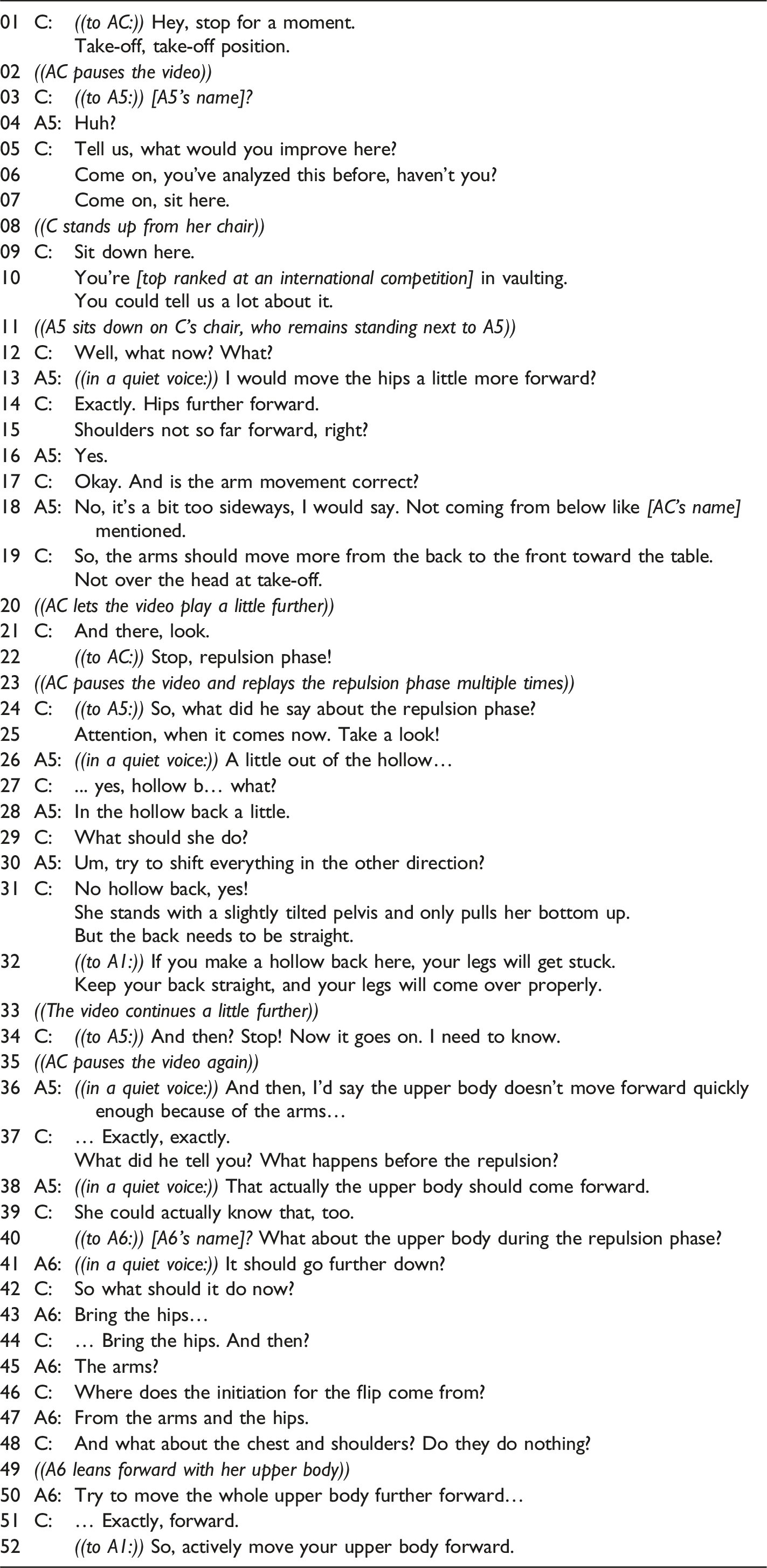
In this film session, the coach specifically asks athletes 5 and 6 to speak in order to analyze the vaulting technique of athlete 1. However, two key observations emerge: First, the coach does not give the two athletes the opportunity to conduct their own analysis. She either interrupts the players’ analysis too quickly in order to make technical corrections herself, or she predetermines the answers through her questions. Second, both athletes respond in very quiet voices and with a questioning tone, suggesting a sense of uncertainty.
Even though the coach’s interview statements cannot be accessed due to technical reasons, 4 the transcript provides indications of explicit athletes’ participation. In the case of athlete 5, the coach refers to the fact that she achieved a very good result on the vault at an international competition. By doing so, she emphasizes the status of this athlete as an expert in the discipline of vaulting and includes her in the communication as a technical specialist. It can therefore be assumed that the coach wants to help athlete 1 to optimize her technique by deliberately involving athlete 5, because she embodies and conveys expert knowledge at a higher level than she herself can. This seems particularly plausible in a sport like gymnastics, where technical adjustments need to be made in highly complex movement patterns that a coach cannot physically execute and therefore can only experience and verbalize to a limited extent.
The athletes’ interview statements confirm that the technical advice from an athlete recognized as a specialist fosters better understanding, because it is it is more likely to be comprehended and internalized by another athlete. Here, they attribute an expert status to athlete 5 in addition to her sporting successes, because she is better able than the coach to empathize with the movement process: “[A5], through her [international competition] preparation and her own vaults, had done everything on the computer. Everything was animated there, showing how she could improve, and she reviewed her own vaults, which gave her a lot of knowledge about how it should look, at least. [...] Maybe an athlete sees it a little differently when they perform this vault themselves and might have some small insights or tips, regarding the feeling of the movement, because I hardly think any of the coaches actually know what it feels like to execute that vault.” (A1) “I think the coach just wanted [A5] to be able to transfer it better to [A1]. She’s simply a better gymnast on the vault because she has had much more experience with it. And she has also felt it herself. So, I don’t think that’s a bad idea at all.” (A4)
In the case of athlete 6, the coach indicates that she should also know the answer to her question. The interviews further reveal that athlete 6 performs the same vault exercise as athlete 1 and therefore has a kind of expert knowledge, too, that the coach would like to check through participation. In this way, the coach can determine to what extent athlete 6 recognizes the technical mistakes and makes improvements, that is, has understood and can apply the coach’s technical ideas. This would also reveal possible misunderstandings, which could then be corrected. This kind of participation can therefore serve to train athletes’ ability to observe and reflect with regard to the improvement and correction of technique. This was also mentioned by the athletes in the interviews: “With [A6], it was simply about seeing whether she had an idea of how it should look—whether she knows it.” (A1) “The coach also tries to involve the gymnast who performs the same vault. And I would say she has also tried a little to test whether [A6] can correct it on her own. This also shows whether the gymnasts have listened to her and have remembered what they should do.” (A2)
However, the athletes consider the way the coach involves them in this situation to be ineffective. They attribute this primarily to the fact that the coach either interrupts the speaking athlete and immediately corrects her or implicitly provides the answers through the way she formulates her questions. Ultimately, the analysis is not conducted by the athletes but by the coach herself: “I guess the idea was that a gymnast would speak to another gymnast and correct her. But it was only a small attempt, and then the coach took over or finished the sentence instead.” (A3) “In the end, it didn’t really achieve much to ask the gymnast, because ultimately, the coach ended up saying what she meant or thought anyway.” (A1) “The coach wants to know what [A5] has to say about it, but actually already knows the answers and then, of course, reveals them.” (A4)
Additionally, the athletes assume that the two participating athletes are afraid of saying something wrong and therefore do not analyze the vault technique from their own perspective. This is probably influenced by the coach’s language and tone. Looking at the sequence, one gets the impression that the coach is exerting latent pressure on the athletes, not only because she interrupts and corrects them but also because she gives the impression of expecting a “correct” analysis. As a result, the way participation is initiated in this situation may have a humiliating quality for the athletes. As the following quotes suggest, this form of participatory communication is perceived as an inadequate method because the athletes fear being exposed or embarrassed if they give an incorrect response. This also explains why they appear insecure in this sequence, responding in a very quiet and questioning manner: “If you perform the vault yourself and then say something that is completely wrong, the coaches might think, ‘Well, she’s great, she does the vault herself but actually has no clue.’ That makes you more hesitant and you don’t really dare to say anything because you’re not sure whether what you’re saying is 100% correct.” (A1) “The two who were supposed to say something were worried about saying something wrong because they thought it might lead to trouble.” (A1) “[A5] really doesn’t dare to say much. I think she’s actually a bit scared of saying something wrong.” (A4)
This example illustrates that this form of participatory communication—being deliberately involved as an expert to analyze another athlete’s technique—can, in principle, be effective in making information more comprehensible or testing knowledge, but it does not work out well in this case. In particular, the issue here is seen in the coach’s communication style. By not allowing the athletes to finish their thoughts and by essentially providing the answers herself, she takes over the analysis rather than fostering purposeful participation. Additionally, the way she involves the athletes creates a sense of pressure, making them fear being exposed if they say something incorrect. As a result, instead of expressing their own perspectives, they focus on anticipating and repeating what they believe the coach expects to hear. However, this kind of participation undermines the potential for mutual understanding. If athletes do not feel confident enough to articulate their own viewpoints, they neither fulfill the status of an expert to help another athlete, nor can their knowledge be effectively verified and potential misunderstandings identified.
Discussion
Viewed in the context of existing research, the theoretical considerations and empirical findings of this study confirm previous findings that the purposeful participation of athletes in communication with coaches can lead to mutual understanding (e.g., Cranmer & Goodboy, 2015; Lindgren & Barker-Ruchti, 2017), cooperative athlete behavior (e.g., Czekanski & Turner, 2014; Gilchrist & Mallett, 2016) and effective regulation of dissent and conflict (e.g., Cranmer et al., 2018; Rhind & Jowett, 2010). By taking a differentiated and systematic view of the communication process, this study also demonstrated that participation can have an impact not only on satisfaction, motivation, or sporting success (e.g., Becker, 2009; Mata & Da Silva Gomes, 2013; Turman, 2003b) but also on the resolution of communicative problems within the coach–athlete relationship. This expands the academic understanding of participatory communication by showing that, depending on the given conditions, appropriately initiated participation can enhance successful communication, while inappropriate design can cause or intensify communicative problems. These insights appear highly relevant, because from a systems-theoretical perspective, coaches can only influence athletes’ behavior through communication. Purposefully arranged and solution-oriented participation can therefore make a crucial contribution to effective communication and successful collaboration between coaches and athletes.
Moreover, some studies have already indicated that the athlete’s status, the definition of the coach’s role, or situational conditions can have an influence on effective athletes’ participation (e.g., Cranmer & Buckner, 2017; Fletcher & Roberts, 2013; Kassing & Anderson, 2014) or that athletes reject participation if the conditions are lacking (e.g., Becker, 2009; Mallett & Lara-Bercial, 2016). Although this implies that the situational and socio-structural context, as well as the expectations of both coaches and athletes, are likely to be relevant conditions for participation, it has mostly remained unclear exactly which communicative processes promote athletes’ participation and which restrict it. The communication-theoretical foundation provides a basis for precisely outlining the specific preconditions and communicative strategies for enhancing functional participation in these film sessions:
The two cases from field hockey illustrate that coaches actively attempt to establish a culture of constructive participation during film sessions. The coaches systematically encouraged this in the youth teams of the respective association by asking players to speak up and by fostering an environment where players, by the time they become adults at the latest, also challenge their coach without being asked in order to work out a better solution together. In addition to establishing expectations of participation over time, the key preconditions for this are the social-structural composition of the squads as well as an open, communicative, and criticism-friendly approach to the coach’s role.
The final case study shows that athletes’ participation as experts in a technical analysis can, in principle, be valuable, as it enables information in a way that is understandable directly at first hand or allows knowledge to be checked. However, in this situation, the coach hardly gives the athletes an opportunity to present their own perspectives. Instead, she conducts the conversation in a way that is kind of embarrassing for the athletes, so that they do not dare express their own views freely because they are afraid of saying something wrong. For participation to be truly effective, coaches in elite sports should aim to reduce or prevent such a “climate of fear” and instead build athletes’ confidence in their own expertise. Therefore, coaches should, for instance, encourage athletes to participate in a purposeful way, value their (possibly contradictory) perspectives, and also constructively address incorrect answers, because only then can technical misunderstandings be identified and resolved, resulting in learning effects for the athletes. Furthermore, it is also important for coaches to reflect on their own communication style and to avoid language patterns that hinder constructive athletes’ participation. For example, the athletes on this squad argue that the coach should take on a more passive role in such meetings, allowing them more time and space to articulate their perspectives: “The coach would just have to keep her mouth shut.” (A4) “Actually, the coach should let [A5] say what she thinks all the time or how she sees the movements. And only at the end should she say what might have been wrong or what was right. Or maybe [A5] forgot something and then she could add to it.” (A1)
The insights gained from this study not only offer academic value, but—as already indicated—also have practical relevance for coaches and athletes. Understanding why and how athletes should be effectively integrated into the communication process represents a crucial resource for both coaches and athletes that should not be underestimated. After all, effective communication between coaches and athletes is a fundamental requirement for enhancing satisfaction, motivation, and ultimately sporting success. For this reason, this topic should be addressed particularly in coach education and training programs, with a focus on the conditions under which well-implemented participation can contribute to mutual understanding, cooperative athlete behavior, and the effective regulation of dissent.
At this point, the limitations of this study should also be addressed. First, the theoretical consideration of participatory coach–athlete communication was based on the research question regarding the functions and preconditions for the communication process. However, it also seems interesting to explore in more depth the methodological part of this process, additional relevant environmental expectations (like organizational and group structures), and potential consequences, that is, how coaches can encourage their athletes to participate as effectively as possible, considering the organizational and group-specific conditions in elite sport, and what problems might otherwise arise. Second, the empirical evaluation was based on a re-analysis of data from previously completed research projects. As a result, neither the video sequences shown in the interviews nor the accompanying questions were selected with the presented theoretical framework in mind, and some of the data had already been analyzed and published with regard to other questions. However, the advantage of audio and video recordings is precisely that they allow fleeting events such as participatory communication to be captured as social reality in a form that is particularly valid and remains available for re-analysis: “Regardless of the interpretation and analysis of the researchers collecting the data, the audiovisual data are in principle accessible to other observers in the same way as to those who collected them. In this respect, this approach enhances the […] very problematic intersubjectivity of the observations, and it generates a kind of validity that cannot be achieved with any other method” (Knoblauch, 2001, p. 131; own translation). Even though this study successfully described and explained the functions and preconditions of athletes’ participation, future studies should align their data collection and analysis more closely with the theoretical considerations developed to uncover further mechanisms. In addition, this study examined three examples from film sessions. Nevertheless, participation is also likely relevant in other settings typical of elite sports (e.g., before, during, or after competitions, in training, or in one-on-one meetings) and requires different preconditions.
Finally, if we broaden our view to include the current key challenges in elite sport, which also directly affect athletes (such as elite sports funding, psychological and physical violence, sexism, discrimination, etc.), future studies exploring these issues should also consider athletes’ participation. After all, these are also problems for which it can be assumed that participation can contribute to finding solutions. Not only do athletes demand a say with their coaches; it is increasingly common to hear that they are also joining forces in an organized manner in order to exert a deliberate influence on sport and association policy decisions. In particular, players’ unions or athletes’ representatives would be interesting cases for further scientific examination, as they could provide additional insights into participatory communication in elite sports.
Footnotes

Ethical Considerations
At the time of application for this study, no ethical approval from an institution was required. The author declares that the ethical standards of scientific research were always observed when undertaking the study.
Consent to Participate
All study participants were informed verbally and consented to participate in this study.
Consent for Publication
All study participants were informed verbally and consented to the anonymized publication of their data.
Funding
The author received no financial support for the research, authorship, and/or publication of this article.
Declaration of Conflicting Interest
The author declared no potential conflicts of interest with respect to the research, authorship, and/or publication of this article.