




Abstract
Inspired by the regular reflections and suggestions for the future that regularly appear within Communication & Sport, this paper reports the result of a systematic review of a sample of articles from the first 10 vol of the journal to document the most common methods, forms of data employed, theoretical frameworks (and how they are applied), and nationality of author affiliation. Results reflect that the analysis of media texts, either qualitative or quantitative in nature, is the most common methodological approach. Moreover, qualitative approaches dominate the journal. With respect to theories or organizing frameworks, a select few theories appear most frequently, and frameworks related to gender are most common (i.e., hegemonic masculinity, heteronormativity, etc.). Furthermore, most references to theories or framework are just that—mere references. Only a minority of references offered theories as the guiding framework for the articles in which they appeared. To further advance legitimacy of the field, we offer suggestions for expanding the methodological approaches employed within the field, as well as suggestions for the explicit treatment of theory.
Keywords
Anniversaries and other milestones (e.g., the start of a new year, changing of decades, turn of the century) tend to spark much reflection. And such reflection on the past is often accompanied by predictions, guesses, or other forward-looking thoughts about the future. This is true of the communication discipline in general, and it is equally true of Communication & Sport. To that end, see founding editor Lawrence Wenner’s “Reflections on the trajectory and future of a disciplinary project” (2017a) to mark the journal’s first five years, later his “Parting Shots on Communication & Sport” (2021) at the end of the journal’s first decade, followed by a “Vision for the Future” from new editors Marie Hardin and Andrew Billings (2022). C&S has always been mindful of both its past as well as its promising future.
One hallmark of such reflections is often some form of review of scholarship within the field. Examples abound, with some scholars taking a broad historical overview (e.g., Rogers, 1993), some probing for the rise and fall of competing theories, methodological approaches, statistical procedures, or foci (e.g., Berelson, 1959; Bryant & Miron, 2004; Schramm, 1957), and others critiquing or assessing the state of affairs along with attempts to identify its causes (DeFleur, 1998; Gerbner, 1983). Similar reflections have explored scholarship investigating communication and sport, although they paint an incomplete picture due to limits in their scope (e.g., Abeza et al., 2014) or breadth of focus (e.g., Abeza, 2023; Abeza & Sanderson, 2022; Kunkel et al., 2023; Schäfer & Vögele, 2021).
Thus, the end of the first decade of Communication & Sport marks an excellent opportunity to catalog the nature of scholarship in the field (or “fields,” as the case may arguably be per Wenner, 2015). In this paper, we begin by describing a systematic review of the methods and theories appearing within the pages of C&S to summarize dominant methods and methodological traditions as well as the various theories, frameworks, and concepts within the journal. In addition, we probe the international composition of the journal over time in terms of the scholars appearing within its pages. We conclude by both interpreting the broader significance of these findings to the field of communication and sport (and specifically the readership of C&S) as well as offer guidance on how to continue the legitimization of the field.
Overview of the Study
From its outset, C&S was designed to be broad in scope, an “inclusive home” for scholars from numerous disciplines doing work that reflects varied theoretical and methodological orientations, as well as differing perspectives on scholarship in communication and sport (Wenner, 2012, p. 6). In the inaugural issue of C&S, Wanta (2012) noted, “There is no singular ‘theory of sports communication,’” but instead we draw upon a variety of established theories or traditions (p. 78). Moreover, Wenner (2012) touted the diverse methodological perspectives represented on the journal’s editorial board. These opening refrains foreshadowed the potential for considerable breadth in the journal’s theoretical and methodological focus. Thus, we query how much the journal’s first decade reflected this potential breadth: RQ1: What are the dominant methods reflected within C&S as well as orientation to data (i.e., quantitative or qualitative) reflected therein? RQ2: What are the dominant theories or organizing concepts and frameworks employed within C&S, and how have they been employed?
One additional area for exploration is the sources of data reflected in C&S. Numerous scholars have lamented an overreliance on the analysis of media content within sport communication research or called for greater reliance on original sources of data (i.e., consumers or producers of communication content; Abeza, 2023; Kunkel et al., 2023). Likewise, even among studies that draw upon individuals as sources of data, one longstanding critique is overreliance on convenience samples of student research participants (Sears, 1986). With this in mind, we pose the following questions: RQ3: What proportion of studies employ individuals as original sources of data (i.e., employ human subjects as research participants)? RQ4: Among studies employing samples of human research participants, what is the nature of these samples (i.e., convenience samples of student subjects or purposive samples)?
Lastly, C&S was explicitly conceived with an international scope, a home for scholarship from contributors around the globe (Wenner, 2012). Moreover, this international focus was reiterated halfway through the journal’s first decade, suggesting potential for increased contributions from global contributors (Wenner, 2017b). As such, our final questions probed the international nature of contributors to the journal: RQ 5: What is the composition of authorship within C&S with respect to nationality? RQ6: Furthermore, did this composition increase over time?
Method
Sample
The total universe of content was all research articles published within the first 10 vol of C&S. From this universe, a proportionate stratified sample of 183 articles was collected for analysis. This sampling technique was selected to ensure representation of each volume within the journal, given that the number of articles per volume increased with the addition of more issues in volume 6.
To develop the sampling frame, only articles labeled within the journal as “research articles” on the journal’s website were included for consideration (N = 343), omitting articles labeled as “editorial,” “introduction,” or “correction.” Based on a desired confidence level of 95% with a of +/− 5% margin of error, a sample > n = 174 was desired. 1 Next, the sampling frame was stratified by volume, and articles were randomly sampled within each stratum. Because the number of articles per volume of C&S increased over time, the proportion of articles sampled within each stratum was varied according to the proportion of articles that a given volume represented within the total universe. For example, volume two consisted of only 26 research articles (7.6% of the universe), volume seven consisted of 37 total research articles (or 10.8% of the universe), and volume 10 consisted of 61 articles (17.8% of the universe). Thus, the number of articles sampled from each volume mirrored these proportions. Finally, review of the sampled articles revealed that despite being labeled as “research articles,” two articles were introductions to special issues, and were subsequently eliminated for review, sample yielding a final N = 181.
Analysis Strategy
Articles were independently examined by the two authors and a trained graduate student. For the coding of method and author affiliation variables, the unit of analysis was the overall article. For each unit, the first author and the graduate student coded the sampled articles for multiple nominal-level as well as open-ended variables. Method was a nominal-level variable with nine options: Essay, survey, quantitative content analysis, experiment (including survey-experiment or online experiment), focus group, interview, meta-analysis or other summary, textual/critical/thematic/rhetorical or other non-quantitative analysis of media texts, or other. For any method categorized as “other,” a brief description was recorded. In addition, the general nature of the data reflected within the article was also coded: not applicable (for essays), quantitative, qualitative, or both.
Furthermore, the nature of any human subjects engaged in the research was also recorded, first with a binary yes/no variable, and then with a variable capturing the nature of the sample: convenience sample of student subjects, or a purposive sample. This could include students, provided that the sample of participants met the criteria stated in the article (e.g., student athletes). For these samples, a brief description was provided as an open-ended response. Lastly, the nature of the author affiliation was captured with a nominal-level variable with three options: U.S.-only institutions, international institutions, or a mix. Recognizing that author affiliations do not always align with author nationalities, this method nevertheless proved the most objective way to capture international authorship. For any articles with authors with international affiliations, the country reflected was recorded and later tallied.
For these variables, intercoder reliability tests were performed on a commonly coded subsample of 15% of the sample (n = 30). Intercoder reliability was acceptable by both percent agreement and Krippendorf’s alpha (method, ⍺ = .80; nature of data, ⍺ = .77; use of human subjects, ⍺ = .92; nature of human subjects, ⍺ = .93; author affiliation, ⍺ = .94). For all disagreements, results were reviewed by the first author for inclusion in the final data set.
For the analysis of theory-related variables within the sample, a multi-stage, iterative process was adopted. During initial stages of training and development of the coding scheme, a sample of articles from C&S that were not selected in the study sample was selected for mutual review and discussion between the two authors. That initial review revealed that beginning the coding a priori with an exhaustive list of “theories” was a challenge for multiple reasons. But primary among them was that a conservative interpretation of “theory” would fail to capture much work that was theoretically informed but failed to employ explicit language or markers to indicate as such. Take for example, “hegemonic masculinity”—as we will soon discuss, one of the most widely used concepts or guiding frameworks within C&S. Whereas some scholars explicitly present this as a theoretical orientation (e.g., Parry et al., 2022), others offer it in such a way that it clearly serves as a key guiding concept in the work but is never referred to as a “theory” per se (e.g., Henning & Andreasson, 2021). Thus, simply searching for the word “theory” in a given article would certainly undercount the presence, use, or role of theory within the pages of C&S.
Thus, to more inclusively capture the use of theory, articles within the sample were independently examined for the presence of a theoretical framework, use of theory, and nature of how the theory was employed. First, we reviewed sampled articles for a theory, model, or guiding concept or framework, acknowledging that articles could reference multiple theories. For this phase of analysis, each theory/concept/framework cited within an article served as the unit of analysis such that any given sampled article could include multiple frameworks. Each reference was coded for two nominal-level variables. For each theory/concept noted, the use of theory was classified into one of four categories: mere/brief reference, guiding framework, a new theory being proposed, or expansion of the theory. In addition, the coding scheme examined the nature of the reference: whether the concept was presented as a theory proper (i.e., is presented in a way that provides explicit reference to the theory or concept as a guiding framework) or if the concept was employed without any explicit language positions it as the guiding framework.
Next, a combined list of theories, frameworks, or guiding concepts was compiled. Redundancies were noted (e.g., “agenda setting” and “intermedia agenda setting”), and theories/concepts/frameworks were discussed for possible dismissal. In such cases, we returned to the original article to confirm/disconfirm exclusion of the theory/concept as a guiding framework. This yielded a final list of 143 theories/concepts for analysis. 2 To test for intercoder reliability, coding decisions for theory-related variables were tested on the aforementioned randomly selected subset of articles. Reliability for the use of theory (90% agreement; Krippendorf’s alpha = .82) and nature of reference (91% agreement; alpha = .81) were both satisfactory. Disagreements were resolved by the first author for inclusion in the final data set.
Results
Methods within C&S
Methods Employed Within Sample of C&S Articles.
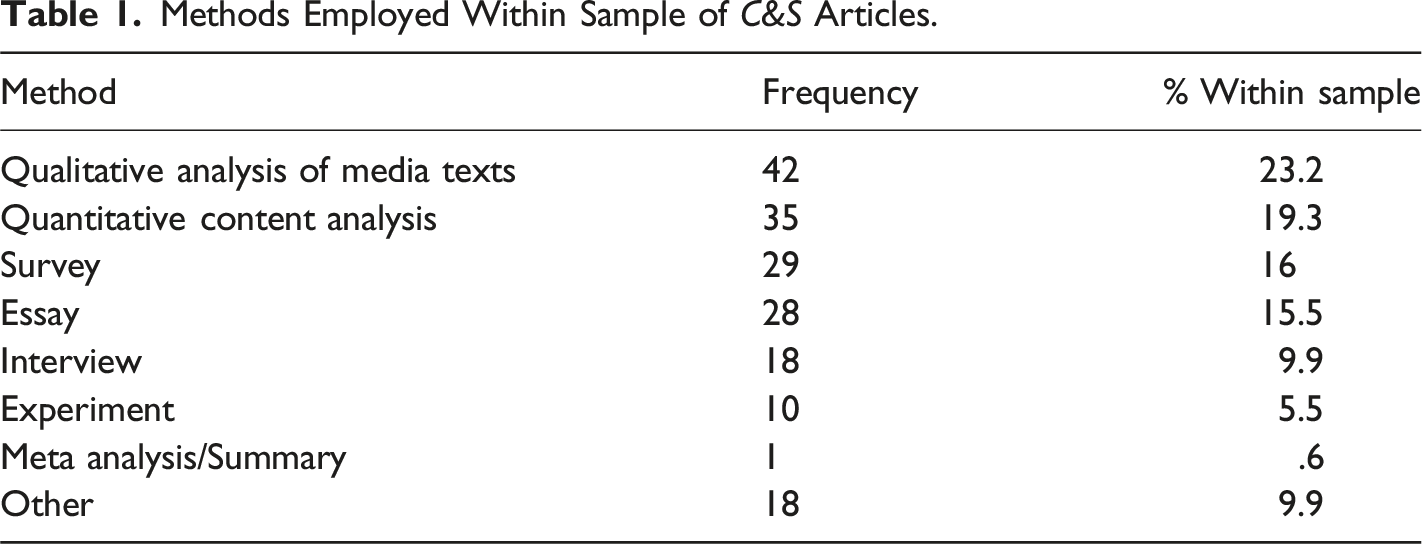
Other common forms of research included surveys or essays, both appearing at a nearly identical frequency. Less common were experiments, representing a relatively small proportion of the sampled articles.
Notably, the “other” category captured nearly 10% of sampled articles and reflected a varied mix of approaches, or as was often the case, a mix of multiple methods. For example, ethnographic work in physical or online environments combined multiple approaches including participant observation, interviews, and author participation as a member of a population (e.g., Ahmad & Thorpe, 2020; Kang & Seibold, 2018). Other studies employed multiple methods in a more sequential fashion (e.g., content analysis followed by interviews; Kavasoğlu & Koca, 2022) or novel approaches not captured by common categorizations (e.g., “drawing analysis,” Zanin et al., 2021). Lastly, case studies that reflected examination of singular events or phenomena but did not align squarely within categories of content analysis also appeared within this category (e.g., de Haan et al., 2015; Reed, 2015). In sum, analysis of media content reflected the dominant methodological approach within the sample of C&S articles.
In addition to examining the specific method employed within sampled articles, RQ1 also queried the broader approach to data within these pieces. Frequencies and associated proportions were examined for both the full sample as well as the subset of articles that were not categorized as essays through the previous analysis. Results show that qualitative approaches to data dominate the journal (42% of the full sample, and almost half, or 49.4% of the smaller subset of articles not categorized as “essays”). When looking at the full sample, quantitative approaches to data comprised one third of sampled articles (33.7%), with less than 10% of sampled articles employing a mix of both (8.8%). Thus, among the data-driven scholarship within C&S, qualitative approaches were most common.
Use of Theory in C&S
Research Question 2 examined the nature of the theories present in C&S, including how they were used. The analysis revealed 143 concepts or theories within the sample, and most of them appeared relatively infrequently. Indeed, the mean number of times any given theory/concept was cited was 2.93 (SD = 5.64), and 94 of the concepts/theories (63.76%) were cited only once. To offer just a few examples of such perspectives, the integrated crisis mapping model (Jin et al., 2012; cited in Meadows & Meadows, 2020), or three-stage model of organisation-public relationships (Grunig & Huang, 2000; cited in de Haan et al., 2015) both appeared only once within the sample.
Most Frequently Cited Theories and/or Concepts Cited Within Sampled C&S Articles.
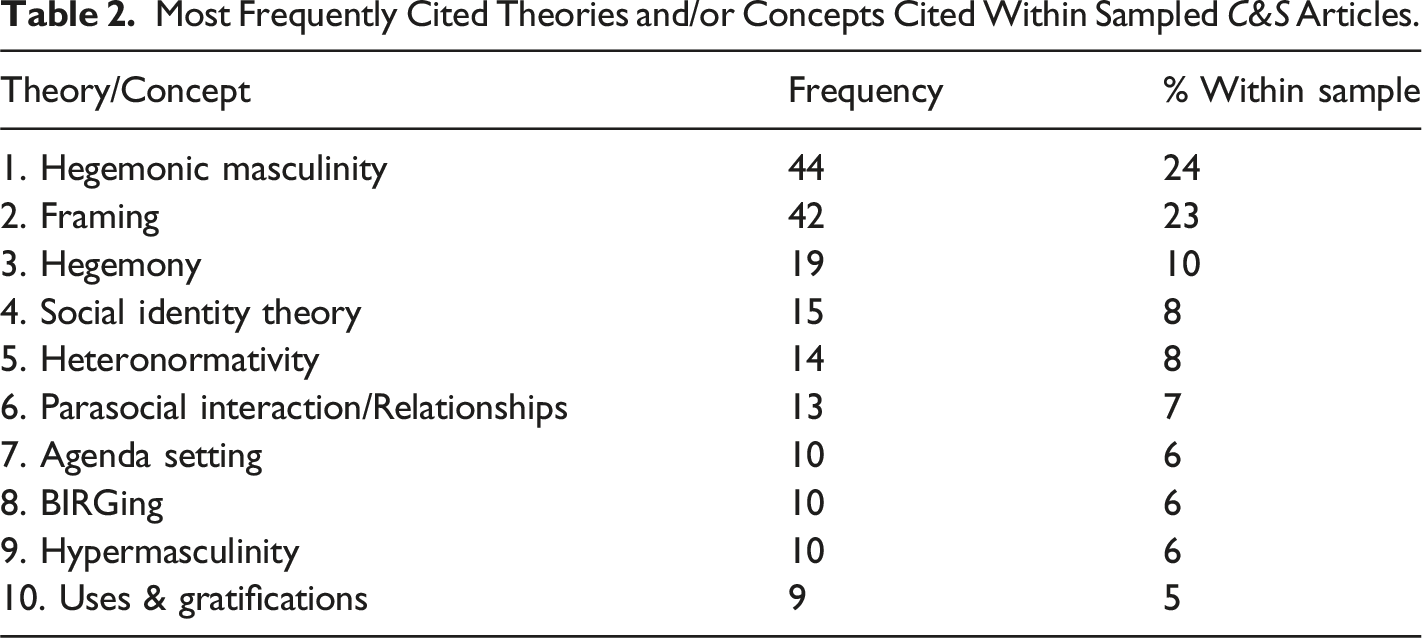
Although several of these are somewhat self-explanatory (e.g., agenda setting, uses and gratifications), others bear elaboration and/or explanation. For example, hegemonic masculinity sometimes but not always appeared in tandem with the broader concept of hegemony, and vice versa. Thus, they appear separately in this list. For example, Sherwood et al.’s (2017) examination of media coverage of women’s sports repeatedly notes the “male-dominated, hegemonic nature of sports newsrooms” (p. 648), but it does so in a way that never references hegemonic masculinity as a constellation of behaviors or characteristics that suggest a particular form of masculinity. In contrast, consider Sanderson et al.’s (2016) examination of the framing of NFL quarterbacks. They note that “hegemonic masculinity abounds” (p. 7) before recalling instances where athletes continue to play through injury to demonstrate toughness, thereby positioning it as a behavior.
Similarly, references to Social Identity Theory often, but not always, were provided in tandem with Basking in Reflected Glory (BIRGing). Therefore, although related, they appear separately in this analysis. For example, Atwell Seate et al. (2017) explicitly drew upon SIT in their examination of the FIFA World Cup, but the authors never referenced the phenomenon of BIRGing. Conversely, Ruihley and Pate (2017) briefly reference BIRGing (p. 151) without citing Cialdini et al.’s (1976) original work probing this phenomenon or diving into the broader theoretical foundation of Tajfel and Turner’s (1986) Social Identity Theory.
In terms of how these theories/concepts were employed within the sample, results for two variables were consulted. With respect to how the theories were used, most references were simply that, mere or brief, casual references (n = 233, 55.6% of references), and a minority of references appeared as the guiding framework for the articles in which they appeared (n = 168, 40.1%). These were also coded for whether the theories/concepts were articulated as formal theories (i.e., clearly labeling or referring to them as theories or theoretical frameworks v. merely citing them by name without escalating it to “theory” status). In contrast to the previous finding, most theories were referred to as just that—theories (n = 242, 57.8%)—while a minority was referred to as merely concepts (n = 177; 42.2%).
Most Common Explicitly Cited Theories or Frameworks Among Sampled C&S Articles.
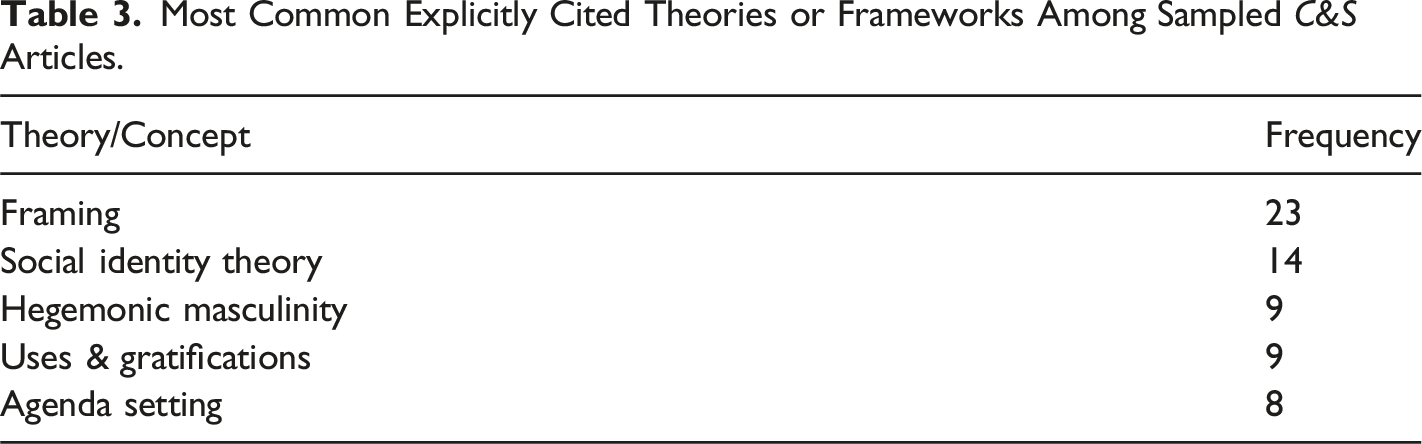
For example, Oh et al.’s (2021) examination of Korean Olympic women’s unified ice hockey team explicitly noted “media framing” in the title and keywords, and they noted that “The study utilized insights from framing theory and agenda setting theory to consider the ways in which people presented and discussed certain aspects of [the unified North and South Korean team] in South Korea” (p. 893). As another example, Parry et al. (2022) refer to Connell’s (1987) “hegemonic masculinity theory” (p. 566) in their analysis of masculinity in rugby, clearly positioning it as an organizing theoretical framework, as does Reichart Smith’s (2016) visual analysis of Olympic ice hockey (e.g., “Hegemonic masculinity is a widely used theory…” p. 64). However, also consider Henning and Andreasson’s (2021) articulation of hegemonic masculinity [emphasis added]: “One way to theoretically approach muscle-building practices in general and fitness doping in particular is to try to dissect the whole phenomenon in relation to the concept of hegemonic masculinity” (p. 992). Thus, ambiguity surrounding what constitutes a theory proper v. guiding concept was evident.
Sources of Data in C&S
Given broader concerns regarding the source of data within communication and sport scholarship, this analysis also examined the nature of data employed within the sample (RQ3, RQ4). First note that a majority of studies within the sample (n = 114; 63%) did not employ human subjects as study participants. Thus, these studies relied on publicly available data (e.g., social media content) or reported no original data at all.
Furthermore, RQ4 probed the nature of data among the smaller subset that did employ human subjects (n = 67; 37%). The vast majority of those did not employ convenience samples of student subjects (n = 51; 76.12%). Instead, they used samples from a variety of sources, including current and former journalists (Li et al., 2017), athletes (Cranmer et al., 2019), parents (Boneau et al., 2020), adult sports fans or fantasy sports users (Billings et al., 2017), and more.
International Representation in C&S
As previously noted, C&S has explicitly been positioned as a home to scholars from around the world (Wenner, 2017b). As such, the analysis also examined the nature of authorship for articles within the sample. Regarding RQ5, results show that a majority of sampled articles was written by authors exclusively from the U.S. (n = 107; 59.1%). One-third of articles were exclusively from scholars outside the U.S. (n = 59; 28.3%), and a small percentage of articles from teams representing both U.S. and international affiliations (n = 15; 8.3%). Twenty different countries were reflected within the varied author affiliations in the sample. Among those countries reflected by international scholars, articles with authors from Australia, Canada, and the United Kingdom were most frequently represented (see Figure 1). After those three countries, representation dropped off considerably, with articles with scholars from these countries appearing in single digits. Countries with associated author affiliations among sampled C&S articles.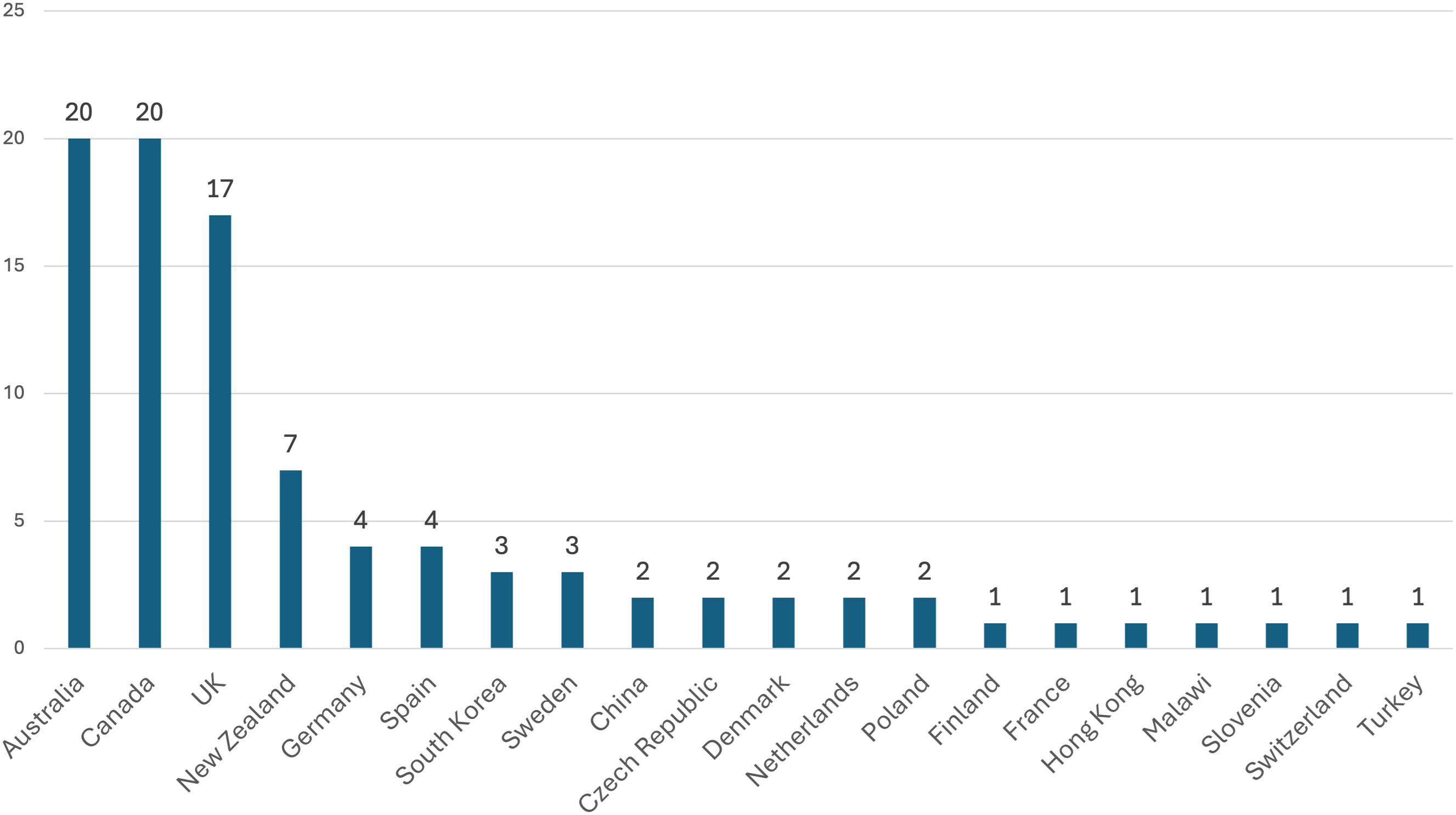
To further probe for the international composition of authorship within C&S, data were also examined for two time periods, before and after Wenner’s (2017b) explicit call for continued broadening of the international scope of its scholarship (RQ6). Data were analyzed via a chi-square test of association and found no statistically significant relationship between article authorship and time period (χ2 (2) = 2.31, p = .32, V = .11). The proportion of articles authored by scholars with U.S.-only affiliations only slightly decreased across the two time periods (60.9% in the first five years, 58% in the second), and the proportion of articles from scholars with international affiliations was likewise equal (34.8% in the first time period, 31.3% in the second). Among articles with authors reflecting a mix of U.S. and international institutions, the difference was larger but still statistically trivial (4.3% within the first five years, 10.7% in the second five-year period).
Discussion
Wenner (2015) noted that, as is the case in many disciplines, reflection upon scholarship that explores the crossroads of communication and sport is healthy to the discipline. True to form, he captured the benefits of such reflection in his distinctly eloquent prose: “It strikes me that considerations of this sort are always important in a scholarly area and periodic stocktakings, to assess the contours and sensibilities of any scholarly community sharing common interests can be seen as essential and preventative maintenance should the field’s ‘heading’ need some adjustment.” (p. 248)
In this spirit, the present investigation added to such “stocktakings” by cataloging the methodological approaches, varied concepts and theoretical frameworks, and authorship reflected in the first decade of the journal. Results reflected the considerable diversity Wenner (2012) imagined in describing the raison d’etre of C&S. Moreover, this analysis also suggests needs and opportunities to further broaden the horizons of our scholarship and add to the legitimacy of the field.
Methods and Authorship in Communication & Sport
With respect to the methods employed in C&S, our analysis revealed lots of “looking at content” using varied approaches, both quantitative and qualitative in their orientation. Conversely, a smaller percentage of articles employed surveys, interviews, or experimental designs where individuals more directly served as an active source of data. Thus, Wenner’s (2015) prior assertation that scholars examining communication and sport show a “disproportional preoccupation with mediated sport content” continues to ring quite true (p. 252). In offering this critique, he further acknowledged that “there is an appeal to analyzing and critiquing mediated sport content that is abundant and readily accessible” (p. 252), and we agree. However, the result of this preoccupation is to overlook other equally relevant sources of information—the myriad actors involved in the production and consumption of sport media content at all levels and in all forms (Abeza, 2023). Moreover, reliance on analysis of freely available social media content can also ignore passive consumers of content who may not actively contribute to social media discourse (Kunkel et al., 2023)
To be clear, this preoccupation with content is not necessarily a shortcoming, as content can reveal much about the organizational, cultural, or individual sources of that content. Likewise, content can also speak to potential effects of consumption, again at an individual or broader social level. However, to elevate scholarship where media content is the focus of inquiry, we strongly encourage researchers to make these potential connections to sources and audiences clear and explicit. (And as we will soon note, to also explicitly use theory to guide these inferences).
For example, Neuendorf’s (2017) “integrative model of content analysis” provides an excellent discussion of “linkages,” where she implores researchers to make explicit logical or empirical links between content producers, the content itself, and/or receivers. Likewise, Riffe et al. (2019) offer a “centrality of content” model that also notes the central role of communication content in this broader consideration of the origins of media messages and potential impacts on individuals or society. In this vein, we encourage researchers to more strongly embrace these suggestions in order to elevate C&S’s ongoing preoccupation with media content. Moreover, we echo those who have observed a continued overreliance on the analysis of media content (Abeza, 2023; Kunkel et al., 2023; Sanderson, 2023; Schäfer & Vögele, 2021) and encourage scholars to employ the broad array of methods and tools at our disposal to probe the full spectrum of issues surrounding communication and sport.
Among studies that do employ individuals as a source of data, scholarship appearing in the first decade of C&S reflects a strong diversity of sources and does not merely rely on convenience samples of “college sophomores” (Sears, 1986). Thus, in this respect, the validity of our scholarship is buoyed by its reliance on data sources appropriate to the questions being explored.
Our analysis also revealed that a majority of the scholarship appearing in the first 10 vol of C&S was offered by scholars from the United States (59%), with roughly one-third of articles penned by international teams of scholars (29%). Moreover, those proportions were relatively consistent over time. Notably, past examination of studies employing content analysis in sport communication has revealed a similar focus on U.S.-based content (Schäfer & Vögele, 2021). Thus, the journal still has room for greater diversity in terms of the source and geographic focus of its scholarship, and we repeat past calls to further engage with researchers from around the globe (Wenner, 2017b). Sports is a universal phenomenon, and our scholarly inquiry examining it should be as well.
Theory in Communication & Sport
In their inaugural essay as co-editors of C&S, Billings and Hardin (2022) called for “theoretical and methodological advancement,” adding that “manuscripts that are sound in logic and approach but that also push boundaries and evoke new ways of thinking will be the ones that we prioritize over well-trodden intellectual ground” (p. 4). This begs the obvious question: What is that well-trodden ground?
Review of concepts and theories in the first 10 vol of C&S reveals a considerable diversity of concepts and theories appearing in the journal. However, we also found a very few frequently cited frameworks. Notably, several of these “greatest hits”—uses and gratifications, framing, parasocial interaction, agenda setting, etc. (see Table 2)—resemble findings from studies examining the more narrowly defined literature surrounding social media and sport (Abeza, 2023; Abeza & Sanderson, 2022; Kunkel et al., 2023). Likewise, the large list of distinct theoretical perspectives we noted resonates with similar scoping studies (Kunkel et al., 2023).
Given the aforementioned methodological focus on analysis of media content, it is not surprising that framing appeared in nearly one-quarter of the scholarship in C&S as a framework to explain the potential impact of how content is represented. Beyond these select few theories or frameworks, few dominated the journal, and the remainder appeared relatively infrequently (i.e., in less than 10% of sampled articles). In sum, scholars publishing in the journal are collectively drawing upon a wide variety of theoretical frameworks but also leaning heavily on a select few.
If there is a central focus of C&S, issues of gender and sport may well reflect that focus, and the frameworks of hegemonic masculinity, heteronormativity, and hypermasculinity all appear among the most cited theories or frameworks. Notably, these frameworks were absent from quasi-comparable reviews of literature in the field (Abeza, 2023; Abeza et al., 2014; Abeza & Sanderson, 2022), suggesting a potential distinguishing characteristic of the journal relative to other outlets focusing on the nexus of sport, media, and communication. One possible explanation for this is the broader focus of the present review encapsulating all literature within C&S compared to more focused reviews that examined only scholarship examining social media in sport. Alternately, it could serve as a distinguishing characteristic of C&S.
Notably, when theory was referenced in C&S it was just that—referenced and not closely interrogated or employed as a guiding theoretical framework. As previously noted, although a wide variety of theories or central theoretical concepts was noted within the sample, fewer than half of these references were recognized as the central theoretical focus of a given article. Returning back to the most common framework, hegemonic masculinity, it embodies this finding. Among the 44 times it appeared within the sample, it was most often merely referenced (59%) and less frequently employed as a guiding framework (38.6%). Likewise, when it was referenced, it was rarely offered as a formal theoretical framework (20.5%) and more frequently noted as a guiding concept (79.5%). Thus, although theory certainly appears within C&S, it often does just that—appears.
Concepts v. theories
Further clouding the waters in terms of how theory is employed within the journal, some perspectives were noted more as concepts rather than offered as theory proper. In this respect, we are not alone, as others have offered similar observations when examining the use of theory in the more narrow literature examining social media in sport (Kunkel et al., 2023). For example, framing is a robust theoretical tradition within communication research at large (Bryant & Miron, 2004), and its frequent presence in C&S reflects as much. However, references to framing as a theoretical framework were frequently implicit in nature. For example, Laurendeau and Moroz (2013) referenced “media framing of issues” but only in passing as a means of acknowledging how media coverage can emphasize aspects of a given media text (p. 387). Similarly, Hodler and Lucas-Carr’s (2016) analysis of media texts discussing/depicting Olympic swimmer Dara Torres repeated refers to media framing of the athlete (i.e., “the media narrative frames Torres as a role model and fitspirational figure…” p. 449; “Torres’s body was framed as an object…” p. 452). Within these, framing was noted but never explicitly invoked as a theoretical framework accompanied by supporting citations to formal articulations of the theory.
Another example of some imprecision with respect to articulation of a theoretical framework is the occasional escalation or promotion of concepts to theories. For example, Oats and Vogan’s (2014) analysis of controversy surrounding the song, “One Shining Moment” in televised coverage of the NCAA basketball tournament illustrates this escalation of a concept to the status of “theory.” In the abstract to their article, they note that their manuscript employs “Jonathan Gray’s theorization of media ‘paratexts”—the ancillary content that surrounds primary media texts” (p. 328). However, the piece fails to articulate this theorization in any formal sense. Similarly, English’s (2022) examination of journalistic sports coverage from traditional newsroom staff in contrast to in-house staff within sports organizations notes the “theorization of contemporary sports journalism” (p. 855) but does not elaborate on such theorization in any formal sense.
Frameworks v. theories
One additional challenging discovery is the myriad ways that “theory” is both articulated and used. For example, Mutz and Gerke’s (2018) analysis of the impact of sports teams performance on fans includes a robust discussion (and explicit heading) of “Theoretical Framework.” However, no singular, identifiable theory is cited. Impacts of team performance on fan identification and emotional response are discussed, but no specific theoretical mechanism is offered.
Hambrick and Kang’s (2015) examination of sports organizations’ use of Pinterest reflects another example of a study that clearly (and explicitly) employs a framework (i.e., the “relationship-marketing conceptual framework,” p. 445). However, this begs the question—is a “framework” on par with a theory proper? Moreover, they conclude their analysis with a section describing “Theoretical Implications” (p. 449). And although they discuss multiple potentially important concepts (e.g., fanship, identification/identity), the discussion fails to explicitly note any actual theoretical traditions where these might be relevant.
Another challenge is inconsistency in how some traditions are referenced. For example, Benoit’s work on organizational or individual response to crisis was variably referred to crisis repair theory (e.g., de Haan et al., 2015) or “image repair typology” (e.g., Hambrick et al., 2015, p. 196). Likewise, de Haan et al.’s (2015) examination of organizational response to crisis illustrates the challenge of recognizing the application of “theory,” insomuch as it references multiple related perspectives or approaches (e.g., Grunig’s situational theory, 1997; Grunig’s relationship management approach, 2011; Benoit’s crisis response approach, 1997; Grunig & Huang’s three-stage model of organization public-relations, 2000). Thus, no single “theory” guides the analysis but instead a broad collection of related perspectives.
Frameworks as Both Theory and Method
Also clouding the role of theory in C&S is the occasional presence of a concept that acts as both a guiding conceptual framework as well as methodological approach. For example, Stanley (2022) offers framing as both a theory and a “method of inquiry” (p. 977). Similarly, cultural studies appears as another approach that blurs the lines between theory and method. For example, Butterworth (2014) noted that his analysis of sport media coverage on the 10th anniversary of the 9/11 attacks employs “the tradition of critical and ideological rhetorical studies” (p. 208).
Perhaps the most common example of implicit references to a particular conceptual perspective were the many references to Michele Foucault (e.g., Lamb & Hillman, 2015; Laurendeau & Moroz, 2013; Mocarski & Billings, 2014). Within numerous articles, authors invoked his work to articulate their scholarly point of view as suggest an associated mode of analysis. For example, Mocarski and Billings’ (2014) analysis of media texts featuring professional basketball player LeBron James sought to illuminate common discourses surrounding the athlete. They note, “We use the word discourse in Foucault’s sense, where a discourse is the shared understanding of cultural norms and a discursive formation involves the regularities that help to produce such understandings” (p. 5). Despite the fact that “theory” is never explicitly invoked, it would certainly be misleading to characterize this work as “atheoretical.” Moreover, some work seems to deliberately eschew the constraints of a particular theory in order to facilitate broad exploration. For example, Lamb and Hillman’s (2015) exploration of “Tough Mudder” events as a cultural text or ritual notes that, “The theoretical focus of the article is necessarily broad in order to capture the popularity of Tough Mudder among white-collar professionals” (p. 84). That is to say, no specific theory is invoked; instead, the piece invokes the Foucauldian approach as well as concepts such as social Darwinism or identities of race, or gender to contextualize their investigation into the cultural meaning of the event.
Similarly, is “critical discourse analysis” a method or a theoretical vantage point? Although it suggests a set of methods, the “critical” approach also implies a particular theoretical orientation or view of the purpose or function of theory (e.g., Wagner & Sveinson, 2023). Thus, despite absence of the word “theory,” to call such work “atheoretical” ignores the broader context of that approach.
Advancing Legitimacy in Communication and Sport Scholarship
Legitimacy is a recurring motif in within C&S (Real, 2013; Wenner, 2015, 2017a, 2017b, 2021; Whannel, 2012)—first the need to legitimize the field through its scholarship, then leading to continued legitimacy through interest groups or divisions within the professional organizations, journals, edited volumes, focused curricula or programs within universities. It is worth noting that this concern is not unique to the subfield of communication and sport but has been broadly levied against the field of communication at large, and the discipline in general has long struggled with core questions of who we are and our place in the academy (Bryant & Miron, 2004). But these concerns may be heightened among those who study communication and sport.
Just as sports journalists continue to work to overcome the perception of sports as the “toy department” within newsrooms or newsgathering organizations (e.g., Cassidy, 2017), this preoccupation with legitimacy may suggests that scholars studying communication and sport face similar perceptions: Is communication and sport the “toy department” within the communication discipline? One could rightly argue that the success of C&S as indexed by citation counts, impact factors and the like (Billings & Hardin, 2022, 2023; Wenner, 2017a, 2021) further advances and cements our legitimacy. However, Wenner (2021) warns that new scholars who will produce the future of research in communication and sport should not “overestimate the value of sport and what may seem to be a ubiquitous interest in it” (p. 861). In short, not everyone shares our enthusiasm for the subject matter and its broader social importance, and we must diligently labor to enhance the view of our scholarship among those outside our boundaries. We suggest that the more precise articulation of theory, along with a growing focus on theory testing, development, refinement, and expansion could aid this legitimization.
In his address to the 10th annual meeting of the International Association for Communication and Sport (published in print in volume 5, issue 4 of C&S), Wenner (2017b) offered two challenges for the growth of the field—a broadening of the international scope of the field and broadening the disciplinary boundaries. We conclude by offering our own challenge—elevating the focus on theory within C&S.
How do we achieve that? First, as others have noted (Abeza, 2023; Sanderson, 2023), we must move beyond our “disproportional preoccupation with mediated sport content” (Wenner, 2015, p. 252). To be certain, it is hard to resist both the ease and value of examining an ever-growing body of communication content to examine what it can offer about communication and sport (Schäfer & Vögele, 2021). The sources of such content now includes both legacy (e.g., Cooky et al., 2015) and new media organizations (Garcia & Proffitt, 2022); in-house reportage from within teams that blurs the lines between journalism and public relations (e.g., English, 2022; Mirer, 2022); direct communications from athletes themselves (e.g., Frederick et al., 2015); as well as the audiences for sports media content who constantly produce volumes of content via social media that are ripe for analysis (e.g., Fan et al., 2020). However, we echo Hutchins’s (2014) sentiment that “A thematic analysis of a limited sample of tweets focused on a sports event/league or athlete/celebrity is becoming a tired formula, especially when there is little connection to a broader research framework or agenda” (p. 123). Even in such analyses where content is the focus, we must clearly articulate a theoretical framework in order to tie this content to some broader significance. In addition, we encourage scholars publishing within C&S to embrace calls for methodological advancement and embrace the broader toolkit of methods at our disposal and not limit our methods to analysis of media texts (Abeza, 2023; Billings & Hardin, 2023).
Second, we encourage scholars publishing within C&S to more clearly and explicitly articulate their theoretical focus and do more than merely reference a framework. In their essay marking the anniversary of their first year as co-editors of the journal, Billings and Hardin (2023) repeatedly noted the important role of theory in determining initial fit within the pages of the journal, that scholarship must be both grounded and advance theory [emphasis added]. Here we re-emphasize our study’s finding that much reference to theory was simply that—brief reference.
Although our focus here is on scholarship at the intersection of communication and sport, commentary offered on the broader discipline of communication in general offers useful insights. In his essay probing the fractured state of communication theory, Craig (1999) noted that the despite the focus on a single shared phenomenon (i.e., “communication”), the discipline is characterized by a lack of a singular coherent framework or shared goals. Communication’s interdisciplinary roots has led to a proliferation of theories: “They neither agree nor disagree about anything, but effectively bypass each other because they conceive of their normally shared topic, communication, in such fundamentally different ways” (p. 121).
Such could possibly be said of communication and sport. Wenner (2015) characterized the field of communication and sport as consisting of three unique traditions/perspectives with competing epistemologies, foci, scope, and aims (i.e, the “Media, Sports, & Society” disposition; the “Sport Communication as Profession” disposition; and the “Communication Studies and Sport” disposition). Despite a shared interest in communication and sport, these traditions probe different questions, employ different methods, and often work to satisfy different goals. The broad and “inclusive home” that Wenner (2012) called for at the outset of C&S may have indeed yielded considerable diversity (p. 6). But one unfortunate artifact of that diversity could be the potentially false assumption of common epistemological foundations and shared views of what constitutes “theory.”
How then do we collectively work to advance as a coherent, unified and collective body of scholars seeking to further legitimize communication and sport as an area of study? Noting the abundance of disparate traditions within communication, Craig (1999) offered a dialogical-dialectical approach to communication theory, where these traditions entered into shared dialog regarding what ties us together, along with a complimentary (and deliberate) grappling of the tensions that separate or distinguish these tensions: “a common awareness of certain complementarities and tensions among different types of communication theory, so it is commonly understood that these different types of theory cannot legitimately develop in total isolation from each other but must engage each other in argument” (p. 124).
We call for this approach in communication and sport, and such dialogue fulfills the interdisciplinary vision of the journal. However, to do this meaningfully, we must precisely and clearly articulate our respective frameworks and theories. To again borrow from Craig’s concluding admonition to the field, “Communication theorists should address their writing, even though usually on specialized topics, to the field as a whole [emphasis added]” (p. 153).
Given the interdisciplinary nature of C&S, its contributors, and its readership, more explicit articulation of theory aids the reader in detecting key epistemological foundations and moves frameworks from implicitly hidden “between the lines” to more explicitly referenced for the uniformed who wish to dive deeper. In doing so, this can “signal the field relevance of the work and provide entry points” (Craig, 1999, p. 153). To provide these entry points for all readers of C&S, we challenge scholars advancing communication and sport to grapple with theory in a meaningful way: • Explicitly state (and cite) a specific theoretical framework or tradition; • Tie their work into these frameworks and make connections clear; • Work to thoroughly engage with theories using an appropriate method and not merely reference vague orientations; • And conclude by articulating how their work advances, contradicts, expands, or otherwise sheds light on their respective theories.
In doing so, we can help continue to the work of legitimizing communication and sport both within the community of scholars working in this shared space as well as those looking from the outside.
Footnotes
Declaration of Conflicting Interests
The author(s) declared the following potential conflicts of interest with respect to the research, authorship, and/or publication of this article: The authors whose names are listed immediately above certify that they have NO affiliations with or involvement in any organization or entity with any financial interest, or non-financial interest in the subject matter or materials discussed in this manuscript.
Funding
The author(s) received no financial support for the research, authorship, and/or publication of this article.
