




Abstract
A Chinese classic novel The Journey to the West (Chinese: 西游记, pinyin: Xi You Ji) has been yielding large volumes of English renditions across genres and media in the past 120 years starting in 1895. This body of renderings gives considerable material for research on how particularly translations have been handled. To give an overview of this research, this article proposes a bibliometric analysis to sketch a map of the translation studies conducted so far on The Journey to the West. A series of queries are made: which translators are most researched; which translations are most often compared with each other; which research questions are most addressed or ignored; which theories are most applied to resolve these questions. As Rovira-Esteva et al. state, “we need maps to know where we are so as to be helped instead of unconsciously being steered by them” (p. 160). The multiple and complementary perspectives we provide in this article are constructive to identify problems and lacunas and point out future directions. The present analytical framework has been applied to English translations of a Chinese classic, but we believe it can be successfully extrapolated to other similar cases.
Introduction
The Journey to the West (Chinese: 西游记, pinyin: Xi You Ji; TSJW) is a Chinese classic novel composed by Wu Cheng’en (1368–1644) during the Ming Dynasty. The plot is based on the trip Buddhist monk Xuanzang (602–664) made to India in search for sacred texts. This voluminous book extends over 100 chapters and recounts the adventures of Tripitaka, another name for Xuanzang, together with three animal spirits: a monkey, a fish, and a pig. Over the past decades, TSJW has been continuously translated into a rich array of languages and favored as a piece of world literature for the embodied values of rebelling against authority, fighting for liberty and independence, searching for truth and goodness in the process of adventure. To the English-speaking community, the novel was most famously translated by Arthur Waley in 1942 and retranslated by American Chinese scholar Anthony C. Yu in 1977–1983. These well-established English translations contribute to a further cross-genre adaptation into children’s books, films, TV series, and so on. Up to date, there has been a multitude of studies on the English translation, dissemination, manipulation, and reception of this Chinese classic. Nevertheless, there is little in these discourses on presenting a comparative overview of how the English translations of TSJW are researched in China and abroad. This research paper proposes a bibliometric analysis of the studies on these translations so as to sketch a map of the Translation Studies conducted so far on TSJW.
Bibliometric Analysis in Translation Studies
Bibliometric analysis is a quantitative approach designed to research the knowledge structure, research foci, and the development trends of a research field based on the analysis of interrelated articles, theses, and books. However, it is only in recent years that bibliometric research has emerged in the realm of translation studies marked by Perspectives: Studies in Translation Theory and Practice, a renowned translatology journal, devoting an entire issue (Volume 23 Issue 2, coedited by Sara Rovira-Esteva, Pilar Orero, & Javier Franco Aixelá) to this topic (see Gile, 2015; X. Li, 2015; Zanettin et al., 2015; Zhang et al., 2015). On a positive note, these studies highlighted the reliability of bibliographic information as research data. However, few have brought the citation information into account (Dong & Chen, 2015). Moreover, much research is geared toward a descriptive study without making effective use of inferential statistics to develop a larger picture.
To our knowledge, a review of the existing literature shows the application of bibliometrics in translatology with the following purposes: (a) To obtain a diachronic and holistic view of translation studies in the sense of the evolution of a particular key term. For example, Liu et al. (2015) sketched the changing perception of Nida’s kernel concept “dynamic equivalence” over the past three decades in China. (b) To track the development of a research approach. With the aim of identifying the merging trend between discourse analysis and translation studies, Zhang et al. (2015) conducted a thematic analysis based on eight indexed translation journals. In their research on the geographic distribution, they verified that United Kingdom, Spain, and Hong Kong China were the most active regions to apply a discourse analysis approach in their translation studies. (c) To synchronically or diachronically delineate the practice and research of a translation activity. Martínez-Gómez (2015), for instance, investigated the evolution of nonprofessional interpreting from 1973 to 2013. (d) To compare the research foci across regions. For example, Wang and Chen (2017) spotted the divergence in research foci between Chinese translation journals and the international ones. Based on the technique of cluster analysis and visualization, they found that descriptive translation research was a bridge between the two largest schools of translatology, that is, the linguistic approach and cultural studies. (e) To serve as a benchmarking for research assessment. Rovira-Esteva and Orero (2011) investigated how authors within Spanish and Catalan university education systems performed in high-impact journals.
Methodologically, some researchers confine their research to intuition-based analysis and descriptive statistics (e.g., publication counting, keyword analysis). This approach usually fails to elaborate on the relations between variables. As is known, descriptive statistics simply describes what is going on in the data, whereas inferential statistics is to make inferences from data to more general conditions. In this sense, a bibliometric analysis with rigor and precision shall embrace both statistical approaches and will be even better to illustrate the results in a graphical representation. These requirements can be easily realized by bibliometric software than through an intuition-based analysis.
Research Method and Questions
The major analytical tool we use in this article is VOSviewer, which is applied to construct and visualize bibliometric networks. These networks may, for instance, “include journals, researchers, or individual publications, and they can be constructed based on citation, bibliographic coupling, co-citation, or co-authorship relations” (http://www.vosviewer.com). The main specificity of this tool is its automatic cluster analysis, that is, an unsupervised classification tool which divides data (e.g., keywords of papers) into meaningful groups (clusters) with high or low interclass similarity. In many circumstances, this technique can serve as a starting point for a subsequent qualitative interpretation. In doing so, quantitative and qualitative inquiries interact. A close reading of the literature may help redress the structured, closed-ended, preconceived survey performed by the bibliometric software. Indeed, an automatic classification scheme is “a convenient method for the organization of a large data set so that it can be understood more easily and information retrieved more efficiently” (Everitt et al., 2011, p. 3). Nevertheless, like many other multivariate statistical techniques, cluster analysis may turn out to be somewhat unnecessary and superfluous when dealing with few data. In other words, bibliometric analysis entails a substantial body of research objects. At first, we only found three relevant articles from the Web of Science. This scarcity indicates that so far there have been few high-quality international journal papers published on the topic of TSJW. To expand the spectrum of the survey, we used Google Scholar to find more papers, as well as publications in the form of book chapters, theses, monographs, and so on. Given that most of the literature on the topic was written in Chinese, more than in English, we adopt a software-assisted bibliometric analysis of the Chinese contributions while supplementing an intuition-based one on the international bibliography. Overall, the qualitative aspects of the data in both Chinese and English will be taken with caution. Figure 1 illustrates the flow of our research design.

Flowchart of the research design.
As shown in Figure 1, the Chinese bibliographical references containing the meta-information, that is, journal names, author names, abstracts, keywords, and so on, were batch downloaded from the largest academic online library in China, “CNKI. 1 ” After manually uploading the meta-information of references, we interpreted the keyword list and cluster graph generated by VOSviewer. The qualitative analysis in both Chinese and English aims at winnowing the seemingly disordered literature down to a systematic analysis of most researched translators, questions, and theories. Furthermore, we are interested in how theories are being applied as well as what the translation stance of researchers is, for example, if they regard translation as a re-creation or as a replication of the source text. The ultimate goal of this study is to cross-reference the research foci in China and abroad so as to reveal the common aspects, detect the research gap, and gauge future directions of TSJW.
On the whole, our research design adopts a mixed-method technique, which embraces two fundamental principles: (a) the methodological eclecticism integrating the quantitative and qualitative methods to fulfill the survey scope and depth; (b) the iterative, cyclical paradigm including both an inductive and a deductive logic (see Meister, 2018).
Results and Discussion
A Bibliometric Analysis of Translation Studies on TSJW in China
We searched CNKI for the references whose abstract contained “翻译” (translation) and “西游记” (The Journey to the West) and obtained 250 references, among which there are 136 journal papers, 98 master theses, 10 doctoral dissertations, and six conference papers. The diachronic specifications are illustrated in Figure 2.

Publications of TSJW in China (1979–2017).
By contrast, there are 3,041 pieces of literature in the same time span under the theme of translation studies of The Dream of the Red Chamber (pinyin: Hong Lou Meng; Chinese: 红楼梦), another Chinese classic. Therefore, the total number of publications of TSJW in China does not confirm the canon status of the source text. The coverage of monographs in CNKI is relatively limited compared with the journals it holds. To make up this shortage, we also searched the electronic database, including Amazon Books and the National Library of China. The retrieved results are translations of the original novel with scant translation research works under this theme. Figure 2 shows that the first paper appeared in the year 1981 in the database. Between 1981 and 2006, there are only sporadic publications. Thereafter, TSJW has been gaining increasing attention in China, especially after 2013. Then, what are the current research foci and possible lacunae? The answers will be revealed by means of a keyword analysis of the bibliographical data (see Table 1).
Top 30 Keywords of TSJW in China.

Note. The diversified Chinese names of “Arthur Waley,” 阿瑟韦利, 阿瑟威利, 阿瑟韦理, 亚瑟韦利, 亚瑟威利, and so on, are merged into one unified transcription “阿瑟·韦利” in the statistic process. Likewise, we merged the Chinese names for Jenner. TSJW = The Journey to the West.
Table 1 presents the most frequently used keywords of TSJW in China. Keywords play a critical role in academic communication directing readers to potential research objects, questions, hypotheses, methods, theories, conclusions, and so on. The analyst should not only observe the high-frequency keywords but also categorize the isolated keywords into inner-related groups. We noticed that translation methods and strategies are the most conspicuous keywords (see the shadowy rows). Apart from this, a contextual reading of the keywords listed in Table 1 informs us of at least the following aspects:
Finding 1: Most researched translators
The most frequently mentioned translator is Arthur Waley (14 occurrences), followed by Richard Timothy (seven occurrences), Anthony Yu (four occurrences), and William John Francis Jenner (four occurrences). Only a small number of researches seem directed to Yu and Jenner specifically. We will verify this assumption later.
As Wang and Humblé (2018) contend, Timothy and Waley manipulated the original text in their translations to fit their personal ideology and “social poetics” (p. 507). As a Welsh Baptist missionary to China, Timothy fused his religious stance into his translation blending Christianity with Buddhist allegory. For Waley, social poetics, that is, “what the role of translated literature is or should be in the social system” (Lefevere, 1992, p. 26), has been given a large part in his translation strategies. The repetitive plots and pervasive narrative poems are directly simplified because this Chinese novel is regarded as popular literature in the target context. Although Jenner’s and Yu’s complete translations are closer to the source text, Chinese academia has hitherto been more interested in rewriting and in the manipulation than in the analysis of the complete translations. For example, Yang (2008, p. 12) refers to Waley’s manipulative translation as “creative treason,” which manifests itself through simplification (verse omission, chapter selection, cultural adaptation) and personalized translation (artistry and fluency of the translation take priority over fidelity). In the same vein, Hao (2014) uses the term “re-creative translation” to denote Waley’s rewriting. The research scope of the above two studies has extended from text analysis to the observation of the sociocultural context, considering that the translation and publication of Monkey occurred in the context of the Second World War. Indeed, Waley hoped to convey the heroic spirit of the protagonist via translation to the British public. Whereas the war extended throughout the production and the reprints of Monkey, the stocks of the book kept running out, and hence, it was reprinted 4 times during the war alone (Luo & Zheng, 2017, p. 9). With regard to Timothy, quite a few researchers studied the topic of conflation of Christianity with the original Buddhist allegory (Hu & Wang, 2014; Ouyang & Mu, 2017).
Table 2 reports the results of juxtaposing the names of four influential translators and the way they are compared in light of the discourse of abstract. As shown in Table 2, the co-occurrence of the translator’s name may help reformulate our previous assumption that Waley and Timothy are indeed considered the most cited translators.
Co-occurrence of the Name of the Translator in the Abstract.
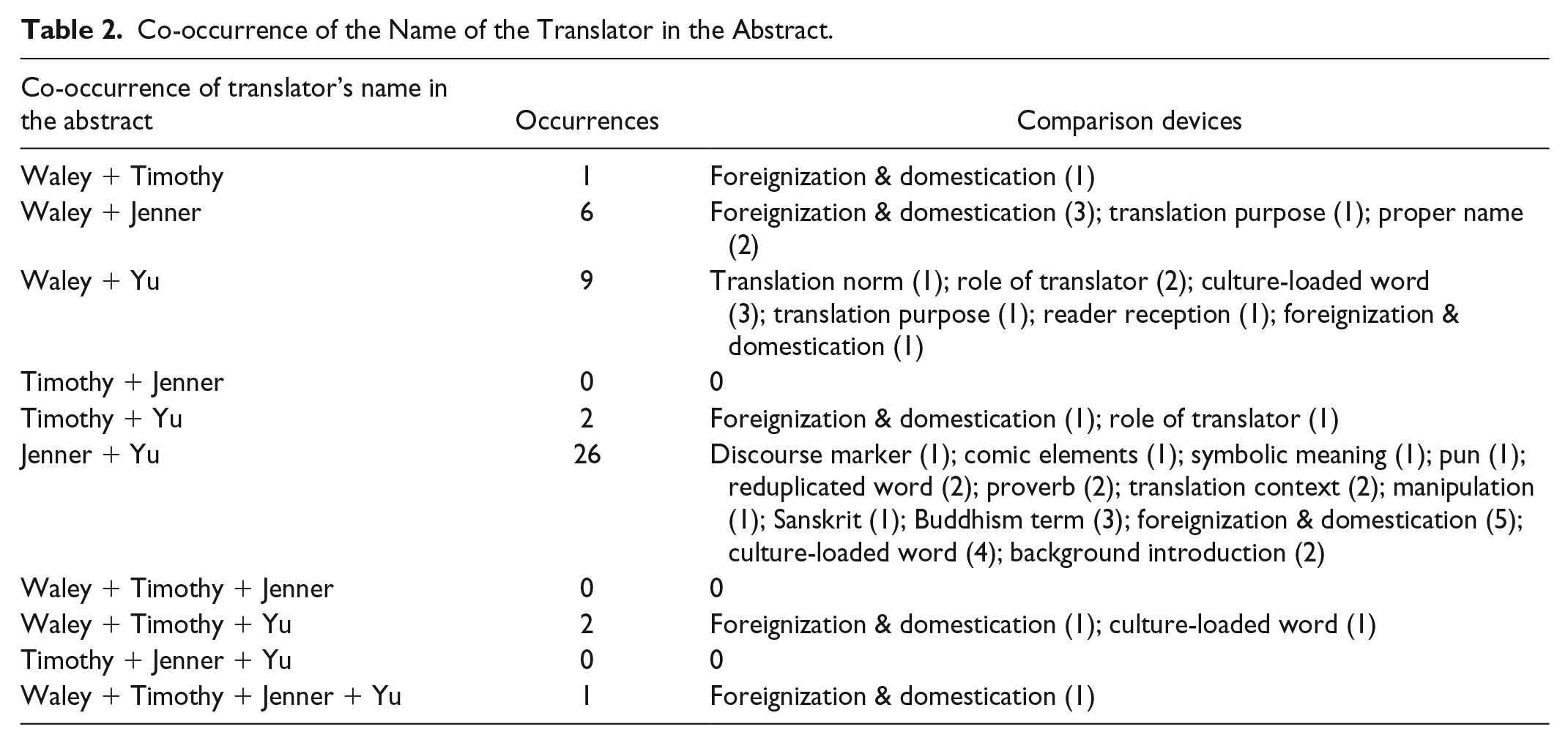
Challenging the claim derived from Table 1 that Yu’s translation escaped scrutiny, Table 2 shows that Yu is the most often mentioned translator, habitually compared with Jenner and Waley. In comparative translation studies, we shall be “wary of comparing things that are comparable” (Tyulenev & Zheng, 2017). The prominence of the top two juxtapositions is reasonable for the purpose of comparing the best-known versions (Waley and Yu) and comparing the complete versions (Jenner and Yu). An intriguing question arises: Why do Tables 1 and 2 display an incongruous story? We infer from it that the selection of keywords in some research papers does not necessarily explicate the prominence of the translator, whose significance would be justified in the abstract. In this sense, an iterative research design to triangulate various data sources is necessary and indispensable. Surprisingly, although the translator names appear in the abstract or keyword, few studies in Table 1 are translator-oriented, but rather concentrate on the translation strategy used (see the comparison devices in Table 2), especially the translation techniques for the untranslatable phenomena.
Finding 2: Most popular outlook of translation studies
Echoing the findings of Table 1, the central concern of TSJW in Chinese academia is the translation methods and strategies. Under this overarching theme, the research set out to explore the translation practice and principles of the following key issues: verse (Su, 2009), fuzzy numbers
2
(Tian, 2011), reduplicated words (Liu & Zhang, 2012), Buddhist words (Healy, 2015), proper name (R. Li, 2014), culture-loaded words (Wu & Lu, 2016), couplet chapter title (Feng, 2014), and so on. Albeit somewhat overlapping, these extensive discussions also demonstrate the fact that the source text is a cultural kaleidoscope with abundant meaning potential to explore. Due to the linguistic and cultural asymmetries between Chinese and English, one of the concomitants of the strategy research is translatability, that is, whether an adequate translation can be achieved; if not, what compensatory strategies can make up for this deficiency. Actually, the current debate regarding translatability has not extended to “social and ideological issues concerning what should or should not be translated” (Hermans, 2009, p. 300). Instead, most studies have assumed a source text–centered stance, criticizing the undertranslation appearing in different renditions of TSJW. A typical example is as follows. Ren (2011) outlined the compensatory strategies for religious allusions based on two complete translations by Yu and Jenner. However, these prescriptive principles sound too idealized to fit into the ever-changing target context: Translators must endeavor to bridge the cultural gap between the source text and the target context by means of compensatory strategies. In order to elucidate the religious connotation, the translator is required not only to fill the meaning vacuum for target readers but also to take the aesthetic values of the source text into account. Beyond that, the translator must accept the responsibility of disseminating Chinese culture. (Ren, 2011, p. ii)
No matter how impartially the translation may read, each version will to some extent “reflect the translator’s own mental and cultural outlook” (Hatim & Mason, 1990, p. 11). If we agree that Waley and Yu translated according to different poetics (as popular or serious literature), then we may find that Ren’s (2011) “one-size-fits-all” emphasis lacks its applicability. Moreover, these studies may have disregarded the fact that “most publishing houses in the West have deliberately introduced in-house editing to ensure that translations are fluent in the target languages” (Dollerup, 2007, p. 105). The external factors sometimes may render theoretical considerations less than convincing. It might just be fairly naive to apply one universal standard to forcibly compare the translation quality of different renditions. We do appreciate Ren’s (2011) efforts in favor of national culture but cannot approve of cultural narcissism in translation studies. Recently, Chinese researchers have been showing considerable unease regarding the manipulations and rewritings conducted by foreign translators and joining the ideological debates in light of “cultural security” (Qu, 2012), “cultural awareness” (Z. Zhu, 2016), “cultural self-confidence” (Cheng & Zhou, 2017), and “discourse power of translation” (Cao & Tang, 2017) to protest against the intervention from the translator. If we agree with the conception of the “translator as mediator” (Hatim & Mason, 1990, p. 128; Katan, 2014, p. 20), we may acknowledge that “equivalence” is one of the feasible strategies and evaluate the manipulation or rewriting on the ground of intercultural empathy: The readability and translatability of translated literature shall be repeatedly negotiated under cross-cultural circumstances. Instead of attracting target readers, to impose ego aesthetic values too much is likely to alienate the target audience, stepping into cultural self-isolation in the polysystem. In effect, translation is an experimental exploration. The ambition of retaining the accuracy and authenticity of the original all at once will undoubtedly jeopardize the dissemination and recognition of a translation. Thus, a gradual increase of the culture-loaded information is a feasible solution. Effective intercultural communication cannot possibly be achieved in one go. (Y. Sun, 2012, p. 23, author’s translation)
To sum up, research on the translation strategies applied in the TSJW has highlighted linguistic and cultural aspects of the source text, and it is illuminating to pair “translation problems” with feasible strategies (Nord, 2006, pp. 174–177). However, weaknesses still haunt TSJW in the following three aspects: a legion of repetitive studies that lack originality, inadequate emphasis on macro studies (numerous superfluous comments at the lexical level), and a one-sided translation outlook centering on the source text. We will revisit this below.
Finding 3: Most applied theories
According to Table 1, the most quoted theories of TSJW are Skopos theory, reception aesthetics, and relevance theory. Common to these three theories is an overriding concern for the target readers, despite the fact that their theoretical presentation may vary in the form of “addressee” (Skopos theory), “reader’s horizons of expectations/recipient” (reception aesthetics), or “hearer” (relevance theory): In the frame of this [Skopos] theory, one of the most important factors determining the purpose of a translation is Reception aesthetics further brings to the fore the The central claim of relevance theory is that human communication crucially creates an expectation of optimal relevance, that is, an expectation on the part of
This appears to be at odds with the source text–centered outlook stated in Finding 2. Paradoxically, a few novice researchers use one of these three theories in their research to ponder the same question, that is, foreignization/domestication, culture-loaded word, and so on, but derive largely similar conclusions. This logical incongruity can be conquered by explicating whom “the reader/recipient/audience” refers to in effect. After a close reading of the literature, we find that the so-called “reader” in many studies is an idealized concept instead of the flesh-and-blood readers (Chen, 2011; Han, 2016; Jiang, 2011; Ren, 2011; Wu & Lu, 2016; Zhou, 2015). More precisely, the reader’s reaction is methodologically substituted with the translator’s reaction, the critical reader of the source text as well as the sense-maker of the target text. As a consequence, the conception of “reader” in Skopos theory, reception aesthetics, and relevance theory is reduced to a guise to justify the translation strategies.
Translation is not only the representation of the source text but also of the social construction based on the interaction between the target text and the reader. However, “reader” is a quite blurry concept, which may be changeable under concrete circumstances. Therefore, we suggest an alternative, that is, a sociocultural approach in terms of poetics, patronage, ideology (see Lefevere, 1992), which can better embrace the role of the reader in a broader sense. Ouyang and Mu’s (2017) research can be regarded as one of the few but persuasive examples in this paradigm. Based on extensive research in historical archives, they certified that the patronage was composed of Christian Literature Society for China (Chinese: 广学会) and the Qing government (the last Chinese feudal monarchy, 1636–1912), who had determined the translation strategies and the readership (Ouyang & Mu, 2017). Besides, they also supported their historical findings by means of textual and paratextual evidence, for example, the translation of Buddhist allusions, the pictorial elements in the translation, distribution and printing of the publication. In this sense, their research is a good example bridging the micro and macro research as we have argued at the end of Finding 1.
Cluster Analysis
Our bibliometrics goes from an isolated keyword analysis to cluster analysis: A total of 51 stable keywords (occurrence ≥ 3) from 182 articles are grouped into 11 clusters (see the full list, Table 3). As shown in Figure 3, each file color corresponds to an independent cluster. The larger the cluster, the more keywords contained under the theme. For an easier understanding of Figure 3, we provide the English translations of the Chinese keywords on the basis of the automatically generated results by VOSviewer. Actually, Figure 3 and Table 3 are telling the same story while being complementary to each other: The figure visualizes the size of each cluster as well as the affinity between clusters, whereas the table displays a full list of clustered keywords. The adjacent clusters may share some common features. For instance, Clusters 1 and 2 contain the synonymous keywords “Chinese classic novel” and “Chinese ancient novel.”
A Full List of Keyword Clusters of TSJW (Retrieved From 182 Articles).


Keyword clusters.
According to Table 3, Cluster 1 is concerned with historical and cultural aspects of the source text. The central tenet of this cluster is the closeness to the source text and the originality of the source culture. For example, the Heart Sutra has a close intertextual connection with TSJW. M. Zhu and Zhang (2016) used Edward Conze’s English translation of Heart Sutra as a standard reference to evaluate two translators, Jenner and Yu, with regard to their Buddhism literacy. Cluster 2 represents a juxtaposition of Four Classic Chinese Novels, introducing the translation history of TSJW in Thailand (Amornwanitsak, 2007), Egypt (Ha, 2008), Japan (Kimura, 2009), and so on. Clusters 1 and 2 represent a source text–oriented approach. By contrast, Clusters 3 (functional equivalence), 4 (relevance theory), and 5 (Skopos theory) can be placed under the broad umbrella of “target-text-oriented functionalism.” As we have argued in Finding 3, this topic is most sought-after in Chinese TSJW. Functionalism, albeit extensively applied, has been underused so far, not giving full consideration to the need of authentic readers in the target context. 3 Cluster 6 specializes in the complete translation comparison. Cluster 7 concerns the cultural misreading and mistranslation (Huang, 2007). Cluster 8 represents the blending of Christianity with Buddhism in Timothy’s variation, as previously mentioned in Finding 1. Cluster 9 is the translation criticism based on readers’ reaction research through the prism of reception aesthetics (supporting Finding 3). Cluster 10 is about the hermeneutics in TSJW. It should be added that small as Clusters 10 and 11 shown in Table 3 (a marginalized position at the bottom of Figure 3), translation ethics and hermeneutics might be a useful instrument to evaluate the rationale of rewritings and manipulations in the translation. Of particular note, the manipulation of the translator can also occur in a faithful complete translation reflecting the cultural mediation of the translator. For instance, Xu (2015) followed the ethics model of Chesterman (2001), that is, ethics of representation, ethics of service, ethics of communication, norm-based ethics, and ethics of commitment, to evaluate Jenner’s and Yu’s translations of geographic settings. In sum, the top keyword analysis (Table 1) and cluster analysis (Table 3) indicate that Chinese academia is inclined to concentrate their research on the textual comparison and translation strategy analysis with scant attention paid to the macro level, for example, translation as world literature. In the next section, we will present an overview of international TSJW.
An Overview of International TSJW
It should be noted that the international TSJW discussed below is a review of the relevant international journal articles, theses, and book chapters whose authors might also have Chinese nationality rather than a strict ethnic definition. Moreover, we have to acknowledge that our account for international TSJW is solely based on the literature in English without giving consideration to works in other languages. Based on a close reading of the literature obtained from Google Scholar, we finalized 13 pieces of reference to analyze. In what follows, international publications will be sorted out along the continuum of macro, meso, and micro.
At the micro level, researchers are mainly interested in evaluating the translation methods and strategies. Unlike most similar cases we have mentioned, Wong (2013) denies the applicability of the “foreignization/domestication” criteria in Waley’s case by presenting textual and paratextual evidence in defense of his view: The translation strategies are motivated by artistic and communicative considerations. It is inspiring to reflect on the symbiotic relationship between theory and practice. Moreover, some studies transcend the confines of textual translation to the intersemiotic adaptation. Through a lens of cognitive linguistics, Jin (2017) asks how narratives, including complex narratives like films, indoctrinate cultural values by means of conceptual metaphors. In this sense, this study interfaces the micro level (intercultural transfer of conceptual metaphors representing “emotion” in TSJW) and the meso level (in the movie Monkey King: Hero Is back, fire is the key imagery to construe the process of character perfection).
The meso-research level is understood as a transitional region between the micro textual analysis and macro-comparative literature research, connecting the intrinsic literariness of translation with the sociocultural background. Within the limited number of cases of meso-research, Luo and Zheng (2017) is an innovative example. They delved into the publication process of Waley’s Monkey by analyzing the preface written by the translator, the letters exchanged between the translator, the publisher, and the book cover designer. This article concludes that the external actors might exert substantial influence on the process of a translation project. Rather than assessing the similarity between the original novel and the translation, meso-research is more interested in how translated literature interacts with the target context. J. Sun (2013), for example, noticed that Jenner’s translation occurred when British literature had transformed from traditional realism to modernism. The shifting of poetics in the target context influences the decision making of the translator. Other telling examples concerning the literariness of the translation are Hao (2016) and Wang and Humblé (2018). In Hao’s (2016) study, Anthony Yu’s abridged translation The Monkey and The Monk is compared with Waley’s Monkey. Through a comparison of the different approaches in these two translations, Hao (2016) delineates the differences in textual features and images of protagonists and demonstrates how such differences, especially the changing representation of Tripitaka, might affect English-language readers’ understanding of religious references and themes in the story. Wang and Humblé (2018) conclude that Yu’s translation successfully foregrounds the religious theme of Buddhist conversion, highlighting the tenet of scourging of evil and the exaltation of good. Contrary to the predominant criticism on Timothy’s religious manipulation (e.g., Liu, 2017), Lai (2016) sees a bright side to it in its significance for promoting Christian-Buddhist dialogue as well as comparative religious studies in the early 20th century.
At the macro level, researchers usually carry out TSJW from a world literature viewpoint. Škultéty (2009) and Indriyanto (2017) examine the recreating of TSJW in the English literary context and verify that the Monkey-hero has integrated with the English literary system “becoming a sovereign property of the English language and mostly, American literature” (Škultéty, 2009, p. 119). Likewise, Vakhnenko (2017) and Hung and Chan (2018) show how this translated novel molded and affected Japanese literature, as well as the visual arts. The consciousness of world literature forms a competing claim with the “cultural narcissism” we have criticized before (see Finding 2). Unlike Ren (2011), who rigidly insisted on restoring the originality of each detail, Hsia’s (2015) argument may be credible when renegotiating the translatability of the source text: His yu chi (The Journey to the West) is crowded with characters and episodes; its design of a journey makes it inevitable that only the pilgrims are the objects of continual attention while the assorted gods, monsters, and human characters they meet on the road claim only secondary interest. . . . The main pilgrims—Tripitaka, Monkey, and Pigsy, the last two, especially, are famed in world literature-Don Quixote and Sancho Panza. As a satiric fantasy grounded in realistic observation and philosophical wisdom, His yu chi does suggest Don Quixote—two works of comparable importance in the respective development of Chinese and European fiction. (Hsia, 2015, pp. 107–108)
Echoing Hsia (2015), Hajdu (2014) adds weight to the necessity of refraction by historical fact in Hungary. In the socialist period (1957–1989), Hungary assigned a leading sinologist to the translation of two Chinese classical novels, The Journey to the West and Water Margin, whereas The Dream of the Red Chamber and Jin Ping Mei were indirectly translated from their German abridged versions. However, those indirect translations were far more popular, having several consecutive editions. Hajdu (2014) ascribes the success of indirect translation to its two-step domestication of the foreignness of the source text, soliciting a more active response from Hungarian readers. In contrast with the studies at the micro level, the macro studies remind us of a seemingly self-evident truth: Literary translation is by no means a strict discursive replacement between two languages but a repeated intercultural mediation. As Lefevere (1981) proclaimed, “the refraction does not impair the intrinsic values of the original canonized text, even though their intrinsic values alone could not have gained canonized status for them” (p. 72).
Conclusion
In this article, we have conducted a bibliometric analysis of the translation studies of TSJW in Chinese and international academia. The results demonstrate that this topic has not aroused sufficient attention at home and abroad, which does not commensurate with the canon status of the source text and its long English translation history. Based on our literature review, TSJW in China and abroad has been done along the continuum of micro, meso, and macro levels. Figure 4 illustrates the mentioned three layers with regard to the translation outlook and the corresponding theoretical groundwork.

The stratification.
Micro Level
Translation is researched as text by means of text linguistics, stylistics, and textual analysis approaches. The central concern is the translation method and the strategy. In the Chinese sphere, this topic is the predominant type addressing the linguistic and cultural aspects of translation practice. Yet, there exists a large body of repetitive research at the lexical level, especially on the culture-loaded words, which might be prescriptive without referring to a larger social context (e.g., ideology, social poetics, and patronage). Although Skopos theory, reception aesthetics, and relevance theory (all of them reader-oriented theories) are frequently quoted to elucidate translation phenomena, the immanent translation outlook is source text–centered. In practice, some studies mechanically apply theory in their research. To one degree or another, this epistemic dislocation could be attributed to the translation direction from L1 to L2 wherein translation critics more naturally set out from their L1. Despite fewer publications, the international sphere displays a better congruity between theory and translation outlook. Moreover, some cases introduce cognitive linguistics to elaborate on how semiotic resources are deployed to construe the image of the protagonist, whereas paratext analysis justifies the translator’s inclination to foreignization or domestication. In this sense, the micro level is transcending borders toward a meso zone.
Meso Level
Translation is researched as a story, usually through the lens of narratology, poetics, and so on. Except for rare examples, few Chinese TSJW cover this domain. Notwithstanding a popular fashion for comparing the complete translation (e.g., Yu’s) with the abridged one (e.g., Waley’s), few perceive the reshaping of narrative taking place in the abridged translation. This could be one possible future direction for TSJW at the meso level. The international publications can be separated into two strands of approach, that is, external and internal. The external approach extends translation studies to the sociocultural backdrop, for example, the intervening role of patronage, poetics, and ideology of the translator. The internal approach focuses on the narration and on the literariness of each translation. This level can serve as a bridge connecting translation technique studies with comparative literature studies.
Macro Level
Translation is researched as literature, especially by means of comparative literature research strategies. The uppermost concern is how the translation is refracted to better suit the needs of the target audience. Macro research remains underrepresented at home. By contrast, the international sphere has brought both textual and intersemiotic (multimedia) variations into account. From a comparative literature perspective, the redundant characters and repetitive plots in the source text may be deemed advisable to rewrite or abridge directly. Otherwise, a source text–duplicating translation may fail the test of the book market and exert limited intercultural influence in the target context. On the contrary, the survival variations in textual as well as intersemiotic forms become an integral part of the target literary system.
Figure 4 suggests that TSJW is currently developing in a triple way with considerable independence. Given the complexity of cultural and linguistic richness of this literary canon, there is no single approach that ever exists will for sure give a comprehensive and incisive answer with regard to the translation, dissemination, and reception of TSJW. Therefore, we articulate that future studies will gain new impetus from the interface between micro, meso and macro research. In doing so, we are largely able to discern what is lost in the process of a national classic novel enshrining as a part of world literature and what manipulative factors are at stake in this process.
Footnotes
Declaration of Conflicting Interests
The author(s) declared no potential conflicts of interest with respect to the research, authorship, and/or publication of this article.
Funding
The author(s) disclosed receipt of the following financial support for the research, authorship, and/or publication of this article: This paper was supported by the Funds of State Language Commission, China under the grant number ZDI 135-63.
