




Abstract
This study explored how one United States-based sports media company (SMC) represents disability through their Twitter account. A directed content analysis approach was utilized to analyze the tweets of the SMC for calendar year 2019. Of 6080 tweets reviewed, 126 (2.1%) were determined to represent disabled athletes or individuals. 43 (34.1%) tweets represented disabled athletes or individuals in participant roles while 83 (65.9%) represented disabled individuals in spectator or nonathlete roles. The tweets were coded into one of four categories of disability portrayal (Garland-Thomson, 2002): wonderous (n = 73), sentimental (n = 43), realistic (n = 7), and exotic (n = 3). They were then open coded into relevant subcategories to provide more context. Findings demonstrate that despite the flexibility and opportunity to feature more diverse sports and athletes through one of their social media platforms (Twitter), the SMC chooses to continue the hegemonic practices deployed in their traditional outlets that focus on nondisabled athletes, popular sports, and representing disabled athletes and individuals through ableist and charity-focused narratives. By drawing attention to these inequities, we may be able to promote change and more equitable opportunities for disabled athletes as sports journalism is cemented in digital platforms.
The language used to discuss and describe disability and disabled people, in scholarship and in the media, is a reflection of value (Spencer et al., 2020). That is, and according to Spencer et al. (2020), “the languages and terminologies we employ are laden with assumptions and understandings of what disability is, who is and is not responsible for it, what it means for rights and access, and, ultimately, how it positions people in society” (p. 132). Our language about disability is embedded with different conceptual models or ways of understanding disability that have developed over time (Goodley, 2016; Mitra, 2006). For example, disability has been approached from medical, sociological, and political perspectives, and the definition of disability has been written and revised to fit each unique context (Haegele & Hodge, 2016; Mitra, 2006). Researchers conducting critical disability studies, for example, have proposed that disability is a “culturally fabricated narrative” (Davis, 1995, p. 13), or social construct, which interacts with the individual level of impairment (Misener et al., 2019, p. 4). With this in mind, and reflecting our beliefs, we intentionally use the term ‘disabled’ throughout this article to refer to individuals who experience an interaction between their impairment and social environment that leads to a disabling of social participation (Misener et al., 2019).
The choices of terminology and language used within particular contexts can tell a story about how people within those spaces value and understand disability and disabled people (Spencer et al., 2020). For example, physical activity and sport have been identified as spaces in which disabled individuals can empower themselves (Blinde & Taub, 1999; Santino et al., 2021). Unfortunately, many disabled people are prevented from participating in regular physical activity because of cultural, social, and political constraints (Misener et al., 2019; Ross et al., 2022).
One possible cause of this disabling might be media portrayals of disability (Garland-Thomson, 2002), as it is known that media dictates what is considered acceptable to illustrate or promote in sociocultural contexts (Millington & Wilson, 2016). Despite advances in political and social capital, disabled individuals continue to be portrayed as either greater than or less than human, rarely seen as equals, through the way that media depicts and describes disabled people (Oliver & Barnes, 2012). Garland-Thomson (2002) identified the four most common ways in which disabled individuals are photographically represented in media contexts, each having the potential to further oppress and marginalize an already disadvantaged population. The four types of representations that Garland-Thomson identified were: wondrous, sentimental, realistic, and exotic. In wondrous portrayals of disability, the disabled figure is positioned as the exception to human capability rather than the rule (Garland-Thomson, 2002), a trend that is analogous to the concept of ‘inspiration porn’ (Grue, 2016). Wondrous representations of disability suggest that disabled individuals have a deficit that can be overcome through displays of physical prowess (Grue, 2016). These direct the consumer or viewer to look up in awe (Garland-Thomson, 2002) as though “people with impairment have a smaller scope for achievement than is the case” (Grue, 2016, p. 840). Similarly, Rees et al. (2019) found that when disabled athletes are represented in text and print media, they are often represented from a medical model that emphasized diagnosis, or as ‘supercrips’ who have overcome great odds. This often results in a medico-tragedy narrative, that “positions impairment as the result of an unexpected medical problem or pathology” (Pullen, 2022, p. 848), with an emphasis on a need to ‘fix’ the individual in question. Such representations may perpetuate or promote negative stereotypes and understanding of disabled individuals. In contrast, sentimental portrayals of disability direct the consumer to look down upon the disabled figure with pity (Garland-Thomson, 2002). This model infantilizes disabled individuals, positioning them as a grateful recipient while the viewer is hailed as the benevolent rescuer (Garland-Thomson, 2002). Exotic representations of disability further distance the viewer from disabled individuals, portraying disability as something alien or sensationalized that exists entirely separate of the viewer’s perceived reality (Garland-Thomson, 2002). While labeled ‘realistic’, Garland-Thomson’s (2002) final category merely suggests that an illusion of reality exists, as the viewer is encouraged to align with the object of scrutiny. In realistic models, impairment is typically normalized or minimalized in an effort to spur the viewer into some sort of social or political action (Garland-Thomson, 2002).
Sport media is not only nonimmune to these trends, but rather have been found to perpetuate stereotyped images of disability (Silva & Howe, 2012) if, and when, disability appears in the media at all. To date, a rich body of research focused on the representation of disability sport, and more specifically Paralympic sport, exists. This literature has largely explored and examined disability representation in traditional media sources, such as newspaper, magazines, websites, and television ads (Beacom et al., 2016; Brittan, 2017; McGillivray et al., 2021; Silva & Howe, 2012). In these studies, it is evident that disability sport, Paralympic sport, and recreation for disabled individuals is reported upon significantly less frequently, and with significantly lower quality than nondisabled sport (Bertschy & Reinhardt, 2012). According to Brittain (2017), when the available media coverage is of good quality, it may potentially introduce people to concepts and ideas they are unfamiliar with and go against what society has socialized individuals to believe about disability. However, what is reported often propagates misconceptions of disability (Pardun, 2005), such as those identified in Garland-Thomson’s work (2002), or the more commonly used typologies in sport media, such as supercrips or inspiration porn (Cherney et al., 2015). That is, when disability sport does appear in the media, the emphasis is commonly on a contrived narrative about disabled individuals overcoming extremely difficult circumstances in order to achieve athletic success (McPherson et al., 2016) rather than on the athletic success itself (Hardin & Hardin, 2003).
Sporting events, and the media spectacles that often follow, can provide a powerful platform to disseminate messages about the disabling effects of an oppressive society (McPherson et al., 2016). Although researchers have examined older modes of media representation, considerably less work has been done to explore how disability is represented in modern sports media. Studies using modern forms of sports media (i.e. social media) have focused on a variety of aspects including the self-presentation of disabled athletes on Instagram (Mitchell et al., 2021), disability discourse centered around a specific hashtag, or topic, (e.g., #amputeefitness; Mitchell et al., 2019), and how ‘diversity agendas’ are represented on Twitter by various European public service media companies (Rojas-Torrijos & Ramon, 2021; Ramon & Rojas-Torrijos, 2022).
While research exploring the use of social media as a sports media platform continues to grow, it is important to highlight how social media as a platform has risen, and continues to rise, in popularity in comparison to older models of print and television coverage (Hull & Lewis, 2014). This is, in part, due to the immediacy of information (Hull & Lewis, 2014) and opportunity for interaction with the source of the information (French & Le Clair, 2018) afforded by social media platforms. Sports journalism through social media is seen as more dynamic and opportunistic (Litchfield & Kavanagh, 2018) than traditional models of sports journalism. As a result of this shift, the types and levels of sports covered have the opportunity to be more diverse and reach larger audiences (Rojas-Torrijos & Ramon, 2021). They might now include, for example, a spectacular catch or play made in a recreational competition or competition in other elite, non-dominant sporting associations or leagues that have historically not received the same amount of airtime or space in traditional platforms (Hull & Lewis, 2014).
The purpose of this study was to explore the online representation of disability by a major sports media company (SMC). Consistent with the elevation of grassroots and community-level sports through social media, this analysis extends beyond just disabled athletes (and, therefore Paralympic athletes) to explore how disability, generally, has been represented by one United States-based SMC. By doing so, we may be able to broaden our conversation about disability representation beyond elite athletes to consider how all and any disabled people are displayed and represented as athletes or in relation to sports.
Method
Media research has been used in sport contexts to examine the production, representation, and consumption of a variety of types of media, including, most recently, digital media (Millington & Wilson, 2016). Bundon (2016) described “Web 2.0” as an opportunity for users to collaborate and co-create sport media content. However, Dart (2009) found that SMCs and conglomerates continued to dominate production and consumption of sports materials well after the increase of online blogs and forums that promote user engagement. Presently, Twitter represents one of the largest domains for sports (and other types of) media, which is part of the company’s continued success (French & Le Clair, 2018; Weller et al., 2014). In the same regard, Twitter has proven to be a beneficial source of digital information for researchers because of the “large datasets [that] can be retrieved from the Twitter Application Programming Interface (API)” (Weller et al., 2014, p. xxxi). Working from Dart’s (2009) findings, the authors of this paper acknowledge the reach and engaged audience of SMCs relative to individual athletes or smaller sports organizations. Thus, this study used Twitter data to explore the prevalence and representation of disability in sports media.
In exploring the representation of disability, this study used a social model of disability that “sees disability as a social construct” (Mitra, 2006, p. 236). Further, disability is “not the attribute of the individual; instead it is created by the social environment and requires social change” (Mitra, 2006, p. 236). This conceptualization of disability required the researchers to consider their own biases and understanding of disability. Each of the researchers are former adapted physical education teachers and current disability researchers, working in a field that has long prioritized the medical model of disability. The researchers’ understandings of disability are thus embedded in these experiences. While each of the researchers ascribe to a social model of disability, they acknowledge that interpretations may sometimes be made based in past experiences and understandings of disability rather than current beliefs. The researchers have attempted to be fully transparent about any such instances throughout this manuscript.
Data Collection
Because of this study’s use of publicly available data on Twitter, IRB and human subjects’ review approval were not required or obtained. Historical data were collected from Twitter using an online scraping tool (WebScraper). Scraping tools provide researchers an opportunity to collect data from internet sources in an electronic manner (Devi et al., 2015). Historical data were collected that included tweets from one United States-based SMC’s Twitter account. This SMC’s account was chosen because of their status as one of the most followed SMCs on Twitter, with roughly 35 million unique followers at the time of search. The identity of the SMC is protected to comply with use of Twitter data in research and ensure confidentiality of all named individuals in specific content described herein (Beurskens, 2014). Additionally, steps were taken to redact the names of all individual persons identified in the tweets to ensure ethical reporting. While readers can find the SMC and individual’s names by searching for the included tweets, we found it important to maintain their anonymity within this manuscript. Data were collected from January 1, 2019 to December 31, 2019. The authors chose to use tweets from one year only due to the high number of tweets yielded in the search and manual analysis of each individual tweet. The year 2019 was selected because it was the most recently completed full year of sports (due to the COVID-19 pandemic). After all historical tweets for the year 2019 were collected, all tweets were compiled into one Microsoft Excel file, sorted by date, and duplicate tweets were manually eliminated from the overlapping web scrape. In total, 6,080 unique tweets were collected for the year 2019.
Coding and Data Analysis
This study adopted a directed content analysis approach that utilizes both quantitative and qualitative analysis procedures (Hsieh & Shannon, 2005). This process allowed the researchers to explore the usage of words and content within the analysis while also uncovering the underlying meaning associated with the content included (Hsieh & Shannon, 2005).
After data collection ended, tweets were first sorted using 0 (non-disability) and 1 (disability) categories by the second and third authors (i.e., analysts). During this process, it proved difficult to adhere to a social model of disability as the authors were forced to identify relevant tweets using medical diagnoses and/or displaying an individual with visible characteristics of impairment (e.g., amputation, use of mobility aids such as a wheelchair, physical characteristics of Down syndrome). Additionally, chronic medical conditions that impact daily living and social participation (e.g., cancer) were included in our definition and conceptualization of disability. This approach would typically align more with a medical model of disability focused on bodies and/or capabilities as opposed to social, relational, or rights-based approaches of disability (Withers, 2012). However, the authors felt that this was a necessary process in order to identify and understand the social implications and representation of disabled athletes or individuals in sport contexts.
Following this initial sorting, there were 126 disability-relevant tweets identified which were categorically and open coded by the analysts (Strauss & Corbin, 1998). Strauss and Corbin’s (1998) two-step coding approach can be “especially useful when the researcher already has several categories and wants to code specifically in relation to them” (p. 210). Thus, this two-step process involved coding each tweet into one of the four categories of disability portrayal (wondrous, sentimental, exotic, and realistic) outlined by Garland-Thomson (2002), and open coding tweets within each category to develop subcategories that contextualized the meaning of the tweets (Hsieh & Shannon, 2005). Garland-Thomson’s categories have not previously been used in this manner as sport media is often examined through supercrip, inspiration porn, charity, or other typologies (Cherney et al., 2015; Rees et al., 2019), and is applied to coverage of elite-level athletes (e.g., Paralympians; see Beacom et al., 2016; Brittan, 2017; McGillivray et al., 2021; Mitchell et al., 2021; Silva & Howe, 2012). Given that this was not an examination of the representation of disabled athletes but rather disability representation in and around sport, we felt confident that this framework would not only provide clear categories, but also that the categories were broad enough that all tweets would be able to be appropriately coded. Other studies have set out to understand the ‘diversity agenda’ of various public service media companies (Ramon & Rojas-Torrijos, 2022; Rojas-Torrijos & Ramon, 2021), and this study had a similar aim while being more centrally focused on disability.
During the initial process, the two analysts independently coded each tweet into one of the four categories. This involved developing an understanding of the main message and context of each tweet (tweets ranged from captioned text of photographs or video representation with dialogue). The analysts viewed the text with the photo and/or video to develop an understanding of the contextual representation of the text before assigning each to a category. It should be noted that it is often the case that distinctions between codes may not always be clear-cut, and considerable over-lap may have existed (Beacom et al., 2016), however each tweet was recorded into just one category to provide an easily accessible data representation. As such, after all tweets were categorized, codebooks were compared, and the first author reviewed the codes and provided input on any discrepancies between the two analysts. Following group discussions, which included cross-checking and extensive conversations, all three authors came to a consensus of categorization before further analysis was conducted (Beacom et al., 2016).
Next, the second and third authors open coded each tweet to develop subcategories that provided more context and understanding of the tweets represented by the four broad categories. This involved reviewing the tweets again and writing a short code (or name) for each tweet representing the main message of the tweet (e.g., “hero of [name]). After each tweet had been assigned a code, similar codes were grouped together, and all three authors worked together to develop subcategories that accurately represented the data.
Finally, the remaining tweets were categorized into two binary categories: participant or non-participant. Participants were disabled athletes such as Paralympians, Special Olympians, or other elite-level disabled athletes, as well as disabled individuals participating in sport at a non-elite level (e.g., high school, recreational sport, or community-based sport). Non-participants were disabled individuals in spectator or other nonathlete roles (e.g., receiving an award or recognition unrelated to sport performance, receiving charity or attention from a nondisabled athlete).
Results
Representation Categories, Subcategories, and Sample Tweets.
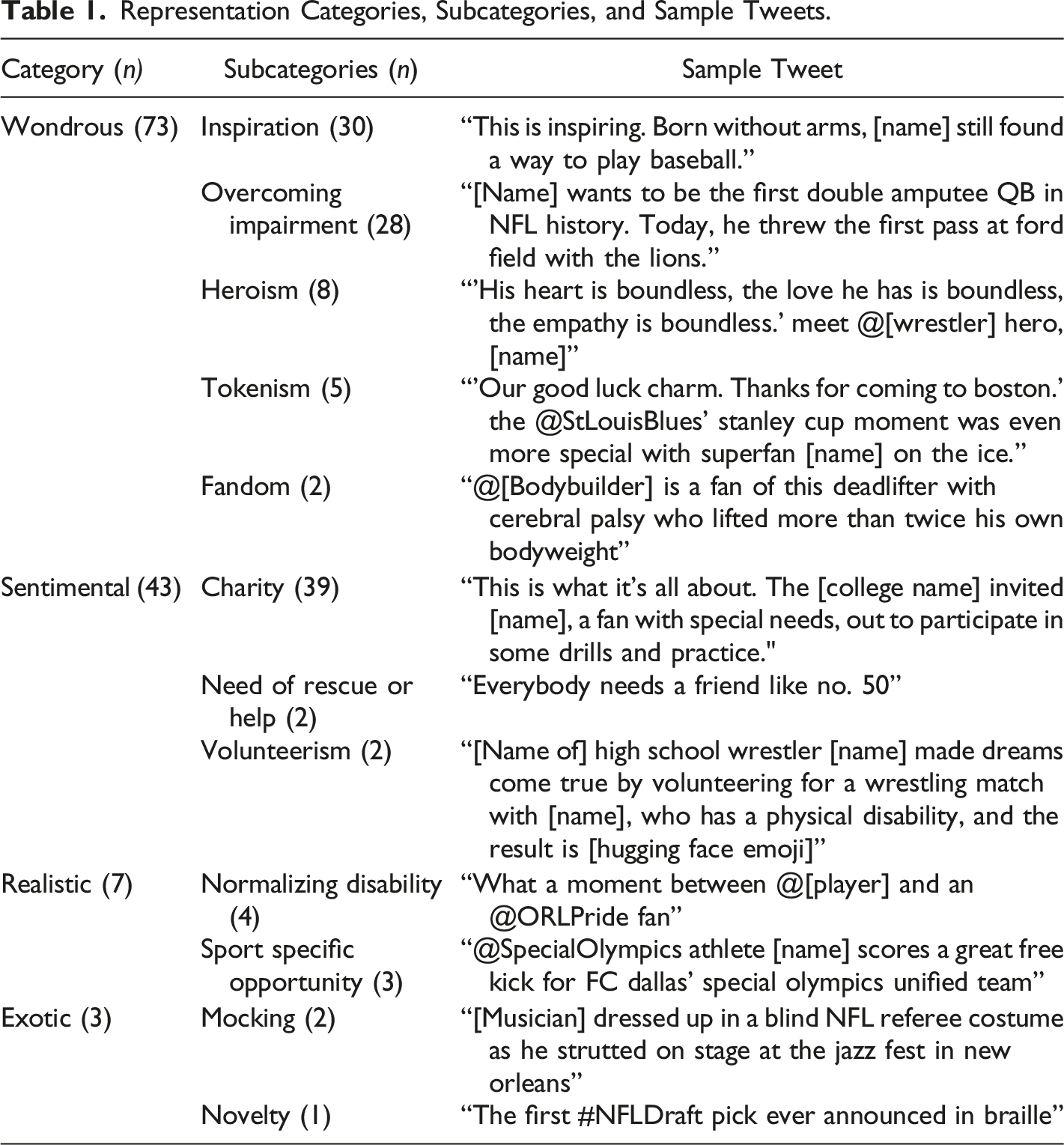
Wondrous
Wondrous representations of disability represent disabled individuals as having deficit that can be overcome through displays of physical prowess (Grue, 2016). Of the 126 tweets, 73 (58%) were categorized as wondrous. Of which, the majority of disabled individuals were represented in nonparticipant roles (n = 40). Five subcategories were developed from the tweets including: inspiration (n = 30), overcoming impairment (n = 28), heroism (n = 8), tokenism (n = 5), and fandom (n = 2).
Inspiration
All 30 of the tweets coded into this subcategory explicitly used some form of the word ‘inspire’, and many referred to individuals with visible physical impairments. One example of a tweet in this subcategory is: “[Name], a strength athlete with cerebral palsy, announces the 85th pick of the #NFLDraft for the Ravens… What an inspiration.” This tweet included a video of a person with cerebral palsy ambulating independently to an onstage podium alongside another individual, before announcing the National Football League (NFL) draft pick. Another tweet (see Table 1) included a video of a young person holding their baseball mitt under one arm while throwing a baseball with the other.
Other tweets in this subcategory referenced medical conditions that were less visible. A video of a man skating and pushing a hockey goal across an ice rink, for example, read: “Inspiring. [Name] makes his first return to the rink since getting injured [in a well-publicized motor vehicle accident].” Another included a link to an article on the SMC’s webpage discussing a young fan’s experience with a chronic illness: ‘The thing that she taught me was to just be a warrior.’ On their Stanley Cup run, the St. Louis Blues have found inspiration from an 11-year-old battling a life-threatening disease that only 15 other children in the world have.
Overcoming Impairment
Tweets in this subcategory described or showed disabled individuals performing athletic tasks, all highlighting and prioritizing the person’s disability prior to acknowledging the skill being demonstrated. A video from what appears to be a football practice, for example, was captioned: “[Name], a 13-year-old QB with prosthetics legs, doesn’t let anything stop him from playing the game he loves.” In the video, the young man completes a pass to a receiver down field. Later in the year, a video of the same young man throwing a pass in a simulated play during an NFL game was shared (see Table 1).
In another tweet referencing professional sporting events, a video of a young person with congenital amputations throwing a baseball read: “[Name], who was born without hands, threw out the first pitch at tonight’s Orioles game.” Congenital amputations were represented in other tweets as well. One such clip featured a young man with no arms and was accompanied by the text: “This is so powerful. He overcame his fear and landed the 20-inch box jump.”
While most of the tweets in this subcategory hinted at disability having had to be overcome for the event to take place, some were more explicit. For example, the tweet, “[Name] daughter doesn’t let anything stop her,” was posted along with a video of a young, female, wheelchair user shooting baskets. There are no other apparent obstacles shown in the video, indicating that her wheelchair must have been the obstacle.
Heroism
Similar to the subcategory inspiration described above, this subcategory was developed due to the explicit use of the word ‘hero’, or one of its forms, within the tweets. Further, the tweets all described a well-known athlete’s hero as being a disabled individual. “Purdue QB [name] reflects on the life of his hero, [name]” is one such tweet, which was shared alongside a photo of the athlete pushing the wheelchair of a gentleman wearing Purdue apparel. The gentleman mentioned here had recently passed away after a several year battle with cancer.
In some of the tweets, no information is shared about why the individual is worthy of the title ‘hero’ beyond their disability diagnosis. [Professional bodybuilder], for example, bestowed the title on a person with cerebral palsy, as described in the following tweet: “In February, [name]’s viral deadlift video caught the eye of @[Bodybuilder], who called the athlete with cerebral palsy his ‘hero.’ A month later, [name] got to flex in front of [Bodybuilder] at his event.” A similar tweet used both ‘hero’ and ‘inspiration’ to accompany a video of a young woman with Down syndrome playing a practice hole with a professional golfer: “‘You’re our hero.’ In January, [name] played a practice hole with [name], a golfer who has down [sic] syndrome. She was his inspiration as he closed out his U.S. Open victory on Sunday.”
Tokenism
Four of the five tweets in this subcategory all referenced the same individual, a child with a chronic illness who was coined a ‘superfan’ of a professional hockey team (the same child was featured in tweets representing other categories as well). The team appears to have invited her to many games and press events throughout their Stanley Cup season, with tweets documenting each event. Three such tweets accompanied a video of the fan crying while meeting players on the ice after their win, the first presented in Table 1. The same moment was captioned in other tweets reading “‘ALL THE FEELS’… @StLouisBlues superfan [name] witnessed her team make HISTORY!” and “11-year-old [name] kisses the Stanley Cup. [name], who has a rare disease called HLH, was invited by the Blues to #Game7.” Later, a tweet captioned: “Blues superfan [name] lifted the #StanleyCup during the parade in St. Louis,” accompanied a video of the young fan surrounded by players from the team. In the video, prior to the fan being handed the Cup, a reporter asked a nearby player what made her so special. The player’s response was “everything… she’s special. She is a special individual. Everything about her is awesome.” In another National Hockey League (NHL) themed post, a video of an NHL mascot entering the hospital room of a young fan read: “Pure joy. 7-year-old Flyers fan [name] got a new Gritty-themed prosthetic leg this morning, and @GrittyNHL came to check it out.”
Fandom
In both of the tweets representing this subcategory, an interest in and admiration for a disabled individual was expressed. In one tweet, presented in Table 1, a man represented in the heroism category above was featured again in a video showing him completing a deadlift. In a video highlighting a less well-known athlete, a Little League World Series player and his family are shown while commentators describe his brother’s recent diagnosis and treatment for kidney cancer: “Little Leaguer [name] looks up to his little brother [name], who was diagnosed with kidney cancer earlier this year but is still in Williamsport supporting his big brother.”
Sentimental
According to Garland-Thomson (2002), sentimental representations of disability are those that direct the consumer to look down upon the disabled figure with pity. Disabled individuals or athletes were represented in nonparticipant roles in 40 of the 43 tweets in this category. Three subthemes were developed from the tweets representing the sentimental category. These subthemes were: charity (n = 39), need of rescue or help (n = 2), and volunteerism (n = 2).
Charity
In the charity subcategory, many tweets showed individuals with Down syndrome being given a tangible item or experience. In one, a college football coach presented the equipment manager, a young man with Down syndrome, with tickets to the Superbowl while the team cheered. This video was accompanied by the text: “This video will make your day … Clemson head coach [name] surprises equipment manager [name] with tickets to the Super Bowl.” In another, “This is why we love sports. [Name], an Arkansas fan with Down syndrome, shared a moment with Razorback commit [name] after receiving a pair of his gloves,” described a clip of a man with Down syndrome crying while a college football player signs and hands him a pair of football gloves. Game worn apparel also appeared in a video of a professional basketball player giving sneakers to a fan with Down syndrome in the stands, captioned “[NBA Player] made this fan’s day by giving him his game-worn sneaks.” Although a tangible item was not given in a video of a young man with Down syndrome participating in a drill with a college football team, the spirit of having been given something special due to his disability carried through (see Table 1).
Other tweets in this subcategory also portrayed special experiences being given to disabled individuals, but with chronic medical conditions rather than intellectual disability. In one reading: “@[Player] flew a young fan, who is battling cancer, and his family from Spain to come see the Jazz play in MSG,” footage of a basketball player sitting between two children in the stands precedes a video of one of the children rebounding shots taken by the team in warmups. In a similar tweet, a blindfolded young woman is surprised on the court of a WNBA game with the caption: “@[Player] brought this fan to tears by making her Make-A-Wish dream come true.”
Need of Rescue or Help
Both of the tweets in this subcategory referenced the same event, a youth basketball game where a boy wearing number 50 continually stops the game to provide a boy with an orthopedic impairment chances to score. In the video, all other players on the court stop and stand still each time the disabled child attempts a basket. When he does make a basket, both teams cheer. One of these tweets read: “Go out there and be a No. 50 today.”
Volunteerism
In the two tweets representing the volunteerism subcategory, disabled youth were given the opportunity to ‘participate’ in high school athletic events. In the videos accompanying these tweets, it is clear that the disabled student was being set up for success while the crowd cheers. One such tweet showed a young man without a disability allowing himself to be pinned during a wrestling match with a young man with an unspecified physical disability. After the match, the disabled student was declared winner (see Table 1). In a similar video, a young man in a power chair dressed in a football uniform drove a football from the 50-yard line to the endzone while the defense stood still, and the offense ran around him cheering. This video was captioned: “‘The [name] Special’. [Name], a boy with Duchenne muscular dystrophy, got the chance to score his first touchdown.”
Realistic
Realistic representations of disability support an illusion of reality where the viewer is encouraged to align with the object of scrutiny. Two subthemes were developed from the tweets representing the realistic category. These subthemes were: bias-free representation (n = 4) and sport-specific opportunity (n = 3). In this category, all 7 tweets represented disabled individuals as participants. One important distinction is that while many of the tweets in this category also included a disabled child as a spectator, they were coded as participant due to the presence of elite-level disabled athletes.
Bias-Free Representation
The tweets within this category feature a disabled individual (or individuals) without focusing the reader’s attention to the visible disability of those photographed. While we cannot conclude that the representation was agenda-free, we must appreciate the lack of outright bias. Two of the tweets in this subcategory featured a professional soccer player with a congenital amputation sharing a moment with a toddler with a similar congenital amputation. The first tweet (see Table 1) occurred at a soccer match while the second, “Orlando Pride’s [Player] is reunited with her number one fan [name] at the FIFA Best Awards” was taken outside of an awards ceremony. Both pictures show the two in matching poses. Another tweet presented a professional football player who also shared a similar congenital amputation with a toddler, this time showing a video of the two posing for photos in front of a backdrop. The video was accompanied by the following text: “@[Player] and a young fan shared a priceless moment.” A link to a magazine issue showing athletes with diverse body types, some disabled and some nondisabled, also presented bias-free representation disability. This tweet read: “Every body has a story. #BodyIssue.”
Sport-Specific Opportunity
The tweets coded as sport-specific opportunity stated a fact about an adapted sporting event and provided accompanying media, similar to the way in which nondisabled sports were represented on the SMC’s social media. In the first (see Table 1), a video of a free kick during a unified soccer game was featured. In the second, a man skateboarding on his knees at the X-games accompanied text reading: “Incredible. Here’s the gold medal run from @[Skateboarder] in Adaptive Skateboard Park at #XGames Minneapolis 2019.” Finally, a montage of video clips from a Special Olympics basketball game read: “The first appearance by [country name] women at the @SpecialOlympics World Games marks history as their female basketball team gets the GOLD.”
Exotic
Exotic representations of disability further distance the viewer from disabled individuals, portraying disability as something alien or sensationalized that exists entirely separate of the viewer’s perceived reality (Garland-Thomson, 2002). The tweets representing the exotic category were found to be either mocking in nature (n = 2), or portraying disability as a novelty (n = 1). All three tweets featured disability in a nonparticipant role, however the two tweets subcategorized as mocking did not feature a disabled individual at all.
Mocking
In the mocking subcategory, nondisabled individuals dressed up as disabled individuals in an effort to amuse. In the first (see Table 1), a musician walked on stage with cheerleaders on either arm, dressed as an NFL referee with dark sunglasses and tapping a white cane in front of him. In the second, someone dressed as Forrest Gump, a notably disabled movie character, batted and then ran down the 1st baseline and off the field during a college baseball game. The tweet read: “Run, Forrest! Run!”
Novelty
Finally, one tweet was coded as being novel (see Table 1). Along with the text, a video of a young person with a visual impairment using Braille to read an NFL draft pick was shown.
Discussion
In this study, we explored the online representation of disability in sport by a United States-based SMC over a one-year period. Through this analysis, we learned that media representation behaviors that have previously been identified in traditional media sources for Paralympic and disability sport athletes (Beacom et al., 2016; Brittan, 2017; McGillivray et al., 2021; Silva & Howe, 2012) are likely continuing in contemporary social media outlets. Of the 6,080 original tweets posted by this SMC in 2019, just 126 (2.1%) included disabled athletes or individuals. While we still have a limited understanding of the scope of disability representation in sport via social media platforms, the numbers in this study are consistent with the Twitter coverage of disability sport by public service media companies across Europe (Ramon & Rojas-Torrijos, 2022; Rojas-Torrijos & Ramon, 2021). However, an important distinction is that both previous studies have examined disability sport, specifically, while this current study took a holistic and general approach to examine the representation of disability in and around sport, which included only three total instances of disability sport representation.
While these studies all share some similarities in their findings, it is difficult to provide direct comparisons between the frequency of coverage in print and television versus digital platforms or between studies examining digital frequencies as sport coverage is fluid and dependent upon what is happening in the sporting world at any given time (McCombs, 2005). That is, it is likely that disability sport coverage increases during Paralympic years, the most notable disability sporting event that draws a global audience and spectatorship (Kolotouchkina et al., 2021), while significantly decreasing in off-years. Because of this, it is important to develop strategies to further analyze and categorize social media representation in the future that allows for direct comparisons of various national and international SMCs. One potential solution may be to follow the design of Rojas-Torrijos and Ramon’s (2021) study that examined the ‘diversity agenda’ of multiple European SMCs over a similar timeframe.
The present study provides a simple, yet important, investigation of disability representation in and around sport that researchers can build from in the future given the likelihood that Twitter, and other social media platforms, will remain as constant fixtures for the foreseeable future for sports journalism (Hull & Lewis, 2014). Additionally, due to the dynamic and diverse opportunities afforded to SMCs via social media platforms (Litchfield & Kavanagh, 2018), we, as consumers and researchers of disability sport, should continue the discussion and push for equitable coverage and visibility through these social media platforms. Despite findings that SMCs are not restricted by airtime (Hull & Lewis, 2014) or sport-specificity demands in their coverage (Ramon & Rojas-Torrijos, 2022) using social media platforms, it is evident that companies continue to follow hegemonic, and dangerous, representation patterns. Perhaps increasing the visibility of these patterns will help spur change, but at the very least this should be the next great frontier for researchers with an interest in disability representation in sport.
As, or perhaps more, important as the lack of general disability representation, is the lack of representation of disabled athletes or sport participants. Of the 126 total tweets, just 43 tweets (34.1%) featured disabled athletes in participant roles. Representing disability from a majority spectator or nonathlete perspective sends a message to disabled and nondisabled viewers alike that sport and physical activity is not something that disabled people are able to or should participate in (Brittain, 2004). It is important to ensure visibility of disabled athletes to reduce stigma and remove stereotypes about disabled people (Kolotouchkina et al., 2021). Otherwise, resulting perceptions of incapability between disabled people and sport participation can have a number of deleterious impacts, including reinforcing notions that disabled persons are incapable of physical endeavors and communicating to parents of disabled youth that sport and physical activity is not something for them to consider or engage in (Shields et al., 2012). These deleterious impacts impose barriers and keep disabled people out of sport in a multi-pronged manner (Brittan, 2004).
In addition to ensuring that disabled persons are visible in sport media, we must also consider how they are depicted through the terminology and language that is used when describing them (Spencer et al., 2020). In this study, the majority of the posts were categorized as wondrous (n = 73; 58%), with many coded as either inspiration (n = 30) or overcoming impairments (n = 28). In these posts, disabled persons are positioned as an exception to human capability, and viewers are directed to look at the disabled person in awe for overcoming their impairment (Garland-Thomson, 2002; Grue, 2016). For us, these types of depictions tend to have clear motivations; to sensationalize disabled people to create ‘feel-good’ content, or inspiration porn, for nondisabled audiences for inspiration (Grue, 2016). According to Oliver and Barnes (2012), this type of depiction frames disabled individuals as “victims of some appalling tragedy or as superheroes struggling to overcome a tremendous burden” (p. 104). It is clearly problematic that the majority of posts related to or including disabled people fall into this category, as it supports assertions that media is interested in objectifying disabled people, devaluing their experiences, and mystifying their place in the world for their own gain (Grue, 2016; Martin, 2019). Unsurprisingly, posts and images that might be considered wondrous, inspirational, or focus on overcoming barriers have gained some negative attention from disability rights advocates and scholars. For example, Martin (2019) described, when discussing inspirational images in particular, that: Inspiration porn is viewed negatively by many people, especially individuals with disabilities, because it is seen as co-opting a disabled persons’ impairment and as objectifying because the person is equated to his or her disability. The purpose of the image is to inspire able-bodied individuals by giving them perspective by encouraging them to feel better by thinking ‘at least I am not as bad off as that person in a wheelchair’ (p. 199).
As such, despite potential counterarguments that depictions of disabled people in media must be a good thing in and of itself, media members must be mindful and considerate of how depictions of disabled people as forms of inspiration or as wondrous beings can contribute to furthering their marginalization within sporting contexts, and society in general.
While wondrous tweets were the most common category of posts, those coded as charity (n = 39; 31%), under the sentimental category, were the most frequent code. In these posts, disabled individuals were infantilized and positioned as being grateful recipients of much needed charity where the viewer was hailed as benevolent and kind (Garland-Thomson, 2002). These posts may be reflective of what and how people involved in social media posting believe about disability and disabled people, as views of disabled individuals as needing to be in receipt of charity is strongly aligned with medical model ideologies (Roush & Sharby, 2011). That is, in instances where medical professionals cannot eliminate, or significantly ameliorate, impairment, disabled people are viewed as pitiful and in need of charity by those ascribing to the medical model (Roush & Sharby, 2011). Interestingly, people with Down syndrome were commonly represented in this category, which may show one specific group that people involved in social media posting view as needing charity or helpless. This type of messaging, unsurprisingly, is counter to contemporary ‘nothing about us, without us’ ideologies (Charlton, 2000), and has been condemned by those in the disability studies community, who identify it as patronizing and demeaning, and suggest that stereotyping disabled people as helpless and dependent further perpetuates opportunities for marginalization and exclusion (Goodley, 2016). However, it remains common in social media posts, and is highly related to disability-related fundraising, despite the cost to dignity and stigma to disabled people (Roush & Sharby, 2011). Those engaged in creating and posting social media content with and about disability and disabled people should continue to be encouraged to do so but must also be cognizant of the messages they are sending, as well as the unintended harm that their language and terminology may be creating. Further, social media managers and editors must consider the implications of ideologies such as ‘nothing about us, without us’ and how engaging with the members of the disability community could enhance their reporting.
Like all research, several limitations should be taken into consideration when consuming and interpreting our findings. For example, the coders failed to adhere to the social model of disability at times during reduction and open coding (e.g., searching for tweets based on medical diagnoses or physical characteristics, conflating disability and impairment). Greater emphasis and adherence to trustworthiness could have been promoted through a critical friend who identifies as a disabled athlete. In addition, Garland-Thomson’s (2002) categories of disability representation may have unnecessarily moved the conversation away from the preexisting stereotypes and narratives of media representation that have been predominantly used in examining sports media representation (Cherney et al., 2015; Rees et al., 2019). Given that the majority of the open coding led to subcategories that fit preexisting stereotypes (e.g., inspiration, medico-tragedy, supercrip), it may be more beneficial to use these stereotypes and conceptualizations as initial categories in the future as they more closely relate to those found in traditional sports media. Furthermore, it is important to note that our analysis includes all mentions of disability or disabled people, and therefore the 2.1% rate could not be compared directly to prior work exploring the depiction of disabled athletes, specifically, in sport media (e.g., Rees et al., 2019). Finally, readers should be mindful that only a one-year cross section of posts were considered for this analysis, and these posts are now about three years old. As such, they should not be considered a representation of current practices in social media and could not be reflective of recent social movements (e.g., #MeToo, Black Lives Matter). However, we elected to use 2019 for this study as it was the final full year of sport, and sport coverage, prior to the global COVID-19 pandemic.
Conclusion
This study, like those before it that have examined traditional forms of media representation (Rees et al., 2019), highlighted inequitable representation of disabled athletes and individuals by a major United States-based SMC. In particular, this study provided significant insight into the various ways disabled individuals and athletes were represented, in part by revealing that only 43 of the 126 tweets (34.1%) represented disabled individuals as sport participants while approximately two-thirds of representation relegated disabled individuals to spectator or other nonathlete roles, thus reinforcing stigma and bias against disabled individuals as incapable of becoming sporting individuals (Brittain, 2004). Wondrous representations that draw on supercrip and inspiration porn narratives were the most predominant forms of representation, which is consistent with previous research findings (Rees et al., 2019), however tweets coded in the subcategory ‘charity’ were most prevalent and may perpetuate patronizing and demeaning understandings of disability that promote exclusion and marginalization (Goodley, 2016).
While Garland-Thomson´s (2002) conceptualization allowed the researchers to interpret and discuss all of the posts in a clear and concise manner, the open-coding process resulted in the development of subcategories that closely align with preexisting categories. Using these preexisting categories may therefore be beneficial in the future regardless of the type of disabled individuals represented (e.g., athlete or nonathlete, participant or spectator). Due to the increased use of social media platforms for sports media (Hull & Lewis, 2014) and plentiful, flexible opportunities offered by these platforms (Litchfield & Kavanagh, 2018), research must continue to explore disability representation in this new landscape. Possible emphases in future research may include: 1) comparisons between different SMCs over a specified time period 2) trends of one SMC over time, 3) coverage around specific events (i.e., Paralympic Games) and 4) the impact of representation on sport performance. Further, while it was outside the scope of the current study, the authors suggest that it may be valuable to investigate potential links between the quantity and quality of social media posts relating to disability within a specific SMC. Are the overwhelming number of ‘wonderous’ or ‘sentimental’ posts, for example, an overcorrection of the overall lack of representation?
Footnotes
Declaration of Conflicting Interests
The author(s) declared no potential conflicts of interest with respect to the research, authorship, and/or publication of this article.
Funding
The author(s) received no financial support for the research, authorship, and/or publication of this article.
