



Abstract
Background:
Knee extension exercise is useful and practical for obese and overweight people as this form of exercise is effective in minimizing body weight loading on joints and improving the body’s physiological function. This study aimed to compare the physiological and psychophysical parameters of office workers while computer-based working in an active workstation equipped with an active footrest (AFR) prototype with a mechanism for performing knee extension exercises in a sitting position, and also to compare the physiological and psychophysical parameters among normal-weight and obese office workers.
Methods:
In this quasi-experimental study, the physiological parameters of heart rate (HR) and energy expenditure (EE) (measured with the Fitbit Charge HR smartwatch) were measured in two cross-over random sessions for 32 office workers (16 normal-weight and 16 obese) aged 28 to 50 years (M = 42.72, standard deviation [SD] = 4.37) while performing office tasks in sitting and active workstations (equipped with AFR). Perceived physical exertion, comfort, fatigue, and liking were also measured by rating the participants.
Findings:
Short-term activity of the participants with AFR performing computer tasks significantly improved physiological and psychophysical parameters compared with the participants in sitting workstations. However, there was no significant difference in the effect of AFR on physiological and psychophysical parameters between normal-weight and obese participants.
Conclusions/Application to Practice:
Given the significant increase in EE and HR resulting from exercise with AFR compared with the conventional workstation, the use of AFR can help office workers achieve the minimum standard of physical activity at their workplace.
Keywords
Background
Before the modern era, humans were rarely exposed to long periods of sitting with minimal movement and reduced energy expenditure (EE) (Kett & Sichting, 2020). However, with technological advancements in recent decades, manual jobs have been replaced by highly sedentary tasks such as office work (characterized by computerization) (Dupont et al., 2019). Currently, the main source of sedentary behavior in adults is their job (Ruiter et al., 2022). Thus, many office environments are the cause of obesity among employees and obesity-related diseases (Eggleston et al., 2019; Zhu et al., 2020). Numerous studies have shown that office workers spend an average of 6 to 10 hours in a sitting position (Kett & Sichting, 2020). While long periods of sitting are considered to be the main cause of obesity and the risk factor for cardiovascular diseases, musculoskeletal disorders, metabolic disorders such as diabetes, and premature death (Cho et al., 2014; Eggleston et al., 2019; Peterman et al., 2012; Wilmot et al., 2012; Zhu et al., 2020). Moreover, the National Health and Nutrition Examination Survey (NHANES) showed that people working in sedentary work environments are 37% more prone to abdominal obesity compared with jobs requiring physical activity (Steeves et al., 2012). Although overeating helps to increase fat storage, the current obesity epidemic is due in part to increased energy intake and decreased physical activity (Balasubramanian et al., 2021; Kim & Choo, 2023).
In recent years, to deal with the health burden of sedentary behavior of office workers, researchers have turned their attention to workplace interventions such as active workstations (sit-to-stand, treadmill, and cycling desks) that enable office workers to do physical activity during work (Zhu et al., 2020). Because evidence shows that regularly interrupting long periods of inactivity (getting up, moving, doing light activities) is beneficial for physical, mental, and cognitive health and reduces the negative health consequences of inactivity (Pilcher & Baker, 2016; Renaud et al., 2020; Sliter & Yuan, 2015). In addition to enabling changing posture and improving muscle activity (from motionless position to muscle contraction), active workstations have other benefits such as increasing EE and regulating high blood pressure compared with conventional workstations (Zhu et al., 2020).
Despite the above advantages, overweight and obese people and pregnant women have limitations and difficulties in using common workstations and sit-to-stand, treadmills, and cycling desks (Barbieri et al., 2017; Elmer & Martin, 2014). While obese people severely suffer from sedentary behavior and work 120 minutes more than normal-weight staff daily in a sitting position (John et al., 2011). Thus, to make it possible for obese people to take the benefits of exercise during office work, an active footrest (AFR) prototype with a knee extension exercise (KEE) mechanism was developed and built to be used by all people, including obese people (Mohammadian et al., 2021). Knee extension exercise is useful and practical for obese and overweight people (Bisconti et al., 2019) as this exercise transfers the minimum load to the person, and also the person’s weight load on the joints is minimized (Botta et al., 2020). Furthermore, KEE helps to improve muscle structure, improve oxygen transport through convection and environmental diffusion, and subsequently, enhance oxygen intake (Esposito et al., 2011). Thus, this exercise has already been used to train patients with chronic heart failure or aerobic performance disorders (Esposito et al., 2018). Thus, this study aimed to compare the physiological and psychophysical parameters of office workers while working with computers in an active workstation equipped with the AFR prototype with a mechanism for performing KEEs in a sitting position, and also to compare the physiological and psychophysical parameters among normal-weight and obese office workers.
Methods
Participants
Thirty-two (16 normal-weight and 16 obese) volunteered to participate in the quasi-experimental interventional study. The participants were selected from office workers at the Kerman University of Medical Sciences through convenience sampling. To record the participants’ demographic characteristics and check whether they met the inclusion criteria, applicants completed a questionnaire. To be included, participants must have been between ages 20 to 50 years, had a body mass index (BMI) of 18.5 to 25 for normal-weight people or BMI above 30 for obese people, had at least 1 year of experience as a full-time employee (at least 35 hours per week), held job in which at least 75% of their working time was in a sitting posture (e.g., sedentary behavior related to desk or computer work), and had quality sleep (ensuring 7 hours of self-reported continuous sleep 24 hours before the study).
Suffering from metabolic diseases, diabetes, high blood pressure, respiratory or nervous disorders, smoking, routine use of aspirin, catecholamines, sedatives, painkillers, or beta-blockers (due to their known effect on EE), consumption of caffeinated substances, alcoholic beverages, or drugs 24 hours before the study, suffering from musculoskeletal disorders, having an injury or a history of injury (especially in the lower limb), cardiovascular diseases, high blood pressure (higher than 159 mmHg for systolic or 99 mmHg for diastolic blood pressure) (Schuna et al., 2019), pregnancy and breastfeeding were the exclusion criteria. In addition, the Physical Activity Readiness Questionnaire (PAR-Q) was used to ensure that the participants did not have health problems during exercise.
Once screened for study participation, individuals were matched based on age and height factors. For this purpose, each normal-weight person was matched with the closest obese participant by age and height. To this end, people were asked about their age and height before attending the laboratory (online and in person), and then, if they were eligible, they were invited to participate in the study. Before performing the test, the objectives of the study and the procedure taken to conduct the study were explained to the participants, and written informed consent was obtained. This study was reviewed and approved by the ethics committee for research on human experimentation of Shiraz University of Medical Sciences (SUMS) under the code IR.SUMS.REC.1400.285.
Procedure
The participants were asked to refrain from eating energy-generating food and doing any physical activity (including exercise) for 12 hours before the test. The data were collected daily from 9:00 am to 1:00 pm, in the laboratory. At the beginning of the experiment, the participants’ demographic data were recorded in a form, and the participant’s height and weight were measured with an electronic scale. When performing the mouse pointing task, typing and reading were trained adequately to the participants to limit the learning effect on the results (Cho et al., 2014). Besides, before starting the test session at the active workstation, the participants were trained on how to work with the AFR. The participants then spent 15 to 20 minutes getting familiar with AFR (Alderman et al., 2014). Afterward, each participant wore the smartwatch on their left hand and lay in a supine position with their eyes closed (without falling asleep) on the massage bed for 5.5 minutes to record physiological data at rest. After reading and recording the physiological data in the data collection form, the participants then adopted a good posture (by adjusting the height of the chair, monitor, or AFR) at the simulated workstation and performing computer-based tasks (mouse pointing, typing, and reading tasks) in random order in one of the paths (A or B) displayed in Supplemental Figure 1 for 10 minutes. To acclimate the participants to the conventional sitting and active workstation conditions, they started and completed the computer tasks after 2 minutes. If a participant finished the test before 10 minutes, she or he should continue her or his activity until the end of the test (10 minutes). Then, in the next session (on the second day), after meeting the requirements for the test, the participants completed the same computer-based tasks at the opposite workstation for 10 minutes. By completing the test in each of the active and sitting workstations, after 2 minutes of rest (to reduce the possibility of fatigue effect on judgment Cho et al., 2017), the perceived physical exertion, comfort, fatigue, and liking in each workstation were reported.
Study Design
Physiological parameters (HR and EE) were measured while participants performed three tasks of mouse pointing, typing, and reading in two sitting and active workstations (with AFR) in two cross-over random sessions (to control the confounding effect of learning and fatigue) (Supplemental Figure 1). To measure the physiological parameters at rest, the participants laid on a massage bed for 5.5 minutes in a supine position with their eyes closed (without falling asleep) and the highest and lowest mean values were recorded as resting energy expenditure (REE) and resting heart rate (RHR) (Yoon et al., 2019). Previous studies have recommended 5 minutes to be sufficient to achieve accurate metabolic values during rest and light exercise (Beers et al., 2008; Horswill et al., 2017). In this study, to ensure the accuracy of the physiological data, the participants performed computer tasks for 10 minutes at each of the sitting and active workstations (Supplemental Figure 2). The exercise speed of the participants using the AFR was also controlled at a constant rate to make comparisons possible. The participants performed a light KEE (with reciprocating movement of the legs) with a cadence of 60 ± 5 rpm (Ainsworth et al., 2011; Koren et al., 2016; Lafortuna et al., 2008) for each leg and low resistance (1 kg of force) (Yoon et al., 2019) using the AFR.
The AFR
The AFR was designed and fabricated in a previous study (Mohammadian et al., 2021) (Supplemental Figure 2). Active footrest facilitates light KEEs. This device has an electro-optical power meter (with optoelectronic sensors) to display cadence (in rpm) and the time duration of operation (in seconds).
Instruments
Heart rate and EE were measured as physiological responses during the participants’ activity at the conventional and active sitting workstations using the Fitbit Charge HR smartwatch (Fitbit, USA). This device calculates EE in kilocalories per minute (kcal/min) following specific logarithms based on the current HR and individual factors (age, weight, and height) (Schellewald et al., 2018). Heart rate assessment is performed every 3 seconds with optical HR sensors. The validity and reliability of this smartwatch for measuring HR and EE have been confirmed (Düking et al., 2020; Schellewald et al., 2018). The participants’ perceived physical activity level was measured by administering Borg’s Ratings of Perceived Exertion (RPE) Scale, as a psychophysical tool. Using this tool, the participants rated their physical exertion when working in each of the workstations on a 15-point scale from 6 (no exertion) to 20 (maximum exertion). The validity and reliability of this scale have been confirmed in several studies (Cabral et al., 2020; Daneshmandi et al., 2012; Muyor, 2013; Woods & Buckle, 2006). In addition, three 100-mm visual analog scales (VAS) were used to measure the self-reported comfort, fatigue, and liking of the participants in the two sitting and active workstations (Beers et al., 2008). The two ends of these scales represent “1 = not comfortable at all” to “100 = very comfortable,” “1 = very fatigued” to “100 = not fatigued at all,” and “1 = do not like at all” to “100 = like very much.”
Computer-Based Tasks
The participants performed three computer-based tasks including mouse pointing, typing, and reading. To perform the mouse pointing task, a two-dimensional tapping test was used. This test has nine sequences, each with two independent variables of amplitude (which refers to the distance between the circles in pixels) and width (which refers to the width of the circles in pixels). The combination of three amplitudes (100, 200, and 400 pixels) and three widths (20, 40, and 80 pixels) generates nine sequences of varying task difficulty. In the two-dimensional test, 15 circles (15 exerts in each sequence) are displayed in a circle layout on the screen, one of which is blue, and by clicking on it, the blue color is randomly transferred to other circles. In this test, the participants were asked to complete the sequence by tracing the blue color and clicking on the index circle (blue color).
In the typing test, the participants typed a text (which was not repeated for each person in two test sessions) using the keyboard. To reduce the learning bias caused by the repetition of the text, two texts were prepared. The texts were given to the participant in random order in each session. The texts were selected from statements commonly used in daily official letters (purchase requisition and loan application). Each text contained one paragraph with 39 words and 180 characters. To do the typing text, the participants viewed the text placed on the top half of the computer screen and typed it in a Word document located on the bottom half of the screen (Commissaris et al., 2014; Straker, 2019).
In the reading task, two nontechnical moderately difficult scripts were selected from common Persian texts. These scripts contained two paragraphs with 180 words and were randomly displayed on the monitor screen in a 14-font size in pdf format in each test session, and the participants were asked to read them in a clear voice.
Statistical Analysis
Quantitative variables were described by mean and standard deviation (SD). Then, the normality of the quantitative variables was investigated using the Shapiro–Wilk test. Accordingly, the paired sample t-test was used to analyze the differences between the variables within the group in the conventional and active workstations. The analysis of covariance (ANCOVA) was used to compare variables in simultaneously the between-subjects factor (normal and obese people) and the within-subjects factor (sitting and active workstations), as well as their interaction. In ANCOVA, the dependent variables were the EE, HR, RPE, comfort, and fatigue in active workstations. Also, these variables in conventional workstation and exercise were as covariates in ANCOVA. The independent variable was BMI (normal-weight and obese people). Data analysis was performed using SPSS 22 software at a significance level of 0.05.
Results
The participants in this study were 32 office workers (16 normal-weight and 16 obese) aged 28 to 50 years (M = 42.72, SD = 4.37). Table 1 shows the participants’ demographic characteristics. As indicated, there was no significant difference between normal-weight and obese participants in terms of height and age, and the two groups were well-matched.
Demographic Characteristics of Office Workers Studied (n = 32)
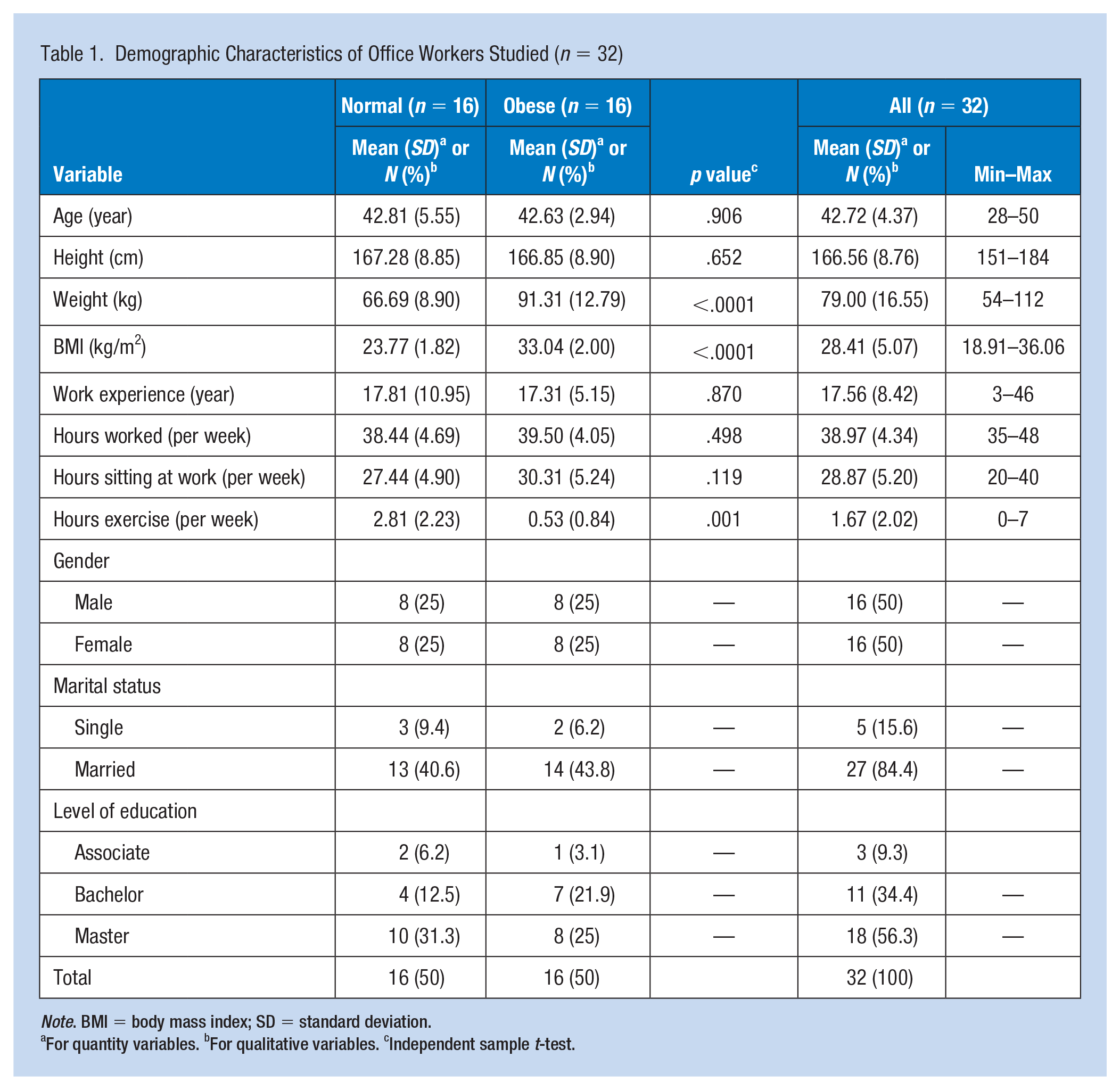
Note. BMI = body mass index; SD = standard deviation.
For quantity variables. bFor qualitative variables. cIndependent sample t-test.
The results of the paired samples t-test for the physiological performance of the participants in two (sitting and active) workstations indicated that the EE and HR of the participants while doing tasks in the active workstation were significantly higher than the sitting workstations (Table 2). Based on the data in Table 2, the participants reported significantly higher RPE, comfort, fatigue, and liking in active workstations than in sedentary workstations. Supplemental Figures 4 and 5 show a comparison of the average HR and EE of the normal-weight and obese participants while performing computer-based tasks in two sitting and active workstations.
A Comparison of Energy Expenditure, Heart Rate, and Psychophysical Scales (Perceived Physical Exertion, Comfort, Fatigue, and Liking) in the Participants in the Two Sitting and Active Workstations (n = 32)
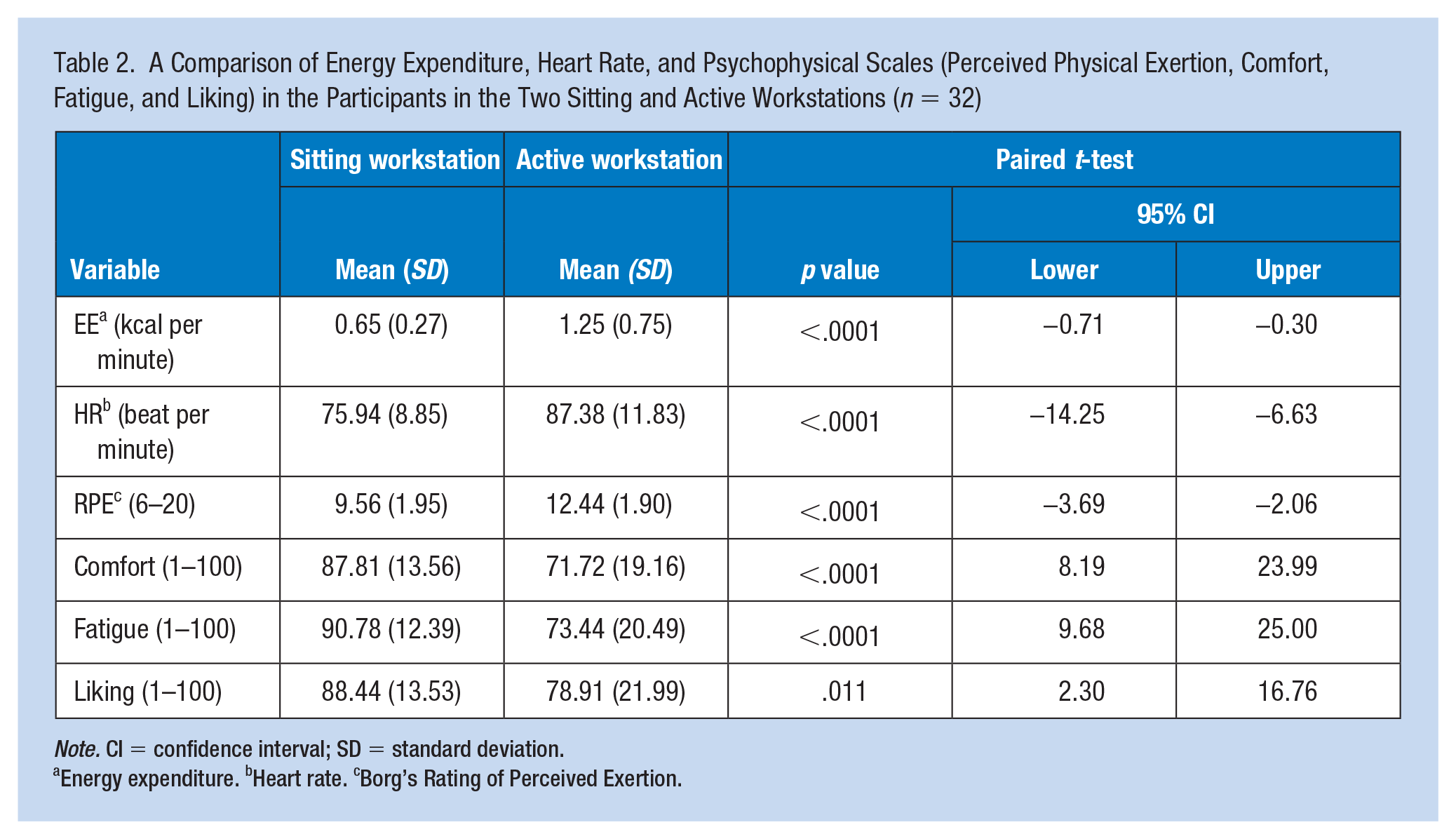
Note. CI = confidence interval; SD = standard deviation.
Energy expenditure. bHeart rate. cBorg’s Rating of Perceived Exertion.
The ANCOVA indicated no significant difference in EE, HR, RPE, comfort, fatigue, and liking variables between the normal-weight and obese participants in active workstations while adjusted by sitting workstation scores and exercise (Table 3).
A Comparison of Energy Expenditure, Heart Rate, and Psychophysical Scales (Perceived Physical Exertion, Comfort, Fatigue, and Liking) for the Normal-Weight and Obese Participants in the Active and Sitting Workstations (n = 32)
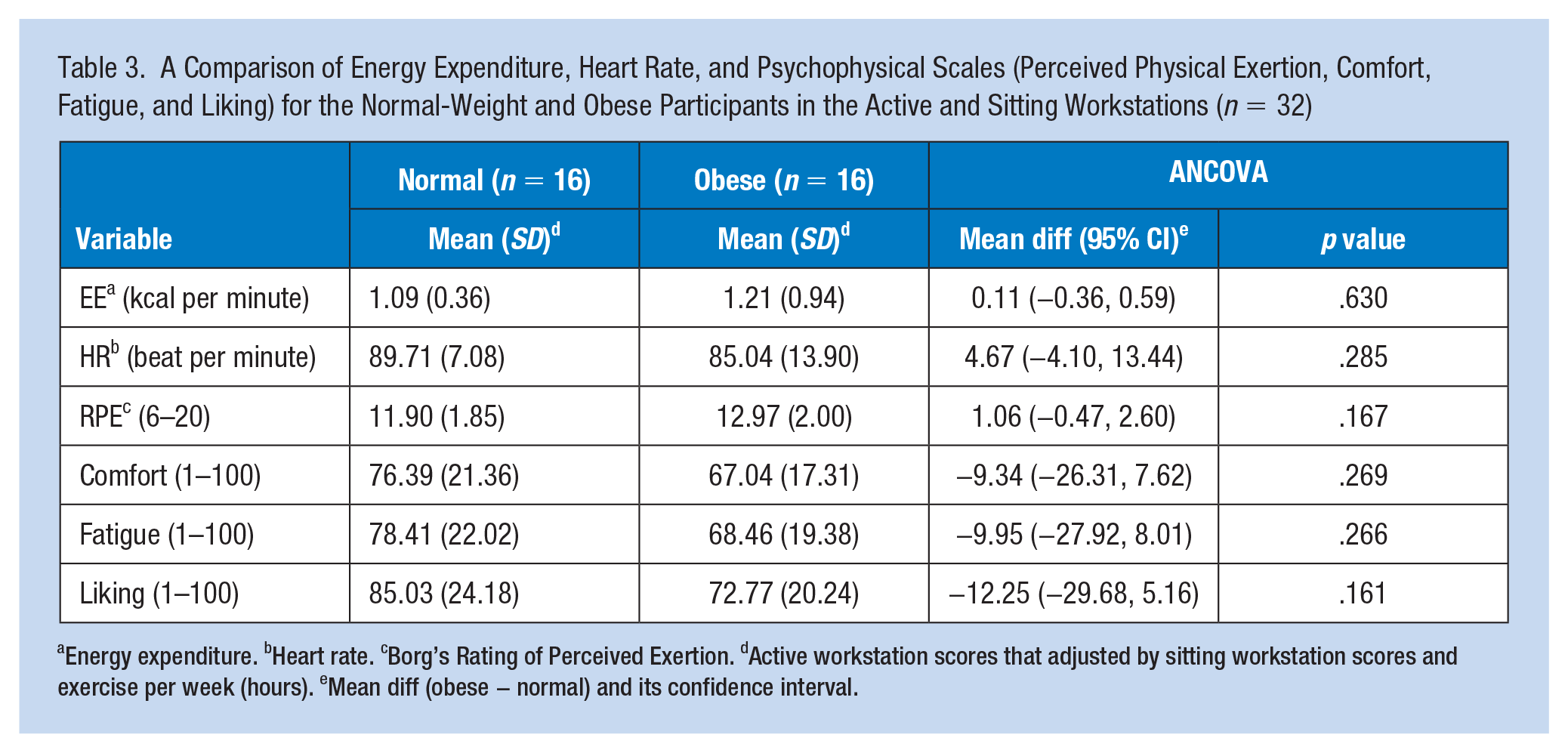
Energy expenditure. bHeart rate. cBorg’s Rating of Perceived Exertion. dActive workstation scores that adjusted by sitting workstation scores and exercise per week (hours). eMean diff (obese − normal) and its confidence interval.
Discussion
Following other studies in the literature (Benden et al., 2014; Carr et al., 2014; McCartney, 2016; Schuna et al., 2019; Thorp et al., 2014; Tyton et al., 2018), the data in this study indicated short-term activity of the office workers using AFR while performing computer-based tasks (mouse pointing, reading, and typing) caused a significant increase in physiological parameters (EE and HR) and psychophysical scales (perceived physical exertion, comfort, fatigue, and liking) regardless of BMI compared with the conventional sitting workstation. However, there was no significant difference between the two groups of normal-weight and obese participants in terms of the physiological and psychophysical performance in the active and sitting workstations.
Energy expenditure is one of the important advantages of active workstations. Previous studies addressing light exercise performed by the participants with a treadmill (2.60 ± 0.20 kcal/min) (Schuna et al., 2019), cycling (2.04 ± 0.12 kcal/min) (Schuna et al., 2019), and elliptical (1.7 ± 0.40 kcal/min) (Carr et al., 2014) workstations reported more EE than this study. In contrast, participants’ EE while working in the stand (0.90–1.20 kcal/min) (Benden et al., 2014; McCartney, 2016; Thorp et al., 2014), therapy ball (1.20 kcal/min) (McCartney, 2016), and (1.24 kcal/min) (Tyton et al., 2018) workstations were reported lower than the AFR. One of the goals of designing AFR was to reduce excess exercise movements to improve cognitive function and facilitate the use of it by obese people (Mohammadian et al., 2021). Consequently, the cost of achieving this goal was to reduce the EE in this device compared with treadmills and cycling active workstations. Nevertheless, according to World Health Organization, adults should have at least 150 minutes of moderate activity (3–6 metabolic equivalents-METs) per week to achieve health benefits (Koren et al., 2016; Schellewald et al., 2018). As in previous studies, the risk of type 2 diabetes was reduced when physical activity increased to four METs per week (Cox et al., 2011). Thus, given the significant increase in EE and HR due to exercise with AFR compared with resting and sitting positions (Supplemental Figures 4 and 5), it seems that the use of AFR can significantly help office workers achieve the minimum standard of physical activity at their workplace.
The average HR of this study was higher than the participants’ HR while working on a desk bike (76.60 ± 4.20 beats per minute: bpm) (Schellewald et al., 2018), active life trainer (76.30 ± 9.30 bpm) (Schellewald et al., 2018), desk pedal (75.70 ± 4.90 bpm) (Schuna et al., 2019), standing (84 ± 11 bpm), and HORV (77 ± 10 bpm) workstations in previous studies (Tyton et al., 2018). In contrast, the participants’ HR in the studies of the treadmill (88 bpm) (Cox et al., 2011) and elliptical (89 ± 11 bpm) workstations (Carr et al., 2014) was reported to be higher than the HR measured in this study. The change of HR during exercise by AFR compared with the resting position in normal-weight and obese people was 15 and 16 bpm, respectively, while doing light exercise that changes the RHR by approximately 14 bpm is enough for unfit individuals (Belardinelli et al., 1995).
The office workers in this study doing exercise with AFR perceived more physical exertion compared with the standing (7.6) and cycling (11.2) workstations (Tronarp et al., 2018). Moreover, the level of comfort and liking of the office workers in the active workstation were significantly lower than in the conventional sitting workstation. The participants’ fatigue while using AFR was significantly higher than the sitting workstation. Beers et al. reported the same results in studying therapy balls and standing workstations (Beers et al., 2008). Since these scales are considered psychophysical tools (Borg, 1990), the psychological effects caused by the COVID-19 pandemic (Prati & Mancini, 2021) and the long-term nonuse of AFR while performing office tasks may have affected the participants’ reports.
The short-term training (15–20 minutes) for the participants to get familiar with AFR was considered one of the limitations of this study, which probably had a confounding effect on the results of the study, especially the psychophysical outputs. Besides, as this study was conducted during the COVID-19 pandemic, the participants had to use surgical masks to comply with the health protocol. This requirement can also be considered a confounding factor. Another limitation was related to the investigation of performance in short task duration. Conducting longer-term studies in a real office environment, taking into account all the limitations, adds to the validity of the results.
Implications for Occupational Health Practice
This study examined the influence of KEE and BMI on physiological and psychophysical performance. The results indicate short-term activity of office workers using AFR while performing computer-based tasks (mouse pointing, reading, and typing) caused a significant increase in physiological parameters (EE and HR) and psychophysical scales (perceived physical exertion, comfort, fatigue, and liking) regardless of BMI compared with the conventional sitting workstation. Occupational health nurses play a vital role in managing office workers’ well-being and performance in university settings. These findings can be used to plan exercise interventions for office workers by AFR to reduce sitting time in office workers working at universities.
Applying Research to Occupational Health Practice
Knee extension exercise is useful and practical for obese and overweight people. This study examined the impact of an active footrest (AFR) prototype (with a mechanism for performing knee extension exercises) and body mass index on physiological and psychophysical performance. The results indicate that short-term activity of the participants with AFR while performing computer tasks significantly improved physiological parameters of energy expenditure, heart rate, and psychophysical scales of perceived physical exertion, comfort, fatigue, and liking compared with the conventional sitting workstations. However, there was no significant difference in the effect of AFR on physiological and psychophysical parameters between normal-weight and obese participants. Findings can help implement AFRs as a potential tool for motivating physical activity in workplaces to prevent sedentary behavior and its effects like obesity.
Supplemental Material
sj-docx-1-whs-10.1177_21650799231188133 – Supplemental material for Knee Extension Exercise Effects on Physiological and Psychophysical Performance: Normal Weight Versus Obese Office Workers
Supplemental material, sj-docx-1-whs-10.1177_21650799231188133 for Knee Extension Exercise Effects on Physiological and Psychophysical Performance: Normal Weight Versus Obese Office Workers by Mostafa Mohammadian, Alireza Choobineh, Mohsen Razeghi, Hadi Daneshmandi, Haleh Ghaem, Reza Kazemi, Yunes Jahani and Naser Hashemi Nejad in Workplace Health & Safety
Footnotes
Acknowledgements
This article was extracted from a thesis written by Mr Mostafa Mohammadian, a PhD student of Ergonomics at Shiraz University of Medical Sciences (SUMS), and the ethics code (IR.SUMS.REC.1400.285) was obtained from the Ethics Committee for Research of SUMS.
Author Contributions
All authors read and approved the final manuscript. M.M., A.C., and M.R. contributed to the Conceptualization and Project administration. H.G., Y.J., and M.M. contributed to Statistical analysis. M.M., H.D., and R.K. contributed in Writing—original draft. M.M., M.R., A.C., and N.H.N. contributed to the Methodology and Writing—review & editing.
Conflict of Interest
The author(s) declared no potential conflicts of interest with respect to the research, authorship, and/or publication of this article.
Funding
The author(s) disclosed receipt of the following financial support for the research, authorship, and/or publication of this article: This work was supported by the SUMS (grant no. 20943).

Supplemental Material
Supplemental material for this article is available online.
References
Supplementary Material
Please find the following supplemental material available below.
For Open Access articles published under a Creative Commons License, all supplemental material carries the same license as the article it is associated with.
For non-Open Access articles published, all supplemental material carries a non-exclusive license, and permission requests for re-use of supplemental material or any part of supplemental material shall be sent directly to the copyright owner as specified in the copyright notice associated with the article.
