




Abstract
Background:
Approximately 50% of women in all workplaces experience sexual harassment. Women who work in male-dominated occupations may be more susceptible to sexual harassment than those who work in non-male-dominated occupations. Research on factors contributing to workplace sexual harassment in male-dominated occupations is limited. This paper reviews the known antecedents that put female workers at risk of sexual harassment in select male-dominated occupations and to identify gaps in the literature and opportunities for future occupational health nursing research.
Methods:
A search was conducted using PubMed, CINAHL, PsycINFO, and Web of Science. Included articles addressed sexual harassment of female workers in male-dominated occupations such as law enforcement, firefighting, truck driving, and construction.
Results:
The search yielded 25 relevant research articles. Antecedents to sexual harassment in the workplace included lower rank, shorter tenure, physicality of the job, job insecurity, negative relationships with peers and/or supervisors, treating women as outsiders, exaggerated gender differences, unequal gender ratios, and promotions based on gender. Common antecedents to sexual harassment in the workplace identified in the literature include organizational culture and gender composition.
Conclusion/Application to Practice:
Workplace sexual harassment of women is a problem in male-dominated occupations. Research is needed to better understand the organizational antecedents of sexual harassment in male-dominated occupations within community settings to prevent workplace sexual harassment.
Background
Workplace sexual harassment affects 25% to 80% of all working women (Feldblum & Lipnic, 2016) and is one of the most common forms of workplace sexual violence (Fitzgerald, 1993). Workplace sexual harassment has received much attention since the 1980s, with an increased research focus in the past decade (De Haas & Timmerman, 2010; Jagsi et al., 2016; Jenner et al., 2019; Lampman et al., 2016). However, research in male-dominated occupations is limited.
Sexual harassment has its origins in power and control (Lopez et al., 2009; Lunenburg, 2010). It is generally used as a means of social exclusion in male-dominated occupations (Lopez et al., 2009; Lunenburg, 2010; McDonald, 2012) where women are often described as weak or fragile, inferior, outsiders, and unqualified (Gruber & Bjorn, 1982; Hulett et al., 2008; Lillydahl, 1986; Morral et al., 2014) and men are often described as having masculine qualities, such as power, toughness, and aggressiveness (Vogt et al., 2007). Historically, the use or misuse of power between co-workers (informal power) and between management and subordinates (formal power) can be a precursor to workplace sexual harassment (Benson & Thomson, 1982; Cleveland & Kerst, 1993; McKinney, 1994; Rospenda et al., 1998).
Not until 1964 was there an accepted definition of workplace sexual harassment established by Title VII of the Civil Rights Acts and its identification as a crime (Cates & Machin, 2012; United States Equal Employment Opportunity Commission [US EEOC], n.d.). Workplace sexual harassment is described as any unwanted behavior of sexual nature that unreasonably interferes with the job duties of an individual (e.g., work performance) or creates an environment that is uncomfortable or hostile. This could be physical advances, requests for sex favors, inappropriate sexist or sexual remarks, or other unwanted conduct (US EEOC, n.d.).
Women in male-dominated occupations experience a range of sexual harassment, from bullying and discrimination to threats and sexual assault (rape) perpetrated most often by co-workers and supervisors (Jahnke et al., 2019; Prokos & Padavic, 2002; Seklecki & Paynich, 2007; Yoder & Aniakudo, 1995, 1996) The most prevalent types of sexual harassment in male-dominated occupations are gender harassment and unwanted sexual attention (Anderson et al., 2005; Griffith et al., 2016; Martin, 1978; Reed & Cronin, 2003) while sexual coercion and attempted or actual rape are the least prevalent types reported (Lonsway et al., 2013; Somvadee & Morash, 2008; Texeira, 2002).
Male-dominated occupations are described as those in which women make up less than 25% of the workforce (American Federation of State County and Municipal Employees [AFSCME], 2019). There are 68 male-dominated occupations in the United States (United States Department of Labor [US DOL], 2019). Table 1 outlines the percentage of women in each occupation category, grouped according to the 2018 Standard Occupational Classification System (US DOL, 2018).
Occupations With Fewer Than 25% of Women in Their Workforce by Occupational Category
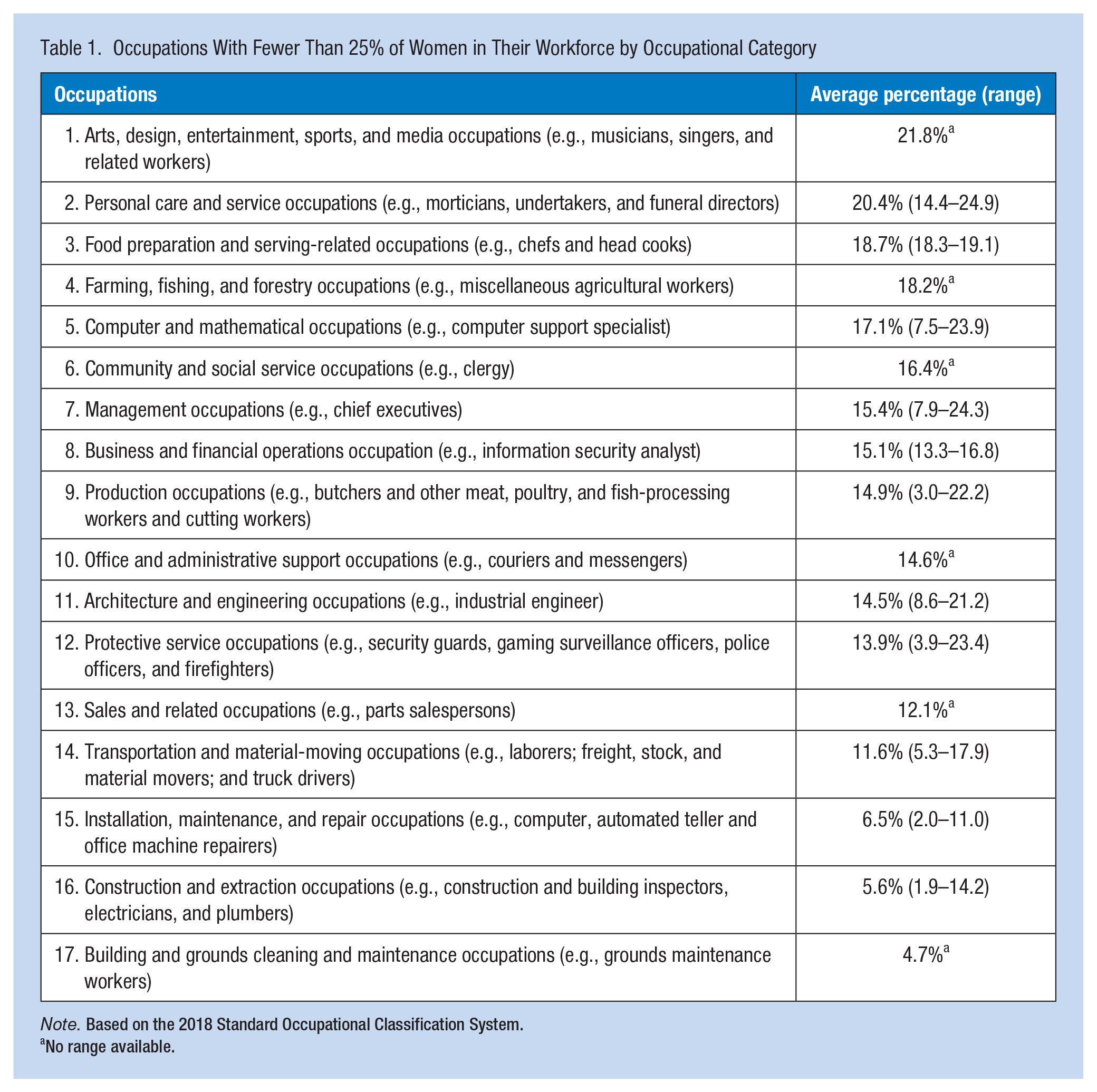
Note. Based on the 2018 Standard Occupational Classification System.
No range available.
Most women employed in male-dominated occupations work in community-based settings, described as places where employees provide services outside of an employer’s walls (Commission on Accreditation of Rehabilitation Facilities, 2020; Law Insider, 2020). The reasons women choose male-dominated occupations in community-based settings are varied and include better pay and benefits, greater autonomy, and the opportunity to work with their hands (AFSCME, 2019). The barriers for women in male-dominated occupations are greater than those for women in more conventional occupations and are thought to include lack of acceptance by peers and supervisors, improper training, isolation, and sexual harassment (AFSCME, 2019).
It is estimated that 20% to 100% of women working in male-dominated occupations have reported being the victim of sexually harassing behaviors while at work (Curtis et al., 2018; Hom et al., 2017; Lonsway et al., 2013; Seklecki & Paynich, 2007; Somvadee & Morash, 2008). This estimate may not be accurate as not all women label the unwelcomed behaviors as sexual harassment (Denissen, 2010), indicating there is either a lack of knowledge about sexual harassment or systemic organizational factors that may put women at risk and impact how they respond to harassment (Griffith et al., 2016; Hom et al., 2017; Khan et al., 2017; Lonsway et al., 2013; Seklecki & Paynich, 2007; Somvadee & Morash, 2008; Texeira, 2002).
Organizations in which expectations or tasks are assigned to individuals based on gender have higher rates of sexual harassment as women are often feminized and made to feel powerless in their jobs (Folgerø & Fjeldstad, 1995; Rogers & Henson, 1997). In traditionally masculine occupations where physical strength and resistance are necessary, sexual harassment of women is greater than it is in workplaces that do not require physical strength (Gruber, 2003; Gutek & Morach, 1982; Wasti et al., 2000). In gendered environments, men may protect their social status and use gender hierarchy as a basis for sexual harassment (Berdahl, 2007).
Little research with women in community-based male-dominated occupations such as protective services (police officers and firefighting), truck driving, or construction has been conducted. This systematic review provides an overview of research related to sexual harassment of women in male-dominated occupations: law enforcement, firefighting, truck driving, and construction. This review aims to (a) identify and report the state of science related to antecedents that put women at risk of sexual harassment in selected male-dominated occupations and to (b) identify gaps in the research literature related to sexual harassment in selected male-dominated occupations and opportunities for future occupational health nursing research.
Methodology
PubMed, CINAHL, PsycINFO, and Web of Science were the databases used for this review. Medical Subject Headings (MeSH) headings used in PubMed included sexual harassment in combination with workplace, police or law enforcement, firefighters, and construction industry. No MeSH headings were found for truck drivers or the trucking industry. The following key words were used in searches: sexual harassment in combination with workplace, police or law enforcement, firefighters, truck driver or trucker, construction, construction trades, construction industry, and construction worker. Additional search options employed included female, U.S., and adult. Articles identified for inclusion in the review were peer-reviewed and written in English; published between January 1980 and January 2020. We conducted our search telescoping back over this extended timeframe to include some of the first and seminal studies of this topic done in the 1980s and because of a lack of more recent research reports in general and in truck driving, specifically. This timeframe was necessary to identify studies of sexual harassment among women employed in other male-dominated occupations besides trucking. Preferred reporting items for systematic reviews and meta-analyses methodology was utilized to assess the quality of evidence. Article abstracts and text were reviewed for relevancy. Duplicates, reviews, books, dissertations, and studies conducted outside the United States, those concerning women under the age of 18 years, those relating to the medical profession, and those solely focused on responses to sexual harassment and sexual harassment of men were all excluded. Ancestry searches for additional articles that met the search criteria were conducted. Retained studies all focused on selected male-dominated occupations within the United States and investigated antecedents placing women at risk of workplace sexual harassment.
The initial literature search returned 330 articles. Nineteen articles on women in law enforcement, fire service, truck driving, and construction were identified from the initial search using the methods described above. An additional 6 articles were identified following ancestry searches from the original 19 articles. In total, 25 articles were retained for inclusion in this review. Figure 1 illustrates the search methodology.
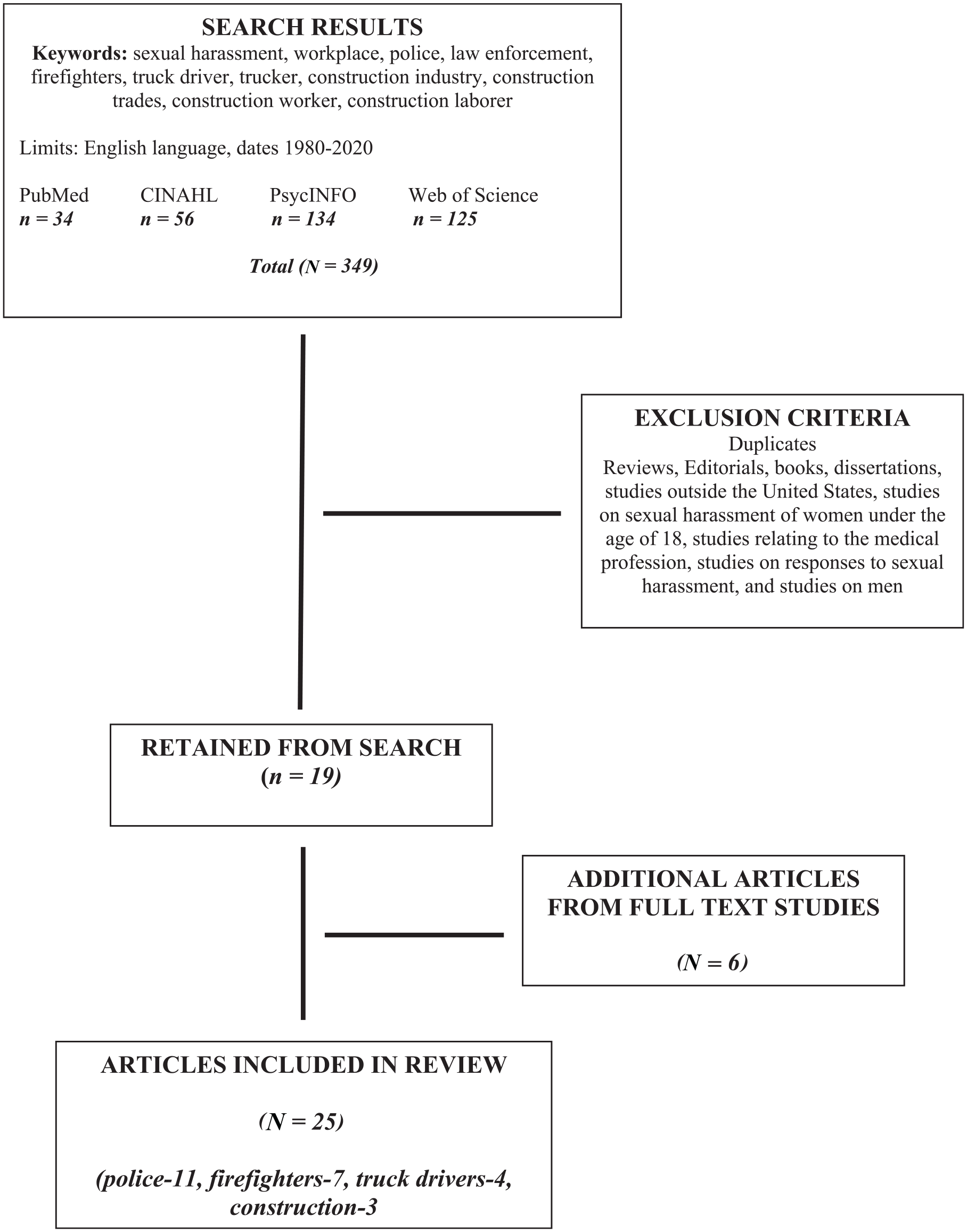
Literature Search Methodology and Outcomes.
Results
Study sample sizes ranged from 21 to 2,531. Thirteen of the 25 studies (52%) were comprised of only female participants. Cross-sectional (n = 12) and qualitative (n = 7) or mixed-methods (n = 6) designs were used. Most studies (n = 13 [52%]) employed one or more frameworks, theories, or models to guide the studies. Eight (32%) of the 25 studies utilized validated measurement instruments. Fifteen utilized researcher-developed measures, and two employed both.
Overall, most of the studies involved protective services (n = 18 [72%]), followed by truck driving (n = 4 [16%]), and construction (n = 3 [12%]).
Antecedents of Sexual Harassment in the Workplace
Findings from these 25 studies on antecedents, or risk factors, for sexual harassment in the workplace revealed that organizational culture (80%) and gender composition (32%) were the primary antecedents to sexual harassment in the selected male-dominated occupations. Co-worker relationships and traits associated with the job were most often reported while gender composition and remedies were the least investigated topics in the research. Studies on antecedents to sexual harassment of women in protective services were the most prominent ones (72%) while those with women in construction were less common. The studies on women in trucking did not directly address antecedents to sexual harassment; instead, sexual harassment was integrated into measurement of workplace violence and health of drivers as part of larger studies on workplace violence and the health of drivers (Anderson et al., 2005; Bernard et al., 2000; Lembright & Riemer, 1982; Reed & Cronin, 2003).
Organizational Culture
Twenty (80%) of the 25 articles on antecedents to sexual harassment made reference to organizational culture as a precursor to sexual harassment (Bernard et al., 2000; Goldenhar et al., 2003; Griffith et al., 2016; Hulett et al., 2008; Martin, 1978; Seklecki & Paynich, 2007; Somvadee & Morash, 2008; Yoder & Aniakudo, 1996). Organizational culture refers to the beliefs, attitudes, and assumptions that people in a particular environment share and that impart acceptance of sexual harassment (Chamberlain et al., 2008; Fitzgerald et al., 1994). The organizational culture of the workplace was comprised of many facets that reportedly contributed to sexual harassment of women in male-dominated occupations. It included traits associated with the job (e.g., teamwork, acceptance, and physicality); workplace relationships (e.g., co-worker to co-worker and employee to supervisor); and the presence, accessibility, and effectiveness of harassment remedies, such as the presence of policies and consequences for the harasser and protections against sexual harassment.
Women in male-dominated occupations in community settings (e.g., law enforcement, firefighting, truck driving or construction) face the risk of sexual harassment due to, in large part, the culture of the workplace (Bernard et al., 2000; Stohr et al., 1998) as women were often not accepted as a part of the team. Consistent with the theory of tokenism (Kanter, 1977), women were often hired to give the appearance of equality between genders in a workplace. In these workplaces, women are often excluded from organizational socialization and forced to endure hostile work environments meant to further alienate them (Pogrebin & Poole, 1997; Rabe-Hemp, 2008; Yoder & Aniakudo, 1996). These exaggerated circumstances and the presence of hegemonic masculinity, which is the culture dynamic that legitimizes the impression of the male’s higher social standing and makes women subservient, may have begun in training and eventually followed women into their careers (Prokos & Padavic, 2002; Rabe-Hemp, 2008). In this case, women report being treated as outsiders in their jobs; being made to feel less welcomed into the profession; or reported that they were perceived as weak and incompetent (Griffith et al., 2016; Hulett et al., 2008; Martin, 1978; Pogrebin & Poole, 1997; Prokos & Padavic, 2002; Rabe-Hemp, 2008; Seklecki & Paynich, 2007). In addition, the behaviors associated with sexual harassment were often considered part of the job. When women chose not to accept sexual harassment as normal behaviors associated with the job, their positions within the workplace were reportedly jeopardized. Their lack of acceptance of harassing behaviors was labeled by men as “sensitivity” or “overreaction” and often caused them to lose their social status within the workplace or increased the degree of harassment they faced after the incidents occurred (Martin, 1978; Texeira, 2002).
In addition to teamwork and acceptance, organizational culture traits, physicality, the physical stature, or strength required to complete a job were important organizational culture traits associated with sexual harassment. As many women lack the physicality of men, they often did not successfully complete assessments, physical training, or orientation. For firefighters, the pass rate on agility tests for women was one-half of that of men (Hulett et al., 2008); although women did not have the same physical strength as men, they were tested using the same criteria used to test male firefighters. Women in protective services and construction also raised physical safety concerns related to physicality as they were inadequately trained, forced to learn on their own, and given equipment that did not accommodate their physical size (Curtis et al., 2018; Griffith et al., 2016; Hollerbach et al., 2017; Hulett et al., 2008; Pogrebin & Poole, 1997). Women in construction reported skill underutilization making them appear incompetent or reported having to overcompensate to prove themselves, both leading to subsequent sexual harassment (Goldenhar et al., 1998). Women in law enforcement reported that their physical stature had been called into question, and as a result, they were perceived as less competent and subsequently experienced sexual harassment (Hassell et al., 2011; Martin, 1978; Pogrebin & Poole, 1997; Somvadee & Morash, 2008). Female officers also expressed that male officers felt the need to protect them just because they were women and had different physical capabilities, compared to male officers (Pogrebin & Poole, 1997). These perceptions and beliefs on the part of male employees show how workplace relationships affect the incidence of sexual harassment.
In addition to job traits, poor workplace relationships might increase the risk of sexual harassment for women in male-dominated occupations. Poor workplace relationships are characterized by mistrust and lack of confidence in co-workers, leading to safety concerns and low morale, increasing the risk of sexual harassment. In law enforcement, women who were considered troublemakers for reporting harassment also reported being put into more danger during training and while on the job, compared to women who did not report harassment and male officers. As a way of maintaining control and punishing women for reporting, male law enforcement officers preferred to see women struggle with tasks rather than help them. This predisposes the female officers to sexual harassment because of lack of strength and/or knowledge (Griffith et al., 2016; Hollerbach et al., 2017; Hulett et al., 2008; Pogrebin & Poole, 1997; Texeira, 2002). Furthermore, women were often humiliated or demoralized as men made them the focus of sexual jokes or engaged in inappropriate workplace gossip about them (Martin, 1978; Pogrebin & Poole, 1997), creating tension and further mistrust between co-workers.
Workplace gossip about women in protective service occupations and in the construction industry was reported to result in decreased productivity, giving men an unfair advantage and making women seem incompetent and unqualified (Goldenhar et al., 1998). As a result, women were frequently passed over for promotions or job assignments (Griffith et al., 2016; Hulett et al., 2008; Prokos & Padavic, 2002; Rabe-Hemp, 2008; Seklecki & Paynich, 2007) and were forced to do “women’s work” such as clerical duties, in turn, making men feel superior (Rabe-Hemp, 2008) and women the object of derision. Even when women initially reached positions of power, they were often not taken seriously and were subjected to gender harassment or unwanted sexual attention by co-workers and supervisors who were often disregarded by organizations (Prokos & Padavic, 2002). However, female truck drivers reported that having a male co-driver protected them against harassment and discrimination (Lembright & Riemer, 1982), and the female subjects felt that occupation type affected self-appraisal of harassment (e.g., women in male-dominated occupations were less likely to label harassment as such) (Lembright & Riemer, 1982; Maeder et al., 2007).
In addition to co-worker relationships making a difference in the working environment, relationships with supervisors may have an effect on sexual harassment in the workplace. Women in construction felt that if a male supervisor accepted them, the environment was comfortable and safe, allowing them to obtain training, work without harassment, and perform to the best of their abilities (Goldenhar et al., 2003). In contrast, male supervisors who were not supportive could make the working environment unpleasant and the workplace ripe for sexual harassment (Denissen, 2010). In law enforcement, individual traits of female officers such as personality, expertise, and access to critical information made co-worker harassment more likely than harassment by someone in management (quid pro quo) (Somvadee & Morash, 2008). In the workplace, co-worker harassment was more common and more easily identified as sexual harassment. Women who were victims of quid pro quo experienced it more frequently and more severely before they recognized it as sexual harassment (Burgess & Borgida, 1997). However, for both types, women might be reluctant to voice concern over harassment as supervisors and organizations failed to adequately address the complaints (Denissen, 2010; Hulett et al., 2008) and remedies to sexual harassment might or might not occur.
Six (24%) of the 25 studies on antecedents to sexual harassment addressed remedies in the form of policies and procedures and protections against sexual harassment. Increased incidents of sexual harassment were linked to organizational cultures that tolerated the behaviors associated with sexual harassment and lack policies to prevent the behavior (Hulin et al., 1996; Khan et al., 2017). In contrast, organizations with sexual harassment policies in place helped deter workplace sexual harassment and had lower incidents of sexual harassment (Hulett et al., 2008; Rosell et al., 1995). Many women in male-dominated occupations were unsure if their companies had reporting policies (Anderson et al., 2005), or they believed the policies might not adequately tackle the issue (Denissen, 2010; Hulett et al., 2008; Somvadee & Morash, 2008). In one study, 28% of female truck drivers reported having knowledge of their company’s sexual harassment training; only 11% reported knowing that their companies had reporting policies (Anderson et al., 2005). For female law enforcement officers, being married to someone in the same field and longer tenure and higher rank in their departments were protective against sexual harassment (Haarr & Morash, 2013; Texeira, 2002).
Gender Composition
Gender composition, or the ratio of men to women within the work group, was another common antecedent to sexual harassment identified in eight (32%) of the 25 studies on antecedents (Hulett et al., 2008; Martin, 1978; Murphy et al., 1995; Pogrebin & Poole, 1997; Somvadee & Morash, 2008; Stohr et al., 1998; Texeira, 2002; Yoder & Aniakudo, 1996). Gender composition also referred to the nature of the job duties and tasks assigned to each member of the work group, as well as the sex of the supervisor (Fitzgerald et al., 1997; Fitzgerald et al., 1994; Gutek et al., 1990). Women who had more contact with men, such as female secretaries who works in an environment dominated by men, were more likely to be sexually harassed than women who worked in gender-neutral environments or those dominated by women (Hulett et al., 2008; Murphy et al., 1995; Stohr et al., 1998), which was consistent with the social-contact hypothesis (Gutek et al., 1990). Women who worked in primarily female worker environments (e.g., female correction institutions) reported fewer experiences with sexual harassment (Stohr et al., 1998).
Because job descriptions were often based on gender roles (behaviors, attitudes, or activities assigned to a person based on their biological sex), women in male-dominated occupations who performed the same work as men reported being treated differently (generally discriminated against) and reported experiences of being sexually harassed (Murphy et al., 1995; Pogrebin & Poole, 1997; Yoder & Aniakudo, 1996) as they were seen as women first rather than workers (Rosell et al., 1995). This was consistent with the sex-role spillover theory (Gutek & Morach, 1982). However, female truck drivers reported that harassment and discrimination were societal/cultural issues based on gender issues as opposed to company issues (Bernard et al., 2000).
Gaps in the Literature
Fifteen studies on law enforcement, firefighting, and construction indicated that poor workplace relationships were a precursor to sexual harassment. However, researchers in these occupations failed to address the state of harassment in workplaces where there were good relationships between co-workers nor did the researchers examine the reasons for the poor relationships when they existed. Only one study on truck drivers addressed co-worker relationships (Lembright & Riemer, 1982). Authors of that study discussed that having a male co-driver was protective against sexual harassment but failed to address the possible negative relationships between co-workers.
There was also an identified gap in literature related to the antecedent of gender composition. Researchers briefly examined gender composition as a part of larger studies on sexual harassment in seven of the studies on law enforcement, firefighting, and construction. In these studies, gender composition was discussed within the context of the ratio of men to women within a workplace and the discrimination women face in predominately male workplaces. Sexual harassment of women in predominately female workplaces was discussed in only one study (Stohr et al., 1998). In addition, one study on truck drivers (Bernard et al., 2000) discussed discrimination of women as a societal issue as opposed to an organizational issue but did not examine gender composition of the workplace as a risk for sexual harassment.
Discussion
Sexual harassment of women in male-dominated occupations has been a growing concern over the last few decades as more women enter male-dominated workplaces. This systematic review summarized the state of the science related to antecedents to sexual harassment in selected male-dominated occupations and identified gaps in the literature.
Findings from these studies identified key constructs related to organizational culture (physicality, workplace relationships, and harassment remedies) and gender composition (male-to-female ratio, contact, and gendered job roles) as primary antecedents to sexual harassment that were consistent across the selected male-dominated occupations of law enforcement, firefighting, truck driving, and construction. Some antecedents have been studied in more detail than others as much of the research focused on co-worker relationships and work-related responses to sexual harassment as opposed to physicality of the job, harassment remedies, and gender composition. In addition, most researchers focused on women in law enforcement and firefighting, with few studies concentrated on women in truck driving and construction.
Researchers indicated that organizational culture, particularly workplace relationships, played a large part in determining whether sexual harassment was an issue within the workplace or not. Co-worker relationships included peer-to-peer and worker-to-supervisor relationships.
Physicality of the job and the presence or absence of harassment remedies were mentioned in studies on law enforcement, firefighting, and construction but were not as prominent in the discussions on co-worker relationships, and while physicality was identified as an important trait in male-dominated occupations, it was not addressed in studies on truck drivers. Harassment remedies were mentioned in six studies on law enforcement, firefighting, and construction. It was also mentioned in one study on truck drivers as part of a larger study on workplace violence (Anderson et al., 2005), but it did not delve into the relationship between harassment remedies and the presence or absence of sexual harassment as a result of the remedies, thus emphasizing this gap in the literature.
Major limitations identified by this review include (a) weak to moderate study designs, (b) non-standardized instrumentation, and (c) self-report or response bias. The majority of the literature reviewed was cross-sectional, qualitative, or mixed-method studies with small sample sizes, resulting in data that were not generalizable. Also, while cross-sectional and qualitative designs provided a wealth of information, they did not provide understanding of the causes of sexual harassment on women in male-dominated occupations. Second, researchers have not consistently used theories or models to guide their research; nor have they used established or tested measures, which could result in contradictions and test results that are not reliable or valid. Third, there is the potential for self-reporting or response bias. In many of the studies, respondents were asked perceptions of sexual harassment or perceptions of experiences in male-dominated occupations, leaving the responses open to interpretation.
In addition to the identified study limitations, studies on female truck drivers are limited. Researchers who examined workplace violence and health issues incorporated sexual harassment as a part of those larger studies. Studies are needed to specifically target sexual harassment of female truck drivers. Prevalence rates reported in the larger studies are more than a decade old and need to be updated to determine the extent of the problem within this population. Antecedents such as traits associated with the job (teamwork, acceptance, and physicality) and workplace relationships need to be better examined by occupational health nurses collaborating with organizations in developing, refining, and implementing sexual harassment remedies such as policies and procedures for reporting incidences of sexual harassment, to encourage a positive working environment where women feel welcomed, safe, and appreciated.
Implications for Occupational Health Nursing Research
While antecedents to, or risk factors of, sexual harassment have been studied in the protective services and construction occupations, investigation of antecedents to sexual harassment has been limited in these occupations. Most of the studies described prevalence and type of harassment.
It is evident that future research is needed to investigate what factors contribute more fully to workplace sexual harassment, especially among selected male-dominated occupations. We identified a lack of research driven by theoretical or conceptual frameworks in this review. Because of the factors external to workers in male-dominated occupations that are antecedents to sexual harassment, future occupational health nursing research of these phenomena should be framed within an ecological theory or framework. Understanding the extent to which characteristics of organizations (e.g., male-to-female ratio) and organizational culture contribute to frequency and type of harassment may help to determine how and why sexual harassment occurs. In addition, understanding perceptions of sexual harassment between harassers and complainants is critical in assessing risks and developing company, and perhaps, industry-wide harassment remedies such as policies and procedures. Finally, understanding co-worker and supervisor relationships can help occupational health nurses to build interventions or develop education programs to change attitudes and behaviors for respectable workplaces and make training and education over new or revised policies effective.
Conclusion
Workplace sexual harassment is a continuing problem as more women seek employment in male-dominated occupations in community settings. Despite growing concerns and recognition that organizational culture and gender composition of the workplace play a role in the incidence of sexual harassment, the majority of researchers did not consistently measure antecedents to sexual harassment in protective service, truck driving, and construction occupations. Furthermore, researchers did not compare how men and women view the risk factors for sexual harassment in these selected male-dominated occupations. The scientific rigor of many of these studies was insufficient as either the psychometric properties of many of the research-developed measures were not reported or studies included instruments with poor psychometric performance. Many of the studies rely on a qualitative design and self-report data, creating the potential for response or social desirability bias. Frameworks, theories, and models are inconsistent and often lacking in antecedent studies. Developing and testing a framework to guide the study of antecedents to sexual harassment in male-dominated occupations are warranted. Employers’ understanding of the organizational culture that contributes to sexual harassment in male-dominated occupations could inform policies and procedures that serve as deterrents to sexual harassment as well as promote a more cohesive and accepting workplace.
In Summary
Sexual harassment effects women in male-dominated occupations.
Organizational culture and gender composition have been identified as antecedents to sexual harassment.
Additional studies need to concentrate on female truck drivers and women in construction.
Footnotes
Declaration of Conflicting Interests
The author(s) declared no potential conflicts of interest with respect to the research, authorship, and/or publication of this article.
Funding
The author(s) disclosed receipt of the following financial support for the research, authorship, and/or publication of this article: This publication was supported by CARERC through the grant 6T42OH010278. Its contents are solely the responsibility of the authors and do not necessarily represent the official views of the National Institute for Occupational Safety & Health/Centers for Disease Control and Prevention (NIOSH/CDC).
