




Abstract
Background: Social media, an online vehicle for communication and media sharing, is a growing phenomenon in many aspects of everyday life, including health care. We explored the ways occupational health nurses can use social media as a helpful resource as well as identified potential concerns associated with its use. Methods: A review of the literature was conducted between December 1, 2019, and April 10, 2020, using PubMed and Google Scholar. Key search terms included social media, social network, nurse or nursing, occupational health, and online health. Criteria for selection included studies with results on social media within health care, nursing, and/or occupational health. Studies were also included if the health effects of social media were addressed. Six additional studies that had been previously identified by hand searching were included. Findings: These findings support the use of social media in occupational health for encouraging participatory health care among employees. Occupational health nurses can also utilize social media for health information, online health communities, emergency communication, health education workshops, professional connections, and continuing education. However, awareness of safe social media practice is necessary due to the possibility of misinformation and privacy breaches. Conclusion/Application to Practice: Social media can be used for education and communication with employees and is a way to support employees with specific health conditions through participation in online health communities . Occupational health nurses can take advantage of the speed and accessibility of social media to reach large numbers of employees. It is also a useful tool for addressing many health concerns encountered by employees; however, careful sourcing of information, awareness of company policies, and other safe practices can help to ensure it is helpful and not harmful.
Keywords
Background
In recent years, social media (SM) has become more than just a tool for socializing with friends and family; it has become a means to market and sell products and services, disseminate information, conduct research, and has become a communication tool between health care providers and patients. Inaccurate claims on the internet are common; however, the occupational health nurse can use encounters such as the one described below, to educate employees about SM. A Google search for “high blood pressure” results in over 350,000,000 hits. The influence of web-based health information on health care consumers is clear. Social media in particular is a growing phenomenon in health care (Surani et al., 2017). Accessing healthcare information has seen a rapid uptick in SM use for all of the above reasons.
Vignette: A 58-year-old employee with a history of hypertension has presented to the clinic for a blood pressure check. He states that he quit taking his blood pressure medication because a friend posted an article on SM that talked about the dangerous side effects. The occupational health nurse discusses the article with the employee and points out that the information is not completely correct. They review the medication together and the nurse coaches him on ways to find reliable medical information on the internet.
Social media has been formally defined as a group of internet-based applications that enable “creation and exchange of User Generated Content” (Kaplan & Haenlein, 2010). For the purposes of this review, SM is an online vehicle for communication and media sharing, often but not always interactive. All SM platforms are designed for communication, media sharing, or both, but each has slightly different capabilities and serves different purposes. Twitter, for example, limits users to 280 characters per posting (originally 140; Markham et al., 2017) and works much like an online bulletin board. It is often referred to as a microblog. Facebook, on the other hand, does not limit the words or characters and each user has their own page, which can become a storehouse for pictures, memes, and articles. Other SM platforms include but are not limited to, WhatsApp, Snapchat, YouTube, Instagram, and LinkedIn. There are many types of SM, but here we will refer mainly to 2 types: Social networking and media sharing (Foreman, 2017).
Occupational health nurses have a unique opportunity to take advantage of the many ways SM can improve the health of clients and employees, advance careers, enhance communication, and disseminate information. However, SM is not without risks, which may include false information (Silver, 2019), privacy issues (Wolf et al., 2014; Yancey, 2017), and potential health consequences associated with overuse (Alley et al., 2017; Zivnuska et al., 2019). It best serves the occupational health nurse to understand the balance between the many benefits and burdens of SM. This paper explores the literature as it applies to SM and occupational health. The purpose of this review is to inform occupational health nurses on the use of SM as a health resource and to raise awareness of its potential risks.
Methods
A review of the literature was conducted using PubMed and Google Scholar. Since SM is a phenomenon that is not limited to health care, web sites for major health, nursing, and occupational health were also searched, as well as journals specializing in information technology and business. A further search included the reference lists of selected articles and lists of those who had cited the articles. Key search terms included SM, social network, nurse or nursing, occupational health, and online health. Studies published in English after 2010 were considered; however, statistical resources were limited to the last 5 years. Manuscripts were chosen based on the applicability to occupational health nursing and SM use in nursing, in general. Studies were also included if they addressed health effects from using social media.
Findings
Approximately 30% of U.S. adults use SM to find health information (National Institute of Health [NIH], n.d.). This can be particularly useful for the occupational health nurse in reaching large numbers of people. Social media also offers the opportunity to share health information quickly and in a way that is easily accessible, which may become crucial during outbreaks such as the COVID-19 pandemic or in emergency situations. There are a number of different types and classifications of SM sites. See Table 1, which describes the types and classifications of SM sites that may be useful for occupational health nurses.
Types and Classifications of Social Media Sites
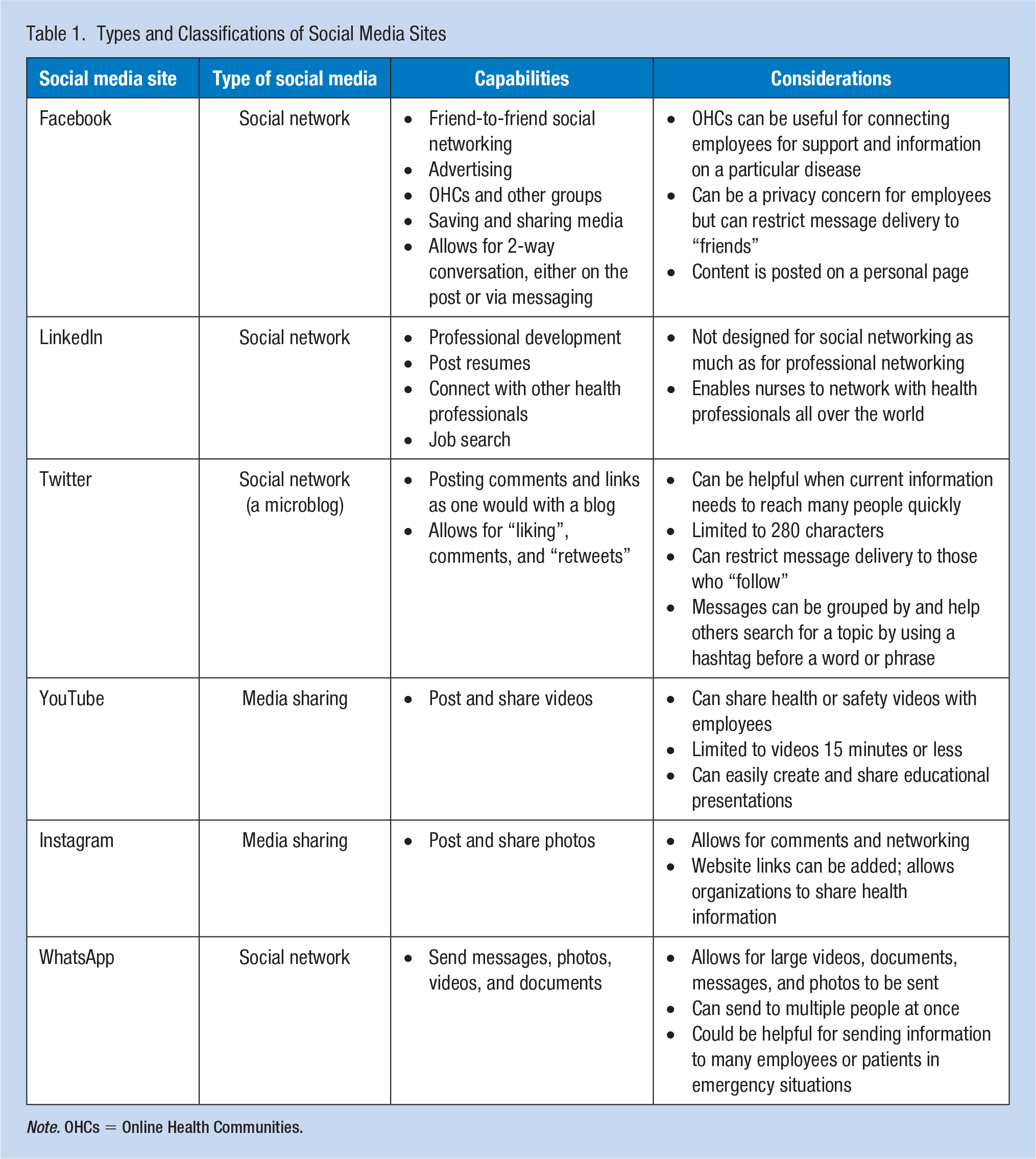
Note. OHCs = Online Health Communities.
Participatory Health care
Social media tools enable participatory health care (Wolf et al., 2014) and support self-care for many employees with health issues. One effective way this can be done is through apps that are embedded within the SM platform. For example, researchers successfully involved SM users for physical activity tracking (Pagkalos et al., 2017). A SM app was also effective for enabling young people with diabetes to enter and track their blood sugar in real time while also receiving medical advice (Larkin, 2011).
Online communities are another way to encourage workers to participate in their health care. With careful sourcing of information, the occupational health nurse can recommend online health communities (OHCs), especially if the OHC is administered by a reputable healthcare organization. OHCs are public or private groups that are formed on a SM platform, for the purpose of virtually connecting individuals with similar diseases, conditions, or health interests. These connections may help reduce the stigma of certain diseases and conditions. Moreover, employees can be empowered to manage their own health with the help of professional guidance and peer-to-peer engagement on OHCs (Willis & Royne, 2017). The presence of a nurse moderator on OHCs was helpful for improving the content of the health information on online forums and also informing those who might be less likely to utilize in-person services (Grainger et al., 2017).
Beyond OHCs, SM can be a valuable resource for occupational health nurses who wish to supply employees with accurate health information. Employees can be referred to articles or videos on various SM platforms to provide evidence-based health information. Videos, either produced by the occupational health nurse or obtained from another online source, can be posted on YouTube and other SM platforms. Entire courses on topics such as safety in the workplace, may be provided on SM for employee viewing. Specific health interests such as high blood pressure can be shared on SM via links to reputable healthcare organizations such as the American Heart Association (AHA, n.d.), which has links to Twitter, Facebook, YouTube, Pinterest, LinkedIn, and Instagram.
Ensuring Health Information Quality
Many Americans who use SM turn to at least one of the platforms daily (Perrin & Anderson, 2019) and are likely to look to SM for answers to their health questions, especially in the absence of provider guidance (Langford & Loeb, 2019). Provision of accurate health information is not only helpful; it is vital given the influence of SM and the amount of misinformation on the internet. The guidance provided can be as simple as obtaining information from or referring employees to reliable resources such as the local hospital, the American Nurses Association (ANA, n.d.-a), the World Health Organization (WHO, n.d.), or the Centers for Disease Control and Prevention (CDC, n.d.), all of which can be accessed via Facebook, Twitter, LinkedIn, and Instagram. Many of these organizations have a significant presence on SM. For example, a Facebook search of the word “vaccine” brings up many reputable health organizations. Importantly, health experts need to be a voice of reason in online health debates and discussions (Orr et al., 2016). Without an expert to filter the information on SM, employees may believe inaccurate health claims. This has been the case with the vaccine debate (Kata, 2012; Orr et al., 2016), in which anti-vaccine groups found a voice on SM and very quickly spread misinformation about the side-effects of vaccines. The end-result has been the resurgence of diseases that had previously been controlled (Orr et al., 2016).
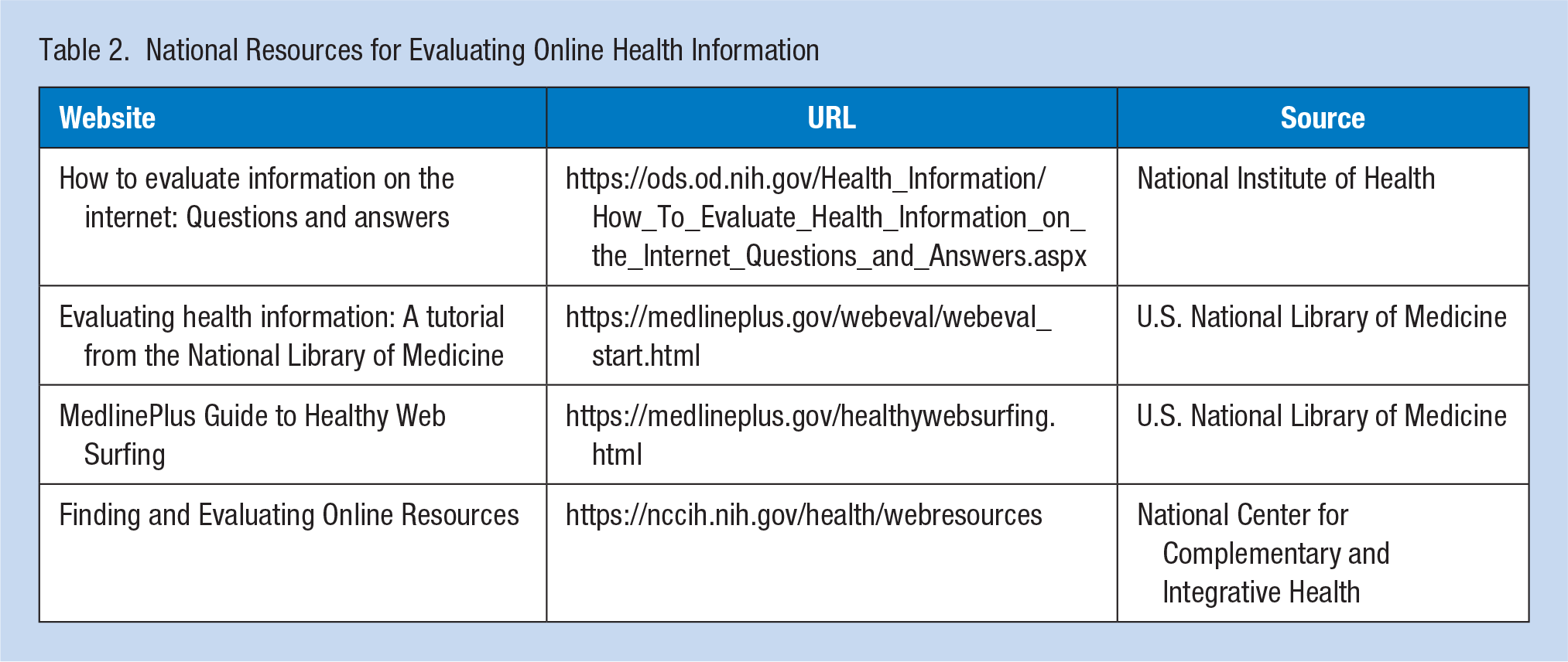
There are a number of resources that can help the occupational health nurse determine the quality of online health information when recommending OHCs or any website to clients or employees. Table 2 describes national resources for evaluating online health information. The National Institute of Health has several online resources that can assist in critiquing OHCs and other health information on the web. This can be especially helpful when encountering employees who request or need guidance regarding health information they have discovered on the web.
National Resources for Evaluating Online Health Information
Health Disparity Gap
Not everyone is able to access health information by traditional means. To compound the problem, underserved workers who may not have access to traditional health information carry a higher burden of chronic disease and may be less likely to receive care, thus putting them at a higher risk for injury (Kalliny & McKenzie, 2017). Social media has the ability to narrow this health disparity gap (Moorhead et al., 2013). For example, SM interactions can be arranged in cases in which transportation is an issue (Whittaker & Wade, 2014). Smartphones can be an especially efficient way to extend the reach of SM. James and Harville (2018) found that African American women are interested in engaging in SM for health information and have high ownership of smartphones. For those who cannot afford a smartphone, free government issued phones are available (Federal Communications Commission [FCC], n.d.). By 2020, individuals who access SM on a monthly basis by smartphone are expected to reach 186 million (Statista, n.d.). Access to SM is widening, which underscores the importance of considering it as an avenue for sharing health information with those who experience health disparities (Moorhead et al., 2013).
Safety
Occupational health nurses can utilize SM for safety concerns of all types, including work-related accidents and injuries. Social media has been employed to quickly share large amounts of information. One example is WhatsApp, a SM messaging system with end-to-end encryption, which is capable of sending large quantities of data. This could replace Fax and courier in some instances, by allowing for a quicker response time to emergency situations (Mars & Scott, 2016). There are also examples in which nursing assessment has been accomplished remotely with SM (Casella et al., 2014).
Safety information can be widely and quickly disseminated by engaging workers in SM platforms (Olszewski & Wolf, 2015). Secure groups can be created in Twitter as a way to quickly communicate emergencies that affect the employees. Occupational health nurses may also find it helpful to utilize SM tools to complement the company’s disaster plans. Training is available by the National Disaster Preparedness Training Center for those who wish to learn to use SM for disaster planning and response (Olszewski & Wolf, 2015).
Live streaming could easily be incorporated into occupational health for the purposes of sharing information live with many people at remote locations. Live streaming such as Facebook Live could also create opportunities for holding safety and injury prevention workshops or for raising awareness about issues such as workplace violence.
Resources and Career Development
In recent years, SM has become an avenue for nurses to share scientific knowledge and advance their careers. LinkedIn is especially effective for professional development and was created for that primary purpose. Currently, LinkedIn has 660 million members in 200 countries with 2 new members signing up every second (LinkedIn, n.d.). Occupational health nurses can join groups such as the ANA, post resumes, and connect with other nurses and high-profile leaders in health care. Nurses can use LinkedIn and other SM platforms to grow professionally by seeking out career-relevant information, networking, job-searching, and posting resumes.
Because of the reach of SM and ability to provide up-to-date material, occupational health nurses can obtain information and links that inform current practice. For example, Twitter allows for updates on topics such as workplace violence and noise control which can be searched by using a “hashtag” in front of a word or phrase. Twitter can also be used for real time discussions at conferences (Markham et al., 2017). Occupational health nurses can even obtain continuing education credits on SM by accessing or sharing links to professional online groups. The American Association of Occupational Health Nurses (AAOHN) has used SM to share information about the AAOHN National Conference (AAOHN, n.d.-b) where nurses can obtain continuing education credits. The AAOHN also maintains an active SM presence, giving members access to the latest information, products, and services by linking to their website. With live streaming and the advent of Facebook Live, continuing education providers can now provide seminars live.
Risks and Limitations of Social Media
False information
Social media brings many advantages for the occupational health nurse but these must be balanced with an awareness of possible negative consequences. Many SM users express concern that misinformation has become a problem in the United States (Silver, 2019). Many healthcare professionals are also understandably cautious about the reliability of online health information (Surani et al., 2017). As previously discussed, it is important for the occupational health nurse to assess the quality of health information that employees are getting from SM, whenever possible. In addition, it is also important to educate employees on ways to recognize legitimate health information (Wolf et al., 2014). More on distinguishing between legitimate and false health information can be found in Table 2: National Resources for Evaluating Online Health Information.
Privacy issues
Occupational health nurses should be aware that anything that is posted on SM could be discovered by their employer or client. Furthermore, controversial comments that are posted could have career-altering repercussions (Yancey, 2017). Nurses who use SM for either personal or work-related reasons should follow the SM guidelines put forth by their organization so that there is no blurring of boundaries. In addition, the ANA, which has a significant footprint in social media, has put forth principles for social networking: (ANA, n.d.-b). Their recommendations include not transmitting or placing online individually identifiable patient information. The ANA also states that nurses should observe ethically prescribed professional patient–nurse boundaries and understand that patients, colleagues, organizations, and employers may view postings. Furthermore, they suggest taking advantage of privacy settings and separating personal and professional information online. Finally, the ANA states that nurses should bring content that could harm a patient’s privacy, rights or welfare to the attention of appropriate authorities, and they suggest participating in the development of organizational policies governing online conduct.
Private health information can become public through SM in a number of ways. This may include someone sharing information you posted or simply a family member looking over your shoulder. Online audiences may include friends, acquaintances, professional colleagues, and clients. Therefore, keeping work and personal life separate online (make personal accounts private) as well as putting forth a professional face at all times is vital (Hennessy et al., 2019).
In the current SM climate, there is also an ongoing concern of hacking. WhatsApp, which allows for health-related content to be sent quickly and allows for immediate response, also has end-to-end encryption (Mars & Scott, 2016), making it an attractive health-related SM resource. However, not all SM is safe for sending and receiving private health information. Strict privacy settings and strong passwords can help ensure SM privacy. Nurses should also be cognizant of the laws related to patient privacy set forth by the Centers for Disease Control called the Health Insurance Portability and Accountability Act (HIPAA) (CDC, n.d.). Following the ANA guidelines mentioned above will help to prevent sharing of health information resulting in infractions of this law. Nurses who may have less experience with the internet may need to be educated on the importance of internet safety and how to evaluate health information (Wolf et al., 2014). Employees should also be made aware of the importance of confidentiality of healthcare information (Wolf et al., 2014). Occupational health nurses can help to ensure safe SM use by being aware of company policies for both themselves and the employees. Unfortunately, a large percentage (40%) of healthcare workers were unaware of company SM policies (Surani et al., 2017).
Health consequences
Social media use is associated with high computer use and greater sitting time on non-work days (Alley et al., 2017). The overall health implications of sedentary time is well-documented (Biswas et al., 2015), but SM may bring other unforeseen consequences such as addiction. The interactive nature of SM can lead to addiction, due in part to its reinforcing nature (Zivnuska et al., 2019). Social media addiction can take so much time and energy that it diverts resources away from family and work, thus interfering with work-life balance (Zivnuska et al., 2019). Companies can be encouraged to help address this by supporting time management skills (Zivnuska et al., 2019), but occupational health nurses may need to step in and refer the employee to appropriate resources when addiction is suspected.
Psychological health can also be impacted as a result of interactions on SM. Bullying and harassment are unfortunate by-products of contemporary SM (Geiger, 2018). About 59% of the teens say they have been harassed on SM and many adults (41%) experience similar concerns (Geiger, 2018). In today’s environment, occupational health nurses need to be aware of this pervasive trend on SM.
Discussion
Social media can be a helpful resource for the occupational health nurse. Health education, emergency management, and online support are all available to employees due to the speed and accessibility of SM. Occupational health nurses can also utilize SM as a vehicle for professional development. However, it is important to be aware of the potential risks that SM brings to health, health information, and privacy. In the end, the occupational health nurse who is mindful of SM precautions has a very effective tool for educating and caring for employees in today’s workforce.
Conclusion
Social media enables occupational health nurses to quickly share accurate health information with employees. In an online world of false claims, occupational health nurses have opportunities to provide legitimate health information via SM. Both employees and occupational health nurses can take advantage of learning modules available on SM. An awareness of privacy concerns, false information, and health consequences are several strategies to mitigate harm associated with the use of SM.
Applications to Professional Practice
Social media can be useful for the occupational health nurse in a number of different ways. For example, the speed and volume of information provided by many platforms can be a crucial tool for communicating important information. Unanticipated events such as the global COVID-19 pandemic necessitate rapid dissemination of accurate information to employees. The AAOHN provides online tools for occupational health nurses during such times (AAOHN, n.d.-a). This information can be sent to employers and employees via SM to keep them abreast of the most recent health implications and recommended practices. In addition, SM promotes the focus currently placed on the prevention of illness and injury in the workplace. As an example, Vision Zero (n.d.) promotes a worldwide health and safety campaign in large part via SM. Vision Zero has an active Twitter campaign and a private LinkedIn group, promoting total workplace safety. With the responsible utilization of SM, occupational health nurses can make today’s workplace a healthier and safer environment.
Footnotes
Conflict of Interest
The author(s) declared no potential conflicts of interest with respect to the research, authorship, and/or publication of this article.
Funding
The author(s) received no financial support for the research, authorship, and/or publication of this article.

Author Biography
Lee Anne Siegmund, PhD, RN, is a nurse scientist in Cleveland Clinic’s Office of Nursing Research and Innovation. Her research interests include prescriptive exercise, and use of technology and social media in research. She has an ongoing desire to improve clinical practice in order to prevent disease and complications that may result from non-optimized behaviors.