




Abstract
While social media offer an unprecedented opportunity for orchestrating large-scale communication campaigns, it is often difficult to track audience responses on various digital platforms over time and to ascertain if their engagement is aligned with the original intention. In this article, we share a promising solution—the purposive embedding and tracking of unique content elements as “markers” using text analytics techniques. Four markers were introduced in an Indian melodramatic television serial, Main Kuch Bhi Kar Sakti Hoon (I, A Woman, Can Achieve Anything), which was part of a larger transmedia edutainment initiative in India to promote sanitation, family planning, and gender equality. These markers served as anchors for audience engagement with the originally intended messaging embedded in the narratives as well as for program monitoring and evaluation. We applied various web-based tools to systematically track marker-related engagement on Facebook, Twitter, and YouTube across eight months. We also conducted semantic network analysis to better understand how marker-related social media comments evolved over time. Our investigation of using markers for digital engagement and narrative exchange in MKBKSH makes an important and timely methodological contribution to the scholarship and praxis of social and behavior change communication.
Keywords
In mid-2020, Instagram and Facebook were flooded with millions of black-and-white images of women showing support for each other. Nominated by their friends, these women joined the #ChallengeAccepted social media campaign from across the world. Endorsed by several female celebrities, the campaign gained global traction within a few days, spiraling way beyond its original intention. Knowledgeable observers knew that the campaign originated in Turkey, symbolizing solidarity with femicide victims whose deaths were announced in newspapers with the purposive use of black-and-white pictures. The Turkish activists had initiated the #ChallengeAccepted to raise awareness of gender-based violence and calling for the perpetrators to be prosecuted. 1
While the #ChallengeAccepted campaign represents a noteworthy example of using social media to spur global user engagement with the issue of femicide, it also demonstrated how intended campaign messages get lost in the ether as they spread over time across geographic and cultural boundaries. Such diversion and dilution have also happened to other well-known campaigns like the ALS Ice Bucket Challenge 2 and Kony 2012. 3 The upshot: While the rise of social media offers an unprecedented opportunity for large-scale user engagement to promote good causes, challenges exist in preserving the intentionality of campaign messages and in tracking meaningful user engagement across digital platforms and across time and space.
In this article, we share a promising solution—markers, which can be defined as verbal expressions, visual representations, and modeled behaviors that are novel, unique, easily identifiable, and also well-aligned with a project’s social objectives. 4 Because of their distinctive nature, markers are also highly effective for program monitoring and effects attribution. 5 In the digital space, if carefully designed, markers can help spur public discourse, evoke active participation, and move the needle in desired prosocial directions. The content of markers is closely tied to storytelling and the format of markers is usually aligned with the platform choice of a project. Transmedia edutainment (short for entertainment-education through transmedia storytelling) uses narrative engagement across different entertainment media for health promotion and social change.6– 8 Markers can be introduced in entertainment programming and subsequently monitored on multiple media platforms and assessed using various textual analytics techniques.
In the present field-based study, we report on the use of markers in a transmedia edutainment initiative led by the Population Foundation of India, Main Kuch Bhi Kar Sakti Hoon (I, A Woman, Can Achieve Anything; hereafter, MKBKSH). The researchers and authors of this article worked closely—throughout the planning and broadcast of MKBKSH Season 3—with the production team to purposefully design the markers, facilitate their implementation on multiple platforms, then systematically monitored marker-related social media engagement for over eight months—from January to September 2019. Based on this digital tracking of markers, we were able to identify attributes of social media content formats and promotional strategies that effectively spurred enthusiastic and meaningful audience engagement.
We begin this article by reviewing the key constructs and conceptual frameworks—that is, transmedia edutainment, markers, digital story circles, and narrative exchange—to provide a rich contextual container for our study. We then detail the co-creation, implementation, and textual analytics solutions we employed in the field, in collaboration with our partners. Thereafter, we report the results of market-related digital analytics and semantic network analysis. Our investigation of using markers for digital engagement and narrative exchange in MKBKSH represents an important and timely methodological contribution to the scholarship and praxis of social and behavior change communication.
Transmedia edutainment and markers
As an innovative transmedia edutainment initiative, MKBKSH leveraged the power of storytelling through a flagship melodramatic television serial broadcast in India across three seasons (2013–2019) and 183 episodes. Centering around multiple characters, intersecting plots, and social topics, the highly popular television serial was adapted on the radio in multiple regional languages and gained extensive audience outreach through various digital platforms, including a real-time interactive voice response system, mini-documentaries on YouTube, an artificial intelligence chatbot on Facebook Messenger, and allied promotional activities on popular social media.9, 10 MKBKSH’s main plot centered on its protagonist Dr Sneha, a young medical doctor who leaves her lucrative practice in Mumbai to return to her home village of Pratappur to challenge and overcome regressive social norms such as child marriage, sex-selective abortion, domestic violence, open defecation, gender inequality, and large family size. As a transmedia edutainment program, MKBKSH was not just a one-off infomercial; rather, it was purposely designed to serve as a catalyst for spurring interpersonal discussion and shifting public discourse across platforms and over time. 11 – 13 Notably, as the social media outreach for MKBKSH Season 3 expanded, audience members found multiple, low threshold entry points for narrative engagement across different media platforms.
Markers as points of digital engagement
The growing mobile internet penetration in India 14 , 15 offered an unprecedented opportunity for MKBKSH Season 3 broadcast in 2019 to leverage social media as an amplified “point of engagement” and “site of discourse” 16 (p. 354). Online user engagement can significantly affect public agenda setting 17 and the renegotiation of norms and values. 18 Active user engagement that convey injunctive norms on social media, such as content that generates many likes, shares, and comments, can influence attitudes and behaviors.19–21 In MKBKSH Season 3, markers functioned as points of engagement that allowed us to follow how social norms are shifting around key issues such as sanitation, family planning, and gender equality.
A set of markers were co-created by the MKBKSH producers and researchers based on project objectives and audience inputs.10, 22 These markers were then introduced in the melodramatic television serial and strategically promoted on social media. Audiences were invited to share their perspectives on the important health and social issues featured in the program.
In MKBKSH Season 3, markers were presented in various compelling and playful media formats—all designed to invite audiences to engage in meaningful ways.23, 24 The idea was to build on the lessons learned from digital media engagement exemplars such as the ALS Ice Bucket Challenge, 2 Je suis Paris Facebook Frame, 25 planking, 26 and the dab. 27 These exemplars showed that unique verbal challenges, visual symbols, and body movements can entice social media users, build momentum, and spread rapidly. 24 Therefore, we not only introduced new terms, but also visual imagery and dance moves through various social media platforms, allowing audience members and users to reflect on, interact with, and endorse the prosocial messages embedded in the markers (Table 1).
Markers studied in MKBKSH Season 3 from 26 January to 1 September 2019.

Note. As with any social media posts, multiple markers may be tagged simultaneously. The frequency counts in the Facebook column correspond to the number of posts tagging the marker by the MKBKSH social media team.
The markers’ narrative context
MKBKSH Season 3 consisted of 52 episodes that were broadcast in two parts with a break of 10 weeks in-between. The first 26 episodes were broadcast from 26 January to 21 April 2019, focusing on sanitation issues and gender equality. For example, the marker Swachhta Elaan (cleanliness pledge) was strategically introduced during this period. Its narrative context was established through a storyline involving Panna, a young woman who is molested by several men when she goes to defecate in the field because her home has no toilet. The violence inflicted on Panna, along with a major plotline centering around an epidemic outbreak in Pratappur due to unsanitary conditions, spurred a movement in Pratappur to build toilets and improve sanitation. The eventual purpose was for Pratappur to become open defecation free. As the story unfolds, Panna becomes an apprentice to Dr Sneha and they both champion the cause of hygiene and sanitation, making house visits to educate residents. They also make appearances on Pratappur Vaani (Voice of Pratappur), a local community radio station hosted by Munna and Buaji—both respected and credible sources—who use humor to engage and persuade their listeners. The culmination of this community mobilization drive on MKBKSH, including the celebration of its open defecation free status, occurs in the village square with the collective performance of a popular Qawwali (a genre of Sufi singing with dialogic call and response) in which community members emphasize their Swachhta Elaan (cleanliness pledge) to maintain sanitary practices.
The second part of MKBKSH Season 3 was broadcast from 8 June to 1 September 2019, focusing on family planning and other matters of sexual and reproductive health. In her now formalized role as a community health worker, Panna brings a Mast Pitara (pleasure basket) to the Pratappur Vaani community radio station, where she has lively conversations with Munna and Buaji about the pleasures of its contents: Mast Topi (pleasure hats, i.e. male condoms), Mast Goli (pleasure pills, i.e. oral contraceptive pills), and Mastbandi (pleasure-closure, i.e. vasectomy). Later, a new character enters the stage, Condom Baba, a medical doctor turned mystic, who preaches the advantages of condom use through riddles, puzzles, and anecdotes. When Condom Baba—who opened a Condom Dhaba (roadside condom café)—is brought to court for openly (if not brazenly) bringing taboo sexual issues to the public, he convinces the judge about the importance of his work, allowing viewers to move toward more open conversations about sexual topics, including viewing protected sex in a new light as “healthy passions.”
Another marker Lambi Sagai (long engagement) was introduced in a romantic storyline featuring Panna and her fiancée Sameer, a creative technology tinkerer from a high social caste. Sameer’s mother stigmatizes Panna (on account of her molestation) and is vehemently against Sameer marrying her. By the end of the first 26 episodes, the young couple decides not to rush into marriage, but rather to choose Lambi Sagai, allowing them to establish their careers and a healthy and happy foundation for a life together. The purpose of Lambi Sagai was to present a counter narrative to the predominant regressive practice of early marriage while also emphasizing the value of collective decision-making and deep understanding between would-be couples about their mutual aspirations in life.
The marker Laadlidin (day of the beloved woman) was introduced in late January 2019, during the first week of the broadcast of MKBKSH Season 3. On television, Sneha’s parents celebrated their anniversary by having four young girls collectively cut their birthday cake. The purpose behind the marker was to portray a new practice—a public celebration of girls’ birthdays at par with boys’ birthdays thereby emphasizing gender equality.
The markers’ strategic purposes
In MKBKSH Season 3, the various markers provided positive alternatives to existing beliefs and practices turning upside down prevailing regressive social norms. For example, Lambi Sagai (long engagement) is an alternative to child/early marriage, when couples prematurely marry before they are developmentally, emotionally, and financially capable of supporting a family. In a romantic scene between Panna and Sameer in MKBKSH 3 Episode 25, Lambi Sagai becomes the topic when Sameer promises to stay engaged to Panna, emphasizing they would marry some years later when their careers are established, and they feel ready for the family life. Lambi Sagai exemplifies how markers can effectively attract the audience’s attention because of their “novelty” and create conditions to engage them in considering alternative perspectives through relatable and credible characters, dialogues, and storylines.
Markers also provide an invitation for audience members to share their opinions and stories about the newly-espoused possibilities and realities. MKBKSH’s social media posts tapped into the markers by creatively evoking them in character dialogues and in appropriate plot situations. As conversation starters and calls to action, these posts invited audience members to engage in multiple ways, for instance, post poetry to expound on their Swachhta Elaan (cleanliness pledge), provide reasons they would choose Lambi Sagai (long engagement), and so on. Using social media in this manner can empower the audiences to shape the unfolding narrative and public discourse underlying each of the newly-introduced markers.
Finally, markers can serve as unique anchors that allow program evaluators to track user engagement around the key themes of edutainment narratives.4, 5 Effect attribution is a major challenge for public campaigns and health interventions in media-saturated environments with competing messages on multiple platforms. A common challenge for conducting big data research for social sciences is that this large amount of information is often clouded with noise such as spam, irrelevant content, and superficial user responses.28, 29 By definition, markers can serve as anchors for identifying the most relevant data (“needles in the sea” in empirical social science research using big data) showing evidence of new perspectives and desired realities embedded in unique terminologies, visualizations, or practices that can be traced back to their narrative origins and nowhere else. Program evaluators can track these meaningful digital footprints over time and across different platforms to follow how social norms in online conversations may be shifting, thus enhancing the efficacy of program monitoring and assessment. 30
Marker promotion through digital story circles
In our investigation of markers, we were guided by the conceptual framework of digital story circles, an approach that delineates the optimal conditions for effective audience engagement around critical elements of digitally sustained narrative exchange. 31 Stemming from the digital storytelling movement, 32 this framework prioritizes resources, platforms, processes, and infrastructures that intersect and co-evolve across time and space through digital storytelling and narrative exchange to allow for emerging agency, mutual recognition, and civic participation.31, 33 Embedded in digital story circles is the recognition of online fan communities where users find a space to interact with their favorite dramas, games, and media characters, 34 and where the original narrative world is enriched through massive user-generated content. 35 Across platforms and over time, audience engagement molds it into new forms, often beyond their intended meaning or purpose. 36 By introducing markers, our purpose was to inspire and invite audience members across platforms to directly voice their experiences and opinions about MKBKSH’s social issues and gauge the degree to which their intentionality was maintained.
In the context of MKBKSH Season 3, the marker-related storylines, characters, events, and quotes provided the narrative resources to raise important social issues in a public space. Social media provide platforms for narrative exchange, while their technical features as well as the users’ social networks provide the infrastructures for such narrative exchange. The process of narrative exchange is set in motion with different media formats. For instance, Facebook posts can evoke certain scenes and character dialogues and ask audiences for their opinions. Using this framework, we aimed to orchestrate narrative exchange around each MKBKSH marker, creating multiple touchpoints for audience engagement.
In implementing the social media strategy for MKBKSH Season 3, the creative team was guided by four key consideration:
37
(1) Inspire: social media posts were designed to shine the light on a marker-related narrative element of the television serial that was geared to enhance knowledge, attitude, and/or behavior change; (2) Introduce: markers were presented to the audiences in a compelling manner using unique and novel verbal expressions (e.g. hashtags), visual representations (e.g. Facebook frames, dance moves), and newly-modelled behaviors (e.g. toilet cleaning challenge) that represent positive alternatives to their existing reality; (3) Invite: invitations were extended through the social media posts with specific calls for action for audiences to share their own stories in creative ways; and (4) Inspire (again): audience members discovered their human agency as storytellers by discovering their own voice, by seeing their story connecting with other people’s stories, and witnessing the collective amplification of marker-related discourses, leading to a new series of social media posts. Taken together, we asked: How can carefully constructed markers stimulate and sustain meaningful narrative exchange as part of a transmedia edutainment experience? More specifically, we centered our empirical study around the following research questions:
Methods
Marker co-creation
Prior to the launch, the Population Foundation of India’s knowledge management team worked with the researchers to create a message matrix around key health and social issues. The creative production team led by Feroz Abbas Khan shared a draft screenplay in November 2018. The Population Foundation of India’s social media team, who managed MKBKSH’s website and social media accounts, used the screenplay to develop marker strategies in January 2019. The research team was asked to provide advice and monitor online audience engagement in the wake of the television serial. With the support of the production team, a list of markers (Table 1) was created and updated with various versions of Hindi spellings and common misspellings to optimize the search results.
Marker monitoring
The producers shared the scripts of specific episodes as soon as they become available. A few days before the episodes were broadcast on television, they were shared with the communications and social media team. During this phase—loosely inspired by action research approaches for organizational learning 38 —we monitored audiences’ digital engagement with markers on a weekly basis across the entire broadcast period of MKBKSH Season 3 and synthesized our interim findings to the Population Foundation of India through bi-weekly reports. 39 These reports served a formative purpose in that they highlighted opportunities for the social media team to use markers to further integrate the television drama storylines with promotional content in the transmedia extensions. Our research team and Population Foundation of India’s social media team coordinated regular conference calls to determine and reflect on indicators of engagement and other factors that set successful posts apart from others. This enabled the research and social media teams to quickly assess the audience response to the social media posts, build on and amplify what was working, and course-correct and modify what was not working. It also allowed the research team to finetune the data retrieval and analysis.
Marker evaluation
Data collection
From 26 January to 1 September 2019, we conducted weekly searches to retrieve Facebook, Twitter, and YouTube content tagged or associated with any of the digital markers in Table 2 and in various English, Hindi, and other Indian regional language spellings. More specifically, we used the RFacebook package 40 to retrieve a total of 368 posts on the MKBKSH Facebook page and 7885 associated user comments, as well as collect social media analytics data on the number of likes to posts (338,329) and comments (2584), as well as post shares (6047). We used the rtweet package 41 to download 1068 Twitter messages by 514 unique users that included any of the markers, as well as collect social media analytics data on the number of retweets (544) and replies (162). We used YouTube Data Tools 42 to retrieve a total of 106 videos on the MKBKSH channel and 844 associated user comments, as well as collect social media analytics data on the number of views (1,450,508), likes (5394), and dislikes (1185). Together, the retrieved information from these sources constituted our analytical database for this study.
The “anchor words,” that is, the words that were included in the semantic networks by default.

Data analysis
First, we tallied the cumulative social media analytics for each of the four markers across all three social media platforms over the 8-month period. Second, we conducted simple text searches using regex queries in R to determine whether posts and comments were connected to a marker. Comments that directly responded to posts including markers, as well as comments including markers, were kept for further analysis. Any text in Hindi or other Indian regional languages was translated to English by calling Google’s Natural Language API using the googleLanguageR package. 43 Third, we used the wordcloud2 package 44 in R to plot word clouds for each marker, including the 25 most frequent words, and colored them along with relative TF-IDF scores, 45 which indicate word relevance to the marker. The word clouds were only used in the bi-weekly reports, allowing the social media team to keep a finger on the pulse of the conversation.
For the evaluation, we employed semantic network analysis as a method for visual text analytics 46 to better understand how marker-related discussions in these social media comments evolved over time. Our semantic networks include a short list of anchor nodes (i.e. marker-related words as manually selected from the top 90th percentile of most frequently used words across the larger data set; Table 2) and all other words that were associated with these anchor nodes that also appeared in the 90th percentile of word occurrence for each month and each marker. Short phrases such as Swachh Bharat (the name of the national sanitation campaign) were selected based on frequent occurrence by one of its words and combined into a phrase to set it apart from other occurrences (i.e. swacchta [cleanliness] vs. swachhta elaan [cleanliness pledge]). This means the nodes in our semantic networks represent words that were consistently associated with the markers, hence, representing the most meaningful narrative exchange. For the purpose of network visualization, our node size was based on the word frequency and the node color was determined by how it corresponded to each of the four markers (accordingly, colors were mixed if a node corresponded to multiple markers). The threshold for including an edge between two nodes was set at 0.15, indicating the correlation coefficient for two words co-appearing in the same comment and the edge width was used to indicate the frequency of co-appearance. The threshold level was validated by comparing the networks to plots that used higher and lower threshold values. To streamline our semantic network analysis results, we aggregated the monthly data into three phases matching the natural progression of MKBKSH Season 3 broadcast and promotion schedule: phase 1 from late January to March, phase 2 from April to June, and phase 3 from July to September 2019.
Results
Overview
By late January 2019, MKBKSH had built up a lively community of 134,700 likers on Facebook along with 52,600 followers on YouTube and 2400 followers on Twitter. The Facebook Page became the central point of digital narrative engagement and the main focus of this article, besides a few noteworthy exceptions highlighted later in this paper. Overall, a total of 128 marker-related Facebook posts were made by the Population Foundation of India’s social media team, with 3321 audience comments and an average of 25.9 per post (SD = 62.2), compared to 228 non-marker-related Facebook posts with 4380 audience comments and an average of 19.2 comments per post (SD = 41.3). Table 3 shows the digital analytics for the four markers tracked in MKBKSH Season 3. The marker with the highest average comments per post was Lambi Sagai (long engagement), receiving more than triple the average for non-marker-related posts. The comment averages of Laadlidin (day of the beloved women), Swachhta Elaan (cleanliness pledge), and Mast Pitara (pleasure basket) were slightly lower than the average for non-marker-related posts.
Key digital analytics of marker use in MKBKSH Season 3.

Note: Comments that included markers have also been posted in response to posts that included other markers or no markers at all. In computing the mean number of comments and standard deviations per post, comments that did not respond to marker-related posts were omitted.
To provide an account of how our systematic monitoring of markers allowed us to creatively adapt, experiment, and enhance their impact over time, the results are presented chronologically in Figure 1. This figure visualizes interactions across the television serial, audience reach, engagement, and comments on the MKBKSH Facebook page.

Digital engagement through makers.
Table 4 shows the words that occurred most frequently in comments that responded to social media posts tagged with a marker.
The most frequently used words in responses to post about markers.

*Corresponds with a key topic and is included by default in the semantic networks.
Figures 2 to 4 show the evolution of the semantic networks through the three phases and how engagement with the markers changed over time.
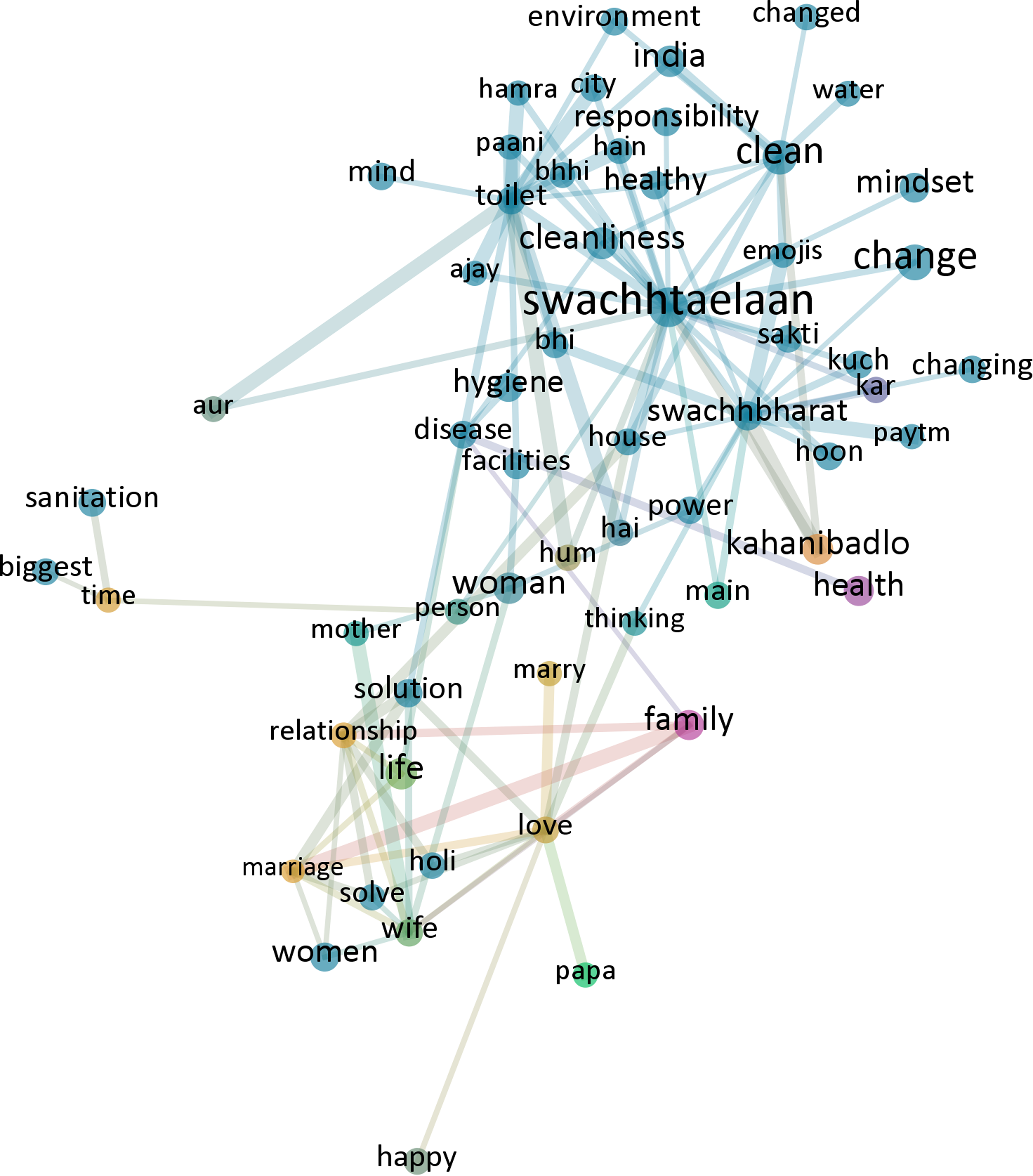
The semantic network for engagement with markers in phase 1 (January–March 2019).
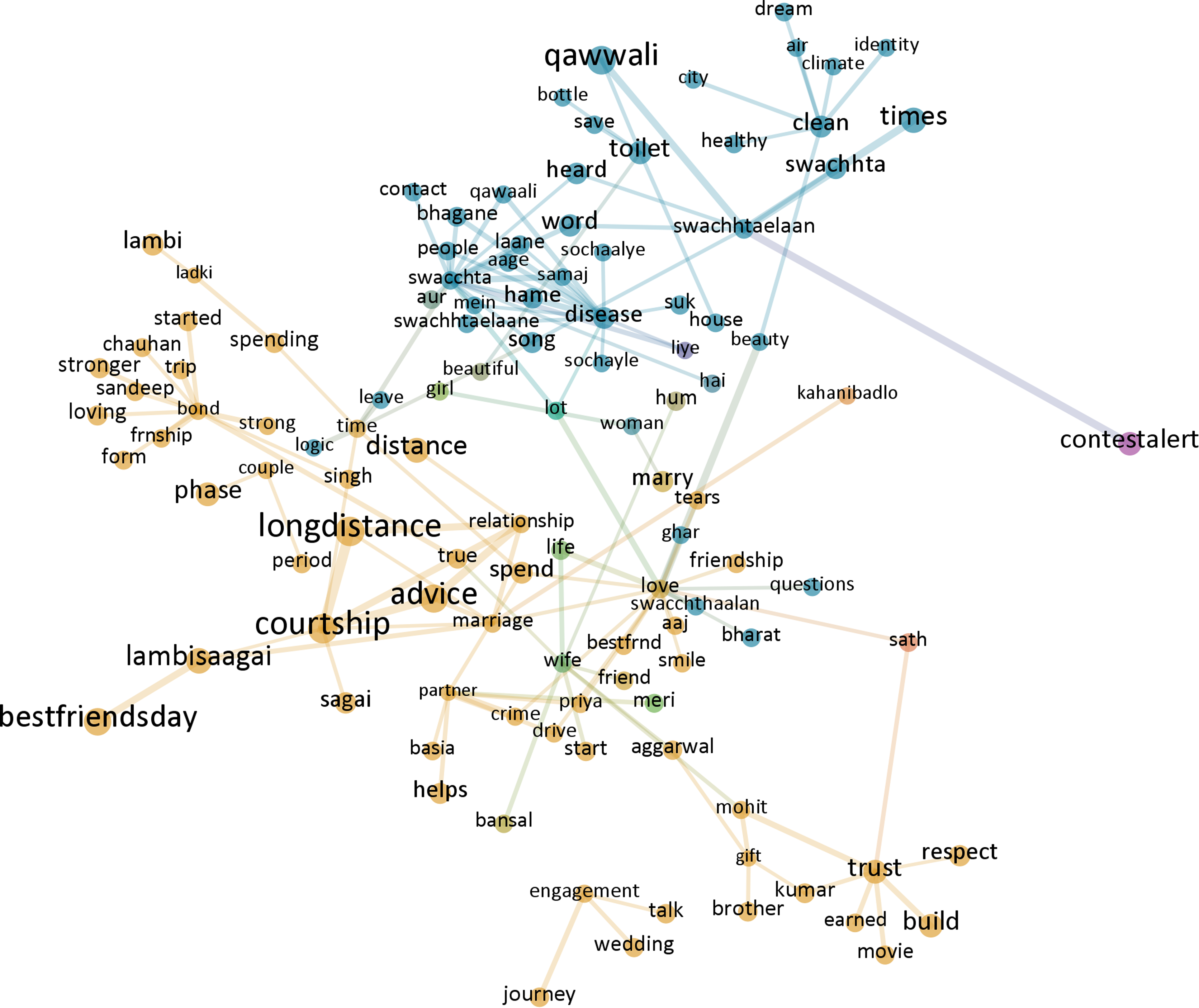
The semantic network for engagement with markers in phase 2 (April–June 2019).

The semantic network for engagement with markers in phase 3 (July–September 2019).
Swachhta Elaan (cleanliness pledge)
On 18th March, the social media team posted a scene from that day’s MKBKSH episode where Dr Sneha and Panna—who are making house visits to raise awareness for sanitation and hygiene—encounter a villager who does not want to change her old habits. Using the scene to inspire and introduce the topic of sanitation, the post invited the followers to share how they would respond if they were in the position of Dr Sneha. This post received 1500 likes, 0 shares, and 235 comments, detailing reasons why it was important to keep India’s cities and villages clean: Facebook comment #1: “Make India clean, because it’s your country, it’s your first home #Swacchaelaan.”
Facebook comment #2: “Cleaning up the country cannot be the sole responsibility of sweepers. Do citizens have no role in this? We have to change this mindset. Our first step is to help keep environment clean. #Swacchtaelaan.”
On 26th April, the social media team posted a YouTube video where Munna and Buaji perform a Qawwali song centered on the key messages of Swachhta Elaan. This song was prominently featured in Episode 18 broadcasted on 24th March. Notably, this video resulted in 7700 views, 414 likes, and 207 comments on YouTube. The post asked followers to count the number of times the word Swachhta (meaning cleanliness) occurred, but the audience was not yet asked to chime in with their views and perspectives. Therefore, on 8th May, the social media reposted the Qawwali song on Facebook, breaking it off after the first sentence to invite the audience to finish the lyrics. This resulted in 436 likes, 0 shares, and 284 comments. Most of these were poetic renditions of a clean India—that is, a reinforcement of Swachhta Elaan, “We found happiness and peace in making a toilet at home. In spreading hygiene and sanitation in the country.”
The semantic networks showed how engagement with Swachhta Elaan evolved over time. In March (Figure 2), the comments dealt with taking responsibility and changing mindsets about hygiene, and the health benefits of sanitary living that accrue to individuals, households, and communities across India. Engagement in April was limited to the Swachhta (cleanliness) word count challenge. The Qawwali challenge in May (Figure 3) received responses about how hygiene, sanitation, and cleanliness could prevent diseases and keep household members healthy.
Mast Pitara (pleasure basket)
To stimulate engagement with the Mast Pitara marker, the social media team drew extensively from clips of Panna and her Mast Pitara, Condom Baba’s quotes and riddles, and funny conversations about reproductive health between Munna and Buaji. Despite specific invitations, the audience appeared to be somewhat hesitant to respond openly. Such is understandable as reproductive health issues and discussing contraceptive options is particularly taboo in public. The social media team tried to boost meaningful engagement using lighter and more playful media formats.
A series of quizzes and puzzles with a cash prize were posted from late June to early July. These posts received 50, 118, and 76 comments suggesting user participation and positive reinforcement of the intended message. Most comments were, however, responses to close-ended questions and not directly related to markers. For example, a word finder was posted on June 25 with the message “Spot the word CONDOM and tell us how many times can you see it in the comments below,” receiving 958 likes, 1 share, and 50 comments. Although the invitation was specific, it did not invite audiences to reflect on the knowledge, beliefs, and practices associated with the Mast Pitara marker.
The social media team also tried to break the taboo nature around contraceptives through humor. Carefully constructed memes featuring Munna and Buaji as well as Condom Baba were posted. They featured funny quotes or captions and some were double-word plays. None of the memes received a substantial number of comments. Again, possibly because sex and condoms are considered too private to discuss in a rather public space such as Facebook.
On 11 July (also the World Population Day), the social media team posted a music video of the rap song Condom Bole—a tribute to one of the contents of the Mast Pitara. The song was purposely written for MKBKSH Season 3 and would later make an appearance in the television serial on 11th August (Figure 5). The Condom Bole rap represented a high-energy song and dance spectacle that was performed on stage in Pratappur’s village square. To emphasize the “protective” aspects of condoms, it featured youth in colorful raincoats negotiating a gentle downpour while multi-color umbrellas rotated over the heads of a swinging crowd. The music video was shared on social media with the following message: “Promise to use condoms and keep up with your partner for double protection and fun! Listen and share this song together too!” This post received 346 likes, 134 shares, 32 comments on Facebook and 8896 views, and 216 comments on YouTube such as these: YouTube comment #1: “Say no to unprotected sex, I am with condom, pill may have side effect… I impress with nice video.”

Condom bole rap song and dance challenge.
YouTube comment #2: “We always feel shy and don't speak on this issue but we all need to break all myths and talk on this issue.”
With the music video providing inspiration, subsequent posts on Facebook, YouTube, Instagram, and TikTok invited audiences to engage by sharing their own lyrics and music videos for the Condom Bole song, the subtext being “it is okay to talk about contraceptives.” The lyrics challenge received 3618 likes, 11 shares, and 26 comments.
The social media team received seven music videos that were later shared on Facebook and Instagram. On 26th September (also the World Contraceptive Day), the Condom Bole video was reposted together with the seven videos that were posted as Instagram stories earlier, aiming to create a safe space by also showing user-generated content. This time, the posts aimed to repeat the Qawwali format and read, “This World Contraceptive Day, complete our condom rap with your own lyrics and take your stand on male involvement in family planning. Don’t forget to use #MastPitara. Three of the best entries will win a surprise.” This post received 124 likes, one share, and 60 comments, showing the challenge to promote narrative exchange around sensitive issues in a public space such as Facebook.
The semantic networks showed that while engagement with Mast Pitara was intense, it was over a short duration and at the surface. From July to September, the marker connected a number of contraceptive options. The intense relationships were largely explained by the nature of the quizzes that asked audiences to spot these contraceptive options on images. Engagement with Condom Bole was similar, with many responses simply repeating hashtags mentioned in the social media posts. An exception was the Condom Bole lyrics challenge in September that resulted in a comment that explicitly mentioned safe sex.
Lambi Sagai (long engagement)
A series of Lambi Sagai posts in April coincided with the dramatic resolution in the ongoing love story of Panna and Sameer as they decide to delay their marriage. Interestingly, Lambi Sagai was relevant to the long-standing engagement (across all three seasons of MKBKSH) between the protagonist Dr Sneha and her fiancé Arjun as well. Like Sameer, Arjun is very understanding and supportive of Dr Sneha’s life mission. Both these couples served as role models for delaying marriage as a positive alternative to those who did not plan their families. These marker-related narrative character developments were purposely introduced to affirm and celebrate the career choices made by Panna, who becomes the Pratappur village community health worker and Dr Sneha, the medical doctor devoted to transforming her home community.
From 17th to 19th of April—the days before the last two episodes of the first part of MKBKSH Season 3 were broadcasted—the social media team posted the following on Facebook: (1) A dictionary definition introduced the marker Lambi Sagai and invited the audience to share their perspectives on the concept, which resulted in 233 likes, five shares, and 185 comments. (2) An inspirational video clip from Episode 9 broadcasted on February 23 where Panna and Sameer meet at a romantic location by the village well and talk about Lambi Sagai. The message invited audiences to share their views: “Sameer chose Lambi Sagai. If you were in his place then what path would you choose and why?” This resulted in 614 likes, 25 shares, and 248 comments. (3) A video clip from Episode 26 broadcasted on April 21 where the Pratappur Vaani community radio host Buaji explains Lambi Sagai to villagers, with the message “Who is your Lambi Sagai partner? Tag them and share your story.” This resulted in 528 likes, 12 shares, and 296 comments.
After the weekend broadcast, the social media team posted on Monday a collage of pictures with Panna and Sameer and Dr Sneha and Arjun, tapping from an abundance of narrative resources that had been provided by the television serial over the years: “Every pair has a story of their own. Share a photo with a partner, and tell your story in the comments! Don't forget to tag them!” This Facebook post received 2300 likes, 30 shares, and 245 comments, including pictures and short love stories such as these: Facebook comment #1: “Our bonding started building during our internship and those days I cannot forget there were ups and down during our internship but we able to manage it because of our understanding and also because of Lambi Sagai.”
Facebook comment #2: “Ours is a love beyond expectations and imagination, Lambi Sagai of ours built a strong bonding between us, so true and so pure …, my love for you is mountain high and river deep.”
Meanwhile, the social media team shared the same posts as Instagram stories, asking the audiences why they would support Lambi Sagai and aggregating 10 responses as a “sticky story” on top of their own Instagram page.
On 16th May, the social media team launched their Lambi Sagai Facebook Frame—a digital picture frame that Facebook users could add to their profile pictures with a simple click. By adopting the Facebook Frame, the audience was asked to endorse the idea visually, leveraging the technical infrastructure of Facebook and allowing the marker’s message to spread via personal social networks. The message read: “Share your Lambi Sagai moments on your profile picture using our new Facebook Frame. Share a screenshot in the comments maybe? We would love to see it.” This post received 130 likes, 18 shares, and 128 comments, with screenshots of the audiences’ newly framed profile pictures (Figure 6).

The Lambi Sagai (long engagement) Facebook frame launch and audience response.
In September, the social media team posted a series of Lambi Sagai memes. One meme shows Dr Sneha and Arjun dancing together and on the bottom, it says: “Hey! I just met you, I think Jaldi Shaadi (Early marriage) is crazy, Lambi Sagai maybe?” referring to Carly Rae Jepsen’ popular song Call Me, Maybe. This meme resulted in 92 likes, 1 share, and 75 comments; mostly short anecdotes about how couples met, were engaged or got married. All memes used the narrative resources at MKBKSH’s disposal, but this one also specifically invited audiences to share their views and opinions: “Lambi Sagai or Jaldi Shaadi (Early marriage), what’s your pick? Share your funny #LambiSagai moments with us.”
The semantic networks showed how engagement with Lambi Sagai evolved over time. The post series in April resulted in audiences chiming in on all the pros of a longer engagement: getting to know one’s partner, building trust, and forging a stronger bond (Figure 3). A post on best friends’ day in June was tagged with Lambi Sagai and resulted in audiences tagging their best friends in the comments. Engagement in September (Figure 4) compared Lambi Sagai with Jaldi Shaady (early marriage), stressing that Lambi Sagai offers an opportunity to create a stronger bond. During these months, memes kept audience engagement lively and fairly diverse in range.
Laadlidin (day of the beloved woman)
In late January 2019, during the first week of the broadcast of MKBKSH Season 3, the first wave of comments emerged in response to a digital story circle set up for the marker Laadlidin (Day of the beloved woman). Following the four steps of digital story circles, a Facebook post successfully initiated the process of narrative exchange: (1) an image from the television serial in which a community celebrated the birthdays of several girls was featured as inspiration. (2) The accompanying text introduced the marker: “Indians up to 25 years of age are in search of a son, while 210 million girls are unsolicited. Give daughters equal status. Celebrate #Laadlidin as her birthday” as shown in Figure 7. (3) To invite the audience to share their realities, specific calls for action were included in this post: “If you [woman] are your deeply loved by your family, share your photo with us in the comments with #Laadlidin! Don't forget to tag your friends!” This post received 11,000 likes, 139 shares, and 94 comments, of which nearly 25% included a family picture. The comments featured words such as girls, papa, mama, love, marriage, and mother, showing that the Laadlidin marker was successfully used to stimulate audience reflection and discussion about the importance of valuing girls and their important role in the family. (4) To inspire again, the social media team aggregated the inputs by posting a collage of the user-submitted pictures and issued an invitation: “Join us with your #Laadlidin! Thanks for sharing! Become a part of this [Laadli] team! Share your photo!”

The first Laadlidin (day of the beloved woman) post resulting in comments about family.
In the previous case, a digital story circle was set in motion by drawing from the narrative resources provided by the television serial. But story circles do not need to be confined to that. In mid-July, a post referred to a real-world event to spur engagement around Laadlidin (Day of the beloved woman) by connecting it to the value system beneath the marker. At that time, the venerated Indian Space Research Organization (ISRO, or India’s NASA) launched the Chandrayaan-2 rocket on its way to the moon—a high profile event of immense national pride on account of its international significance. On 22nd July, the social media team posted on Facebook an image of the two women who led the project, Ritu Karidhal, and M. Vanitha, with the following text: “Let’s celebrate this historical moment when women lead India into the frontiers of space. Tag and tell us of girls and women who are special to you and their #Laadlidin achievements that make you proud.” The post received 594 likes, 43 shares, and 113 comments, sparking social media comments about how these female scientists were “a true inspiration” for other young women in India. The subtext was that women could excel in all career tracks, including science, technology, engineering, and mathematics (STEM)—fields that are dominated by men: From the day I met you, I either wanted to be just like you or I wanted to be your best friend. You carried yourself with such grace and strength and I wanted to learn how to do the same. #Laadlidin.
The semantic networks showed how engagement with Laadlidin evolved over time. The posts in January resulted in family members expressing love and affection for each other, although this was not sustained through a series of posts (Figure 2). In July, the ISRO-post about inspirational women led to a series of comments (Figure 4).
In summary, to answer RQ1, our results detailed above suggest that markers can be used to stimulate narrative exchange around sensitive topics while preserving the original intentionality when they are embedded in social media posts that refer to a story that the audience knows and/or follows and when social media posts specifically invite the audience to share their perspective on the topic. To answer RQ2, a variety of media formats can be used to start and sustain narrative exchange: audiences can be asked to share stories in text, as poems, or as song lyrics. Similarly, audiences can be asked to share pictures or endorse key messages by applying frames or other visual filters to their photos. Lastly, audiences can also be invited to participate in dance challenges, although our data suggest that the effort requested from the audiences should not be too high as it can pose a barrier to participation.
Discussion
This study demonstrated that markers can be used to stimulate narrative exchange around sensitive topics while harnessing their original intentionality. MKBKSH Season 3 provides an example of how communication channels such as television, radio, and social media can be strategically purposed into layered interactive communication systems that offer a continuous stream of engagement points on social topics for audience members. Markers can be used to stimulate meaningful audience engagement exchange in that they link social media content formats to a corpus of meaningful stories. Program evaluators can track the digital footprints of these purposefully designed markers over time and across different platforms to gauge how norms in online conversations are shifting, enhancing the efficacy of program monitoring and assessment.
The concept of digital story circles provides a framework to develop various social media content formats for meaningful engagement and enhancing visibility on social media. The MKBKSH Season 3 television serial's narrative served as a source of resonance and inspiration for many audience members, allowing social media posts to introduce corresponding markers and invite audiences to respond with their opinions, predilections, and perspectives. This turned out to be less linear than we expected: rather than inspiring, introducing, and inviting sequentially, the different elements were often combined into one post To sustain engagement, it thus became the trick to continuously find new formats and angles to spur engagement around aspects of the markers. From the four steps in our framework, the third one—invite—seems to be of particular importance. A strong invitation often explained the difference between a handful and hundreds of comments around the featured health and social issues. These included requesting audiences to finish song lyrics; showing a scene and asking what audiences would do in the place of Dr Sneha or Panna; and inviting audiences to share their stories, comments, and pictures. These posts set social processes in motion that resulted in rich audience responses, including the posting of pictures and messages about partners, sisters, mothers, or other family members as well as messages about gender equality and the importance of clean and sanitary communities. Furthermore, by monitoring engagement around markers, we were able to harvest empirical evidence of digital story circles, showing that—in transmedia edutainment—implementing the concept can contribute to the larger strategic goals of transmedia edutainment campaigns.
Our results show that the markers that were strongly rooted in the MKBKSH Season 3 television serial proved to be the most valuable sources of conversation material, especially when the markers appeared in the television serial and social media post schedule was coordinated. The Lambi Sagai (long engagement) posts in the late April provide a pertinent example of how the social media team set a story circle in motion toward the climax of the romance between Panna and Sameer: a dictionary definition introduced the marker, dramatic scenes provided context and inspiration, and specific messages invited audiences to share their views on marriage. Drawing from the same narrative context, content formats such as memes can be used to sustain engagement in the month thereafter.
It is likely that specific invitations lowered the threshold to respond to social media messages. Conversely, when posts or markers only include a strong but close-ended message, audiences seemed less likely to comment. Such posts include slogans, quotes, or statistics and were liked and shared frequently. They increased MKBKSH Season 3’s online presence adding to its buzz and visibility.
Furthermore, our results indicate that affiliating messages with popular, knowledgeable, and inspirational characters—real or fictional (e.g. Dr Sneha as well as the ISRO team)—increases audience engagement. Affiliations of posts with real-world events such as World Population Day and International Friends Day added contemporaneous topicality. Further, the social media team deftly capitalized on the contemporaneous success of sports idols and role models such as the women scientists of ISRO and the Indian women’s world badminton champion, PV Sindhu.
This study demonstrated how technical and social infrastructures can be leveraged to stimulate and sustain narrative exchange and enhance its visibility across the timelines of the target audience. This was done by simple means such as inviting audiences to share thoughts and images in the comments, for example, but also in more sophisticated and more visible ways, such as the Lambi Sagai (long engagement) Facebook Frames. The most meaningful engagement around sensitive topics occurred when the audience members were specifically invited to address a challenge. For example, the Qawwali and Condom Bole song text challenges resulted in meaningful engagement and feedback, but the Mast Pitara (Pleasure basket) word scramblers did not. Similarly, humorous video clips and memes with Panna’s quotes or Condom Baba’s riddles received up to several hundred likes, but the responses (e.g. “ha ha” or “funny”) barely stimulated meaningful conversations on key issues in MKBKSH Season 3.
Limitations and further research
Our study also demonstrates that transmedia edutainment can benefit from a greater extent of coordination of stories, markers, and elements across various media and platforms. There were a number of posts that included markers that the tracking systems did not account for. For example, data retrieval mechanisms were not setup for TikTok and Instagram beforehand, as the social media team did not plan to use these platforms to stimulate engagement with digital markers. As the season progressed, some marker-related content was posted on these platforms, leading to a few relevant cases of meaningful engagement that were not captured adequately. Cross-tagging and non-clarity about the various spellings of markers during the broadcasting phase added to the confusion, and due to a short production cycle, the television episodes only became available a few days before broadcast, making it difficult for the social media team to adequately follow-up on all the marker opportunities.
Adapting to this situation, our collaboration with the Population Foundation of India’s social media team came to resemble action research for organizational learning: in short sprints, we collaboratively determined what to monitor and what lessons we could draw from previously monitored data. This allowed the social media team to develop and test novel media formats, and improve on what works. Nonetheless, transmedia edutainment can benefit from a better alignment between screen writing and social media strategies, for example by using an overarching “marker matrix” that shows when markers are featured on what channels.
Our study shows that the purposive implementation of markers in transmedia edutainment can contribute to harnessing and tapping into the intentionality of a campaign. As a campaign travels across cultural borders on the web, the intentionality may still be watered-down if audiences decide to do so. Systematic monitoring of markers can help to identify how markers spread, and how the meaning is renegotiated and allows practitioners to intervene early on. Furthermore, systematic monitoring allows practitioners to continuously find and finetune media content formats to stimulate meaningful engagement and leverage social influence on social media.
In closing, MKBKSH Season 3 could rely on a constant stream of new stories provided by the television serial. Grassroots campaigns such as #ChallengeAccepted cannot rely on a long-running television serial, but can be powered by the stories from the audience. For that, it could be beneficial for campaigners to go beyond simply using a descriptive hashtag. Rather, meaningfully inviting and connecting stories from the audience to newly introduced markers could help generate and spawn new possibilities and realities.
Footnotes
Acknowledgements
We would like to thank screen writer and director Feroz Abbas Kahn and Population Foundation of India for the collaboration on this project.
Contributorship
RL conducted most of the digital tracking and wrote the first draft of this manuscript. All authors reviewed and edited the manuscript and approved the final version of the manuscript.
Declaration of Conflicting Interests
This study was commissioned by Population Foundation of India (PFI) to Center for Media & Health (CMH). MB is the director of CMH and RL was an employee of the CMH at the time this research was executed. AS is an advisor to PFI.
Ethical approval
The study complies with the professional and ethical standards of Dutch academia. Ethical Review Board approval was not required for this study.
Funding
The authors disclosed receipt of the following financial support for the research, authorship, and/or publication of this article: This work was funded by PFI and supported by a grant by the Dutch Friends Lottery (Media Lab Project).
Guarantor
RL.
Informed consent
Not applicable, because this article does not contain any studies with human or animal subjects.

Trial registration
Not applicable, because this article does not contain any clinical trials.