




Abstract
Background:
Over the past three decades, the number of female farmers in the United States has increased to nearly 1 million, yet research on this occupational group is limited. Job stress arising from job dissatisfaction in other occupations is associated with both acute and chronic diseases. The purpose of this study was to examine the associations of demographic characteristics, agricultural occupational factors, and health indicators with farm-work satisfaction among female farmers.
Methods:
Cross-sectional data from the Sustained Work Indicators of Older Farmers Study (2002–2006) was used to examine older female farmers (N = 332) from North Carolina and Kentucky. This secondary data analysis used farm-work questions adapted from the Kentucky Farm Health and Hazard Surveillance Project to measure demographics and occupational factors, the 20-item Center for Epidemiologic Studies-Depression Scale to measure depressive symptoms, and a single item from the National Health Interview Survey to measure self-perceived health status.
Findings:
Controlling for demographic characteristics, work factors, and health indicators, the female farmers were more likely to report satisfaction with farm work when they had performed a greater number of agricultural tasks in the past year and if they had lower levels of depressive symptoms.
Conclusions/Application to Practice:
This study provides an initial basis for further research with women working in agriculture. Occupational health nurses, particularly those practicing in agricultural areas, can enhance their quality of care by having a greater understanding of the factors associated with farming and farm life that affect female farmers’ overall health.
Background
Increasingly, women are choosing farming as a career or are assuming greater responsibility for the farm work (Hoppe & Korb, 2013). A total of 56% of production farms in the United States have at least one female farm operator and of those, 38% have a female as the principal farm operator (i.e., the person in charge of the farm’s daily operations) (United States Department of Agriculture, National Agricultural Statistic Service [USDASS], 2019). When counting both principal and secondary (i.e., a person with an equal workload and decision-making) farm operators, the number of female farmers in the United States is nearly 1 million (United States Department of Agriculture, National Agricultural Statistic Service [USDASS], 2014). Female farm operators increased from 121,600 to 306,200 between 1982 and 2007 (Hoppe & Korb, 2013). The number of female producers increased by 26.6% between 2012 and 2017 (USDASS, 2019). These data suggest that the work of women in farming may be evolving from a supportive to a more primary role. Today’s farm women operate the farm business, and perform tasks such as baling hay, planting crops, tilling ground, livestock management, and a variety of other responsibilities historically performed by men (Hoppe & Korb, 2013). The changing occupational role of farm women has resulted in a significant gap in knowledge of the impact of farming on women’s overall wellbeing. Depressive symptoms and suicide are increasing among production farmers (Behere & Bhise, 2009; Burgard & Lin, 2013), but it is not known if female farmers also experience these problems at a similar rate. Exploring factors that impact the mental health of female farmers (e.g., job satisfaction) is critical to the wellbeing of this occupational group.
Job satisfaction is a combination of psychological, physiological, and environmental factors that result in an internal sense of satisfaction (Hoppock, 1935). Kaliski (2007) described job satisfaction as “a feeling of enthusiasm and contentment with one’s work leading to personal fulfillment.” The association between job satisfaction and physical health include enhanced cell immunity and reduced inflammatory agents (Dirlam & Zheng, 2017). Low job satisfaction also impacts mental health by increasing stress, burnout, anxiety, depression, and by lowering self-esteem (Dirlam & Zheng, 2017; Faragher et al., 2005).
Factors that influence job satisfaction include (a) appreciation for the work, (b) work-life balance, (c) good relationships with colleagues, (d) interesting job content, and (e) attractive salary (Morgan, 2014). These factors emerged from studies of nonfarm work; however, some of the factors seem to contribute to farmers’ work satisfaction (Herrera et al., 2018). Family and colleague relationships, maintenance of family values, interesting variety of job tasks, and autonomy of work contribute to farm-work satisfaction; however, there is no standard measure across studies, making a comparison of studies of job satisfaction problematic (Besser & Mann, 2015; Herrera et al., 2018; Juntunen et al., 2019).
Farming is a way of life intertwined with the land and a strong sense of family (Juntunen et al., 2019; Löfgren & Olsson, 2019). Farmers report being more satisfied with farming than with off-farm work (Juntunen et al., 2019). In Amshoff and Reed (2005, p. 306), a farmer stated, “If you are doing it because you want to, then it’s not considered work.” This feeling is shared among current generations: “I love what I am doing, if you enjoy it, it isn’t work, so I haven’t thought about retiring” (Juntunen et al., 2019, p. 5). Factors that enhance job satisfaction in the non-farmer may not influence satisfaction in the farmer. Despite long work hours, economic uncertainty, and physically demanding tasks, farmers are generally satisfied with their work, some even fearing death if they could not farm (Besser & Mann, 2015; Droullard et al., 2017; Juntunen et al., 2019).
The life of farming and the tradition of farming enhance family relationships and work-family experiences (Löfgren & Olsson, 2019; Sprung & Jex, 2017). This style of life appears to satisfy females in the farm family as well. In the few studies that included women, the female farmer’s satisfaction from farm work came from the intimate work–family environment and the spouse’s satisfaction with farm work (Sprung & Jex, 2017). The the lack of research examining the role that farm work plays among farm women yields an incomplete portrait of the female farmer who may have a different perspective of farm work than men. The purpose of this study was to explore the association of demographic characteristics, health indicators, and on- and off-farm factors with farm-work satisfaction among female farmers aged 50 years and older.
Method
Setting and Sample
This cross-sectional secondary data analysis examined the associations of personal characteristics, farm work, and health status with job satisfaction in older female farmers in Kentucky and South Carolina between 2002 and 2006. The original (parent) study was a 4-year descriptive cohort study, Sustained Work Indicators of Older Farmers, and was conducted in Kentucky and South Carolina (Reed et al., 2008). Data on demographic characteristics, farm-work exposure, physical and mental health, and sociocultural aspects of agriculture were collected.
In the parent study, data were collected via mailed surveys and telephone interviews. Five surveys were spaced 1-year apart in waves and timed to capture the seasonal aspects of farming. For these analyses, data were selected from Waves I and II. Wave I included demographic questions and Wave II included items specific to the female farmer (e.g., farm tasks, farm-work satisfaction, and the number of hours performing farm work) as well as health outcomes of depressives symptom level and self-perceived health status.
The parent study population included persons who were farmers and spouses of farmers residing in Kentucky and South Carolina. Participants were recruited from three data sources: (a) male farmers who had participated in the Kentucky Farm Family Health and Hazard Surveillance Project (KFFHHSP) in 1994–1996 (Browning et al., 1998), (b) a list of Black farmers surveyed by the Kentucky Agricultural Statistics Service (2002), and (c) a list of Black farmers surveyed by the South Carolina Agricultural Statistics Service (SCASS). The latter two sources were used to augment the sample of Black farmers. The primary farmer in the study had to self-identify as a farmer and actively participate in farm work at the time of data collection. The spouse may or may not have participated in farm work. A letter was sent to each household explaining the study prior to the first phone call. The initial phone call confirmed participation interest, assessed eligibility, and obtained verbal consent. Inclusion criteria for the parent study were (a) farmer aged 50 years or older or the spouse of a farmer who was participating in the study and (b) ability to speak or read English. The Institutional Review Boards at the University of Kentucky and Clemson University approved the study prior to data collection. Verbal consent was obtained from each participant at each data collection point. At the completion of each wave, each participant received a small monetary award.
Data were collected via computer-assisted telephone interviews or by mail if requested by the study participant. Two members in the same household (i.e., farmer and spouse) were encouraged to participate if the primary farmer enrolled. Each participant completed the survey independently. Because the focus of this study was to examine satisfaction with farm work among female farmers, only females who reported at least 1 hour of farm work in the past week (including active farming and farm-related tasks), and who also provided data on farmworker satisfaction were included.
Measures
A standard survey was used to assess gender, age (in years), race/ethnicity, and years of education. The composition of the racial and ethnic backgrounds indicated a distribution of four categories: White, non-Hispanic, African American, Hispanic/Latino, and American Indian; this variable was recoded to a binary variable of “White/non-Hispanic” with African American, Hispanic/Latino, and American Indian coded as “non-White.” White, non-Hispanic was used as the reference group. Items for the original study were adapted from questions used in the Kentucky Farm Health and Hazard Surveillance Project (Browning et al., 1998). Participants were queried (yes/no) about the types of farm tasks they had completed in the last year. Items reflected a broad range of tasks pertaining to crop production and animal care, as well as tasks related to managing the farm. Sample items in this list included “mowed fields,” “herded animals,” and “ordered farm supplies.” The total score was the number of “yes” items. Participants were also asked about the number of hours spent farming in the past week, which was categorized using the United States Department of Labor (USDL) standard less than 20 hours per week, which indicated part-time work, whereas full-time work was defined as 20 hours or greater per week (Mayhew, 2017). Those having worked 20 hours or more were coded as the reference group. Participants were also asked if they had an off-farm job in the past 12 months (yes/no).
Self-reported physical health was measured using a single item from the National Health Interview Survey: “How would you rate your health in general? Would you say it is ‘Excellent,” ‘Very good, “Good,” “Fair,” or “Poor.” Because the data were skewed toward more positive self-assessment, this variable was dichotomized prior to analysis. One group included those who rated their health as “good,” “very good,” or “excellent” and the other group comprised those whose self-rating was “fair” or “poor.”
The 20-item Center for Epidemiologic Studies-Depression Scale (CES-D) (Radloff, 1977) was used to measure depressive symptoms. The CES-D was developed to quickly measure depressive symptoms; it is one of the best-known and most widely used measures of depressive symptoms. Its reliability and validity have been supported across demographically diverse populations (Radloff, 1977; Weissman et al., 1975). Participants were asked to report the frequency of their symptoms during the last week on 16 negative and 4 positive items with response options that included “less than 1 day,” “1–2 days,” “3–4 days” and “5–7 days.” The items were totaled for a cumulative final score after the four positive items were reverse coded. The scores were then divided into two groups based on cut scores of 16 or greater to indicate at least mild to moderate depressive symptoms (Lewinsohn et al., 1997).
With regard to satisfaction with farm work, participants were asked, “Overall, how much personal satisfaction do you get from your farm work?” (no satisfaction, very little satisfaction, some satisfaction, a great deal of satisfaction).
Data Analysis
Descriptive analyses, including frequency distributions, means, and standard deviations, were used to summarize the total number of farm-related tasks, the demographic characteristics of the sample, work characteristics, and health status. The groups with high and low job satisfaction were compared on demographics, work characteristics, and health using the two-sample t-test or the chi-square test of association. Multiple logistic regression was used to test whether the personal, farm-related, and health status indicators were associated with the binary outcome of satisfaction with farm work relative to dissatisfaction. For selected analyses, only the cases that completed the key variables were retained in the subset for that analysis. Odds ratios (ORs) and 95% confidence intervals (CIs) were calculated for job satisfaction. There were no violations of the assumptions of logistic regression. An alpha level of .05 was used for all statistical tests. Analysis was done using SAS, V. 9.3. (SAS for Windows, V. 9.3, 2002–2010).
Results
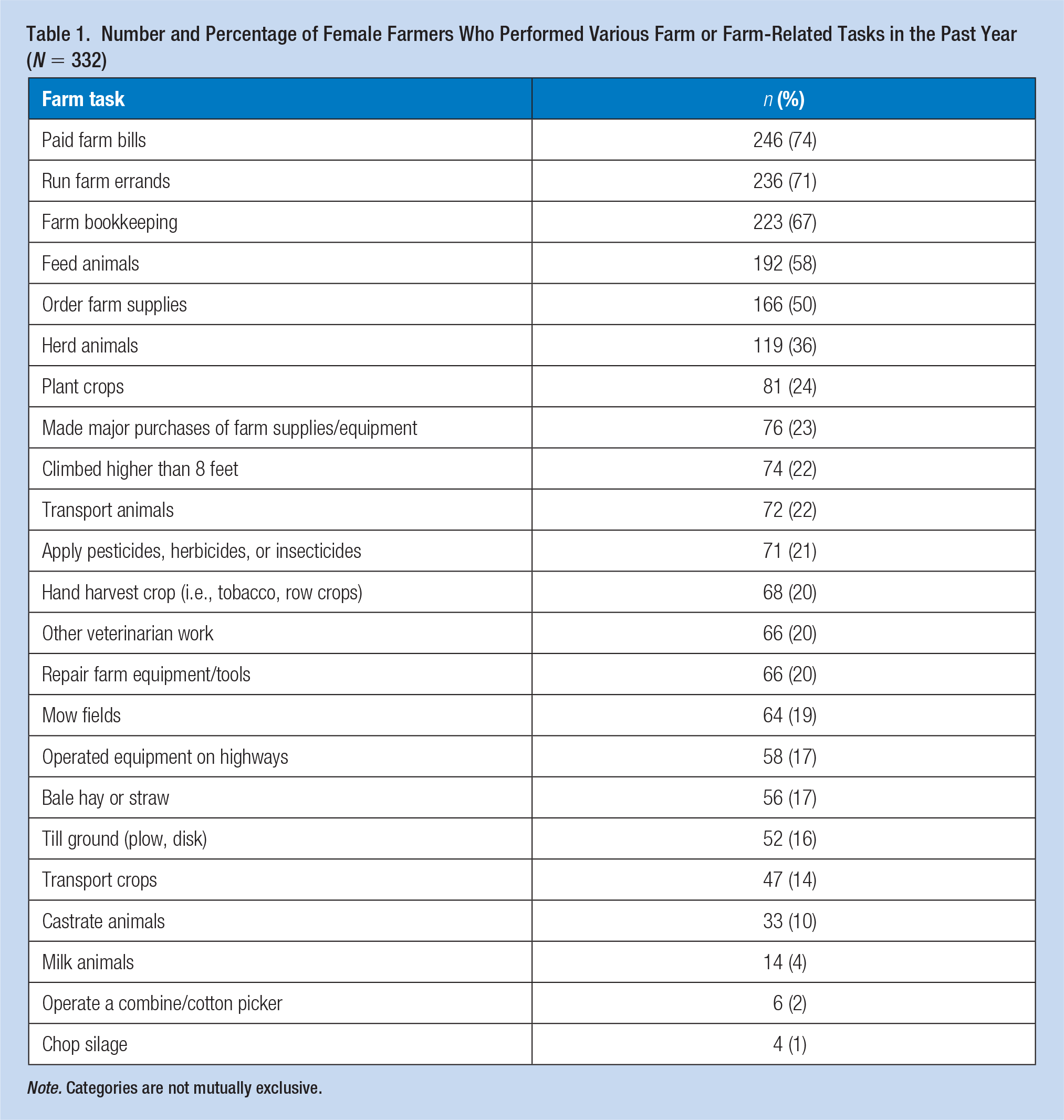
The sample included 332 women with a response rate of 43%. The mean age of participants was 63.8 years (SD = 7.87). Most of the women were White/non-Hispanic (80%). The mean years of education were slightly more than a high-school diploma (M = 12.6, SD = 2.97). The female farmers worked a mean of 13.2 (SD = 13.48) hours per week on the farm, with the majority (83%) of the sample working less than 20 hours per week on the farm. Nearly half held an off-farm job (44%) in addition to their farm role. The women were fairly active in farm work. Table 1 shows the farm-related tasks performed in the past year as reported by the sample. There were six distinct farm tasks most commonly reported as performed over the past year out of the list of 23. One-third or more of the women reported paying farm bills (n = 246), running farm errands (n = 236), farm bookkeeping (n = 223), feeding animals (n = 192), ordering farm supplies (n = 166), and herding animals (n = 119). Fewer women reported milking animals (n = 14), operating a combine/cotton picker (n = 6), and chopping silage (n = 4).
Number and Percentage of Female Farmers Who Performed Various Farm or Farm-Related Tasks in the Past Year (N = 332)
Note. Categories are not mutually exclusive.
Given that most participants (83%) chose either receiving some or a great deal of satisfaction from farm work, this variable was skewed and thus the variable was recoded as a binary indicator, little to no satisfaction and some to a great deal of satisfaction. Most rated their health as at least good, very good, or excellent (79%). Their self-reported level of depressive symptoms was also overwhelmingly positive, only 11% scored 16 or above (high level of depressive symptoms) on the CES-D.
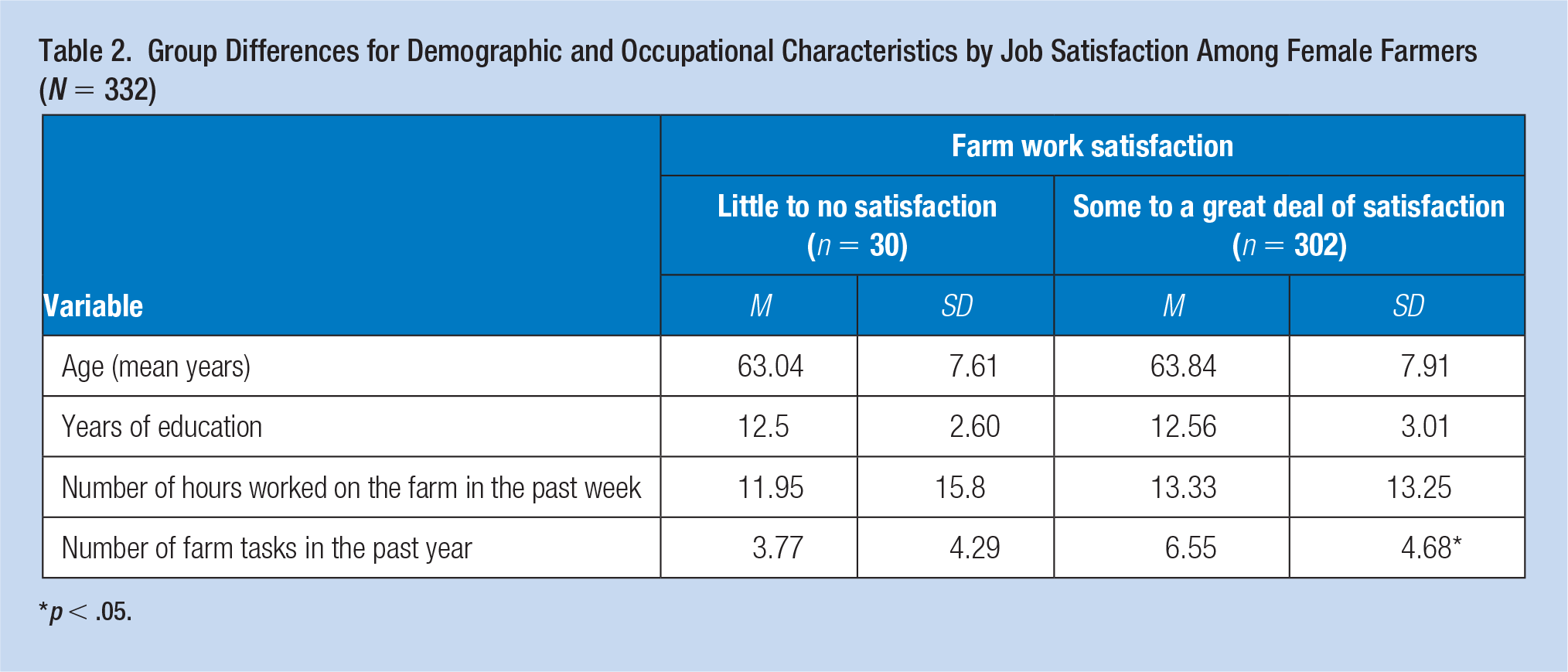
When comparing those with little or no satisfaction with their farm work (n = 30) and those with some to a great deal of satisfaction (n = 302), the number of farm tasks completed in the past year demonstrated a significant group effect (t [330] = −3.13, p = .002) (Table 2). Those with little to no satisfaction reported fewer farm tasks performed over the previous year (M = 3.8, SD = 4.3), compared with a mean of 6.6 (SD = 4.7) tasks for those in the more satisfied group (p = .002). The other group comparisons for job satisfaction by race/ethnicity, age (in years), years of education, having an off-farm job, working part-time versus full-time on the farm, number of hours worked on the farm in the past week, self-reported health rating and CES-D score were not significant.
Group Differences for Demographic and Occupational Characteristics by Job Satisfaction Among Female Farmers (N = 332)
p < .05.
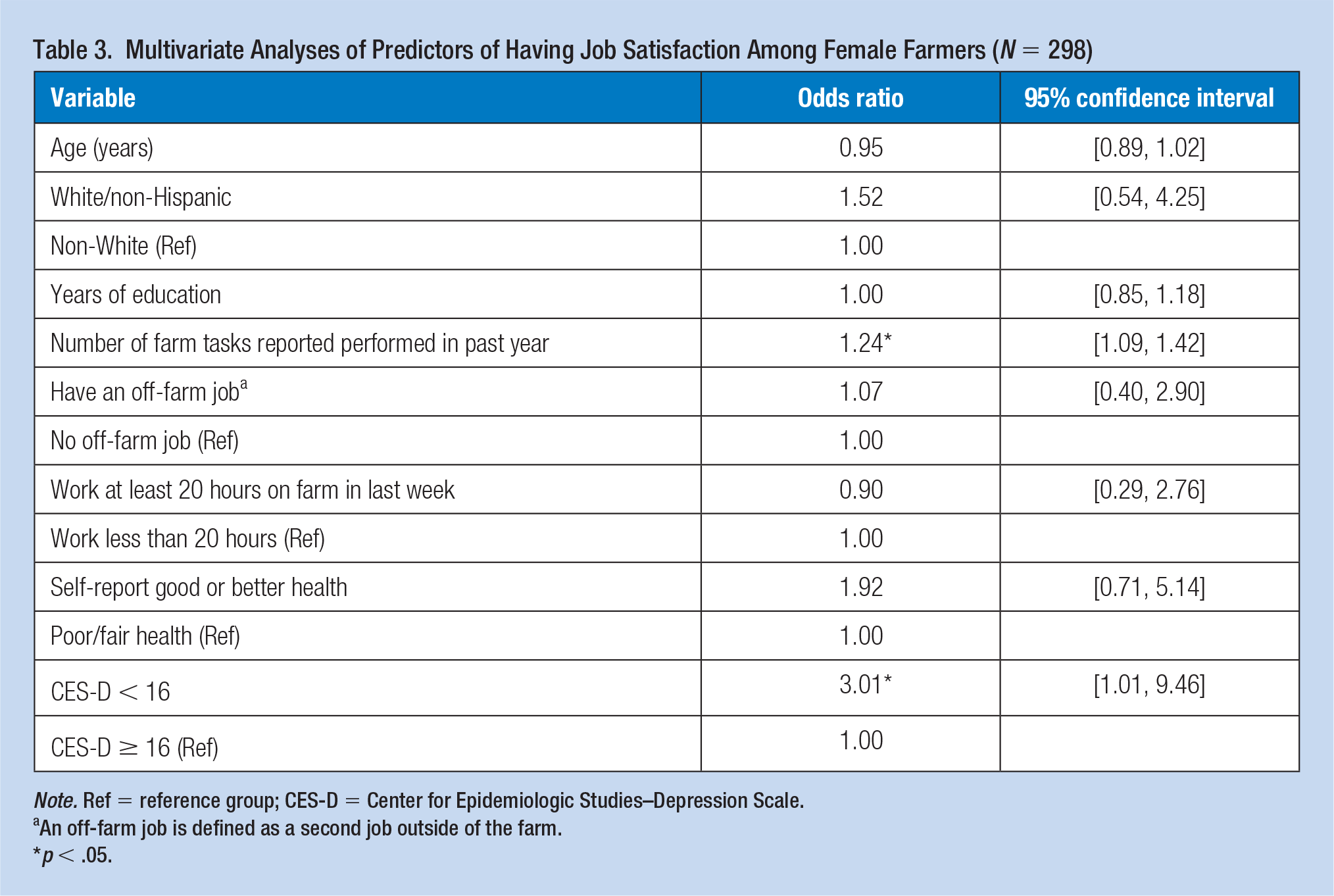
For the logistic regression model (Table 3), the variance inflation factors were all below 2.0, indicating that multicollinearity was unlikely to influence the regression estimates. Of the eight predictors in the model, only two demonstrated an elevated odds of job satisfaction including number of farm tasks in the past year (OR: 1.24; 95% CI = [1.09, 1.42]), indicating that for each additional farm task, 24% was more likely to report at least some satisfaction with farm work. Compared to participants with high levels of depressive symptoms (CES-D ≥ 16), those with a CES-D score below 16 were three times more likely to be satisfied (OR 3.10; 95% CI = [1.01, 9.46]). Other variables, including age, race/ethnicity, years of education, and having an off-farm job, the indicator for at least 20 hours of farm work in the past week, and a self-rated health level of good or better, were not significantly associated with farm work satisfaction.
Multivariate Analyses of Predictors of Having Job Satisfaction Among Female Farmers (N = 298)
Note. Ref = reference group; CES-D = Center for Epidemiologic Studies–Depression Scale.
An off-farm job is defined as a second job outside of the farm.
p < .05.
Discussion
In this study of female farmers, the performance of a greater number of agricultural tasks in the past year and a lower level of depressive symptoms were associated with farm-work satisfaction. Performing more agricultural tasks suggests women may receive intrinsic rewards from farming similar to that reported by men, and women enjoy farm work and/or do not consider some of the farm tasks as work (Amshoff & Reed, 2005). It is plausible that the autonomy of production, organization of tasks, and the craft of farming appeals to female farmers as well as male farmers (Juntunen et al., 2019; Mann & Besser, 2017).
The significance of a lower level of depressive symptoms as a predicator of job satisfaction supports the relationship between work engagement and depressive symptoms previously discussed. In a related study, greater farm-work satisfaction of female spouses of farmers aged 50 years and older was associated with fewer depressive symptoms (Rayens & Reed, 2014). Hakanen and Schaufeli (2012) found similar results: the engagement in farm work that female farmers enjoyed was negatively related to depressive symptoms and positively related to life satisfaction. These relationships, coupled with the blending of work and family farm culture that has been shown to appeal to women, may influence the overall wellbeing of the female farmer. This increase in work engagement may be associated with better psychological functioning resulting in greater satisfaction from farm work (Herrera et al., 2018; Sprung & Jex, 2017).
The “healthy” worker effect could account for our results. Men and women who report poorer health are more likely to be out of the workforce than individuals reporting excellent health and may not have qualified for the study (Johnson et al., 2017; Picciotto & Hertz-Picciotto, 2015). Although we excluded those women who did not perform farm work, the women who actively engaged in farm work may have done so because their health was better and thus, they reported greater satisfaction from the work related to a generalized sense of wellbeing, both physically and mentally. Similar to male farmers, personal satisfaction from farm work could potentially be a result of being physically able to perform that work.
Strengths and Limitations
The primary strength of this study is the large sample of female farmers from two states. One limitation is the lack of racial/ethnic diversity of the sample that limits generalizability of our findings. However, our racial/ethnic distribution is consistent with the underlying population of women on farms in these two states. An additional limitation is the small number of participants in the low-satisfaction group. While the confidence limits for the significant odds ratios were relatively narrow, suggesting model stability, we may have been able to identify other factors related to low farm-work satisfaction if more participants had a score indicating low job satisfaction. Finally, the sample largely included farm wives who may have taken a less active role in day-to-day farm tasks than their husbands, because only about a quarter reported that they had worked on the farm for at least 20 hours the previous week. While inferences can be made from these findings regarding older women who perform farm work, further studies are needed to generalize the relationships of personal, farm-related, and health-related indicators with farm-work satisfaction among female farmers of all ages. To continue this work with primary or secondary female farm operators who are younger, single, or of a racial/ethnic minority is especially important. As female farmers are progressing into a more dominant role with full or equal responsibility of farm decisions and tasks, it is likely that the type, frequency, number of, and time spent on farm task/s may change, potentially affecting the women’s level of satisfaction from farm work. These findings certainly identify a gap in the knowledge, but the largely less-dominant role in this sample of female farmers limits the generalizability of the results to women who are performing in the capacity of a principal or secondary farm operator.
Finally, this is a secondary analysis of a data set not primarily focused on job satisfaction from farm work. The data were collected by cross-sectional design, reflecting only one moment in time in an occupational culture that is highly seasonal. Dynamic variables, such as perceived health, number of hours working on the farm over the past week, and CES-D score may not consistently be reflective of their effects on job satisfaction from farm work.
Conclusion
As female farmers engage in this historically male-dominated vocation, occupational health nurses must be aware of the culture and values that may influence the health and work of women participating in production agriculture. This report provides preliminary evidence of factors that may be critical in influencing the health and wellbeing of female farmers.
Applying Research to Occupational Health Practice
The occupational nurse is aware of the effects of job satisfaction on the overall health of workers. As more research becomes available on female farmers and job satisfaction, the occupational health nurse will be able to more easily assess the factors affecting farm women’s physical and mental health and therefore, will be more easily able to identify specific resources to assist female farmers in achieving optimal wellness. It is the aspects of the agrarian culture and the factors associated with farming and farm life that occupational health nurses, particularly those practicing in agricultural populations, need to familiarize themselves with to efficiently provide culturally competent care. It is important to understand the type of farming in one’s practice community, identify female farmers in the community, and the role each of the women play on the farm as well as resources available in the community to enhance efficiency of care.
Footnotes
Declaration of Conflicting Interests
The author(s) declared no potential conflicts of interest with respect to the research, authorship, and/or publication of this article.
Funding
The author(s) received no financial support for the research, authorship, and/or publication of this article.

Author Biographies
Cheryl D. Witt is an assistant professor at the University of Louisville School of Nursing. She performed the secondary analysis of the data and interpreted the results. Dr Witt drafted the original document and revised according to recommendations from co-authors, approved the final draft, and is accountable for all aspects of the content.
Deborah B. Reed is professor emeritus at the University of Kentucky College of Nursing. She conducted the primary study upon which this manuscript is based. She contributed to the “Background” and “Discussion” sections, and edit of this paper.
Mary Kay Rayens is a professor and biostatistician at the University of Kentucky College of Nursing and College of Public Health. She provided advice on the data analysis and contributed to the “Methods” and “Results” sections, in addition to reviewing the final draft.
Sharon Hunsucker is faculty at Frontier Nursing University. She provided advice on potential predictors and editing of the final drafts.