




Abstract
This cross-sectional study explored the relationship between professional commitment and job satisfaction among nurses. A total of 132 registered nurses were recruited from a hospital in northern Taiwan. A self-reported structured questionnaire was used to collect data. Findings revealed significant differences among nurses in willingness to make an effort and their marital status, appraisal in continuing their careers, job level, and goals and values related to working shifts. Significant differences were found between inner satisfaction and work sector and marital status. Nurses’ professional commitment was strongly related to job satisfaction; aspects of professional commitment explained 32% of the variance in job satisfaction. Study results may inform health care institutions about the importance of nurses’ job satisfaction and professional commitment so hospital administration can improve these aspects of organizational environment.
Nurses’ job satisfaction is a significant issue because of its impact on patient satisfaction and health care quality (Willem, Buelens, & Jonghe, 2007). Recently, a critical shortage of registered nurses has developed worldwide, and this shortage is expected to worsen (H. Lu, Barriball, Zhang, & While, 2012). Nurses report experiencing occupational stress (Salilih & Abajobir, 2014), which, along with the shortage of qualified professional nurses, can negatively affect their professional commitment and job satisfaction (Kuokkanen, Leino-Klipi, & Katajisto, 2003). A better understanding of nurses’ job satisfaction and professional commitment could aid hospital administrators in retaining nursing staff (Lin, Wang, Li, & Huang, 2007), thus improving patient outcomes.
Gardner (1992) defined professional commitment in nursing as the intent to build a career that is a meaningful, lifelong pursuit and observed that this process is dynamic and has a variety of patterns and styles. Teng, Shyu, and Chang (2007) investigated how professional commitment moderates the effects of burnout, providing nurse managers with strategies to reduce the impact of burnout on staff. Professional commitment is (a) the belief in and acceptance of professional goals and values, (b) willingness to exert considerable effort on behalf of the profession, and (c) a strong desire to maintain professional membership (Lachman & Aranya, 1986). Furthermore, researchers have reported that the concept of professional commitment includes professional concerns, involvement, loyalty, relationships, recognition, beliefs, ethics, internal satisfaction, professional growth, and job involvement (Mowday, Steers, & Porter, 1979; Tsai, 2000).
Mowday et al. (1979) found that employees who had higher levels of professional commitment demonstrated better job performance, higher job satisfaction and productivity, and less absenteeism and tardiness. Nurses’ job satisfaction affects patient satisfaction and the quality of health services delivered (Asegid, Belachew, & Yimam, 2014). Teng et al. (2007) found that job satisfaction predicted turnover intention for nurses who had either high commitment or low commitment. Highly committed professionals are more responsive to advancing their professional value (Schlett & Ziegler, 2013; Teng et al., 2007). The traditional model of job satisfaction focuses on all the feelings that individuals have about their work (H. Lu et al., 2012). Job satisfaction refers to individuals’ overall assessment of their jobs and is a popular topic of study because of its impact on the workplace (Teng et al., 2007). Asegid et al. (2014) found that low job satisfaction might lead to a decrease in service quality and an increase in patient care costs. Fang and Hung (2014) investigated 233 married female nurses and discovered that job stress and over commitment to work were significant determinants of their health status. Based on a systematic review of 100 studies measuring the sources and effects of hospital nurses’ job satisfaction, H. Lu et al. (2012) concluded that hospital nurses’ job satisfaction is closely related to working conditions and the organizational environment; job stress; role conflict, ambiguity, perception, and content; and organizational and professional commitment. Herzberg, Mausner, and Snyderman (1959) developed a two-factor theory, wherein they hypothesized that job satisfaction results from both intrinsic and extrinsic factors. Intrinsic factors are motivating factors (i.e., personal achievement, recognition, responsibility, advancement, growth, and the work itself). Although the absence of these factors is not necessarily dissatisfying, when present, they can be a motivational force (Herzberg et al., 1959). Extrinsic factors are related to the external working environment (i.e., supervision, working conditions, coworkers, pay, policies and procedures, job security, status and personal life; Herzberg et al., 1959). Despite varying levels of job satisfaction across studies, sources and effects of job satisfaction are similar (Schlett & Ziegler, 2013). The purpose of this study was to assess the relationship between professional commitment and job satisfaction among nurses in Taiwan.
Method
This cross-sectional study recruited nurses from a northern Taiwan hospital. A structured questionnaire was used to collect demographic data as well as data on the factors affecting professional commitment and job satisfaction among nurses. Power analysis was used to calculate the appropriate sample size. An effect size of 0.2, power of 0.8, and α less than .05 were adopted for this nursing study. The calculated sample size was 132. The self-administered questionnaire was sent to all potential participants. A total of 150 questionnaires were sent and 132 were returned, yielding a response rate of 88%.
Measures
The demographic characteristics collected included age, marital status, education, work sector (department), work shift, and job level on a nursing proficiency ladder, a system with hierarchical structure that can be divided into four levels associated with an individual’s clinical abilities and proficiency growth. The four levels were N1 (responsible for basic nursing), N2 (critical care nursing), N3 (in charge of education and holistic nursing), and N4 (responsible for research and specialized nursing; Leu, Liao, Chang, & Su, 2010).
Professional commitment questionnaire
Perceived professional commitment was measured using a scale developed by the researchers after a systematic review of the literature (Lin et al., 2007; H. Lu et al., 2012; H. Lu, While, & Barriball, 2005; K. Y. Lu, Lin, Wu, Hsieh, & Chang, 2002). The scale included 26 items scored on a 4-point Likert-type scale, ranging from 1 point (strongly do not support) to 4 points (strongly support). The 26 items addressed the three main categories of professional commitment: willingness to make an effort, appraisal of continuing one’s career, and belief in goals and values. Willingness to make an effort describes the extent to which nurses are willing to exert considerable effort on behalf of the organization. Items in this section included statements such as, “I am willing to put in a great deal of effort beyond that normally expected to help this organization be successful” (Cronbach’s α = .90). Appraisal in continuing one’s career measures the degree to which employees feel that they should remain in their current jobs. Items in this section included statements such as, “I would accept almost any type of job assignment in order to keep working for this organization” (Cronbach’s α = .70). Belief in goals and values measures the extent to which nurses had strong beliefs in and acceptance of the organization’s goals and values. Items in this section included statements such as, “I am proud to tell others that I am part of this organization” (Cronbach’s α = .74). A higher score indicated greater professional commitment. The questionnaire’s Cronbach’s α value for this study was .83.
Job satisfaction questionnaire
The researchers adopted a previously validated Job Satisfaction Scale by Yeh, Liu, Ke, and Chen (2004) for this study. This self-assessment scale includes 20 items addressing two subscales that measured inner satisfaction and external satisfaction. Inner satisfaction is the satisfaction employees feel from the job itself, such as feelings of accomplishment and responsibility. Items in this section included statements such as, “the chance to work alone on the job” (Cronbach’s α = .90). External satisfaction describes the satisfaction employees garner that is not directly tied to the job itself, such as praise and positive working conditions. Items in this section include statements such as, “the way my job provides for steady employment” (Cronbach’s α = .72). To score the Job Satisfaction Scale, a 5-point Likert-type scale ranging from 1 point (very dissatisfied) to 5 points (very satisfied) was used. This instrument’s Cronbach’s α was .88 for the current study.
Ethical Considerations
This study was approved by the Chang Gung Memorial Hospital research ethics committees (Institutional Review Board approval: IRB102-3477D). The purpose of this study was explained to each participant, and they were assured that their responses were anonymous and confidential. All participants in this study were volunteers. Informed consent was obtained from every participant prior to data collection.
Data Analysis
SPSS for Windows 17.0 (SPSS, Inc., Chicago, Illinois) was used for data archiving and statistical analysis. To describe the distribution of demographic data, professional commitment, and job satisfaction, the researchers used descriptive statistics (i.e., frequency, percentage, mean, and standard deviation). Differences in professional commitment and job satisfaction by demographic characteristics were analyzed using the student’s t test or a one-way ANOVA. Correlations between professional commitment and job satisfaction were calculated using Pearson’s product–moment correlation, and a p value of less than .05 was considered statistically significant.
Results
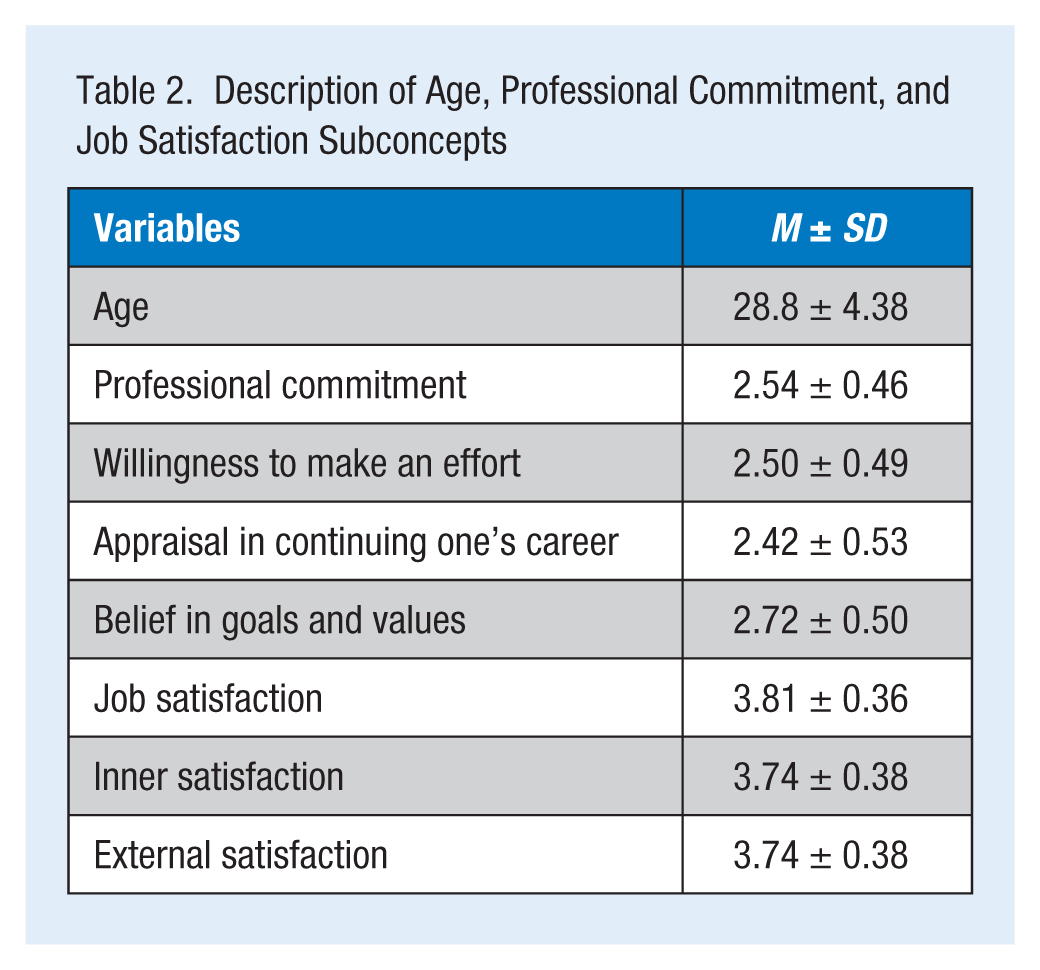
The majority of the 132 respondents was unmarried (62.1%) and had earned a college degree (58.3%); the nurses’ mean age was 28.8 years (SD = 4.38). In terms of nurses’ work life, 28.8% worked on surgical units, 73.5% worked shifts, and 40.9% were classified as N2 (Table 1). Their mean scores on professional commitment and job satisfaction were 2.54 and 3.81, respectively (Table 2). Among professional commitment factors, appraisal in continuing one’s career had the highest mean score, and willingness to make an effort had the lowest mean score. Among job satisfaction factors, external satisfaction had the higher mean score.
Sample Demographic Variables
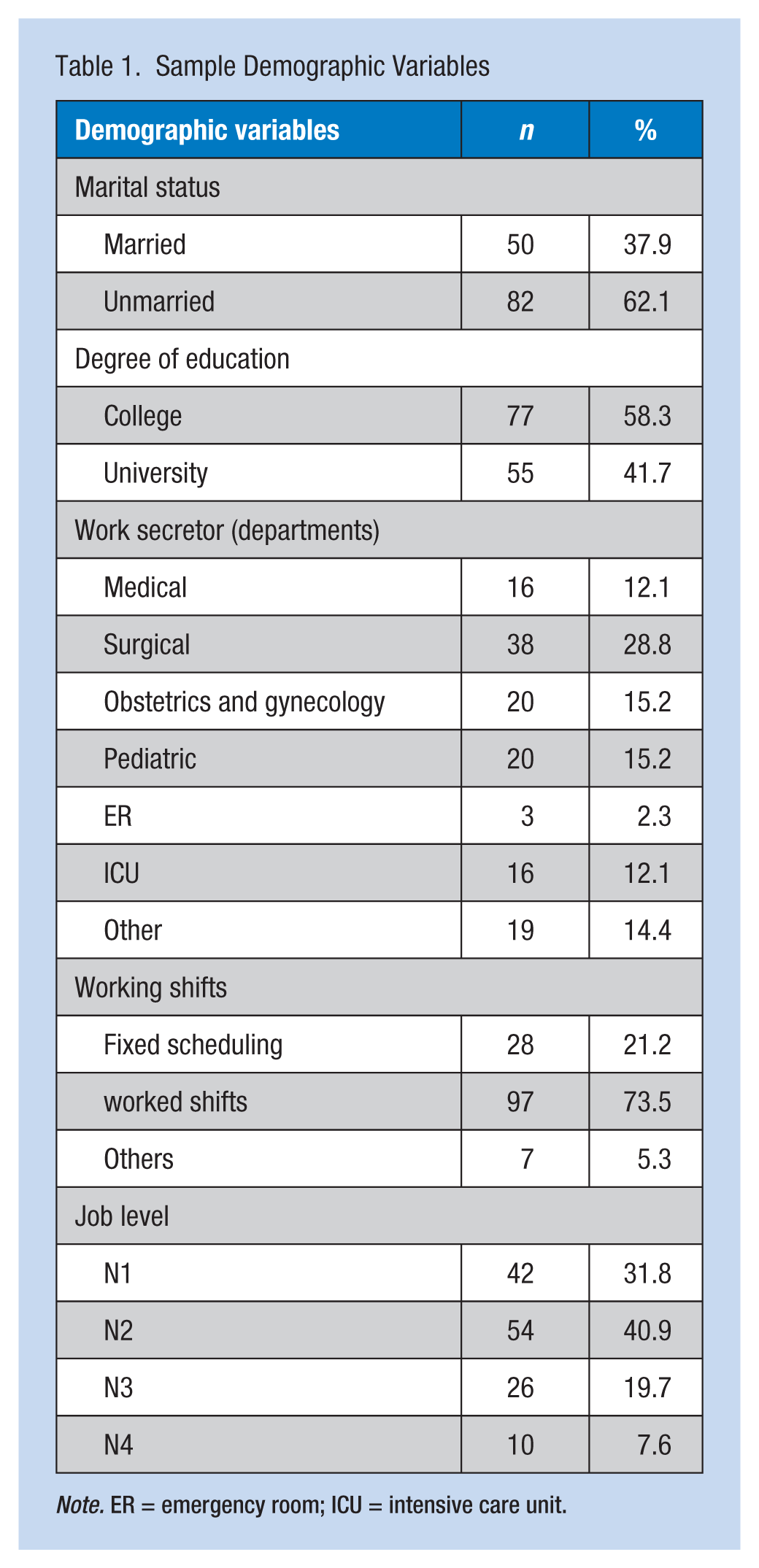
Note. ER = emergency room; ICU = intensive care unit.
Description of Age, Professional Commitment, and Job Satisfaction Subconcepts
Differences Among Participants’ Demographics, Professional Commitment, and Job Satisfaction
Results showed a significant difference between participating nurses’ willingness to make an effort by marital status (t = 1.98, p < .05). For appraisal in continuing one’s career, the data showed significant differences among participants by job level (F = 3.30, p < .05). However, this relationship was too weak to demonstrate a significant post hoc difference by group. For belief in goals and values, results showed significant differences among nurses by shift worked (F = 3.42, p < .05). Again, this relationship was too weak to demonstrate a significant post hoc difference by group. For inner satisfaction, results showed significant differences by nurses’ departments (F = 3.91, p < .01), but the relationship was too weak to demonstrate a significant post hoc difference by group. No significant differences were found between nurses’ demographic characteristics and external satisfaction (Table 3).
Relationships Among Demographic, Professional Commitment, and Job Satisfaction Variables
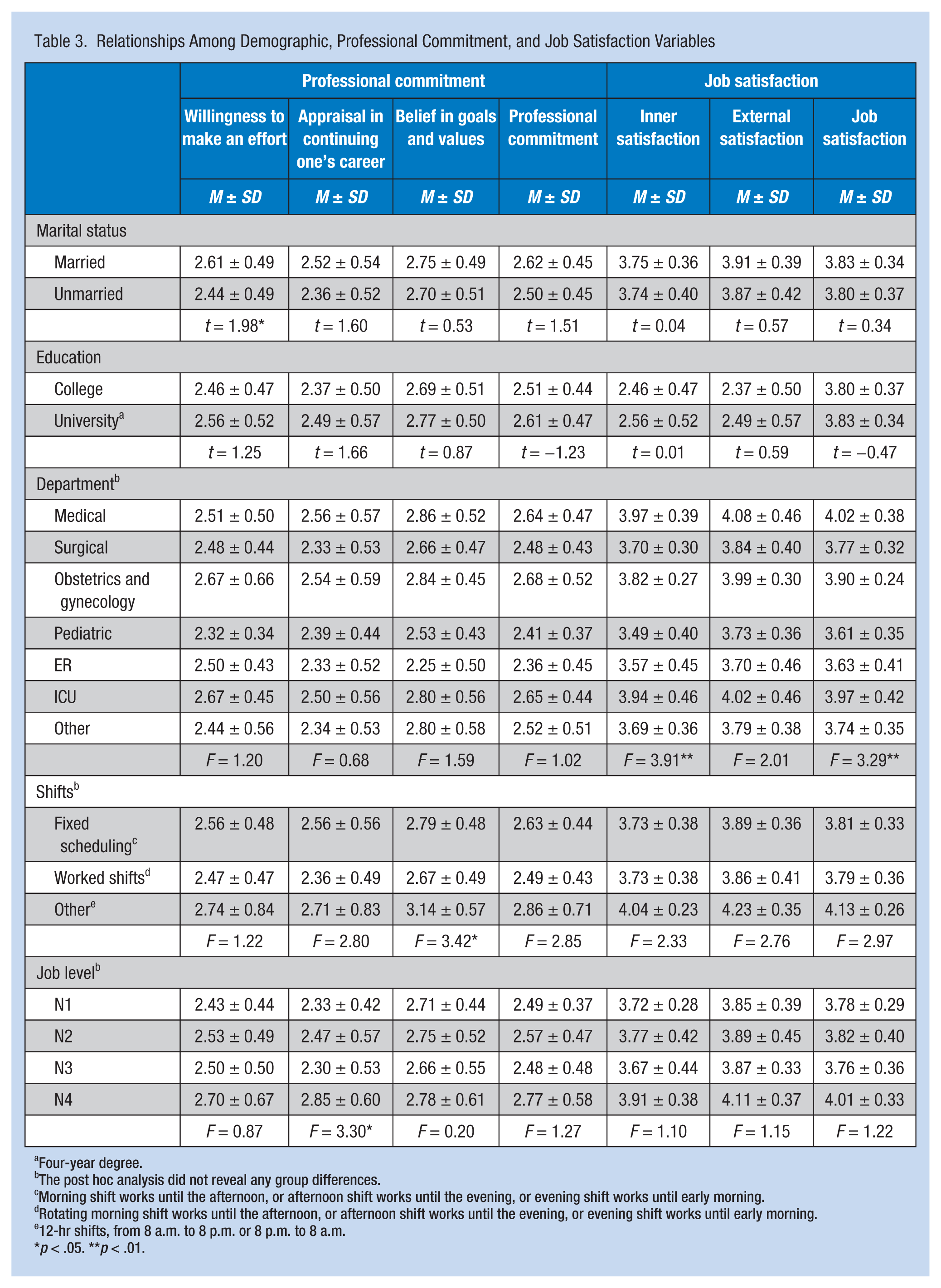
Four-year degree.
The post hoc analysis did not reveal any group differences.
Morning shift works until the afternoon, or afternoon shift works until the evening, or evening shift works until early morning.
Rotating morning shift works until the afternoon, or afternoon shift works until the evening, or evening shift works until early morning.
12-hr shifts, from 8 a.m. to 8 p.m. or 8 p.m. to 8 a.m.
p < .05. **p < .01.
Relationship Between Professional Commitment and Job Satisfaction
Relationships among willingness to make an effort, appraisal in continuing one’s career, belief in goals and values, inner satisfaction, and external satisfaction were evaluated by calculating Pearson’s product–moment correlations (Table 4). The results showed that willingness to make an effort correlated significantly and positively with appraisal in continuing one’s career (r = .77, p < .01), belief in goals and values (r = .71, p < .01), inner satisfaction (r = .36, p < .01), and external satisfaction (r = .39, p < .01). In addition, appraisal in continuing one’s career correlated significantly and positively with belief in goals and values (r = .68, p < .01), inner satisfaction (r = .39, p < .01), and external satisfaction (r = .35, p < .01). Finally, inner satisfaction correlated significantly and positively with external satisfaction (r = .71, p < .01).
Relationship Between Age, Professional Commitment, and Job Satisfaction Subconcepts
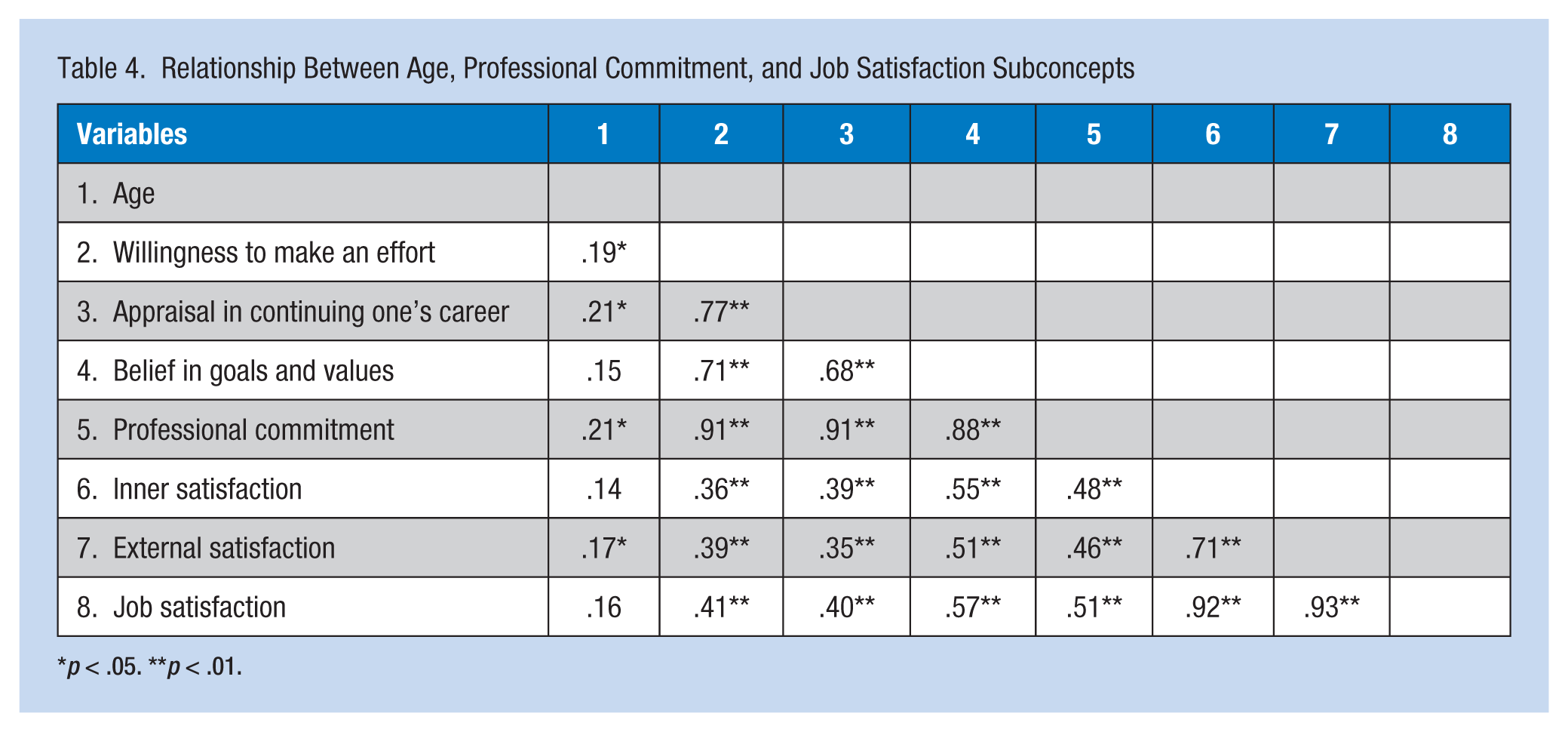
p < .05. **p < .01.
Discussion
The main objective of the present study was to examine the relationship between professional commitment and job satisfaction among professional nurses. A significant difference was found among nurses’ willingness to make an effort by their marital status. The results showed that married nurses had higher willingness to make an effort scores than unmarried nurses. This finding supported the results of previous studies (Cherniss, 1999; Korabik & Rosin, 1996). A significant correlation was found between age and professional commitment in this study, which was consistent with results of previous studies (K. Y. Lu et al., 2002; Waugaman & Lohrer, 2000), but contradictory to the study by Oladotun and Öztüren (2013) who found no statistically significant differences between age and professional commitment.
Study results also showed that most demographic variables had no statistically significant relationship to job satisfaction. This finding was congruent with results of a previous study, which showed that demographic variables do not significantly contribute to nurses’ job satisfaction (Oladotun & Öztüren, 2013).
A strong relationship was noted in the present study between professional commitment and job satisfaction. This finding confirmed the results of several previous studies (Brewer & Nauenberg, 2003; Kuokkanen et al., 2003; Lopopolo, 2002). This research demonstrated that professional commitment influences both intrinsic and extrinsic job satisfaction. This finding is also consistent with results of a previous study, which reported on the influence of intrinsic and extrinsic job satisfaction on turnover among correction officers (Udechukwu, 2007). Professional commitment and job satisfaction have more influence on nurses remaining in the profession than other forms of commitment (K. Y. Lu et al., 2002). Findings of the present study showed that willingness to make an effort, appraisal in continuing one’s career, and belief in goals and values together explained 32% of the variance in inner satisfaction and external satisfaction. This finding suggests that individuals with higher willingness to make an effort, appraisal in continuing one’s career, and belief in goals and values are more likely to experience a higher level of job satisfaction. Teng et al. (2007) also suggested that professional commitment moderated the influence of burnout on job satisfaction. Therefore, professional commitment appears to be a crucial predictor of job satisfaction.
Implications for Practice
In summary, the present study found that marital status, job level, and working shifts were associated with professional commitment; however, work sector (department) and marital status were associated with inner satisfaction. Willingness to make an effort, appraisal in continuing one’s career, and belief in goals and values together explained 32% of the variance in inner and external satisfaction. The findings of this study provide insight for nursing administrators who should be aware of and concerned with the issue of nurses’ job satisfaction. These leaders have the ability to reduce nursing turnover intention by improving nurses’ job satisfaction.
This study had several limitations, including a small sample size. A larger sample would have strengthened the significance of the findings. Data from a single medical center hospital do not guarantee the applicability of results to nurses employed in other medical centers; results may be subject to regional limitations. Also, this study was cross-sectional with structured self-reported questionnaires, which may have been subject to respondent bias. Based on the results of this cross-sectional study, the instrument needs refinement and further testing. A clear direction for future research is to improve the reliability of the measurement instruments and extend the present study to a multi-hospital validation process to ensure the applicability of the study results between professional commitment and job satisfaction.
Applying Research to Practice
Based on surveys in one hospital, registered nurses expressed that significant differences were found between inner satisfaction and work sector and marital status. Nurses’ professional commitment was strongly related to job satisfaction. Extending the present study to a multi-hospital validation process to ensure the applicability of the study results between professional commitment and job satisfaction is recommended in future research.
Footnotes
Conflict of Interest
The author(s) declared no potential conflicts of interest with respect to the research, authorship, and/or publication of this article.
Funding
The author(s) disclosed receipt of the following financial support for the research, authorship, and/or publication of this article: The author(s) would like to thank Chang Gung Memorial Hospital of Taiwan for financially supporting this research (Contract No. CMRPF 170091).
Author Biographies
The specialties of Dr. Hsu are in women’s health and cancer nursing. She used to work in Chang Gung Memorial Hospital as a head nurse. She also works as a nursing consultant in a medical center in Northern Taiwan.
The specialties of Miss Wang are in evidence-based nursing and nursing education. She also works as an internship instructor in a medical center in the Junior College of Medicine, Nursing and Management.
The specialties of Miss Lin are in evidence-based nursing, women’s health, and nursing education. She also works as a nurse researcher in a medical center in Northern Taiwan.
The specialties of Dr. Shih are in fibromyalgia and nursing education. She previously worked in New York City as an assistant director in hospitals. She now works as a nursing consultant in a medical center in Northern Taiwan.
The specialties of Dr. Lin are in evidence-based nursing, Aboriginals, and nursing education. She also has worked as a nursing consultant in a medical center in Northern Taiwan.