




Abstract
Sleep and work schedules differ considerably between rail workers and the broader U.S. workforce. Due to extended work hours and night shift schedules, train and engine service workers who operate passenger trains or move freight are most vulnerable to fatigue. This article addresses the need for comprehensive fatigue risk management systems (FRMS) for rail operators. Using a transactional ergonomic perspective, FRMS are discussed with a focus on fatigue education and administrative controls to reduce feelings of tiredness, low motivation, poor concentration, and low physical activity among mass transit rail operators. Recommendations for intervention implementation and evaluation are provided.
Fatigue is a common health problem affecting more than a quarter of U.S. adults (Blackwell & Clarke, 2013; Centers for Disease Control and Prevention [CDC], 2013a; HealthyPeople, 2014). Physical and subjective effects of fatigue can be detrimental to overall quality of life and well-being, and sleep deprivation is a significant contributing factor (CDC, 2013a; HealthyPeople, 2014; Lerman et al., 2012; Newman, 2013; Seaward, 2012). Nearly 30% of employed U.S. adults experience insufficient sleep (CDC, 2014). These workers are more likely to have night shift schedules and work in transportation and warehousing industries (Lerman et al., 2012). One of the top 10 priorities for the National Transportation Safety Board (NTSB; 2014a) is a focus on public mass transit by rail.
Sleep and work schedules differ considerably between rail workers and the broader employed adult population. Rail workers are likely to have up to 7 hours less sleep on workdays compared with other workers (U.S. Department of Transportation [USDT], 2013). Among the various types of rail workers, train and engine service workers who operate commuter and passenger trains and move freight are most vulnerable to fatigue due to extended work hours and night shift schedules (USDT, 2013). The association between fatigue and shift work, and the impact this association can have on safety and efficiency in the workplace, is well documented (CDC, 2013b; Dorrian, Baulk, & Dawson, 2011; Lerman et al., 2012; NTSB, 2014a; USDT, 2013).
Rail Accidents and Fatigue
Feelings of tiredness underlie the human factors that have contributed to about one third of rail accidents, injuries, and deaths in the United States (USDT, 2012, 2013). Fatigue increases the likelihood of an accident related to human factors from 11% to 65% above what is normally expected by chance (USDT, 2013). However, rail accidents related to fatigue are underreported; only one reporting code, known as H104 or employee asleep, is used to categorize these occurrences (NTSB, 2014b; USDT, 2013). As such, nationally, only 18 accidents were reported from 1990 to 1999 as an H104, and even fewer through 2013 (USDT, 2013).
New York’s Metropolitan Transit Authority (MTA), for example, a massive rail system that ranks seventh in the world in ridership and employs nearly 45,000 workers in the city’s five boroughs, has had 13 accidents logged between the years 2000 and 2014 (MTA, n.d.-a, n.d.-b; NTSB, n.d.). Seven of these accidents were cited as being related to human factors and inattentiveness, and five of these occurred on the Metro-North Railroad (NTSB, n.d.). Only one accident at the MTA has been coded as an H104 over the past 14 years, and this accident also took place on the Metro-North Railroad (NTSB, n.d.). A special investigation report was conducted because of the recent series of five accidents at Metro-North over a 1-year period (NTSB, 2014a). Among the top organizational concerns cited in the report is the lack of a fatigue risk management program that may have prevented the most recent sleep-related accident (NTSB, 2014a).
Fatigue Risk Management
The transactional ergonomic perspective (TEP) suggests workers’ beliefs, attitudes, and susceptibility to fatigue, coupled with the stressors of the workplace environment, shape their appraisal processes and ability to cope (Matthews, 2002). This is the foundational framework of any comprehensive fatigue risk management system (FRMS). Workplace safety departments that have a risk management program for fatigue generally address workplace design and the environment; administrative controls such as scheduling, workload, and staffing; sleep hygiene education and management of sleep disorders; and monitoring of fatigue and worker attentiveness (Lerman et al., 2012). These efforts are also coupled with general medical surveillance of sleep health, sleep disorders, and medication use. These components in total comprise the FRMS that was developed as a multitiered approach to minimize and manage the body’s response to fatigue in the workplace. The system addresses not only the education and training of workers in their management and coping techniques to combat fatigue but also the workplace environment, such that stress related to the nature of the work is minimized.
Recommendations for Program Planning and Evaluation
Fatigue risk management varies across organizations and no one type of program may fit all worksites. Implementation, however, of at least two components of the FRMS, fatigue education and administrative controls that reduce work intensity, may be a start, particularly for worksites that lack a fatigue program.
Research on fatigue among rail workers generally involves short-term diary studies that gauge 14 days of work activity, sleep and rest behavior, and commuting (USDT, 2012). Descriptive studies have targeted the hours when rail workers sleep and work, and the trends in sociodemographic and lifestyle factors associated with these behaviors. Variables such as family composition, daily activities, sleep disturbances, health status, and health behavior; work duration and intensity; and scheduling and shift work/night shifts have been investigated in comparing types of rail work and understanding associated symptoms of fatigue on the job (Dorrian et al., 2011; Lerman et al., 2012; Paterson, Dorrian, Clarkson, Darwent, & Ferguson, 2012; USDT, 2013). Australian-based studies on rail workers have used standardized fatigue and workload questionnaires, wrist actigraphs, and 14-day sleep diaries to determine the influence of sociodemographics, health behavior, work duration, and night shift schedules on sleep behavior and fatigue (Dorrian et al., 2011; Paterson et al., 2012). Studies focused on the short-term effects of increased work breaks have utilized a 5-day intervention of intermittent standing periods to gauge the impact of rest on fatigue and musculoskeletal symptoms (Thorp, Kingwell, Owen, & Dunstan, 2014).
Fatigue risk management interventions targeting rail operators should involve self-monitoring through work and sleep diaries for at least 14 days (Lerman et al., 2012). Early phases of the intervention can address fatigue education and changes in administrative controls in terms of quantity and duration of work breaks to reduce subjective symptoms of fatigue.
Fatigue education is an alertness training program for managers and employees to address knowledge, attitudes, beliefs, and susceptibility to fatigue (Lerman et al., 2012). For rail workers, fatigue education may be measured by knowledge of fatigue, sleep hygiene, and coping strategies. The National Institutes of Health (NIH) Teacher’s Guide on misconceptions about sleep (NIH, n.d.) and the Patient Knowledge Assessment Tool—Fatigue (Pain Resource Center—City of Hope, 2014) have questionnaire items that address fatigue knowledge. Administrative controls are measures regarding the operations of the workplace and could involve three to four scheduled breaks per shift for rest or exercise, social interaction, and food. According to a review of FRMS literature by Lerman and colleagues (2012), these breaks can be longer than the standard break, lasting a minimum of 20 minutes. Work breaks can also be documented using a work diary. The outcome variable, subjective symptoms of fatigue, encompasses feelings of tiredness, low motivation, reduced concentration, and reduced physical activity. Items from the Checklist Individual Strength (CIS20-R) are widely used internationally and can gauge such symptoms of fatigue (Beurskens, Bültmann, & Kant, 2000; Dabrowska-Makoweic & Koszada-Wlodarczyk, 2006). Sleep and work diaries can also be used to measure sleep loss and feelings of mental tiredness at work. Demographic variables such as age, gender, marital status, job title, and time employed at job can be collected as well via items from the Workplace Health Site Interview questionnaire (CDC, 2013b).
Upper management involvement will be key in implementing fatigue education sessions and mitigating alertness through extended work breaks. Administrators can build participant buy-in, shape the work culture, and heighten awareness about the importance of fatigue and sleep deprivation. Incentives may be provided to participants and a recruitment coordinator could facilitate the distribution and completion of diaries and self-administered questionnaires, which will increase completion and allow participants to ask questions. Information bias in terms of recall and demand characteristics can play a factor, particularly among workers where recent fatigue-related accidents are salient.
Workers should face minimal risks by taking part in a fatigue risk management intervention. Questionnaire items (including sleep and work diaries) will require participants to share personal information that may make them feel uncomfortable, stressed, or upset. Potential physical and/or mental health risks may be associated with lifestyle changes or work-related behavior changes that participants may make during a fatigue risk management intervention. Medical surveillance staff should be involved in the monitoring and care of all intervention participants.
Program evaluation can also be done using pre–post measures. The use of randomization techniques and the selection of comparable groups as controls can increase the potential to demonstrate benefit to management. Control group workers may be interviewed at baseline and monitored using sleep and work diaries. The sample workflow diagram in the Figure illustrates how a control group of rail operators might be included in the intervention evaluation plan. Face-to-face contact and informational talks at the worksite, mailed flyers, and recruiter phone calls may be used in recruitment efforts. Assuming the pilot intervention benefits workers, the provision of fatigue education for any control group participant will address potential ethical concerns in terms of receipt/nonreceipt of intervention components.
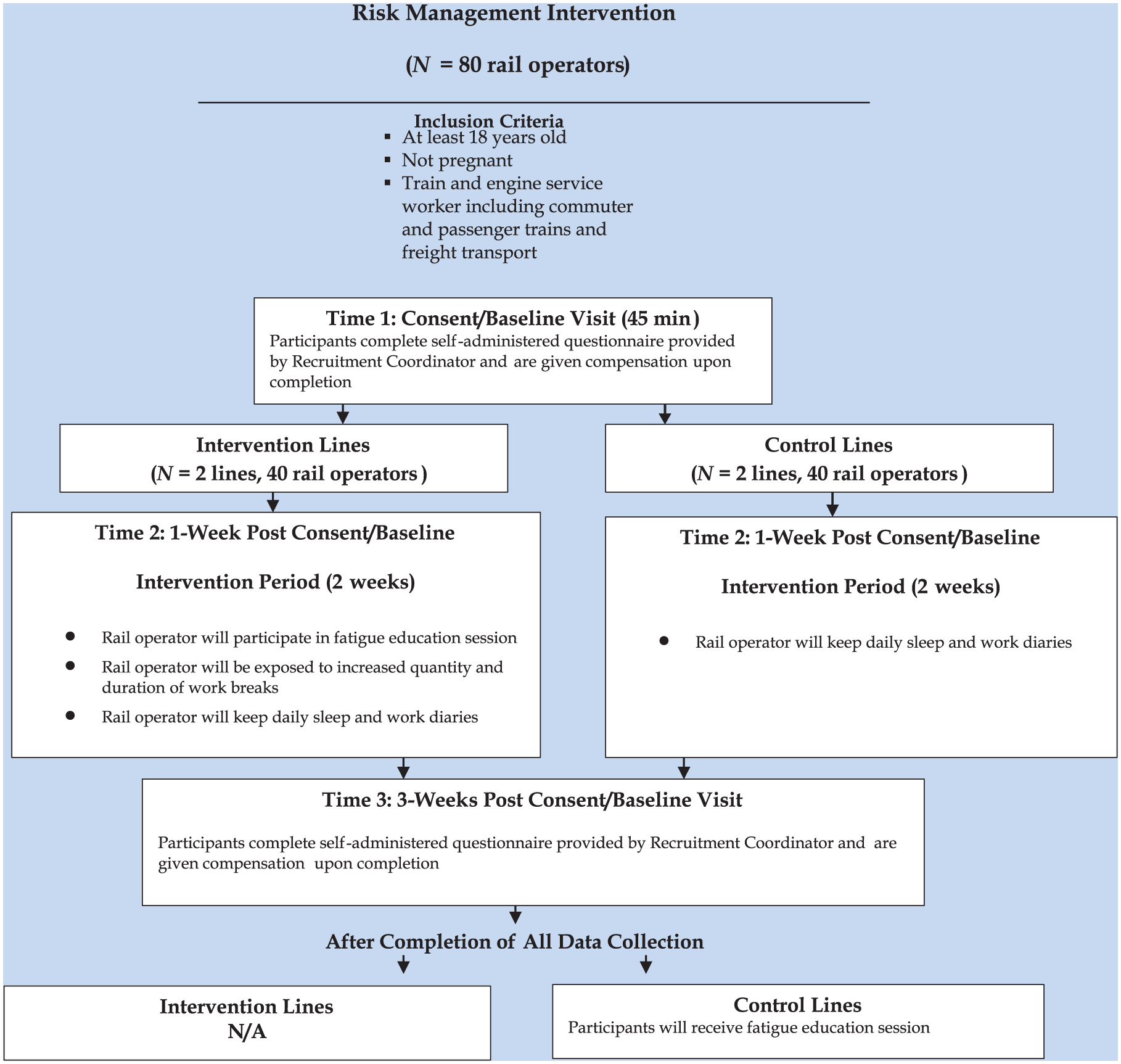
Sample participant flow diagram for rail operator fatigue risk management intervention (N = 80 rail operators).
Discussion
Implementation of FRMS for rail operators is imperative for mass transit systems and is among the top concerns identified by the NTSB. A comprehensive FRMS program involves several components. Introducing a fatigue risk management intervention may require multiple phases, testing, and evaluation to determine the efficacy of specific strategies and to identify improvement in workers’ symptoms. Evaluation should be an integral part of any health program (from the beginning) and key stakeholders should be involved in intervention development. Assessment of best practices in reducing sleep deprivation and fatigue for drivers is well documented; however, developing the proper program fit can be a challenge. In the first phase of implementation, key intervention components may include use of sleep and work diaries, fatigue education sessions, and changes to the work culture to decrease the intensity of the work. Integration and support from upper management and administrators can increase buy-in and participation.
Footnotes
Conflict of Interest
The author(s) declared no potential conflicts of interest with respect to the research, authorship, and/or publication of this article.
Funding
The author(s) received no financial support for the research, authorship, and/or publication of this article.
Author Biography
Ajeenah L. Haynes is a medical sociologist and survey researcher. She has a public health background in behavioral science and health promotion. Her work focuses on vulnerable worker groups in terms of health disparities and illness behavior, as well as psychosocial stress and fatigue.