




Abstract
The present study examined the association between shift work and fatigue among male (n = 230) and female (n = 78) police officers. A 15-year work history database was used to define dominant shifts as day, afternoon, or night. A 10-item questionnaire created from the Standard Shiftwork Index (SSI) assessed fatigue. Gender-stratified analyses of variance and covariance and Poisson regression were used to compare means and prevalence of individual items across shifts. No significant differences in total fatigue scores were observed across shifts. However, the prevalence of the fatigue item “feelings of tiredness” was 89% higher among male officers working the afternoon shift compared with officers working the day shift (prevalence ratio [PR] = 1.89, 95% confidence interval [CI] = [1.12, 3.23], p = .020), after adjustment for covariates. Women reported a lower prevalence of tiredness than men on the afternoon shift. Organizations with afternoon shift workers should consider reducing fatigue at work through education and other methods.
Fatigue is difficult to define because of its multifaceted complexity. Moore-Ede, Davis, and Sirois (2010) defined fatigue as an impairment of mental and physical function, including sleepiness, affected physical and mental performance, depressed mood, and loss of motivation. Other researchers have defined fatigue as tiredness, exhaustion, and less capacity to perform necessary functions brought on by long periods of activity (Bokesem & Tops, 2008; Ricci, Chee, Lorandeau, & Berger, 2007; Stasi, Abriani, Beccaglia, Terzoli, & Amadori, 2003). Frone and Tidwell (2015) extended the concept of fatigue by proposing three work resource–specific factors: (a) Physical work fatigue represents extreme physical tiredness, (b) mental work fatigue represents extreme mental tiredness, and (c) emotional work fatigue represents extreme emotional tiredness. For the present study, the authors used the Frone and Tidwell (2015) definition as applied to work fatigue and feelings of physical and mental tiredness. Fatigue is of particular interest to police officers. Not only does fatigue affect tiredness, but may also affect the health status of officers (Vila, 2006; Violanti et al., 2017) and elevate their risk of on-duty injuries (Fekedulegn et al., 2017) and even occupational decision making. Thus, addressing officer fatigue is of interest to not only officers, but governments and communities as well.
According to the Bureau of Labor Statistics (BLS; 2016), approximately 806,400 police officers were employed in the United States in 2014. The number of police officers is expected to rise to 839,500 by 2024 (BLS, 2016). Police officers work 24 hours a day, 7 days a week and therefore require shift work. The demands of shift work have been shown to result in fatigue in other workers (e.g., nurses, construction workers, and police officers). However, studies generate conflicting results about the relationship between shift work and fatigue. The relationship between sleep and fatigue is complex yet highly interrelated (Basinska & Wiciak, 2012; Senjo, 2011). The demands of police work are thought to relate to this current study’s focus on fatigue in several ways.
Specifically, individuals in this occupation work shifts, often for long hours, and experience less nightly sleep, an especially serious concern for police officers who are overly tired and sleep deprived on duty (Vila, 2006; Vila & Kenney, 2002). In a recent police sample (Ma et al., 2013), 32% of officers averaged fewer than 6 hours of objectively measured sleep per night. Van Dongen, Maislin, Mullington, and Dinges (2003) found chronic restriction of sleep to 6 hours or less per night can produce cognitive performance deficits equivalent to up to two nights of total sleep deprivation.
Rajaratnam et al. (2011) surveyed 4,957 police officers on matters of sleep and fatigue and found that 40.4% screened positive for at least one sleep disorder, 33.6% screened positive for obstructive sleep apnea, 26.5% for moderate to severe insomnia, and 5.4% for shift work disorder. Of the total cohort, 26.1% reported falling asleep while driving. Senjo (2011) found “extraordinarily” elevated levels of fatigue in police officers due to a high prevalence of fatigue and reduced sleep risk factors (e.g., secondary employment, overtime, and night shift work).
Shift work can contribute to fatigue and tiredness by affecting circadian rhythms, contributing to sleep insufficiency, and disrupting familial and social life (Akerstedt, 2003; Camerino et al., 2010; Ohayon, Smolensky, & Roth, 2010; Violanti et al., 2017; Wirth et al., 2011). Although shift work and fatigue have been largely studied, little evidence is available on gender differences in fatigue among police officers across various shifts. In the present study, the authors examined the association of shift work and tiredness, a symptom of fatigue, among urban police officers and assessed whether the association varied by gender.
Method
Data from the Buffalo Cardio-Metabolic Occupational Police Stress (BCOPS) study were used for the current analyses. The BCOPS study was a cross-sectional study that investigated the associations between occupational stressors and the psychological and physiological health of police officers (Violanti et al., 2006).
Sample
The study was initiated in 2004, and a total of 710 police officers who worked with the Buffalo Police Department in New York were invited to participate in the BCOPS study; 464 (65.4%) officers agreed to participate and were examined between May 19, 2004, and October 2, 2009. No specific inclusion criteria limited participation in the study, except that participants were required to be sworn police officers and willing to participate. Written informed consent was collected from each participant. Data were collected at the Center for Preventive Medicine, State University of New York at Buffalo. The study was approved by the Internal Review Board of the State University of New York at Buffalo, and the National Institute for Occupational Safety and Health (NIOSH) Institutional Review Board (IRB). In the present study, the analytic sample included 308 officers with complete data on shift work and fatigue.
Measures
A 15-year work shift history database (from May 23, 1994, to date of the BCOPS study examination), day-by-day accounts of start time and hours worked, was used to define shifts as day, afternoon, or night. The shift an officer spent the majority of hours was considered the dominant shift. The methodology for derivation of dominant shift as day, afternoon, or night is described elsewhere (Fekedulegn et al., 2013).
Chronic fatigue was assessed using the Standard Shiftwork Index, a 10-item questionnaire developed by Barton et al. (1995). In the current study, the questions about chronic fatigue were introduced with this statement: The following items relate to how tired or energetic you generally feel, irrespective of whether you have had enough sleep or have been working very hard. Some people appear to suffer from permanent tiredness, even on rest days and holidays, while others seem to have limitless energy. Please indicate the degree to which the following statements apply to your own normal feelings.
The study participants were asked to rate (score) each of the 10 items on a 5-point Likert-type scale (1 = not at all, 2 = little, 3 = somewhat, 4 = much, and 5 = very much). The questionnaire consisted of five negative items (I usually feel drained, I feel tired most of the time, I usually feel rather lethargic, I often feel exhausted, and I feel weary much of the time) designed to measure general feelings of tiredness and lack of energy. The remaining five items (I generally feel I have plenty of energy, I generally feel quite active, I generally feel full of vigor, I generally feel alert, and I usually feel lively) were positively worded to measure general feelings of vigor and energy (the opposite of fatigue). A single total score was computed by summing the ratings from the 10 items after reverse coding the five positively oriented items. A higher score indicates greater feelings of chronic fatigue. In addition, the chronic fatigue questionnaire was introduced to the BCOPS study 9 months after the start of the first clinic examination (Fekedulegn et al., 2017), and hence, only 316 of the 464 participants had the opportunity to complete the questionnaire. The remaining 148 officers who did not complete the fatigue questionnaire were excluded from analyses. The instrument has high reliability with a Cronbach’s alpha coefficient of .84 (Cohen, Manion, & Morrison, 2000). For this sample of officers, the estimated alpha coefficient was .94.
Assessment of Covariates
Study participants self-reported demographic and lifestyle characteristics including age, gender, race/ethnicity, marital status, education, rank, smoking status, alcohol consumption, and physical activity. Height and weight were measured with shoes removed and recorded to the nearest half centimeter and rounded up to the nearest quarter of a pound, respectively; body mass index (BMI) was calculated as weight in kilograms divided by height in meters squared. Physical activity was assessed using the Seven-Day Physical Activity Recall questionnaire developed for the Stanford Five-City Project (Sallis et al., 1985). Alcohol consumption per week was derived from data collected using the Food Frequency Questionnaire (FFQ) where, among other things, the officers also reported how often they drank the following amounts of alcoholic beverages: beer (12 Oz), red wine (6 Oz), white or rose wine (6 Oz), and liquor and mixed drinks (1.5 Oz). One drink was defined as a 12-ounce can or bottle of beer, one medium glass of wine, or one shot of liquor.
Statistical Analysis
Two main analyses were conducted. First, the authors compared mean values of the overall chronic fatigue score across dominant shift using an ANOVA/ANCOVA procedure. Second, the prevalence of individual fatigue items was compared across dominant shift. For this analysis, the authors first classified the ratings for each item into two categories: Those who rated the item as 1 (not at all) or 2 (little) were collapsed in one group (referent group), and those who rated the item as 3 (somewhat) or 4 (much) or 5 (very much) were combined into a second fatigued group. The relationship between shift work and each individual fatigue item was examined using Poisson regression. All analyses were stratified by gender and conducted using the SAS System, version 9.3 (2017; SAS Institute, Cary, NC).
Results
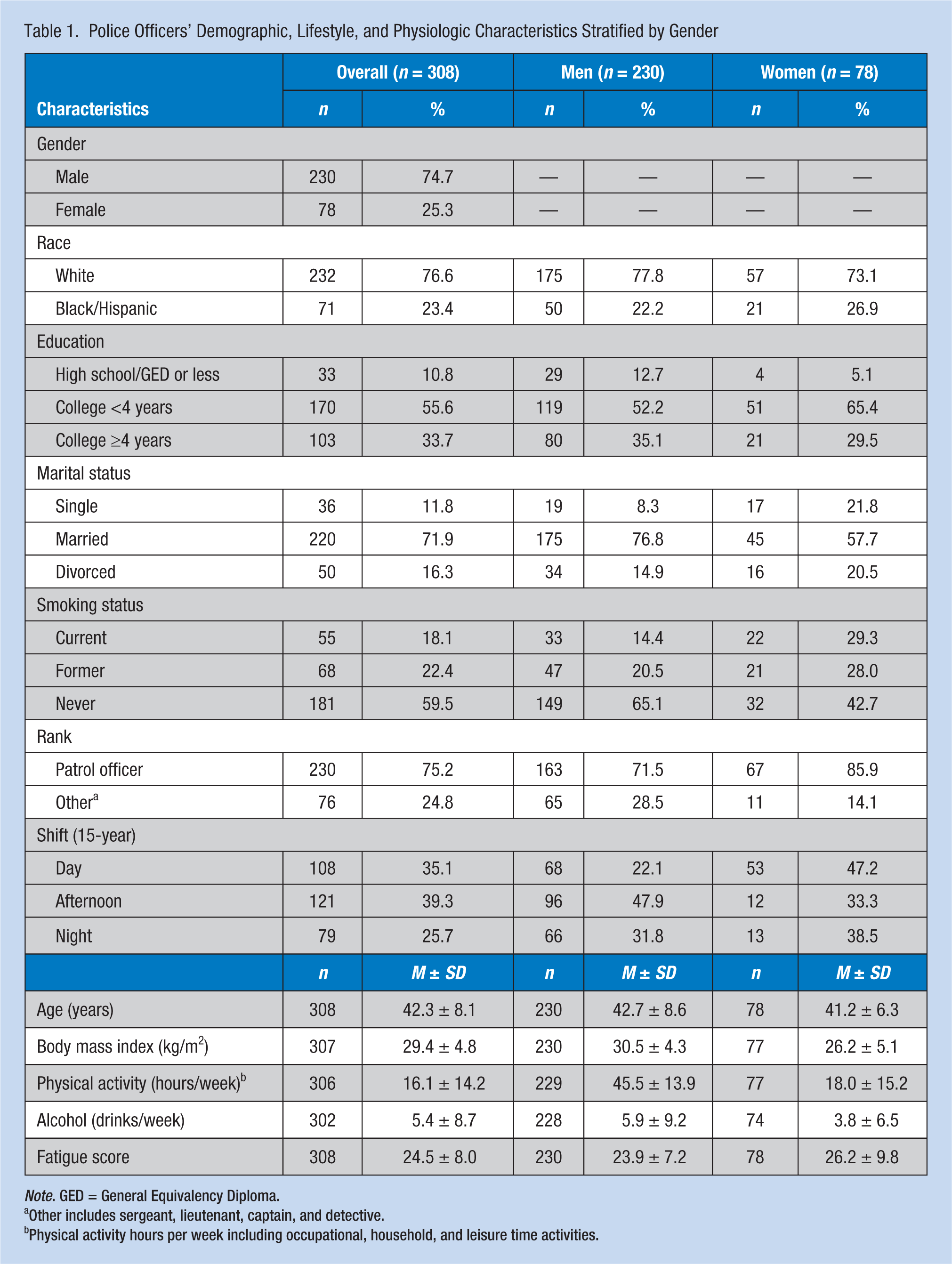
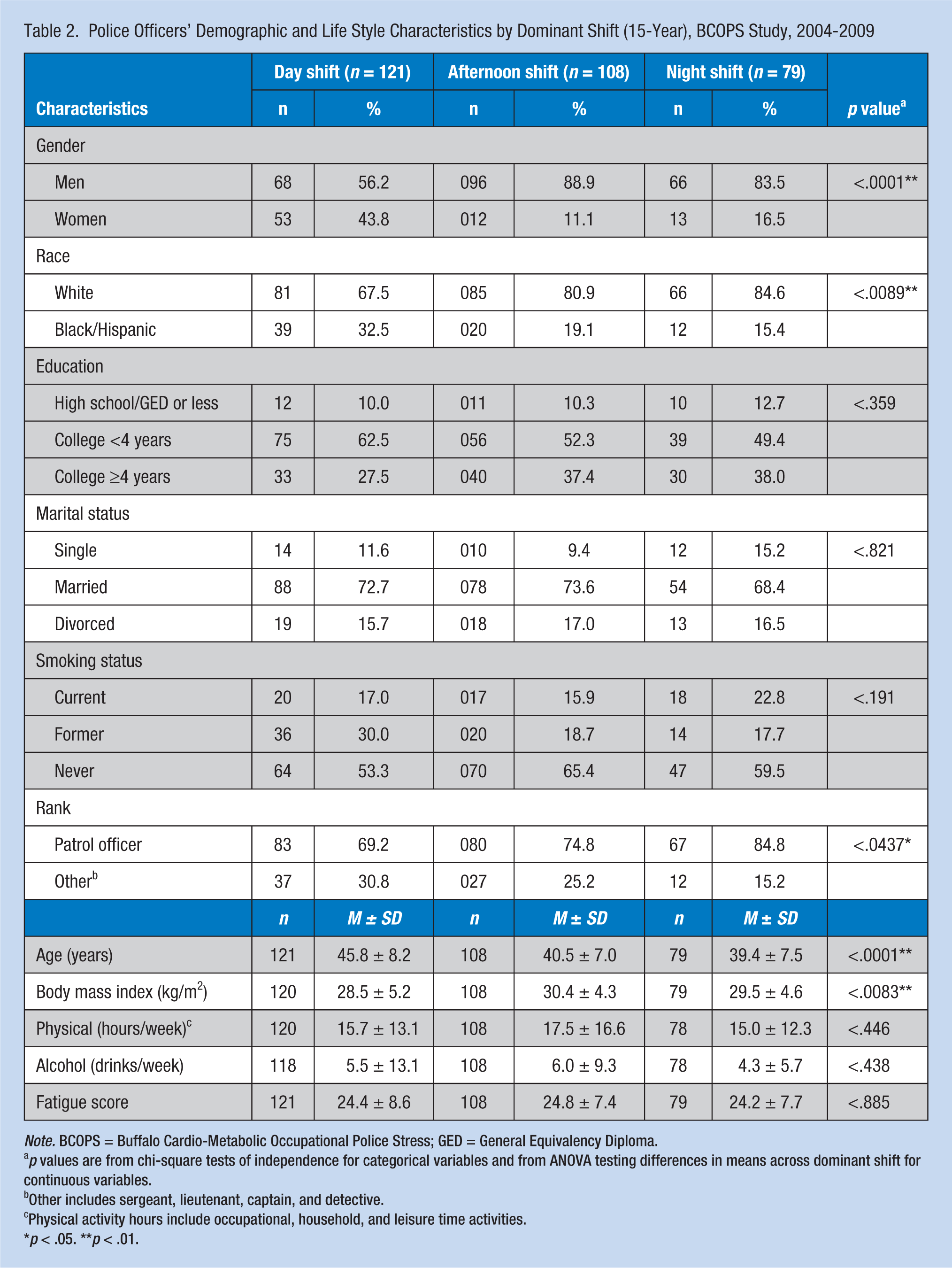
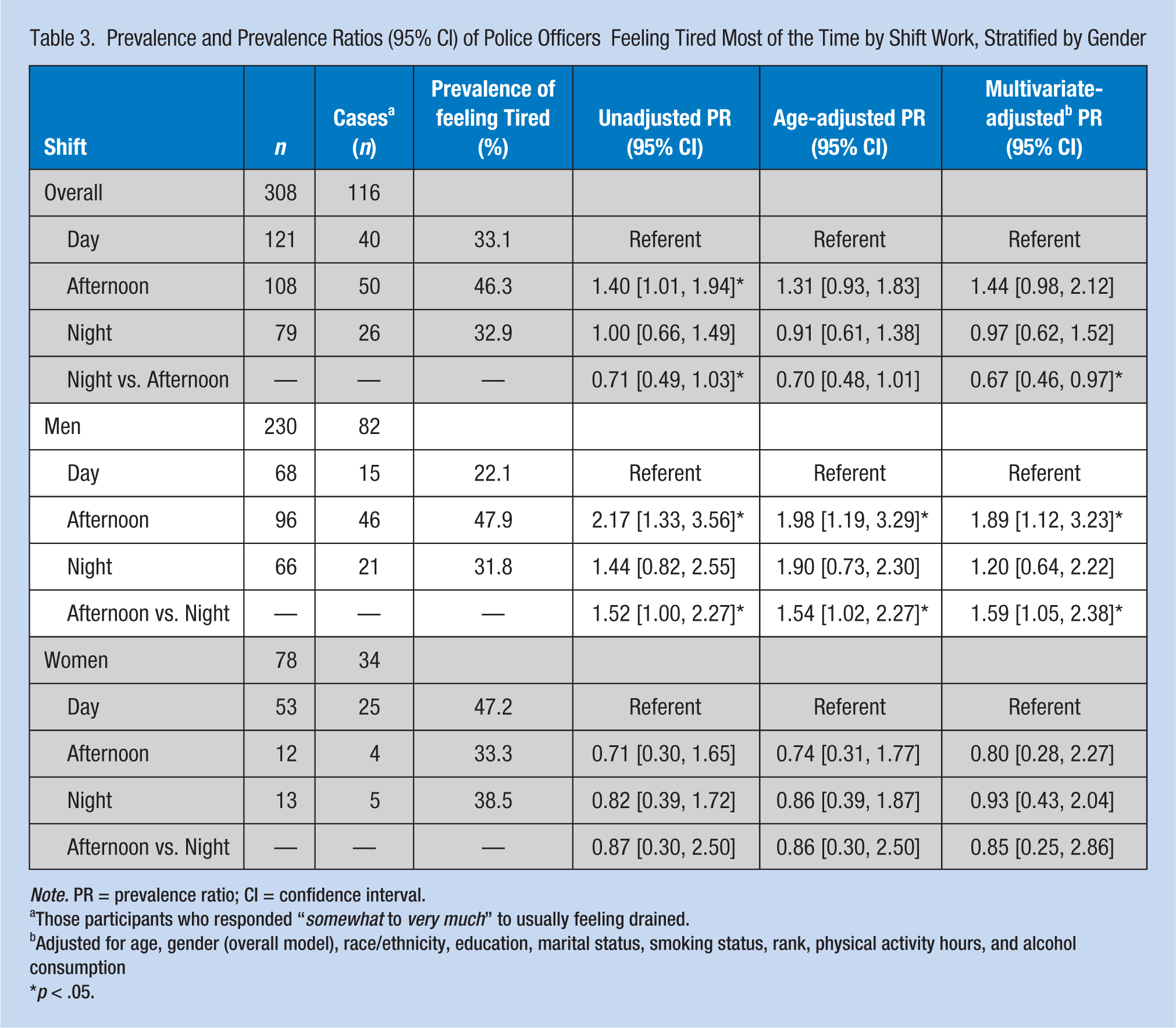
The demographic and lifestyle characteristics of the 308 study participants are presented in Table 1. The majority were White (77%), male (75%), married (72%), and patrol officers (75%). The mean fatigue score was 24.5. Overall, no significant differences in total fatigue scores were observed across shifts before stratification (Table 2). Analysis of individual items, however, revealed a significant association between shift work and feelings of tiredness among male officers. The prevalence of tiredness was twofold higher in male officers working the afternoon shift compared with male officers working the day shift (prevalence ratio [PR] = 2.17, 95% confidence interval [CI] = [1.33, 3.56], p = .0020; Table 3). Adjustment for covariates including age, race/ethnicity, education, marital status, smoking status, rank, physical activity hours, and alcohol consumption did not attenuate this association (covariate-adjusted PR = 1.89, 95% CI = [1.12, 3.23], p = .0196). In addition, prevalence of tiredness was 59% higher among officers working the afternoon shift compared with those officers working night shifts (covariate-adjusted PR = 1.59, 95% CI = [1.05, 2.37], p = .0266). Conversely, women officers reported being less tired on both the afternoon and night shifts (0.71, 95% CI = [0.30, 1.65] and 0.82, 95% CI = [0.39, 1.72], respectively) than on day shifts, although the finding was not statistically significant.
Police Officers’ Demographic, Lifestyle, and Physiologic Characteristics Stratified by Gender
Note. GED = General Equivalency Diploma.
Other includes sergeant, lieutenant, captain, and detective.
Physical activity hours per week including occupational, household, and leisure time activities.
Police Officers’ Demographic and Life Style Characteristics by Dominant Shift (15-Year), BCOPS Study, 2004-2009
Note. BCOPS = Buffalo Cardio-Metabolic Occupational Police Stress; GED = General Equivalency Diploma.
p values are from chi-square tests of independence for categorical variables and from ANOVA testing differences in means across dominant shift for continuous variables.
Other includes sergeant, lieutenant, captain, and detective.
Physical activity hours include occupational, household, and leisure time activities.
p < .05. **p < .01.
Prevalence and Prevalence Ratios (95% CI) of Police Officers Feeling Tired Most of the Time by Shift Work, Stratified by Gender
Note. PR = prevalence ratio; CI = confidence interval.
Those participants who responded “somewhat to very much” to usually feeling drained.
Adjusted for age, gender (overall model), race/ethnicity, education, marital status, smoking status, rank, physical activity hours, and alcohol consumption
p < .05.
Discussion
The present study examined associations between assigned work shifts and fatigue in male and female police officers. Overall analysis revealed no significant differences in reported fatigue across shifts. However, further analysis of individual items from the Standard Shiftwork Index revealed that “feeling tired most of time” was twice as prevalent in men working afternoon shifts compared with men working day shifts. The association, however, was not evident among women.
Gender differences in tiredness across the various shifts were interesting, considering that results suggested that women reported a lower prevalence of tiredness than men on the afternoon shift. Both men and women participate in all phases of police work, including routine patrol and handling of critical incidents which may occur in the line of duty. Thus, female officers’ occupational exposures should not vary substantially from male officers’ occupational exposures during the workday. It is plausible that the prevalence of secondary employment and overtime hours was more common among male officers on afternoon shift compared with men working day and night shifts. However, data regarding secondary employment and overtime schedules were not collected. If officers work secondary jobs or overtime prior to their afternoon shifts, they may more likely report tiredness.
In addition, peripheral factors may be associated with women officers’ reported fatigue based on the shift worked. The finding that men were least tired on day shift and most tired on afternoon shift, and the opposite was true for women, lends support to the hypothesis that domestic responsibilities differ for working men and women. The highest prevalence of tiredness occurred among men on afternoon shift (47.9%), and the lowest prevalence occurred among men on day shift (22.1%), in direct contrast to tiredness prevalence among women. Women on day shift reported a tiredness prevalence of 47.2%, but women on afternoon shift reported a tiredness prevalence of only 33.3%, although these differences were not statistically significant. Because it is unlikely that men and women experienced different work stressors within the same shifts, it is possible that men and women are tired for different reasons. To some degree, men may report tiredness based primarily on the fact that the afternoon shift is the busiest policing shift; women may report tiredness based primarily on balancing external responsibilities with shift work. Qualitative research has suggested that women who place priority on domestic responsibilities and men who place priority on workplace responsibilities are fulfilling respective gender norms (Emslie & Hunt, 2009).
In the present study, the ages of women officers were in the mid-40 range, and these officers were potentially likely to have children at home. Moreover, single parenthood is substantially more common among women, and many female officers may have the dual role of officer and head-of-household. Working the day shift may indicate a choice among women with child care and domestic responsibilities to balance them appropriately. Furthermore, although no data were collected, it is also possible that women may prefer shifts other than days because their spouses, who may also be police officers, may be working the day shift. Future research should investigate the differences in men’s and women’s child care responsibilities controlling for shift and occupation.
In addition, women may have psychosocial factors which protect these officers who work later shifts. Female officers appear to use more effective types of coping with the stress of shift work. Taylor (2011) concluded that women are more likely to “tend and befriend” than men, thus creating social support networks to protect officers from occupational stress. Interventions which assist men in developing social support networks and coping mechanisms may decrease the burden of tiredness among men working busy shifts.
A systematic review of individual differences in shift work tolerance has been noted between genders and among shifts. Eight studies found that men were more tolerant and less fatigued due to shift work than women, but four studies found that men were less tolerant of shift work than women. However, these studies defined shift work as night shift occurring between 7 p.m. and 6 a.m., which is not entirely congruent with the current study’s definition of shifts because the current study had accurate data to determine the actual shift worked.
Physiological factors may affect workers on afternoon shifts. Previous work by Borbely (1982) developed a model of sleep regulation influenced by time of day and exposure to light and darkness (Daan, Beersma, & Borbely, 1984; Keijzer, Smits, Duffy, & Curfs, 2014), which affects melatonin. Typically, melatonin levels are low to absent during the daytime, begin to rise in the evening, and peak during the nighttime hours. It is plausible that evening shift workers may experience tiredness because circadian regulation is influencing melatonin secretion leading to the onset of sleep.
The strengths of this study are the availability of an established cohort characterized by lifestyle habits and psychosocial factors. Limitations include the use of a single department police population which may limit generalizability of study findings to other departments that have somewhat different characteristics. The sample of police women is relatively small, and future studies with larger samples could substantiate these results. The study is cross-sectional and hence eliminates casual inference. Future work should consider the effect of fatigue longitudinally on both the psychological and physiological well-being of police officers and assess potential social correlates that explain gender differences between shift work and fatigue. It is not possible to eliminate shift work in this occupation, but education on proper sleep hygiene along with research on the appropriate lengths of various shifts may improve officer health. For example, Bell, Verdin, Lewis, and Cassidy (2015) found that officers working three consecutive 13 hour 20 minute (13:20) shifts per week suffered from more fatigue, sleepiness, and cognitive processing problems than officers working four 10-hour shifts. Amendola, Weisburd, Hamilton, Jones, and Slipka (2011) found that officers working10-hour shifts had a significantly higher quality of work life and averaged significantly more sleep than those officers working 8- or 12-hour shifts.
Implications for Practice
Future intervention research should reduce the prevalence of tiredness among male officers working the afternoon shift. In addition, police departments and occupational researchers could collaborate in assessing afternoon shift–specific occupational stressors. Researchers and departments could identify the risk factors for tiredness among afternoon shift–working male officers in addition to repeating the study with a larger female police sample. Completing these assessments may generate additional insights in developing occupational and behavioral interventions that could generate the most efficacious results for officers.
Summary
Long-term fixed shift work was not significantly associated with overall fatigue scores among study police officers. However, male officers working the afternoon shift were more likely to feel more tired than those who worked the day or night shifts, regardless of whether they had enough sleep or a high workload. The higher prevalence was not explained by demographic factors (i.e., age, race/ethnicity, marital status, and police rank or health behavior including smoking status, physical activity, and alcohol consumption). The association was not evident among female officers. These results point to the need for work-related resources and beneficial sleep and shift strategies in police work.
Applying Research to Practice
Male but not female police officers report a twofold prevalence of tiredness on the afternoon shift. This is usually the busiest of all shifts in police work. Female officers appear to cope better with this shift because of more active styles of coping and supporting each other. Organizations engaged in shift work should consider reducing fatigue at work through sleep hygiene education and positive coping strategies for officers.
Footnotes
Conflict of Interest
The author(s) declared no potential conflicts of interest with respect to the research, authorship, and/or publication of this article.
Funding
The author(s) disclosed receipt of the following financial support for the research, authorship, and/or publication of this article: This research was supported by funding from the Centers for Disease Control and Prevention, National Institute of Occupational Safety and Health Grant 1R01OH009640-01A1.

Author Biographies
John M. Violanti, is a research professor at the University at Buffalo, SUNY, Buffalo, New York. He has worked extensively in areas of police stress, posttraumatic stress disorder, shift work, and health.
Sherry L. Owens is currently a postdoctoral fellow at the Dartmouth Institute for Health Policy and Clinical Practice. She previously worked for the National Institute of Occupational Safety and Health, a branch of the Centers for Disease Control and Prevention in Morgantown, West Virginia, as a regular fellow.
Desta Fekedulegn is a senior service fellow at the Biostatistics and Epidemiology Branch, Health Effects Laboratory Division of the National Institute for Occupational Safety and Health at the Centers for Disease Control and Prevention. His research interests include analytic methods in epidemiology; actigraphy-based assessment of sleep, circadian rhythm, and physical activity; and effect of stress on subclinical measures of cardiovascular diseases.
Claudia C. Ma is with the Biostatistics and Epidemiology Branch, Health Effects Laboratory Division, National Institute for Occupational Safety and Health. She is currently an associate service fellow and investigates occupational exposures and health outcomes in working populations.
Luenda E. Charles is a senior epidemiologist with the National Institute for Occupational Safety and Health at the Centers for Disease Control and Prevention. Her research focuses on occupational health and cardiovascular disease epidemiology with emphasis on associations of workplace stressors with subclinical cardiovascular and metabolic disorders.
Michael E. Andrew is chief of the Biostatistics and Epidemiology Branch, Health Effects Laboratory Division, National Institute for Occupational Safety and Health (NIOSH). He has 30 years of experience in statistical methods for clinical and epidemiological study designs, analyses, and publication. His research interests include workplace stress, autonomic function, and cardiovascular disease.