




Abstract
For the past 75 years, the American Association of Industrial Nurses, and later the American Association of Occupational Health Nurses, has advocated for occupational and environmental health nurses by supporting quality undergraduate and graduate education in the specialty and certification through the American Board of Occupational Health Nurses, Inc., and providing funding for and dissemination of occupational health nursing research as well as by developing occupational health nursing practice standards, competencies, and code of ethics.
Keywords
As we celebrate the 75th anniversary of the American Association of Industrial Nurses (AAIN)/American Association of Occupational Health Nurses (AAOHN); the 65th anniversary of Workplace Health & Safety, the Official Journal of AAOHN; and the 20th anniversary of the AAOHN Foundation, we look back on occupational health nursing education, practice, and research that have affected the health and safety of American workers. AAOHN has supported National Institute of Occupational Safety and Health (NIOSH)–funded Education and Research Centers at major universities across the country, set standards and benchmarks for quality nursing practice in both mainstream and unique businesses and industries, and provided funding for and dissemination of notable nursing research studies.
Education
The first occupational health nurses were trained in hospitals and often used the medical model to develop their roles and provide care. However, with the enactment of the Occupational Health and Safety Act in 1970 and the resulting formation of NIOSH, graduate education for all members of the occupational health and safety team became available (NIOSH, n.d.-a). In 1977, the first nine Educational Resource Centers (ERC) were established at Harvard, the University of Cincinnati, Johns Hopkins University, the University of Texas Houston, the University of Minnesota, the University of North Carolina, the University of Washington, the University of Illinois Chicago, and the University of Arizona (NIOSH, n.d. . . . identifying occupational hazards, conducting research and field studies, and conveying the results to OSHA, the Mine Safety Health Administration, other federal agencies, and professionals working in the field. A second objective was to provide training programs based on the results of research and study for OH&S professionals. (NIOSH, n.d.-b, para 3)
Today, 18 ERCs are funded across the country, providing programs for the core disciplines (i.e., occupational and environmental health nursing, occupational and environmental medicine, industrial hygiene and safety) as well as a variety of other occupational health and safety-related disciplines (Table 1). Occupational health nurses are offered masters (MSN, MPH) and doctoral (PhD, DNP, DrPH) degrees in this nursing specialty. These nurses develop skills in both occupational health and safety practice and research, developing roles as educators, researchers, leaders, policy analysts, consultants, and clinicians.
NIOSH-Funded Education and Research Centers 2017
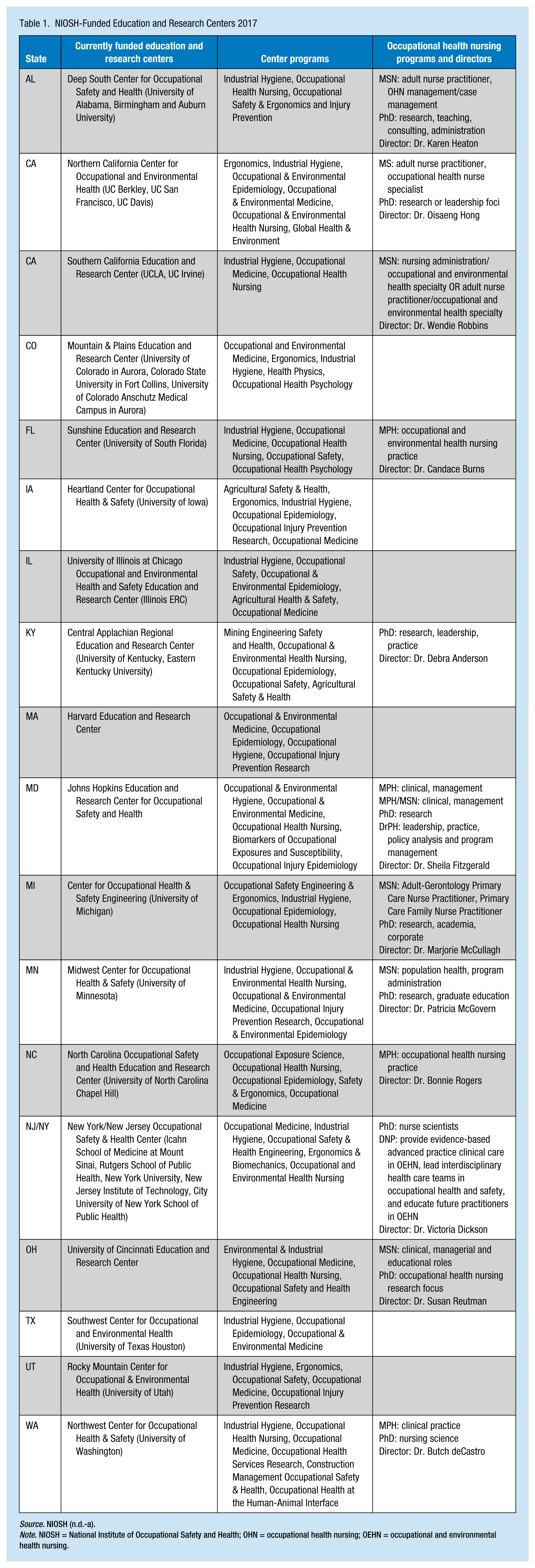
Source. NIOSH (n.d.-a).
Note. NIOSH = National Institute of Occupational Safety and Health; OHN = occupational health nursing; OEHN = occupational and environmental health nursing.
Most occupational health nurses have earned a bachelor’s degree or higher (AAOHN, 2013); AAOHN leaders and ERC faculty have long argued that occupational health nursing content and practice are essential to baccalaureate curricula (McCullagh, 2012). McCullagh and Berry (2015) developed a comprehensive occupational health nursing module for use by community health faculty, especially those faculty with no experience in occupational health and safety.
Practice
Occupational health nursing, often considered a subspecialty of public health or community health nursing, was originally practiced as an extension of hospital care in the home. In the early 20th century, Betty Moulder (Pennsylvania coal companies) and Ada Mayo Stewart (Vermont Marble Company) provided primary and tertiary care to employees and their families. This hybrid model of public health and home care reduced employee-related costs to employers. Department stores (e.g., Filene’s in Boston and Carson-Pirie-Scott in Chicago) also hired nurses to care for employees. In 1909, the Milwaukee Visiting Nurses Association (VNA) hired an industrial nurse to provide care to workers. Visiting Nurses Associations in other major cities followed suit. Since the first occupational health nurse cared for workers, nurses have practiced in a variety of workplaces, providing care to diverse worker populations by applying a myriad of strategies and interventions.
Today, occupational health nurses are employed by businesses and industry; companies that provide occupational health and safety services to other organizations; local, state, and federal government agencies; and consortiums of businesses that share occupational health and safety personnel. In addition, occupational health nurses provide services through their own consulting firms. AAOHN has supported occupational health nurse clinicians and practitioners by providing routinely updated Standards of Occupational and Environmental Health Nursing (AAOHN, n.d.), Competencies in Occupational and Environmental Health Nursing (AAOHN, 2015), and Code of Ethics and Interpretive Statements (AAOHN, 2016). In addition, AAOHN has supported the American Board of Occupational Health Nurses, Inc. (ABOHN) which offers certification to occupational health nurses, developed a variety of documents to support practice including the Core Curriculum, and provided continuing education credit via webinars, the annual national conference, and state and local offerings. Over the past 6 years, AAOHN has hosted the triennial Global Summit for occupational health nurses who practice internationally. The Global Summit brings together occupational health nurses from around the world to discuss common issues and share best practices.
Research
In this era of evidence-based practice, both educators and clinicians are dependent on the findings of studies completed by nurse researchers. AAOHN has not only disseminated research findings, along with clinical articles, for the past 65 years via its official journal (i.e., AAIN Journal, Occupational Health Nursing, AAOHN Journal, and now Workplace Health & Safety), but AAOHN, and now the AAOHN Foundation, has provided funding for member researchers. Recently, AAOHN has written grants to fund collaborative research projects (e.g., respiratory protection).
AAOHN members and ERC faculty focus much of their research on the National Occupational Research Agenda (NORA; Figure 1). Since 1996, the agenda has had three iterations based on the following overarching questions:
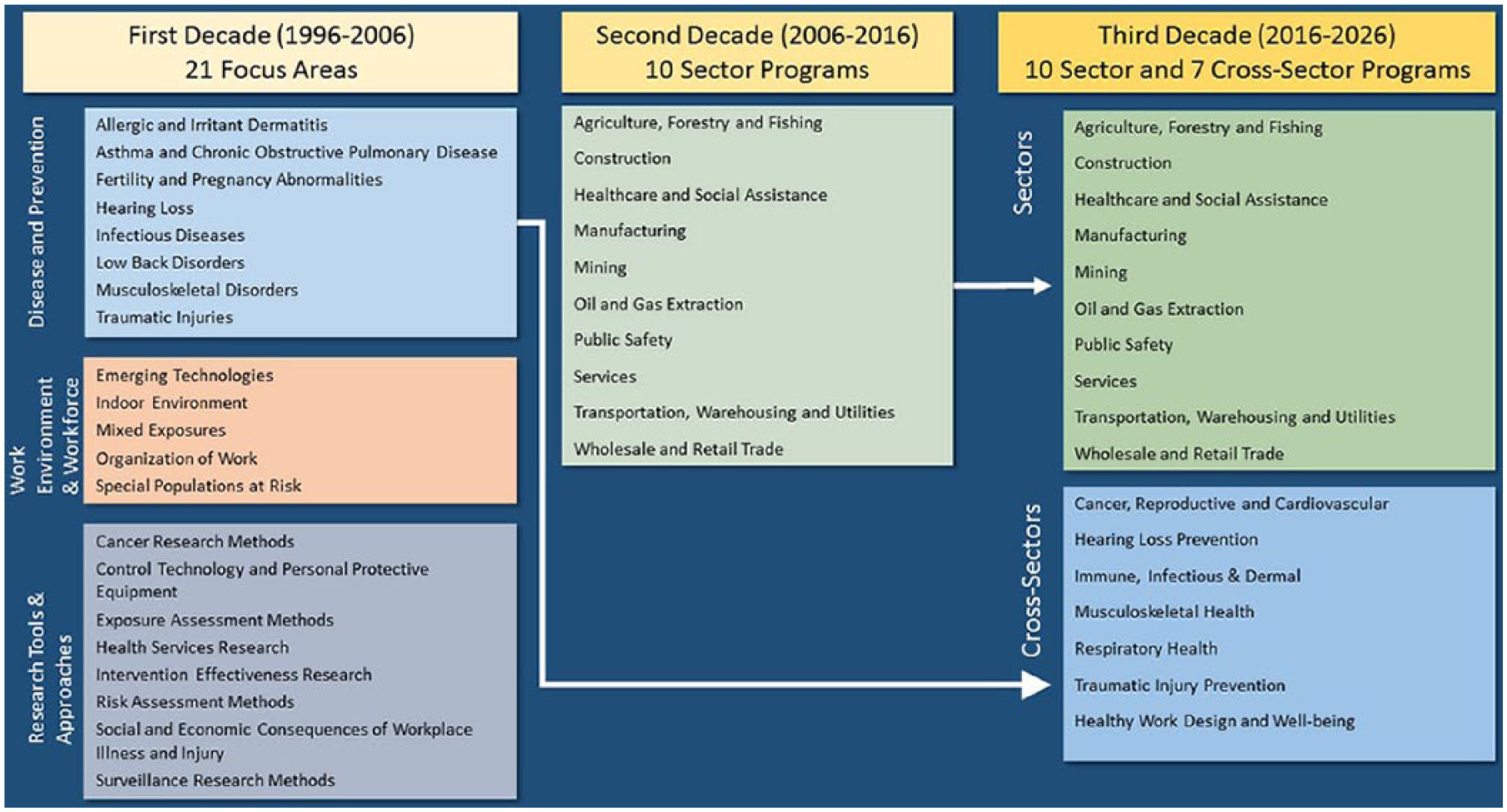
The evolution of the NORA.
1996-2005: “What will the workplace of 2006 look like? What research will be needed to ensure a safe and healthy workplace?”
2006-2015: “How do we better move research into practice in the workplace?”
2016-2025: “What research should we be doing in 2020 and beyond? Can an efficient and effective structure be found to identify and integrate research priorities?”
(NIOSH, n.d.-c)
The creation of NORA has resulted in a more cohesive research agenda for occupational safety and health in general and occupational health nursing in particular.
AAOHN has employed research methods to develop occupational health nursing competencies for registered and licensed practical nurses using the Delphi method (AAOHN, 2015, 2017). Workplace Health & Safety reviewers and editors now expect not only rigorous research articles but also evaluated successful program articles that present data in support of outcomes, and literature reviews that use a standardized process to ensure comprehensive inclusion of published articles.
The Future of AAOHN and Occupational Health Nursing
AAOHN will continue to advocate for occupational health nurses and the companies and workers for whom they provide services. More workers should have access to occupational health nurses globally. These nurses should have opportunities to impact legislation and policy initiatives, not only in the United States, but in every country. To be an effective worker advocate, occupational health nurses must be included as providers in regulations and standards meant to protect workers from harmful work environments. However, to be regarded as effective members of the health and safety team, occupational health nurses must earn baccalaureate and higher degrees; occupational health nursing content should be included in every undergraduate nursing program and graduate occupational health nursing programs should be fully subscribed nationwide. The collaborative research agenda (NORA) should continue to be focused on worker health and safety in a variety of workplaces. From a practice perspective, occupational health and safety programs and services should be evaluated in regard to health and safety outcomes and return on investment.
AAOHN, over the next 75 years, must continue to provide educational, practice, and research leadership, advocating for both employees and employers, and ensuring the highest quality nursing care based on rigorous nursing education, well-conceived standards, competencies and ethics, and innovative nursing research studies.
Footnotes
Conflict of Interest
The author(s) declared no potential conflicts of interest with respect to the research, authorship, and/or publication of this article.
Funding
The author(s) received no financial support for the research, authorship, and/or publication of this article.