




Abstract
Prolonged sitting time (ST) is a risk factor for all-cause mortality, independent of physical activity. Nurse educators are particularly at risk due to limited physical activity, older age, and the increasing use of computers. This descriptive correlational study was designed to explore the ST of nurse educators in relation to their self-reported health status and general health indicators. A convenience sample of 56 nurse educators was recruited, and participants completed demographic items, general health questions, and the Workforce Sitting Questionnaire (WSQ; Chau, van der Ploeg, Dunn, Kurko, & Bauman, 2011). More than one half of the participants were either overweight or obese based on their body mass index (BMI). Sitting time domains for “watching TV” on a non-working day (r = 1.00) and during “other leisure activities” on a non-working day (r = 1.00) were associated with a current diagnosis of diabetes. These findings add to an understanding of the effects of ST on health risks for nurse educators.
Keywords
In recent years, researchers have recognized the distinction between lack of exercise and being sedentary (Owen, Healy, Matthews, & Dunstan, 2010; Owen et al., 2011). It is now understood that meeting physical activity guidelines does not prevent one from being sedentary (Vandelanotte et al., 2013). Sedentary activities are those that generally require a low level of energy expenditure, typically between 1.0 and 1.5 metabolic equivalent of task (METS; Owen et al., 2010). The term sitting time (ST) has been used in the literature to describe the primary position one assumes in sedentary activities (e.g., working at a computer, traveling in a car, reading, or playing video games; Owen et al., 2010). Evidence synthesized from numerous studies has indicated a link between sedentary behaviors and health conditions, including type 2 diabetes, cardiovascular disease, and all-cause mortality regardless of whether an individual meets standard physical activity guidelines (Peddie et al., 2013; Proper, Singh, van Mechelen, & Chinapaw, 2011). Staiano, Harrington, Barreira, and Katzmarzyk (2014) found a positive correlation between body mass index (BMI), waist circumference, triglycerides, high-density lipoprotein cholesterol (HDL-C), and measures of insulin resistance.
Understanding the full impact of sedentary behavior and ST specifically requires an examination of both leisure and occupational activities that increase ST (Owen et al., 2011). The impact of sedentary leisure activities has been explored in a variety of studies, many of which commonly focus on activities such as television viewing (Veerman et al., 2011); however, Vandelanotte et al. (2013) noted that adults may spend much of their workday sitting, leading to increased health risks. A systematic review by Thorp, Owen, Neuhaus, and Dunstan (2011) indicated that more study is warranted regarding the effects of both leisure and occupational ST on health risks.
Nurse educators are a workforce of interest due to their changing work environment. An increased emphasis on technology use (e.g., computers for on-line teaching) and research has led to more ST for nurse educators. No current studies have been published examining the effect of ST on self-reported health ratings and health indicators among nurse educators. The specific aims of this study were to determine (a) if total ST on work and non-work days was associated with self-reported elevated BMI, hypertension, hypercholesterolemia, and type 2 diabetes and (b) which ST domains on workdays and non-workdays were associated with elevated BMI, hypertension, hypercholesterolemia, and type 2 diabetes in a population of nurse educators.
Method
A descriptive correlational study was conducted with a convenience sample of 56 nurse educators recruited from a national research conference held in the southern United States. Conference attendees were approached by the researchers during poster sessions, and the study was explained. Participants also had the option to participate in a separate drawing for one of four US$50 incentives. Consenting participants completed a survey about their general health, demographics, and ST using the WSQ (Chau et al., 2011). This 10-item self-report tool measures total ST and ST associated with transportation, work, TV viewing, computer use at home, and other leisure activities during the previous 7 workdays and non-workdays. This tool has the advantage of reporting work-related sitting on non-workdays, a common occurrence with some occupational groups such as nurses. Test–retest reliability for total ST on a workday, non-workday, and on average for women was reported as excellent (intraclass correlation coefficient [ICC] = .77-.90), and an average total ST per day demonstrated moderate strength concurrent validity (r = .53, p < .01; Chau et al., 2011).
Descriptive and correlational statistics were used to characterize the data and identify associations between general health and ST. Alpha levels were set a priori at p < .05, and IBM SPSS Statistics Version 23 was used for the statistical tests. This study was approved by the Human Subjects Review Board at the authors’ university, located in southcentral Kentucky.
Results
Demographic data are displayed in Table 1. The sample was predominantly female, married, and employed as full-time nurse educators. Eighty percent of the sample reported their general health as excellent or very good even though more than one half of the participants had BMIs in the “overweight” or “obese” category. Approximately 25% of the respondents were diagnosed with hypertension and hypercholesterolemia and taking medication. Total ST on work and non-workdays and ST domains for all workday categories did not correlate with self-reported BMI, hypertension, hypercholesterolemia, or type 2 diabetes. However, ST domains for “watching TV” on a non-workday (r = 1.00) and “other leisure activities” on a non-workday (r = 1.00) were associated with taking medications for diabetes.
Participant Characteristics (n = 56)
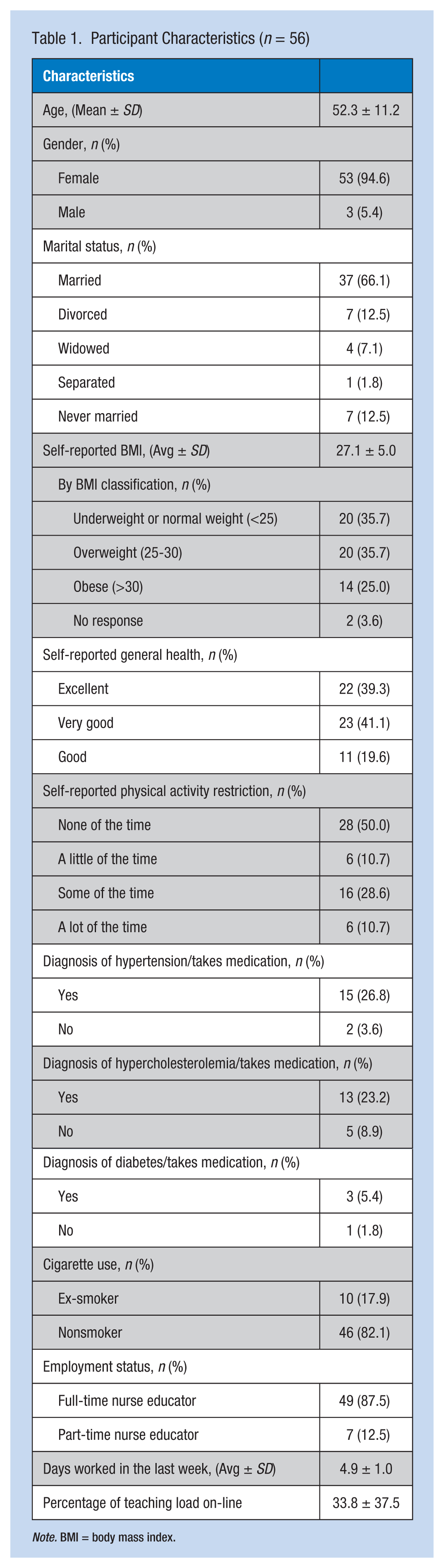
Note. BMI = body mass index.
Discussion
Sedentary behavior has been linked to the development of chronic disease and increased cardio-metabolic risk (Bauman, Chau, Ding, & Bennie, 2013). Nurse educators are considered at risk due to their increased use of technology that has increased ST. Total ST for work and non-work days was not associated with self-reported BMI, hypertension, hypercholesterolemia, and type 2 diabetes; however, ST on a non-workday in some categories was positively and significantly associated with the use of anti-diabetic medications in the study sample. This finding is consistent with a study of American adults who responded to the 2007 to 2010 U.S. National Health and Nutrition Examination Survey that demonstrated increased ST with significantly increased BMI, HDL-C, insulin resistance, and 2-hour post load glucose (Staiano et al., 2014). Although associations of ST with cardio-metabolic risk factors were not significant in this study, more than 60% of the sample exhibited BMIs in the “overweight” or “obese” categories, and 25% reported a diagnosis of hypertension or hypercholesterolemia.
The present study noted positive non-work day correlations of ST while “watching TV” and during “other leisure activities.” Several studies have found increased cardio-metabolic risk with increased ST while viewing television in a population of Australians (Dunstan et al., 2010; Thorp et al., 2010) or other screen-based entertainment conducted in Scotland (Stamatakis, Hamer, & Dunstan, 2011). Thorp et al. (2010) found that ST while viewing television was linked to BMI, elevated systolic blood pressure, lower HDL cholesterol, and elevated 2-hour post load glucose; Dunstan et al. (2010) reported that television viewing time was associated with increased cardiovascular disease mortality. In addition, Stamatakis et al. (2011) demonstrated that screen-based entertainment time was related to increased cardiovascular disease risk. In an U.S. study, Patel et al. (2010) noted that leisure time spent sitting (≥6 hours/day vs. < 3 hours/day) was linked to increased cardiovascular disease mortality. Analysis of data from the Nurses’ Health Study demonstrated that sitting while viewing television, working, driving, and other sitting-at-home activities was positively associated with the incidence of type 2 diabetes (Hu, Li, Colditz, Willet, & Manson, 2003).
This study was limited by the number of participants compared with the referenced studies. In addition, data were collected through self-report, and it is likely that some participants misreported their height and weight that was used to calculate BMI. Furthermore, participants may have had undiagnosed hypertension, hypercholesterolemia, or type 2 diabetes at the time the study was conducted.
Implications for Occupational Health Nursing Practice
Higher levels of ST are associated with the relative risk of diabetes and cardiovascular disease incidence and cardiovascular mortality (Wilmot et al., 2012). Nurse educators, as an occupational group, are particularly at risk since a significant portion of the workday is spent sitting while teaching on-line classes, preparing educational materials, grading assignments, and conducting scholarly work. Future studies should observe the sitting behavior of a national sample of nurse educators with varying demographic characteristics. In light of current evidence, interventions to decrease ST should also be investigated to protect the health of nurse educators.
Occupational health nurses could design and implement worksite interventions to decrease sedentary behavior. Increasing awareness of the health consequences of sitting at the workplace and at home may decrease ST. Social support and information on cues to decrease sitting have also been shown to decrease ST (Gardner, Smith, Lorencatto, Hamer, & Biddle, 2015). In addition, occupational health nurses can advocate for restructuring workers’ environments to facilitate standing and walking.
The majority of nurse educators are employed by academic institutions, sites with few occupational health nurses. Nursing leaders in these academic units must recognize the health risks associated with ST among their faculty and advocate for creative strategies to eliminate, reduce, or modify ST risks. Through collaboration with local chapters of the American Association of Occupational Health Nurses, occupational health nurses could improve the health of nursing faculty by educating them on the importance of ergonomic evaluations, standing desks, frequent standing or walking breaks, and other strategies to reduce ST. In the absence of occupational health nurses, engagement of supportive programs through human resources departments or wellness centers with a vested interest in the health of all employees should be investigated. With the shortage of nurse educators nationwide, it is imperative that university and college administration develop a collaborative approach to address the health risks associated with ST among nurse educators. An escalating shortage of nurses is not only a major concern for the nursing profession but also a concern for the public.
Applying Research to Practice
Sitting time is a risk factor for all-cause mortality and both leisure and occupational activities can increase sitting time for various professions. An increased use of simulation and online technology, along with more time spent in research activities, has led to increased sitting time for nurse educators. The shortage of nurse educators nationwide makes it imperative that institutions of higher education and nursing leaders recognize the risk that sitting time poses for their faculty and advocate for research and interventions to decrease sitting time among nurse educators. Interventions such as conducting ergonomic evaluations, using standing desks and encouraging frequent standing or walking breaks can be taught and encouraged by occupational health nurses or incorporated into existing institutional wellness programs that serve nurse educators.
Footnotes
Conflict of Interest
The author(s) declared no potential conflicts of interest with respect to the research, authorship, and/or publication of this article.
Funding
The author(s) received no financial support for the research, authorship, and/or publication of this article.
Author Biographies
Lizbeth P. Sturgeon is an Associate Professor in the WKU School of Nursing. She has a PhD in Nursing from the University of Kentucky and currently teaches Evidence Based Practice and Pharmacology.
Dawn Garrett-Wright is an Associate Professor in the WKU School of Nursing. She is Board Certified as a Psychiatric Mental Health Nurse Practitioner and has a PhD in Nursing from Vanderbilt University.
Eve Main is an Associate Professor in the WKU School of Nursing. She is a Board Certified Family Nurse Practitioner and serves as the Coordinator of the WKU Doctorate of Nursing Practice Program.
Donna Blackburn is a Professor in the WKU School of Nursing. She coordinates the WKU Nursing Administration MSN Track and holds a PhD in Nursing from Vanderbilt University.
M. Susan Jones is a Professor Emerita at WKU. She currently works for the Institute of Rural Health at WKU and is a Fellow in the NLN Academy of Nursing Education.