




Abstract
Intimate partner violence (IPV) is a major public health problem in the United States. Negative outcomes of IPV affect women’s attainment and maintenance of employment. The purpose of this study was to develop a theoretical framework that described and explained the process by which women who have experienced IPV attain and maintain employment. Grounded theory methodology was used to analyze interviews of 34 women who had experienced IPV. Analysis suggested that women who had experienced IPV could attain employment; however, they had difficulty maintaining employment. Entanglement of work and IPV was experienced by all 34 participants because of the perpetrator controlling their appearance, sabotaging their work, interfering with their work, or controlling their finances. Some women described ways in which they disentangled work from IPV through a dynamic unraveling process, with periods of re-entanglement, resulting in job security and satisfaction.
Keywords
Intimate partner violence (IPV), sexual violence, and stalking continue to be major public health problems in the United States, with nearly one in three women experiencing violence in their lifetimes (Black et al., 2011). According to the Centers for Disease Control and Prevention (2012), the term intimate partner violence “describes physical, sexual, or psychological harm by a current or former partner or spouse”. Researchers have identified risk factors and negative outcomes associated with physical, sexual, and psychological harm and stalking by current and former intimate partners or spouses. These risk factors and negative outcomes affect women’s attainment and maintenance of stable employment.
Risk factors for IPV include financial instability, less education, unemployment, previous victimization, and housing instability (Cho, 2012; Rollins et al., 2012). Women who experience IPV may have zero, one, or several of these risk factors. A college education decreases the risk for IPV (Bracken, Messing, Campbell, LaFlair, & Kub, 2010; Hayes, 2012). However, IPV occurs across all socioeconomic levels and cultures (Black et al., 2011; Cho, 2012; Kwesiga, Bell, Marshall, & Moe, 2007; Potter & Banyard, 2011).
Compared with women with no history of abuse, women with a history of IPV are at significantly increased risk of psychosocial, mental, musculoskeletal, and reproductive disorders. Specifically, women experiencing violence have an increased risk for sexually transmitted diseases, respiratory infections, gastro-esophageal reflux disease, chest pain, abdominal pain, urinary tract infections, headaches, and contusions or abrasions (Bonomi, Anderson, Rivara, & Thompson, 2009; Humphreys, Cooper, & Miakowski, 2011; Sutherland, Sullivan, & Bybee, 2001). A relationship between IPV and post-traumatic stress disorder (PTSD) symptoms in women has been well documented (Kimerling et al., 2009; Ramos, Carlson, & McNutt, 2004; Romero, Chavkin, Wise, & Smith, 2003). Furthermore, an increased risk of substance abuse and depressive symptoms has been linked to IPV (Bonomi, Anderson, Reid, et al., 2009; Coker et al., 2002; Tolman & Rosen, 2001).
Health care utilization and costs for women experiencing ongoing physical abuse was found to be 42% higher, and for those experiencing non-physical abuse only 33% higher, than non-abused women (Bonomi, Anderson, Rivara, & Thompson, 2009). In addition to health concerns and risks, cumulative IPV is known to have negative effects on economic capacity many years after the violence occured (Lindhorst, Oxford, & Gillmore, 2007). In addition, negative radiating effects of IPV to other relationships such as co-workers, friends and family members have also been noted (Riger, Raja, & Camacho, 2003).
In general, women’s participation in the workforce has increased steadily from 33.9% in 1950 to 59.3% in 2005 with a projection of 59.4% in 2020 (U.S. Bureau of Labor Statistics, 2011). Employment has been identified by women survivors of IPV as a crucial factor in becoming financially and personally healthy as well as one of the most important factors in ending abuse (Rothman, Hathaway, Stidsen, & de Vries, 2007; Strube & Barbour, 1984; Wilson, Baglioni, & Downing, 1989). Stable financial conditions have been found to decrease the risk for IPV (Carlson, McNutt, Choi, & Rose, 2002; Cho, 2012; Keim, Strauser, & Olguin, 2009), implying that efforts to improve socioeconomic situations and reduce poverty among women may reduce IPV. Wilson and colleagues (1989) found women’s employment was significantly predictive of the woman leaving the abusive relationship.
Mental health symptoms following IPV interfere with women’s ability to concentrate and complete work tasks. In one study, employed women reported intrusive memories, depression, and hyper-arousal, related to the abuse, decreased when they were working (Brush, 2003). Mental and physical health have been noted to mediate the transition from an abusive relationship as well as being successful in accessing additional education and stable employment. Furthermore, Mascaro, Arnette, Santana, and Kaslow (2007) found depressive symptoms created vulnerability for job loss; however, the ability to gain employment despite high levels of depression was linked to lower depression levels in the long term.
The workplace has been identified as a significant source of formal and informal support. Workplace formal and informal support has been shown to be associated with significantly less risk of mental health, physical health, and anxiety symptoms, current depression, PTSD, and suicide attempts among women who have experienced IPV (Coker et al., 2002). Workplace support may help women remain employed (Swanberg, Macke, & Logan, 2007).
Although it is known that employment helps women who have experienced IPV in a number of ways, these women face significant problems in attaining and maintaining employment. Women who experienced physical assault were significantly more likely to report low or moderate employment stability in the preceding 12 months than women who did not experience IPV (Crowne et al., 2011). Riger, Staggs, and Schewe (2004) found that recent violence was linked to unstable employment.
Once employed, numerous barriers thwarted employment maintenance. Perpetrator interference and sabotage of work activities were common experiences among at-risk women (Alexander, 2011; Bell, 2003; Logan, Shannon, Cole, & Swanberg, 2007; Moe & Bell, 2004; Postmus, Plummer, McMahon, Murshid, & Kim, 2012; Swanberg, Logan, & Macke, 2005). Banyard, Potter, and Turner (2011) found that women experiencing IPV reported difficulty concentrating and excelling at work. Health issues and perpetrator interference affected workers’ ability to concentrate on work tasks and regular punctual attendance, putting women at risk for poor work evaluations, decreasing their potential for maintaining employment and career advancement. Poor work performance, tardiness, and absenteeism have been identified as employee characteristics of workers experiencing IPV (McFarlane et al., 2000; Reeves & O’Leary-Kelly, 2007).
Although the prevalence of IPV against women and the effect on their employment and health is well documented, the process by which women who have experienced IPV attain and maintain stable employment has not been fully explored. The purpose of this study was to develop a theoretical framework to describe and explain the process by which women who have experienced IPV attain and maintain stable employment.
Method
Grounded theory based on symbolic interactionism guided the exploration of this psychosocial process. Institutional review board approval was granted by the authors’ institution. Women, who had experienced IPV, were recruited by posting flyers in community settings throughout west central Ohio. Although men experience IPV (Black et al., 2011), they were not included in the study sample because of the potential for differences in IPV and employment maintenance experienced by men. Women interested in participating in the study called a phone number listed on the recruitment flyer. The principal investigator described the study to the inquirers and screened participants to determine if they met inclusion criteria. Women were included if they had experienced IPV and been employed at any point in their lifetimes. Potential participants were excluded if study participation would put them in immediate danger. Interviews were conducted in community settings, and informed consent was obtained before each interview. Interviews were audiotaped, transcribed verbatim, and verified for accuracy. Each participant received US$35 as compensation for study participation.
Charmaz’s (2006) approach was used to analyze data gathered through these interviews. The research team met weekly to conduct initial, focused, axial, and theoretical coding to develop a theoretical framework that describes and explains the process of attaining and maintaining employment for women who have experienced IPV.
Results
The sample consisted of 34 women who had experienced IPV, 32 of whom were no longer in the abusive relationship. Participants’ ages ranged from 18 to 65 (M = 44) years. Fourteen of the participants were African American and 20 were Caucasian. Income ranged from less than US$10,000 to more than US$200,000 (M = US$42,000) A majority of participants (n = 20) had three or more children. Nineteen of the participants were employed at the time of the interview.
Theoretical Framework
The theoretical framework that was developed from the data is depicted in Figure 1. One core category, which the research team named “intertwined work and IPV,” and three major concepts named “entangled work and IPV,” “disentangled work and IPV,” and “re-entangled work and IPV” were identified. These concepts are linked by a process named “unraveling work and IPV.”
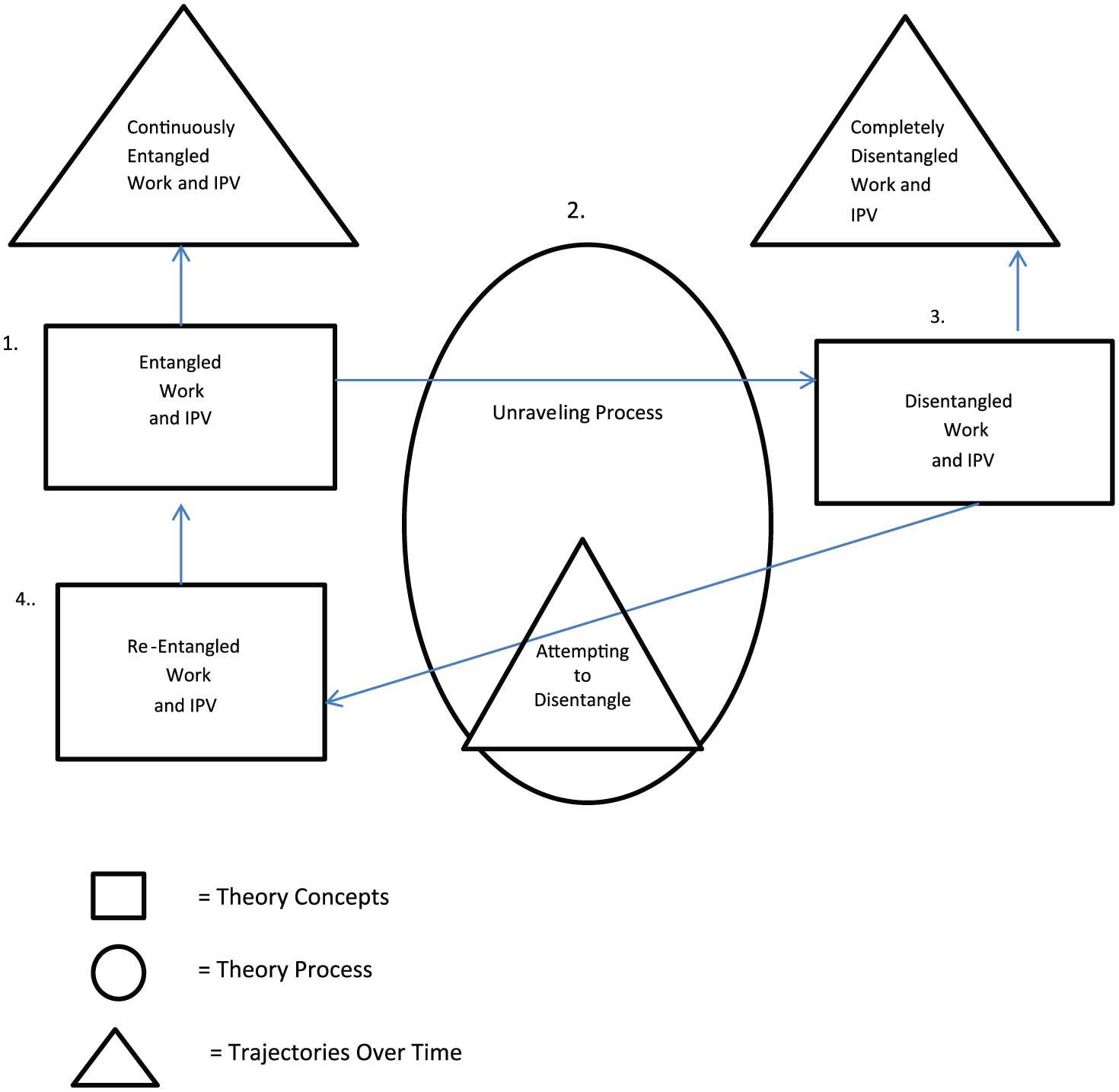
Intertwined work and IPV.
Intertwined work and IPV
The core category emerging from interview data among all participants was intertwined work and IPV. Although the participants had little difficulty attaining employment, they had great difficulty maintaining employment because of the intertwining of work and violence. The word intertwined is defined as “twisted together, closely involved with each other” (Merriam-Webster, 2014, Intertwined). All women described situations in which their work and their violent relationship were connected or closely involved with each other. One participant described the intertwining this way,
I had no problem getting jobs, they would see that I do want to work and I am a hard worker, and a lot of jobs, even though I had a number of absences it would take them awhile to fire me, for when I was there, I worked good and they would give me chances but they just couldn’t give me chances no more.
All participants initially tried to stay in the violent relationship and maintain employment while struggling to keep work and violence separate. A majority hid injuries with clothes or make up or hid emotional expression during work. One participant described her attempts to keep work and IPV separate:
It was a bruise on my arm, so when I went to work I had to wear something that would cover it up. And I had trouble cuz . . . I had to lift something so I had to call one of the guys over to help me . . . and they said “what is wrong with your arm” and I said, “I hurt it.” They bought it. I was able to pull it off and I thought OK I can do this.
However, eventually, all participants reached the conclusion that keeping their work separate from their violent relationship was not possible. They all determined that they could not be both in a violent relationship and maintain work.
One participant noted,
I just want to make sure that it’s very well understood that me personally I feel like it’s pretty much impossible to hold a job and keep a job and be in a domestic situation. One way or another, something is going to have to give.
Their attempts to separate work and IPV were futile because work and violence were not just intertwined, they were entangled.
Entangled work and IPV
Entangled is defined as “wrapped or twisted together, involved in a perplexing or troublesome situation, or to make complicated” (Merriam-Webster, 2014, Entangled). Working women who experience IPV live in complicated situations where violence is part of her work, with the perpetrator exerting control over work as well as home life. Entangled work was focused on or colored by the abusive partner and under his control. When work was about him, under his control, and entangled with the violence, the woman considered the relationship, even if it was violent, of paramount importance—more so than her own well-being. One participant noted,
He just was physical . . . I kind of felt . . . I had no choice to quit too . . . if he just hits me in the face; they’re going to ask me questions because I was . . . I was scared he’d go to jail. I didn’t want him to be upset with me. That’s all I cared about.
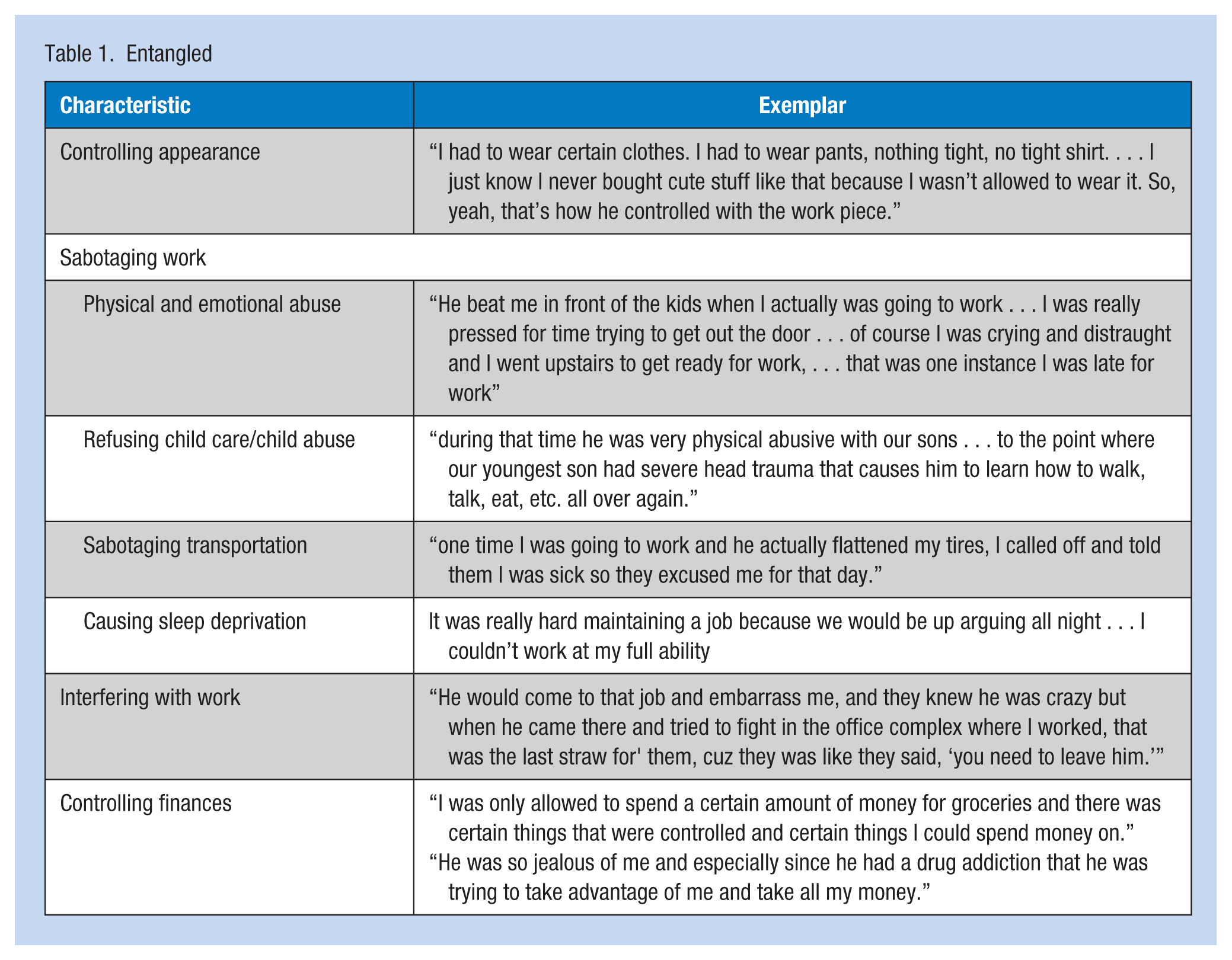
Women shared four common ways that work and IPV were entangled and the abuser exerted his control, including (a) controlling appearance; (b) sabotaging work; (c) interfering with work; and (d) controlling finances (Table 1).
Entangled
Disentangled work and IPV
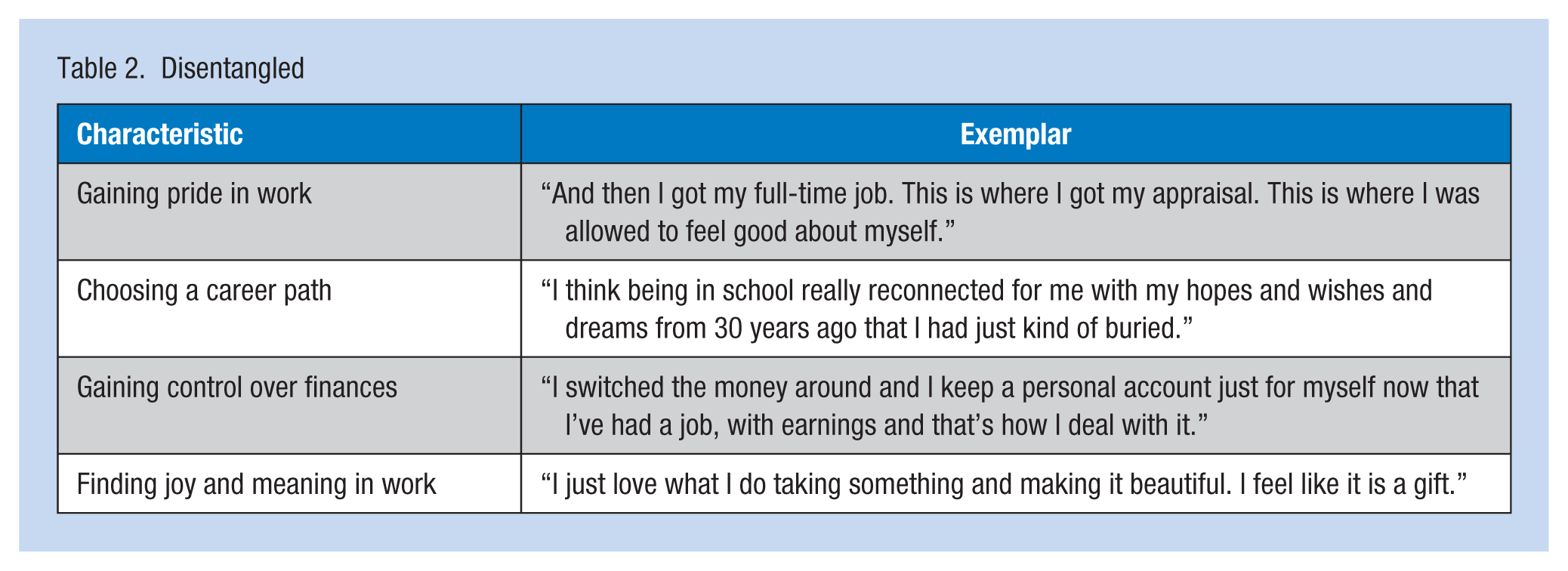
Some women were able to successfully disentangle work from violence. Disentangled is defined as “to separate (things that are twisted together or caught on one another), or to remove the twists or knots in (something)” (Merriam-Webster, 2014, Disentangled). To maintain meaningful employment, work must be separated from violence. When work becomes disentangled from violence, work is about her as a strong woman and under her control. Work being disentangled from IPV means creating a new identity for the woman and part of that new identity is her work. Women who achieved disentangled work and IPV indicated that once their work was no longer about the violent relationship and became about her and her meaning and purpose, she regained control and job stability. One participant expressed, “Now I have learned that I’m a good [work position]. So now I’m focused on career and that kept me kind of balanced.” A few women described several aspects of work being disentangled from violence, including (a) gaining pride in work, (b) choosing a career path, (c) gaining control over finances, and (d) finding joy and meaning in work (Table 2).
Disentangled
Re-entangled work and IPV
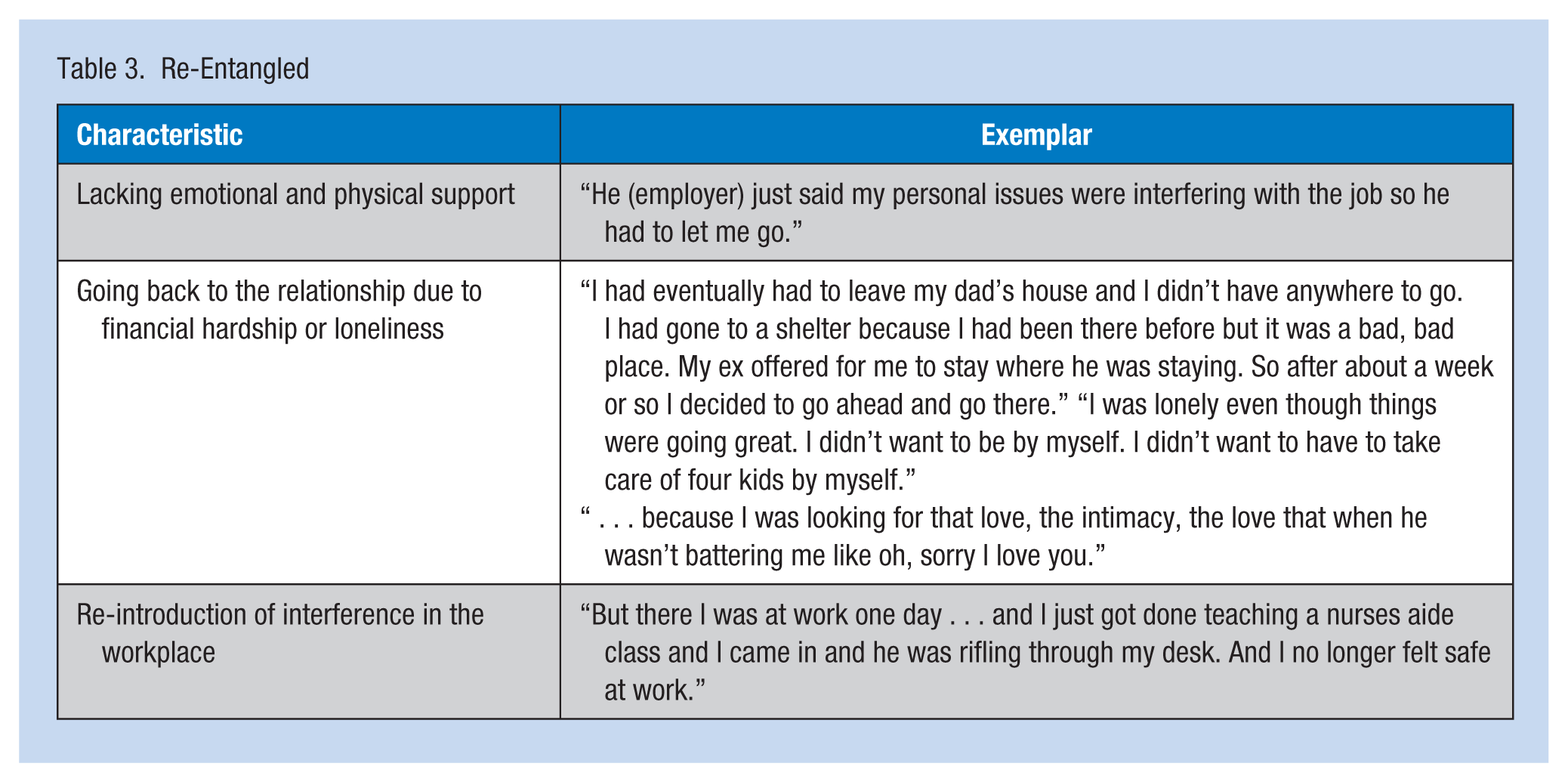
All participants described at least one time when their work became re-entangled with IPV. Re-entangled is defined as “to return to being wrapped or twisted together, involved in a perplexing or troublesome situation, after a period of a less perplexing, troublesome or complex and twisted situation” (Merriam-Webster, 2014, Re-entangled). The women, starting to disentangle violence from work, often received help from others. Women described the abuser reacting to their attempts to pull apart the entangled work and IPV with more violence and intensified attempts to control their partners. In doing so, work and IPV became further entangled with an increase in violence. Participants described three common ways their work and the violent relationship became re-entangled: (a) lacking emotional and physical support, (b) going back to the relationship due to financial hardship or loneliness, and (c) re-introduction of interference in the workplace (Table 3).
Re-Entangled
Unraveling process
The process of unraveling entangled work and IPV is a dynamic process of separating the entangled threads of work and IPV with periods of re-entanglement along the way. Unraveling is defined as to disengage or separate the threads of, to disentangle (Merriam-Webster, 2014, Unraveling). This process can be compared with attempting to pull apart the threads of a fine chain of a necklace that has been knotted into a ball. As attempts are made to pull apart the chain, other areas of the chain become more entangled and knotted. However, with continued persistent attempts, as each knot is separated and the chain is unraveled, it finally becomes disentangled and can be used for the purpose intended.
Although the process is dynamic, participants who began the unraveling process started from a common point; for the majority of participants, the starting point was when they became aware of the violence. This awareness was facilitated through confrontation by others or a particular violent episode involving the participant or her children.
A majority of participants discussed being so entangled in the violent relationship that they were not even aware of the abuse. A point of awareness occurred when co-workers, family, or friends confronted the woman about the abuse. The workplace was one of the sources of this awareness. Most participants described co-workers confronting them about the abuse. One participant noted, “I had to have somebody else that was my co-worker tell me because I didn’t know.” One participant reflected on the love she felt for the perpetrator and how co-workers recognized the effect, “Like a couple of people said well . . . you don’t look the same anymore. I don’t think you need to be in that situation. I couldn’t see it because I’m so in love.”
Once aware of the entangled work and IPV, the unraveling process was further facilitated in four common ways: (a) receiving emotional or physical help from others, (b) standing up to the abuser, (c) putting her trust in God, and (d) having a reason to get out of the relationship (Table 4).
Unraveling Process
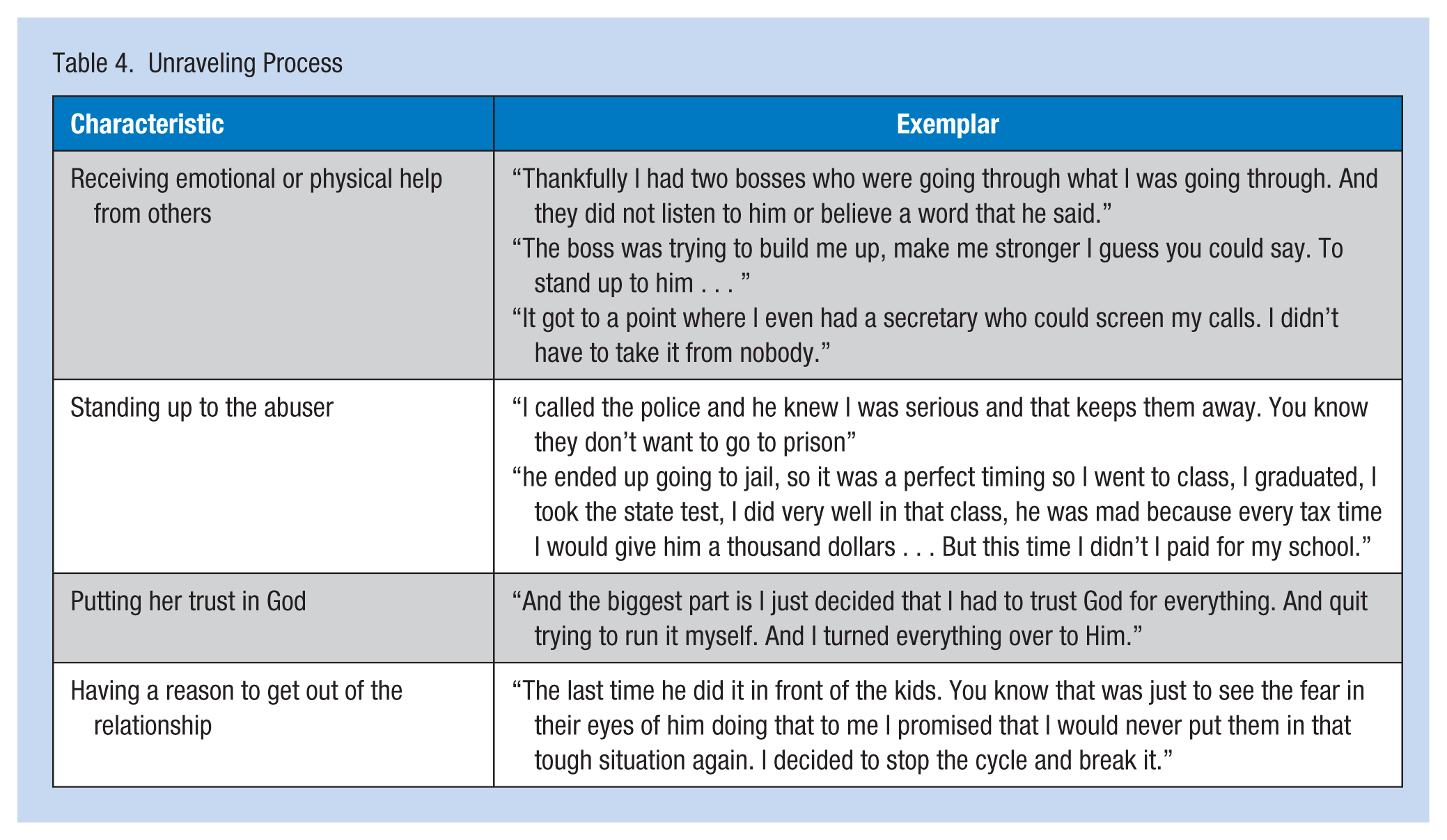
With continued support from others and persistence by the woman to stand up to the abuser, the unraveling of the entangled work and IPV continued. It is through a process of multiple, continued attempts to unravel the entangled work and IPV, despite repeated episodes of re-entanglement, that some women completely unravel work and IPV. Work is then disentangled from violence, is meaningful, and is about a strong woman.
Trajectories
Three trajectories were identified among women who had experienced IPV, and were attempting to attain and maintain employment: (a) continuously entangled, (b) attempting to disentangle, and (c) completely disentangled.
Continuously entangled
One trajectory identified was women (n = 15) whose work and violent relationship were entangled and who were unable to unravel work and IPV, remain employed, or establish job stability. Typical participants who exemplified this trajectory were women under age 40 who cycled in and out of employment while attempting to maintain a violent relationship. These women attained employment, typically in retail, various restaurants or the fast food industry. However, these women repeatedly experienced perpetrator interference during the workday that continued the entanglement of work and IPV. This interference was often recognized by co-workers and bosses resulting in some co-workers confronting the employee about the abuse. The abused worker sometimes remained employed or stood up to the abuser. After each incident, participants often chose to quit the job rather than be fired. Consequently, these participants never were able to disentangle work and IPV or progress through the unraveling process.
Attempting to disentangle
The second trajectory identified was women (n = 12) who were actively attempting to unravel work from the violent relationship, trying to establish job stability. A typical participant who exemplified this trajectory were women, typically under 40 years old, who were, at the time of the interview, attempting to disentangle their work from violent relationships. These women attempted to disentangle work and IPV but often experienced re-entanglement during the unraveling process. These women were attempting to stand up to their abusers at the time of the interview and had started to let other people, such as co-workers, know what they were experiencing.
Completely disentangled
The third trajectory identified was women (n = 7) who successfully disentangled work and IPV and were able to establish job stability and meaning. Participants who exemplified this trajectory were typically older women who had worked through the unraveling process and consequently disentangled work and IPV, maintaining meaningful employment in careers they loved. These participants often experienced IPV early in their careers through perpetrator sabotage with physical and emotional violence. They found their work and education as safe havens to deal with the violence. These participants became aware of the abuse after being confronted by friends, relatives, or co-workers. They then began the unraveling process by standing up to their abusers and receiving help from family and friends. After experiencing periods of re-entanglement by returning to violent relationships, these participants often received counseling and co-workers helped them continue the unraveling process. They maintained employment with persistence, using work and education as their safe place.
Discussion
Women who have experienced IPV attain jobs; however, they often cannot maintain meaningful employment while in a violent relationship. Work and IPV are integrally intertwined. Women’s attempts to separate work and IPV may be futile because work and violence are not just intertwined, they are entangled. For women who experience IPV, work is either about the perpetrator, under his control, and entangled in the violence, or work is disentangled from the violence and becomes about her, under her control, and part of her identity as a strong woman. Women often become re-entangled in the IPV during the unraveling process.
Similarities were found among women who had experienced IPV in attaining and maintaining employment, the impact of employment on the worker, and the impact of the violence on employers. Findings from previous studies included the difficulty women experienced in attaining employment (Alexander, 2011; Allen, Bybee, & Sullivan, 2004; Brush, 2000; Davidson, Nitzel, Duke, Baker, & Bovaird, 2012; Gorde, Helfrish, & Finlayson, 2004; Honeycutt, Marshall, & Weston, 2011; Levin, 2001; Lloyd & Taluc, 1999). A few of the women in this study did report difficulty attaining employment, after attempting to unravel work and IPV, resulting in the establishment of a sporadic work history, which then affected their ability to attain future employment.
Researchers in previous studies described factors affecting employment maintenance, including physical and psychological health concerns, current IPV, social support, workplace support, perpetrator interference, and economic abuse (Adams, Bybee, Tolman, Sullivan, & Kennedy, 2013; Adams, Tolman, Bybee, Sullivan, & Kennedy, 2013; Bell, 2003; Browned, Salomon, & Bassuk, 1999; Crowne et al., 2011; Hayes, 2012; Kimerling, et al., 2009; Lindhorst et al., 2007; Logan et al., 2007; Moe & Bell, 2004; Postmus et al., 2012; Potter & Banyard, 2011; Riger et al., 2004; Staggs, Long, Mason, Krishman, & Riger, 2007; Swanberg & Logan, 2005; Swanberg, Macke, & Logan, 2006; Swanberg et al., 2007; Tolman & Rosen, 2001; Yragui, Mankowski, Perrin, & Glass, 2012). Similarly, this study found employment maintenance equally difficult for women experiencing IPV. In addition, this study described specifically how work and IPV were entangled and the re-entanglement women encountered in the process of unraveling work and IPV, with rich descriptions for each.
Identification of employment as critical to escaping abusive relationships was found by researchers in previous studies. Investigators found that women who disclosed IPV to others in the workplace were most likely to receive informal and formal support (Swanberg & Logan, 2005; Swanberg et al., 2006; Swanberg et al., 2007; Yragui et al., 2012). Similarly, this study found that co-workers and supervisors had a significant impact on women maintaining employment. Most of the women who unraveled work and IPV and found job stability cited co-workers and supervisors as supportive, helping them recognize the abuse, providing emotional support, and helping them physically remove themselves from the relationship. Emotional support was extended via positive statements, training, or a work contract to maintain productivity. Women also cited ways in which co-workers and supervisors provided physical boundaries with security, and initiated contact with law enforcement personnel. Those women who attempted to hide the abuse from co-workers and employers were less likely to gain co-worker support and maintain employment.
Previous researchers identified interference tactics used by perpetrators of IPV to control women: direct verbal harassment during the workday, manipulating resources such as child support and child care, stalking behaviors, and intimidating co-workers and friends (Bell, 2003; Hayes, 2012; Logan et al., 2007; Moe & Bell, 2004). This study revealed similar interference tactics used by perpetrators to include work itself as a source of control.
IPV was shown in previous studies to affect employers through decreased employee productivity, decreased job satisfaction, increased absenteeism, and difficulty concentrating (Banyard et al., 2011; McFarlane et al., 2000; Reeves & O’Leary-Kelly, 2007; Swanberg & Macke, 2006). Participants in this study also described the negative impact of abuser interference with daily work activities and workers’ inability to maintain consistent attendance or productivity in the workplace.
Differences from previous literature were found related to women who had experienced IPV attaining and maintaining employment, the impact of employment, and the impact on employers. Previous literature described the attainment of employment for women with IPV experience as difficult, citing several factors such as education and health concerns (Allen et al., 2004; Alexander, 2011; Brush, 2000; Davidson et al., 2012; Gorde et al., 2004; Honeycutt et al., 2011; Levin, 2001; Lloyd & Taluc, 1999). In contrast, women in this study initially attained employment; however, it was difficult to maintain consistent employment. Previous researchers reported that women who experienced IPV had established unstable work histories while cycling in and out of abuse (Bell, 2003); however, the unraveling process leading toward job stability and the ways work and IPV were re-entangled resulting in the inability to maintain employment were not identified. Specifically, the role of co-workers during the unraveling process was found to be critical to women’s ability to maintain employment in this study. The daily, ongoing physical and emotional impact of the violence was also described in this study through the rich descriptions of the women’s attempts to prepare for work each day and also meet the constant daily demands of the abuser. All of the women in this study experienced a period of time when the work itself was used as a source of control by the partner to abuse the woman, resulting in the entanglement of work and IPV.
Limitations
This study had several limitations. The research team acted to minimize these limitations and strengthen the design. Self-report was used to gather data thus limiting the descriptions to those memories participants were able to remember and were willing to share during the interview. However, grounded theory is based on participants’ responses about their own individual perceptions of events and experiences of the psychosocial process of attaining and maintaining employment. The retrospective design of the study is another methodological limitation. However, all participants described events, thoughts, and feelings about attaining and maintaining employment in extensive detail. The study was strengthened by the diversity of the sample in age, race, and income which increase the likelihood of transferability of the findings.
Implications for Practice
Recognition of the ways work and IPV are entangled and ways re-entanglement occurs are critical in guiding and supporting women as they attempt to unravel work and IPV while minimizing episodes of re-entanglement. Reinforcement and expansion of education and training around recognition of IPV in the workplace for personnel at all levels is critical. In addition, after being educated about the ways women attempt to maintain these relationships while working and the ways work and IPV are entangled, disentangled, and re-entangled in the unraveling process, employers, occupational health nurses, advocates, and criminal justice personnel may recognize and intervene during these episodes to guide women toward unraveling work and IPV, while minimizing re-entanglement.
This study confirms the need to continue to take proactive steps to ensure the security of all personnel in the workplace, especially those in positions working with the public (e.g., in restaurants, stores, or other businesses) who are most vulnerable to public perpetrator interference. Policies ensuring electronic security (e.g., phone lines and email) are also essential. In addition, the study highlights the critical role of co-workers and supervisors in assisting employees in becoming aware of the abuse and their support in taking steps to protect these women and their families. Consequently, policies that support ongoing encouragement of employees and administrators to use existing resources (e.g., security personnel and law enforcement) to establish and maintain a secure workplace are essential. Education of supervisors responsible for scheduling, attendance, and productivity is critical to early intervention to support employees in ending abuse and maintaining consistent employment. Use of secure on-line access to payroll information as well as on-site credit union facilities may be encouraged for women who need to establish financial independence, further protecting their assets from perpetrators’ economic abuse.
Applying Research to Practice
Educate
Administrators and personnel about the definition and prevalence of intimate partner violence (IPV);
Common ways IPV and employment are entangled, become disentangled, and are sometimes re-entangled as well as facilitators of the unraveling process;
Critical roles of co-workers and supervisors in assisting employees in becoming aware of the abuse and the support needed to protect workers and their families;
Potential signs of IPV related to attendance and productivity and how to implement early interventions to support employees in ending abuse and maintaining consistent employment;
Signs and symptoms of abuse and ways women attempt to hide the signs of abuse.
Encourage
Employees and administrators to use existing resources such as security personnel and law enforcement to establish and maintain secure workplaces;
Use of on-site credit union facilities for women who need to establish financial independence, further protecting their assets from perpetrators’ economic abuse.
Ensure
Security policies related to physical safety, electronic security of communication tools (e.g., phone lines, cell phones, and email), individual personnel information, and payroll information are established and followed by all personnel.
Physical security of all personnel in the workplace especially those in positions working with the public who are most vulnerable to public perpetrator interference.
Footnotes
Declaration of Conflicting Interests
The author(s) declared no potential conflicts of interest with respect to the research, authorship, and/or publication of this article.
Funding
The author(s) received no financial support for the research, authorship, and/or publication of this article.
Author Biographies
Andrea Borchers is an associate professor and graduate chair of nursing at Kettering College. During her 35 years as a nurse leader she cared for patients and families experiencing challenges with mental illness, intimate partner violence and children with special health care needs in the acute care, home and school settings. Her research interests include occupational health with a focus on employment maintenance and intimate partner violence.
Rebecca C. Lee is an Associate Professor at the University of Cincinnati College of Nursing. Her program of research focuses on development of culturally-tailored interventions to promote health among vulnerable populations such as those experiencing homelessness.
Donna S. Martsolf is the Associate Dean for Research and Translation at the University of Cincinnati College of Nursing and a Fulbright Scholar. Her 25-year program of research has contributed unique insights into interpersonal violence (sexual violence, dating violence, and childhood maltreatment) both in the U.S. and Haiti.
Jeff Maler is an active duty nurse with the United States Army. During his undergraduate degree at the University of Cincinnati, he participated in numerous research projects with a focus on intimate partner violence, homeless veterans, health disparities and PhD pipelines.