



Abstract
Workplace bullying (WB) is an increasingly prevalent topic in the nursing literature. Recently, a new concept has been introduced into WB research to explain the motivations of WB instigators using elements of the Power-Control Wheel (PCW). Initially, this wheel was designed to assist intimate partner violence (IPV) targets/victims identify patterns of abuse and intervene with male batterers/instigators. Research examining IPV and victims/survivors of WB demonstrate that targets often share common abusive experiences, including intimidation, coercion and threats, isolation, and economic and emotional abuse. This article demonstrates clear support for the Duluth Model and its application to WB target experiences. Applications of this model to identify WB and assist individuals to identify and describe experiences of abusive work environments are discussed.
Keywords
Workplace bullying (WB) and other forms of abuse are a growing economic (Hollis, 2015, 2016; McTernan, Dollard, & Lamontagne, 2013) and social (Gumbus & Lyons, 2011) concern. WB continues to encompass a myriad of aggressive workplace behaviors that vary in intensity and frequency and, according to Bartlett and Bartlett (2011), has not been encapsulated by a precise definition or supported by federal legislation in the United States. This lack of clarity regarding a precise definition of WB led the authors to define this behavior to include a set of enduring and repeated acts between employees where an imbalance of power between the target or victim and the instigator or offender exists. The kinds and/or types of acts are not specified. The target views both the behavior set and its effects subjectively. Furthermore, bullying can be direct, or indirect (Bartlett & Bartlett, 2011), in-person or via social media (Farley, Coyne, Sprigg, Axtell, & Subramanian, 2015). In their review of the literature, Bartlett and Bartlett (2011) placed WB behaviors into three categories. Bullying could be work-related, affecting various aspects of employment (i.e., workload, how work is done, or how workers are evaluated and/or advanced in the organization). It could also come in the form of personal attacks, often directly toward the target. Finally, it may involve verbal or physical manipulation and/or intimidation of the target who suffers constant and unrelenting criticism.
It is also agreed that acts of WB form a relatively distinct pattern of victimization, which is “frequent (once or twice a week) and persistent (6 to 12 months)” (Samnani & Singh, 2012, p. 582). Even with a strong definition of bullying behavior, Dzurec and Bromley (2012) note the challenge of capturing WB. Reporting may be hampered by workers’ ability to process what is, or has been, happening to them. The authors identified that victims may not even recognize that their experiences are episodes of bullying. Abusive behaviors can often be subtle, enduring and, without the right context, unnoticeable.
Bullied workers can not only suffer a myriad of maladaptive workplace behaviors but may also suffer physical, emotional, and psychological effects of WB (Bartlett & Bartlett, 2011). Employees can, for example, exhibit burnout, absenteeism, low morale, less job satisfaction, loss of income, and fewer total hours worked. Physically, workers are at risk for adverse overall health outcomes, including long-term illnesses, drug and alcohol abuse, headaches, sleep disorders, and higher health care costs. Emotionally, workers can suffer depression including suicidal ideation and/or suicide attempts, and posttraumatic stress disorder (PTSD). Psychologically, workers report more anger, anxiety, feelings of powerlessness, and sadness, and lower levels of self-esteem, which affects their overall stress levels and interactions outside the workplace.
Bartlett and Bartlett (2011) and Nielsen and Einarsen (2012), in their meta-analyses of 66 studies, summarized the organizational impacts of WB. Neilsen and Einarsen found that employers provided evidence of a reduction in productivity and higher lost time and health care costs. This same study also demonstrated that negative workplace cultural changes, which may contribute to the cycle of bullying, can increase legal costs due to wrongful discharge litigation. Martin and LaVan (2010) documented that bullying environments can lead to lawsuits resulting from workers’ verbal or physical aggression as well as declines in customer/client relations.
Many of the experiences reported in the literature on bullying include the same features reported by intimate partner violence (IPV) targets. Research and theorizing on WB have resulted in understanding the role of power in the workplace and how theories of power control in intimate relationships can be extended to workplace relationships. For example, Van Heugten (2012) reported that when one respondent sought help with WB from a union representative, the representative offered Needham’s (2003) book, which makes a direct link between concepts of WB and those used to explain domestic violence. One of the most widely applied treatment models to address IPV is the Duluth Model. The purpose of this article is to examine this model and provide evidence for its application to WB.
IPV and the Duluth Model Power-Control Wheel (PCW)
The Domestic Abuse Intervention Programs (DAIP), otherwise known as the Duluth Model, is one of the most widely used psychoeducational community-based intervention programs for men who have been identified as batterers (Pence & Paymar, 2004). The PCW, created by Pence, McDonnel, and Paymar in 1982 is a conceptual tool to illustrate patterns of abusive behavior by men in heterosexual relationships (Pence & Paymar, 1993). The eight spokes/themes of the wheel were identified by asking female victims of IPV, who were about to go to court, what they wanted judges and prosecutors to know about their treatment at the hands of their abusers, beyond the episodic events of physical and/or sexual violence. Physical and sexual acts of violence, because of the physical evidence these acts may leave, are heavily relied on in the evidentiary process, but do not convey to the court all forms of abuse experienced on a weekly, daily, and sometimes hourly basis by IPV victims. Victims wanted the court to know about their lived experience between the acts of violence when more common and everyday abuse occurred, reinforced by threats of physical and/or sexual aggression. The researchers and participants worked together on the power-control image until both were satisfied (DAIP, n.d.; Pence & Paymar, 1993).
According to its creators, the wheel represents a pattern of violence, abuse, and coercive behavior. The PCW is a therapeutic tool used to help victims of IPV visualize and name the abuse tactics used, identifying strategies the abuser uses to continue to exert power and control. Understanding how power is used by the abuser can empower the victim to clearly identify abusive situations and seek change. Abuser treatment often includes PCW components. The PCW has been extended to other power relationships where abusive behavior has created power imbalances. For example, wheels have been tailored to specifically look at same-sex abusive relationships and school bullying. This article synthesizes and evaluates some of the derivations of the PCW that have been adapted to the workplace and offers modifications that are more consistent with the original proposed model.
PCW
The PCW identifies types of abuse that IPV victims experience, illustrated by a wheel (Pence & Paymar, 1993) with eight sections or spokes, each identifying a group of behavioral control tactics categorized by the DAIP team working with IPV victims. Victims of IPV identified that offenders often used (a) intimidation, (b) emotional abuse, (c) isolation, and (d) minimizing and/or denying and/or blaming the victim for her own victimization. Victims also reported that the abusers would (e) use children as tools of control, (f) use power associated with male privilege, (g) abuse economically, and (h) use tactics of coercion and/or threats to assure compliance. The wheel was not designed to capture all forms of abuse, but included primary modes of abusive behavior used by offenders.
On the PCW, physical and sexual violence are located on the outside of the wheel, external to control tactics, which are inside the wheel forming eight spokes. Violence and the threat of violence, in any form, aids in victim compliance by increasingly controlling victim behavior. At the heart of all of these behaviors, located in the center/hub of the wheel, is the desire by the victimizer to control the victim and to gain power in the relationship. The Duluth Model supports power and control as key motivators of abusive behaviors. This wheel also illustrates how physical and sexual violence are not always present in abusive relationships. The threat of physical and sexual violence exists, and is reinforced through various controlling behaviors.
Derivations of the PCW
An early derivation of the PCW included the Bullying PCW (National Center on Domestic and Sexual Violence [NCDSV], n.d.). This wheel was adapted, using the PCW, to help children and those professionals helping children identify bullying. Although the idea of a Bullying PCW is interesting, the wheel adapted by Anton (n.d.) looked significantly different from the original PCW. Like the PCW, it shared the concepts of emotional abuse, social isolation, economic abuse, and minimizing, denying, and blaming. Unlike the original wheel, it combined the use of coercion and threats with the use of intimidation in a single spoke. The adapted PCW also added humiliation, social status, and technology as three separate new spokes. It omitted the concept of the use of others, and privilege. This adaptation has not been promoted on the DAIP website.
In another example, Duthie (2009) explored parallel power processes experienced by domestic violence workers. She developed a Workplace PCW to illustrate the behavior she was observing in her study. Adapting the Duluth Model, Duthie used her version of the PCW to explain how workers, who ironically mirrored the very maltreatment they were working with clients to resolve, abused their coworkers. Unlike the original PCW, her wheel was reduced from eight to six elements for this specific environment. Like the DAIP PCW, her wheel included workers reporting emotional abuse, minimizing and/or denying and/or blaming victims for abuse, and the use of isolation tactics by coworkers. Workers reported experiencing verbal abuse, similar to the original wheel in which clients of domestic violence reported acts of coercion and verbal threats.
Workers also identified what Duthie (2009) called abuse through privileges of power, which parallels the use of male privilege found in the PCW. The word “male” was dropped as many of the abusive coworkers in the Duthie study were female. Rather than identifying intimidation per se, Duthie not only widened the scope, calling a collection of similar behaviors psychological abuse that incorporated both physical and psychological elements of intimidation, but also included employer practices of standing over workers and management’s overt support of abusive workers’ behaviors. Excluded from Duthie’s adapted workplace, PCW is the use of children in the abusive relationship, understandably, as this familial element is not part of a typical workplace. In addition, the outside circles representing the threats of physical and sexual violence were omitted from this model without explanation.
In an adaptation of the PCW, which more closely aligned with the original model, Barnes (2012) acknowledged the importance of capturing the dynamics of WB to manage issues that arose from these dynamics. She offered that the Duluth Model could be effective in capturing the dynamics of WB by substituting the workplace for the home environment of the original model. In the model, the author retained all essential spokes of the original PCW, substituting “others” for “children” and reframing male privilege, assumed under the heteronormative model of the original PCW to “supervisory privilege.” Like Duthie (2009), she also omitted the symbolic outside circles representing the threats of physical and sexual violence that reinforce power and control. This article tested whether the basic concepts of the Workplace PCW were supported by existing literature regarding the dynamics of WB.
Adaptation of the PCW to WB
Although previous authors have attempted to use modified versions of the PCW to address various aspects of toxic workplaces, each author has strayed from what Pence and Paymar (1993) intended (Duthie, 2009) or did not use all tools offered by the model (Barnes, 2012; Duthie, 2009). Furthermore, where more of the original model by Pence and Paymar was adopted to explain WB (Barnes, 2012), no real evidence was provided to substantiate the validity of the adaptation. What follows is an adaptation of the PCW to WB, true to the originators design and supported by evidence that demonstrates the application has validity (Figure 1). Similar to the PCW developed by Pence and Paymar, this wheel is not meant to describe all possible behaviors that victims of workplace abuse experience but, rather, to illustrate the behavior themes that emerge within an abusive workforce.
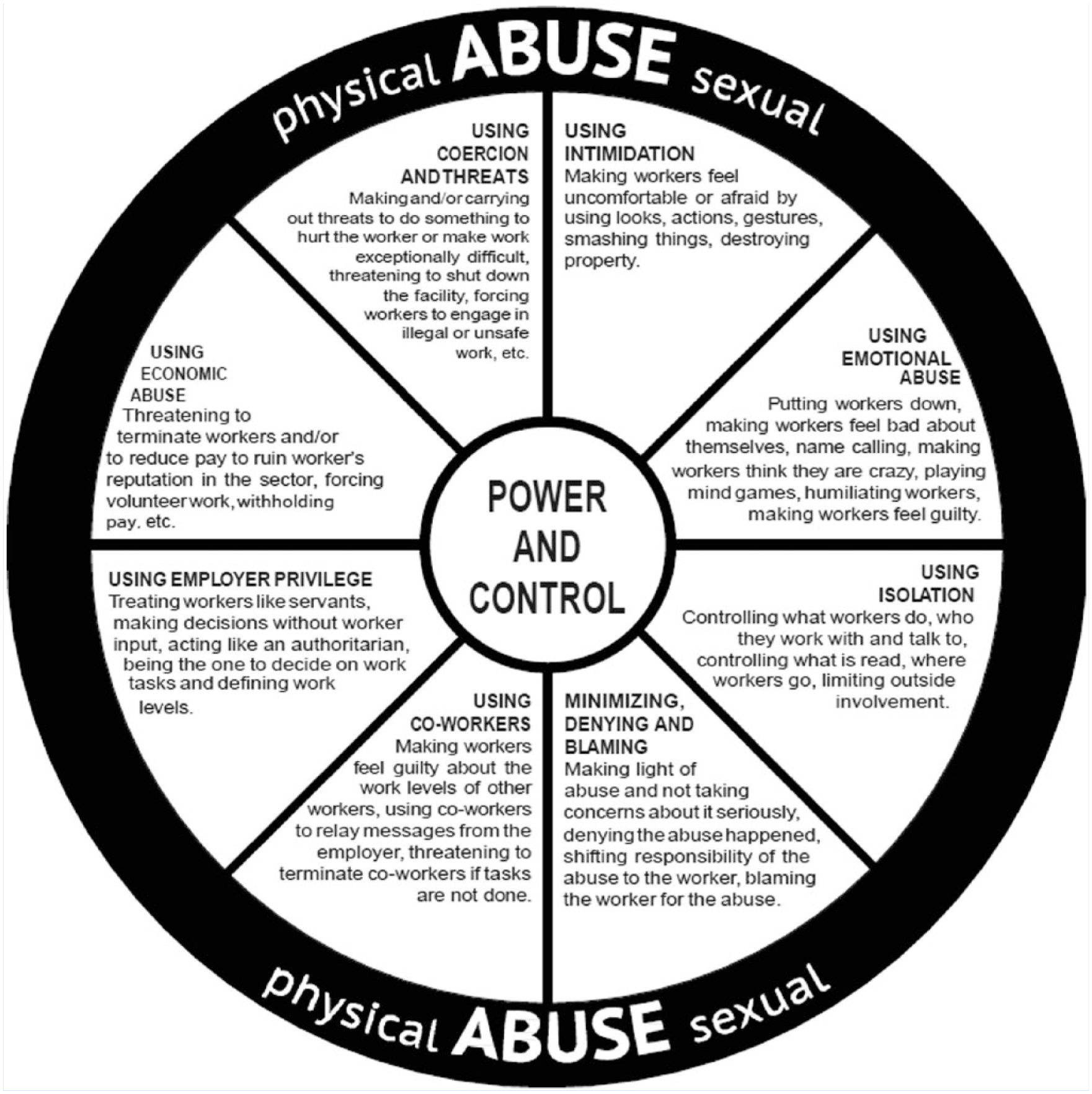
The Workplace Power Control Wheel Pertaining to Workplace Bullying.
First, Pence and Paymar (1993) noted that IPV victims commonly reported the use of intimidation by their offending partners. The IPV PCW offers examples of predominantly physical acts of intimidation such as threatening looks, actions or gestures, smashing objects, or hurting pets, designed to elicit fear. Hutchinson, Vickers, Wilkes, and Jackson (2010), in their study of Australian nursing staff, noted that victims of WB often remarked on similar tactics used by their employers including, but not limited to, bullies raising their voices or hands when being addressed, verbal abuse, being followed, watched or stared at, and blocking or compromising their work. Rouse, Gallagher-Garza, Gebhard, Harrison, and Wallace (2016) reported that physicians noted several behaviors meant to intimidate them including, but not limited to, pointing fingers, invading personal space, being shoved, or blocking their way (35.4%), and being excessively monitored (34.8%).
Second, Pence and Paymar (1993) offered that many IPV victims reported that their partners were emotionally abusive to them during their battering experience. The authors give examples of putting victims down, name calling, eliciting guilt from victims, and creating feelings of instability or craziness. Similarly, Hutchinson et al. (2010) found that workers reported acts of abuse including spreading malicious gossip; exposure to verbal putdowns, insults, and humiliation; excessive criticism; suggestions that targets were mentally unstable or suffering from madness; and mistakes identified in public. Van Heugten (2012) noted that respondents in her study reported being ridiculed at meetings to make them appear incompetent, causing targets to lose confidence in their own skillsets. Rouse et al. (2016) stated that physicians often reported humiliation and ridicule at work (73.8%), and gossip spread about them (65.7%). They also reported being shouted at, or were targets of spontaneous anger (60.3%), were insulted or had offensive remarks made about their bodies, attitudes held, or aspects of their private lives (46.0%). In addition, targets were subjected to excessive teasing or sarcasm (22.4%) and practical jokes (12.3%). Strandmark and Hallberg (2007) argued that slander was used to diminish the reputation of individuals before removing them from the workplace. Insults were used to devalue workers both personally and in the perceptions of other coworkers to facilitate the leaving process.
Third, many IPV victims reported that batterers used isolation techniques to control victim behaviors (e.g., limiting target interactions with others in the workplace, controlling reading materials, limiting victim travel, and decreasing victims’ involvement in the outside world; Pence & Paymar, 1993). The offender, over the course of the abuse, socially isolates his partner as an ever-increasing part of gaining control over his victim (Ulrich, 1998). All of these actions served to further separate victims from friends, outside family members, and coworkers. Evidence suggests that these strategies were also used in the workplace. Van Heugten (2012) and Lewis and Orford (2005) noted that identified bullied workers had become increasingly isolated, both professionally and socially. In fact, participants remarked that, in many ways, this workplace isolation was one of the most distressing aspects of the bullying experience.
In another study, addressing the effects of workplace mobbing, researchers reported that those who witnessed bullying often removed themselves and/or withdrew from the bullying situation (Duffy & Sperry, 2007). Van Heugten (2012) observed that social isolation increased while social support decreased as bullying continued. Hutchinson et al. (2010) were more specific in their findings, suggesting that nursing participants reported isolation from supportive peers, and were ignored and excluded from conversations and activities. Rouse et al. (2016) reported that bullied physicians reported having their opinions ignored (72.9%), being ignored in conversations, having emails ignored (71.7%), and being excluded from group activities and friendly conversations (56.0%). Strandmark and Hallberg (2007) reported that public sector workers, who were bullied and eventually expelled from the workplace, claimed that exclusion from the social aspects of work was part of the removal process. Isolation, in work settings that value team work in particular, may be especially harmful (Miller & Rayner, 2012).
Fourth, Pence and Paymar (1993) and Whiting, Oka, and Fife (2012) suggested that the minimizing, denying, and blaming process downplays abuse, suggesting that the concerns of IPV victim are not taken seriously. The abuser denies the abuse happened or minimizes the harm inflicted. Offenders may passively or actively blame the victim, implying or outwardly accusing the victim of instigating the abuse (Landenburger, 1993; Ulrich, 1998). Ongoing abuse, embarrassment, and concealing the abuse from others have been shown to lessen self-esteem, and cause feelings of emptiness, worthlessness, and emotional paralysis (Herman, 1992; Landenburger, 1989, 1993; Moss, Pitula, Campbell, & Halstead, 1997). Likewise, Hutchinson et al. (2010) reported that participants who perceived themselves victims of WB reported being made to feel incompetent or stupid and/or blamed for incompetence. They also reported being denied sick leave when experiencing illness, adjusting to ever-changing goals and deadlines, and experiencing repercussions when goals and deadlines are not met, and denied due process when negatively evaluated. In some cases, workers reported being denied meals and breaks at work. Rouse et al. (2016) reported that 62.5% of targets experienced a persistent lack of performance recognition, that someone else had taken credit for their work (55.3%), persistent criticism for their errors or mistakes (43.1%), and frequent reminders of errors and mistakes (41.2%).
Fifth, Pence and Paymar (1993) stated that IPV victims noted their abusers used children in various ways to control the victim. The authors included examples in which children were used to relay messages, creating victim guilt. Although coworkers are rarely family members, businesses often use the family analogy to illicit more worker productivity (Wilke, Wilke, & Viglione, 2015). Working in close conditions, day after day, can often create strong ties between workers.
Horizontal bullying, or lateral bullying, is the process whereby coworkers bully other coworkers and is recognized as a health and safety issue (Granstra, 2015). Yildirim and Yilderim (2006), in a study of workplace mobbing, found consistently that, regardless of behavior, coworkers were included in bullying situations. Farrell and Shafiei (2012) reported that 56% of nurses’ bullying experiences were perpetrated by colleagues. The authors identified that one of the causes of this bullying may be tied to differential power dynamics in the workplace and the hierarchical nature of health care professions. Furthermore, some nurses created a hierarchy within a theoretically horizontal system when power was not granted by management. Management, by not addressing workplace culture, is viewed at fault for refusing to address these issues and thereby promoting bullying (Granstra, 2015; Van Heugten, 2012). Ciby and Raya (2014) noted that participants identified that, in some cases, coworkers were used by management to monitor the behavior of other workers. Barnes (2012) and Duthie (2009) did note that coworkers were often directed or encouraged by superiors to bully other workers, or that bullying was essentially condoned without corrective action by management. All of these bullying behaviors by colleagues support the retention of bullies (Barnes, 2012).
Sixth, Pence and Paymar (1993), in developing their heteronormative model, asserted that victims described behaviors they categorized as using male privilege, derived from patriarchal forces that culturally allow men to abuse and batter women with little, if any, social repercussions. The authors illustrated this behavior: treating victims like servants, excluding victims from decision-making, and victims assuming roles defined by abusers. Similarly, victims of WB often report they experienced abuse of power by their superiors. Participants reported being degraded or challenged about their abilities and achievements publicly. Workers were assigned demeaning work, were given unsubstantiated negative performance evaluations, experienced rumors or character slurs, and were challenged regarding their credentials by employers and colleagues (Hutchinson et al., 2010). A study of physicians found that about half of those who experienced bullying reported losing responsibilities and then being expected to complete trivial or unpleasant tasks (49.6%), receiving insulting, unjustified, and nonconstructive comments in performance evaluations (48.6%; Rouse et al., 2016). Strandmark and Hallberg (2007) argued that unjust treatment through performance evaluations and less compensation by management served to legitimize bullying in the workplace to encourage the target to leave.
Seventh, many IPV victims report that abusers controlled the finances leading to economic abuse. Pence and Paymar (1993) describe economic abuse as including, but not limited to, threatening a victim’s ability to secure or maintain jobs, controlling access to income, and forcing the victim to ask for money. By their very nature, workplaces are tied to the worker’s economics and as such can either enhance or reduce their financial stability. Targets working for employers that do not remedy bullying may face threats of job and/or wage loss and ongoing financial instability as a result of this behavior.
According to Hutchinson et al. (2010), bullied nurses reported financial abuse most often by limiting or denying career opportunities. Workers reported exclusion from educational opportunities needed for skill development and promotion opportunities, committees or workplace activities, or opportunities that foster practice of specialist skills. Workers also reported more direct threats to economic stability (e.g., job dismissal, lower paid shiftwork assignments, or job reclassification to a lower status). Targets reported heavier workloads than coworkers, having basic information withheld, relocation that hampered job performance, lack of administrative support and necessary equipment, and other forms of sabotage hampering job performance. Van Heugten (2012) reported that loss of income was a significant factor for social workers in her study. Rouse et al. (2016) reported that bullied family physicians were exposed to unimaginable workloads (50.7%) and given tasks with unreasonable deadlines (35.5%).
Eighth, the use of coercion and threats (e.g., physical harm to the victim should they not comply with abuser demands, forcing victims to engage in illicit activities) was also identified in the Duluth Model by victims of IPV as a power-control tactic used by their abusers (Pence & Paymar, 1993). Similarly, Hutchinson et al. (2010) reported acts of intimidation increased pressure and feelings of threat, and decreased a sense of safety. The authors also reported that nurses were verbally threatened as well as pushed or threatened with physical violence by senior staff. In a survey of family physicians, 7.9% of respondents reported being threatened with physical violence or physical abuse, or experiencing actual abuse. This same study also reported that 28.9% of respondents had been pressured to ignore benefits to which they were entitled (e.g., vacation time, sick leave, and travel expenses; Rouse et al., 2016).
Physical and Sexual Violence at Work
Finally, missing from the Barnes (2012) and Duthie (2009) models is the outer ring of physical and sexual violence. Pence and Paymar (1993) stated this outer circle served as symbolic representation of the threats of actual physical and sexual harm that were ever-present in abusive relationships. Victims of IPV acknowledged, in focus groups facilitated by Pence and Paymar (1993), that acts of physical and/or sexual aggression were not as prevalent as other power-control behaviors identified by the spokes of the PCW. However, just the threat of these actions could reinforce adherence to controlling behaviors by placating the abuser/instigator to avoid more serious physical and sexual harm. Physical and sexual violence are well documented in workplace literature (Catley & Jones, 2002; Clancy, Nelson, Rutherford, & Hinde, 2014; Jones, Robinson, Fevre, & Lewis, 2011). Working to avoid physical and sexual harm is not unusual, especially by individuals who have been targeted for harassment. These threats can come as much from clients (Love, 2016) as from management (Jones et al., 2011). In health care professions, for example, one method used to exert control over workers is to assign targeted workers to more dangerous and abusive clients more often, placing workers’ health and safety at greater risk, contributing to a climate of violence (Specter, Coulter, Stockwell, & Matz, 2007) and the bullying of workers.
Discussion
The Duluth Model clearly locates power and abuse with the employer and not other coworkers. Coworkers are used to reinforce abusive workplace culture, similar to ways in which children are used in the IPV PCW. Coworkers are used to deliver victimizers’ messages to victims, spread gossip, and participate in isolation tactics orchestrated by the abusers. It is the employer who is ultimately responsible for creating workplace culture, and, therefore, an abusive workplace environment is ultimately changed by strong leadership and management of abusers; change is not the responsibility of the victim. Lack of action by employers aware of abuse in the workplace may signify that an abusive workplace serves the employer.
One of the concerns of researchers who focus on IPV and other forms of family violence is that victims, a disproportionate number of whom are women and girls, can die (Sev’er, Dawson, & Johnson, 2004), but IPV is not considered as lethal as other forms of violent victimization (Anderson, 2013). This lack of concern about IPV may also be true of bullying. Feminist scholars argue that theory and research about women’s issues have often been “ghettoised” (Chafetz, 1997). Feminist theory that emerges from work on women’s experience is argued to be limited because these theories do not include men’s experiences. The Duluth Model and the PCW tool is an example of how feminist theory and practice can be extended to other domains such as the workplace, and to a more gender-inclusive workforce model, allowing theories derived from feminist thinking to become more mainstream.
Although Duthie’s (2009) and Barnes’ (2012) Workplace PCWs are powerful concepts, it is argued here that the potential of Pence and Paymar’s (1993) PCW has not fully been realized in either adaptation of the model. Duthie focused her work on the theoretical underpinnings of parallel power processes, where workers, and the clients they serve, experience mirrored situations including gendered asymmetry of victim populations. Duthie also identifies that the abusers in her study were more often other coworkers with similar positions. Duthie’s research, in fact, adds further support for how coworkers are used to perpetuate abusive work culture and is identified in the model proposed in this article.
Barnes (2012), although holding more true to the Duluth Model than Duthie (2009), also does not acknowledge the presence of physical or sexual violence in the workplace that underpins the power-control relationship originally posited in the Duluth Model. These environmental factors permeate not only family boundaries but also workplace boundaries as well. Workers can be threatened with, or assigned to, more dangerous work (Specter et al., 2007), which threatens worker safety. Furthermore, employees can work in environments that are sexually inappropriate (Spector, Zhou, & Che, 2014), and sometimes violent. Unlike Duthie (2009) and Barnes (2012), the threat of physical and sexual violence is retained and remains on the outside of the wheel. It is argued that sexual and physical threats exist in an abusive workplace culture and, although may not be specifically part of workers’ experiences, serve to reinforce power and control in the worker–employer relationship. Cultural threats of physical and sexual violence are assumed to mirror other trends in victimization, in which women may be more susceptible to acts of sexual abuse in the workforce than men.
Overall, ample evidence supports the application of the Duluth Model to abusive workplaces. One of the many successes of the PCW for IPV victims was that abused women could step back and see more clearly the levels of violence they had experienced when shown the wheel (Pence & Paymar, 1993) and victims of violence could name their abusers’ tactics. Van Heugten (2012) also noted similar effects among social work participants in her study who reported bullying. Targets reported bewilderment during their experiences, only recognizing, in hindsight, that they had been abused in many ways. The realization emerged by either witnessing the behavior applied to other workers, or being drawn to their own abuse in conversations with others. Respondents noted that while experiencing the bullying, they were discouraged from speaking about the abuse for fear of retaliation by their bullies. Once they had left the bullying environment, the process of naming the abuse and the tactics used by the workplace bully often led to the realization that leaving was the best option for them. Naming their experiences moved them forward along the path to resilience and healing, as naming offered opportunities to explain bullying behavior and identify possible interventions.
Application
The IPV PCW is an effective tool in education and training to prevent violence in relationships. The tool also has a wide range of therapeutic uses in IPV counseling and treatment. As noted above, targets of bullying experience workplace abuse in a variety of ways. Courageous women in the original Pence and Paymar (1993) study identified aspects of bullying that occurred in between the more obvious and episodic acts of physical and/or sexual violence perpetrated by their partners. This information was gathered to educate judges and lawyers about the full scope of abuse beyond tactics that leave physical evidence. WB often leaves no physical evidence. Although models of bullying include acts of physical and sexual aggression, this model notes that these less common forms of workplace violence are often reinforced by more common acts that can be less obvious (e.g., acts of intimidation, threats of job or wage loss, etc.). Adapting the IPV PCW to the experiences of abuses of power in the workplace has implications for occupational health and safety practice.
As an educational tool, the PCW has been used in a variety of settings to discriminate acts of abuse from other behaviors. With respect to educational opportunities regarding IPV, the wheel is used in courses and individual interactions on IPV, and during the initial weeks academic years to educate groups about indicators of unhealthy relationships. In workplaces, the Workplace PCW could be used for seminars about various elements of toxic workplace environments to enhance worker satisfaction and safety and create healthy workspaces. The PCW is also used as a training tool for counselors and other advocates of IPV victims. As a training tool for those employees responsible for addressing complaints of WB, the Workplace PCW can clarify the multifaceted nature of this workplace issue. The wheel also offers insight and a more complete and nuanced picture of occupational abuse to the employer.
Van Heugten (2012) and Dzurec and Bromley (2012) noted that targets of WB are often overwhelmed by the actions of their colleagues and managers while actively being bullied. Targets may know they are being bullied, but clearly identifying the behaviors they are experiencing as bullying is difficult. The pattern of bullying can be complex, multipronged, and compounding. Feeling overwhelmed in an abusive situation is also common among IPV victims. The PCW is used therapeutically with abuse victims to identify and articulate all forms of abuse they have experienced, which assists both counselors who aid IPV victims and the targets of abuse. Victims can use the Workplace PCW to identify and name abusive behaviors, bringing clarity to victims’ experiences, which can reduce their bewilderment and empower targets to work toward solutions that enhance their own personal well-being and safety in the workplace.
Finally, extensive Duluth Model–based programming, focused on male batterers in heterosexual relationships, has been created, is widely used (Day, Chung, O’Leary, & Carson, 2009; Shepherd & Pence, 1999), and has been found to be effective in ending abusive behaviors (Gondolf, 2007). The tool is used therapeutically for offenders to identify their own abusive actions and recognize how they manipulate power in relationships. It is suggested that this programming model could be adapted to the workplace. Using various PCW programs available for IPV abusers, a plan of treatment for WB offenders could be developed using this tool. Such a program may be effective for those employees who support toxic work environments via their own behavior or through the encouragement of others.
Footnotes
Conflict of Interest
The author(s) declared no potential conflicts of interest with respect to the research, authorship, and/or publication of this article.
Funding
The author(s) received no financial support for the research, authorship, and/or publication of this article.

Author Biography
Hannah S. Scott is a professor in the Faculty of Social Science and Humanities at the University of Ontario Institute of Technology (UOIT) in Oshawa, Ontario, Canada. She specializes in the areas of victimology, evaluation, homicide studies, homelessness, and vulnerable populations. She is the founder and former Director of the Centre for Evaluation and Survey Research (currently the Social Research Centre) at UOIT.