




Abstract
Much of the research on internationally educated nurses (IENs) has focused on the challenges they encounter in the United States and how they can best be integrated into the workplace. Despite their many challenges, Filipino IENs continue to come to the United States and thrive, bringing with them diverse experience and knowledge that contribute to the provision of quality care to a patient population that is becoming increasingly diverse. Although a substantial body of research has been published on IEN coping, fewer studies have focused on the influence of culture on Filipino IEN’s preferred coping strategies. This study contributes to the burgeoning interest in understanding culture’s influence on coping patterns and preferences among diverse populations. Occupational health nurses and administrators can use these findings to develop culturally appropriate health promotion programs and interventions to retain quality nurses and promote healthier workplaces.
Internationally educated nurses (IENs) are an essential part of the United States (U.S.) nursing workforce. Much of the research on IENs has focused on the challenges they encounter in the U.S. health care system and how they can best be integrated into the workplace. Studies have shown that immigrant nurses may have an even greater challenge than non-immigrant nurses because they encounter additional stressors such as adaptation issues, language barriers, and discrimination (Connor & Miller, 2014). Although the stressors that health care workers face may be unavoidable, the deleterious physical and psychosocial impact of stress may be prevented by employing effective coping strategies.
Despite their many challenges, IENs continue to come to the United States and thrive, bringing with them diverse experience and knowledge that contribute to the provision of quality care to a patient population that is becoming increasingly diverse. What can be learned from how IENs cope with the stress they encounter? This article discusses the strategies that Filipino IENs use to cope effectively with their work-related and nonwork-related stress. These findings are part of a larger study that explored stress and coping in a sample of Filipino IENs within the context of the immigration and adaptation process.
Coping is defined as the individual’s cognitive and behavioral responses to manage the internal and external demands of stress (Folkman, 2013; Lazarus & Folkman, 1987). The perception of stress as well as the health consequences of stress are influenced by the individual’s ability to cope. Coping research seeks to understand the coping mechanisms used when experiencing specific stressors and which mechanisms are more effective in promoting health and wellness (Kuo, 2013). The results from studies on coping have been inconsistent or conflicting. Many studies have associated emotion-focused or avoidance strategies with higher levels of psychological distress (Karlsen, Oftedal, & Bru, 2012). However, these findings tend to occur more often in Western countries, whereas emotion-focused strategies, such as taking time out and spiritual interventions, are positively associated with well-being in studies of Asian populations (Lambert, Lambert, & Ito, 2004; Lambert, Lambert, Petrini, Li, & Zhang, 2007). A growing body of research has begun to identify the influence of culture and context as some of the variety of factors that influence the relationship between coping and mental health outcomes, which may be contributing to the inconsistent findings (Yeh, Inman, Kim, & Okubo, 2006).
Method
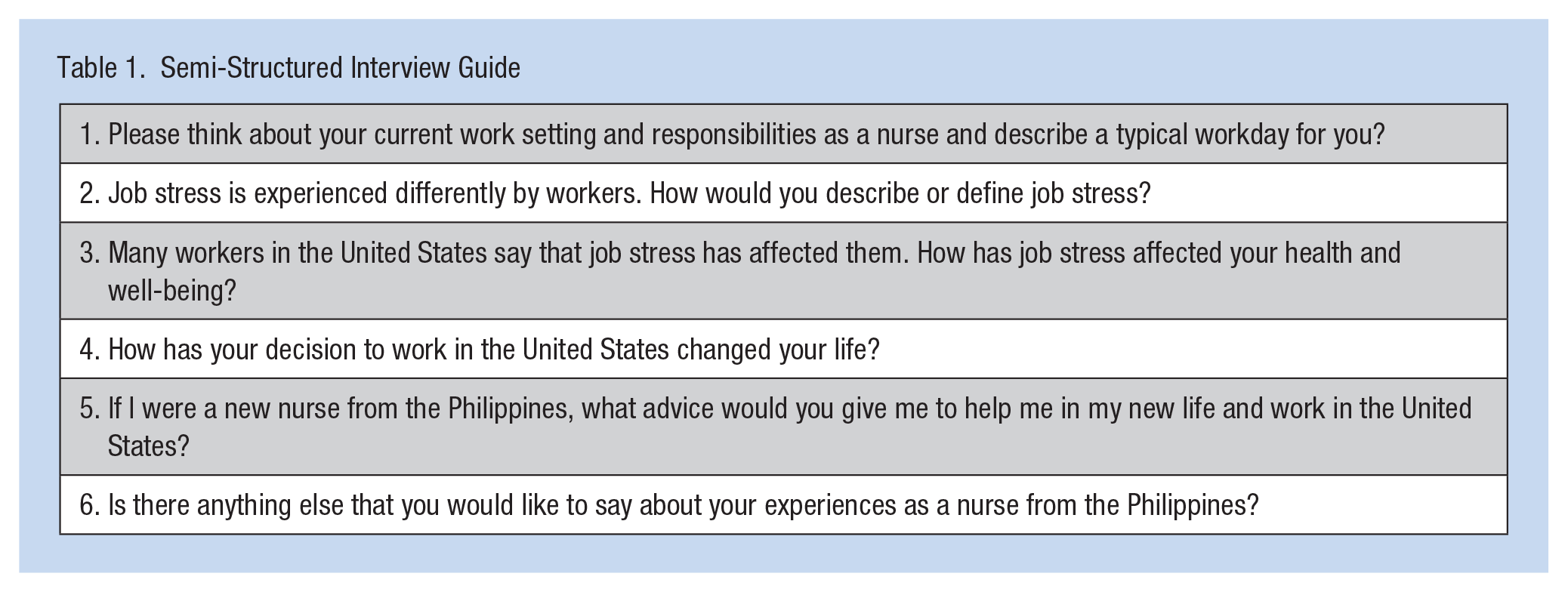
This study used a cross-sectional qualitative descriptive design to gain a deeper understanding of the strategies Filipino IENs use to cope with work- and nonwork-related stress. In-depth interviews using a semi-structured, open-ended interview guide (Table 1) were used to elicit information relating to the specific aims of the study. The study was approved by the researcher’s Institutional Review Board. Interview participants were informed that participation was voluntary, and they did not have to answer any questions they were uncomfortable answering. No financial incentive was given for participating in the study; however, a tote bag was given to each participant as a token of appreciation for their time.
Semi-Structured Interview Guide
Being a Filipino woman, this researcher was aware of the advantages and disadvantages of being an insider with respect to sharing the same culture with the participants. As such, she used strategies such as reflective journaling, member checking, and peer debriefing to minimize potential bias and establish credibility.
Population and Sampling Methods
A purposeful sampling procedure was used to select the sample with the following inclusion criteria: Filipino women who (a) were at least 21 years old, (b) received their basic nursing education in the Philippines, (c) worked as a registered nurse (RN) in the Philippines prior to migrating to the United States, and (d) worked in a U.S. health care facility at the time of the interview. Following the advice of key informants, the researcher used networking to recruit the participants. She sought professional colleagues, leaders from Filipino nursing associations and social and religious organizations, and personal acquaintances who worked with IENs or were well connected with the target population. The researcher explained the purpose, specific aims, and goals of the study to gain support and then asked them to refer colleagues or acquaintances who might be interested in participating in the study. This process averted participants’ potential initial distrust because a known and trusted individual endorsed the study.
Interested participants were then contacted by telephone and screened for eligibility. Eligible participants who agreed to participate in the study were scheduled to be interviewed at a later date, time, and location. To facilitate recruitment and ensure participants’ privacy and confidentiality, interviews were conducted on the participants’ own time and away from their workplace to reassure them that the study was not related to their employment, and also to permit them to speak freely about their experiences.
Twenty Filipino women ranging in age from 28 to 48 years were interviewed; all the women were RNs who worked in a health care facility in a Midwestern city and had been living in the United States for an average of 9 years (range = 2-17 years).
Data Collection and Analysis
Written informed consent was secured prior to the interview. The interviews were conducted in English, lasted 30 minutes to 2 hours, and were audio-recorded. The main questions that elicited responses regarding coping strategies were as follows: (a) What challenges have you faced after immigrating to the United States? (b) What helped you manage these challenges? (c) If I were a new nurse from the Philippines, what advice would you give me to help me in my new life and work in the United States? Field notes were documented to remember participant’s behaviors and features of the environment and setting during the interview. The researcher also kept a reflexive journal to note impressions and personal reactions from the interviews.
The interviews were transcribed verbatim. Atlas.ti, v6.0 (Atlas.ti, Berlin, Germany, 2009), a qualitative data management software, was used to assist the researcher with data analysis. This software was used for coding and identification of themes and concepts. Auerbach and Silverstein’s (2003) method of qualitative analysis was used to manage the content and analyze themes from the data. The coding procedure began after the first three interviews. Each subsequent interview was coded after it was transcribed. The codes were reviewed periodically (e.g., after coding another transcript) to assess redundancy. If different codes were given for the same idea, the codes were combined. Relevant interview texts were analyzed to develop a list of categories that reflected the research concerns. Data saturation was reached after analysis of 17 of the 20 interviews.
In addition to exploring stress and coping themes, the researcher also analyzed the data for commonalities and differences within and across groups of IENs based on the length of time they had been in the United States. The analysis revealed that despite the length of time these IENs had been in the United States, no discernible differences in their preferred coping methods and strategies were found.
Results
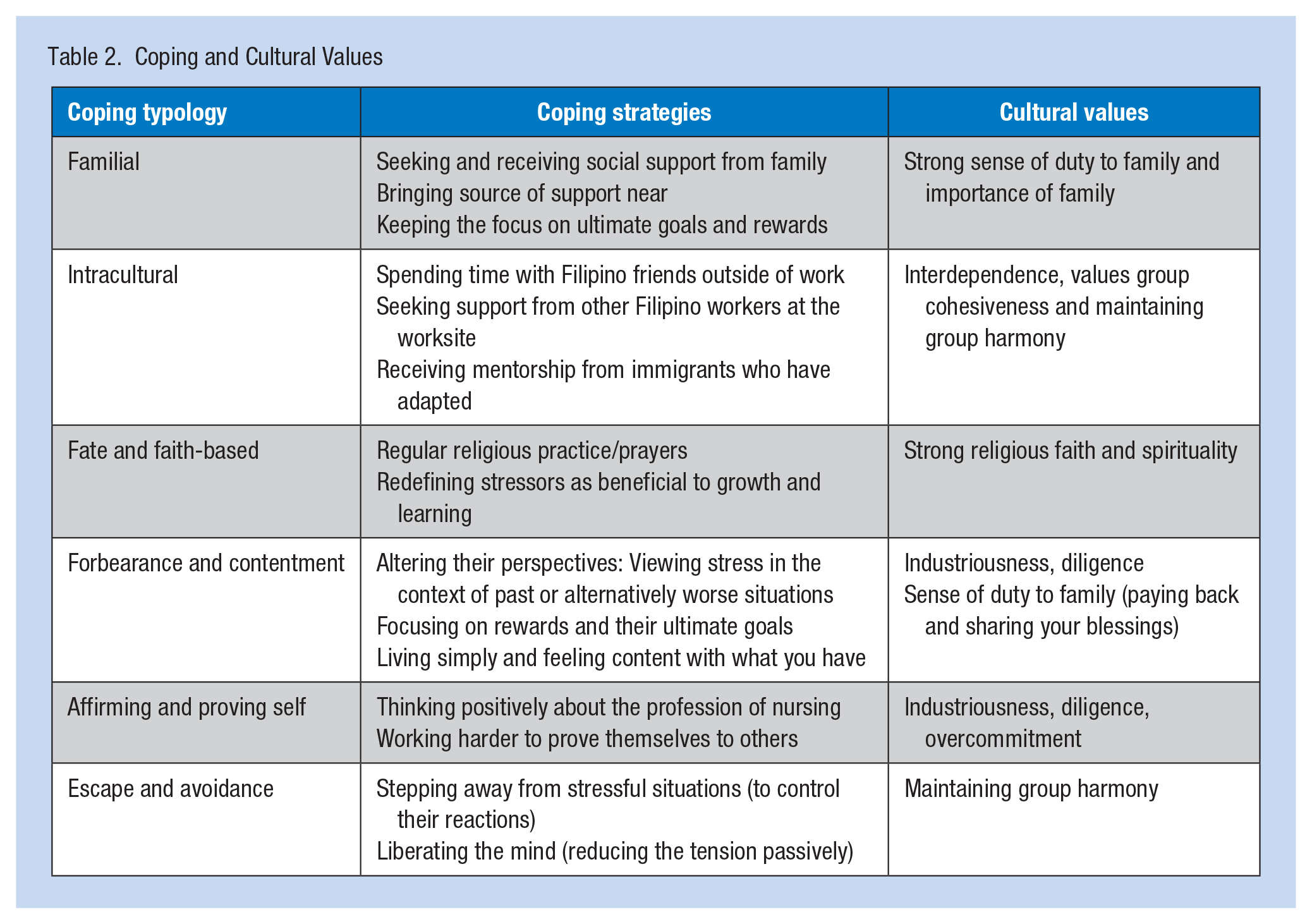
The mean age of the 20 RNs was 30.5 years (range = 28-48 years). The women had lived in the United States on average 9 years (range = 2-17 years). The themes that emerged reflected similar coping behaviors and strategies and were categorized as (a) familial, (b) intracultural, (c) fate and faith-based, (d) forbearance (patience and self-control) and contentment, (e) affirming the nursing profession and proving themselves, and (f) escape and avoidance.
Familial Coping
The participants described a strong connection to their nuclear and extended families. As such, all the women exhibited coping behaviors that were tied to their strong sense of duty to, and respect for, their families. Participants sought and received social support primarily from their family members. They often talked to their parents about their challenges and acted on their advice to cope with stress. Technology (e.g., cell phones, Internet) enabled them to receive emotional support from family members living in the Philippines or another state. In addition, calling or texting alleviated some of their loneliness due to the physical separation from family members. As one of the IENs explained, “I spend a lot of money calling them overseas. I do not know, I just feel like that is the only connection I have with them.”
The participants said that in the Philippines, parents commonly live with their adult children and their families, sharing in child care and household responsibilities. Several of the women said that as soon as it was possible, they petitioned their parents and/or siblings to come to the United States to help them cope with and balance their multiple responsibilities.
You know [my parents help with] babysitting. It’s not a lot of stress for us because you don’t have to worry about childcare and when you get home, you are tired from work, you don’t have to cook. It would otherwise be hard with both me and my husband working.
Most of the women said they often cope by thinking of the benefits that may result from working in the United States; this strategy balances, and may even outweigh, the stress they encounter as immigrant RNs. Two women commented, Even though I’m lonely, depressed sometimes—it is necessary to make that sacrifice to reach our goal. That’s how I overcome—and prayers. I’m focused on the good outcome from all of the sacrifice. And one more thing that helps is the joy that you bring to your families in the Philippines. Knowing that you are at least giving them something, making them happier . . . It is like an inspiration. It is so rewarding and so inspiring—even though the next day you are going to be stressed out again. That is the driving force—the family. It serves as an inspiration, really.
Intracultural Coping
Intracultural coping involves seeking social support from others who share the same background and experiences. The respondents appeared to have an unspoken connection with fellow Filipino workers that obligated them to help each other. This finding can likely be attributed to the nurses’ strong sense of duty to family and, by extension, to the Filipino community. At the workplace, these women found camaraderie and comfort with other immigrant Filipino nurses with whom they shared common experiences: “Because we are undergoing the same ordeals and same difficulties . . . we tend to vent our feelings to each other. That is good help . . . we tend to share stories and that helps.”
Many of the women also found comfort in just knowing that other Filipino IENs were employed at their workplace: When I come to a hospital the first thing I do is still look for other Filipinos then you feel comfortable . . . even if you do not know them . . . if there is another Filipino there; I feel like I belong.
Women also reported finding tangible support from other Filipino immigrant nurses at the workplace. One RN commented, The good thing about my unit is that there are a lot of Filipino nurses. The team work among them is outstanding because if one person is drowning, there are people around you who you could trust. They become your friends through working together. It overcomes the stress.
Fate and Faith-Based Coping
All the women used fate and faith-based coping strategies to help them meet challenges. Stress was often viewed as an inevitable part of life and nursing: “I have learned to deal with it. I just have to accept that it is always going to be there. Nursing is a stressful job.”
All the participants in this study were Christian (mostly Catholic) and had a strong sense of faith in whatever religion they practiced. Most of the participants interviewed in this study sought relief from stressors by turning to their religions. Many of the women expressed the strength of prayer to help them get through difficult times: Prayers, I think, are powerful. Sometimes I just pause and take a moment to pray: like something positive—like I can do it—something to lessen it. Give me something to lift me up for the moment. A smile from a friend, one joke, just give me that, I pray—just to make the tiredness go away for the moment.
Besides praying for themselves, they also believed in the power of others praying for them. Some of the women found churches that had a predominantly Filipino congregation. Many of the women became active in their church and not only found solace in prayer but also drew social support from members of the church community: One blessing that we have is being able to go to a Baptist church that is Filipino-American Baptist church . . . you have a taste of home in the church. Once a week you are with people that you could relate. I think that makes a difference.
Many of the participants also coped by thinking that enduring hardships would make them stronger and more resilient.
I know that God prepared me before he sent me here . . . my experience and everything that happened to me in the past years really equipped me to be here . . . like I said it’s like survival of the fittest . . . aside from hard prayer, be receptive to everything.
Forbearance (Patience, Self-Control) and Contentment
The women in the study also used coping strategies that involved restraint in response to stressors. These strategies included ways of coping that did not directly address the causes of stress; instead they focused on altering their views or just tolerating the stress. For example, the participants reframed the stress by comparing current and past experiences. They explained that they could handle present stressful situations because they were able to overcome worse situations in the past: I came from a poor family, so I know what it’s like to be poor. So when I came here, I don’t want stress to ruin my life . . . So maybe the hardship that I encountered in the Philippines makes me stronger here. I don’t let stress affect me.
It was also common for the women to compare working environments, often recalling their worst work experiences to weigh against the current experiences: I think because I came from a nursing home where we reach up to 30 patients per one nurse. So when I came here, 4, 5, 6 patients—I can handle it. But all of my coworkers, they complain about it. Maybe because they are not used to working in a nursing home or something but I used to work with a lot of patients [workload] in the nursing home.
Financial challenges were common, and many coped by feeling content with what they had: I only buy the necessities . . . So me I live a simple life . . . I am a simple person, this is what I want to do . . . if you buy more, you get more, you work more, and I do not want to do that because I want to spend time with my kids.
These strategies are tied to their strong sense of duty to family in that they consider the benefit to their families over their own needs and feelings. In addition, these strategies are non-confrontational, which is congruent with their values of maintaining group cohesiveness and social harmony.
Affirming the Nursing Profession and Proving Themselves
Many of the participants said that thinking about the positives of being a nurse also helped them cope with the difficulties inherent in the profession: For me, I mean, being a nurse is like not only work but it is an obligation and it is also my, my passion. And helping people erases every hardship that you went through once you see them healed and be grateful and thankful for what you have done.
Most of the nurses encountered unfair work practices and discrimination or were challenged about their presence in the United States; the way they coped with this was by working even harder to prove themselves. In response to the discrimination she faced, one participant said, But most importantly, prove yourself that you are as worthy to be working in the US as much as anybody. Once you have proven yourself, you are able to rise out of that stereotype. Once you earn their respect, you will get their support.
Escape and Avoidance
The final category of coping strategies was described as escape and avoidance. When feeling overwhelmed or stressed at work, participants explained that they often stepped away from the situation to avoid confrontation: You don’t want to answer them in a crazy way, so you go someplace [sighs] and let it out because it’s hard . . . I just go to staff lounge, drink some water and come back . . . You don’t want to say bad words, you don’t want to do something that’s not right, so you have to calm yourself, go somewhere else.
Diverting their focus away from the stress of work was also commonly used by the women in this study. Once they left the workplace, many of the women made the effort to forget work and also reported doing something they enjoyed, such as shopping, to cope with the stress they encountered: I want to enjoy my life too. So I cannot just think of work all day long, so I have to turn off my light switch when I get home . . . I have my ways of coping with stress; I try to forget about work when I get home.
Discussion
Culture served as the context for participants’ preferred coping strategies and behaviors. Overall, the women used collective and indirect ways of coping that could be connected to one or several of the cultural characteristics identified in previously published findings. The coping behaviors and strategies were classified under six typologies: (a) familial, (b) intracultural, (c) fate and faith-based, (d) forbearance (patience and self-control) and contentment, (e) affirming the nursing profession and proving themselves, and (f) escape and avoidance. Table 2 lists the coping typologies and specific coping behaviors employed by study participants. The participants expressed a strong sense of duty to, and respect for, their families and demonstrated coping behaviors that aligned with this cultural value.
Coping and Cultural Values
Several studies on Asian Americans found that as an aggregate, they tend to use emotion-focused (e.g., religious coping, escape-avoidance, distancing) strategies to cope with stressors (e.g., discrimination; Bjorck, Cuthbertson, Thurman, & Lee, 2001; Lee & Mason, 2014; Noh & Kaspar, 2003). Traditionally, coping strategies have been categorized as emotion- or problem-focused behaviors (Carver, Scheier, & Weintraub, 1989; Lazarus & Folkman, 1987). Mixed results regarding which type of coping strategy (i.e., passive/emotion-focused coping strategies or confrontational/problem-focused) are associated with better health outcomes have been reported. For instance, Bjorck et al. (2001) found that problem-solving strategies such as seeking social support predict less distress, whereas passive or emotion-focused strategies such as self-control and escape avoidance predicted greater distress. Noh and Kaspar’s (2003) study of Korean immigrants also found that emotion-focused coping had a detrimental effect on their mental health status; however, they found that ethnic support moderated the negative effects of emotion-focused coping. This finding would seem to indicate that dichotomizing coping strategies and labeling them as maladaptive or adaptive is not sufficient to explain the way ethnic immigrants cope (Yeh et al., 2006). Accepting stress as normal justified Filipino IENs’ challenges and allowed them to ignore or become accustomed to occupational stress.
The women in this study chose different methods of coping depending on the type of stressor they encountered. Often times, they used multiple methods to cope with a particular stressor. For instance, participants sought social support from their family, other Filipinos, and Filipino organizations to cope with the loneliness and separation from their network of family and friends left behind in the Philippines. Faith-based coping strategies such as prayers and redefining stressors as beneficial to their growth and learning were also often used by the women. Although some readers may perceive this coping method as minimizing or rationalizing, it may be beneficial in situations in which individuals feel that they have little or no control over the situation.
Despite the length of time in the United States, participants continued to prefer collective and indirect strategies to cope with stress; however, those nurses who had established a sense of permanency in the United States were more comfortable expressing their displeasure. In general, the participants also said that they would not likely seek help from mental health professionals (e.g., psychiatrist, psychologist, social worker) for mental health issues such as stress, depression, and anxiety. This finding is probably related to the social stigma of mental health issues (Javier et al., 2014; Sue, Cheng, Saad, & Chu, 2012).
Evidence suggests that ethnic identity may have mental health benefits for Filipino Americans. Mossakowski (2003) found that for Filipino Americans, ethnic identity buffers the stress of discrimination, and ethnic identity itself is strongly associated with fewer depressive symptoms. This finding supports the importance of culturally specific coping methods, such as familial and intracultural coping strategies, that tie their values to their preferred coping strategy. Ethnic identity involves being committed to one’s ethnic group, being proud of one’s own cultural heritage, and maintaining a strong sense of belonging through cultural practices, for example, preparing and eating ethnic foods (Phinney, Horenczyk, Liebkind, & Vedder, 2001; Phinney & Ong, 2007).
A limitation of this study is that it is cross-sectional in design, and although the participants were asked to reflect on their experiences from migration to present time, recollection bias could have affected the results. Longitudinal studies that track the evolution of migrants’ coping behavior and cultural adaptation across different phases of their lives would be desirable.
Implications for Practice
The findings from this study identified strategies that Filipino IENs reported as effective in coping with stressful situations; the findings, therefore, have implications for occupational health nurses who are responsible for designing and implementing health promotion interventions as well as administrators of organizations who employ IENs. The results from this study support the use of collective coping strategies, which lessen emotional distress opposed to direct or problem-focused coping methods. This study also demonstrated that cultural values are associated with IENs’ preferred coping strategies and supports the evidence (Kuo, 2011; Kuo, Arnold, & Rodriguez-Rubio, 2014) that individuals who operate from a collectivistic standpoint, such as Filipino immigrants, view themselves as interconnected to their social environment. Similarly, these IENs emphasized family and group harmony above individual needs or desires.
Research has shown consistently that Asian Americans are less likely to seek help for mental health problems than other demographic groups (Chu & Sue, 2011; Sue et al., 2012). This finding is likely due to the stigma related to mental health issues for this population and perhaps the discomfort of participating in programs that support the use of direct and more confrontational methods of coping. Therefore, occupational health nurses must develop interventions that are culturally appropriate; IENs may be more likely to participate in health promotion programs and interventions that incorporate cultural values. The nurses’ preferred coping strategies are highlighted in Table 2.
Moreover, the information gained from this study can be useful to administrators, particularly those who manage immigrant health care providers who may be new or still adjusting to life in the United States. Managers may use this information for staff development to improve interpersonal relationships in a multicultural and diverse work environment. Filipino IENs tend to congregate together during their breaks and speak to each other in their native language, which may cause their peers to be resentful and suspicious of their willingness to be part of the mainstream society. Managers can correct misconceptions about IENs talking in their native language and educate others that this behavior may be part of coping with occupational stressors. Managers should be cognizant that IENs may be reluctant to speak for themselves; many may choose to cope with discrimination, resentment, and bullying by proving they are effective nurses. Managers should reassure IENs that they can safely advocate for themselves in these situations as well as build stronger rapport by finding social networking opportunities where IENs can find emotional support from their peers and supervisors.
Conclusion
Although a substantial body of research on coping exists, fewer studies have focused on the influence of culture on Filipino IENs’ preferred coping strategies. This study contributes to the burgeoning interest in understanding culture’s influence on coping patterns and preferences among diverse populations. Occupational health research must continue to focus on understanding the role of culture and adaptation on stress and coping behaviors to retain quality nurses and promote a healthier workplace.
Applying Research to Practice
Immigrant nurses are an important part of the U.S. nursing workforce. They bring with them diverse experience and knowledge that contribute to the provision of quality care to a patient population that is becoming increasingly diverse. However, studies have shown that immigrant nurses encounter unique stressors such as adaptation issues, language barriers, and discrimination. Therefore, it is imperative that occupational health nurses, as well as administrators of organizations that employ immigrant health care providers develop culturally appropriate health promotion interventions to help them cope effectively with stress. This study identified strategies that Filipino immigrant nurses reported as effective in coping with stressful situations and can assist in designing and implementing programs to promote a healthier workplace.
Footnotes
Conflict of Interest
The author(s) declared no potential conflicts of interest with respect to the research, authorship, and/or publication of this article.
Funding
The author(s) disclosed receipt of the following financial support for the research, authorship, and/or publication of this article: This research received funding from the National Institute of Occupational Safety and Health (Grant#3 T4OH008672).
Author Biography
Dr. Jorgia Connor is Assistant Professor and Director of the 4-year BSN at the Loyola University Chicago-Marcella Niehoff School of Nursing. Her background and expertise in community health and occupational health nursing motivates her research interest in cumulative stress, health promotion, and disease prevention, particularly in the immigrant populations.