




Abstract
Reducing distracters detrimental to commercial truck driving is a critical component of improving the safety performance of commercial drivers, and makes the highways safer for all drivers. This study used a driving simulator to examine effects of cell phone, texting, and email distractions as well as self-reported driver optimism bias on the driving performance of commercial truck drivers. Results revealed that more visually demanding tasks were related to poorer driving performance. However, the cell phone task resulted in less off-the-road eye glances. Drivers reporting being “very skilled” displayed poorer driving performance than those reporting being “skilled.” Onboard communication devices provide a practical, yet visually and manually demanding, solution for connecting drivers and dispatchers. Trucking company policies should minimize interaction between dispatchers and drivers when the truck is in motion. Training facilities should integrate driving simulators into the instruction of commercial drivers, targeting over-confident drivers.
Keywords
Since 2009, fatality and injury rates from large commercial truck and bus collisions have steadily increased, contrary to the national trend of overall truck fatal and non-fatal injury rates, which have declined (U.S. Department of Transportation [USDOT] & Federal Motor Carrier Safety Administration [FMCSA], 2013). Taking into account death, injury, and property losses, large commercial truck and bus crashes cost Americans an estimated US$87 billion in 2011, an increase from 2010’s US$84 billion and 2009’s US$79 billion.
Commercial truck drivers spend significant time behind the wheel, are expected to maintain contact with dispatchers (Ng, Wessels, Do, Mannering, & Barfield, 1995), and are exposed to numerous technologies that potentially contribute to driver distraction, such as smart phones and onboard computers. Driver distraction, in this article, is defined as “the diversion of attention from activities critical for safe driving to a competing activity” (Hanowski, 2011, p. 4).
Reducing distracters that are specifically detrimental to commercial truck driving performance is a critical component of the overall goal of improving the safety-related performance of commercial drivers, and, in doing so, making the highways safer for all drivers. This study was designed to understand the relationship between self-reported skill-level bias and simulated distracted driving performance among commercial truck drivers.
Previous Research
Much of the previous research in this area is from naturalistic driving studies, studies during which individuals are observed as they go about normal activities. These studies are ideal for examining driver distraction in the commercial trucking industry and have strongly indicated the need for additional work in this area; however these studies consume time and resources. Led by the seminal work of the Virginia Tech Transportation Institute (VTTI), naturalistic studies in this area have found that almost all commercial truck driver critical safety incidences involved driver distraction, driver inattention was involved in all observed collisions, and critical safety incidents were nearly 10 times more likely to occur while drivers were interacting with the truck’s dispatching device (Olson, Hanowski, Hickman, & Bocanegra, 2009).
Optimism Bias
Although it has been well established that electronic device interaction while driving increases the risk of degraded driving performance (Olson et al., 2009), little is known about individual factors, such as self-reported driving skill, that may influence commercial driving performance, particularly when distracted.
Self-reported driving skill can be used to determine a driver’s level of optimism bias. Optimism bias is a systematic error in perception of an individual’s own standing relative to group averages, in which negative events are seen as less likely to occur to the individual than average compared with the group, and positive events as more likely to occur than average compared with the group. (Dalziel & Job, 1997; Weinstein, 1980)
The effect of driver optimism bias on actual driving performance has widely been studied in older adults, teens, and taxi drivers, but not in commercial truck drivers. It negatively affects the driving habits of younger drivers (White, Cunningham, & Titchener, 2011) and taxi drivers (Dalziel & Job, 1997), but not older drivers (Edwards et al., 2008).
Current Study
The current study examined the driving performance of 50 volunteer commercial truck drivers recruited from a trucking company in the southeastern United States. Study participants completed four trips in the truck simulator while performing the following tasks: (a) talking on a cell phone, (b) text messaging, (c) emailing, or (d) no secondary task. The rationale for examining these particular secondary tasks was based on results from a previous study (Olson et al., 2009), and the reality that many commercial trucks have built-in emailing devices for drivers to communicate with dispatch. Participants also completed a survey of demographic characteristics and skills ratings by commercial truck drivers.
Based on prior studies, it was hypothesized that (a) participants would exhibit poorer driving performance depending on the demand of the specific secondary task (Hanowski, Perez, & Dingus, 2005; Klauer, Dingus, Neale, Sudweeks, & Ramsey, 2006; Olson et al., 2009), and (b) drivers rating themselves as more highly skilled and experienced would perform worse than they predicted using the skills rating questions (Dalziel & Job, 1997; Horswill, Waylen, & Tofield, 2004; White et al., 2011).
Method
Fifty-five commercial truck drivers were recruited through flyers displayed in areas prominently visible throughout the truck company premises. Eligibility criteria included (a) ages 21 to 65, (b) possession of a valid, state-issued Commercial Driver’s License (CDL), (c) sleeping at least three nights per week in the sleeper berths of their commercial trucks, (d) deemed medically fit per USDOT standards, (e) personal ownership and possession of a cell phone, and (f) ability to read, write, and speak English. Exclusionary criteria included (a) a previous, medical diagnosis of sleep apnea, and (b) self-reported routine and habitual use of sedating or hypnotic medications, illicit drugs, or alcohol.
Five of the eligible participants were excluded from the study: two due to simulator-related motion sickness and three due to data quality issues related to the simulated drive. Fifty participants were included in the statistical analysis.
Procedures
Research assistants secured written informed consent from the participants meeting eligibility criteria for the study. Participants then completed a research team-created data collection survey.
Once simulator proficiency had been established, the study participants engaged in four, 22.5-mile driving scenarios, with a series of secondary tasks presented during the simulated route using a counterbalanced, Latin square design to control for potential order effects. These tasks included (a) no secondary task, where participants anticipate receiving a secondary task, but received none; (b) a cell phone conversation, where participants received a cell phone call 10 seconds after beginning the scenario and engaged in a naturalistic phone conversation with an unfamiliar research assistant for the remainder of the scenario; (c) a text message interaction, where participants received a text message 10 seconds after beginning the scenario and engaged in reading and responding to text message exchanges with an unfamiliar research assistant for the remainder of the scenario; or (d) emailing interaction, where participants were sent an email message 10 seconds after beginning the scenario and engaged in reading and responding to email messages with an unfamiliar research assistant for the remainder of the scenario. Participants were offered a break of less than 5 minutes between each of the four drives.
Tasks were semi-structured to imitate a typical conversation with unfamiliar individuals. Questions were purposely structured to be open ended, neutral (non-emotional), and largely based on questions used in previous studies (Stavrinos et al., 2013). After completion of the driving task, participants were debriefed and compensated US$200.
Measures
Truck driver survey
Participants completed a laboratory-developed questionnaire providing a detailed overview of demographics and self-rated skill as commercial drivers (“How skilled do you think you are as a commercial driver?”). Possible responses included (a) “very skilled,” (b) “skilled,” (c) “somewhat skilled,” and (d) “not skilled at all.”
Driving simulator
Participants engaged in a computerized driving simulation task in an L-3 Communications TranSim™ (D.P. Associates, Inc., Alexandria, Virginia) commercial truck driving simulator to provide a measure of driving performance under specified conditions of interest (see Figure 1). The simulation was displayed on three plasma screens, providing a 180° field of view. Participants sat within the simulator’s driver compartment, which provided a view of the roadway and dashboard instruments, including a speedometer, tachometer, trailer and brake release buttons, and a brake pressure gauge. The buttons added to the external validity of the task, by requiring necessary action by commercial motor vehicle (CMV) drivers to initiate the truck’s motion. The truck was controlled by moving a force-loaded steering wheel, changing gears (10-speed), and using the accelerator, clutch, and brake pedals appropriately. The commercial truck was programmed to carry an 80,000-pound high-tarped load. An onboard stereo sound system provided naturalistic highway driving noise.
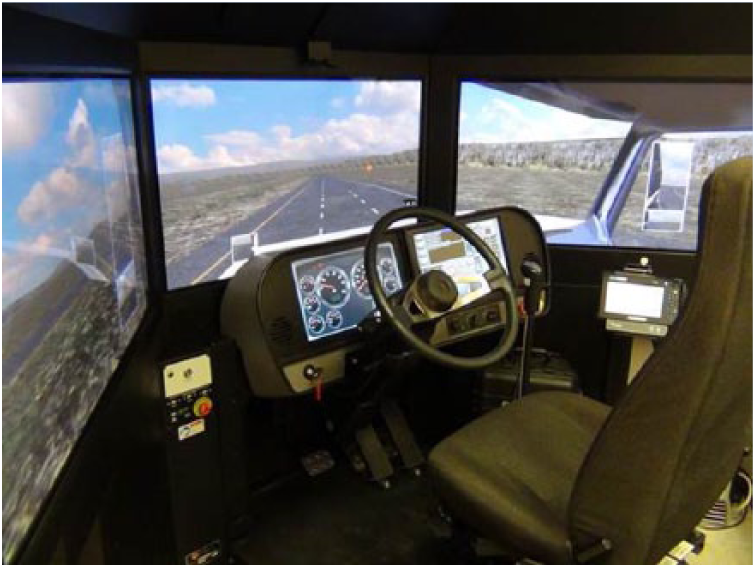
Photograph of the L-3 Communications TranSim™ driving simulator operator compartment.
Driving scenarios
The simulated daytime environment was a four-lane interstate segment, with traffic moving on both sides of the road, mimicking typically encountered roadway conditions. Speed limit signs appeared throughout the scenarios and ranged from 55 mph to 60 mph. Drivers were encouraged to “drive as they normally would.” Simulated traffic was programmed to interact with the participant driver, based on pre-set parameters, imitating real world traffic conditions.
Variables
Three indicators of driving performance were electronically recorded by the simulator:
The total number of collisions was calculated for each secondary task. A collision was reported as an instance when the participant driver collided with either another vehicle or object.
Space management was based on the Smith System (Smith System, 2014) and measured by the total number of times the participant driver was less than 10 seconds away from a lead vehicle.
Speed exceedances were calculated as the total number of times a driver went more than 15 mph over the posted speed limit.
Two video cameras (one mounted above the simulator, providing a full image of the participant driver, and another on the Operator’s Console [OpCon]) provided a full, unobstructed view of the driving scene. Two trained research assistants manually coded the videos to capture additional indicators of driving performance:
Lane deviations, defined as centerline crossings or road edge excursions, were recorded as indicators of impaired driving performance. Greater within-lane deviation indicated poorer driving precision (Shinar, Tractinsky, & Compton, 2005; Weafer, Camarillo, Fillmore, Milich, & Marczinski, 2008);
Off-the-road eye glances were deemed as instances when the drivers’ eyes were off the simulator screens and glanced elsewhere. Using the video recordings, coders manually recorded the number of times participants looked away from the screen. Coders were blinded to the condition (or secondary task) for each drive. Inter-rater reliability was established by having two independent coders record glances for 20% of the sample (r = .997), and then one of the coders completed the rest of the files.
Data Analysis
Mean and frequency distributions were used for continuous and categorical variables, respectively, to describe demographic characteristics of the participants. To determine the effect of secondary tasks on driving performance, generalized estimating equation (GEE) statistical models were used (Hubbard et al., 2010). The use of GEE modeling methods allowed for the inter-dependence of the observations, as each participant engaged in four drives, and adjusted for within-person covariance. More specifically, the GEE Poisson model was chosen because this type of model demonstrated the best fit with the data (i.e., count outcome variables).
GEE Poisson models were used to calculate rate ratios (RRs) and associated 95% confidence intervals (CIs). The natural log of miles driven during the simulation driving segment was used as the offset in the Poisson model to model the rate rather than the count. Models were created for each driving performance measure, with the no secondary task as referent group in each scenario. The same GEE Poisson model was used to calculate RRs and associated 95% CIs for the effect of skill on each driving performance measure, in which “skilled” was the referent group. “Skilled” was used as the referent because it is an average estimate instead of an over- or under-estimation. The mean rate for each driving performance measure was calculated per 100 miles because of slight variations in simulated scenario distance. The p values less than .05 were considered significant for all analyses. All statistical analyses used SAS, Version 9.2 (SAS Institute Inc., 2011).
Results
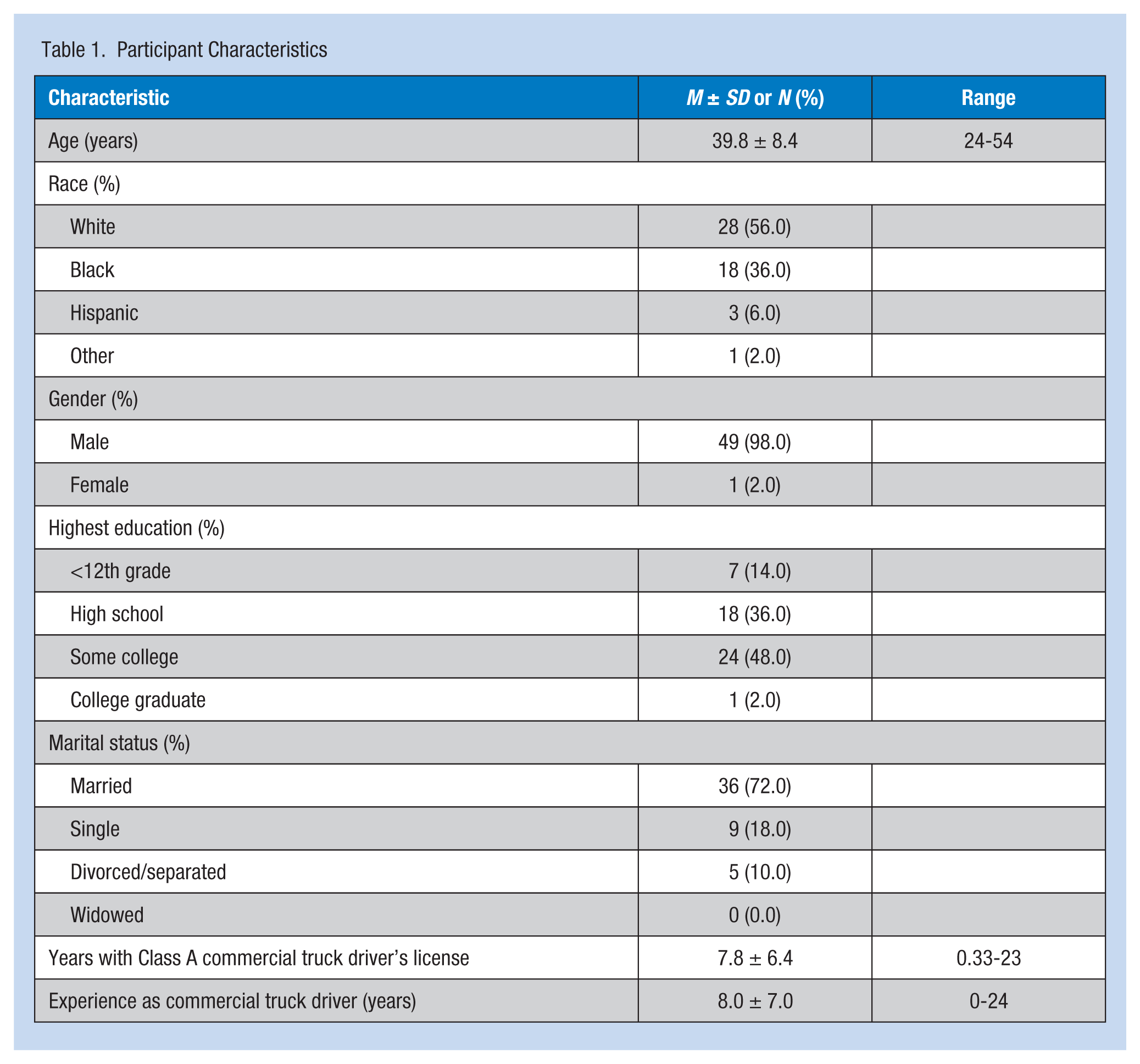
The average age of the participants was 40.5 years (see Table 1). A large proportion of participants were Caucasian (56.0%) or African American (36.0%), male (98.0%), and married (72.0%). The average experience as a commercial truck driver was 8.6 years, with an average 7.8 years as a Class A commercial driver’s license holder.
Participant Characteristics
Both the emailing (RR 1.95, 95% CI = [1.76, 2.19]) and texting (RR 1.90, 95% CI = [1.68, 2.14]) tasks showed a significantly higher rate of “all violations” (speeding, space management, collisions, and lane deviations) compared with the no task scenario (see Table 2). The texting task resulted in a significantly higher rate of lane deviations (RR 2.71, 95% CI = [2.22, 3.30]) and eye glances off the road (per mile; RR 20.17, 95% CI = [16.38, 24.82]). The emailing distraction resulted in significantly increased rates of collisions (RR 5.48, 95% CI = [1.45, 20.68]), lane deviations (RR 2.89, 95% CI = [2.39, 3.49]), and eye glances off the road (RR 12.88, 95% CI = [10.45, 15.86]). The cell phone task resulted in a significantly lower rate (RR 0.58, 95% CI = [0.42, 0.78]) of off-the-road eye glances (per mile).
Association Between Secondary Tasks and Driving Violations
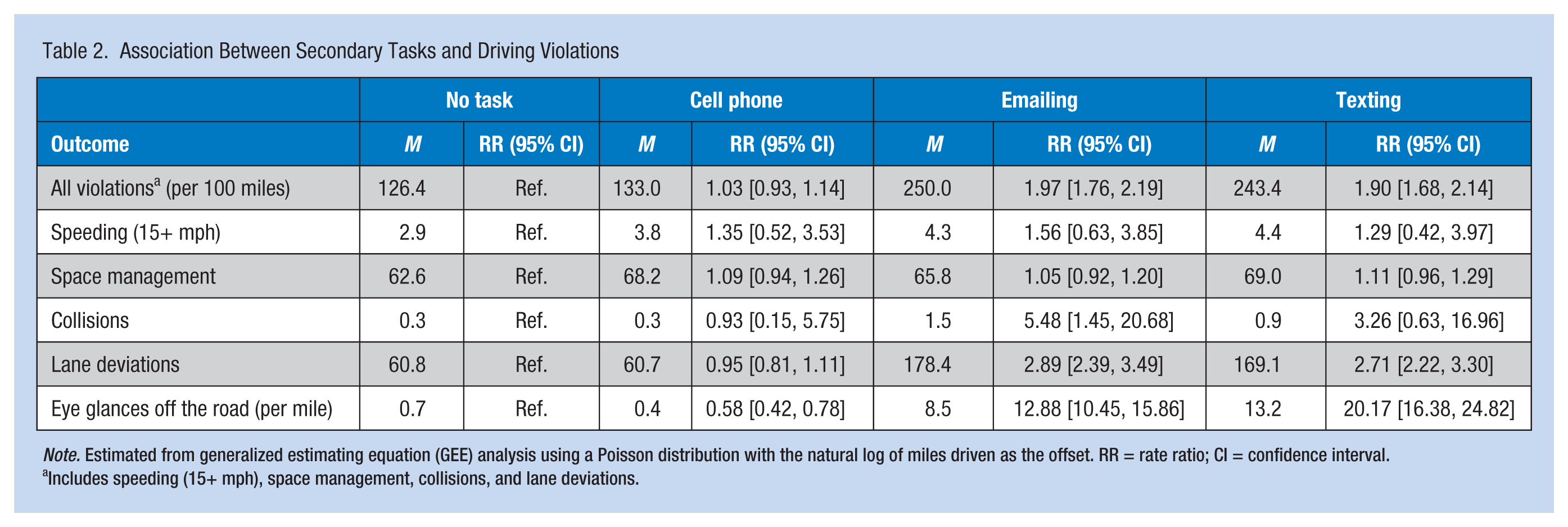
Note. Estimated from generalized estimating equation (GEE) analysis using a Poisson distribution with the natural log of miles driven as the offset. RR = rate ratio; CI = confidence interval.
Includes speeding (15+ mph), space management, collisions, and lane deviations.
With those who reported being “skilled” as the referent, drivers reporting being “very skilled” had more speeding over lane deviations (RR 1.22, 95% CI = [1.15, 1.30]), eye glances off the road (RR 1.06, 95% CI = [1.04, 1.09]), and total violations (RR 1.15, 95% CI = [1.10, 1.21]), which encompassed speeding violations over 15 mph, space management, collisions, and lane deviations. Those who reported themselves as “somewhat skilled” had significantly fewer instances of speeding over 15 mph (RR 0.45, 95% CI = [0.26, 0.78]).
Discussion
The current study replicated the findings of the impact of distraction on commercial truck drivers in naturalistic studies by using the less expensive, safer modality of a truck simulator. Findings from the current study suggest that secondary tasks are not equally detrimental. Similar to the findings reported by other researchers (Olson et al., 2009), these results suggest that having a conversation on a handheld cell phone had the least adverse effect on driving performance outcomes. However, the more visually demanding secondary tasks such as emailing and texting degraded driving performance to a greater extent.
Consistent with these findings, Hosking, Young, and Regan (2006) found that passenger vehicle drivers’ eyes focused significantly less on the road while text messaging in a high-fidelity driving simulator. However, it is particularly noteworthy that eye glance behavior varies by type of secondary task. Another study found an association between cell phone conversation and frequency of long-eye fixations on the roadway ahead (Mazzae, Goodman, Garrott, & Ranney, 2004). A similar pattern of results was found in the present study with a significant reduction in off-road eye glances during the cell phone task. Given that visual attention to the roadway results in decreased crash risk (Olson et al., 2009), talking on a cell phone has been suggested to be a protective measure in commercial truck drivers by indirectly causing them to increase their visual attention on the road center while conversing. Yet, other studies have found that drivers engaged in conversation may not scan the environment as they usually do when not distracted. Additional research in this area is warranted.
Eliminating distracted driving is a national transportation goal, as reflected in the Federal Motor Carrier Safety Administration’s final ruling prohibiting interstate truck and bus drivers from using handheld cell phones while operating CMVs (U.S. Department of Transportation, 2011). However, the more visually demanding tasks, such as onboard computer use, may be a more significant area of concern. Because constant communication between company dispatchers and drivers is essential, onboard communication devices have provided a practical, but visually and manually demanding, solution for keeping drivers and dispatchers connected. Technology-based solutions may play a role in eliminating the impact of distraction for commercial drivers. To the authors’ knowledge, no other study has compared commercial truck drivers’ self-reported driving skill with their actual driving performance. Consistent with previous attempts to examine optimism bias in drivers of passenger vehicles (White et al., 2011), this study’s findings suggest that some commercial truck drivers tend to over-estimate their own driving skills, with those who rated themselves as “very skilled” driving less cautiously than drivers who rated themselves as “somewhat skilled.” Future research should also consider individual differences that may relate to the perception of skill and driving performance to provide additional training targets.
Limitations
First, the sample size of 50 commercial truck drivers is modest. It is possible that the study lacked sufficient statistical power to detect significant relationships among particular outcomes of interest. A study examining a more robust study population should be conducted to reliably generalize to the U.S. commercial truck driver population. Although the sample was slightly younger than the national median age of commercial drivers (46 years; Bureau of Labor Statistics, 2015), the driving experience of the current study sample (M = 8 years) was comparable with the driving experience of other studies investigating commercial truck drivers (typically just over 5 years of experience; Apostolopoulos, Sonmez, Shattell, Gonzales, & Fehrenbacher, 2013). Other studies also reported more variability with regard to years with Class A licensure compared to this study (Markkula, Benderius, Wolff, & Wahde, 2013).
Second, although the use of the driving simulator provided extensive data collection in a safe environment, it is difficult to conclude with certainty that driver behavior in the laboratory setting will mirror on-the-road driving behavior. A recent study (Morgan et al., 2011) suggested that simulators may be useful tools for research and training purposes with commercial truck drivers. However, it is possible that participants operating the simulator did not perform in the same manner they might have in naturalistic driving tasks, a phenomenon known as the Hawthorne effect (Miller & Brewer, 2003).
Third, technical restrictions prevented the calculation of additional driving variables of interest such as standard deviation of lane position, and duration of eye glances. Future studies may overcome these limitations by using a high-fidelity truck simulator with complementary eye tracking equipment.
Finally, some drivers consumed caffeinated beverages or used tobacco products, both of which have known stimulant effects. Research on the effects of driving performance after using these substances is limited. Future studies should account for these potentially confounding variables by limiting use or quantifying consumption and controlling for it in the statistical procedures.
Despite the lack of a one-to-one correlation between simulator-based and naturalistic driving performance, simulators provide a safe, comparatively inexpensive, and controlled environment for studying commercial truck driving performance and have the additional advantage of providing regular opportunities for training and re-training (Morgan et al., 2011).
Implications for Practice
Consideration should be given to the finding that although drivers may be able to control their initiation of communication with dispatchers, they cannot control dispatchers initiating communication with them. Thus, educational campaigns targeting dispatchers should inform them of the potentially harmful impact of distraction. Trucking company policies and procedures might also be revised to minimize the amount of interaction between dispatchers and drivers when vehicles are in motion.
Truck driving training facilities could consider integrating the use of driving simulators into the initial instruction of commercial drivers, targeting over-confidence in drivers by making them more aware of their actual driving ability. Previous studies among younger drivers have attempted to address the potential negative effects of optimism bias (White et al., 2011) as well as hazard perception (Horswill, Taylor, Newnam, Wetton, & Hill, 2013). Applying this construct to driver training and periodic re-training could serve as a basis for adopting a useful “prevention-oriented” intervention for commercial truck drivers.
Applying Research to Practice
Consideration should be given to the reality that while drivers may be able to control their initiation of communication with dispatchers, they cannot control the dispatcher’s initiating communication with them. Thus, educational campaigns targeting dispatchers informing them of the potentially harmful impact of distraction promise to be a useful countermeasure to consider. Trucking company policies and procedures might also consider operational modifications to minimize the amount of interaction between dispatchers and drivers during periods of time when vehicles are in motion.
Truck driving training facilities could consider integrating use of driving simulators into the initial instruction of commercial drivers, targeting over-confidence in drivers by making them more aware of their actual driving ability
Footnotes
Acknowledgements
Special thanks to the UAB University Transportation Center, the UAB Injury Control Research Center, the Translational Research for Injury Prevention Laboratory, and the UAB School of Nursing Research Assistants for data collection and entry. Also, we would like to acknowledge the support and guidance of Joe Petrolino, Dr. Richard Hanowski, and Dr. Andrea Underhill through various developmental stages of this project.
Conflict of Interest
The author(s) declared no potential conflicts of interest with respect to the research, authorship, and/or publication of this article.
Funding
The author(s) disclosed receipt of the following financial support for the research, authorship, and/or publication of this article: This work was supported through grants from the National Transportation Research Center, Inc., and the University of Alabama at Birmingham University Transportation Center.
Author Biographies
Despina Stavrinos is assistant professor in the Department of Psychology at the University of Alabama at Birmingham. She earned her BS in psychology from the University of Alabama and her MA and PhD in developmental psychology from the University of Alabama at Birmingham. Her research focuses on the cognitive aspects of transportation-related injury, with a particular emphasis on the impact of distraction on pedestrians and drivers.
Karen Heaton is associate professor in the UAB School of Nursing and director of Occupational Health Nursing in the Deep South Center for Occupational Health and Safety. Her research focuses on the unique relationships among sleep restriction, sleep apnea, and other health factors and injury in the population of long-haul truck drivers.
Sharon C. Welburn is a research assistant in the Translational Research for Injury Prevention (TRIP) Laboratory. She earned her BS in psychology at the University of Alabama at Birmingham and her MPH in epidemiology at the University of Pittsburgh. She is currently a doctoral student in epidemiology at the University of Pittsburgh.
Benjamin McManus is a fourth-year doctoral student in the Lifespan Developmental Psychology Program at the University of Alabama at Birmingham. He earned a BS in psychology and a BS in biology from the University of Alabama at Birmingham. His primary research interests focus on human factors, information processing, and cognitive performance in transportation.
Russell Griffin is an assistant professor with the UAB Department of Epidemiology and is the co-director of the Research Support Services Unit for the Center for Injury Sciences at UAB. In 2010, he joined the UAB Crash Injury Research and Engineering Network (CIREN) where he is a lead statistical analyst.
Philip R. Fine is emeritus professor of medicine and founding director/principal investigator of the University of Alabama at Birmingham’s Injury Control Research Center; the UAB University Transportation Center; and the Southern Consortium for Injury Biomechanics.