




Abstract
Adolescent workers may not be aware that violence is a safety concern in the workplace. As part of a larger mixed-methods pilot study, investigators used a self-administered survey and individual interviews with 30 adolescent workers from a chain of food service stores in a Midwestern metropolitan area to explore experiences of workplace violence (WPV) and ways of learning WPV-specific information. Participants reported experiencing verbal and sexual harassment and robberies. Most participants reported awareness of WPV-specific policies and procedures at their workplace; the ways participants reported learning WPV-specific information varied. Findings support the need for occupational safety training to assist adolescent workers prevent and mitigate potential WPV.
In 2013, approximately 4.5 million adolescents aged 16 to 19 held jobs in the U.S. civilian sector representing 3% of the total civilian labor force (U.S. Bureau of Labor Statistics [BLS], 2014). Adolescents primarily held jobs in the retail and service sectors (Runyan et al., 2007). Certain work environment characteristics, such as high levels of customer interaction, cash handling, and working early morning and late night hours, contribute to increased risk of workplace violence (WPV), especially among retail and service sector workers (Schaffer, Casteel, & Kraus, 2002; Schat, Frone, & Kelloway, 2006). Until recently, WPV research primarily focused on adult workers’ experiences. These study findings, however, may not accurately reflect adolescent workers’ experiences. Thus, the purpose of this article is to report the results of a qualitative-dominant mixed-methods study in which adolescent workers describe experiences of and training for WPV at their current places of employment.
What Is WPV?
WPV is a critical occupational safety concern in the United States. According to the U.S. Department of Labor, nearly 17% of 4,383 fatal occupational injuries recorded in 2012 were attributed to assaults or acts of violence in the workplace; assaults and violent acts are the second leading cause of occupational fatalities, trailing only transportation accidents (BLS, 2013). However, most acts of WPV involve non-lethal aggression. The U.S. Occupational Safety and Health Administration (OSHA; n.d.) defines WPV as verbal harassment, intimidation, physical threats, and assaults committed against anyone (e.g., employees, customers, visitors) present at the work site. In 2009 alone, an estimated 137,000 U.S. workers experienced a non-fatal assault that required treatment in emergency departments (Centers for Disease Control and Prevention, 2014). However, the actual number of workers who experience any form of WPV each year is likely much higher. Unfortunately, no mechanism currently exists to capture data for all WPV incidents, especially those incidents that do not result in physical injury.
Even though no specific WPV standards currently exist, the Occupational Safety and Health Act of 1970 (OSHA, 2004) contains the General Duty clause, which mandates that employers provide workers with an environment “free from recognizable hazards that are causing or likely to cause death or serious harm” (Section 5a, para. 1). This duty requires employers to implement WPV prevention plans including, but not limited to, policies and training for employees.
However, data on employer-provided WPV policies and training for adult workers are mixed. Results from the 2002 Workplace Risk Supplement to the National Crime Victimization Survey indicated that a majority of more than 55,000 participants knew about written WPV guidelines (60%) or received WPV prevention materials (57.6%) at their place of employment. However, fewer participants (28%) reported attending or participating in employer-provided WPV prevention training (Jenkins, Fisher, & Hartley, 2012). Conversely, a 2005 BLS survey of U.S. workplaces found that most workplaces reported no formal programs or policies to address WPV (70%) and provided no WPV training for employees (78%; BLS, 2006). Moreover, among the 5% of workplaces that reported a WPV incident within the past 12 months, more than 80% did not develop new or modify existing WPV programs or policies in response to the incident (BLS, 2006).
Little is known about adolescent workers’ experiences and receipt of WPV training. A review of literature uncovered few studies focused on adolescents and WPV. Rauscher (2008) found that approximately one third of 14- to 17-year-olds with jobs reported experiencing verbal threats, sexual harassment, or a physical assault at least once in their lifetimes. Two separate studies indicated that 52% of female high school students (Fineran & Gruber, 2009) and 35% of male and female high school students (Fineran, 2002) who held part-time jobs had experienced sexual harassment in the workplace. Among these studies, customers were identified as the most common WPV perpetrators (Fineran, 2002; Fineran & Gruber, 2009; Rauscher, 2008). Moreover, adolescent workers reported receiving limited safety training from their employers (Runyan, Bowling, Schulman, & Gallagher, 2005; Runyan et al., 2007). Among those who reported receiving safety training, WPV-specific issues were the least addressed topics (Runyan et al., 2007).
Even though limited data support adolescents experiencing WPV and receiving limited WPV training, little is known about adolescents’ experiences of WPV, including which encounters adolescents perceive as WPV. In addition, no published studies have examined the ways adolescent workers learn to handle WPV should it occur. To fill the research gaps about adolescent workers’ perceptions of safety from violence, a mixed-methods study was conducted. The purpose of this facet of the study was to describe adolescent employees’ experiences of and training related to WPV. The two research questions addressed were as follows:
Method
A qualitative-dominant mixed-methods design (Morse & Niehaus, 2009) guided the larger study. Mixed-methods research (MMR) combines quantitative and qualitative approaches (Johnson & Onwuegbuzie, 2004) to yield a more comprehensive view of the study phenomenon than a single approach could produce (Creswell & Plano Clark, 2011; Johnson, Onwuegbuzie, & Turner, 2007; Yin, 2006). Depending on the MMR design selected, the qualitative and quantitative data can be collected at the same or different times and hold equal or unequal weight (Morse & Niehaus, 2009). For this study, quantitative and qualitative data were collected simultaneously; however, due to the qualitative focus of the study, interview data held more weight during data analysis.
Adolescent employees of a food service company in one Midwestern metropolitan area comprised the study population. In 2010, the company employed more than 250 food service workers, of which approximately 50% were adolescents. A convenience sample of 30 adolescent workers was recruited through direct solicitation; flyers were displayed in employee-only areas of participating stores. To be eligible, participants had to be 15 to 18 years old, work at least 8 hours weekly and be proficient in English. A sample size of 30 was deemed sufficient based on the ability to achieve qualitative data saturation to address the primary aim of the mixed-methods study (Molnar, Robers, Browne, Gardener, & Buka, 2005; Varjas et al., 2008).
The first author collected data from April 2010 to April 2011. Prior to data collection, assent and parental permission for those 15 to 17 years old or informed consent for those 18 years old was secured. Data collection was initiated at public libraries or by telephone, whichever the participant preferred. Participants volunteered to participate but could refuse to answer any question or end study participation at any time. Corporate- and store-level management granted permission to recruit adolescent employees for the study, and the first author’s university Institutional Review Board approved the research protocol.
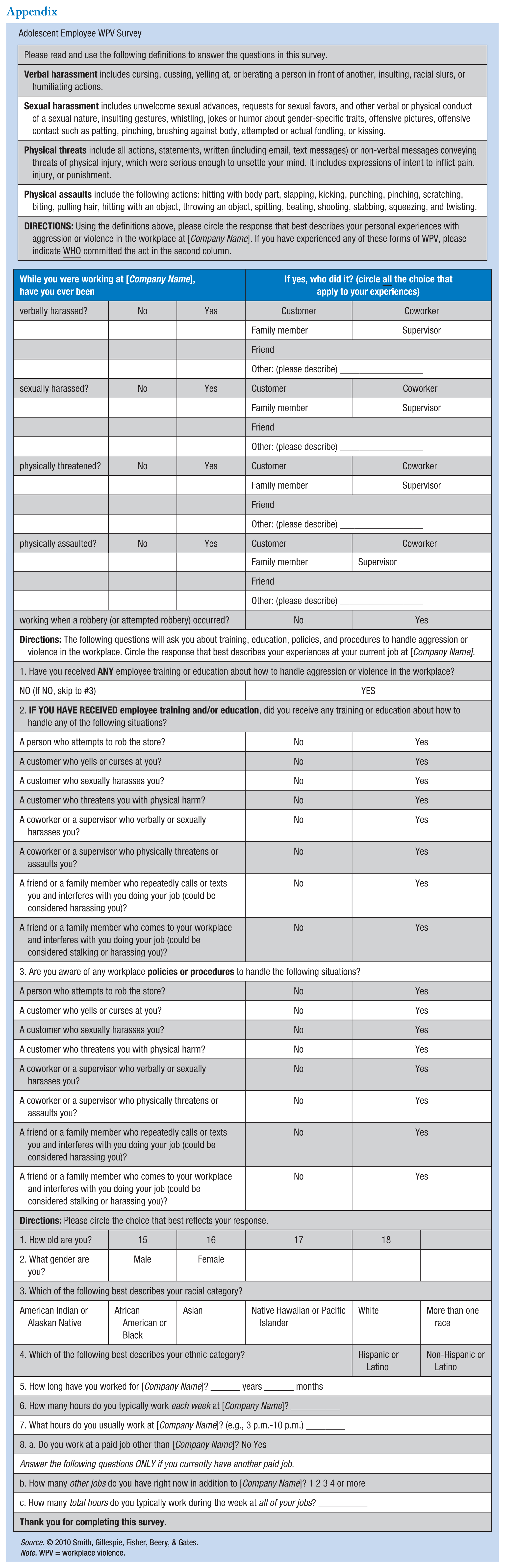
An investigator-developed survey was used to gather self-report data about participants’ direct experiences of WPV and WPV training (see the appendix). Survey questions were based on a review of WPV studies with adolescent workers (Rauscher, 2008; Runyan et al., 2005; Runyan et al., 2007). Questions focused on three aspects of the current workplace: direct WPV experience, exposure to WPV training, and awareness of WPV policies or procedures. The survey instrument included embedded definitions and examples of WPV to promote reliable application of WPV terminology among respondents. The terms training and education appeared together in survey items measuring WPV training. Although the authors acknowledge that training and education are different, the decision to use both terms was based on feedback gathered from adolescents during survey development who reported that most teens would view the terms as interchangeable. A series of yes or no questions measured direct WPV experiences by asking participants whether they had ever experienced verbal harassment, sexual harassment, physical threats, or physical assaults at their current workplace. Participants who indicated a WPV experience were asked to identify the category of perpetrator(s): customer, coworker, supervisor, family member, friend, or other. To address criminally related WPV, one question asked about being at work during an actual or attempted robbery. One question captured participant exposure to WPV training. If participants reported exposure to WPV training or education, they completed a series of yes or no questions to identify whether the training addressed any of eight common WPV scenarios. Similarly, a series of yes or no questions assessed participant awareness of policies or procedures to manage the same eight WPV scenarios.
Prior to survey administration, content validity of the investigator-developed survey was assessed by an expert WPV panel (Polit & Beck, 2006). Seven panel members rated the individual items and the overall survey on dimensions of clarity, relevance, simplicity, and ambiguity. The level of agreement among panel member ratings yielded a content validity index (CVI) for individual survey items (Rubio, Berg-Weger, Tebb, Lee, & Rauch, 2003). The CVI ranged from 0.8 to 1.0 for all four dimensions, and the overall CVI was 0.98, indicating strong content validity. Reliability of the survey was not estimated as its primary purpose was to provide investigators with information about participants’ experiences prior to conducting the qualitative interview and generate descriptive statistics. In addition, the survey contained only one item for each WPV type, WPV training, and WPV policy/procedure and administered only one time, precluding evaluation of internal consistency or test–retest reliability. Despite the lack of survey reliability data, the use of embedded definitions and examples of WPV may have promoted consistency in how participants interpreted and thus responded to survey items.
After completing the survey, participants completed a one-time individual interview conducted by the first author using a semi-structured interview guide. During the interview, the participants who disclosed experiencing WPV on the survey were asked to share their stories about the incident(s). Similarly, participants who reported attending WPV training and/or reported awareness of WPV-specific policies or procedures on the survey were asked to describe the way(s) in which they received WPV information. All interviews were audio-recorded and transcribed verbatim. Noteworthy is that no data were collected from the food service company about WPV incidents reported, WPV training practices, or WPV policies or procedures in place at the time of the study as the primary focus of the study was adolescent worker perceptions of safety, not whether their perceptions matched reality.
Quantitative Data Analysis
Survey data were analyzed using Microsoft Excel 2010® (Washington) to generate an overall number and percent of study participants who experienced WPV, received employer-provided WPV training, or were aware of at least one WPV-specific policy or procedure. Due to the small sample size, no additional statistical analyses were conducted.
Qualitative Data Analysis
Conventional content analysis was used to understand the transcribed interview data (Hsieh & Shannon, 2005). Prior to analysis, the first author verified the accuracy of interview transcripts by listening to the interview recordings and comparing the recordings with the transcriptions. Then, the first and second authors separately coded verbatim participant interview transcripts to identify excerpts describing either WPV experiences or WPV training. Next, the first and second authors met to compare excerpts and develop categories of WPV experiences and ways participants received WPV training. Finally, the third author reviewed the data excerpts and categories for confirmation.
Results
Of the 30 participants, most identified as female (n = 20; 67%), 18 years old (n = 16; 53.3%), working evening hours (n = 23; 76.7%). All participants identified as non-Hispanic Caucasian.
Experiences of WPV
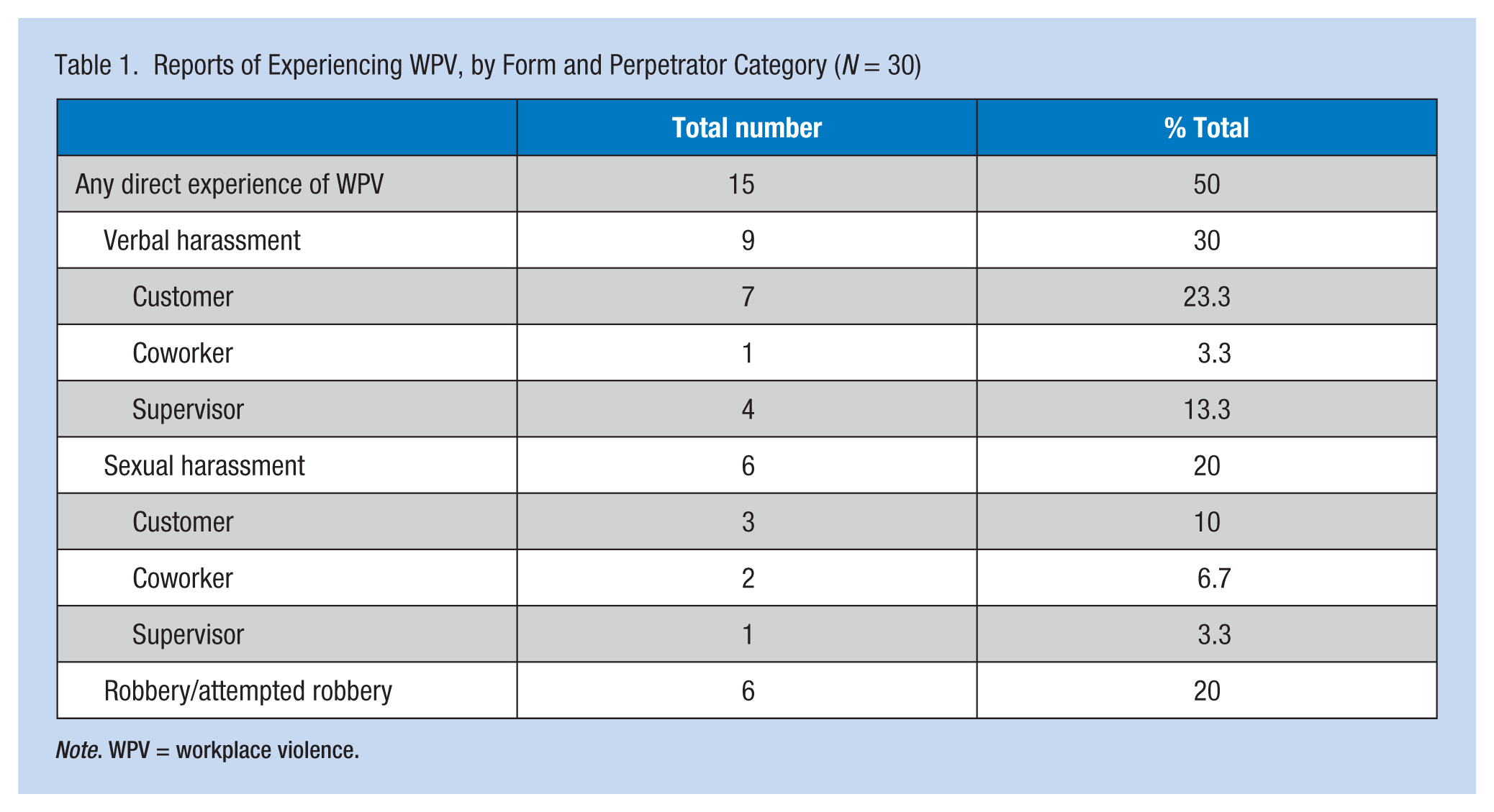
Half (n = 15; 50%) of the participants had experienced WPV at their current workplaces. Among those who experienced WPV, one third (n = 5) disclosed experiencing more than one form of WPV, including verbal harassment, sexual harassment, and robbery or attempted robbery. No participants indicated experiences of physical threats or physical assaults. Among those reporting WPV, perpetrators were customers, coworkers, and supervisors but not friends or family. Table 1 presents a breakdown of WPV by perpetrator category.
Reports of Experiencing WPV, by Form and Perpetrator Category (N = 30)
Note. WPV = workplace violence.
Analysis of the interview data yielded 21 excerpts that described WPV experiences. Three distinct categories of WPV were identified: (a) verbal harassment, (b) sexual harassment, and (c) robbery or attempted robbery and are presented below along with descriptions and participant quotes to further highlight the findings.
Verbal harassment
Verbal harassment was the most common form of WPV reported. Nine respondents (30%) reported experiencing verbal harassment: seven from customers, one from a coworker, and four from supervisors. Customer verbal harassment included situations where customers yelled, screamed, or cursed at participants. For example, an 18-year-old male shared an overall description of his experience: “If you get the order wrong or something, sometimes [customers] just get real mad, pissy and just kind of jaw you up for nothing.” Participants also disclosed experiencing verbal harassment from supervisors, which included derogatory, demeaning, and bullying remarks. A 17-year-old female reported feeling constantly put down by a manager when she first started working at the store: He, like, scared me. He would, like, make me feel like everything I did was wrong . . . I always felt like I wasn’t doing anything right. And he was, like, always had this tone like he was mad.
Sexual harassment
Six respondents (20%), all female, reported sexual harassment: three from customers, two from coworkers, and one from a supervisor. One 18-year-old female respondent recalled an encounter she viewed as sexual harassment during which a male customer was making sexually inappropriate remarks about her work attire: It was when I used to wear an apron . . . and it says “Irresistible” on the top of our apron [points to her breasts]. And this guy [customer] was like “Don’t take this the wrong way.” And of course, you know that it is going to be a bad comment. And he was an older guy. And he was like, “It’s kinda funny where the [word] Irresistible sits on your apron.”
A 16-year-old female spoke about how a 21-year-old male coworker made unwanted sexual comments and even touched her body on several occasions: When he first started working [at the store], he would make comments like, “Why aren’t you 18? I wish you were 18. I’d tell you you’re cute but you’re not 18.” He’d poke me in the stomach . . . and he’d be like “Oh, yeah, like you have a nice ass.”
Robbery/attempted robbery
Six respondents (20%) recounted experiencing an actual or attempted robbery at the workplace. Although no incidents involved a weapon, events described included witnessing customer shoplifting, quick-change scams, and attempted robberies. An 18-year-old female recalled experiencing a quick-change scam as follows: It wasn’t a violent robbery . . . someone came in and did a slight of hand thing. And they were getting change for a $100 bill, and then they were just saying a bunch of stuff. And they kept bouncing money back and forth because the customer was complaining about something. And then [the customer] ended up leaving with $200, and he, like ran out the door.
Experiences of WPV Training
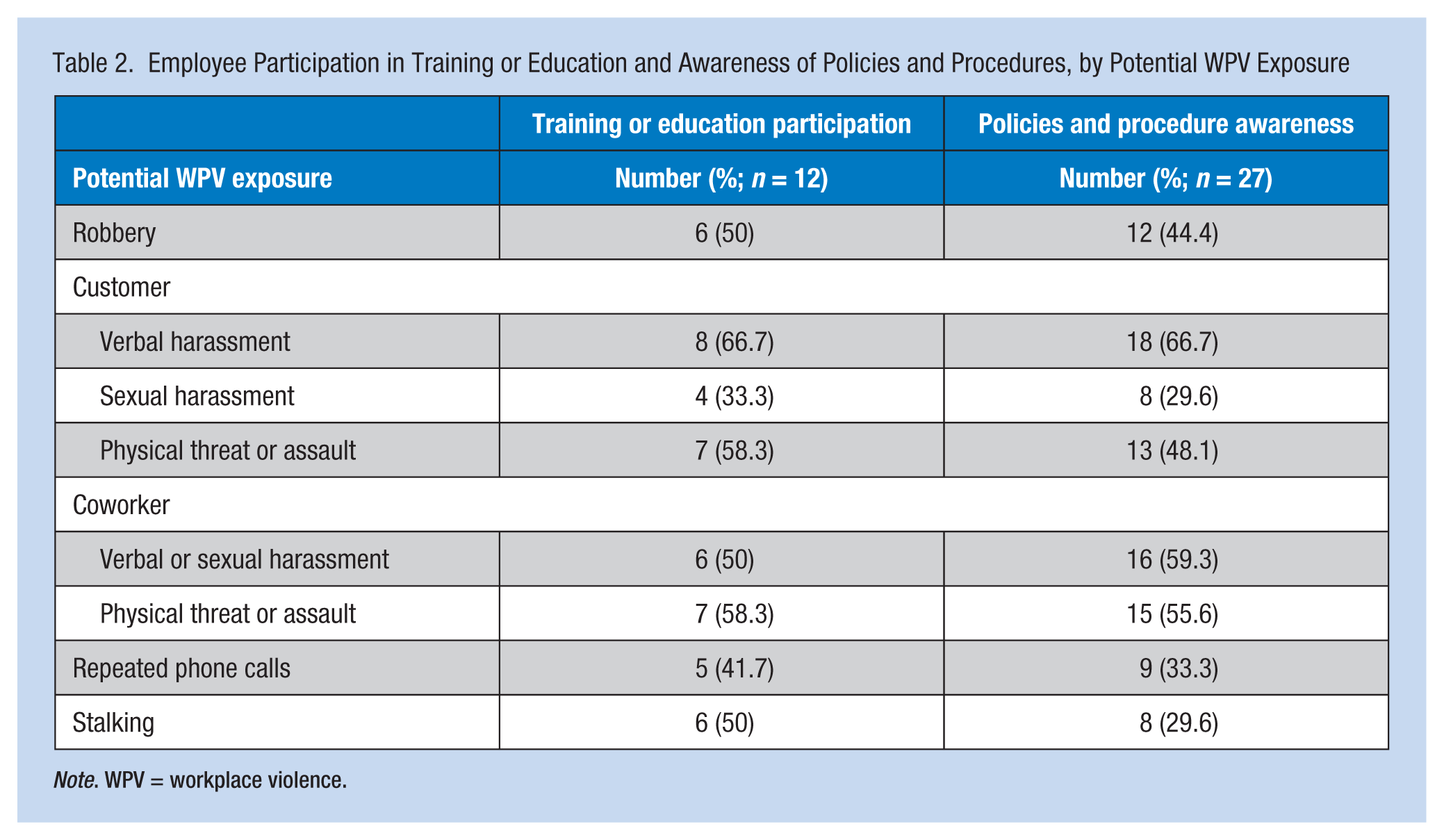
Less than half (n = 12; 40%) of the participants received any WPV training from the company (Table 2). Among the 12 respondents who reported receiving any WPV training, the median number of WPV topics addressed was 3.5 (M = 4.3; range = 2-7). Proper handling of customer verbal harassment was the most frequently reported topic (n = 8; 66.7%); handling customer sexual harassment was the least reported topic (n = 4; 33.3%). Unlike training, most participants (n = 27; 90%) reported being aware of at least one WPV policy/procedure. The median number of scenarios for which participants were aware of a WPV policy/procedure was 3 (M = 3.7; range = 1-8). Once again, handling customer verbal harassment was the most frequently reported WPV-specific policy/procedure scenario (n = 18; 66.7%). Customer sexual harassment (n = 8; 30%) and handling potential stalkers (n = 8; 30%) were the least reported policies/procedures.
Employee Participation in Training or Education and Awareness of Policies and Procedures, by Potential WPV Exposure
Note. WPV = workplace violence.
A total of 105 descriptions of receiving WPV information were identified from the 30 interview transcripts. However, 16 excerpts did not specify the method of delivery and, therefore, were omitted. Among the remaining 89 excerpts, eight categories reflected the distinct ways participants reported receiving WPV training.
Formal instruction from manager
The most common way participants received WPV training was formal instruction from a manager (n = 20; 22.5%). Participant excerpts in this category described receiving instructions from a manager, primarily during new employee training, about how to handle WPV incidents. A 16-year-old female recalled receiving formal instruction: Well with training, when I first started, we just went over everything, and like all the rules and guidelines and stuff like that and just policies, and my manager said not just for [sexual harassment] but for pretty much all [WPV] just to make sure you report, make sure you tell my manager, make sure you tell someone if something happens like that.
Informal communication from manager
A fair number of excerpts (n = 15; 17%) described informal instruction from managers during casual conversations or through stories of prior WPV experiences. A 17-year-old female described informally receiving instruction from her manager about how to handle a robbery: It wasn’t, like, a direct, like, lesson, but me and my—one of my managers were talking, and we were saying I—you know, if I was in the situation, I’d just tell ’em to take whatever they want, and then, as long as, like, no one gets hurt. Like, just calmly—like, “If you wanna take all the money, you can.” Like, that’s what we got told to do. That’s what one [of] my managers said to do.
Made an assumption
Twelve excerpts (13.5%) described how participants did not receive direct WPV instruction; rather, they made assumptions or relied on common sense about how to handle WPV. For example, when asked to describe the content of her WPV training to handle customer threats, an 18-year-old female participant reported, “I mean [the manager’s] never like specifically stated but really if someone goes too far I’m like, I, I don’t, I mean I’m assuming you would tell someone about that [customer threats].” Another participant described using common sense to figure out what to do for customer threats: “The [WPV training] didn’t really specifically address that but I mean, like—uhm, like I guess I would just use my common sense and not do anything to make [the customer] more mad.”
Read it in the employee handbook
Participants learned WPV information from their new employee handbook. Ten excerpts (11%) referred to this method of learning about how to address WPV. One 16-year-old female recalled reading general WPV information in the employee handbook: There does say like something in our handbook like if you ever experience anything always feel free to call for outside help, like 9-1-1, but that’s about it. Like, it didn’t say, “Do call 9-1-1 when this happens. Don’t call 9-1-1 when this happens.”
Another 16-year-old female participant remembered reading information in the employee handbook, but admitted that she could not recall the exact content: They did like mention in the packet all the harassment stuff . . . It was like a 50-page packet that I had to read, so not really much I remembered. Just little bits and bits of things. And it just basically like had, you know, like, you know, if this were to happen, contact the manager.
Talking with coworkers
Some excerpts (n = 6; 6.7%) referenced learning about WPV while talking with coworkers. For example, a 17-year-old male disclosed that he learned how he should respond to a robbery while talking with some coworkers about a recent robbery at one of the other store locations: I was just talking to . . . a coworker whose sister was the one who was in the store when they got robbed. So she was telling me that story, and I was just asking her like, what are we even supposed to do, because I didn’t know if we were supposed to like not give them money, or not give them anything. But she just told me to give them everything they ask for. It’s just so they don’t harm the customers or harm you or the coworkers.
Formal training class
Five excerpts (5.6%) described WPV training being delivered during a class. Of note, the participants who reported attending formal classes also reported additional WPV training when they were promoted to a supervisory role at the workplace. An 18-year-old male remembered WPV instruction during a required training class: We had like a customer service sort of thing when you first get hired. You have to go downtown, and like the family like teaches you customer service stuff. And they addressed [WPV] a little, like they told us like if you get threatened, you’re supposed to tell the manager or whatever, or if like it’s within the employees, I think we’re supposed to go to like one of the main [corporate] people . . . and tell them about it. And if we get robbed we’re just supposed to give them the money, and let ’em go, so that nobody gets hurt.
Extrapolated from previous education or training
Although not received at the current workplace, four excerpts (4.5%) described what participants had learned from previous WPV training: I mean kind of at school [received training or education]. Like they’ve had, like, people come in and talk about certain things. Like sexual harassment or verbal, you know, what you would do or if your friend’s in it, you know, go to an adult or someone you trust.
No WPV information provided
Finally, 16 excerpts (18%) disclosed that participants had not received WPV training. Excerpts described either an overall lack of WPV training or focused on a specific form of WPV for which information was desired. For example, an excerpt from a 17-year-old female revealed that she lacked WPV information from her employer: “We haven’t really gotten much training on—a lot of those questions [points to the survey].” Similarly, an excerpt from a different 17-year-old female disclosed concern about receiving no WPV information: “I just, like, realize I don’t know any—like, they haven’t taught me anything about, um, safety.” Other excerpts within this theme focused on a lack of education specific to particular forms of WPV, mainly robbery. One 18-year-old male recalled, “There’s never really any formal training about robberies.” Whereas a 16-year-old female expressed a desire for robbery-related information: I’d like to know like what we’d do for a robbery or something, like if they’re actually like saying, give me the money, or whatever. I would like to know what we would do in that situation ’cause I haven’t really like—they haven’t really said, like what to do.
Discussion
The current findings support previous research, indicating that adolescent workers experience WPV (Fineran, 2002; Fineran & Gruber, 2009; Rauscher, 2008) and report receiving limited WPV training (Runyan et al., 2005; Runyan et al., 2007). For a cross-sectional survey of nearly 1,200 adolescents aged 14 to 17 years, Rauscher (2008) found that one third had experienced WPV while employed in a formal job, a rate lower than that reported in the current study. Similarities between the current findings and Rauscher’s (2008) findings include verbal threats being the most common form of WPV and customers being the most frequently identified perpetrator. Unlike Rauscher’s findings, physical assault was not reported in the current study. However, the current study explored adolescent workers’ experiences of criminally related WPV, an issue not previously studied in this population. Considering that criminally related WPV remains the leading source of fatal and non-fatal WPV injuries among adult workers in retail and service sectors (Peek-Asa, Runyan, & Zwerling, 2001), the current findings indicate that adolescent workers do experience this form of WPV and, thus, may experience psychological or physical injuries as a result.
Considering that all participants worked for the same food service company, results illustrate a lack of consistency in the content and delivery of WPV training or education from this employer. Only 40% of respondents reported participating in WPV training, a rate comparable with the findings of two previous studies among adolescent workers (Runyan et al., 2005; Runyan et al., 2007) but lower than adult employees (BLS, 2006). However, awareness of policies or procedures yielded a higher response rate among participants who reported that they had basic knowledge of handling certain forms of WPV at their current workplaces. Coupled with previous studies, current study findings also highlight the need for adolescents to receive WPV training prior to entering the workforce. Currently, the practice of issuing employment or age certificates to adolescents below 18 seeking non-agricultural employment varies from state to state (U.S. Department of Labor [DOL], 2013). Most states require adolescents below 16 to obtain a state-issued employment or an age certificate from the state’s labor department or local school (DOL, 2013). However, a handful of states have no such practices, and no states mandate that adolescents submit evidence of work-readiness training to obtain an employment or age certificate. These practices contrast with ones for another adolescent rite of passage: driving. In most states, adolescents below 18 must apply for a learner’s permit, complete driver’s education and training, and abide by provisional licensure rules before they receive an unrestricted driver’s license (DMV.org, 2014). These requirements demonstrate adolescents’ readiness and skill to safely operate a vehicle. Thus, it is recommended that similar workforce readiness and safety training be instituted for adolescents seeking employment. Adolescents below 18 should be required to complete and provide evidence of workforce readiness and safety training to be eligible for an employment certificate. Only then would potential employers know that adolescents have received foundational training to safely enter the workplace.
Limitations
Study limitations include the small non-representative sample, use of self-report survey data, and measuring WPV experiences categorically (i.e., yes or no) versus the number of WPV incidents experienced. Due to the small and homogeneous sample size, advanced statistical analyses could not be conducted, thus prohibiting evaluation of differences based on gender, ethnicity, and report of WPV experiences. In addition, the small sample size and homogeneity of the sample prohibit generalizability of study results beyond this small group. Finally, no information was requested from the food service company about WPV training practices, current WPV policies or procedures, or WPV incidents reported during the time frame of the study as this was not the primary focus of the study. Thus, the research team could not confirm or refute information provided by participants.
Implications for Practice
The occupational health nurse addresses a multitude of safety issues, including WPV with workers of all ages. For instance, occupational health nurses may assist in the development, implementation, and management of WPV prevention programs that include a mix of primary, secondary, and tertiary prevention strategies at their organizations (American Association of Occupational Health Nurses [AAOHN], 2013). However, organizations that employ occupational health nurses may not employ adolescents, so occupational health nurses and their professional association, AAOHN, Inc., should consider lobbying state legislators to require workforce readiness and safety training for adolescents below 18 years of age seeking employment.
To assist in the prevention and proper handling of WPV, occupational health nurses should consider providing consultation to local employers who hire adolescents, especially those who primarily employ youth. As professional consultants, occupational health nurses could contract to provide workplace health and safety services such as conducting periodic risk assessments, developing evidence-based safety policies, providing annual training to managers and workers on safety policies, developing procedures to handle adverse events, and evaluating safety incidents for risk reduction and mitigation. These activities lend themselves to inclusion of WPV as a safety concern and align with WPV prevention recommendations set forth by AAOHN (2013).
Similarly, occupational health nurses and AAOHN, Inc., could partner with educators, parents, and employers of adolescents to be a resource for workplace readiness and safety training (Miller, 2004; Ward et al., 2010; West, de Castro, & Fitzgerald, 2005). Such training would provide adolescents with knowledge and hands-on practice in completing job applications and interviews, recognizing safety hazards and adopting safety behaviors to reduce or prevent injuries. In addition, such training could raise awareness of the legal rights and responsibilities of workers below age 18 particular to a specific state. Job safety and health curriculum developed by the National Institute for Occupational Safety and Health (NIOSH) for use in schools (www.cdc.gov/niosh/talkingsafety) provide a foundation for workplace readiness and safety training. However, as the curriculum provides general guidelines only, occupational health nurses should work with stakeholders to tailor the training to state-specific rules and regulations for workers below age 18.
Future Research Opportunities
Study findings support the need for additional research to further explore WPV experiences and training among adolescent workers. Research with large randomized samples should be conducted to measure WPV incidence, risk factors, and consequences (e.g., quit job, mental health effects), as well as current methods of preparing adolescent workers for WPV events. This information could serve as a foundation for developing and testing targeted WPV interventions among this unique worker population.
Conclusion
Adolescent workers are exposed to WPV and experience inconsistent WPV training. Consequently, lack of training compounded by developmental immaturity may place adolescent workers at increased risk for WPV compared with adult workers in the retail and service sectors. The reported findings coupled with the few studies addressing adolescent WPV experiences highlight the need to develop a richer understanding of WPV among adolescent workers. The future research opportunities discussed above are among the next logical steps needed to be taken; only then can targeted WPV interventions be developed and tested by occupational health nurses to determine their effectiveness for this vulnerable worker population.
Applying Research to Practice
Adolescents report experiences of WPV and inconsistent WPV safety training. Occupational health nurses can reduce WPV experiences among this vulnerable employee population in several ways. Prevention of WPV can be addressed by occupational health nurses consulting with local employers of teens to develop appropriate workplace safety policies and procedures and identifying potential safety risks. Moreover, occupational health nurses can assist adolescents in recognizing and mitigating safety issues, including WPV, as part of comprehensive workplace readiness and safety training programs. Finally, occupational health nurses can advocate for mandatory workplace readiness and safety training for adolescents seeking employment to promote the safety and well-being of America’s youngest workers.
Footnotes
Appendix
Adolescent Employee WPV Survey
| Please read and use the following definitions to answer the questions in this survey. |
| While you were working at [Company Name], have you ever been | If yes, who did it? (circle |
||||
|---|---|---|---|---|---|
| verbally harassed? | No | Yes | Customer | Coworker | |
| Family member | Supervisor | ||||
| Friend | |||||
| Other: (please describe) _________________ | |||||
| sexually harassed? | No | Yes | Customer | Coworker | |
| Family member | Supervisor | ||||
| Friend | |||||
| Other: (please describe) _________________ | |||||
| physically threatened? | No | Yes | Customer | Coworker | |
| Family member | Supervisor | ||||
| Friend | |||||
| Other: (please describe) _________________ | |||||
| physically assaulted? | No | Yes | Customer | Coworker | |
| Family member | Supervisor | ||||
| Friend | |||||
| Other: (please describe) _________________ | |||||
| working when a robbery (or attempted robbery) occurred? | No | Yes | |||
| 1. Have you received |
|||||
| NO (If NO, skip to #3) | YES | ||||
| 2. |
|||||
| A person who attempts to rob the store? | No | Yes | |||
| A customer who yells or curses at you? | No | Yes | |||
| A customer who sexually harasses you? | No | Yes | |||
| A customer who threatens you with physical harm? | No | Yes | |||
| A coworker or a supervisor who verbally or sexually harasses you? | No | Yes | |||
| A coworker or a supervisor who physically threatens or assaults you? | No | Yes | |||
| A friend or a family member who repeatedly calls or texts you and interferes with you doing your job (could be considered harassing you)? | No | Yes | |||
| A friend or a family member who comes to your workplace and interferes with you doing your job (could be considered stalking or harassing you)? | No | Yes | |||
| 3. Are you aware of any workplace |
|||||
| A person who attempts to rob the store? | No | Yes | |||
| A customer who yells or curses at you? | No | Yes | |||
| A customer who sexually harasses you? | No | Yes | |||
| A customer who threatens you with physical harm? | No | Yes | |||
| A coworker or a supervisor who verbally or sexually harasses you? | No | Yes | |||
| A coworker or a supervisor who physically threatens or assaults you? | No | Yes | |||
| A friend or a family member who repeatedly calls or texts you and interferes with you doing your job (could be considered harassing you)? | No | Yes | |||
| A friend or a family member who comes to your workplace and interferes with you doing your job (could be considered stalking or harassing you)? | No | Yes | |||
| 1. How old are you? | 15 | 16 | 17 | 18 | |
| 2. What gender are you? | Male | Female | |||
| 3. Which of the following best describes your racial category? | |||||
| American Indian or Alaskan Native | African American or Black | Asian | Native Hawaiian or Pacific Islander | White | More than one race |
| 4. Which of the following best describes your ethnic category? | Hispanic or Latino | Non-Hispanic or Latino | |||
| 5. How long have you worked for [Company Name]? ______ years ______ months | |||||
| 6. How many hours do you typically work each week at [Company Name]? __________ | |||||
| 7. What hours do you usually work at [Company Name]? (e.g., 3 p.m.-10 p.m.) ________ | |||||
| 8. a. Do you work at a paid job other than [Company Name]? No Yes | |||||
| Answer the following questions ONLY if you currently have another paid job. | |||||
| b. How many other jobs do you have right now in addition to [Company Name]? 1 2 3 4 or more | |||||
| c. How many total hours do you typically work during the week at all of your jobs? __________ | |||||
|
|
|||||
Source. © 2010 Smith, Gillespie, Fisher, Beery, & Gates.
Note. WPV = workplace violence.
Conflict of Interest
The author(s) declared no potential conflicts of interest with respect to the research, authorship, and/or publication of this article.
Funding
The author(s) disclosed receipt of the following financial support for the research, authorship, and/or publication of this article: This research was supported by the National Institute for Occupational Safety and Health Pilot Research Training Program of the University of Cincinnati Education and Research Center Grant T42/OH008432-05.
Author Biographies
Carolyn R. Smith, PhD, RN is Assistant Professor, University of Cincinnati College of Nursing. Her research is focused on violence experienced by adolescents.
Gordon L. Gillespie is an Associate Professor and Robert Wood Johnson Foundation Nurse Faculty Scholar, University of Cincinnati College of Nursing. His research is focused on the prevention and mitigation of workplace violence. His research is supported by the CDC - National Institute for Occupational Safety and Health and several private foundations.
Theresa A. Beery, PhD, RN, ACNP, CNE is Professor and Director of the Center for Education Research, Scholarship, and Innovation, University of Cincinnati College of Nursing. She is also the Director of the Institute for Clinical Inquiry, University of Cincinnati Medical Center.