




Abstract
Firefighters’ work responsibilities involve strenuous physical activity and exposure to extremely stressful situations. The purpose of this research study was to describe the physical activity, stress, and culture promoting or inhibiting a healthy work environment. A descriptive qualitative study design was used with a convenience sample of firefighters from an urban Midwestern public fire service. Respondents participated in focus groups from which data were audio recorded, transcribed verbatim, and analyzed using Colaizzi’s phenomenological method. Themes derived from the data were Stressors Affecting Physical Health, Barriers to Physical Health, Facilitators of Physical Health, and Motivators for Physical Health. Future research is needed to test interventions based on the study findings.
Firefighters are among the first responders to arrive at emergencies and natural or man-made disasters. Firefighters must be physically fit and healthy so they can perform their duties in the interest of the public good (Calavalle et al., 2013; Frattaroli et al., 2013; Perroni, Cignitti, Cortis, & Capranica, 2014). Unfortunately, not all firefighters are in optimal physical health but rather at risk of cardiac disease and injury (Jahnke, Poston, Jitnarin, & Haddock, 2012; Perroni et al., 2014). To apply a systems approach to the promotion of firefighters’ physical health, occupational health nurses must first understand factors contributing to their illnesses and injuries. Therefore, the purpose of this study was to identify those factors that promote or hinder firefighters’ physical health.
Physical health, physical activity, and physical fitness influence firefighters’ abilities to perform their job tasks, which can be strenuous and include handling heavy equipment, moving onto or within the fire truck, performing maintenance inspections, and extinguishing fires. The World Health Organization (2013) defines physical activity as “any bodily movement produced by skeletal muscles that require energy expenditure” (Para 1). Being physically fit includes cardiovascular fitness, muscular strength and endurance, flexibility, and body composition. When firefighters exceed their physical abilities, their bodies can experience short- or long-term physical stress. Short-term physical stress responses include headaches, diarrhea, indigestion, dyspepsia, and fatigue; long-term stress responses include lack of interest, insomnia, clumsiness, change in performance, and isolation (Norwood & Rascati, 2012). Both short- and long-term physical stress responses are undesirable and should be minimized or eliminated to protect firefighters from illness and disease while maximizing their productivity.
Significance
Poor physical health in firefighters has the potential to negatively affect both firefighters and the public. Although much is known about the incidence of disease and injuries in firefighters, minimal information about strategies to optimize the health of firefighters during an economic downturn is available. Therefore, this study will contribute to better understanding this problem while providing implications for occupational and environmental health nurses.
Method
A descriptive qualitative design was used with a convenience sample of firefighters from an urban Midwestern fire department. Following Institutional Review Board approval, respondents were recruited on a volunteer basis from two firehouses. All respondents were adult, full-time, active duty firefighter employees. Focus groups, two at each site, were conducted on different shift rotations to allow all firefighters the opportunity to participate. Each focus group was facilitated by the same researcher for consistency. Questions were asked using an interview guide and probing questions. The focus group sessions were audio recorded and transcribed verbatim. The transcriptions were analyzed using Colaizzi’s procedural steps in phenomenological data analysis including line-by-line coding, clustering significant statements into themes, and returning to study participants for verification of the study findings (Beck, 2009). NVivo 9 (Burlington, Massachusetts) qualitative management software was used for data analysis.
Multiple steps were taken to increase the trustworthiness of the study findings based on recommendations by Lincoln and Guba (1985). For example, the data were independently analyzed by several investigators who then came to agreement on the coding schema. Following individual analysis of each transcript, the investigators discussed line-by-line coding based on the coding schema. A summary of the results were returned to the respondents for confirmation that the data were correctly interpreted. Respondents supported the findings, and no changes were requested.
Results
Eighteen firefighters (16 males, 2 females) participated in the focus groups. No data were collected about age or race. Four themes emerged from the data: Stressors Affecting Physical Health, Barriers to Physical Health, Facilitators of Physical Health, and Motivators to Physical Health.
Stressors Affecting Physical Health
Physical stressors result in a physiological response that can lead to either positive or negative adaptation. Several sources of stress, physical strain, physical exhaustion, and altered circadian cycle, were identified by study participants as ultimately affecting their physical health. Physical strain was caused by lifting and carrying equipment for long periods of time and regular strenuous training exercises. Physical exhaustion was caused by going “. . . from 0 to 100 in a matter of seconds . . .” followed by extinguishing fires. An altered circadian cycle was reportedly the result of their 24-hours-on and 48-hours-off work schedule, and their inability to achieve adequate rest and sleep between medical and fire runs. Several respondents offered comments similar to this statement:
I don’t feel rested when I go home from the firehouse. I never get a good night’s sleep at the firehouse.
Figure 1 displays a typical firehouse sleeping station.
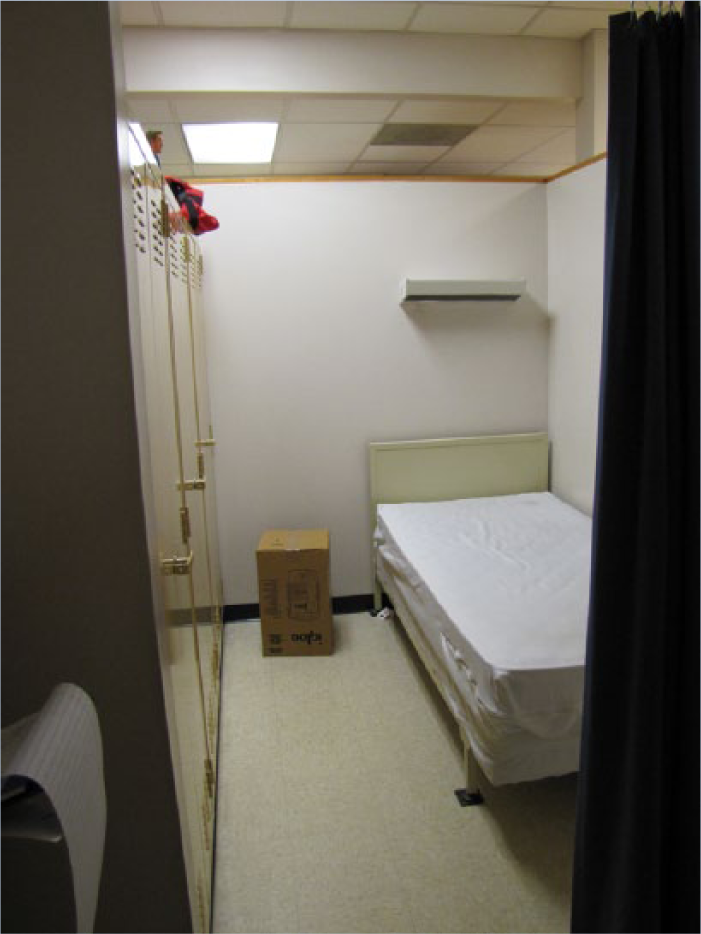
Shared space for firefighter sleeping quarters.
The inability to sleep during the night or nap during the day is worsened by the rotating closure of firehouses known as “brownouts.” Brownouts were believed due to the worsening economy and subsequent decrease in the fire department budget. Brownouts require firefighters from each open firehouse to respond to a greater number of calls than in previous years. In addition, several firefighters reported leaving the firehouse and working for a second employer. For example, one male respondent said,
We—we’re on 24 hours and off 48, so on our—like today—today I’m going to go—at 2:30 I’m driving a school bus for a field trip for a high school after getting off work at 8:00 a.m.
Barriers to Physical Health
A barrier to physical health included anything blocking or impeding the ability of firefighters to engage in physical health-promoting activities. The predominant barrier identified by the respondents was the risk of being in the middle of a workout or just finishing a workout when a call comes in and being too tired to perform to their fullest potential. One firefighter said,
I don’t feel that we work out here for our health. I do it to—I do it today before I have to come in for my shift, because I don’t want to be here and I’m making myself more tired by working out and then doing the runs, so I’d rather do it on my off time before I come in, and then that way when I come in, I’ll take care of the tasks I have to take care of at work. . . . Because I don’t know what kind of runs we’re gonna have. You know, I might—if I was to go down on the treadmill and then we get a fire, and you know, I’m kind of fatigued because we’re running around doing this activity, this on the fire scene, it’s like, I get fatigued so I don’t want to do that while I’m here at work. I’d rather workout on my off day than to come in here.
Another barrier was the inability to schedule workouts due to multiple job-related interruptions. Firefighters also identified poor communication systems in the workout room that interfered with firefighters hearing the alarm and workout room location being too far away from the truck. One respondent responsible for driving the fire engine said,
. . . our stuff is in the basement. And I hate responding—I don’t want to be the last [person] to the truck. That’s my—it’s my goal is never to be the last to the truck. And especially now that I’m driving . . . .
Facilitators of Physical Health
Facilitators of physical health are the resources that enable firefighters to engage in health-promoting activities. Although previously addressed as a physical stressor, the respondents said that hands-on training was a major facilitator, because the training helped them build endurance. Resources available at the worksite such as a workout room (Figure 2), dietician consultation for weight management, and physical fitness programs also were identified as facilitators. Several respondents made comments similar to these:
“. . . over the years, guys have brought in, you know, an old bench or old weights. They upgraded their own home stuff, or, uh, an old treadmill. And we have it down in our—a room downstairs . . .” and “Most of the weight rooms in the firehouses are not bought by the City. They’re made and bought by the guys.” Aspects of the health programs including dietician consultants and physical fitness programs were originally part of a Peer Fitness program where a few firefighters were educated to “put a regimen together for you. But that grant funding dried up so that went away.”
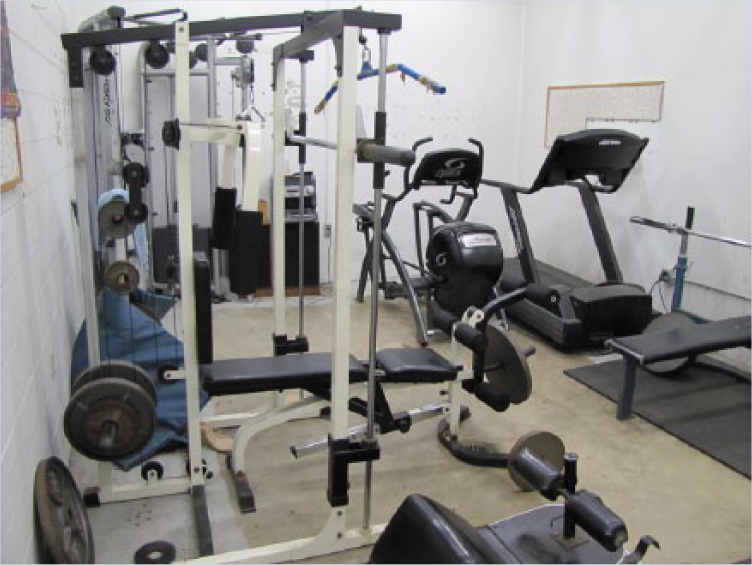
Exercise room in the basement of the firehouse.
Motivators to Physical Health
Motivators to physical health are intrinsic or extrinsic support for maintaining or contributing to activities promoting physical health. The firefighters identified competition, group workouts, and a desire to perform better on the job as the leading motivators for physical health. One of the respondents said,
Again, it’s the competition thing. You know, we’re on engines so we always paint the truck. You know, stuff like that, to keep the . . . even the camaraderie going and keeping the guys going. Like I said, you don’t want to have everybody out back having fun doing something . . . one guy’s, you know, sitting inside. You don’t want to be the guy sitting inside lying on the couch doing nothing.
Although not currently in practice, respondents believed that department-required health screenings and financial incentives could be motivators for improving their physical health. One respondent emphasized his motivation through financial incentives:
If the city said, you know, “Here’s your—you have to have a physical every year, um, and you get—you get a bonus check. Or you get, you know, whatever. We’ll pay for your—your food for a week if you—you know, whatever.” You know, incentives like that, maybe guys would be more apt to—[Another participant: He’s coin operated.]—yeah, I’m coin operated.
Discussion
The physical health of firefighters is as an essential component of firefighter function and often needs improvement (Dobson et al., 2013; Jahnke et al., 2012). The firefighters in the present study openly expressed concerns about their physical health. A leading cause of firefighters’ physical stress was being on duty 24 hours, off duty 48 hours, and inability to achieve adequate rest and sleep while at work. A similar finding was reported by Dobson et al. (2013) and Jahnke et al. (2012). As the United States becomes a 24-hour society, it is not surprising that the number of firehouse calls overnight will increase. This change in societal norms coupled with firehouse brownouts likely contribute to the lack of adequate rest in this sample of firefighters.
Rest also was influenced by the workload of firefighters during their 48-hours-off duty (Haddock, Poston, Jitnarin, & Jahnke, 2013). Firefighters working a second job while off duty negate the rest they could have had. In an effort to address the rest firefighters receive during their 48-hours-off duty, the fire chief in another community implemented a 24-hours-on/72-hours-off duty rotation (Turner, 2010). Measures of health outcomes were not assessed because of the community-sponsored public forums about the need to close or privatize the fire department in this neighboring community as a result of their decreasing tax base and financial resources.
The adverse health effects associated with firefighters’ 24-hours-on/48-hours-off scheduling will likely continue due to the perceived benefits of long, rotating shifts. The benefits include cost efficiency for the firehouse, personal time off during the week, a work week of 48 hours (i.e., 8 hours above the normal 40-hour work week), and ability to maintain secondary employment during the off-rotation period (Haddock et al., 2013). These benefits are appealing and allow firefighters flexibility by working different days each week.
Dobson et al. (2013) identified that the intermittent, unpredictability of service calls was a significant factor that prevented healthy behaviors in their sample of firefighters. The same interruptions prevented an exercise routine in the present study’s sample. The unpredictability in their work shift was the primary rationale offered by those who chose not to start an exercise regimen. Another explanation for not initiating exercise was the distance from the workout basement to the stairwell, and then across the station to the fire engine. Although the distance was not extensive (Figure 3 displays the distance from the stairwell to the fire engine), the increased time needed to hear the notification and ultimately dress and ascend to the fire engine could prolong departure by up to 60 seconds.
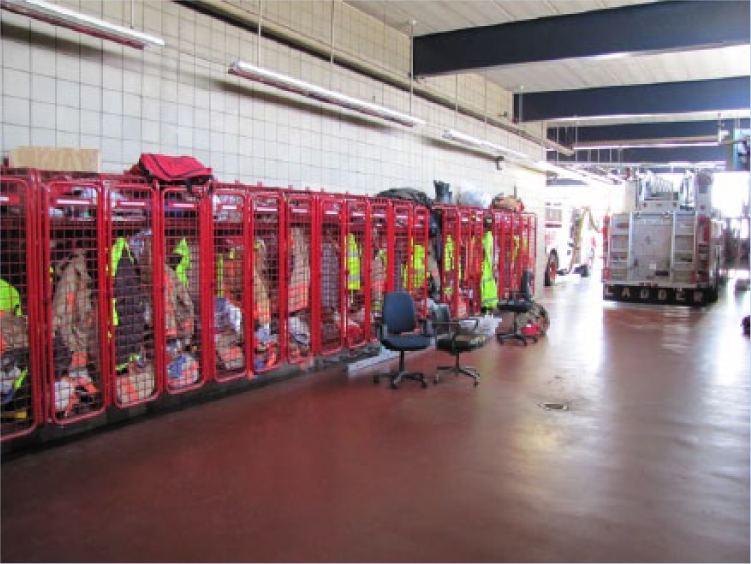
Image of firehouse and fire engine taken from the corner stairwell.
Respondents depicted the facilitators of physical health as access to exercise rooms, dietary consultants, and physical fitness programs. One particular program, the Peer Fitness program, was especially enjoyed by the firefighters. Unfortunately, the program ended when the funding supporting the program ended. Programs that incorporate peers in their delivery may be especially advantageous. Mabry, Elliot, MacKinnon, Thoemmes, and Kuehl (2013) reported that their firefighter health program diffused from study participants to fellow firefighters in different firehouses over time.
The success of Mabry et al.’s (2013) program was identified as being due to team support and competition, both motivators identified by the present study respondents. Firefighters in the present study reported their colleagues influenced their need to be physically active and healthy. Mabry et al. (2013) described one physically healthy firefighter who influenced colleagues to become healthier. The same was true in reverse when a single firefighter adopted the healthier lifestyle of his counterparts. However, it was not known how many and to what degree firefighters opted to be physically active versus resting on the couch when their coworkers were physically active.
Competition is a factor that could be effective in motivating firefighters to be more physically healthy, as noted by one of the respondents. Competition was so successful with the firefighters in Mabry et al.’s (2013) study that their participants compared their anthropometrics and actively coached an individual firefighter in their rotation and firehouse toward improved measures so that the team as a whole would outperform other firefighters in other firehouses or on other rotations.
The present study was limited by the small, homogeneous sample. Although the sample size was small, the findings were not intended to be generalizable. The authors believe that the findings may be transferable to other firefighter settings where the exemplars about physical health are similar.
Implications for Practice
The practice of occupational and environmental health nursing in a firehouse will be considerably different from other practice environments such as hospitals and manufacturing plants. Typically, employees must be encouraged to seek opportunities for physical activity such as using the stairs and taking a walk during meal times. As noted by the respondents in this study, exercise could be a barrier to performing firefighter tasks if workers were fatigued prior to the fire call due to exercise. One strategy that may facilitate physical activity is exercising 5 minutes at the start of every hour while awake. Although the exercise may not maintain aerobic activity for a desirable time period or reach a moderate or vigorous intensity as recommended by the Physical Activity Guidelines Advisory Council, U.S. Department of Health and Human Services (2008), the cumulative exercise of 60 minutes or longer will promote health but not result in fatigue that would be harmful at a fire scene.
Competition and gaming may be additional strategies to incorporate into the daily practice of firefighters. For example, an interactive gaming system like Wii can be used to motivate firefighters to be off the couch and physically active while at work. In addition, firefighters can challenge one another to achieve higher scores within the gaming system. The occupational and environmental health nurse can further promote physical health in firefighters by assessing anthropometric measures, and then evaluating measurement changes over time comparing results by individual firefighters, engine companies, and firehouses. Small tokens can be distributed as prizes for individuals or teams with the greatest improvements in these measurements.
Finally, occupational and environmental health nurses can solicit health champions within each firehouse rotation. The champions can become drivers of health-promoting behaviors (Frattaroli et al., 2013; Kuehl, Mabry, Elliot, Kuehl, & Favorite, 2013). Once in place, nurses can provide regular education to the champions for each month’s health-promotion focus. Examples of education are incorporating intentional physical activity into daily work practices, ways to track caloric burn based on physical activity, and the eight events necessary for firefighters to demonstrate their physical ability at work (Table 1). The champions would be charged with assuring the firefighters in their stations were practicing health-promoting behaviors and performing the eight tasks competently and safely.
Essential Tasks to Evaluate Firefighter Physical Fitness While Wearing a 50 Pound Weighted Vest
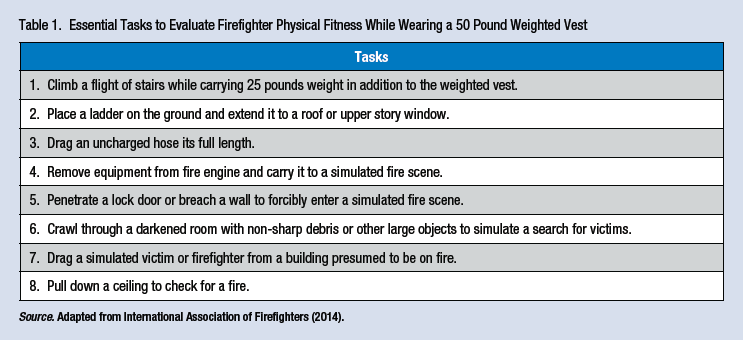
Source. Adapted from International Association of Firefighters (2014).
Conclusion
Firefighters who are physically healthy are essential to public safety. Multiple barriers prevented health-promoting activities in this sample of firefighters. However, health-promoting facilitators also existed. Occupational and environmental health nurses should develop and implement interventions that minimize identified barriers and strengthen facilitators such that the physical health of firefighters is improved. Future research is needed to evaluate the efficacy of proposed interventions based on these study findings.
Applying Research to Practice
Occupational and environmental health nurses can facilitate the physical health of firefighters using several strategies. For example, they can encourage firefighters to exercise 5 minutes out of every hour while awake, facilitate competition and gaming to improve physical activity, and educate firehouse champions to promote physical health with their fellow firefighters.
Footnotes
Conflict of Interest
The author(s) declared no potential conflicts of interest with respect to the research, authorship, and/or publication of this article.
Funding
The author(s) disclosed receipt of the following financial support for the research, authorship, and/or publication of this article: This study was supported by the National Institute for Occupational Safety and Health and the Health Pilot Research Project Training Program of the University of Cincinnati Education and Research Center Grant T42/OH008432-05.
Author Biographies
Ms. Stacy Lovejoy is a staff registered nurse and holds an advanced degree in occupational health nursing.
Dr. Gordon L. Gillespie is an associate professor and Robert Wood Johnson Foundation nurse faculty scholar at the University of Cincinnati. He has an advanced degree in public/community health nursing and a doctoral degree in occupational health nursing research. He has multiple publications in occupational health research.
Dr. Jane Christianson is an assistant professor of clinical nursing at the University of Cincinnati College of Nursing. She has an advanced degree and doctoral degree in occupational health nursing. Her research is focused on employee health.