




Abstract
Incorporating Generative Artificial Intelligence (Gen AI) into education has become popular trend due to its ability to facilitate students’ thinking about answers through dialogue. However, the question of whether this convenience augments or inhibits students’ creativity development remains controversial. Thus, present study focused on a particular group in China, students in secondary vocational schools, who are in the bottom 50% in terms of academic performance at the end of ninth grade studies. This study aimed to answer whether Gen AI, or Gen AI together with teachers providing structure support, could promote creativity development of these students specifically. A quasi-experimental study over 12 weeks with pre- and post-measurement was conducted for 3 classes that comprised 75 total students. Repeated measures ANOVA revealed that students in the classes that incorporated Gen AI experienced significantly upward trends in learning attitude, perceived creativity, and self-efficiency compared to those in the classes without Gen AI, but there was no statistical difference in cognitive load. However, the use of Gen AI failed to promote students’ creativity development. Only when the teacher and Gen AI worked together and the teacher provided structure support, were all dimensions of creativity (fluency, flexibility, elaboration, and originality) improved.
Plain Language Summary
This study investigated whether Generative Artificial Intelligence (Gen AI) could enhance creativity in vocational students, who are typically identified as a low academic performance group in the Chinese educational context. Through a 12-week quasi-experiment with 75 participants, we compared traditional instruction, independent Gen AI use, and teacher-guided Gen AI use. Results showed that while Gen AI significantly improved vocational students’ learning attitudes, perceived creativity and self-efficiency, it failed to enhance actual creative performance when used independently. Significant growth in all creativity dimensions occurred only when teacher provided structure support alongside the Gen AI. These findings highlighted the importance of a teacher’s role in using Gen AI.
Introduction
Creativity is recognized as an essential skill for students that not only can contribute to academic success but also to personal development and career success (Doshi & Hauser, 2024; Gajda et al., 2017). It is included in the 21st-century core competencies (Partnership for 21st Century Skills, 2008) and has been included for the first time as a new area of assessment in the PISA 2022 (OECD, 2023). Generative Artificial Intelligence (Gen AI) has begun to become increasingly integrated into teaching and learning in recent years. Although it facilitates the search for information and the production of work solutions through dialogue, there are differing views on whether this facilitation promotes (Stojanov, 2023; Wu et al., 2024) or inhibits (Chan & Hu, 2023; Putra et al., 2023) students’ creativity development.
Much research has already focused on creativity development, but little attention has been paid to the creativity of students with low academic performance. One particular group in China is students in vocational schools, who are often considered to be failures in the traditional education system (Hao & Pilz, 2021; G. Wang, 2021). For example, students in secondary vocational schools are drawn from the bottom 50% in the entrance exams after finishing ninth grade studies (D. Guo & Wang, 2020; Stewart, 2015). Previous research has placed more emphasis on developing their operative skills, with less attention paid to, or even bias against higher-order thinking such as creativity. Therefore, given this background and the trend toward incorporating Gen AI in the classroom, the question of how to use Gen AI to promote creativity development among academically struggling students is the subject of this study.
Previous studies have suggested that students with low academic performance have the weak learning motivation and insufficient self-regulating learning ability (D. Guo & Wang, 2020; Lichtinger & Kaplan, 2015). The present study upholds the attitude of using Gen AI responsibly and therefore hope that the impact of Gen AI on creativity development doesn’t negatively affect students’ subjective experiences, particularly for those with low academic performance who may have lower motivation and more negative attitudes toward learning. Therefore, although this study focuses on the impact of Gen AI on low-performance students’ creativity, it also discusses its impact on students’ internal psychological perceptions.
Background
What is Creativity?
Creativity is included in the list of 21st-century core competencies because of increasing demand for more creative knowledge work in the global economy (Doshi & Hauser, 2024; Partnership for 21st Century Skills, 2008). As previous researchers have suggested, creativity is the ability to view things in original ways, learn from experiences and relate them to new situations, think in unconventional ways, employ nontraditional approaches to solve problems, and produce unique outputs (Duffy, 1998; A. Y. Wang, 2012). Creativity tests often adopt this concept by assessing the ability of fluency, originality, elaboration, and flexibility (Goff & Torrance, 2002; Stolaki & Economides, 2018).
According to Bloom’s cognitive taxonomy, creativity belongs to higher-order cognitive processes that can be stimulated if by the proper methods and techniques (Anderson, 2005). Problem solving is considered an effective way of fostering creativity, especially with open-ended problems and case studies that require individuals to use higher-order cognitive skills such as analyzing, synthesizing, and restructuring the problem (Mumford et al., 2012). Therefore, as a teaching method that emphasizes problem-led, task-driven, and outcome-oriented teaching, project-based learning fosters creativity by stressing students’ need to create new applications through innovative thinking and hands-on production (S. Y. Chen et al., 2022; Hanif et al., 2019).
Gen AI and Student Creativity Development
With its ability to simulate human-like conversations, Gen AI shows great potential for instantly answering questions, facilitating group discussions, and even helping teachers plan lessons to improve students’ cognitive, behavioral, and emotional well-being (Imran & Almusharraf, 2023; Lo, 2023; Vargas-Murillo et al., 2023). There is also evidence of developing students’ higher-order thinking skills. For example, Ho and Lee (2023) applied Gen AI to enhance students’ programming skills; Li and Wang (2023) used ChatGPT as an inquiry-based learning aid to enhance students’ problem solving and critical thinking skills. H. Lee et al. (2024) developed an assistive learning tool named GCLA based on ChatGPT, and encouraged students first to attempt to solve problems independently, then GCLA provided guidance through prompts rather than direct answers. They found that this approach enhanced students’ self-regulation, higher-order thinking, and knowledge construction compared receiving direct answers using ChatGPT. W. Guo et al. (2025) explored the impact of various student-AI collaborative modalities on creative problem-solving. They highlighted that human agency was crucial in this process, suggesting that the deep integration of human ideas with AI outputs could sustainably enhance agency and foster student creativity. However, it focused solely on student-AI collaboration but ignored the role of the instructor.
Many researchers have expressed their views that Gen AI can promote students’ creativity (Nie et al., 2025). For example, it may be able to simulate problems and scenarios in real workplace situations, provide students with rich learning resources and diverse perspectives, stimulate divergent thinking, and encourage them to generate new ideas and solutions (Stojanov, 2023; Wu et al., 2024). Furthermore, Gen AI may also act as a potential user for students’ creative solutions, providing continuous feedback through dialogue in order to optimize their solutions iteratively (H. Lee et al., 2024).
However, some researchers have suggested that using Gen AI in education may lead to students’ over-reliance on it and reduced intellectual participation (Cai et al., 2024). Some researchers question students’ submission of Gen AI-generated materials as their own work (Lo, 2023; P. Zhang & Tur, 2023) and use of information provided by Gen AI to make decisions (Chan & Hu, 2023), arguing that these actions replace the thinking process and may therefore diminish students’ higher-order thinking skills and independent thinking awareness (Meincke et al., 2025). As a result, it’s not easy to ascertain whether Gen AI can be used to develop higher-order thinking skills (Putra et al., 2023) and potentially impair students’ learning engagement (Sallam, 2023; Vargas-Murillo et al., 2023). Given these conflicting perspectives, it is still unclear whether the effect of Gen AI on creativity cultivation is positive or negative, particularly for learners who face significant academic challenges and may be more susceptible to such risks. This leads to the first research question of this study:
Teaching Methods for Low-Academic-Performance Students
The Chinese education system is compulsory up to the ninth grade. At the end of ninth grade, students take a standardized academic achievement test, known as the Zhongkao, with high achievers entering general high schools and low achievers entering secondary vocational schools. However, there is often a gap between the theory and the practice of classroom teaching in Chinese secondary vocational schools. Vocational education and training (VET) emphasizes student’s abilities on actual work tasks and encourages the learning approach of “learning by doing” (Aarkrog, 2005; Mikkonen et al., 2017). Therefore, it often relies on project-based learning (Megayanti et al., 2020) and gives students the flexibility for autonomous exploration (Jossberger et al., 2020). However, since the fact that students in Chinese vocational schools often have failed exams, their ability to self-regulate learning and meta-cognitive skills is questioned by teachers. Thus, teachers often still used traditional lecture-based teaching methods (D. Guo & Wang, 2020; A. Wang & Guo, 2019).
Creativity development requires giving students sufficient autonomy to engage in exploratory learning (Iwata, 2013). Gen AI may provide more autonomy support for students by providing richer information, more diverse task contexts, and personalized path support (Tahir & Tahir, 2023; Wu et al., 2024). Therefore, the integration of Gen AI into secondary vocational classrooms can theoretically fit the pedagogical philosophy of VET. However, without appropriate guidance, students might get lost in irrelevant information and struggle to achieve learning goals (Matthes et al., 2020; van Loon et al., 2012). Based on self-determination theory (Deci & Ryan, 1985), structure support includes strategies such as providing process guidance, feedback, prompts, and detailed explanations to support students in achieving desired goals (Jang et al., 2010). Previous researchers have found that students learn better in an autonomous web-based environment if teachers provide structure support such as clear goal requirements, process frameworks, and timely feedback and guidance (Cui et al., 2022). Hunter-Doniger (2024) also suggested that creativity flourished when autonomy was combined with constraints. H. Lee et al. (2024) found that structure support provided by teachers, along with autonomy support provided by Gen AI, had a significant positive impact on undergraduate students’ creativity compared to traditional ChatGPT use. Therefore, structure support is critical if project-based learning with Gen AI is applied to the VET student population. This leads to the second research question:
Present Study
Based on the above literature, creativity has been widely valued as an important higher-order thinking for students’ future development. However, several research gaps still require further exploration. First, with the recent trend in integrating Gen AI into teaching and learning, there are differing views on whether Gen AI promotes or inhibits students’ creativity development (Chan & Hu, 2023; Stojanov, 2023). It’s worth noting that existing research on creativity has ignored students with low academic performance, especially students from Chinese vocational schools. Second, the teaching method which Gen AI provides autonomy support and teacher provides structure support has been validated in college students (H. Lee et al., 2024). However, the question of whether it can also promote the creativity development of academically struggling students remains to be answered by empirical research.
In response to the above research gaps, the present study will conduct a quasi-experimental study on Chinese VET students to explore whether Gen AI can promote their creativity development. The research proposes the following hypotheses:
Methods
Intervention Design
A 12-week quasi-experimental study employed a pretest-posttest control group design in a course named Innovation Training. The intervention focused on stimulating students’ creativity development through a series of situational tasks. The implementation information is presented in Figure 1 around the theme of generating a business plan (9 weeks). ChatGLM, an artificial intelligence assistant developed based on the language model trained by Zhipu AI Company and Tsinghua University KEG Lab in 2023, was chosen because it was available for free in China and had proven features for training intelligent bodies such as that used in this study (Figure 2). The control group received traditional instruction, while the experimental groups used Gen AI as a supplement. We confirmed that this study involved no physical or psychological risk to participants. The study was approved by the Institutional Review Board in China. Prior to the study, we clearly explained the entire experiment and obtained approval from the school head, teacher, and students.
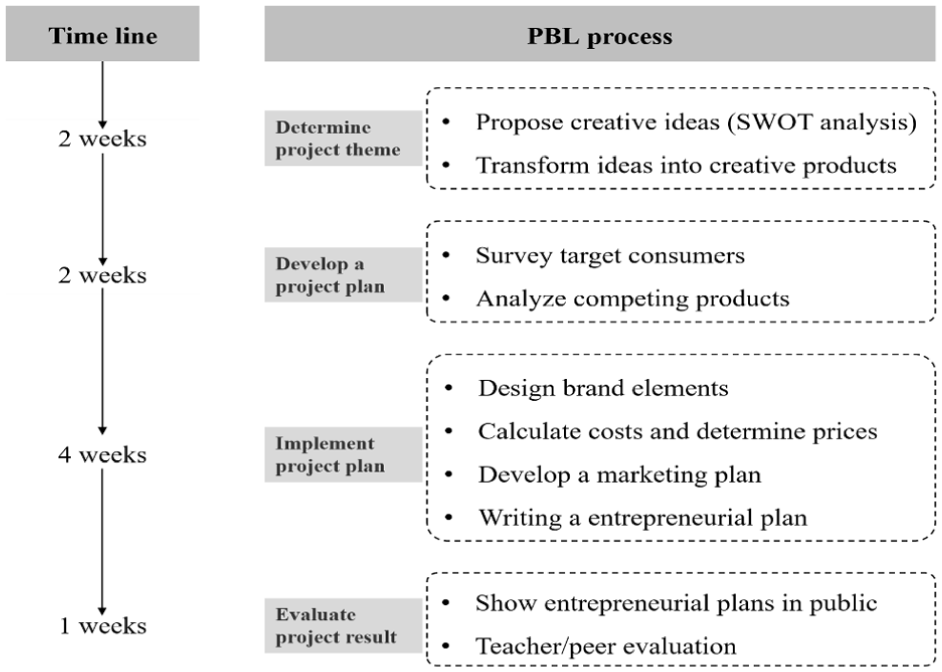
Curriculum implementation information.

The intelligent body used in present study.
Three experiment conditions were designed and implemented: experimental group 1 with Gen AI, experimental group 2 with Gen AI integrated structure support from teacher, and a control group without Gen AI. They all employed a project-based pedagogical approach in which diverse task scenarios were devised to develop an innovative program intended to foster creativity. The teaching activities of the three classes are shown in Appendix A. In the control group, the teacher led the students to complete the tasks, including lecturing on concepts and operational steps, presenting cases for analysis, and finally letting the students complete the tasks. Both experimental group 1 and experimental group 2 used ChatGLM to give students more opportunities for autonomous exploration. The difference was that in experimental group 1, the teacher intervened little in the students’ autonomous explorations; but in experimental group 2, the teacher provided more structure support, such as communicating the task objectives before the task began, providing a task sheet as a scaffolding of the process, and offering personalized feedback during the students’ autonomous explorations to prevent deviation from the final goal. In conclusion, both experimental group 1 and 2 used ChatGLM to afford students more autonomy support than the control group, but the teacher in experimental group 2 also provided students with more structure support. Using the SWOT analysis activity from the third week as an example, Figure 3 presents the teaching process across different groups during this activity.

Teaching processes in different classes for the activity named SWOT analysis (an example).
Participants
As discussed in section “Teaching Methods for Low-Academic-Performance Students,” students in Chinese secondary vocational schools represent a demographic generally categorized as having low academic performance, given that they typically fall within the bottom 50% of scorers on the standardized Zhongkao exam. A total of 75 11th-grade students from 3 intact classes in a secondary vocational school in Shanghai were selected for this study. All participants were aged between 16 and 17 and were enrolled in the same Engineering major, following an identical curriculum and instructional pace. Moreover, all students had met the same minimum admission score requirements for the school and were randomly assigned to their respective classes by the school administration upon enrollment, ensuring a comparable academic foundation across the three groups.
The sample included 26 students in experimental group 1 (female = 19, male = 7), 22 students in experimental group 2 (female = 18, male = 4), and 27 students in the control group (female = 22, male = 5). The gender distribution of pupils in different classes didn’t differ significantly (χ2 = 0.742, p = .690 > .05). A post-hoc power analysis conducted in G* power (Faul et al., 2007) showed that the power-value (1-β) reached .80 with a sample size of 75, an effect size of .26, and an α of .05. These classes were taught by the same female teacher who had a Master’s degree in Education and 11 years of teaching experience, and 10 years were with this course. The school is a medium-level secondary vocational school in Shanghai, with students who tend to enter the workforce directly after graduation. The teacher and students used Gen AI software in the classroom for the first time, although they had previously experienced blended learning and web-based learning.
Procedures
The implementation process for the present study is shown in Figure 4.

Experimental implementation procedure.
Measurements
Cognitive Tests for Creativity
This study referred to the ATTA (Abbreviated Torrance Test for Adults), a creativity test proposed by Goff and Torrance (2002), which assessed four core dimensions: the ability of fluency (the fluency of ideas generated within a given time), originality (the uniqueness of ideas), elaboration (the details of an idea), and flexibility (the variety of ideas used to solve problems). It required students to identify problems, make guesses, and create ideas to solve problems or communicate ideas by writing sentences or phrases and drawing pictures, within 15 min (A. Y. Wang, 2012). However, considering this study was implemented in a creativity training course, the original questions of the ATTA test were not used directly to avoid potential inaccuracies influenced by prior exposure to questions. Previous researchers have suggested that divergent thinking task is a popular and reliable method to evaluate creativity (Barbot, 2019; Runco & Acar, 2012). Therefore, we developed an open-ended question to assess students’ creativity after discussions with the teacher, based on her experience of teaching this course and understanding of these students.
In the pre-test, students were asked to propose innovative strategies to make daily life more convenient within 15 min. On the post-test, students were asked to think of innovative strategies to build an international child-friendly city in Shanghai, also within 15 min. To ensure comparability in theme, difficulty, and structure, the tasks followed established practices in creativity assessment where comparable but non-identical scenarios are utilized. The task design was informed by the authors’ prior expertise in creativity measurement. Furthermore, the participating teacher reviewed the tasks to ensure they were appropriate for the target student population in terms of thematic relevance and cognitive demand.
According to the scoring scales (Ren et al., 2016), the fluency score was obtained by calculating the number of non-repetitive responses given by each participant; the originality score was calculated by counting the number of unusual responses (those given by less than 5% of the sample); the elaboration score was calculated by counting the number of responses given by participants that contained specific details; and the flexibility score was the number of different categories from a pre-generated category list used in a participant’s responses. Two researchers scored pre/posttest responses, and the coefficients of agreement for the raters were all higher than 0.76 and were significantly correlated. The criteria and cases for creativity evaluation are shown in Appendix B.
Internal Psychological Perceptions
Previous studies of creativity development have also examined internal psychological perceptions, such as flow experience, perceived creativity, self-efficacy, and cognitive load (Primus & Sonnenburg, 2018; Puente-Díaz, 2023; Redifer et al., 2021). For example, the PISA 2022 measured internal psychological perceptions when testing creativity (OECD, 2023). The present study focused on a group of struggling students who tended to have a negative attitude toward learning, so improving their attitude toward learning was also an important characterization of teaching effectiveness. Based on the above considerations, a questionnaire was developed to assess the degree of students’ learning attitude, flow experience, perceived creativity, self-efficacy, and cognitive load. It consisted of 24 items on a five-point Likert scale from “1” (highly disagree) to “5” (highly agree).
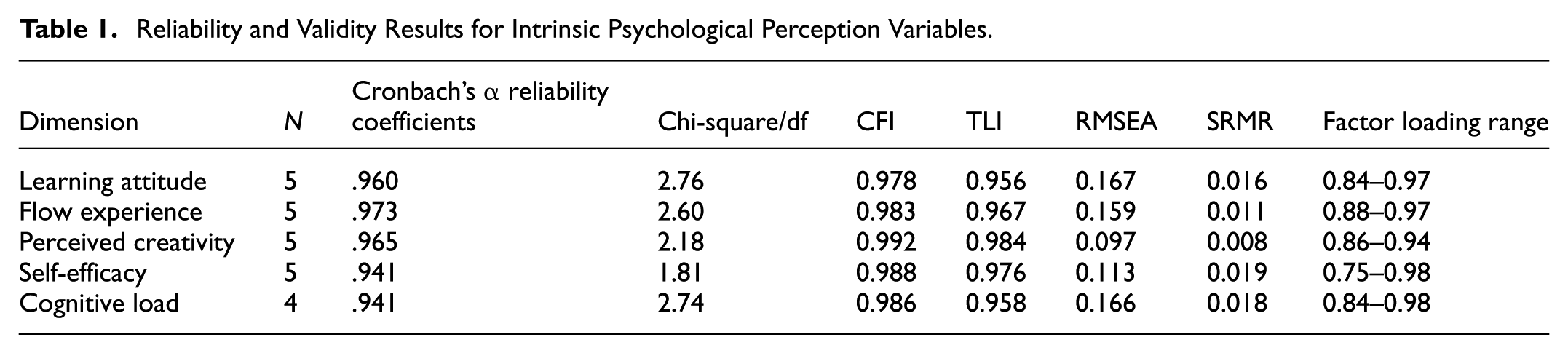
As shown in Table 1, Cronbach’s alpha reliability coefficients of the above dimensions all above .9. While the RMSEA exceeded 0.08, previous evidence suggested that RMSEA might be artificially inflated in small samples (Kenny et al., 2015). Given that the CFI and TLI were higher than 0.9, the factor loadings were above 0.7, and the SRMR were below 0.08, the model fit met the acceptable criteria suggested by Hu and Bentler (1999). Additionally, considering that the scales have been well-established with previous research, we conclude that the measurements are robust and suitable for further analysis.
Reliability and Validity Results for Intrinsic Psychological Perception Variables.
Data analysis
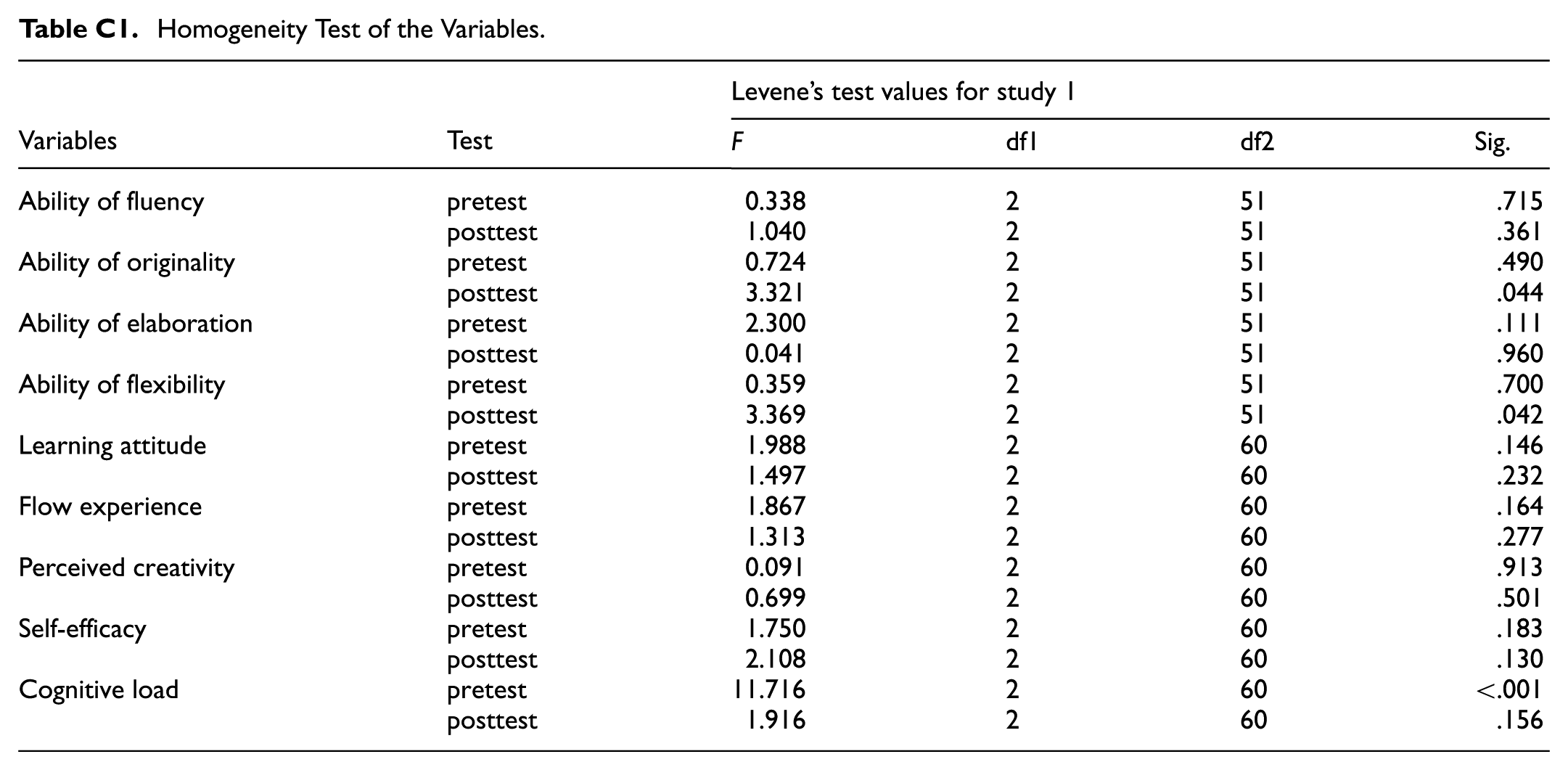
Repeated measures ANOVA was used to compare the students’ progress from pre-test to post-test in various conditions. Given that the repeated measures ANOVA is robust to the violation of normality, the assumption of homogeneity of variance was tested before the data were analyzed (Gravetter & Wallnau, 2013). The homogeneity of variations between the groups was analyzed using Levene’s Test (results shown in Appendix C), and the Wilks Lambda value was selected as the result for the variables that violated this assumption.
Results
Creativity Test Results
Table 2 and Figure 5 present different groups’ score changes on each dimension of creativity over time. There was a significant difference in the ability of fluency (F = 7.274, p < .01,
Descriptive Statistics and Repeated ANOVA Results for Creativity.

Note. CG = Control group; EG1 = Experimental group 1; EG2 = Experimental group 2.
significant at p < .01.
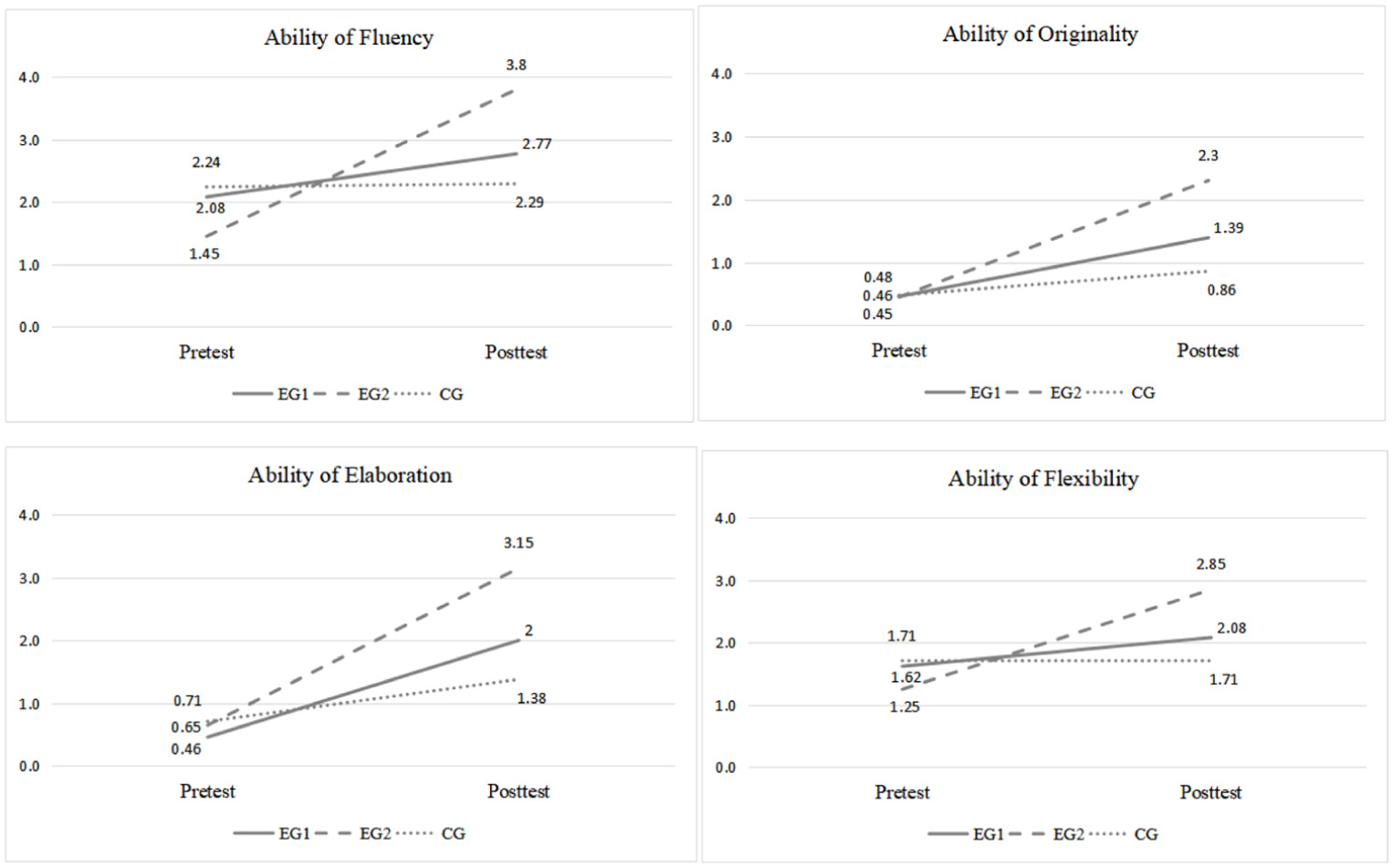
Changes in scores over time for each dimension of creativity.
The repeated measures ANOVA results for creativity between each group are shown in Table 3. Students in experimental group 2 improved significantly in all dimensions compared to the control group: fluency (F = 11.798, p < .01,
Repeated Measures ANOVA Results for Creativity Between Each Group.
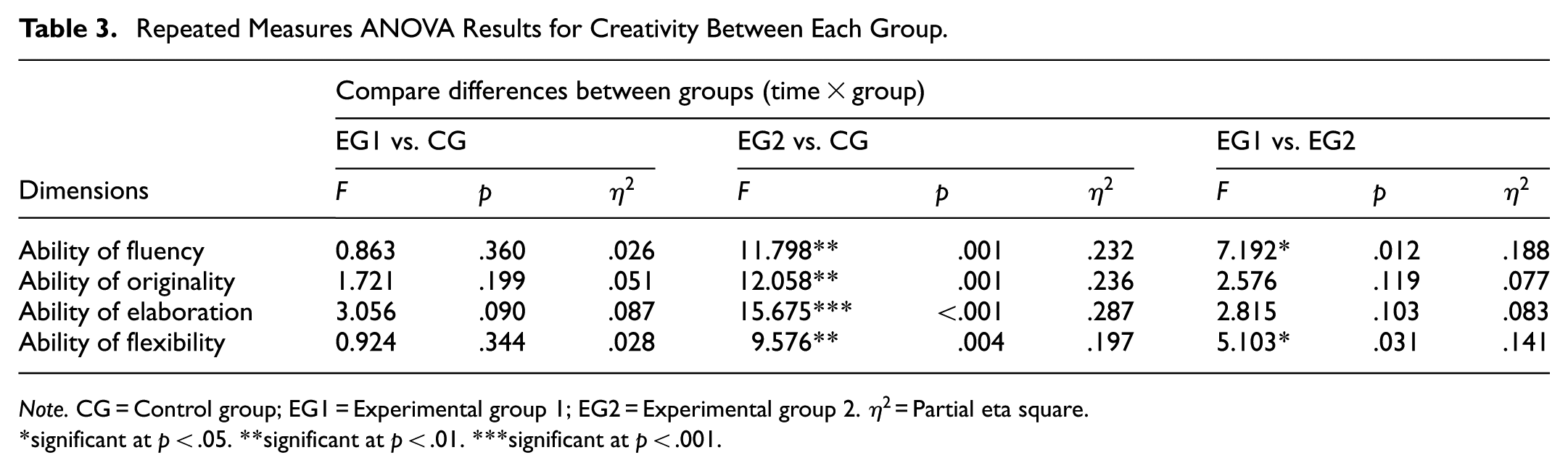
Note. CG = Control group; EG1 = Experimental group 1; EG2 = Experimental group 2.
significant at p < .05. **significant at p < .01. ***significant at p < .001.
Internal Psychological Perception Results
Table 4 presents the results of the descriptive statistics and repeated measures ANOVA for each dimension of internal psychological perception. Significant interaction effects were found for all three classes in terms of changes in performance in learning attitude (F = 6.867, p < .01,
Descriptive Statistics and Repeated Measures ANOVA Results for Internal Psychological Perception.
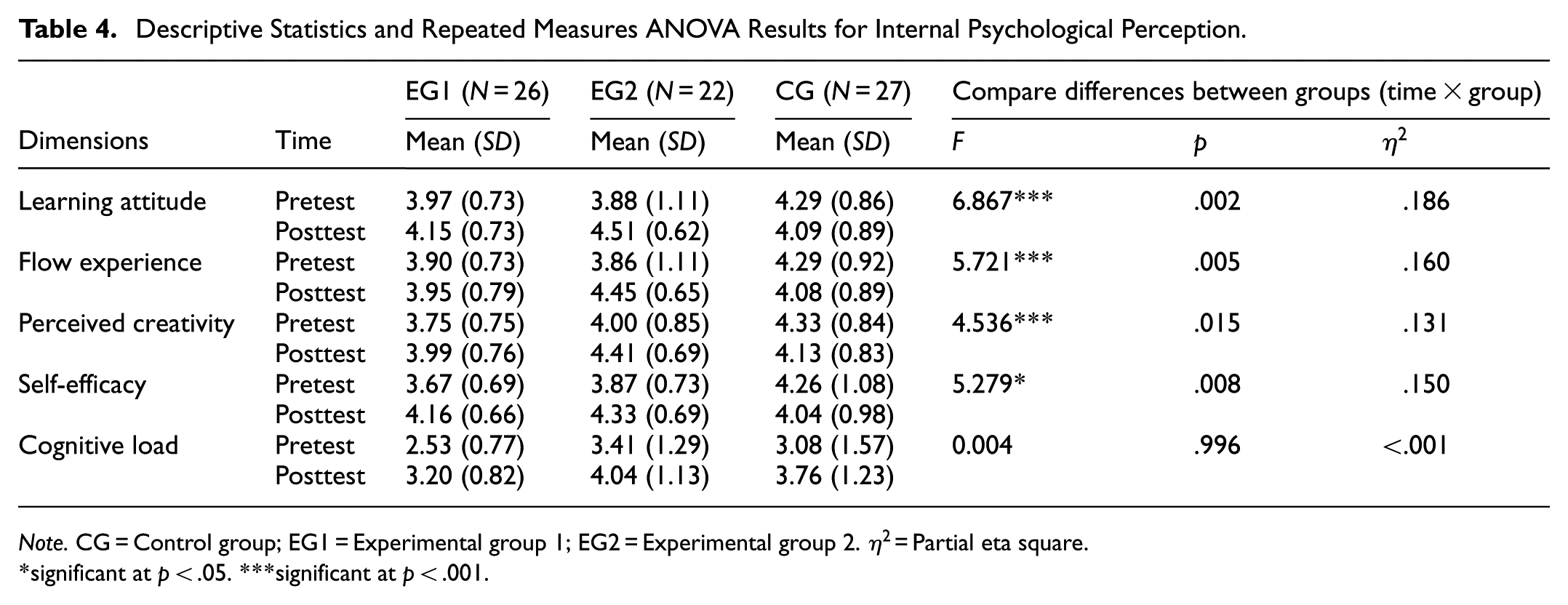
Note. CG = Control group; EG1 = Experimental group 1; EG2 = Experimental group 2.
significant at p < .05. ***significant at p < .001.
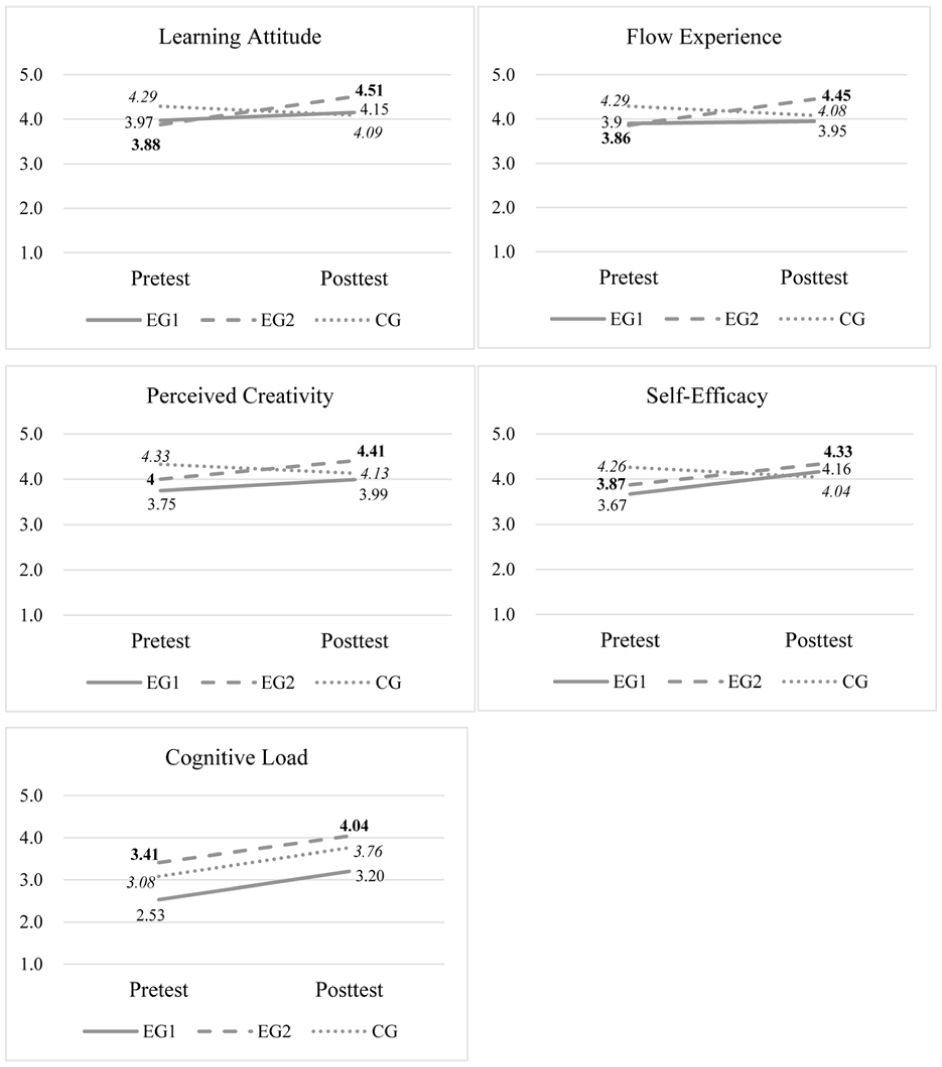
Changes in scores over time for each dimension of internal psychological perception.
As shown in Table 5, experimental group 2 not only had significantly higher interaction effects in learning attitude (F = 11.702, p < .01,
Repeated Measures ANOVA Results Between each Group for Internal Psychological Perception.
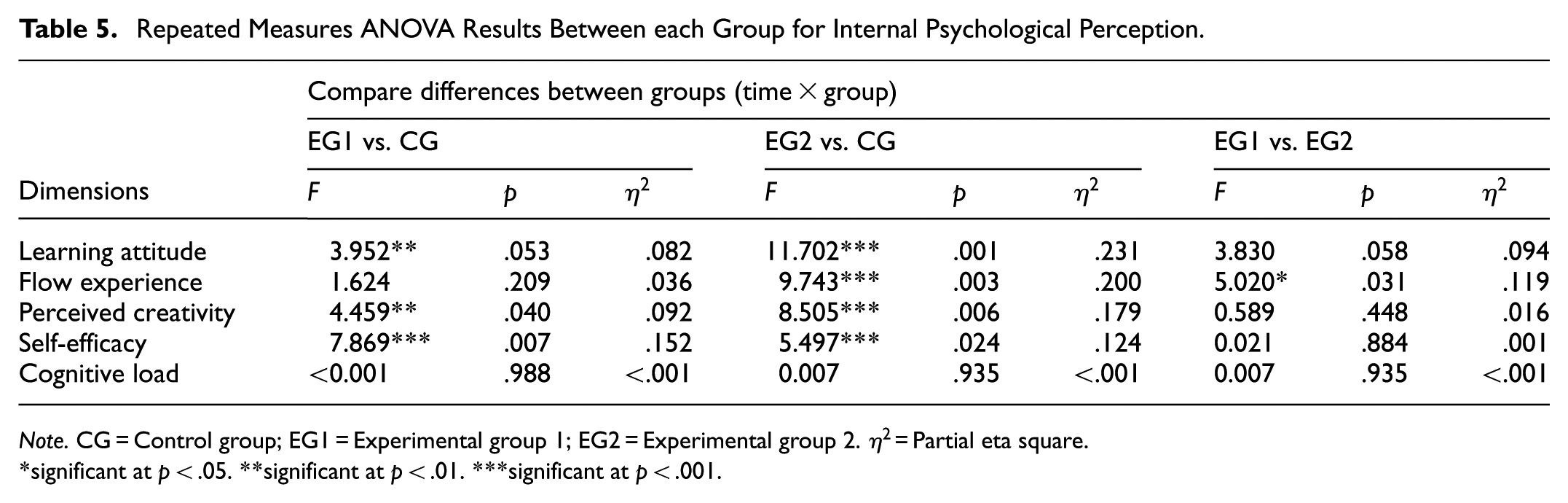
Note. CG = Control group; EG1 = Experimental group 1; EG2 = Experimental group 2.
significant at p < .05. **significant at p < .01. ***significant at p < .001.
Discussion
As Gen AI becomes more frequently and deeply integrated into teaching and learning, researchers have increasingly discussed its benefits for student learning outcomes and thinking development. However, there has been little empirical research on whether Gen AI facilitates or inhibits creativity in students with low academic performance. This study examined the potential effects of Gen AI on creativity development in a group of secondary vocational school students, who are typically identified as a low academic performance group in the Chinese educational context. Our observations suggested that although integrating Gen AI into the classroom might encourage students to maintain a more positive internal psychological perception, it wasn’t associated with a direct, significant improvement in students’ creativity performance.
The Essential Role of Integrated Teacher and Gen AI Support in Fostering Low-achieving Students’ Creativity
For the general population, the positive impact of Gen AI can be attributed to its ability to help users solve creative problems by enhancing the associative processes involved in creative problem-solving (W. Guo et al., 2025; B. C. Lee & Chung, 2024). Previous studies have found that the integration of Gen AI into the classroom promotes creativity development (X. Chen et al., 2024), including that of students whose families have a low socioeconomic status (Perez, 2024). However, this study analyzed students with low academic performance and identified a different trend. Results of the present study suggested that the use of Gen AI alone might not be sufficient to significantly affect students’ creativity; specifically, the combined support of Gen AI and teacher (EG2) was more effective in promoting creativity than using Gen AI alone (EG1).
Why did the use of Gen AI alone failed to show significant positive facilitation when targeting a population of students with low academic performance? One possible explanation may be the creative problem-solving process required integrating divergent and convergent thinking (Cropley, 2006; Eymann et al., 2026). Divergent thinking emphasizes viewing problems in unconventional ways and generating as many ideas as possible (Runco & Acar, 2012). Gen AI provided students with multiple sources of information, expanding the boundaries of the knowledge and ideas they already had and potentially enhancing their divergent thinking (H. Lee et al., 2024). However, the variety of information Gen AI presented may have also affected students’ attention (Kartal, 2024). Developing creativity also requires convergent thinking to evaluate, select, and deliver complete creative products (Kim & Pierce, 2013), which involves seeking specific answers or solutions to problems through logic and experience (Cropley, 2006). This process requires more developed meta-cognitive skills (Urban et al., 2024).
Present study was concerned with students in the bottom 50% of academic performance on the Zhongkao, whose learning experience and skills were frequently inadequate to solve complex problems. Therefore, their teacher provided structure support, such as feedback and scaffolding, appeared to guide students on how to use meta-cognitive skills and helped them use convergent thinking, which directly contributed to the superior creativity scores in EG2 compared to both EG1 and the CG. We argue that the development of creativity may require students to synthesize the information provided by Gen AI and their own ideas to generate final creative solutions with the guidance of the structure support provided by the teacher.
Impact of Gen AI on Low-achieving Students’ Internal Psychological Perceptions
Our results showed that for this sample, Gen AI was associated with significant increases in students’ attitudes toward learning, perceptions of creativity, and self-efficacy without imposing additional cognitive load, consistent with previous studies’ findings (Chang et al., 2021; Chen et al., 2024; H. Lee et al., 2024). Interestingly, although EG2 outperformed EG1 in creativity performance, the addition of structure support provided by teacher didn’t significantly influence students’ internal psychological perceptions. This further highlighted the potential of Gen AI in helping academically struggling students cultivated a more positive learning attitude.
Self-efficacy is the most critical component that influences whether and how much energy an individual expends when faced with a particular task (Power et al., 2020). This study echoed Chang’s et al. (2021) and H. Lee’s et al. (2024) findings, which suggested that learning incorporating Gen AI could be linked to increased students’ self-efficacy. Gen AI served as a brainstorming partner (Gong et al., 2022) and provided real-time, personalized, and high-quality learning support, as well as full-time problem-solving assistance. Students could turn to Gen AI for help whenever they were struggling, which was particularly important for these students with low academic performance, thereby increasing their self-efficacy, stimulating interest in learning, promoting a positive attitude toward learning, and enhancing their perception of their own creativity. As some students said, “I’m so in love with ChatGLM! It’s like opening the door to a new world for me.”“Studying with ChatGLM makes me feel like my mind has been opened, and all kinds of creative ideas are coming out like a spring. I’m super excited to make those ideas come true one day.” As we all know, observed improvements in the attitudes and self-efficacy of students with low academic performance are meaningful outcomes.
Perhaps more importantly, when the teacher provided structure support, students’ flow experience compared to classrooms that only received Gen AI appeared to be significantly enhanced. What is the ideal combination of teacher and technology? Are teachers indeed irreplaceable? Previous research has explored these questions (Cui et al., 2022) and have found that the addition of Gen AI may lead to strain and information overload in the use of technology, which requires good process guidance (Iku-Silan et al., 2023). The teacher in this study took on the role of providing timely guidance and avoiding disorientation, which was found not only to contribute significantly to the development of students’ creativity but also to help students had a more positive flow experience, suggesting that teachers continue to play an irreplaceable and vital role even in the nascent era of AI.
Limitations and Conclusion
Some limitations of the current study need to be discussed. First, to reduce the interference of external factors, students remained in their regular classrooms. However, because the study utilized intact classes rather than individual randomization, this quasi-experimental design might have been influenced by unobserved cluster-level variables, such as varying classroom atmospheres or pre-existing peer dynamics. Consequently, while our findings indicated significant trends, they could not be interpreted as definitive causal evidence, and caution should be exercised when attributing the observed changes solely to the intervention. Second, this study was based on a relatively small sample from a single vocational school and was conducted by a single instructor. These factors might be limiting the generalizability of the findings to other educational settings. Consequently, the results should be viewed as exploratory rather than universal. Future research with larger, more diverse samples involving multiple schools, teachers and students is necessary to further validate the reliability and broader applicability of our findings. Third, in future research, more process information needs to be included in measurement and evaluation; for example, the content of students’ conversations with ChatGLM needs to be coded and analyzed. Additionally, it’s also valuable to examine the data-driven mechanisms involved in how Gen AI influences the development of creativity.
In conclusion, the present study focused on a particular group in China, students in secondary vocational schools, who were in the bottom 50% group at the end of ninth grade and were considered to have low levels of academic performance. Through a 12-week quasi-experimental study, we explored how the integration of Gen AI and teacher’s structure support influenced these students’ creativity. In summary, while H1 was supported in terms of psychological perceptions, the significant creativity growth predicted in H2 highlighted the irreplaceable role of teacher in AI-enhanced vocational education. The findings discussed above provided an exploratory look at Gen AI for creativity enhancement for students with low academic performance from a Chinese sample and highlighted the potential importance of how teacher use Gen AI. Although the current study’s findings are based on a Chinese cultural context, we believe this study will provide valuable insights for researchers in other cultural contexts as well.
Footnotes
Appendix A
Implementation Details of Gen AI-Supported PBL Activities Across Three Classes.
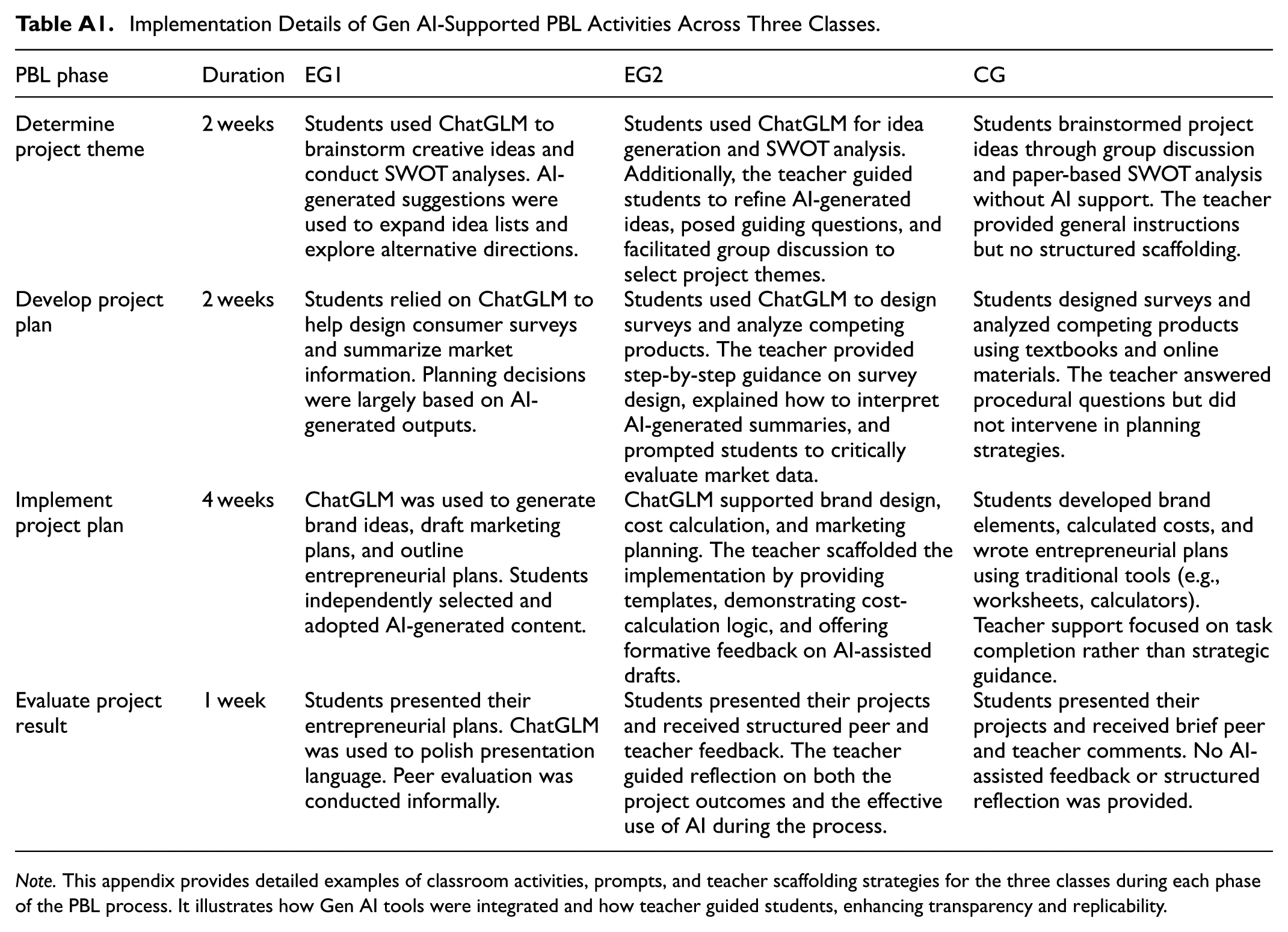
| PBL phase | Duration | EG1 | EG2 | CG |
|---|---|---|---|---|
| Determine project theme | 2 weeks | Students used ChatGLM to brainstorm creative ideas and conduct SWOT analyses. AI-generated suggestions were used to expand idea lists and explore alternative directions. | Students used ChatGLM for idea generation and SWOT analysis. Additionally, the teacher guided students to refine AI-generated ideas, posed guiding questions, and facilitated group discussion to select project themes. | Students brainstormed project ideas through group discussion and paper-based SWOT analysis without AI support. The teacher provided general instructions but no structured scaffolding. |
| Develop project plan | 2 weeks | Students relied on ChatGLM to help design consumer surveys and summarize market information. Planning decisions were largely based on AI-generated outputs. | Students used ChatGLM to design surveys and analyze competing products. The teacher provided step-by-step guidance on survey design, explained how to interpret AI-generated summaries, and prompted students to critically evaluate market data. | Students designed surveys and analyzed competing products using textbooks and online materials. The teacher answered procedural questions but did not intervene in planning strategies. |
| Implement project plan | 4 weeks | ChatGLM was used to generate brand ideas, draft marketing plans, and outline entrepreneurial plans. Students independently selected and adopted AI-generated content. | ChatGLM supported brand design, cost calculation, and marketing planning. The teacher scaffolded the implementation by providing templates, demonstrating cost-calculation logic, and offering formative feedback on AI-assisted drafts. | Students developed brand elements, calculated costs, and wrote entrepreneurial plans using traditional tools (e.g., worksheets, calculators). Teacher support focused on task completion rather than strategic guidance. |
| Evaluate project result | 1 week | Students presented their entrepreneurial plans. ChatGLM was used to polish presentation language. Peer evaluation was conducted informally. | Students presented their projects and received structured peer and teacher feedback. The teacher guided reflection on both the project outcomes and the effective use of AI during the process. | Students presented their projects and received brief peer and teacher comments. No AI-assisted feedback or structured reflection was provided. |
Note. This appendix provides detailed examples of classroom activities, prompts, and teacher scaffolding strategies for the three classes during each phase of the PBL process. It illustrates how Gen AI tools were integrated and how teacher guided students, enhancing transparency and replicability.
Appendix B
The following steps describe how student creativity scores were assigned. First, a structured Excel file was created for each task, in which raters recorded each participant’s ID along with all ideas generated by that participant. Next, raters familiarized themselves with all ideas and performed an initial review, removing responses deemed inappropriate or irrelevant. Finally, two independent raters categorized and evaluated all ideas. Through multiple rounds of verification and discussion, they determined the total number of categories, assigned each idea to a category, and identified infrequently mentioned (original) ideas.
Appendix C
Homogeneity Test of the Variables.
| Variables | Test | Levene’s test values for study 1 | |||
|---|---|---|---|---|---|
| F | df1 | df2 | Sig. | ||
| Ability of fluency | pretest | 0.338 | 2 | 51 | .715 |
| posttest | 1.040 | 2 | 51 | .361 | |
| Ability of originality | pretest | 0.724 | 2 | 51 | .490 |
| posttest | 3.321 | 2 | 51 | .044 | |
| Ability of elaboration | pretest | 2.300 | 2 | 51 | .111 |
| posttest | 0.041 | 2 | 51 | .960 | |
| Ability of flexibility | pretest | 0.359 | 2 | 51 | .700 |
| posttest | 3.369 | 2 | 51 | .042 | |
| Learning attitude | pretest | 1.988 | 2 | 60 | .146 |
| posttest | 1.497 | 2 | 60 | .232 | |
| Flow experience | pretest | 1.867 | 2 | 60 | .164 |
| posttest | 1.313 | 2 | 60 | .277 | |
| Perceived creativity | pretest | 0.091 | 2 | 60 | .913 |
| posttest | 0.699 | 2 | 60 | .501 | |
| Self-efficacy | pretest | 1.750 | 2 | 60 | .183 |
| posttest | 2.108 | 2 | 60 | .130 | |
| Cognitive load | pretest | 11.716 | 2 | 60 | <.001 |
| posttest | 1.916 | 2 | 60 | .156 | |
Acknowledgements
We are grateful to Dr. Wanruo Shi from Tsinghua University for her valuable support and assistance throughout the implementation of this research.

Ethical Considerations
This study was approved by Tsinghua University Science and Technology Ethics Committee (Humanities, Social Sciences and Engineering) (Approval No: THU-09-2023-06). Before each study, we clearly explained the whole procedure of the experiment and obtained the approval of the school head, teacher and students. Participation was entirely voluntary.
Funding
The authors disclosed receipt of the following financial support for the research, authorship, and/or publication of this article: This project was funded by the National Natural Science Foundation of China (NSFC: No.72404171), the Ministry of Education in China Project of Humanities and Social Sciences (24YJC880023), and Shandong Provincial Natural Science Foundation (ZR2024QF236).
Declaration of Conflicting Interests
The authors declared no potential conflicts of interest with respect to the research, authorship, and/or publication of this article.
Data Availability Statement
The data in this study can be provided upon request via e-mail to the corresponding author.