




Abstract
The use of technology in language learning is an emerging research field, especially in terms of how learners’ attitudes and acceptance of technology affect the process and experiences of language acquisition. This study seeks to evaluate the role of Generative AI (GenAI) tools in enhancing foreign language proficiency and to explore the motivational factors influencing their adoption and success. Utilizing the Technology Acceptance Model (TAM), this study explores the role of GenAI in foreign language learning among Chinese students. A cross-sectional survey design was utilized to collect data from 548 Chinese university students who use GenAI tools for foreign language learning in and outside the English as a Foreign Language (EFL) classroom. Questionnaires were collected on three respective scales: the Foreign Language Motivation Scale (FLMS), the Foreign Language Proficiency Scale (FLPS), and the AI Technology Acceptance for Foreign Language Learning Scale (ATA-FLLS). Data were analyzed through descriptive statistics, correlation analysis, path analysis, and structural equation modeling (SEM) to explore the relationships between ATA-FLL, FLP, and FLM. The findings demonstrated that positive relationships between perceived usefulness (PU) and perceived ease of use (PEOU) have a significant impact on Foreign Language Proficiency (FLP). Also, results reveal that self-efficacy (SE) mediated the relationship between PEOU and FLP, which indicates the subtle interplay between the factors of the Technology Acceptance Model (TAM) and psychological mediators; those factors collaboratively contribute to students’ foreign language achievement.
Plain Language Summary
This research investigates the impact of Chinese university students’ utilization of generative artificial intelligence (GenAI) learning tools tailored for foreign language learning on their motivation and proficiency in foreign language acquisition. Findings indicate that a positive disposition towards GenAI enhances motivation, particularly self-efficacy, which in turn leads to improvements in the four language skills of listening, speaking, reading, and writing. Motivation acts as a mediating factor between the acceptance of GenAI and language proficiency advancement. The study builds on previous research but focuses more on GenAI tools tailored for foreign language learning and the university student population.
Introduction
AI has profoundly transformed second language acquisition by reshaping how learners engage with foreign language proficiency, motivation, and learning outcomes (Almelhes 2023; Wu et al., 2024). Positive psychology, which seeks not only to understand learners’ processes better but also to aid in their holistic development and positive learning experiences, has also resulted in a “positive turn” in English as Foreign Language (EFL) acquisition research (F. Huang et al., 2024). This change has a major effect on the psychological moods and personal well-being of students, which is why it is particularly relevant in AI-integrated and GenAI learning environments (Wang et al., 2024).
Two main reasons for implementing GenAI in foreign language instruction are particularly significant and relevant at this point: First, GenAI technologies are especially suited for learning foreign languages since their primary technology is designed to comprehend and produce human language (OpenAI, 2023), which closely aligns with the goals of language learning. Learners can instantly apply vocabulary and grammatical structures in a dialogic setting with GenAI tools, which offer interactive conversational practice that is essential for fluency development (Kasneci et al., 2023). Language learning, by nature, is based on experience and, thus, requires ongoing interaction and engagement with the medium of language (Li & Jeong, 2020). With English considered a global lingua franca (Zheng et al., 2024), however, there is an ever-growing demand for creativity and efficiency in ways to promote awareness of the English language. Practicing this way requires learners to internalize linguistic features and subtle interactions, which differ from experiential disciplines. Language researchers (Jansen et al., 2024) observed that rapid feedback from GenAI platforms can mimic the social interaction-driven process of natural language acquisition, enabling a more organic language skill development that is challenging to duplicate in other academic fields. GenAI systems are beneficial for language learners by providing speech recognition, interactive dialogues, and other advantages like being accessible 24/7 and rapid feedback (Adeshola & Adepoju, 2024). The personalized and interactive nature of GenAI makes it even more attractive. But both teachers and students must recognize its limitations and unpredictability (Kasneci et al., 2023). Although there are pedagogical justifications for GenAI, whether technology is effective in education is contingent upon the knowledge and acceptance of students. Using the Technology Acceptance Model (TAM), this study investigates the interactions of major TAM constructs in predicting Foreign Language Proficiency (FLP): Perceived Usefulness (PU), Perceived Ease of Use (PEOU), Attitude toward Use (ATU), and Behavioral Intention (BI) with motivational factors (Learning Needs, Self-Efficacy, and Achievement Motivation). Specifically, this study examines the mediating role of motivation in the relationship between GenAI acceptance and FLP in Chinese EFL university students. This study utilizes motivation to address the gap in understanding the role of psychological factors in GenAI acceptance and learning performance.
Literature Review
Technology Acceptance Model
Based on the Theory of Reasoned Action (TRA), Davis (1989) developed the Technology Acceptance Model (TAM). The model’s main thesis posits that behavioral intention to use technology is shaped by beliefs about its usefulness and ease of use rather than general attitudes. By following a simple methodology, TAM sought to provide a framework for investigating a broad range of behaviors displayed by technology users (Davis, 1989). TAM’s primary objective was to shed light on the mechanisms influencing technology adoption to predict user behavior and offer a theoretical framework for successful technology deployment.
The model shows four main characteristics: Perceived Usefulness (PU), Perceived Ease of Use (PEOU), Attitude Toward Using (ATU), and Behavioral Intention (BI). PU reflects the degree to which a person believes that using a certain technology enhances performance, while PEOU refers to the extent to which users believe that interacting with a system is free of effort. These factors further exert an impact on users’ attitude toward using technology (Attitude Toward Using (ATU), behavioral intention (BI), and actual usage behavior (Davis, 1989). This construct was conceptualized based on Bandura’s idea of outcome judgment, which is the belief that behavior results in a favorable outcome (Bandura, 1982). Based on data supporting the relationship between system performance expectancy and system utilization, perceived usefulness was operationalized (Marikyan & Papagiannidis, 2024).
When users perceive that technology may improve their academic or career outcomes, their intention to use it increases. According to Nilashi and Abumalloh (2025), TAM is a popular framework for forecasting and elucidating user acceptance of a variety of technologies in information systems, human-computer communication, and educational technology. Therefore, this study uses a technological approach to understand how PU, PEOU, ATU, and BI of students toward GenAI influence their foreign language proficiency (FLP).
Generative AI Acceptance in Foreign Language Learning
Advanced AI systems that use machine learning techniques to create original text, image, and audio output are referred to as generative AI (GenAI) (Baidoo-Anu & Ansah, 2023). The advancement of neural network topologies and deep learning methods has enabled GenAI to produce highly contextualized and human-like responses (Pack & Maloney, 2023). By offering interactive and personalized language practice, GenAI has created new opportunities and challenges in foreign language (FL) education (Gao et al., 2024). By creating a realistic conversational experience suited to the needs of each learner and providing immediate feedback that is contextually relevant, it enhances language learning effectiveness and learner engagement (Almelhes, 2023). The incorporation of chatbots, adaptive learning platforms, intelligent tutoring systems, and other GenAI technologies is transforming traditional pedagogy practices (Law, 2024). Hsiao and Chang (2023), in a study of 43 senior high school English as a foreign language (EFL) students in Taiwan, demonstrated that AI-enhanced tools significantly improved students’ performance in online writing and reading courses. By offering customized practice sessions and adaptive learning paths that address the student’s individual needs, GenAI applications strengthen second language competence by addressing specific learning gaps and accelerating progress (Wu et al., 2021).
Role of Students’ Motivation in Foreign Language Learning
In language learning environments, it is imperative that the affective characteristics of each learner (learning engagement, well-being, and motivation) interact dynamically with GenAI-based tools (Creely, 2024). When GenAI is recognized as a friendly and non-judgmental facilitator (Lievertz, 2019), which invites active participation in language learning processes and increases self-efficacy (Kim, 2020), levels of motivation and engagement among learners typically increase. According to Deci and Ryan’s Self-Determination Theory (SDT), individuals possess an inherent capacity to become intrinsically motivated and satisfy the three basic psychological needs of autonomy, competence, and relatedness. SDT offers a strong foundation for understanding why language learners during their studies choose artificial intelligence technology (Zheng et al., 2024). Research has shown that generative AI (GenAI) developments can enhance human-computer interaction, productivity, and student motivation. By allowing students to see their progress and achievement in their learning activities, GenAI boosts learning motivation and strengthens self-confidence. By enabling students to select and pursue lots of learning content independently, GenAI encourages autonomy, proficiency, and a sense of purpose. It also reinforces positive learning behaviors and sustained motivations.
Within the framework provided by the Self-Determination Theory, external factors such as perceived language ability, autonomy in technology use, and chances for social interaction play key roles in shaping motivation. Wang and Xue (2024) pointed out that in such a setting, integrated in EFL classrooms, students gain confidence from their language abilities, feel more control over how they learn, and interact more with each other. This contributes to motivating teachers and students in language learning efforts to keep pushing on.
For example, Wei (2023) compared the language learning experience of 60 university students using AI-mediated and traditional approaches. Students who utilized an AI-based language approach demonstrated higher confidence, improved English learning performance, stronger learning motivation, and greater self-regulated learning compared to those in the traditional approach. Similarly, studies on the effect of AI chatbots indicate that learners who felt supported by AI tools reported fewer negative learning experiences and greater satisfaction with their learning process (Linh et al., 2022).
UNIPUS AI: Foreign Language Learning Tool

UNIPUS is an online platform that supports independent English learning among university students in China. It works in tandem with the New Horizon College English Audio-Visual and Speaking Course and the New Horizon College English Reading and Writing Course. The platform includes digital courses, teaching management, interactive modules, a resource center, and other integrated tools (Wang & Xue, 2024). With the development of AI technology, UNIPUS has integrated AI into its system, transforming it into UNIPUS AI. Students can engage in conversations with the AI virtual assistant ZIYAN, inquiring about text themes, literary styles, structures, or other lesson content. Additionally, they can select lesson text directly, copy it with a single click, and swiftly edit their queries. After submitting their answers, students can click on the question number to view detailed answer analyses, in which ZIYAN provides problem-solving strategies and targeted feedback. Moreover, ZIYAN facilitates oral dialogue practice and provides evaluations that help students understand their strengths and weaknesses in spoken language. In this study, UNIPUS AI serves as the GenAI platform through which students’ AI-TAM acceptance, FLM, and FLP are examined.
Rationale
Learning a second language is quite a complex process, and researchers have used various models to explain the interaction of learning a second language and learner motivation. However, the rapid rise of GenAI tools has fundamentally altered the learning environment, and research has not yet clarified how such technologies influence learner motivation. The TAM has elucidated new technology adoption and successful implementations (J. Huang & Mizumoto, 2024). Therefore, this study extends TAM by integrating motivational constructs derived from SDT to examine how GenAI acceptance associates with FLP. While previous research has examined motivation as a moderator (Zheng et al., 2024), this study examines its mediating role by whether learning needs (LN), self-efficacy (SE), achievement motivation (AM), identified regulation (IR), negative motivation (NM), and situational motivation (SM) explain the relationship between GenAI acceptance and FLP. Figure 1 shows the mediation conceptual model of this study, which depicts the relationship among TAM constructs (PU, PEOU, ATU, and BI), FLP (Listening, Speaking, Reading, and Writing), and FLM (Learning Needs (LN), Self-efficacy (SE), Achievement Motivation (AM), Identified Regulation (IR), Negative Motivation (NM), and Situational Motivation (SM)).

Conceptual framework.
Hypotheses
Based on the given objectives, we propose the following hypotheses:
Methods
Research Design
This study focuses on the role of generative AI acceptance, foreign language proficiency, and foreign language motivation among Chinese university students and explores their relationships through a quantitative research design. Data were collected from university students learning English as a Foreign Language (EFL) by using a structured questionnaire. The study aims to explore the impact of generative AI acceptance and foreign language motivation (FLM) on university students’ foreign language proficiency (FLP), and to examine the mediating role of foreign language motivation (FLM) between generative AI acceptance and foreign language proficiency (FLP).
Sampling and Data Collection
The data for the study were collected by the WJX online platform in five universities in two eastern Chinese cities. The target group consists of students who study English as a foreign language (EFL) in universities and use the UNIPUS AI or other GenAI tools simultaneously. The questionnaire was conducted through the WJX online platform, and rewards were set up to achieve the highest response rate (100%) (no missing data) and obtain high-quality questionnaires. The research collected 194 questionnaires as pilot samples, which were used to detect the reliability and validity of the questionnaires for adjusting the questionnaire structure, and all scales were administered in Chinese after forward-backward translation validation. After the questionnaire structure was adjusted, 548 valid questionnaires were collected for formal sample analysis.
Measurement
The Foreign Language Motivation Scale (FLMS) was developed by H. W. Huang (2005). The scale is used to measure motivation in learning a second foreign language with a five-point Likert scale (1 = strongly disagree; 5 = strongly agree). The scale is divided into three sub-scales measuring learning needs (LN), self-efficacy (SE), and achievement motivation (AM). Subsequent to the pilot test, even though the reliability and validity data of the questionnaire were within an acceptable scope, we readjusted the questionnaire structure in accordance with the Self-Determination Theory (SDT) and the hierarchical model of motivation proposed by Vallerand (1997), based on SDT to achieve more accurate conclusions. Specifically, we incorporated three additional factors (Identified Regulation (IR), Negative Motivation (NM), Situational Motivation (SM)) and streamlined the number of questionnaire items from 34 to 26.
With reference to the Common European Framework of Reference for Languages (CEFR), this research formulated a self-assessment scale for foreign language proficiency (FLP). The scale encompasses 20 items, which are categorized into four dimensions (listening, speaking, reading, and writing), and a five-point Likert scale is employed for scoring (1 = Strongly Disagree; 5 = Strongly Agree). The Foreign Language Proficiency Scale (FLPS) was used to assess an individual’s foreign language proficiency (FLP) and exhibited excellent reliability and validity.
Based on the Technology Acceptance Model (TAM), this study developed the AI Technology Acceptance for Foreign Language Learning Scale (ATA-FLLS). A self-developed questionnaire measures the usage and attitude of GenAI technology acceptance by measuring four areas of TAM perspective (PU, PEOU, ATU, and BI). It contains 20 items with a 5-point Likert scale ranging from 1 to 5, and demonstrates strong reliability and validity, as evidenced by the following factor analysis results.
Instrumentation
The research utilized the WJX online platform to collect questionnaires, and SPSS 31, Amos 31, and SmartPLS 4 were employed as data analysis tools. SPSS 31 was used to analyze the demographic data of the samples, reliability, validity, factor loading, normality, common method variance (CMV), multicollinearity diagnostics, and correlations; Amos 31 conducted confirmatory factor analysis (CFA) for all scales; SPSS PROCESS and SmartPLS 4 were applied to test the paths and fit of the structural equation.
Results
This section presents the results of the study, including demographic information of the formal sample, reliability and validity tests, factor loadings, normality, common method variance (CMV), multicollinearity diagnostics, correlations, confirmatory factor analysis (CFA), and the structural equation modeling (SEM) test for mediating effects.
Demographic Analysis
The demographic characteristics of the sample, including age and gender of the participants, were recorded in Table 1. The sample includes a total of 548 participants, with a higher number of females (72.8%) than males (26.6%), and no intention to disclose (0.5%). The participants’ ages range from 17 to 20 years (M = 18.36, SD = 0.606), with the majority (535 students, 97.6%) being in their first year of undergraduate studies.
Descriptive Statistics of Demographics of the Study (N = 548).

Note. M = Mean value; SD = standard deviation.
Reliability Analysis
Reliability analysis was performed on all study scales based on the formal sample (N = 548). Cronbach’s alpha statistics for all the constructs, as shown in Table 2, reveal good to excellent internal consistency. The Foreign Language Motivation Scale (FLMS) (26 items) has good reliability (α = .948), and the AI Technology Acceptance for Foreign Language Learning Scale (ATA-FLLS) (20 items) has excellent reliability (α = .972). The four subscales of the Foreign Language Proficiency Scale (FLPS) (listening, speaking, reading, and writing) also show high internal consistency (α = .892–.926).
Reliability Analysis of All Scales (N = 548).

Note.α = Cronbach’s alpha; CR = Composite Reliability; AVE=Average Variance Extracted; FLM = Foreign Language Motivation; ATA = AI Technology Acceptance for Foreign Language Learning; FLP = Foreign Language Proficiency; LN = Learning Needs; AM = Achievement Motivation; SE = Self-efficacy; IR = Identified Regulation; NM = Negative Motivation; SM = Situational Motivation; PU = Perceived Usefulness; PEOU = Perceived Ease of Use; ATU = Attitude Toward Using; BI = Behavioral Intention.
Table 2 also shows the composite reliability (CR) and average variance extracted (AVE) for all the constructs examined (N = 548). Consistent with the CR values, the CR values range from .876 to .972, all CR > .7, providing evidence of good internal consistency reliability among all variables. Simultaneously, the value range of AVE spans from .408 to .933. Only when FLM (AVE = .408) serves as a single factor, its AVE is lower than .5. For all other factors, their AVE values are higher than .5. According to Maruf et al. (2021), the AVE should be at least .50 or higher. However, if the composite reliability (CR) value is sufficient, an AVE value exceeding .40 is also acceptable. The CR and AVE values suggest that the constructs were measured reliably.
Convergent Validity
The convergent validity of all constructs in this study was evaluated using factor loadings, composite reliability (CR), and average variance extracted (AVE). As can be discerned from Table 2, both the CR and AVE values are at an outstanding level. Table 3 showcases the factor loadings of all items. With the exception of a small number of items in the Foreign Language Motivation Scale (FLMS), all factor loadings exceed the recommended value of .70 (Fornell & Larcker, 1981; Hair et al., 2014). Collectively, the entire questionnaire exhibits satisfactory convergent validity.
Factor Loadings of All Scales (N = 548).

Note. FLM = Foreign Language Motivation; ATA = AI Technology Acceptance for Foreign Language Learning; FLP = Foreign Language Proficiency.
Discriminant Validity
The Fornell-Larcker criterion (Table 4) assessed discriminant validity. The Fornell-Larcker criterion indicated adequate discriminant validity because the square roots of the average variance extracted (AVEs) for most constructs (diagonal values) were greater than the correlations with all other constructs. For instance, Foreign Language Motivation (FLM) (√AVE = 0.771), Learning Needs (LN) (√AVE = 0.781), and Perceived Usefulness (PU) (√AVE = 0.852), all met this criterion.
Discriminant Validity of All Scales (Fornell-Larcker Criterion, N = 548).

Note. FLM = Foreign Language Motivation; ATA = AI Technology Acceptance for Foreign Language Learning; FLP = Foreign Language Proficiency; LN = Learning Needs; AM = Achievement Motivation; SE = Self-efficacy; IR = Identified Regulation; NM = Negative Motivation; SM = Situational Motivation; PU = Perceived Usefulness; PEOU = Perceived Ease of Use; ATU = Attitude Toward Using; BI = Behavioral Intention. Gray shading values indicate the square root of the average variance extracted for each construct.
, ** represent p levels of 1% and 5%, respectively.
Additionally, the square root of the average variance extracted (AVE) for Listening (√AVE = .792) is slightly lower than the correlation coefficient between Speaking and Listening (r = .796), with a difference of 0.004; the √AVE for Reading (√AVE = .809) is slightly lower than the correlation coefficient between Reading and Writing (r = .864), with a difference of .055. According to Henseler et al. (2015), when using the Fornell-Larcker criterion to assess discriminant validity, if most constructs meet the standard but only a few √AVE values are slightly lower than the correlation coefficients, this situation may be considered acceptable in practice, especially when the degree of violation is minor.
Common Method Variance
To evaluate the potential effects of common method bias, we conducted Harman’s single-factor test. The first unrotated factor explained 36.657% of the total variance. This is well below the 50% benchmark, which is suggested as a rule of thumb (Baumgartner et al., 2021). Overall, this suggests that common method variance is not likely a concerning issue in the data as well as in the measurement model results, due to single-source bias.
Assessment of Multicollinearity and Normality
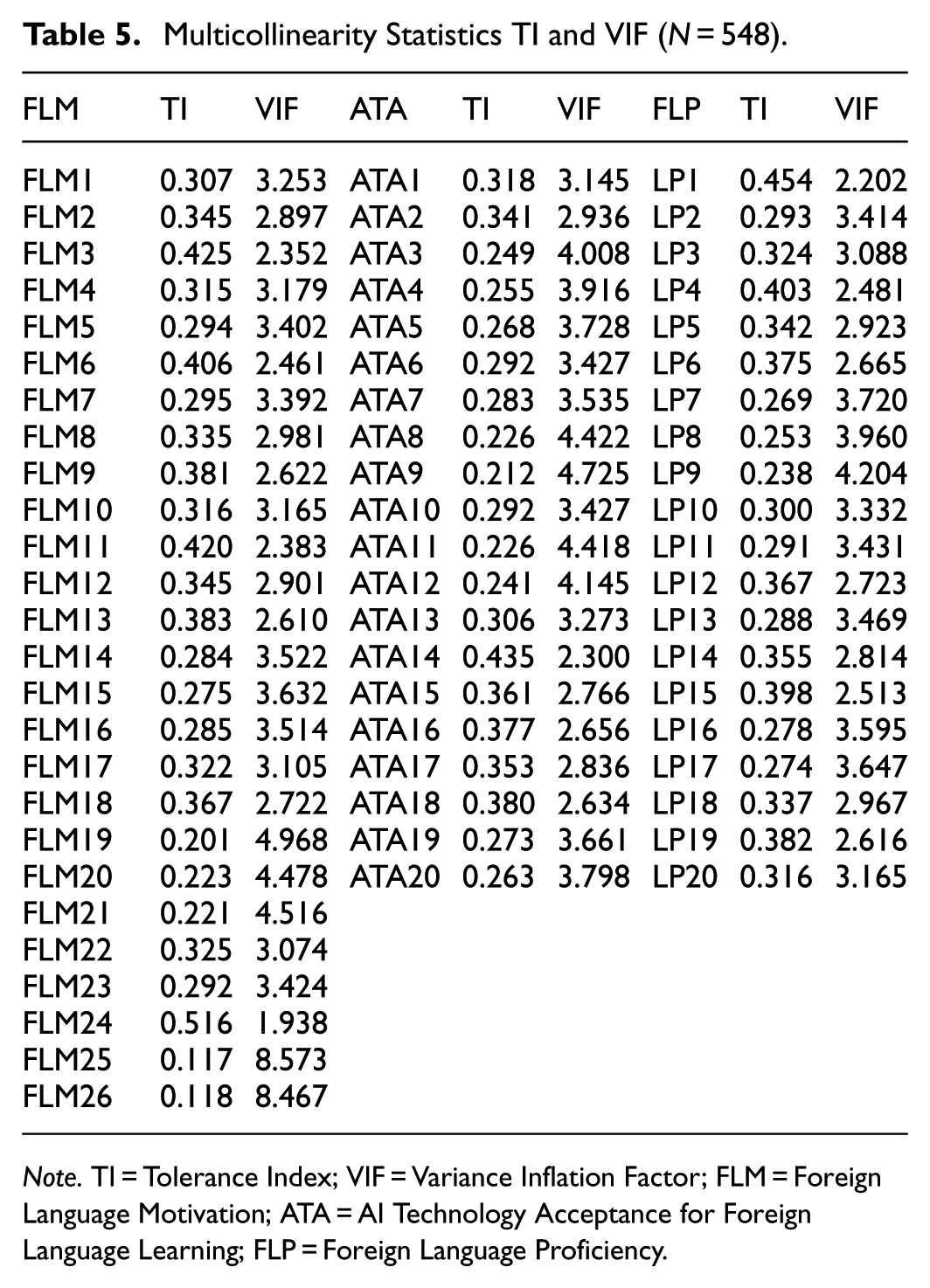
Tolerance Index (TI) and Variance Inflation Factor (VIF) are indicators used to detect multicollinearity in regression analysis. Regarding TI, a threshold of greater than 0.1 (TI > .1) is generally recommended, indicating that multicollinearity is not severe; if it is less than .1, it suggests a significant multicollinearity problem; some literature suggests a threshold of greater than .2 for a more conservative assessment (Marcoulides & Raykov, 2019). All the TI values in Table 5 are above .1, and most of them are above .2, with only two items (FLM 25, FLM 26) ranging between .1 and .2.
Multicollinearity Statistics TI and VIF (N = 548).
Note. TI = Tolerance Index; VIF = Variance Inflation Factor; FLM = Foreign Language Motivation; ATA = AI Technology Acceptance for Foreign Language Learning; FLP = Foreign Language Proficiency.
For VIF, its value range extends from 1 to positive infinity. A value closer to 1 implies lower multicollinearity. Conventionally, a threshold of less than 5 or less than 10 (i.e., VIF < 5 or VIF < 10) is recommended, suggesting that the multicollinearity is acceptable. If the VIF value exceeds 10, it indicates severe multicollinearity (O’brien, 2007). As presented in Table 5, all VIF values are lower than 10, and the majority of them are below 5. Only two items (FLM 25 and FLM 26) exhibit VIF values ranging from 5 to 10. Overall, Table 5 demonstrates that there should be no multicollinearity issues among all the constructs.
Skewness and kurtosis are employed to assess the normality of a sample. A skewness value between −2 and +2 (or more strictly, −1 and +1) is considered acceptable as approximately normal, while values outside this range indicate significant skewness; similarly, for kurtosis (excess kurtosis), −2 to +2 or −1 to +1 is regarded as the threshold for approximate normality (Mishra et al., 2019). As presented in Table 6, all values of skewness and kurtosis fall within the range of −1 to +1. Consequently, all constructs can be deemed to follow an approximately normal distribution.
Normality Statistics Skewness and Kurtosis (N = 548).

Note. S = Skewness; K = Kurtosis; FLM = Foreign Language Motivation; ATA = AI Technology Acceptance for Foreign Language Learning; FLP = Foreign Language Proficiency.
Confirmatory Factor Analysis (CFA)
Confirmatory factor analysis (CFA) was employed to assess the fit of the three measurement models: Foreign Language Motivation Scale (FLMS), AI Technology Acceptance for Foreign Language Learning Scale (ATA-FLLS), and Foreign Language Proficiency Scale (FLPS). Fit indices for each model are displayed in Tables 7 to 9 and depicted in Figures 2 to 4. The recommended fit indices are as follows: χ2/df < 5, CFI > 0.90, TLI > 0.90, RMR < 0.08, NFI > 0.90, GFI > 0.90, RMSEA < 0.08 (Byrne, 1994; Hu & Bentler, 1999). When the primary indices (RMSEA, CFI, TLI) are satisfied, even if some other indices (e.g., GFI or NFI) do not meet the criteria, the model can still be regarded as having an acceptable fit (Goretzko et al., 2024; Xia & Yang, 2019).
Model Fit Indices for the Foreign Language Motivation Scale (Six Factors, N = 548).

Note. Bootstrap = 5,000; CI = 95%.
Model Fit Indices for the AI Technology Acceptance in Foreign Language Learning Scale (Four Factors, N = 548).

Note. Bootstrap = 5,000; CI = 95%.
Model Fit Indices for the Foreign Language Proficiency Scale (Four Factors, N = 548).

Note. Bootstrap = 5,000; CI = 95%.

CFA path diagram for the foreign language motivation model (six factors).

CFA path diagram for the AI technology acceptance in foreign language learning model (four factors).

CFA path diagram for the foreign language proficiency model (four factors).
Per Tables 5 and 6, all items of the Foreign Language Motivation Scale (FLMS) were found to follow a normal distribution, and collinearity diagnostics yielded favorable results. Accordingly, confirmatory factor analysis (CFA) was performed on FLMS using the Maximum Likelihood Estimation (MLE) in Amos, with the path diagram presented in Figure 2.
For the Foreign Language Motivation Scale (FLMS) (Table 7), the CFA results indicated χ2/df = 4.427, CFI = 0.919, TLI = 0.908, RMR = 0.045, RMSEA = 0.079. Overall, these values suggest an acceptable model fit, as most of the indices meet recommended thresholds. However, some improvement could be made to the NFI = 0.898 and GFI = 0.835 model fit values. Overall, the fitting indicators of this model are acceptable.
Consistent with FLMS, all items of the AI Technology Acceptance for Foreign Language Learning Scale (ATA-FLLS) were found to follow a normal distribution, and collinearity testing yielded favorable results. Accordingly, confirmatory factor analysis was performed on ATAS using Amos, with the path diagram results presented in Figure 3.
For the AI Technology Acceptance for Foreign Language Learning Scale (ATA-FLLS) (Table 8), the model was considered an excellent fit to the data, χ2/df = 3.519, CFI = 0.961, TLI = 0.955, RMR = 0.019, NFI = 0.947, GFI = 0.903, and RMSEA = 0.068. All indices met the suggested thresholds (Byrne, 1994; Hu & Bentler, 1999), suggesting a good fit for the ATA construct.
Consistent with FLMS and ATA-FLLS, confirmatory factor analysis was also conducted on the Foreign Language Proficiency Scale (FLPS) using Amos, with the path diagram presented in Figure 4.
The Foreign Language Proficiency Scale (FLPS) (Table 9) reported the following fit indices: CFI = 0.931, TLI = 0.921, RMR = 0.040, NFI = 0.916, and RMSEA = 0.086. While most fit indices (CFI, TLI, RMR, and NFI) meet acceptable requirements, the differences between the χ2/df, GFI, and RMSEA values and the recommended values are very small. Especially, the RMSEA = 0.086, which is the primary fitting index, has a gap of only 0.006 from the recommended value. It falls within the range of 0.08 to 0.1. MacCallum et al. (1996) pointed out that RMSEA between 0.05 and 0.10 indicates fair fit, while > 0.10 indicates poor fit. Hu and Bentler (1999) and other studies have expanded the threshold, suggesting that RMSEA between 0.08 and 0.10 is moderately fit (neither good nor bad), and implying that > 0.10 is unacceptable. Overall, the model can be considered acceptable.
Correlation Analysis
Correlation analysis serves as the cornerstone for the construction of Structural Equation Modeling (SEM) models. In the realm of SEM, parameter estimation and model fitting are generally carried out based on covariance matrices or correlation matrices. Initial correlation analysis is instrumental in discerning the linear relationships among observed variables. This provides guidance for the definition of latent variables and the selection of indicators (Hair et al., 2021).
Furthermore, in the domain of psychology, the classification of correlation strength often draws on Cohen’s (1988) guidelines. Within the context of Pearson’s and Spearman’s correlation coefficients, a correlation coefficient (r/ρ) with an absolute value ranging from 0.1 to 0.3 is considered to represent a weak correlation. When the absolute value of the coefficient falls between 0.3 and 0.5, it is regarded as indicative of a moderate correlation. Meanwhile, a coefficient with an absolute value of 0.5 or higher is recognized as denoting a strong correlation.
Figure 5 presents the correlations between FLM, ATA, and FLP. The correlations among the three factors were obtained by calculating the correlation coefficients using Spearman’s method on the means of the items within each factor.

Heatmap of correlation coefficients of main study variables (N = 548).
Table 10 shows significant positive correlations between all study variables (p < .01). It is worth noting that the correlation coefficient between ATA and FLM is 0.570, which is greater than 0.50, indicating a strong correlation. Additionally, the correlation coefficient between FLM and FLP is 0.443, and that between FLP and ATA is 0.342, both reaching a moderately high level of correlation. This lays a solid foundation for the subsequent SEM modeling and analysis, which can preliminarily respond to H1 and H2.
The Correlation Among FLM, ATA and FLP (N = 548).

Note. FLM = Foreign Language Motivation; ATA = AI Technology Acceptance for Foreign Language Learning; FLP = Foreign Language Proficiency.
represent p levels of 1%.
Figure 6 depicts the correlations between LN, AM, SE, NM, IR, SM, and PU, PEOU, ATU, BI. The correlations among these factors were derived by computing the correlation coefficients of the means of the items within each factor using the Spearman’s method.

Heatmap of correlation coefficients of all factors (N = 548).
Table 11 shows that, except for NM, all other factors of FLM and ATA manifested significant positive correlations (p < .01). It is noteworthy that the correlation coefficients between LN and PU, PEOU, ATU, BI fell within the range of 0.526 - 0.562. Since these values were greater than 0.50, they indicated a strong correlation.
The Correlation Between Factors of ATA and FLM (N = 548).

Note. LN = Learning Needs; AM = Achievement Motivation; SE = Self-efficacy; IR = Identified Regulation; NM = Negative Motivation; SM = Situational Motivation; PU = Perceived Usefulness; PEOU = Perceived Ease of Use; ATU = Attitude Toward Using; BI = Behavioral Intention.
represent p levels of 1%.
Figure 6 and Table 12 present the correlations between LN, AM, SE, NM, IR, SM, and Listening, Speaking, Reading, Writing. The correlations between those factors were obtained by calculating the correlation coefficients using Spearman’s method on the means of the items within each factor. Except for NM, the correlation coefficients between the other factors of FLM and FLP exhibit significant positive correlations (p < .01). Simultaneously, the correlation coefficients of LN, AM, and SE with Listening, Speaking, Reading, and Writing are in the range of 0.3 to 0.5, suggesting a moderate level of correlation.
The Correlation Between Factors of FLM and FLP (N = 548).

Note. LN = Learning Needs; AM = Achievement Motivation; SE = Self-efficacy; IR = Identified Regulation; NM = Negative Motivation; SM = Situational Motivation.
, ** represent p levels of 1% and 5%, respectively.
Figure 6 and Table 13 present the correlations between PU, PEOU, ATU, BI, and Listening, Speaking, Reading, Writing. The correlations between those factors were obtained by calculating the correlation coefficients using Spearman’s method on the means of the items within each factor. The correlation coefficients between each factor of ATA and FLP range from weak (0.249) to moderate (0.346), indicating a statistically significant but modest association (p < .01).
The Correlation Between Factors of FLP and ATA (N = 548).

Note. PU = Perceived Usefulness; PEOU = Perceived Ease of Use; ATU = Attitude Toward Using; BI = Behavioral Intention.
represent p levels of 1%.
SEM Model Fit and Path Indices
The fit of the structural models was assessed using several fit indices presented in Table 14. The main variables (FLM, ATA, and FLP) structural equation model (SEM) for all constructs exhibited a relatively poor fit (χ2/df = 5.059; GFI = 0.708; CFI = 0.751; TLI = 0.743; RMSEA = 0.086). Conversely, the multi-factor SEM demonstrated an excellent fit to the data (χ2/df = 2.680; GFI = 0.850; CFI = 0.900; TLI = 0.894; RMSEA = 0.055). This model not only categorizes the sub-dimensions but also maintains the conceptual relationships among ATA, FLM, and FLP. Additionally, the model fit coefficients span from acceptable to excellent.
Model Fit Indices for SEM of All constructs (N = 548).

Note. Bootstrap = 5,000; CI = 95%.
Despite the fact that the fit indices of the main variables’ structural equation model (Figure 7, Table 15) are less than satisfactory and we are unable to draw valid conclusions from its outcomes, as a simplified form of the multi-factor model, the research results obtained from this model still possess a certain degree of supplementary reference significance for the multi-factor model. (Hair et al., 2019; Kline, 2023).
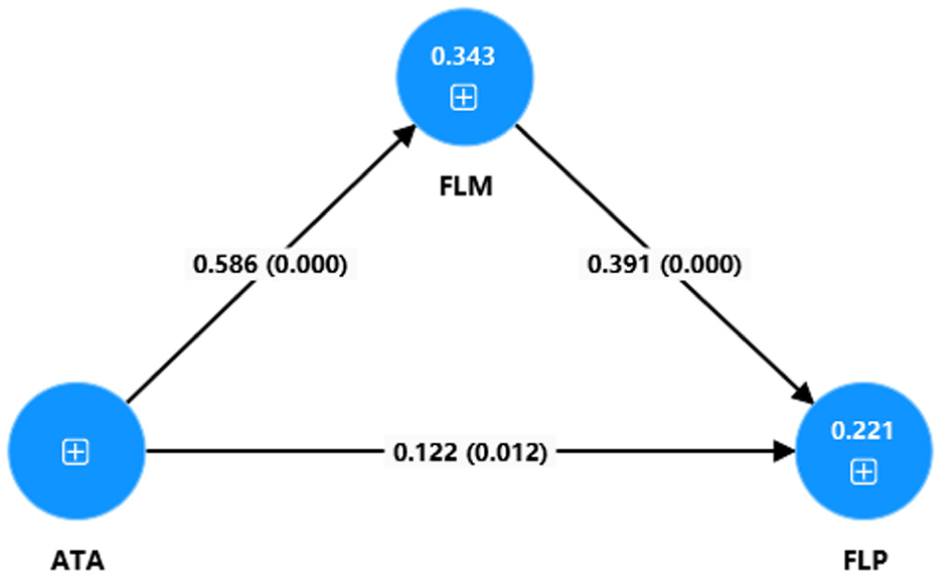
Mediation analysis path diagram (main variables, N = 548).
Mediation Path Analysis Results (Main Variables, N = 548).

Note. Bootstrap = 5,000; CI = 95%.
, * represent p levels of 0.1% and 5%, respectively.
Table 15 (main variables) demonstrates that ATA has a positive effect on FLP (β = .122, t = 2.526, p < .05); ATA has a significant positive effect on FLM (β = .586, t = 13.702, p < .001); The indirect effect via FLM was positive (β = .229, t = 7.367, p < .001). The total effect of ATA on FLP is 0.352 (t = 8.118, p < .001). Although certain indicators have revealed the direct, indirect, and mediating effects among ATA, FLM, and FLP, owing to the unsatisfactory fit of the main variables model, this study is unable to draw corresponding conclusions based on Table 15. Nevertheless, by integrating the results in Table 10, we can obtain preliminary support for hypotheses H1, H2, and H3. But further verification through a multi-factor model is still required.
Table 16 describes the direct impact of ATA on FLM, as well as the mediating effect of ATA and FLM on FLP. Notably, the direct effect of ATA on LN is the largest, with R2 = 0.337 (p < .001, F (4, 543)), and the mediating effect of ATA and FLM on Writing is the largest, with R2 = 0.304 (p < .001, F (10, 537)), and effects of ATA on other factors are also significant. Furthermore, it must be elucidated that, constrained by the limitations of SPSS PROCESS in calculating mediating effects with respect to the number of factors, the factors presented in Tables 16 and 17 are computed as the means of the items within each factor. This approach overlooks the fact that the weights and loadings of each item vary. Consequently, subsequent to obtaining the regression coefficients of the model, additional in-depth analysis is indispensable.
Coefficients for the Mediation Effect Regression Model (Multi-factors, N = 548).
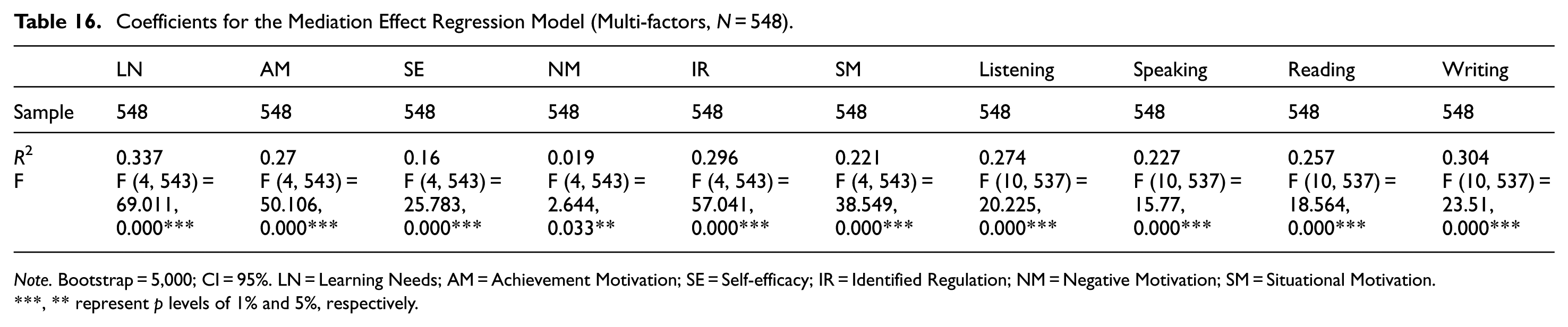
Note. Bootstrap = 5,000; CI = 95%. LN = Learning Needs; AM = Achievement Motivation; SE = Self-efficacy; IR = Identified Regulation; NM = Negative Motivation; SM = Situational Motivation.
, ** represent p levels of 1% and 5%, respectively.
The Mediation Effect Test.

Note. Bootstrap = 5,000; CI = 95%; PU = Perceived Usefulness; PEOU = Perceived Ease of Use; SE = Self-efficacy; IR = Identified Regulation; a, b, c and c' and their superscripts represent the corresponding paths in the mediation model.
, **, * represent p levels of 1%, 5%, and 10%, respectively.
Table 17 shows several moderate pathways that merit attention. These results are derived from SPSS PROCESS analysis. In particular, the moderating effect of SE on the relationship between PEOU and FLM is highly pronounced. Moreover, IR appears to exert a competitive effect on the association between PU and FLM. Although the significance levels are not particularly high, with p-values ranging from .026 to .097, this aspect should be considered during further in-depth analysis.
Figure 8 illustrates the detailed mediation path diagram of ATAS, FLMS, and FLPS, which was analyzed using partial least squares structural equation modeling (PLS-SEM) and generated via SmartPLS 4. The correlation indices corresponding to the detailed paths are provided in Tables 18 and 19.

Mediation analysis path diagram (multi-factors, N = 548).
Direct Path Analysis Results (Multi-Factors, N = 548).

Note. Bootstrap = 5,000; CI = 95%. PU = Perceived Usefulness; PEOU = Perceived Ease of Use; BI = Behavioral Intention; LN = Learning Needs; AM = Achievement Motivation; SE = Self-efficacy; IR = Identified Regulation; NM = Negative Motivation.
, **, * represent p levels of 0.1%, 1%, and 5%, respectively.
Mediation Path Analysis Results (Multi-Factors, N = 548).

Note. Bootstrap = 5,000; CI = 95%. PU = Perceived Usefulness; PEOU = Perceived Ease of Use; SE = Self-Esteem; IR = Identified Regulation.
, **, * represent P levels of 0.1%, 1%, and 5%, respectively.
Table 18 presents the more significant path analysis results. On the one hand, the factors PU, PEOU, and BI of ATA can positively predict the factors LN, AM, SE, and IR of FLM, but the relationship with NM remains unclear. Combining Tables 10, 11, 15, and 17, we can conclude that H1 is supported. On the other hand, the factor PU of ATA can positively predict Listening and Reading. Combining Tables 10, 13, 15, and 17, although some factors of ATA show a competitive effect on FLP, the overall results support H2. Those results indicate that when people feel that the acceptance of technology is more useful and easier to use in learning a foreign language, their motivation for learning the foreign language increases, and it also promotes the development of foreign language proficiency.
Table 19 illustrates the indirect effects of the interactions among ATA, FLM, and FLP. The results presented in the table suggest that between PEOU and FLP, SE serves as the sole mediator with a positive effect and robust statistical significance. More precisely, PEOU exerts a substantial positive indirect influence on FLP via SE, which indicates that when the system is more user-friendly, self-efficacy (SE) enhances the four dimensions of foreign language learning (listening, speaking, reading, and writing), thus boosting FLP. Furthermore, PU has a negative indirect impact on Listening through IR. However, the magnitude of the IR effect is considerably smaller. This implies that although PU inhibits Listening through IR, this effect is not highly significant (p = .044). In contrast to the highly significant positive effect of SE (p < .001), the inhibitory effect of IR is rather negligible. Significantly, LN, AM, IR, NM, and SM do not appear to significantly mediate the relationship between ATA and FLP, as their indirect effects lack statistical significance. Based on the results presented in Tables 10, 15, 16, 17, and 19, it can be concluded that H3 is supported. In particular, this indicates that enhancing self-efficacy (SE) is a more practical method for improving FLP.
Variance Accounted For
VAF (Variance Accounted For) is mainly used in mediation effect analysis to assess the contribution ratio of the mediating variable in explaining the total effect of the independent variable on the dependent variable. Furthermore, VAF < 20% means no mediation effect, 20% < VAF <80% means partial mediation, and VAF > 80% means complete mediation (Vinzi, 2010).
Table 20 shows the mediating role of SE in the relationship between PEOU and FLP. According to Vinzi (2010), SE completely mediates the relationship between PEOU and Speaking (VAF = 82.822%), also completely mediates the relationship between PEOU and Speaking (VAF = 85.946%). Meanwhile, it partially mediates the relationship between PEOU and Reading. Notably, the variance accounted for (VAF) of self-efficacy (SE) exceeds 100%. We examined the effect of perceived ease of use on listening in Table 19, and the value is −0.008, which indicates that the model is a suppression mediation model, meaning that self-efficacy greatly promotes the improvement of students’ foreign language ability through perceived ease of use, while suppressing the negative impact of perceived ease of use on listening. Furthermore, self-efficacy (SE) plays a competitive mediating role between perceived usefulness (PU) and listening (VAF = −20.388%). Specifically, the total effect of perceived usefulness (PU) on listening is positive and significant (β = .206, p < .05), indicating that learners who perceive GenAI as useful are more inclined to engage in listening activities. However, after introducing self-efficacy as a mediating variable, the direct effect increases (β = .233, p < .05), while there is a significant negative indirect effect (β = .042, p < .05).
The Analysis Results of VAF.

Note. PU = Perceived Usefulness; PEOU = Perceived Ease of Use.
Discussion
This research explored the influence of generative artificial intelligence (GenAI) on foreign language learning motivation (FLM) and foreign language proficiency (FLP) from the perspective of the Technology Acceptance Model (TAM). The research results demonstrate that the usage and attitudes of Chinese university students towards generative artificial intelligence (GenAI) can positively predict foreign language learning motivation (FLM), particularly self-efficacy (SE). The research findings indicate that there is a moderate to strong positive correlation between AI Technology Acceptance for Foreign Language Learning (ATA-FLLS), Foreign Language Motivation (FLM), and Foreign Language Proficiency (FLP). These findings echo the conclusion of Honarzad and Rassaei (2019), who pointed out that learners’ motivation, self-efficacy, and self-reliance are largely influenced by technology-enhanced language learning tasks. However, this research places greater emphasis on exploring the influence of generative artificial intelligence (GenAI) on users, with a particular focus on investigating the mediating effects among multiple factors.
The findings of this study suggest that foreign language motivation (FLM) can serve as a significant mediator in the relationship between AI Technology Acceptance for Foreign Language Learning (ATA-FLLS) and foreign language proficiency (FLP). The mediating effect in this study was explored similarly in J. Huang and Mizumoto (2024), who investigated the interaction between the L2 Motivational Self-System (L2MSS) and the Technology Acceptance Model (TAM) among 35 Japanese students after the introduction of ChatGPT, revealing a positive cycle where OL2 promotes motivation, technology acceptance, and language practice in a ChatGPT-assisted EFL environment. However, our research focuses more on the impact of proprietary AI models on second language acquisition and has a larger sample size (N = 548).
In light of the path analysis results, it can be postulated that self-efficacy (SE) serves as a potent mediator in the relationship between perceived ease of use (PEOU) and foreign language proficiency (FLP, encompassing listening, speaking, reading, and writing skills). In some instances, the mediation is complete (e.g., the link from PEOU to Speaking), while in others, it exhibits an inhibitory mediation effect (e.g., the connection from PEOU to Listening). Simultaneously, perceived usefulness (PU) functions as a competitive mediator in the association between identified regulation (IR) and listening. This indicates that the impact of foreign language proficiency (FLP) on the GenAI technology acceptance model (TAM) is accounted for by self-efficacy (SE), which is consonant with the research conducted by Kittredge et al. (2025) and Zhang et al. (2025). However, differing from the research results of Zheng et al. (2024), their findings indicate that SDT motivation might more effectively predict the relationship between behavioral intention (BI) and facilitating conditions. This disparity could potentially stem from differences in the theoretical models employed and the nature of generative artificial intelligence (GenAI) utilized. Nonetheless, both studies can establish the positive influence of motivation. Furthermore, this competitive mediation implies that although perceived usefulness (PU) directly boosts listening engagement, it might indirectly undermine it by diminishing self-efficacy (SE). This could be attributed to the fact that when Chinese university students utilize GenAI for foreign language listening learning, the requirements of complex and long-term listening tasks prove to be overly formidable.
These findings further suggest that the utilization and attitudes of Chinese university students towards generative artificial intelligence (GenAI) exert a substantial influence on their learning motivation, which subsequently impacts their academic attainments. This phenomenon may not be confined solely to the domain of foreign language learning but could potentially be extended to other fields.
Theory Implications
This research promotes the Technology Acceptance Model (TAM) by integrating the influence of generative artificial intelligence (GenAI) on foreign language motivation (FLM) and foreign language proficiency (FLP). It underscores the role of self-efficacy (SE) as a crucial mediator between perceived ease of use (PEOU) and components of FLP, showing different effects. For instance, it acts as a full mediator in speaking skills and a suppressive mediator in listening skills. This finding extends previous works (Honarzad & Rassaei, 2019; J. Huang & Mizumoto, 2024), emphasizing the role of GenAI in motivation, which differs from the predictive power of SDT motivation as discussed by Zheng et al. (2024). This indicates the subtle interaction between TAM factors and psychological mediators, which may extend beyond language learning to other educational domains, enriching the theory of technology-enhanced learning.
Practice Implications
Educators and policymakers are advised to advocate for the application of GenAI tools within foreign language curricula. This initiative aims to boost students’ motivation and proficiency levels. Emphasis should be placed on enhancing self-efficacy by means of user-friendly interfaces. Training programs can be designed to address the issue of perceived usefulness. This approach is intended to alleviate the suppressive effects in areas like listening and to encourage a well-balanced integration of AI in language learning. In the context of Chinese universities, the implementation of large-scale proprietary AI models may contribute to improved foreign language proficiency (FLP) outcomes. GenAI developers should give precedence to features that facilitate long-term language learning tasks and minimize the cognitive burden on users. These insights advocate for the application of GenAI in language education and can also be extended to other fields, such as language cognition, aphasia-assisted intervention, and intervention in depression, which have even more profound significance.
Limitations
This study has limitations, including that the research subjects were limited to Chinese university students, thus restricting its generalizability. Self-reported language proficiency and language learning motivation may be subjective. Additionally, this study did not fully consider the differences between GenAI specifically designed for foreign language learning and general-purpose GenAI, as well as the varying degrees of exposure to AI technology among university students, which could affect their attitudes towards GenAI. Future research should strive to overcome these limitations to reach more consistent conclusions regarding the application of generative artificial intelligence (GenAI) in foreign language learning.
Conclusion
This research is grounded in the Technology Acceptance Model (TAM) to explore the impacts of generative artificial intelligence (GenAI) on foreign language motivation (FLM) and foreign language proficiency (FLP) among Chinese university students. The research results demonstrate that students’ utilization and attitudes towards GenAI positively predict FLM, especially self-efficacy (SE). There exists a moderate to strong positive correlation among AI Technology Acceptance for Foreign Language Learning (ATA-FLLS), FLM, and FLP. FLM serves as a notable mediator between ATA and FLP, highlighting the bridge of motivation between technology acceptance and language skills. Path analysis shows that self-efficacy (SE) acts as a potent mediator between perceived ease of use (PEOU) and various components of FLP. For example, it completely mediates the aspect of speaking and has a suppressive mediation effect on listening. Moreover, perceived usefulness (PU) functions as a competitive mediator between identified regulation (IR) and listening, indicating that PU directly enhances listening but may indirectly reduce it by decreasing SE. This might be attributed to the challenges posed by complex and long-term listening tasks when using GenAI. Overall, these research findings suggest that attitudes towards generative artificial intelligence (GenAI) considerably influence learning motivation, which in turn impacts academic achievements. The potential applications of this study are not confined to foreign language learning but may also be extended to other educational domains.
Footnotes
Acknowledgements
Fei Qin was responsible for writing and analyzing the data, Bin Liu & Weibin Li were responsible for providing guidance on the framework and supervising the entire process, and Huiyuan Li & Jiayin Li were responsible for collecting the data, all authors approved the final manuscript.

Ethical Considerations
This study was conducted after ethical approval from Liaocheng University (HE2024111901). Human participants were engaged through questionnaire surveys. The investigation strictly adhered to the ethical principles outlined in the Declaration of Helsinki (1964) and its subsequent amendments. Written informed consent was obtained from all participants prior to their involvement.
Consent to Participate
Informed consent was obtained from all participants before data collection. Participants indicated their consent by completing an online questionnaire that included an informed consent form, which explained the purpose of the study, the voluntary nature of participation, and the guarantee of data confidentiality. Completion of the questionnaire was regarded as obtaining informed consent.
Funding
The authors disclosed receipt of the following financial support for the research, authorship, and/or publication of this article: Humanities and Social Science Youth Fund of Ministry of Education of China (25YJC740035); Shandong Province Humanities and Social Sciences Specialized Think Tank Key Project (2023ZKZD064); National Social Science Fund Funding Project for Thematic Academic Activities of Academic Societies of Social Sciences (23STA004); Liaocheng University Doctoral Research Initiation Fund for Social Sciences (321052324 & 321051733).
Declaration of Conflicting Interests
The authors declared no potential conflicts of interest with respect to the research, authorship, and/or publication of this article.
Data Availability Statement
The data underlying this study are available from the corresponding author upon reasonable request, subject to approval by all co-authors and compliance with ethical review procedures.