




Abstract
Mathematical thinking is increasingly recognized as a foundational competency for pre-service mathematics teachers (PSMTs), encompassing critical thinking, problem solving, abstraction, and modeling skills essential for effective teaching and learning. This systematic literature review synthesizes empirical studies published between 2018 and 2025 to examine strategies, challenges, contextual variations, and research gaps in fostering mathematical thinking within teacher education programs. Following the PRISMA framework, 21 studies were rigorously selected from major academic databases. Findings reveal diverse pedagogical approaches, including creativity-driven task design, computational thinking integration, digital and AI-supported reflective practices, and contextualized mathematical modeling. Persistent challenges include PSMTs’ difficulties in interpreting real-world problem contexts, responding to student thinking, and engaging in deep reflective practice. Contextual factors such as technological access, self-efficacy, gender, and educational policy further influence the development of mathematical thinking. Notable gaps identified include limited integration of critical and computational thinking frameworks, underutilization of AI-based tools, and insufficient strategies for inclusive and equitable instruction. The review concludes with recommendations for teacher education programs to adopt holistic, research-informed, and culturally responsive pedagogies that embed mathematical thinking as a central component of professional competence.
Plain Language Summary
Mathematical thinking is a key skill for future mathematics teachers, helping them solve problems, reason logically, and connect math ideas to real-world situations. This study reviewed research from 2018 to 2025 to understand how pre-service mathematics teachers develop these skills. By analyzing 21 studies, we found that teachers benefit from activities that encourage creativity, reflection, and the use of technology. For example, using digital tools, AI simulations, or hands-on tasks can improve problem-solving and critical thinking. Integrating computational thinking and mathematical modeling also helps teachers understand abstract ideas more concretely and prepare them to teach complex concepts effectively. However, challenges remain. Many pre-service teachers struggle to interpret real-world problems, apply higher-order thinking, and reflect deeply on their teaching. Factors such as gender, self-confidence, and access to technology influence how well these skills develop. The review also found that existing teacher education programs often lack structured strategies to integrate creativity, modeling, and critical thinking together. The findings suggest that teacher training should provide more hands-on, reflective, and technology-supported learning experiences. This can better prepare future teachers to think mathematically and support their students in developing strong reasoning, problem-solving, and analytical skills.
Keywords
Introduction
Mathematical thinking is widely acknowledged as a core component of mathematical competence and an essential foundation for effective mathematics teaching (Devlin, 2012). It encompasses interconnected cognitive processes such as reasoning, abstraction, generalization, representation, and problem solving, which enable individuals to make sense of mathematical ideas and apply them flexibly in unfamiliar contexts (Abdullah et al., 2024; Rott & Leuders, 2025). For pre-service mathematics teachers (PSMTs), mathematical thinking is particularly critical, as it underpins deep content understanding, informed instructional decision-making, and the ability to anticipate and respond to students’ misconceptions (Bicer et al., 2022; Putri et al., 2025).
Despite its importance, empirical research consistently reports that many PSMTs experience difficulties in moving beyond procedural knowledge toward instructional practices that promote higher-order reasoning, creativity, and conceptual understanding (Bicer et al., 2022; Shure et al., 2025). These challenges are often attributed to traditional teacher education models, limited engagement with cognitively demanding tasks, and weak integration between theoretical knowledge and practical teaching experiences (Daher et al., 2024; Zhou et al., 2023). As a result, strengthening mathematical thinking in pre-service teacher education has become a key concern in mathematics education research.
In response, a growing body of studies has examined various approaches to fostering mathematical thinking among PSMTs, including task design for higher-order thinking skills, mathematical modeling, computational thinking, reflective practices, and the use of digital and AI-supported learning environments (Daher et al., 2024; Drushlyak et al., 2025; Hsu et al., 2018; Kannadass et al., 2023). While this research base is expanding, it remains fragmented, with studies often focusing on isolated instructional strategies or narrowly defined cognitive constructs.
Several review studies have addressed related themes, such as problem solving, higher-order thinking skills, computational thinking, or technology integration in mathematics education (Ozeldi & Yakin, 2021; Zhou et al., 2023). However, these reviews typically (a) focus on specific sub-skills rather than mathematical thinking as an integrated construct, (b) include broad populations such as school students or in-service teachers, or (c) emphasize particular tools or pedagogical approaches. Consequently, there is still no systematic synthesis that comprehensively examines how mathematical thinking is conceptualized, developed, and constrained specifically within pre-service mathematics teacher education.
This systematic literature review addresses this gap by positioning mathematical thinking as an overarching cognitive construct that integrates reasoning, abstraction, modeling, and problem solving, while being supported by complementary processes such as computational thinking, reflective thinking, and higher-order task design. Unlike previous reviews, this study brings together diverse strands of empirical research to provide a holistic and updated understanding of how mathematical thinking is fostered among PSMTs across different educational contexts and systems.
Accordingly, this review addresses the following research questions:
What challenges and barriers are commonly reported in fostering mathematical thinking during pre-service teacher education?
What approaches and strategies are used to develop mathematical thinking in pre-service mathematics teachers?
How does the development of mathematical thinking vary across educational contexts and systems?
What gaps remain in the existing literature?
Addressing these questions is necessary to consolidate current knowledge, identify systematic weaknesses in existing research, and inform the design of coherent teacher education programs that intentionally cultivate mathematical thinking. By synthesizing evidence across methodologies, contexts, and instructional approaches, this review aims to provide teacher educators, curriculum designers, and researchers with a clear foundation for advancing both research and practice in pre-service mathematics teacher education.
Methodology
This study employed a systematic literature review (SLR) design to synthesize empirical evidence on the enhancement of mathematical thinking among pre-service mathematics teachers. Systematic reviews are widely recognized for their rigorous, transparent, and replicable approach to identifying, evaluating, and synthesizing research evidence (Kitchenham & Charters, 2007; Petticrew & Roberts, 2006). The SLR design was chosen to provide a comprehensive overview of contemporary strategies, challenges, and gaps in teacher education, ensuring methodological rigor and minimizing bias.
This review focuses on studies published between 2018 and 2025 to capture the most recent empirical research on mathematical thinking among pre-service mathematics teachers. This period reflects the emergence of innovative approaches including computational thinking, mathematical modeling, reflective practices, and AI-supported instructional tools that have shaped contemporary teacher education. Selecting this timeframe ensures that the review synthesizes up-to-date evidence relevant to current curriculum development and pedagogical practices, while maintaining a manageable scope for a focused analysis.
Search Strategy
A comprehensive search was conducted across three major academic databases: Scopus, Web of Science, and ERIC. The search employed Boolean operators and the following keywords:
“mathematical thinking” OR “mathematical reasoning” OR “mathematical problem-solving” AND
“pre-service teacher” OR “teacher candidate” OR “teacher education” OR “mathematics education.”
The search strategy employed Boolean operators and included the following
The inclusion of both “pre-service teacher” and “teacher candidate” ensured coverage of the varied terminology used in the literature. The search was restricted to studies published between 2018 and 2025, to focus on recent developments in teacher preparation and educational technologies. Earlier studies were excluded to maintain relevance to current pedagogical and technological contexts. Theses and dissertations were excluded to ensure that only peer-reviewed studies with established methodological rigor were considered.
Inclusion and Exclusion Criteria
Studies were included if they:
Focused on pre-service mathematics teachers within formal teacher education programs.
Investigated strategies, interventions, or experiences aimed at developing mathematical thinking, critical thinking, computational thinking, or modeling competencies.
Were published in English in peer-reviewed journals or conference proceedings.
Exclusion criteria were:
Studies targeting in-service teachers or general teacher education without a mathematics focus.
Review articles, book chapters, or publications in non-English languages.
Studies published before 2018.
Screening Process
The literature selection process adopted in this study followed the PRISMA (Preferred Reporting Items for Systematic Reviews and Meta-Analyses) guidelines, which provide a transparent and structured framework for conducting and reporting systematic reviews (Page et al., 2021). A total of 460 records were initially retrieved through a comprehensive search of three major academic databases: ERIC, Web of Science, and Scopus. The search was guided by relevant keywords, including “mathematical thinking,”“mathematical reasoning,”“mathematical problem-solving,”“pre-service teacher,”“teacher education,” and “mathematics education,” to ensure a focused scope aligned with the objectives of the study.
During the identification phase, records that did not meet the predefined inclusion criteria were excluded. Specifically, studies were removed if they were published in 2017 or earlier, if they appeared as review articles, book chapters, or conference proceedings, or if they were published in languages other than English. These exclusion criteria were applied to ensure the recency, relevance, and linguistic accessibility of the included literature.
In the screening phase, all 460 records underwent an initial review, during which 260 duplicate records were identified and removed. This process reduced the dataset to 200 unique studies that proceeded to the eligibility assessment phase. The eligibility phase involved a more detailed review of the remaining articles. It was conducted in three steps: title screening, which resulted in the exclusion of 60 records; abstract screening, which led to the removal of an additional 40 records; and content screening, which excluded a further 30 studies based on a close examination of their relevance and methodological adequacy. In total, 130 records were excluded during the eligibility phase, with 49 of them removed specifically during the content screening stage. Full-text content screening excluded 49 records due to irrelevance or insufficient methodological quality.
Following this rigorous process, 21 studies were deemed to meet all inclusion criteria and were incorporated into the final analysis. These studies underwent a quality appraisal to ensure they met acceptable standards of methodological rigor and relevance to the research objectives. The inclusion of these 21 studies provided a robust foundation for the synthesis of findings and facilitated an in-depth exploration of key themes related to pre-service teacher education and mathematical reasoning (Jeannotte & Kieran, 2017). This structured and rigorous selection process contributes significantly to the credibility and reliability of the review’s outcomes (Page et al., 2021; Figure 1).

PRISMA flow diagram summarizing the systematic search and selection process.
Quality Appraisal of Included Studies
To enhance the methodological rigor and transparency of this systematic literature review, a formal quality appraisal was conducted for all studies included in the final synthesis. The purpose of this appraisal was to evaluate the methodological soundness and relevance of the selected studies and to ensure that the conclusions drawn from the review were grounded in robust empirical evidence.
An established critical appraisal framework appropriate for educational research was employed to assess study quality. The appraisal criteria focused on key methodological dimensions, including clarity of research aims, appropriateness of research design, adequacy of sampling and participant description, rigor of data collection procedures, transparency and coherence of data analysis, and the validity and credibility of reported findings. Each study was systematically reviewed against these criteria to determine its overall methodological quality.
Based on the appraisal outcomes, the included studies were categorized as demonstrating high, moderate, or limited methodological quality. Rather than excluding studies solely on the basis of quality, the appraisal results were used to inform the synthesis process. Findings from studies assessed as high or moderate quality were given greater interpretive weight when identifying recurring themes, drawing conclusions, and formulating implications. Studies with identified methodological limitations were retained to capture emerging perspectives and underexplored areas of research; however, their findings were interpreted cautiously within the broader synthesis.
This quality-informed synthesis approach strengthened the credibility of the review by ensuring that patterns and conclusions were supported by methodologically sound evidence, while simultaneously preserving the breadth and inclusivity of the literature. Incorporating a systematic quality appraisal thus reinforces the validity of the review’s findings and supports its contribution to advancing research on mathematical thinking in pre-service mathematics teacher education.
All included studies were appraised using the Mixed Methods Appraisal Tool (Hong et al., 2018). As shown in Table 1, the majority of studies demonstrated high methodological quality, with clear research questions, appropriate designs, and coherent data analysis. A smaller number of studies were rated as moderate quality, primarily due to limited reporting of sampling strategies or analytic procedures. No studies were excluded based solely on quality; however, methodological rigor was considered during synthesis, with greater interpretive weight given to high-quality studies. Interrater reliability was calculated using Cohen’s Kappa, yielding a value of 0.86, indicating high agreement between raters. Discrepancies were resolved through discussion and consensus. Only studies meeting acceptable quality standards were included in the synthesis, ensuring that the review maintained systematic rigor and validity.
Methodological Quality Appraisal of Included Studies Using MMAT (2018).

MMAT criteria include clarity of research questions, appropriateness of data collection, adequacy of analysis, coherence of interpretation, and methodological rigor. **Systematic reviews were appraised using MMAT criteria adapted for secondary research.
Data Extraction and Analysis
Key information was extracted from each study, including authors, year, context, participant characteristics, mathematical thinking focus, instructional strategies, and outcomes. Data were analyzed using a thematic synthesis approach, identifying recurring themes, patterns, and gaps across contexts. Quantitative and qualitative findings were integrated, allowing for cross-study comparisons and highlighting pedagogical implications. The synthesis explicitly considered the methodological quality of each study to ensure that interpretations were weighted according to evidence strength.
Results
Characteristics of Included Studies
Recent studies across diverse educational contexts demonstrate that mathematical thinking in pre-service teacher education is inherently multifaceted, involving cognitive, metacognitive, and pedagogical dimensions (Schoenfeld, 2016). A total of 21 studies published between 2018 and 2025 were included in this systematic review, focusing on strategies to enhance mathematical thinking among pre-service mathematics teachers (PSMTs). The studies span diverse educational contexts, though there is a notable concentration in Indonesia (Ariani et al., 2022; Kusuma & Mariani, 2024; Laamena & Laurens, 2021; Marom et al., 2024), which may affect the global representativeness of findings. Other studies were conducted in Türkiye, Malaysia, Spain, Palestine, Germany, China, Ukraine, and the USA, reflecting a range of pedagogical and cultural contexts.
The majority of studies were published in the last 5 years, with a noticeable increase in 2024 and 2025, indicating growing scholarly interest in this area. Geographically, research is concentrated in Türkiye (5 studies) and Indonesia (4 studies), followed by Malaysia (2) and Spain (2), with single studies from Palestine, Germany, China, Ukraine, and the USA, reflecting a diverse but uneven global representation. Most studies targeted secondary- and university-level PSMTs (8 and 10 studies, respectively), while only a few addressed early childhood or elementary teacher education (3 studies) as shown in Figure 2.

Distribution of the 21 studies by country.
Methodologically, experimental or quasi-experimental designs dominated the field (10 studies), complemented by digital tool integration (4), qualitative approaches (4), lesson study designs (2), and one systematic review/meta-analysis, suggesting an emphasis on evidence-based interventions. Sample sizes ranged from small classroom-based cohorts (n = 10–30) to larger university-level populations (n = 100–150). Participants were predominantly secondary and university-level pre-service teachers, with some studies including early childhood or elementary pre-service teachers. In terms of mathematical thinking focus, critical thinking and computational thinking were equally prominent (6 studies each), followed by mathematical modeling (4), creativity and problem design (4), noticing and reflective practices (5), and self-efficacy/mindset (3), highlighting the multifaceted nature of mathematical cognition targeted in teacher preparation.
Finally, outcome measures primarily assessed problem-solving ability (10 studies), with additional evaluation of creative thinking (4), modeling competency (5), reflective capacity (4), and higher-order thinking skills (2), illustrating that the development of transferable cognitive skills remains central to these interventions. Collectively, this distribution underscores both the increasing attention to fostering mathematical thinking in teacher education and the need for more comprehensive, contextually diverse, and integrative approaches that address multiple cognitive dimensions simultaneously.
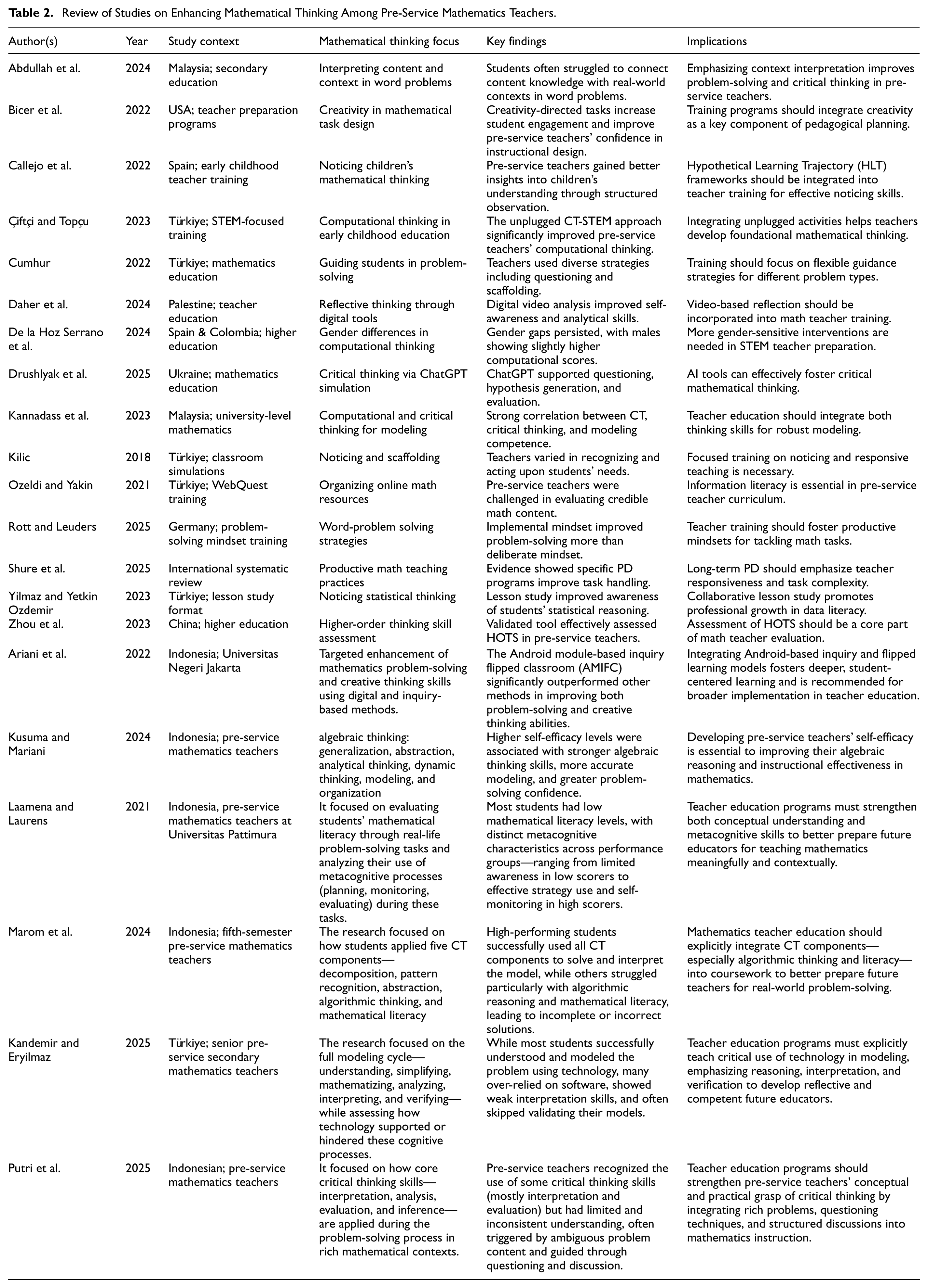
Table 2 synthesizes the key characteristics of the 21 empirical studies included in this review, highlighting study contexts, focal dimensions of mathematical thinking, major findings, and implications for pre-service teacher education. As shown in the table, the majority of studies emphasize computational thinking, mathematical modeling, and reflective practices, while fewer studies explicitly address equity, assessment, or integrated instructional frameworks.
Review of Studies on Enhancing Mathematical Thinking Among Pre-Service Mathematics Teachers.
Challenges and Barriers in Developing Mathematical Thinking
The findings of this study reveal that pre-service mathematics teachers encounter multiple, interrelated difficulties in developing robust mathematical thinking, often rooted in cognitive, pedagogical, and contextual challenges. A significant barrier observed is the limited ability to interpret and apply mathematical concepts in word problems, a skill that demands simultaneous processing of content and contextual understanding (Abdullah et al., 2024). This difficulty is compounded by inadequacies in designing and implementing tasks that promote creativity and higher-order thinking. Many pre-service teachers struggled to integrate open-ended or non-routine problems into their instructional practices, indicating a lack of preparedness in fostering creative mathematical engagement (Bicer et al., 2022).
Another prominent difficulty lies in recognizing and responding to students’ mathematical thinking. The ability to notice subtle cues in student responses and scaffold accordingly remains underdeveloped among many pre-service teachers, limiting their instructional responsiveness (Callejo et al., 2022; Kilic, 2018). This issue is further complicated in early childhood education, where computational thinking and informal reasoning require nuanced observation and pedagogical sensitivity (Çiftçi & Topçu, 2023; Hsu et al., 2018). In problem-solving contexts, pre-service teachers often defaulted to procedural guidance rather than promoting metacognitive reflection or strategic flexibility (Cumhur, 2022).
Reflective thinking, a critical component of mathematical reasoning, was also inconsistently applied (Jeannotte & Kieran, 2017). Despite the integration of digital tools like video-based lesson analysis, many pre-service teachers showed surface-level reflection without deeper analytical engagement (Daher et al., 2024). Gender-based perceptions and digital literacy gaps also influenced computational thinking development, further restricting mathematical modeling skills in diverse learning contexts (De la Hoz Serrano et al., 2024).
The findings also underscore the tension between technological integration and conceptual understanding. While tools such as ChatGPT simulations and Android-based modules show promise in stimulating critical and creative thinking (Ariani et al., 2022; Drushlyak et al., 2025), some pre-service teachers rely heavily on these technologies without internalizing the underlying mathematical principles. Consequently, the development of critical thinking often remains superficial (Firdaus et al., 2015; Putri et al., 2025; Zhou et al., 2023).
Fixed or implemental mindsets hindered pre-service teachers’ abilities to flexibly approach word problems and adapt strategies, often leading to rigid procedural applications instead of conceptual problem-solving (Rott & Leuders, 2025). Moreover, fragmented professional development experiences contributed to these challenges, as pre-service teachers received insufficient opportunities to practice and refine their instructional decision-making within authentic teaching scenarios (Shure et al., 2025).
Lastly, difficulties in statistical reasoning and metacognitive regulation were also observed. Many pre-service teachers found it challenging to structure and analyze data within authentic tasks, pointing to gaps in mathematical literacy and self-monitoring skills (Laamena & Laurens, 2021; Yilmaz & Yetkin Ozdemir, 2023). Self-efficacy also played a critical role; those with lower confidence levels demonstrated weaker algebraic thinking and problem-solving capabilities (Kusuma & Mariani, 2024).
Approaches and Strategies Used to Develop Mathematical Thinking in Pre-Service Mathematics Teachers
Recent studies underscore the pivotal role of innovative instructional approaches in fostering mathematical thinking among learners, particularly pre-service teachers. Abdullah et al. (2024) emphasize the importance of contextualizing word problems to enhance students’ interpretative skills, which serves as a foundational element for deeper mathematical reasoning. Similarly, Bicer et al. (2022) highlight how creativity-directed tasks empower pre-service teachers to design and implement instructional practices that stimulate flexible problem-solving abilities. Approaches integrating hands-on learning tools, such as the length and measurement heuristic learning tools analyzed by Callejo et al. (2022), have demonstrated efficacy in enabling teachers to recognize and nurture mathematical thinking from early childhood stages.
The integration of computational thinking within STEM education, as examined by Çiftçi and Topçu (2023), further supports the development of critical cognitive skills through unplugged activities that build foundational logical reasoning. Cumhur (2022) notes that guiding students effectively through problem-solving processes fosters not only procedural knowledge but also strategic thinking skills essential for mathematical proficiency. Digital technologies also play a transformative role; Daher et al. (2024) document how reflective thinking is enhanced in pre-service teachers through the use of digital video recordings in class activities, promoting self-assessment and metacognitive awareness.
Moreover, research by Kandemir and Eryilmaz (2025) illustrates that technology-enabled mathematical modeling tasks enrich pre-service educators’ conceptual understanding and capacity to connect abstract concepts with real-world applications. The critical and computational thinking nexus is further explored by Kannadass et al. (2023), who found that fostering these interconnected skills enhances modeling competencies vital for advanced mathematical reasoning. Notably, Drushlyak et al. (2025) provide evidence that AI-based simulations, such as those involving ChatGPT, can effectively develop pre-service teachers’ critical thinking, indicating a promising direction for future instructional innovations (Firdaus et al., 2015). Collectively, these findings advocate for pedagogical strategies that blend creativity, technology integration, and reflective practices to cultivate robust mathematical thinking in teacher education programs.
Mathematical Thinking Core Focus Areas
Beyond identifying core focus areas, cross-study analysis reveals that these constructs function in different roles within the development of mathematical thinking rather than as parallel outcomes. Critical thinking and reflective practices consistently emerge as meta-cognitive regulators, enabling pre-service teachers to evaluate assumptions, monitor reasoning, and refine instructional decisions (Parviainen, 2019). Computational thinking and mathematical modeling operate as cognitive–procedural mechanisms that translate abstract mathematical ideas into structured problem-solving actions, particularly in complex or real-world contexts (Hsu et al., 2018). Creativity and task design function as pedagogical enablers, shaping the depth and flexibility of mathematical engagement. These findings suggest that mathematical thinking itself represents an integrative core construct, activated through the interaction of these supporting mechanisms and moderated by contextual factors such as technology access, self-efficacy, and instructional culture. This relational interpretation moves beyond a categorical listing of skills and provides a theoretical lens for understanding how mathematical thinking is cultivated in pre-service teacher education.
As summarized in Table 3, mathematical thinking is most frequently examined through the lenses of critical thinking, computational thinking, and mathematical modeling. Notably, these focus areas often overlap, suggesting that mathematical thinking functions as an integrative construct rather than a collection of isolated skills. However, the table also reveals gaps in the systematic integration of these dimensions within unified pedagogical frameworks, particularly in relation to equity and assessment practices.
Core Focus Areas of Mathematical Thinking.

Structural Components of Mathematical Thinking
Across the reviewed studies, mathematical thinking consistently emerges as an interconnected set of cognitive processes rather than a collection of discrete skills. These processes include interpretation and contextualization, reasoning and abstraction, modeling and representation, as well as evaluation and reflection. Research focusing on word problems and mathematical modeling (e.g., Abdullah et al., 2024; Kandemir & Eryilmaz, 2025) highlights that mathematical thinking is initiated through sense-making activities, whereby understanding the contextual and semantic structure of a problem precedes formal symbolic manipulation. In contrast, studies emphasizing computational thinking (Çiftçi & Topçu, 2023; Marom et al., 2024) foreground algorithmic reasoning, decomposition, and abstraction as organizing principles that structure mathematical problem-solving processes.
Importantly, evidence across studies indicates that these cognitive components do not operate in a linear or hierarchical sequence. Instead, mathematical thinking is characterized by recursive and iterative interactions, wherein evaluative and reflective processes continuously inform interpretation, abstraction, and representation (Daher et al., 2024; Putri et al., 2025). These finding challenges traditional linear models of mathematical problem solving and supports contemporary conceptualizations of mathematical thinking as a dynamic, self-regulating cognitive system.
Supporting Mechanisms in the Development of Mathematical Thinking
A second synthesis-level pattern concerns the mechanisms that facilitate or constrain the enactment of mathematical thinking in pre-service teacher education. Across studies, computational thinking, creativity-oriented task design, and reflective practices consistently function as enabling mechanisms, rather than as independent learning outcomes. When computational thinking is explicitly connected to mathematical meaning-making and modeling processes, it enhances abstraction, representation, and analytical reasoning (Kannadass et al., 2023). However, when treated as a predominantly technical or procedural skill, its contribution to deeper mathematical understanding remains limited (De la Hoz Serrano et al., 2024).
Similarly, creativity-driven instructional approaches have been shown to promote engagement, flexibility, and originality in mathematical problem solving (Ariani et al., 2022; Bicer et al., 2022). Nevertheless, cross-study comparison suggests that the effectiveness of such approaches depends on whether creativity is framed as a form of mathematical exploration and reasoning, rather than as task novelty alone. Reflective practices, particularly those supported by digital tools such as video-based lesson analysis, serve as metacognitive regulators that enable pre-service teachers to critically evaluate their instructional decisions and students’ mathematical reasoning (Daher et al., 2024; Jeannotte & Kieran, 2017). In the absence of structured analytical frameworks or guided prompts, however, reflection often remains descriptive, limiting its impact on the development of mathematical thinking (Parviainen, 2019; Schoenfeld, 2016).
Contextual Moderators and Emerging Theoretical Tensions
Cross-study synthesis further reveals that contextual variables play a critical role in shaping the development of mathematical thinking and in explaining inconsistencies across empirical findings. Factors such as access to digital technologies, curricular priorities, assessment cultures, and broader sociocultural expectations substantially influence how mathematical thinking is enacted and assessed within teacher education programs. For example, studies conducted in technologically rich environments report improvements in mathematical modeling and critical reasoning through the use of digital and AI-based tools (Drushlyak et al., 2025). At the same time, these studies caution that excessive reliance on technological supports may weaken processes of interpretation, validation, and reflective judgment if not pedagogically scaffolded (Kandemir & Eryilmaz, 2025).
A prominent theoretical tension emerging from the literature concerns the balance between procedural efficiency and conceptual depth. While certain instructional interventions lead to gains in task completion and procedural performance, they do not consistently promote deeper reasoning, abstraction, or metacognitive evaluation (Putri et al., 2025; Schoenfeld, 2016). Additionally, findings related to gender differences in computational thinking development (De la Hoz Serrano et al., 2024) indicate that increased access to instructional resources alone does not ensure equitable cognitive outcomes, underscoring the necessity of inclusive and context-sensitive pedagogical designs.
Taken together, these findings suggest that mathematical thinking is not uniformly enhanced through exposure to innovative pedagogies or technological tools. Rather, its development depends on the alignment of cognitive processes, instructional mechanisms, and contextual conditions, highlighting the need for coherent, theoretically grounded approaches in pre-service mathematics teacher education (Schoenfeld & Sloane, 2016).
Figure 3. Conceptual framework illustrating the relationships among key constructs supporting mathematical thinking in pre-service mathematics teacher education. Mathematical thinking functions as the central integrative construct, supported by cognitive mechanisms (critical thinking and computational thinking), enacted through applied processes (mathematical modeling and creative task design), and strengthened by pedagogical and metacognitive practices (noticing and reflection). Self-efficacy, mindset, and gender-related factors moderate the development of mathematical thinking, while enhanced pedagogical competence represents the primary outcome.

Conceptual framework illustrating the relationships among key constructs supporting mathematical thinking in pre-service mathematics teacher education.
Variation in the Development of Mathematical Thinking Across Educational Contexts and Systems
The development of mathematical thinking among pre-service mathematics teachers exhibits significant variation across diverse educational contexts and systems, shaped by factors such as curriculum design, pedagogical approaches, technological integration, and cultural influences (Edwards et al., 2013). For instance, Abdullah et al. (2024) highlight that the interpretation of mathematical content within real-world word problems significantly enhances pre-service teachers’ contextual reasoning, emphasizing the role of culturally relevant problem settings. Similarly, Bicer et al. (2022) demonstrate that pre-service teachers’ readiness to design creativity-directed mathematical tasks depends heavily on the instructional support and institutional emphasis on innovation within teacher education programs. In early childhood contexts, Callejo et al. (2022) show how pre-service kindergarten teachers develop mathematical thinking through hands-on measurement activities, revealing the importance of experiential learning embedded in local educational traditions.
Furthermore, integrating computational thinking through unplugged STEM approaches, as reported by Çiftçi and Topçu (2023), offers evidence that blending STEM with mathematics education enriches cognitive skills but its effectiveness varies according to the institutional resources and faculty expertise available in different countries. Cumhur (2022) also observes that pre-service teachers’ approaches to guiding student problem solving are influenced by their prior experiences and the problem-solving frameworks prevalent in their educational systems. Digital tools and video-based reflections have been identified as effective enhancers of reflective mathematical thinking, yet accessibility and technological fluency differ widely across contexts (Daher et al., 2024). Gender-related factors and inclusivity in computational thinking training further complicate the landscape, with De la Hoz Serrano et al. (2024) reporting disparities that intersect with regional educational policies and gender norms. Emerging studies reveal that AI-supported simulations and digital platforms can advance critical thinking skills in pre-service teachers, though adoption rates and impacts remain context-dependent (Drushlyak et al., 2025; Kandemir & Eryilmaz, 2025).
The interplay between computational, critical, and higher-order thinking skills is increasingly recognized as pivotal for developing modeling competencies, yet this synergy manifests differently across educational systems due to variations in curricular focus and teacher preparation quality (Kannadass et al., 2023; Zhou et al., 2023). Collectively, these findings underscore the necessity for tailored teacher education programs that consider contextual factors to effectively nurture mathematical thinking among pre-service teachers globally.
Gaps in the Existing Literature
A comprehensive analysis of the current literature reveals several significant gaps in the promotion of mathematical thinking within pre-service mathematics teacher preparation programs. Although recent studies emphasize various competencies such as critical thinking (Drushlyak et al., 2025; Putri et al., 2025), computational thinking (Çiftçi & Topçu, 2023; Marom et al., 2024), and metacognitive skills (Laamena & Laurens, 2021), there remains a limited integration of these dimensions into coherent frameworks that systematically foster mathematical thinking across different instructional contexts.
The lack of explicit pedagogical strategies for cultivating creativity-directed mathematical thinking is also evident (Bicer et al., 2022), alongside insufficient focus on the development of problem-posing and modeling skills that underpin deep mathematical understanding (Ariani et al., 2022; Kandemir & Eryilmaz, 2025).
Furthermore, while noticing and interpreting student thinking has gained attention (Callejo et al., 2022; Kilic, 2018; Yilmaz & Yetkin Ozdemir, 2023), the application of these practices in fostering adaptive and reflective mathematical thinking among pre-service teachers remains underexplored. Another notable gap pertains to the underrepresentation of digital and AI-driven tools (e.g., ChatGPT) in enhancing prospective teachers’ capacity for mathematical abstraction, generalization, and reasoning (Daher et al., 2024; Drushlyak et al., 2025).
Studies have also highlighted the compartmentalized treatment of statistical, algebraic, and modeling competencies (Kusuma & Mariani, 2024; Zhou et al., 2023), often failing to contextualize them within interdisciplinary or real-world problem-solving frameworks aligned with 21st-century learning goals. Gender dynamics, equity, and inclusive pedagogy in mathematical thinking development are also inadequately addressed (De la Hoz Serrano et al., 2024). Collectively, these gaps underscore the need for integrated, research-informed teacher education models that embed mathematical thinking as a core, cross-cutting competence supported by reflective practice, technological integration, and sociocultural responsiveness.
Discussion
The current synthesis of literature highlights significant advances and challenges in the preparation and development of pre-service mathematics teachers, emphasizing the interplay of critical thinking, computational skills, and pedagogical strategies in enhancing mathematical understanding and problem-solving abilities. Abdullah et al. (2024) foreground the importance of interpreting both content and contextual elements within mathematical word problems, underscoring that deep comprehension is crucial for effective problem solving. This aligns with Rott and Leuders (2025), who demonstrate how mindset states influence students’ performance in word-problem tasks, suggesting that fostering a deliberate and implemental cognitive approach can substantially improve outcomes.
Furthermore, computational thinking has emerged as a pivotal skill for early childhood and pre-service teachers, as shown by Çiftçi and Topçu (2023), and Marom et al. (2024), who reveal its role in modeling complex phenomena such as epidemic spread, thus supporting Kandemir and Eryilmaz’s (2025) advocacy for integrating innovative technological tools to teach mathematical concepts effectively.
Pre-service teachers’ readiness to design creativity-directed tasks (Bicer et al., 2022) and their reflective practices through digital video analysis (Daher et al., 2024) contribute to the development of instructional strategies that better scaffold student learning, consistent with Kilic’s (2018) findings on noticing and scaffolding skills. The integration of higher-order thinking skills is further validated by Zhou et al. (2023), who developed and validated assessment scales to measure these competencies in pre-service teachers, affirming the need for targeted professional development. Moreover, critical thinking’s role in mathematical problem completion (Putri et al., 2025) and the relationship between computational and critical thinking in modeling competencies (Kannadass et al., 2023) emphasize the intertwined nature of these cognitive domains in cultivating effective mathematical educators.
Gender considerations in computational thinking approaches (De la Hoz Serrano et al., 2024) and the organization of information sources in digital environments (Ozeldi & Yakin, 2021) also highlight contextual factors that impact teacher preparation. Cumhur (2022) points to the diverse approaches pre-service teachers adopt in guiding problem solving, reinforcing the need for adaptive pedagogies that accommodate varied student needs. This is supported by Shure et al. (2025), whose systematic review calls for professional development focused on productive teaching practices involving typical mathematical tasks.
Finally, the development of mathematical literacy and metacognitive characteristics (Laamena & Laurens, 2021), alongside the impact of flipped classroom models on creative thinking (Ariani et al., 2022), suggests promising avenues for enhancing both teacher preparation and student learning outcomes through innovative instructional designs. In sum, the collective findings from these studies indicate that effective pre-service mathematics teacher education must holistically integrate computational thinking, critical thinking, creativity, and reflective practices while accounting for individual, contextual, and technological factors. Such integration fosters the development of teachers who are not only competent in mathematical content but are also capable of facilitating deep, meaningful learning experiences for their future students.
Conclusion
This systematic review synthesizes key trends in current research concerning the development of mathematical thinking in pre-service teacher education. The findings indicate that although meaningful progress has been achieved particularly in areas such as critical thinking, computational skills, and reflective teaching practices substantial gaps persist in the domains of instructional design, assessment strategies, and integrative pedagogies. The literature lacks cohesive models that embed mathematical thinking as a central component of teacher preparation. Moreover, limited research addresses how technology-enhanced environments and AI-based tools can be systematically leveraged to foster higher-order thinking and metacognitive skills. Future research should prioritize longitudinal investigations of instructional interventions, examine the efficacy of digital and AI-supported platforms, and incorporate cross-cultural perspectives to inform more equitable and context-responsive teacher education frameworks. Such efforts are essential to advancing the theoretical and practical dimensions of mathematical thinking within pre-service mathematics teacher preparation programs.
The findings of this review carry several important implications for teacher education programs, curriculum developers, and educational policymakers. First, there is a pressing need to design pre-service mathematics teacher preparation programs that explicitly integrate mathematical thinking as a foundational competency, rather than treating it as an implicit outcome of content mastery. Programs should incorporate structured opportunities for pre-service teachers to engage in problem solving, modeling, and reasoning tasks that reflect real-world complexities. Second, the underutilization of digital technologies and AI-powered tools in fostering mathematical thinking suggests a need to modernize teacher education through targeted integration of technology-enhanced learning environments. These tools can not only scaffold higher-order thinking but also provide dynamic, personalized feedback that supports reflective practice. Third, the limited attention to assessment methods calls for the development of authentic, formative, and performance-based assessments that capture the multifaceted nature of mathematical thinking. Finally, to ensure the inclusivity and contextual relevance of teacher preparation programs, future reforms should consider socio-cultural diversity and encourage comparative research across different educational systems. Addressing these areas can significantly strengthen the capacity of pre-service teachers to cultivate mathematical thinking in diverse classroom settings.
Footnotes
Acknowledgements
We would like to thank you for following the instructions above very closely in advance. It will definitely save us lot of time and expedite the process of your paper’s publication.

Author Contributions
Nofouz Mafarja contributed with Conceptualization the idea, and methodology, analysis and writing original draft, Suzieleez Syrene Abdul Rahim contributed with finding Resources, Hutkemri Zulnaidi contributed with Conceptualization the idea.
Funding
The authors disclosed receipt of the following financial support for the research, authorship, and/or publication of this article: This work was supported by the Universiti Malaya grant number BKP044-2024-ECRG.
Declaration of Conflicting Interests
The authors declared no potential conflicts of interest with respect to the research, authorship, and/or publication of this article.
Data Availability Statement
Data sharing not applicable to this article as no datasets were generated or analyzed during the current study.