




Abstract
Families have been recognized a key element of schools, and models have been developed to aid schools in involving them. Yet, families are not monolithic, and more needs to be understood about how different families position themselves relative to formal schooling. In this article, we explore this phenomenon by analyzing family and educator responses to an open-ended survey collected in a suburban school district. To make sense of these family’s perspectives, we draw on models of citizenship and democratic family engagement as well as positioning theory . We view families and schools through the lens of citizenship Analyzing family and educator comments, we construct three positions: Active participation, potential participation, and exclusion and explore nuances within these. We discuss dynamics of race and power differentials. Finally, we relate findings to a proposed Spheres of Participation model to better understand how families see themselves and are seen by educators in relation to schools. Informed by theory and research, this model supposes a position that did not appear in the comments: Transformative participation. We close with discussion of the implications and potential uses of the model.
Plain Language Summary
In this study, we analyzed comments from a district-wide survey of parents and educators to better understand their perspective on family involvement in schools. We found that family comments fell into three categories: Active participation, potential participation, and exclusion. We found that power relations were an important difference between these categories, and that minoritized status was often perceived as empowering in family-school relations. We drew on existing theory to develop a model for understanding school-family relations with four positions. These are on a spectrum representing distance from power. Partnership and active participation are within the formal boundaries of schools, while adjacent and excluded participation are outside these boundaries. This model can be used to understand how different populations and communities understand their own relationship to schools as well as those of others.
Introduction
Schooling is a foundational part of the cultural and political landscape in the United States. Schools work with students, and where there are students, there are families (a term that we extend to caregivers and legal guardians) with some relationship with schools and schooling. These relations have been understood differently as family involvement, engagement, or partnership (Epstein, 2018; Henderson & Mapp, 2002). The case for family participation in schooling is strong. Researchers have found evidence connecting family participation to student achievement (Communities in Schools, 2010; Park & Holloway, 2017; Wilder, 2014), graduation rates (Englund et al., 2008), and attendance (Epstein & Sheldon, 2002).
Traditional family involvement models often position families outside formal schooling, with decision-making power and influence primarily resting with leadership (Santamaría Graff & Sherman, 2020). Porter et al. (2021) describe technocratic organizational barriers between families and schools as a form of plexiglass. In response to patterns of school shootings, schools have been fortified, with family and community access tightly regulated (Woulfin & Sadler, 2021). For many, the plexiglass might as well be described as bulletproof.
Yet, despite these organizational and physical barriers, families and schools can strive for a greater balance of influence, emphasizing partnership over participation or involvement (Blair & Haneda, 2021; Gershwin et al., 2022). Compared to traditional models, partnership models effectively support positive academic and socio-emotional outcomes (Jeynes, 2012; Smith et al., 2020).
Such research suggests families have a beneficial place and role in schooling. If schools want to cultivate partnerships, or indeed any successful family involvement, educators must ask: How are parents positioned relative to schools? Where is their place? Who decides? And how do the families locate themselves in schooling? These are questions of positioning, locating, and being located through actions and discourse.
Naturally, families are affected by schools. However, an equally pressing issue is how and to what extent families can influence schools. Relations between families and schools evolve, influenced by changing political, cultural, and historical forces (Mendelová & Gužíková, 2024). Neoliberal discourses may position families as customers, with schooling serving as the provided service (Baquedano-López et al., 2013). This position often arises in school choice discussions, where dissatisfied parents can take their business elsewhere (Fennimore, 2017).
Schools have been recognized as a means of preparing students to become functional citizens in participatory democracy (Dewey, 1916; Schul, 2019); however, schools themselves are rarely viewed as truly democratic institutions (Darling-Hammond, 1997). It can be helpful to imagine what schools would look like if they were considered democratic, in terms of leadership, policies, values, and citizenship. What would be the consequences of this perspective for families? Therefore, in response to questions about the role of families in education, we pose another: what would it mean to consider families as citizens of schools, with rights, responsibilities, and identities related to them?
In this article, we explore these questions by analyzing responses from families and educators to an open-ended survey question collected in a Midwestern suburban school district. We interpret this analysis using models and existing theories of citizenship (Banks, 2017) and democratic family engagement (Ochoa et al., 2011), as well as positioning theory (Davies & Harré, 1990). These theoretical frameworks enable us to view families and schools from the perspective of citizenship, leading us to propose a Spheres of Participation model for understanding how families perceive themselves and are perceived by educators in relation to schools. The following research questions guide the study:
How do family members position themselves in terms of their influence and participation in schooling?
How do educators position families in this way?
Literature Review
To relate our model to extant theory and research, we discuss three foci in the literature on family-school relations. Below, we consider models of these relations, research on how families are positioned, and considerations of power dynamics between families and schools.
Families and Schools
In the United States, families’ involvement in schooling is widely practiced and mandated by law in some form (Epstein, 2018; Mapp, 2012). In traditional models, this is often referred to as parent engagement or parent involvement (Daniel, 2011), with school leaders and teachers taking the lead in involving or engaging parents (Santamaría Graff & Sherman, 2020). Families meet teachers on school grounds, at times chosen by school staff. They come as guests, rolled into the existing endeavors of schooling (Pushor, 2012), put to work as helpers, or educated on supporting their children’s learning at home (Christianakis, 2011). A focus group study of families, educators, and community members (with significant overlap among these categories) found that participants called for more partnerships and stronger relationships (Kelty & Wakabayashi, 2020). Yet even these perspectives fit within traditional perspectives, with schools providing opportunities, inviting communication and listening (i.e., two-way communication), and educating parents. Surveys of families have found a tendency to prefer these familiar forms of engagement over more innovative ones, such as open classrooms (Mendelová & Gužíková, 2024). Although initially positive, these efforts often focus on “fixing parents,” essentially changing them to better align with school practices (Baquedano-López et al., 2013; Ishimaru, 2019). Drawing on personal experience and postcolonial theory, Pushor (2012) likened schools’ positions in dominant family involvement models to the empowered protectorate of the disempowered.
In recent years, these models have fallen out of favor, at least in research quarters, and collaborative partnership models emphasizing school-family relationships and shared decision-making have become more prominent (Blair & Haneda, 2021; Zygmunt & Scaife, 2024). Multiple partnership models have been proposed, including those by Joyce Epstein (2018) and the Dual Capacity Framework (Mapp & Bergman, 2021), as well as models that specifically address equitable considerations for minoritized groups—groups that have been historically and systemically disempowered and disadvantaged (Ishimaru, 2019; Miller, 2019; Teemant et al., 2021). In recent years, an increasing number of partnerships between schools and minoritized families have been documented (Anguiano et al., 2020; Rail & Holman, 2022; Yull et al., 2018). Yet, these examples aside, the language of partnership is widespread in the literature on schools and families but harder to find in actual practice (Pushor, 2012). Additionally, partnerships that don’t specifically account for differences in family groups can still perpetuate the harmful “fixing” of families that are not already reflected in the dominant culture of the school (Baquedano-Lopéz et al., 2014; Bower & Griffin, 2011). One way to understand this problem is by examining how schools position themselves in relation to families.
Positioning of Families
Researchers have identified numerous ways families are positioned in relation to schools. Such positioning arises from educational research (e.g., Rail & Holman, 2022), teacher preparation programs (Santamaría Graff, 2021), and reform agendas (Peressini, 1998). Families often position themselves based on their schooling experiences (Räty, 2003) and cultural norms (Huntsinger & Jose, 2009). The beliefs of school leaders and teachers about families are a core factor shaping school-family relations (Pushor & Amendt, 2018). Staff may position families as problems, over- or under-involved, and as “less-than” compared to the educator’s expertise (Graham et al., 2021; Lai & Vadeboncoeur, 2013). Striking differences in how Black families are positioned have been observed between Black and White staff, with the former showing more evidence of asset and ally positioning (Malinen & Roberts-Jeffers, 2021).
Families’ relationships with schools can differ significantly, and some researchers have highlighted the challenge of partnering with marginalized families (Ishimaru & Takahashi, 2017; Love et al., 2021; Pushor & Murphy, 2004). Studies of marginalized families and involvement have found evidence of less involvement (Nzinga-Johnson et al., 2009) as well as deficit positioning and exclusion (Allen & White-Smith, 2018; Cooper, 2009; Jefferson, 2015; Puchner & Markowitz, 2015). Minoritized families have been positioned as passive or complacent (Baquedano-López et al., 2013). Even during home visits with marginalized families, teachers often position themselves as experts and authorities (Paulick et al., 2022), thereby co-opting family culture and practices rather than building partnerships (Morita-Mullaney, 2021).
Overall, the positioning pattern appears to be the difference between families and schools, reinforcing a formal boundary. Not all positioning is negative. Analyzing family biographical narratives and drawing on Foucauldian governmentality, Mendel (2018) argued that families internalize their positioning relative to schools, making this positioning an integral part of their identities as caregivers. Based on this, she speculated that schools could position families as partners in schooling as a democratic endeavor. Koskela (2021) discussed family involvement in terms of agency, recognizing that individual families had very different experiences in their ability to partner with teachers and schools to support the well-being of their children. She, too, held that it is up to schools to create opportunities for partnership with families. In other words, positioning can work for or against family-school partnerships.
Power in Family-School Relations
A core feature of family-school partnerships is shared decision-making, also known as power sharing. Critical perspectives in research on family-school relations have specifically and implicitly highlighted power differences between actors (Mendel, 2018; Park, 2024; Paulick et al., 2022; Todd & Higgins, 1998). This research often portrays schools as the primary drivers of family engagement; as a result, it is easy to assume that schools hold most of the power and families have very little influence in these family-school engagement efforts.
Yet, power is complex, and families can exercise it in many ways (Todd & Higgins, 1998). In response to school outreach efforts, families might complain, organize protests, or simply skip events. Resistance, or apparent indifference, to family engagement efforts often indicates a deficit in the communities that do not go along with the school’s plans. Yet, these discords can also indicate that schools are taking the wrong approach and suggesting what might work better (Santamaría Graff & Vazquez, 2013).
Mendel (2018) recommends that schools actively work to empower families. Yet, families are often quite capable of exercising influence on their own. Families with high socioeconomic status can influence school and teacher policies, resulting in inequitable outcomes (Calarco, 2020; Fennimore, 2017; Posey-Maddox, 2013). Beyond direct financial influence, families with substantial cultural, social, and symbolic capital can mobilize to shape district policies they oppose (Lareau et al., 2018). Here, it is important to clarify the relationship between family background and family capital. Family background, particularly socioeconomic and racial advantage, creates conditions through which families accumulate and deploy various forms of capital. High levels of income and educational attainment, for instance, often translate into access to social networks, linguistic fluency, and symbolic legitimacy (e.g., social standing or status) that schools readily recognize as valuable (Bourdieu, 1986; Yosso, 2005). These mechanisms help explain how advantaged and majoritized families can exert influence.
On the other hand, minoritized families have also shown they can act as partners in schooling (Freeman, 2010), organize for collective influence in schools (Ishimaru, 2018; Shirley, 2009; Warren et al., 2009), and even advocate for and take action against school inequities (Fennimore, 2017; Zygmunt et al., 2024). Yosso’s framework of Community Cultural Wealth (CCW) (2005) provides context for how minoritized families leverage vital resources tied to different forms of capital (e.g., aspirational, linguistic, navigational, resistant, etc.), which confer influence within schools. These forms of capital, rooted in families’ cultural assets and strengths, demonstrate that while dominant institutions often overlook or undervalue minoritized families’ resources, such resources (i.e., skills or knowledge used to maneuver through educational systems), nonetheless, equip families to organize collectively, navigate exclusionary systems, and advocate for more equitable and fair practices.
One way to conceptualize power relationships between families and schools is to frame them in terms of citizenship. Few studies have explored this framing. Yaylaci (2016) stands out as an example, in which teachers, administrators, families, students, and pre-service teachers in Turkey completed a questionnaire prompting them to describe the rights and responsibilities of teachers and families in relation to the school. Although families were recognized as having rights and responsibilities, these differed significantly from those of teachers and administrators. Family rights were aligned with traditional forms of family engagement and participation, including being informed and having opportunities to participate in activities. The most common responsibility identified across participants was the support of the school. The citizenship of families, in this study at least, placed them at the periphery.
Theoretical Framework
If we begin with the presumption that families are citizens, we can then ask what kind of citizens they are in relation to the school. Banks (2017) proposed a typology of citizenship that can help with this question. This typology presents four kinds of participation in culturally and politically diverse democratic societies, moving from institutional powerlessness and isolation to legitimate belonging and participation. Failed Citizenship describes alienation and exclusion from the values and collective endeavors of the state. Failed citizens are in, but not of, a state. They don’t identify with it and are not invited to it. They have fewer rights than others.
Recognized Citizenship describes a position of validation and legitimacy. It is recognition of rights without necessarily requiring the responsibility of action. Recognized citizenship allows for a feeling of relative “normalcy” and complacency. There is action in potential, but as one’s position is recognized, there is not necessarily a need to act. When recognized citizens act, it is Participatory Citizenship. These actions happen through recognized channels, such as volunteering or voting. Rights are balanced with responsibilities, but both are shaped by historical precedent or others with more significant influence. When individuals and groups go outside established legitimate channels or attempt to achieve radical change (such as demanding new rights), this can be understood as Transformative Citizenship.
Banks (2017) presents these categories as concepts to aid thinking rather than as empirical tools to describe or pin down reality. The categories are not entirely discrete, nor are they hierarchical in nature. While the first three types seem to form a continuum from marginalization and alienation to full citizenship, transformative change can emerge from any point. Ultimately, the model helps us understand how individuals position themselves and how they are positioned relative to the state.
As helpful as Banks’ model is for thinking about family influence in schools, it is essential to acknowledge additional theoretical models of family engagement. For this reason, we take Banks’ model as the primary influence but are also informed by Ochoa et al.’s (2011) levels of transformative parent engagement. Ochoa et al. (2011) developed a five-level transformative engagement framework, starting with connectedness and moving to macro civic engagement. The framework begins with Connectedness, focusing on equity and access, valuing partnerships between schools and families, and aligning with Banks’Recognized Citizenship. The second level, Inclusion/Belongingness, represents a commitment to having schools reflect all students’ languages and cultures.
The last three levels of the framework show increasing partnership, especially among bicultural and other minoritized families. The third level, Decision Making, is characterized by shared influence between families and schools on educational decisions. This stage highlights democratic power sharing, understanding of schooling processes, and transparency. Participatory Action Research, the fourth level, involves families working with schools to identify issues, understand their causes, and develop data-driven, community-supported solutions. This aligns with Freirean (1970), a systematic inquiry-based approach to naming, reflecting, and taking action. Partnerships can mature into Macro Civic Engagement, the fifth level, where transformative change in schools extends beyond formal education and becomes a legitimate part of the community and civic life (Santamaría Graff & Sherman, 2020). This level aligns with Banks’ Transformative Citizenship, where families are not mere citizens in schools but rather have significant influence over them, becoming part of the fabric of democratic and civic citizenship. It is the third, fourth, and fifth levels that most inform our thinking about a citizenship model, especially the transformative sphere, which, as discussed below, remains speculative in relation to the data.
Another idea that informed our analysis, and thus our model, is that of traditional models of schooling that rest on a de facto formal boundary between families and schooling (Santamaría Graff & Sherman, 2020), with families (and influence) positioned outside the boundary, and educators and school leaders acting in, and from, the inside. Under traditional schooling and family engagement models, a distinction is made between formally recognized members of the school institution (e.g., administration, teachers, and staff) and those served by the institution (primarily families and students). This category distinction results in at least two classes of participation in school activities
Finally, positioning theory informs the study’s methodology in connecting participants’ open-ended response data to the various models. This theory posits that speech and other communicative acts can serve as evidence of how individuals position themselves and are positioned by others in relation to various individuals, groups, and institutions (Davies & Harré, 1990). Specifically, positioning theory examines how people represent and perform rights and duties in discourse (Harré et al., 2009), which can also be concerned with power relations in terms of acceptance versus defiance (Block & Moncada-Comas, 2022). These emphases make positioning theory suitable for exploring the concept of “family-as-citizens,” given the provided data.
Together, these theories provide a starting point for understanding how families may be positioned and how they position themselves as citizens in schools. The next step is to assess how well these models match empirical data from a survey on school equity, which includes comments from families and staff.
Method
For this qualitative study, we analyzed 228 open-ended comments from family members and staff provided in response to an equity survey. Open-ended survey items are valuable because they allow respondents to share their perspectives in their own words (Singer & Couper, 2017). Starting with Banks’ citizenship model and drawing on reflexive thematic analysis (Braun & Clarke, 2020), we set out to articulate a data-informed model of spheres of school influence. Earlier analysis of this data (Sherman et al., 2026) indicated it would be a helpful starting point for such an effort, and we build on prior work analyzing this data (Sherman et al., 2023).
Context
In 2018 to 2019, in the Midwestern United States, the suburban district of Prairie Community Schools (pseudonymous, PCS) worked with a group of local scholars and community activists (including the three authors) to develop equitable partnerships with families and community organizations. Of the roughly 10,000 students enrolled in 2018, 29% qualified for free or reduced lunch, and 7.5% were identified as English language learners. White-identified students accounted for 67% of the student population.
Led by the third author, this project centered on a 30-hr summer seminar followed by yearlong school-based partnership projects. The researchers designed seminar activities informed by responses from families and educators to a district-wide pre-seminar survey (available in English and Spanish), which focused on equity issues. This survey is the focus of this paper. Respondents self-reported ethnic/racial identity data, providing further context. The family survey received 1,156 responses. The largest category was White (1054/79%), followed by African American or Black (78/7%), Hispanic or Latinx (49/4%), Asian or Pacific Islander (39/3%), multiracial (22/2%), indigenous (5/less than 1%), or another race/identity (8/less than 1%). A few respondents (36/3%) did not wish to disclose their ethnicity. Of the 159 survey responses from PCS teachers and staff, 145 (91%) reported as White, with two reporting as Asian/Pacific Islander, two as multiracial, one as Latino, and one as indigenous. Five PCS staff declined to report their ethnic/racial identity. Hereafter, participant ethnicities will be referenced directly, with “self-identified as” implied in each instance.
Instrument and Data
As part of the equitable family-school partnership project, a 52-item Likert scale survey was developed and sent out in English and Spanish through PCS to staff and families of enrolled students. This research was carried out with the review and approval of the Indiana University Human Test Subjects Institutional Review Board (approval # 1605985109). Participants were informed and provided consent as part of the anonymous survey. The survey employed an equity model of family-school partnership, emphasizing mutual respect, democratic engagement, critical consciousness, and sustainability (Teemant et al., 2021). As part of this online survey, respondents were asked one open-ended question: “Use the space below to tell us anything on your mind related to family-community-school relations.” Aside from the 52 items, this study focuses on the responses to the open-ended question. Of the 1,156 family member responses, 192 included open-ended responses. Of the 158 responses from PCS staff, 36 included open-ended responses. These 228 responses varied in length from two to several hundred words.
Analysis
This analysis emerged from a separate qualitative analysis (see Sherman et al., 2026). It employs reflexive thematic analysis (Braun & Clarke, 2020), a distinct approach from other forms of thematic analysis. It is highly interpretive and emergent, establishing warranted arguments through the researcher’s perspective rather than coder agreement and interrater reliability. The first and second authors analyzed independently and dialogically, comparing interpretations across differences rather than seeking objectivity through consensus.
The original study focused on the 192 family comments. The first author parsed these into fragments based on content focus as a first step. Most comments remained whole, while others were split into two or three fragments in a few cases. The parsing resulted in 223 fragments. At this point, we coded these fragments as positive, negative, or neutral in tone.
Reflexive thematic analysis is theoretically informed without being theoretically constrained. Rather than starting with themes as research inputs, researchers allow themes to emerge in analysis. For this reason, during the analysis, we observed patterns in how families positioned themselves in relation to schools and their influence. Our analysis led us to consider positioning theory, along with the work of Banks (2017) and Ochoa et al. (2011). These theories guided us as we categorized respondents’ representations of their relations to schools.
We identified comments as falling on a four-point participation model, with points named as stages as they emerged. The points were 1 (exclusion), 2 (potential), 3 (active), and 4 (transformative) participation. Comments that did not represent a position (e.g., “I believe PCS is doing great.”) were excluded. We included 123 of the 223 comment fragments on this scale. As we categorized comments in this way, patterns began to emerge. Below, we present findings from this analysis based on the four-point scale and the themes that emerged throughout. As an additional step, we reviewed staff comments to understand how they positioned families. None of the 36 staff comments contained more than one content focus, so none were fragmented. Twenty-four staff comments included some form of positioning of families relative to schools. Analyzing family and staff comments helped us better understand comment patterns using the model and allowed us to refine it based on the comments.
Findings
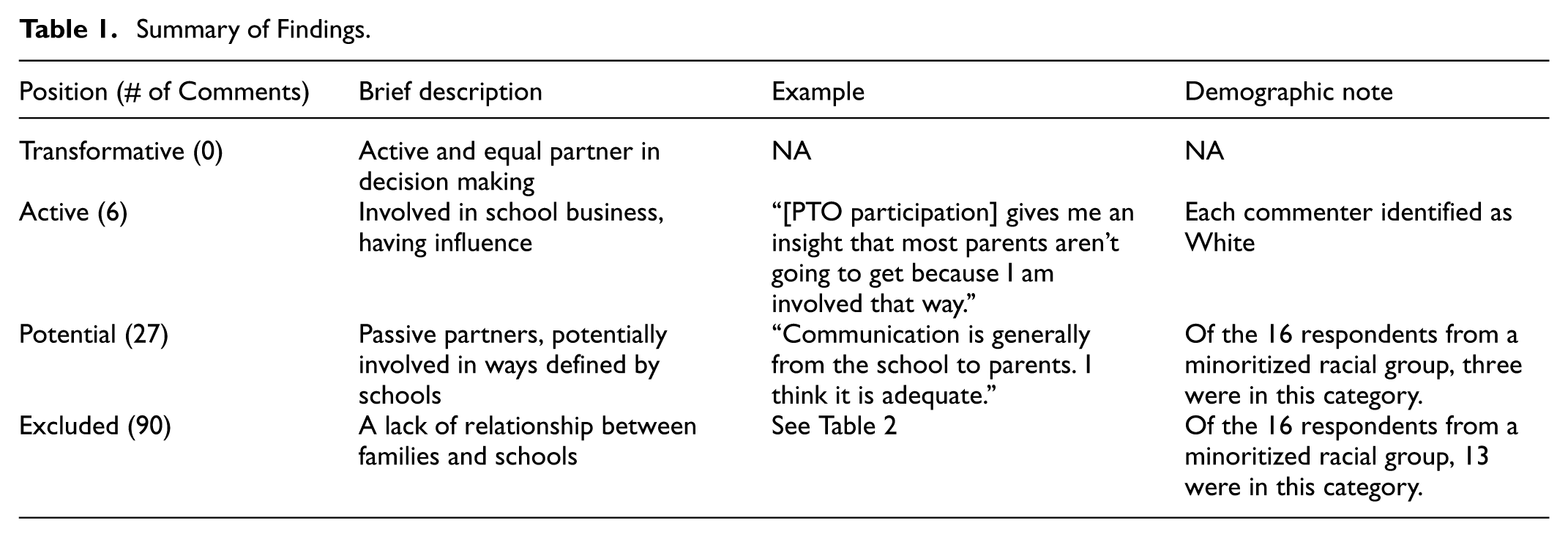
In this section, we present the themes that emerged from our analysis. We start by working backward through Banks’ types of citizenship, from transformative to failed. Based on our findings, we propose different positions: Active participation, potential participation, and exclusion. Most positions, however, fall within the potential and excluded categories. Table 1 provides an overview of the findings. We discuss these positions and the nuances we observed in them below. To better illustrate patterns, we include respondents’ self-reported ethnicities throughout.
Summary of Findings.
Family Responses
Transformative
One way theory can be valuable is by identifying things we might expect to see and thus taking note of their absence. The models of Banks (2017) and Ochoa et al. (2011) would lead us to look for families and community members positioning themselves as active and equal members of the school decision-making process, transforming schools to reflect their values. In other words, we would hope to see transformative positions. Nevertheless, the transformative position was theoretical rather than concrete in this suburban context and data set. As we interpreted the comments, none indicated a transformative level of participation. This finding does not say that such participation did not exist in the district for some families. It was not, however, present in these comments.
Active Participation
We considered comments to represent active participation if they indicated or suggested that respondents were involved in school business in some way and recognized themselves as having legitimate influence. In other words, respondents at this level recognized a right and responsibility to shape their relationship with the school.
Only six comments indicated this position; of these, only two indicated actual influence. Each of these commenters was White. One participant identified themselves as active in the Parent-Teacher Organization (PTO), while the other reported actively initiating conferences with the school. In both comments, the respondents positioned themselves as different from other parents. One respondent said, “I feel like [PTO participation] gives me an insight that most parents aren’t going to get because I am involved that way, but [I] also feel like that is the choice of the family and the level of involvement they want to have at their school.” The other four comments recognize the legitimacy and responsibility of families and the community to take an active role in schooling. Comments were a mix of positive and negative views of Prairie Community Schools (PCS). An example of a negative comment was a respondent who said, “We have never had a conversation about it that we did not initiate.” This comment, along with others, suggested both the ability and responsibility to take action in the sphere of formal schooling.
Potential Participation
We identified comments as Potential Participation if respondents represented being part of schooling in a way largely defined by the school. These comments represented families and communities as involved but passive partners in education, with little influence on what is done in schools and little action within them. Twenty-seven comments fit this position, all but three of which were from White participants. Most of these comments were positive, expressing approval of the school’s activities and decisions. Many comments pertained to communication, with families included, informed, and “kept in the loop.” For example, one respondent said, “Communication is generally from the school to parents. I think it is adequate….”
The overall positivity of these comments suggests a contentment with the status quo in the district. These parents did not see a problem that needed fixing. Only one comment was negative. The respondent said, “There are many improvements with communication and representation that can be better. I feel that the district, as a whole, is trying to figure out a better way, but the process can be slow.” Though there is room for alternative interpretation here, this comment still seems to put the onus of change on the district rather than on families and communities.
Exclusion
We identified comments to represent exclusion from participation if they indicated a lack of relationship among families, communities, and schools. Exclusion accounted for almost three-quarters of the comments, 90 out of 123. Seventy-two comments were from White respondents, seven from African American or Black, one from Asian Pacific Islander, and three from multiracial respondents. Seven identified as another ethnicity or declined to self-identify. As one might expect, the comments were almost exclusively negative or neutral in tone.
With this larger number of comments, several interesting patterns and variations emerged. One recurring distinction noted by many respondents was the difference between how schools represented family-school relationships and how respondents perceived them to be. This distinction was often described in terms of communication and action. For example, respondents (both White) said, “If families have a concern, someone will listen, but nothing is done,” and “Sometimes it feels like decisions have already been made, and parent involvement is all for show, so they feel like their opinions are being taken into consideration.” One White respondent considered the school’s efforts at engagement to be “inauthentic.” Another White participant noted that educators “do what they want and have their mind made up about topics prior to reaching out to parents.” These respondents suggest a perceived contradiction between the stated aims of schools and their actions or, as one respondent put it, “reactive lip service.”
Within the excluded position, three sub-positions were identified. These are presented in Table 2 and described below.
Positions Within the Excluded Category.

Passive Exclusion – Detachment
In 16 comments, respondents represented themselves or their families as detached from formal schooling, without presenting this as a result of school action (or inaction). Examples from White respondents include “As a parent, I feel very detached from the school” and “I have had no real connection to the high school.” One Black respondent said, “I’m not certain that there is a school-family-community relationship.” Although the tenor of these comments is negative, they present this detachment as normal, without attributing it to any specific actor. Respondents positioned the schools and families as passive, with neither necessarily responsible for the current situation or for changing it, and indeed, there was little acknowledgment of the need for change.
Some did recognize the need for change without acknowledging their right, responsibility, or ability to enact it. Two White respondents highlighted a problem, then indicated that someone else should address it, saying, for example, “Testing needs to go. And I wish school administrators would be more vocal in politics to get rid of it,” and “I believe that the principal could try to help students with disabilities [have] more of a chance.”
Illegitimate Exclusion: We are Excluded, and we Should Not Be
Many of the comments presented schools as actively excluding families. These respondents reported being rebuffed after having made an effort to participate. One White respondent said, “I have reached out to the school multiple times, and issues have never been resolved […] I have met many parents feeling the exact same way.” Respondents singled out school administrators, reporting they “completely disregard parents, students, and teachers,” that schools are “run solely by administration,” and that “policies are decided [by] the board and superintendent.”
Some comments highlighted fruitless attempts to communicate, saying, for example, “I called and left numerous messages,” and observed:
It was only yesterday that I found out there is an actual form to fill out in order to report bullying. In NONE of the conversations I’ve had with school leadership to address my concerns has this form ever been offered to me. I had to find out about it on Facebook.
One Black respondent said they had “situation after situation occur” when they had “reached out to principals, teachers, and bus driver supervisors” without a positive result. Some respondents explicitly highlighted race, with one Black respondent writing, “The school does not notice any other students except Anglo Saxon,” and that Black and Brown students are left out of the National Honor Society and awards that require teacher and staff nomination. Several comments mention students with disabilities specifically, about which “Administration is not ‘hearing’ my concerns,” and “Not a single school employee has responded to us.” Some reported feeling powerless, saying, “[regarding] our autistic daughter, we have no say so whatsoever.”
Later grades were explicitly mentioned, with comments saying, “7th- and 8th-grade schools basically close their doors to parent involvement,” and “Parent involvement is discouraged starting in 5th grade and sets a tone for the remainder of the child’s career.” Frustration comes through in these comments. One White respondent described the situation as follows:
Parents are in positions where they can’t voice their opinions or concerns too much lest they be seen as a problem. There are many issues parents agree should be changed, and you don’t see this reflected in any such school policies. Asking how parents can be involved in these decisions is a joke. […] I thought it was a given that parents are simply not involved in policy decisions, etc. I wouldn’t even know where to begin to even attempt being involved in that way.
Legitimate Exclusion: We are Excluded, and We Should Be
One comment stood out by suggesting that families had no need or right to participate in schooling, with the White respondent saying, “Why would I be involved?” The comment deferred to school leadership, saying, “I trust the principal and teachers in our school to know what discipline or curriculum works best,” and “How in the world would a parent know who was involved in a decision to change the dress code or curriculum?” The respondent indicated familiarity with school even as they protested family involvement, saying, “Giving parents the ability to weigh in on what type of discipline structure (moving your clip up and down, for example) should be in the school is absolutely ridiculous….” These comments explicitly opposed the idea of family-school partnerships, positioning the exclusion of families as legitimate and correct. Although we received only one comment representing this point of view, it is notable to have evidence of its existence in the community.
Emergent Themes
Having considered how respondents positioned themselves relative to schools, we can also look at patterns that emerged in identifying these positions. Families in the community are not equally influential in schools, and the respondents echoed this concern.
Interestingly, when comments identified a power disparity between different racial/ethnic groups, many respondents—both White and racially minoritized—identified other groups as having more influence than themselves. It may come as no surprise that families with high economic and social capital would be positioned as having more influence in schools. Examples include statements such as “The only parents whose voices are heard are those within certain social circles” and “The members of the board are fairly affluent, but many of our students are not.” One respondent noted that “Prairie schools are a close-knit community. It is still all about who you know.” Several comments suggest an excluded middle, with attention and resources being directed to “the top 10% and bottom 10%” and those who excel in academics, athletics, or music. Exceptions are seen as being made for “students whose parents cause the most news.”
Several comments reference the majoritized status of Whiteness. One White commentator explicitly stated, “Our school board has one non-white member.” Another White respondent said, “It’s a good old boys club in this community,” making a reference recognized as explicitly gendered and implicitly White (McDonald, 2011). On the other hand, some respondents felt that minoritized populations had greater comparative power in schools. For example, one person argued, “[It] seems if you’re not a majority, you get a lot more freedom to misbehave […] When certain parents push back, then discipline is modified for those students.” Referring to LGBTQ+ groups, another respondent wrote, “No one says anything about a heterosexual group, but there is a lot of publicity given to LBGT groups!” One comment bridged both trends: “ALL STUDENTS MATTER! Not the color of your skin, your income, or if your parent is a member of the school system.”
Staff Comments
Having analyzed family comments regarding participation, we then turned to open-ended responses from school staff. Having only 24 responses, we are limited in reaching warranted conclusions. Nonetheless, this analysis of comments from those within the formal schooling circle provides a valuable perspective on family positionality and the concept of families as citizens in schooling. Of the 34 respondents who commented, all but three identified as White (with one identifying as Asian/Pacific Islander, one as Latino, and one as undisclosed). Aside from two administrators and one counselor, all the staff members were teachers.
Two comments positioned families as unresponsive to efforts to get them involved, saying, “We try really hard to engage our families and community, but it is difficult to get them to participate,” and “It can be a struggle to get parent involvement.” One staff member noted that the district’s approach to managing behavioral issues had broadened their partnerships with families. In these three comments, families were positioned not as active partners but as either responding or not responding to district actions. These comments fit a pattern of teachers emphasizing their efforts, such as the teacher who said, “I work extremely hard to build relationships with my families,” or the counselor who wrote, “Prairie Schools does a good job in trying to keep families informed.”
Some teachers indicated their efforts were less successful. One shared, “I wish communication with parents was easier.” Another teacher wrote, “We currently do not have an opportunity to collaborate regularly in order to build an ongoing relationship.” The Latino teacher stated, “We are struggling in this area.” Others went further, saying, “I feel like we don’t have any [relationships with parents],”“I’m not sure what the relationship is besides the PTO,” and “Our PTO consists of only white women. That needs to change.” One White teacher expressed frustration, saying:
I use many different avenues to communicate with my students’ families. However, sometimes it feels like a one-way street with many parents/guardians not returning communication back to the teachers/school. These are the same families that do not get involved in school activities [or] community affairs but will be the loudest negative voices.
This comment highlights a dynamic explicitly noted in some family comments: not all families were perceived as having equal influence. A teacher echoed this by writing:
The “squeaky wheel” parents get what they want, regardless of what other families or teachers want. We can have two parents wanting two different things, but we will do what the parent that is the loudest wishes, even if we disagree with the outcome.
Another teacher stated, “Sometimes our more affluent families think that they should have all the control.” Another teacher noted, “More families are coming to our district who speak other languages. I would like to see a vast improvement in the ways that we communicate and engage these families.” One teacher stated, “I feel our school almost goes too far with religious and cultural relations that if you are a white Christian, you are not given the same weight as other races and religions.” These comments made at least four distinctions: willingness to complain (or being “loud”), socioeconomic status, language, and race and culture.
While none of the family comments represented themselves as having a great deal of power, five comments from teachers positioned families as having more influence over schools than they had. One teacher argued, “Parents/families have too much say in all school environments. They actually dictate what goes on in our schools.” Another teacher reported, “I sometimes feel administrators and parents feel as if they can run the school.” One teacher shared that there were times when “concerns of parents have driven decisions in a way that puts wedges in collegiate relationships.” A teacher of color (Asian American and Pacific Islander) wrote, “We are afraid to stand up to parents when they complain.” One teacher, who declined to identify their ethnicity, stated, “If a parent calls and complains that a policy is too restrictive (for instance wear [sic] doo rags and hats), then suddenly what was a rule […] no longer applies.” Notably, this commenter mentioned “doo rags,” an explicitly racialized garment (Douglas et al., 2008), suggesting that minoritized students and families were overturning policies.
These staff comments support and differ from how families positioned themselves. On the one hand, staff implicitly positioned families as being outside formal schooling, with communication and organization of involvement coming from staff (whether successful or not). On the other hand, some teachers position some families as having a great deal of influence in schools, to the detriment of schooling. These latter comments sharply contrast the family comments we’ve identified as “excluded.” However, there is a troubling parallel in the family comment of “some parents,” those who are “not a majority,” modifying discipline, and the staff comment about doo rags.
Discussion
With the analysis presented above, we revisit the theories of Banks (2017) and Ochoa et al. (2011) and advance an articulation of family positioning relative to schools using the Spheres of Participation Model (Figure 1). We present this model not as an empirical truth but as a heuristic for understanding family participation in schooling. We note that Banks’ types of citizenship are neither hierarchical nor spatially represented, whereas we arrange our model in concentric circles to imply a hierarchy in terms of distance from the center of influence in schooling. With this distinction, we indirectly draw on Bronfenbrenner’s (2005) bioecological model of human development, as used in Kelty and Wakabayashi (2020), to theorize family perspectives on schooling, and on Wenger’s (1999) models of Communities of Practice. In their model of Transformative Parental Engagement, Ochoa et al. (2011) presented a hierarchy in the form of levels but did not focus on concentric circles as we have. Instead, they articulated qualitatively and concretely what transformative partnerships would entail. In a way, their model fills in the gaps where our empirical data leaves off. It provides the basis for the transformative citizen part of the model.

The spheres of participation model.
Arranged in concentric circles, our Spheres of Participation Model presents degrees of citizenship in terms of participation, with the significant boundaries being the boundary line of formal schooling (i.e., the plexiglass of Porter et al., 2021) and, within that, the core of decision-making influence. Below, we describe the levels of our model, theorizing family members as citizens in the schooling endeavor. We connect these to our empirical findings from family comments and extant research introduced earlier in the paper.
Excluded (Failed Citizenship)
We will begin from the outer extremity of our model: Excluded. In Banks’ (2017) model, Failed Citizenship represents a breakdown and exclusion from schooling, with fewer rights and an identity formed against, rather than with, the collective endeavor of education. Such families participate by enrolling their children in school, but they have no ownership or legitimacy within the formal sphere. It is not their work. This result may arise from the structure of schooling, as well as from various barriers, such as language, physical access, or time constraints (Jefferson, 2015). It may be the result of decisions by school staff. It might be a personal choice (“Why would I be involved?”) or stem from cultural attitudes toward schooling (Huntsinger & Jose, 2009). Schools might promote parental inclusion but still leave families feeling excluded (that is, paying “lip service”). In any case, families can be excluded from the sphere of formal schooling. The majority of the family comments positioned themselves as excluded in this way. Excluded families represented themselves as detached from schooling, actively excluded from the schools, and, in one example, believed families should be excluded from schools. Staff comments did not necessarily indicate that families were being actively excluded. However, many did suggest (at least some) families had far too much influence, and one comment identified the need for better outreach to linguistically minoritized groups.
Structurally, hierarchical governance continues to keep families at the margins (Porter et al., 2021), privileging compliance or acquiescence from families rather than authentic dialogue with them (Baquedano-López et al., 2013; Jefferson, 2015). As an example, some family members in this study reported that even when they reached out to PSC in the hope of informing change, they often found “nothing [was] done” or that their requests were “completely disregard[ed].” Moreover, the literature demonstrates that schools frequently frame families as peripheral helpers rather than as equal partners (Ishimaru, 2019; Pushor, 2012), thereby limiting families’ potential to contribute their expertise to educational policies and practices that impact their children. In this study, family members shared how they contributed their opinions and insights to influence decisions about their children, only to realize that “decisions [had] already been made.”
Adjacent (Recognized Citizenship)
For Banks (2017), Recognized Citizenship represents a position of legitimacy in the collective endeavor without active engagement. Having adjacent status means lacking significant responsibility, having the potential for action without the need, and security without alienation. It can also be interpreted, as found in Yaylaci (2016), as having rights and responsibilities consistent with traditional approaches to family involvement.
As recognized citizens, families are adjacent to formal schooling when they position themselves as legitimate members of the schooling endeavor without responsibility for action. They do not cross the boundary of formal schooling, yet they do not position themselves as unable to do so, should they wish. This position implies satisfaction or complaisance. If there is no problem, schools may not see a reason to take action. However, this category also demonstrates that if a school wishes to form active partnerships with families, it is not enough to provide opportunities and open channels of access. These forms of recognition of families’ citizenship within the school may cause approval amongst the community, but may not lead to involvement. It may lead to sentiments, such as those expressed by teacher comments, that “We try really hard to engage our families and community, but it is difficult to get them to participate.”
Active (Participatory Citizenship)
Banks (2017) defined Participatory Citizenship as citizens acting through legitimate channels available to influence collective efforts: They are Active citizens within the sphere and boundary of formal schooling. They might hold official roles (one respondent mentioned sitting on the PTO), or they might volunteer. For these parents, this formal boundary is permeable. They can cross it, whether to contribute to the collective endeavor (e.g., volunteering in the classroom) or have influence in an established way (e.g., initiating a conference with a teacher or principal). They recognize a legitimate place for themselves in the sphere of formal schooling and are recognized as legitimate.
Out of 123 comments analyzed, only six family members positioned themselves within this formal boundary, while 27 positioned themselves as potentially within it. We consider the latter to be adjacent to, but not inside, the formal boundary. The remaining 90 comments actively positioned families outside this boundary. Although the six participants might have some legitimate influence within the formal boundary, they are not part of the core decision-makers, those who can make transformative changes within the schools. The families in Kelty and Wakabayashi’s (2020) study, whether self-positioned or positioned by educators, were primarily located in this sphere or identified as ideally moving into it. It is the sphere of successful traditional family engagement. Collaboration strategies that would bring families into schools on a more equal footing, such as open classrooms, are less popular (Mendelová & Gužíková, 2024).
Only two teacher comments addressed active families. Both referred to the PTO. One stated they did not know what relationship schools had with families “besides the PTO,” and the other noted, “Our PTO consists of only white women. That needs to change.”
This level represents traditional models of parent involvement, in which families are co-opted into school activities while remaining “peripheral in relation to the life and purpose of the school” (Pushor, 2012, p. 466). Even within this sphere, some have more significant influence than others, owing to greater social, professional, and financial capital (Calarco, 2020; Posey-Maddox, 2013). At this stage, the transformative engagement model of Ochoa et al. (2011) becomes helpful. The first two levels, connectedness and inclusion/belongingness, provide guidelines for ensuring that all families can be active in schools, see their cultures reflected there, and have their presence and contributions recognized as legitimate. While an improvement over being excluded or adjacent, families being active do not reach the partnership level. To achieve this, we must continue with the transformative engagement model and explore family participation in the core circle of decision-making.
Partnership (Transformative Citizenship)
When individuals and groups exercised radical influence on the collective endeavor, Banks (2017) considered this to be Transformative Citizenship. Banks held that transformation could come from all quarters, including failed citizens. Informed by the model of Ochoa et al. (2011), we focus on families as transformative citizens of schools when they operate in partnership with school actors in the core decision-making sphere of formal schooling. Such partnership-based transformation helps schools become more reflective of families’ cultures in an additive and inclusive way.
Ochoa et al.’s (2011) transformative engagement model provides a road map for how this might start and grow. Their third level of shared decision-making offers a foundation for partnership, enabling families to traverse the boundary of the inner circle of influence within the school. The following two levels of participatory action research and macro-civic engagement go beyond our model, aiming to reshape or even dissolve the boundaries between communities and schools.
Family-school partnerships are rare, and there is little evidence in open comments that Prairie Schools had managed to cultivate them. For this reason, the transformative citizenship level of our model remains somewhat speculative, though not without precedent both in theory (Ishimaru, 2019; Miller, 2019; Ochoa et al., 2011; Yamauchi et al., 2017) and practice (e.g., Ishimaru, 2014; Mapp & Bergman, 2021; Warren et al., 2009; Yull et al., 2018).
Power and Influence in the Spheres of Participation
As mentioned above, Banks (2017) recognized that the transformation of the collective endeavor could come from different types of citizens. Some teacher comments suggest that certain families operate in a transformative manner, exerting more influence than other families and even teachers. The teachers represented such disproportional influence as detrimental to the collective endeavor of schooling. Seen through the Spheres of Participation Model, such influence would be characterized not as transformative citizenship, accomplished in partnership, but rather individualized influence arising from self-interest and individual values. They act as individuals (or isolated groups) rather than as citizens. They act on differences rather than through and alongside differences.
While the Spheres of Participation Model may initially appear to be a spectrum of power, it is actually something more specific: power in and through collective endeavor. Conversely, transformative efforts from families not rooted in partnership are aimed at having an effect on schools rather than influencing change with and through them. These positions of families exercising power over rather than alongside differences are evident in teacher comments of some families that “dictate what goes on in our schools,” the “squeaky wheel parents,” the “families that do not get involved in school activities […] but will be the loudest negative voices.” These sentiments reflect individual efforts by families and an individualistic framing of family involvement, which is counter to the intent of partnership models (Warren et al., 2009).
Where schools have actively excluded minoritized families, they can organize and advocate by taking actions to address inequities (Fennimore, 2017). While not necessarily partnerships, minoritized families taking action in the face of inequities is better than inaction and could, hopefully, mature into partnerships with schools. That said, excluded citizenship does not apply solely to culturally, linguistically, ethnically, or socioeconomically minoritized individuals or groups kept at the margins by their status. As the staff comment on White Christians suggests, majoritized groups may exclude themselves or feel excluded from the endeavor of schooling, a finding supported in a separate analysis of this data set as well (Sherman et al., 2026). Banks’ (2017) concept of failed citizenship encompasses individuals who opt out of the collective endeavor of citizenship because they do not believe in or identify with the values or the work. Families that disagree with work being done in schools, such as equity efforts, may exclude themselves (and, in fact, oppose) such endeavors, striving for transformation (or the prevention of it) from outside (Sherman et al., 2026).
Implications and Conclusion
Ultimately, what does it mean to think of families in terms of citizens of schools? The Spheres of Participation Model advances citizenship to conceptualize family participation in schooling in more active, transformative, inclusive, and equitable ways. It provides perspective on why family-school partnership models, despite their challenges, are preferable to traditional models of involvement and engagement. It emphasizes schools as democratic institutions that should be culturally and civically integral and integrated with their communities. It sheds light on disparities in family power and participation, highlighting how some families exert influence over schooling while others feel alienated.
The data in this study suggest that most respondents, seen within the Spheres of Participation Model, position themselves as either excluded or adjacent because their district had continued to define the terms of participation. Families are often positioned as recipients of information or as passive supporters rather than co-decision makers (Santamaría Graff, 2021). Accordingly, many family comments describe detachment, lack of follow-up, or “lip service” from administrators. These experiences create a dynamic where exclusion is normalized and adjacent participation (e.g., receiving information, being “kept in the loop) is interpreted as sufficient engagement.
Unfortunately, transformative participation, where families and schools work together in partnership to co-create structures for joint decision-making, was absent in the data. This absence appears tied to multiple, intersecting barriers. Culturally, deficit narratives about “hard-to-reach” families and perceptions of certain groups as “squeaky wheels” may lead schools to legitimize the perspectives of some families while discounting or dismissing the input of others (Baquedano-López et al., 2013).
In this study, there is some evidence that White, middle-class, English-speaking families who speak out have their concerns taken seriously. In contrast, some racially minoritized families—including those who speak languages other than English—have their knowledge undervalued or ignored. Accordingly, Whiteness and middle-class norms further narrow what counts as legitimate participation, reducing opportunities for certain families—particularly minoritized families—to share essential knowledge and insights benefiting all students (Ochoa et al., 2011). Communicatively, both families and staff described a “one-way street” of outreach in which families’ perspectives were solicited but rarely acted upon. When taken together, these factors provide context for why many families experience exclusion or adjacent participation. Importantly, the absence of transformative participation is not a reflection of families’ lack of capacity but instead of entrenched institutional practices that limit reciprocity and power sharing (Ishimaru, 2019).
The Spheres of Participation Model can be a valuable tool in educational research and practice. For researchers, the concept of families as citizens can serve as an analytic guide for further study and a basis for developing and refining theory. Of particular interest is the phenomenon of family influence in schools and how families may enact influence in ways that are detrimental to public schooling as an equitable, plural, and collective endeavor (e.g., Calarco, 2020; Sherman et al., 2026) or how it may proceed through partnership and democratic ideals (e.g., Ishimaru, 2014; Ochoa et al., 2011). Based on staff comments, the Spheres of Participation model may also be helpful for teachers and school leaders who wish to better understand how families position themselves relative to schooling as a way of navigating resistance and planning efforts to cultivate partnerships. Notably, while schools and districts may be slow to change, families—particularly those from minoritized communities—should not be expected to shoulder the additional burden of leading systemic change efforts. Instead, schools must take responsibility for creating the conditions for equitable partnership, ensuring that families’ energy and advocacy are not continually drawn upon to compensate for institutional shortcomings.
While our analysis of comments provides insight into family self-positioning in relation to schooling, it is limited to those who felt strongly enough to complete a voluntary, open-ended item at the end of a survey that was not explicitly designed to explore this phenomenon. Nevertheless, self-positioning emerged as a phenomenon of interest during analysis. Now articulated, the Spheres of Participation Model can be a valuable tool in future studies that address a broader population. Through interviews, researchers can gain insight into family self-positioning and their reactions to being citizens in the endeavor of schooling. Further, understanding teachers’ reactions to the idea of families as citizens could be a fruitful direction for future research. Finally, there is value in better understanding the formal boundary of schooling posited in the model. A study specifically designed to explore this boundary could identify physical, social, cultural, and psychological barriers in the experiences and self-understanding of families, thereby providing a better understanding of how such barriers can be overcome or dismantled.
Transformative Citizenship remains a theoretically informed yet aspirational concept that requires refinement and development based on empirical data. Unlike the other types of family citizenship, it represents a radical departure from traditional models of family involvement in schools. The Spheres of Participation Model provides a valuable pathway toward realizing a new vision of partnership in schooling and its role within the community.
Footnotes

Ethical Considerations
This research was carried out with the review and approval of the IU IRB, approval # 1605985109. This survey-based study minimized the potential of harm by not collecting identifiable data. Survey respondents received the benefit of having their opinions heard, in the aggregate, by the school district. The research provides societal benefit by improving our understanding of family-school partnerships. Participants were informed and provided consent as part of the survey.
Funding
The authors disclosed receipt of the following financial support for the research, authorship, and/or publication of this article: This work was funded by the US Department of Education (grant no. T365Z170226) through the Office of English Language Acquisition.
Declaration of Conflicting Interests
The authors declared no potential conflicts of interest with respect to the research, authorship, and/or publication of this article.
Data Availability Statement
Data sharing not applicable to this article as no datasets were generated or analyzed during the current study.
Generative Artificial Intelligence
Generative artificial intelligence was not used in the any aspect of this research. A.I. based grammar review was used in the final stages of writing.