




Abstract
Based on the analyses of the local citizenship institutional arrangements and rural-origin migrants’ substantive citizenship practices across three migrant communities in Chengdu, this paper finds that the current local citizenship regime functions as a migrant elite selection system. All the empirical findings suggest that citizenship in Chinese megacities is exclusive and competitive, far from ‘ensuring urban and rural residents move freely and enjoy equal citizenship and public services’ alleged by text-based citizenship policies. Therefore, the separation between text-based citizenship and migrants’ citizenship practices in everyday lives contours the stratified characteristics of local citizenship in Chinese megacities today. ‘The right to the city’, which has been extensively discussed by academia, is still competitive, making hidden exclusions for many disadvantaged migrants.
Plain language summary
Shedding light on the biggest Western megacities in China, this paper scrutinized both the local text-based citizenship regime and migrants’ substantive citizenship practised in their everyday lives. All the analyses demonstrate that the local citizenship regime makes differentials and new exclusions, far from what policy-makers alleged—‘no status rankings’ and ‘allow transfer freely’. This paper’s findings remind academics and policy-makers to notice the heterogeneities in rural-origin migrants and increasingly evident differentials in their substantive citizenship in Chinese megacities since the improvements in universal citizenship may gloss over many hidden inequalities embedded in the current local citizenship regime. Thus, consideration should be given to analyzing the differentials of regions, public goods distribution, migrants’ attributes, and channels for social mobility.
Keywords
Introduction
Based on the long-established Household Registration system (hukou system), extensive studies applied the dichotomic citizenship framework distinguishing rural and urban citizenships as two disparate systems to scrutinize rural-origin migrants’ citizenship in cities, and they were widely regarded as a group excluded and marginalized socioeconomically, politically, and culturally in cities (K. W. Chan, 2009; K. W. Chan & Chan, 1994; Knight & Song, 1999; Solinger, 1999; Whyte, 1996). Due to decades of hukou reform, the lens has been shifted from the dichotomic citizenship system to citizenship localization and relevant practices in Chinese megacities (Dong & Goodburn, 2020; Shi, 2012; Woodman, 2016; Young, 2013; L. Zhang, 2012; C. Zhang, 2018). As many researchers have argued, while gaining more economic power, the reform of marketization in China also made local governments take on more fiscal and social obligations. Hence, local governments started to prudently calculate the economic benefits and welfare costs generated by migrants (K. W. Chan & Buckingham, 2008; L. Zhang & Wang, 2010) and extensively implemented the ‘residence permit system’(juzhuzheng system) and the ‘point-based system’ (jifen system; Young, 2013; L. Zhang, 2012; C. Zhang, 2018). With these implementation arrangements of local citizenship, the megacities of China can attract immigrant talents and boost the local economy, resulting in a high-profile competition for ‘talent introduction’. Based on these preliminary observations, this study sets the following research questions: are rural-origin migrants’ citizenship in this locality differentiated? If so, what do these differentiated practices imply in the local citizenship regime?
With specific evidence on text-based and practical citizenship in one of the Chinese megacities, this paper suggests some new traits of Chinese citizenship today. Rather than a static institutional arrangement, differentiated citizenship is a dynamic concept closely related to the socioeconomic contexts of society. After decades of hukou reforms, the Chinese government effectively mitigated the tensions produced by the dichotomic citizenship system, especially the separation between rural and urban citizenship (Goodburn, 2014). However, a more localized citizenship regime given by the main Chinese megacities is intensifying the boundaries of a locality’s social entitlements and public goods, raising the threshold of ‘the right to the city’ (Harvey, 2008; Lefebvre, 1996; Mitchell, 2003). All these new practices suggest the necessity of rearticulating the ‘differentiated citizenship’ of China today. Thus, this paper aims to identify the factors producing hidden inequality under the rhetoric of universal citizenship improvement and to provide some new perspectives on understanding the landscape of differentiated citizenship in Chinese society.
Conceptualizing Rural-Origin Migrants’ Citizenship Differentiation and Localization
Due to various interpretations of ‘citizenship’ in existing literature, theoretical framing is fundamental to unpacking all the analyses of this study. Many academic discussions on ‘citizenship’ and related applications nowadays start from critically reviewing Marshallian citizenship theories. In T. H. Marshall’s seminal book ‘Citizenship and Social Class’ (Marshall, 1950), he pointed out that the key components to understanding citizenship were ‘membership’ and accompanying ‘rights’ and ‘duties’. Marshallian framework helped establish the most widely applied analytical framework in citizenship studies—conceptualizing ‘citizenship’ by clarifying its exclusion and inclusion (Goldman, 2009). Therefore, the ‘boundaries of membership’ are critical to understanding citizenship. Such insights inspired academics to grasp Chinese citizenship. In the Chinese context, the hukou system is widely acknowledged as the fundamental regime defining Chinese people’s membership and accompanying entitlements. According to the hukou system, Chinese citizenship creates disparities in social status and entitlements between rural and urban members (Solinger, 1999; Whyte & Whyte, 2010), while others provided adequate evidence demonstrating how rural residents, especially those who work in cities, were situated in a subordinated position. Nevertheless, the recent hukou policies reform across the main megacities of China emphasize citizenship localization and make new boundaries and challenged the widely used rural-urban analytical framework mentioned above (A. Smart & Smart, 2001; Tang & Tomba, 2013; Tse, 2016; Woodman, 2016; Young, 2013). Hence, a closer analysis of specific citizenship institutional arrangements and practices is meaningful.
The localization of the citizenship regime in China is closely related to the heterogeneity of rural-origin migrants. The intergeneration gap is one of the most extensively analyzed factors making migrants’ heterogeneity. While income was the first-generation migrants’ primary motivation to move from rural hometowns to cities, the younger generation may expect more opportunities to gain professional skills, make a career, and develop their capabilities (J. Chan & Selden, 2014). Moreover, the new generation shows different labor actions from those of their parent generation. They tend to be less tolerant of injustice and are highly motivated to demand higher wages and better benefits (J. Chan & Selden, 2014, p. 607; A. Chan, 2011; Nang & Ngai, 2009). In many studies, rural-origin migrants in Chinese megacities had to bear the stigma of being low ‘suzhi’ (quality) or ‘wenhua’ (culture), labels referring to ‘the innate and nurtured physical, psychological, intellectual, moral and ideological qualities of human bodies and their conduct’ (Jacka, 2009, p. 524). However, as the statistics in the ‘Migrant Workers Monitoring Survey in 2020’ released by the National Bureau of Statistics demonstrated, the educational attainment of migrant workers significantly rises in the group of ‘college degree and above’, considerably differing from the stereotypes of rural-origin migrants. Thus, the connections between rural-origin migrants’ age and different memberships must be considered when scrutinizing the local citizenship regime and relevant practices.
In addition to the intergenerational difference, migrants’ heterogeneity becomes increasingly evident even in the same generation cohort. The National Bureau of Statistics of China officially indicated the heterogeneity of rural-origin migrant workers in the Fifth Session of the 12th National People’s Congress of 2017. Although rural-origin migrant workers are still widely acknowledged as subordinated blue-collar workers, their occupations are becoming more diverse, including but not limited to self-employed people, freelancers, influencers on social media, and e-commerce operators. To be further clarified, ‘blue-collar workers’ in the Chinese context usually mean industrial workers or other manual workers. However, more recently, researchers have grouped all the basic staff in the secondary and tertiary industries as ‘blue-collar workers’. For example, such an interpretation was applied in a research report on ‘China Blue-Collar Index’ by Renming University of China (Zeng et al., 2021). Therefore, migrants’ subordinated status could be weakened by giving a more inclusive definition of the target group. As the National Bureau of Statistics admitted, it could be a real challenge to define ‘migrant worker’ accurately due to the increasing heterogeneity of migrants today. On the other hand, hukou reforms and related practices across the main Chinese megacities abolished the distinctions between rural and urban citizenship and at least emphasized ‘universal citizenship’ institutionally. Therefore, some rural-origin migrants’ substantive citizenship in daily practices could be up in the air due to the increasingly significant heterogeneity.
Marshallian citizenship theory, referring to citizenship memberships and accompanying entitlements, is essential but never universal in interpreting citizenship practices across the global society. For example, rather than merely a legal status defined by texts, more and more academics acknowledge that citizenship should be considered as ‘practices’ (Lazar, 2008, p. 5). Moreover, ‘boundaries of citizenship’ also show a great degree of heterogeneity today, often regarding citizenship’s location, scales, territories and practices (Woodman, 2018, pp. 2–3). Such changes in citizenship studies help construct a ‘differential multi-tier citizenship’ order (Bauböck, 1994; Yuval-Davis, 1997), suggesting citizenship and corresponding practices are not hardwired to the nation-state scale. Recent instances indicate that ‘local citizenship’ has become a governing technology enabling ‘legal orders working at different scales to coexist’ (Valverde, 2010, p. 234). These new insights in citizenship studies inspire this study to rearticulate rural-origin migrants’ citizenship in Chinese megacities. After decades of hukou reform, the scale of citizenship has been shifted from the nationwide urban-rural dichotomic system to a more diverse multi-tier system. Therefore, the theoretical and practical changes in Chinese citizenship provoke further discussion on the local citizenship regime and rural-origin migrants’ daily practices in Chinese megacities.
Methodology: Sampling City and Place-Based Approach
Choosing Chengdu as the specific locality for this study is meaningful. According to the open data released by the Sichuan Bureau of Rural Development in 2021, the number of rural-origin migrants in Sichuan province is approximately 26 million every year, and the overwhelming majority of these migrants live and work in Chengdu. In the extensive literature on rural-origin migrant workers, many scholars have documented Sichuanese migrant workers. They were often described as industrious, docile, and resilient (Fan, 2004; Lee, 2007; Roberts et al., 2004; Sun, 2009; Wang & Fan, 2006). However, these studies often focused on Sichuanese emigrants in the megacities of the Pearl River Delta and the Yangtze River Delta, and few have shed light on immigrants within this province. Since 2012, the rural migrant labor of Sichuan who chose to work in the home province has outnumbered the size of its emigrant labor. There A nationwide survey also captured the phenomenon of backflow of rural-origin migrants. According to the ‘2020 Migrant Workers Monitoring Survey’ by the National Bureau of Statistics of China, while the number of immigrant workers to Western China (including 12 provinces) has increased significantly (1.7%), that of emigrant workers from Western China is decreasing gradually. Thus, the importance of taking rural-origin migrants within Sichuan province as the target group stands out.
According to the research questions, this paper aims to scrutinize migrants’ citizenship from text-based citizenship and the substantive citizenship practised in migrants’ daily lives. Such objectives fundamentally shaped this study’s methodology. While this study examines all the migrant-related implementation arrangements via the text analysis approach, it scrutinizes migrants’ citizenship practices in this city via a place-based approach. In qualitative research, a place-based approach emphasizes the significance of geographical locations, physical settings, or specific communities in shaping experiences, behaviors, and social phenomena (Jorgensen & Stedman, 2011; Tuck & McKenzie, 2014). This approach can be found in many of Michael Burawoy’s works, mainly in his methodological emphasis on the ‘extended case’ method and ethnographic research (Burawoy, 1979, 1998). Methodologically, the place-based approach investigates how a particular place or environment influences individuals’ interactions, identities, and world understanding. It meets the research objective of understanding rural-origin migrants’ substantive citizenship in their everyday lives in this paper. Thus, choosing proper fieldwork sites is the first step for a qualitative study applying a place-based approach.
The researcher studied beforehand to identify the regions inhabited by rural-origin migrants in Chengdu and made a list of potential research sites. Following the snowball sampling approach, this study collected empirical data involving three migrant communities, spanning almost 3 years (2018–2020). The three migrant residential sites are Flower Town, Western Park, and Tianfu, where migrants share the same identity as ‘rural-origin migrants’ but show significant differences. While Flower Town is a typical urban village, Western Park is a worker-dormitory community, and Tianfu is a newly built community full of migrant elites with better socioeconomic status and higher education attainment. The fieldwork was completed in two phases: empirical data collection across three migrant communities for 12 months in 2018 (from January to December 2018) and intermittent digital ethnography from 2019 to 2020. After a full year of fieldwork in Chengdu, due to long-distance work and the pandemic, this study’s data was further enriched through digital ethnography. For example, the researcher constantly visited interviewee-related online forums or social media groups and conducted one-on-one interviews online. As a result, this study repeatedly conducted in-depth interviews with 65 individuals, including 35 rural-origin migrants, 9 social workers at NGOs, 8 government officials, 8 key administrators in various scale enterprises, and 5 scholars in the relevant research fields. Particularly, all the migrant interviewees’ ages range from 20 to 42; the number of females is 14, and the male count is 21.
It is noteworthy that the three migrant communities in this study were not the researcher meant to choose but an outcome after a data-driven and constant comparison process. Pilot interviews were conducted initially, constructing a sampling frame, narrowing the spectrum of projected topics and establishing a rapport between the researcher and respondents ( Frankland & Bloor, 1999; Teijlingen & Hundley, 2001). With much more theoretical sensitivities given by pilot interviews, more interview rounds were justified and achieved. All of the empirical data was gradually set up at three research sites. Along with all the texts and documents on the local citizenship regime, all the empirical data was cleaned and analyzed using the qualitative data analysis software NVivo. Following an iterative process of ‘coding—recoding—building categories—building themes—theoretical construction’, theories and main arguments are generated.
During the pilot interview phase, all the empirical materials of this phase generated 36 open codes, which were grouped into six categories afterward. Then, after the iterative interviews and visits during the new round of data collection, all the empirical materials of this phase generated 60 open codes grouped into seven categories: migrants’ personal information, differentiated space, migrants’ entitlement, migrants’ social networks in cities, information on other actors in each case, migrants’ everyday lives in cities, dynamics among various groups within each case. These newly established categories reflected the emerging theories. Remarkably, this study followed the fundamental principles of ethics—minimization of harm, respect for individual autonomy, and privacy preservation (Traianou, 2014 [eds. Leavy, 2014]). It complied with the ethical commitment of the fieldwork and anonymized all of the data from the beginning, including the names of the interviewees, organizations, and locations.
The Text-Based Citizenship of Chengdu: Migrant-Selection Technology
Hukou Reform in Chengdu
Citizenship localization and differentiation in Chinese society today demonstrate the tension between the formal equality required at the state level and the uneven distribution of public goods caused by various local policies (K. W. Chan & Buckingham, 2008; L. Zhang & Wang, 2010). The practices of Chengdu also support this point of view. In 2003, Chengdu municipality implemented the conditional hukou-transfer policies and ceased the quota system of hukou transfer (Daihong, 2010). In 2010, Chengdu aimed to guarantee preferential farming policies, achieve a unified household registration system, and ensure that urban and rural residents move freely and enjoy equal citizenship and public services. However, these rural-urban integration pilot policies only referred to the residents within Chengdu’s territory. Therefore, the only hukou policy substantively related to migrants outside Chengdu is the ‘residence permit’ system. Residence permit holders can enjoy equal entitlements as Chengdu residents in 12 aspects: employment, medical and health care, family planning, and legal aid (Ma, 2011, p. 132). In 2018, Chengdu municipality clarified the guiding principle of the local hukou reform policies—Control the population, prioritize migrant talents, keep the system dynamically balanced, and employ the dual-track hukou transfer system. Remarkably, the dual-track system here means that hukou transfer can be achieved by only two main approaches, ‘conditional hukou transfer’ and ‘point-based hukou transfer’.
The local hukou regime of Chengdu is currently a multi-tier system built on geographic, political, and socioeconomic differentials (Zeuthen & Griffiths, 2011; Zhan, 2017). Chengdu government aims to build up a social citizenship system that is ‘multi-tiers differentiation; no status rankings; allow transfer freely’ (Annual Report of Chengdu Urban and Rural Integration and Development, 2016, p. 48). Such objectives show the government’s stance—they allow the differentiation in all the residents’ social citizenship, although the local government alleged ‘no status rankings’ and ‘allow transfer freely’.
Immigrant-Related Institutional Arrangements in Chengdu
Besides the trajectory of hukou reform in Chengdu, the following two instances of institutional arrangements will demonstrate how the text-based citizenship regime functions in Chengdu.
Conditional Hukou Transfer System
The conditional hukou transfer system comprises conditions stipulated by the state and the municipal government. From the table below (Table 1), besides the fixed content formulated by the state, the municipal government of Chengdu takes advantage of its discretion to conduct preferential policies on migrant elites. For example, education attainment, age, and professional skills are the primary factors in migrant selection. However, the conditional hukou transfer system has no connections with non-elite migrants.
Conditional hukou Transfer Policies.
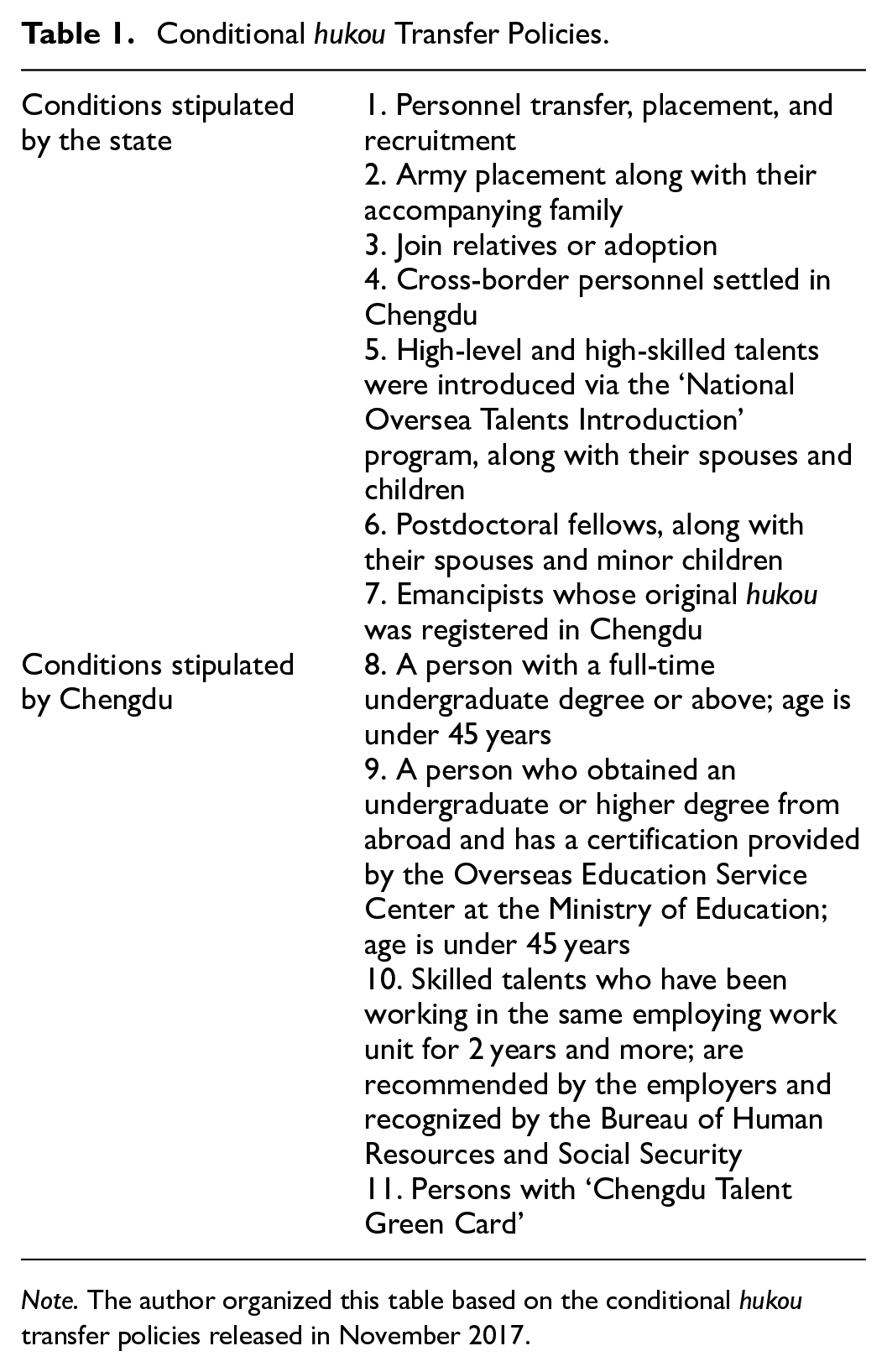
Note. The author organized this table based on the conditional hukou transfer policies released in November 2017.
The Point-Based Hukou Transfer System
As another critical component to understanding Chengdu’s local citizenship regime, this paper must shed equal light on this approach. Following the national guidance on deepening hukou reform comprehensively and other megacities’ experiences, the policies about point-based hukou transfer were released in Chengdu in 2017 and took effect on 1 January 2018 (Table 2).
The Point-Based hukou Transfer Policies.
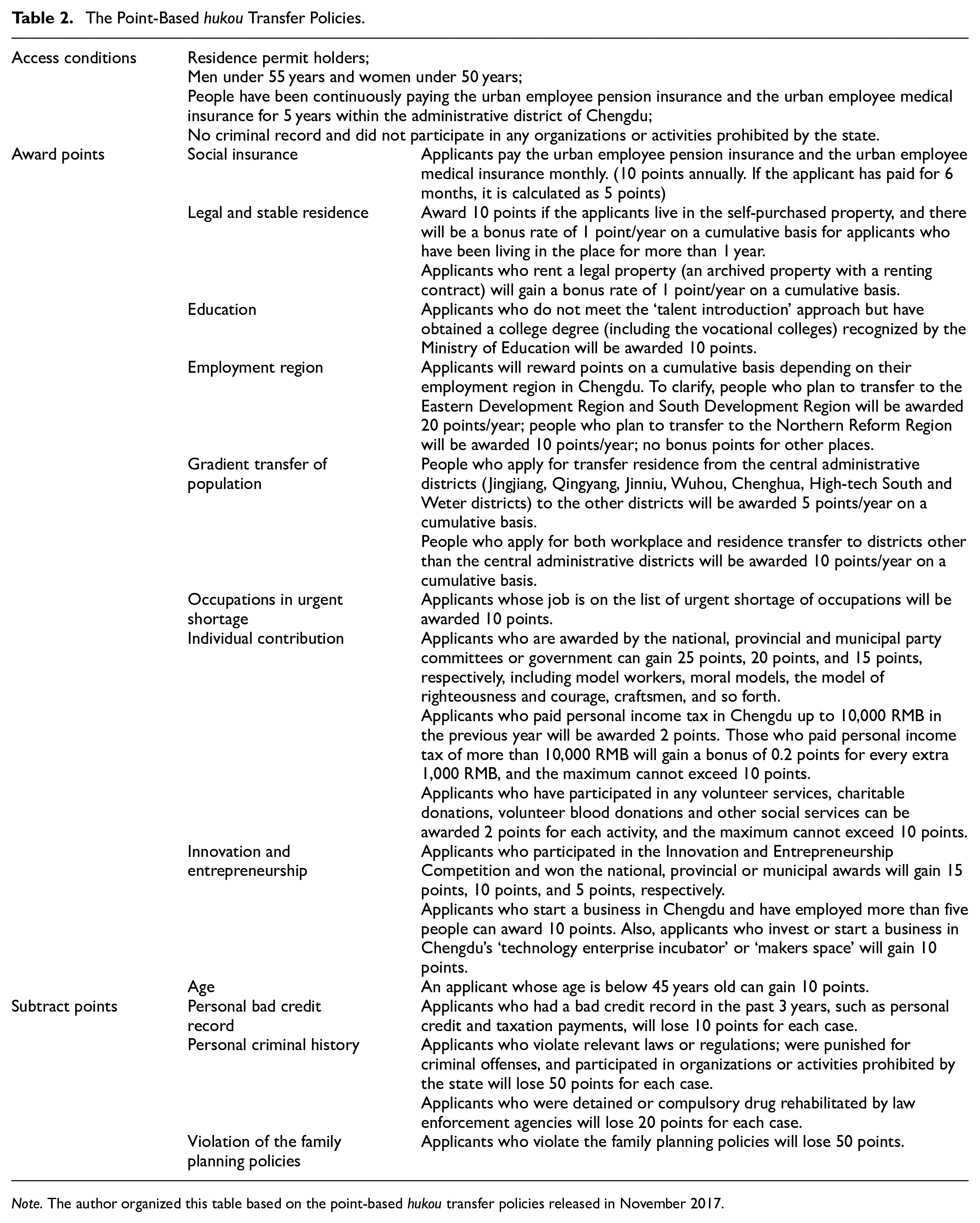
Note. The author organized this table based on the point-based hukou transfer policies released in November 2017.
The table above shows that the point-based hukou transfer system covers 12 indicators: social insurance, residence, education, employment region, gradient population transfer, occupations in urgent shortage, individual contribution, innovation and entrepreneurship, age, and other point-deducted indicators. When ‘Residence Permit’ holders collect 100 points, they can apply for a hukou transfer. The point-based system prefers migrants who can contribute to the local economic growth the most, potentially functioning as a migrant selection and management system in reality. However, the reality is that not all migrants can reach the requirements listed in this policy. In the banner of promoting universal citizenship, such as ‘ensure urban and rural residents move freely and enjoy equal citizenship and public services’ mentioned earlier, many migrants are excluded or marginalized by the current local citizenship regime. Therefore, these non-elite migrants have few chances to gain formal memberships in this city (such as the local hukou), and they can hardly approach the substantial entitlements endowed by these formal memberships in this city.
The ‘Chengdu Drifter’ Scheme: An Institutional Strategy for Immigrant Selection
Inspired by cyber slang ‘Beijing Drifters’(beipiao) and ‘Shanghai Drifters’(hupiao), Chengdu municipality has been marketing the term ‘Chengdu Drifters’(rongpiao) since 2017. Besides the dual-track hukou transfer policies discussed above, Chengdu municipality also implements and advertises the ‘Chengdu Drifter’ Scheme. This scheme was generated in the first place from ‘Chengdu Talent 12 Articles’. On 19 July 2017, the Government of Chengdu City issued an unprecedentedly accommodating policy for immigrant talent, which can be summarized using 12 Articles:
Support high-end migrant talent with innovation and entrepreneurship;
Encourage young talents to settle in Chengdu (hukou transfer);
Guaranteed housing services for migrant talents;
Upgrade medical care for migrant talents;
Simplify the procedures of foreigners’ long-term stay or settlement in Chengdu;
Encourage migrant talents across various industries;
Issue the ‘Chengdu Talent Green Card’;
Support the university-region/university-enterprise collaboration in various industries;
Provide universally free training on professional and technical skills;
Establish an announcement system on the talent’s information;
Encourage organizations to take the initiative to import and cultivate talent;
Set up the ‘Chengdu Migrant Talent Day’.
Since then, the ‘Chengdu Drifter’ Scheme has become one of the most influential talent introduction programs, providing competitive funding for various immigrant talents. According to the officially released policies, its content has been adjusting and updating every year throughout this research. In 2018, the ‘Chengdu Drifter Scheme’ was developed into four categories: long-term projects, short-term overseas projects, youth projects and top innovative and entrepreneurial teamwork projects. The funding from the municipal government for these projects ranged from 600,000 RMB to 5,000,000 RMB. This scheme also sets up special projects in collaboration with local universities, financial industries, and other organizations. Thus, the reality of the ‘Chengdu Drifter Scheme’ is far from the narratives of the cyber slang ‘Chengdu Drifter’, an identity for the sojourners in megacities, but rather, it functions as an effective top-down system for selecting migrant elites.
Suppose this city’s hukou transfer systems set the bar for the formal membership of the local citizenship; the immigrant talent programs such as the ‘Chengdu drifter’ scheme produce more chances to channel these migrant elites to more substantive entitlements in this city. On the other hand, this city has no such substantial policies to empower disadvantaged immigrants, such as those who are senior, poor, with low levels of education attainment, or without any professional skills. Accordingly, disadvantaged immigrants can hardly approach the local citizenship of Chengdu, both memberships and substantial entitlements. To this degree, this paper argues that the discrimination and inequalities between migrant elites and non-elite migrants can be effectively enhanced and even perpetuated in the long term under such differentiated local citizenship systems.
Migrants’ Substantive Citizenship Practiced in Everyday Lives
Tapping into the locality’s text-based citizenship, this study shows that memberships have shaped different entitlements in institutional arrangements. Notably, the two channels for full citizenship, the ‘hukou transfer’ systems and the ‘Chengdu Drifter’ scheme, set up higher bars than the ‘Residence Permit’ membership. Some researchers also state that ‘the consequent contraction in entitlement has often led to the social exclusion of immigrants in terms of diminished life chances’ (Shi, 2012, p. 795). Despite this, the lens on migrants’ citizenship practices in their everyday lives is equally crucial to understanding migrants’ citizenship in Chinese megacities. Technically, following a data-driven and place-based approach, all the themes demonstrated here were generated from iterative data collection and analysis. Although these themes may not be all-inclusive, they are fundamental to understanding rural-origin migrants’ citizenship practices in this city, directly relating to not only migrants’‘rights to the city’ endowed by the institutional arrangements but also their ‘well-being to the city’ practiced daily.
Fundamental Requirements for Local Citizenship: Labor Contract and ‘Five Types of Social Insurance and One Fund’
Most migrants have labor contracts and participate in social insurance schemes. However, a few migrants from Flower Town are still bound to informal employment relationships. In other words, migrants here have more precarious employment and living conditions than migrants from the other two cases. In Flower Town, Lili is the only person who signed a formal labor contract and participated in ‘five types of social insurance and one fund’. Lili is in her early twenties and works at a post parcel collection point. She tends to clarify everything in the labor contract before accepting a job, including working time, working content, salaries, and other social insurance packages (Lili, Interviewee JHM06). This difference is vital between Lili and her other fellows in Flower Town regarding individual awareness of labor rights because the labor contract is fundamental for formalizing employment relationships and accessing various entitlements in Chinese cities (Li & Freeman, 2015).
Unfortunately, other migrant interviewees of Flower Town are engaged in informal employment relationships, which means that they were not eligible to participate in social insurance and many other entitlements. The first reason for not signing labor contracts or participating in any social insurance is that employers seek to circumvent their obligations even though migrants lack awareness of basic labor rights. The second situation tends to be migrants’ voluntary decisions. During our conversations, both Yang (Interviewee JHM05) and Aunt Zhou (Interviewee JHM08) mentioned that ‘social insurance is meaningless’. However, considering migrants’ socioeconomic status, the fundamental cause could be that their income was too low (slightly more than 2,000 RMB monthly) to pay extra bills for their premiums as they are tight on money. Besides, due to the localization of citizenship across Chinese megacities, social insurance is designed to be exclusive and non-portable, which discourages migrants’ willingness to participate (Shi, 2012). Remarkably, although opting out of social security may seem rational for those rural-origin migrants, migrants worsen their precarious working and living conditions in effect. Many migrants of Flower Town agreed that labor rights were often violated at work.
Different from most Flower Town migrants, migrant interviewees from the other two cases can be grouped as the formal workforce because all of them signed formal labor contracts and participated in the social insurance scheme. This factor is key to recognizing the differences in all migrants’ labor relationships and social entitlements in Chengdu across the three cases. Although Western Park migrants suffer from rigid managerial controls and overwhelming working loads on shop floors, they are at least bound to formal labor relationships, and therefore, some migrants view Western Park as a stopgap before they find better work opportunities. In other words, regardless of whether or not Western Park migrants plan to settle down in Chengdu, formalized employment relationships can at least offer a practical option for their future living opportunities. As a result, the differential performance of migrants’ engagement in labor contracts and social insurance may lead to more significant opportunity inequalities in their future lives.
Comparatively, migrant interviewees in Tianfu generally take for granted labor contracts and social insurance. First, labor contracts and social insurance participation are necessary for migrants to access local citizenship in this city. Second, Tianfu migrants with better socioeconomic status and educational attainment have an easier time having formal labor relationships and participating in social insurance schemes. Thus, they take these conditions for granted if they are strongly motivated to live for good and have access to full citizenship in this locality. Based on these observations and endogenous factors, this study argues that migrants’ heterogeneity characteristics can result in differentiated engagement in labor contracts and social insurance and further make differentiated entitlements in the target city.
Differentials in Social Mobility: Migrant Children’s Schooling and Care
Based on migrants’ narratives, their children’s schooling in the host city is one of the most critical entitlements they are truly concerned about because it considerably affects their well-being in cities and even intergenerational mobility. Applying for a space in the primary school of Flower Town is a time-consuming and tedious process. Besides the solid requirement for a long enough time for house rent and their social insurance credit, much paperwork was mandatory, including a ‘Residence Permit’, one parent’s labor contract, and a lease contract, among others. Yang said, if migrant workers like us planned to send their children to a public primary school, they would need to kick off the preparation five years before the little one’s admission year. This is because not all the key documents can be obtained immediately. First, you must take at least one year to get a ‘Residence Permit’. A lease contract for at least three years is also necessary. Other documents, including supporting materials for social insurance payment, labour contract, copy of employer’s business licence, and property leasing qualification, means we need to communicate with employers and landlords beforehand, which was also time-consuming. (Yang, Interviewee JHM05).
Yang signs neither formal labor contracts nor participates in the social insurance scheme. Thus, her younger son was sponsored by his father’s formal employment relationships and social insurance credit, and he barely qualified for school admission. Despite the red tape for a migrant child’s schooling application, Yang and her husband felt relieved that their younger son could finally live with them and study in a local public primary school. Many interviewees mentioned that the demand for migrant children’s schooling is massive, but the educational resources in this area are limited. Yang recalled the impressive scene of people lining up in the early morning, at approximately 5.00 am, to submit all of the documents for a space at the local primary school. Yang and her husband said that they had at least managed their son’s schooling in Chengdu because migrant children rarely got into a local public primary school before.
Unfortunately, Chengdu’s free public schooling resources are only available to migrant children during the compulsory education phase (6–15 years children). Therefore, this family has to decide between continuing to stay and retreating to their hometown when Yang’s son finishes junior middle school. Our numerous conversations reveal that Yang has tended to send her son back to their rural hometown because the tuition fees and other living costs may surge manifold during their younger son’s post-compulsory education period. Even if her son chose to finish his senior high school education in Chengdu, he would have to go back to the place of hukou to take the National College Entrance Examination in China (Gaokao). This empirical evidence suggests a significant correlation between hukou and migrants’ social entitlement in Chinese megacities. As many studies have argued, rural students achieving social mobility through Gaokao is much more challenging due to the massive gap between rural and urban educational resources (Han, 2017, p. 96).
Compared with the migrants of Flower Town, the migrants of Western Park have no opportunities to bring their families into the cities. Western Park is a labor-dorm community, and almost all of the migrants choose to live in dormitories; therefore, many married migrant families must confront separation. Chun (Interviewee WHM19) started working as a student intern at Foxconn Chengdu. She went through many important life events while at Foxconn, including getting married and having children. However, except for the years she got pregnant and took maternity leave, she continued to separate from her husband and family for years. Many scholars criticized the labor dorm regime as a crucial strategy widely deployed by manufacturing enterprises to ensure the maximum utilization of labor power (Ngai & Smith, 2007; Smith, 2003; Smith & Pun, 2006). As productivity and profit always come before workers’ well-being, providing specific rooms for migrant couples or families seems impossible. In such circumstances, similar to Chun’s family, many married workers in this case cannot live together in the host city in the first place, let alone gain access for their children to urban educational resources. Inevitable separation from families and various ‘left-behind’ experiences are other substantial evidence that shows the dormitory labor regime’s function and adverse effects. Although gigantic enterprises in Western Park can guarantee income and non-wage benefits such as social insurance, they aim to attract labor and establish an efficient system to guarantee labor production and reproduction (Rickne, 2013). Again, migrant workers’ full citizenship here is deliberately suspended in the air.
Compared with the migrant peers of the other two cases, those of Tianfu have more choices in terms of children’s schooling resources. Some migrant interviewees here have transferred their hukou status from rural to urban. For example, Kong (Interviewee SHM36) sent his daughter to a local public primary school according to his entire family’s local household registration. Ping (Interviewee SHM35) transferred her hukou status from rural to urban when she worked in Shenzhen. However, she did not transfer her hukou and social insurance to Chengdu, even though her family moved from Shenzhen to Chengdu for a few years. Ping’s husband only met the requirement of paying Chengdu’s social insurance for 6 months, so the family had to pay additional thousands of school-selection fees to gain an admission opportunity for their daughter. The actual total amount of school-selection fees was not confirmed in our interviews; however, relevant media reports show that the minimum school-selection fees of local public primary schools in 2017 could have been 40,000 RMB, and the maximum could have been 150,000 RMB (Dachengwang, 2017).
Such costly school selection fees have been a threshold for selecting affluent migrant families and excluding disadvantaged ones. Moreover, Tianfu migrants’ experiences suggest localized citizenship and differentiated entitlements from city to city. For example, choosing not to shift her hukou and social insurance from Shenzhen to Chengdu was not a contingency but Ping’s rational decision. She said, my husband suggested transferring our daughter’s hukou from Shenzhen to Chengdu so that we could avoid costly school-selection fees, but I did not agree. There would be no easy way to regain Shenzhen hukou if we relinquished it. Additionally, I want to save more options for my daughter’s future education, such as she would like to study in Shenzhen or Hong Kong one day. One of the most important advantages of Shenzhen hukou is that residents are allowed unlimited entry to Hong Kong every year. (Ping, Interviewee SHM35)
Ping’s narratives suggest that, besides the differences across different migrant groups, the citizenship between Shenzhen and Chengdu is also differentiated. Migrant elites of Tianfu can recognize the differentiated entitlements endowed by the hukou of different localities and usually make a rational decision that suits their benefits and well-being.
From a comparative lens across three different spaces, this study contours the landscape of rural-origin migrants’ differentiated citizenship in Chinese megacities. First, schooling resources become a competitive entitlement in megacities. Migrant children without urban hukou used to be regarded as ‘no-citizens’ and lacked entitlements to public services (Solinger, 1999). Schools are the center of power for producing and reproducing social and institutional inequality (Bourdieu & Passeron, 1990; Wills, 1981), which may perpetuate migrants and their children’s disadvantaged status (Dong & Goodburn, 2020; Goodburn, 2009; Lan, 2014; Xiong, 2015; Zhang et al., 2015). With empirical data, this study further shows that although urban schools open their doors to migrant children, they can only access limited, fixed-term urban educational resources.
Second, rural-origin migrants also present differentiated capabilities for reaching urban schooling resources. As Tianfu migrants have shown, their much better financial and living conditions won them more opportunities for superior schooling resources. On the contrary, migrants of the other two cases could only access partial or even no schooling resources in Chengdu due to their disadvantaged socioeconomic status or residence in this locality. Considering that schooling resources are key to social mobility, inequality in opportunities exists for migrants across the three cases.
Exclusions Embedded in City Space: Migrants’ Settlement Plan and Housing Purchase
As a typical urban village community, Flower Town’s low rental is attractive to migrants (500 RMB per room monthly and 200 RMB utility bill). Considering Flower Town migrants’ poor financial situations and cities’ prohibitively expensive living costs, renting a decent residence in this city has been a real challenge for Flower Town migrants, let alone buying property in megacities. Besides, migrants’ income and hukou status are fundamental to their settlement in cities (Liu et al., 2013). Therefore, this study also finds that migrants can hardly live here permanently because they are excluded from some of the most fundamental and necessary social citizenship, such as labor contracts and schooling resources.
Remarkably, although they do not expect to buy property in cities, migrants of Flower Town, especially the younger generation, still prefer to work in cities rather than in their rural hometowns. Munai, the young man from a remote village in the Liangshan Yi Autonomous Prefecture of Sichuan, comments that ‘our generation will never get back to our hometowns. Shall I retreat and be a shepherd or a miner again, just like my father? No, that is not where I belong to’ (Munai, Interview JHM07). Munai’s family currently makes a living by raising goats. Because his hometown is rich in lead-zinc mineral resources, most local men, including Munai’s father, are employed as miners. After toiling and moiling in mines for years, now Munai’s father retired because he was diagnosed with pneumoconiosis. All of the encounters force Munai to acknowledge that their rural hometown is a place many young Yi emigrants are unwilling to return.
However, how long can such a determination continue? Flower Town migrants are generally tangled with a dilemma—they can neither retreat to the countryside nor settle down in cities. Yang’s family represents such an epitome. Yang (Interviewee JHM05) cannot access local social services and public goods without formal labor contracts and social insurance. Even if her younger son successfully entered a public school in Chengdu due to her husband’s sponsorship, schooling as crucial public goods for migrants’ reproduction and social mobility is time-limited. Hence, Flower Town migrants’ insecure status is closely related to their daily suffering in informal employment and various exclusions from local social insurance and public goods.
Migrants’ stratified performance of settlement and urban property purchases in effect reflects various barriers to them having a ‘right to the city’. (Harvey, 2008; Lefebvre, 1996; Mitchell, 2003). Flower Town was well-known as the center of the shoe-making industries, attracting many migrant workers before. The dense shoe-making factories and migrant living residences resulted in severe air and water pollution. The Chengdu municipal government announced an environmental rectification and reform policy in 2017. It generated a ripple effect as its enforcement turned to performance competition among all subdistrict committees. Flower Town was also terribly hit by this environmental protection campaign. Many shoe-making factories were forced to be replaced, and urban villages’ shanties for migrant workers were asked to be demolished. According to the informants, this site will soon become an urban wetland park.
Scholars terms practices of exclusionary-urbanism for the sale of the environment as ‘green eviction’, arguing that ‘green eviction’ can instead result in tangible environmental issues (Ghertner, 2011). During the ‘green eviction’ movement in Flower Town, the interviewee Yang and her family are frustrated. Although this urban village is cramped and poorly equipped, the low rental and convenient neighborhood is a bonus. They would have to move out if Flower Town was demolished. Then, their living costs in Chengdu will sharply increase because they cannot find an economical place like here. Yang elaborated that ‘we were seeking a proper flat outside in the past months, and we found more than 1,000 RMB monthly is the normal case in this area for a suitable place for our family. Besides the monthly rental, we have to pay utility bills as well. The living costs are strikingly high in the cities—our hard-working throughout the year can be with little money left over’. (Yang, Interviewee JHM05) Harvey mentions that the poor, underprivileged, and marginalized may suffer first and foremost during urban restructuring processes (Harvey, 2008). Even though the urban village of Flower Town has been an ‘enclave’ of a megacity, low-income migrants being marginalized is making a bad situation worse.
Unlike their fellows in Flower Town, most Western Park migrants already bought property in cities, even though they have the slightest chance to live with their families in cities due to the ‘dormitory labor regime’. Notably, the city properties they purchased are not in Chengdu but in the cities where their rural hometown belongs. Such empirical findings prove that their economic conditions can be better than those of their fellows in Flower Town but not good enough to buy property in Chengdu. During the fieldwork, the primary requirement for people who plan to buy property is to continuously pay social insurance premiums in Chengdu for 2 years. As all migrant interviewees meet this requirement, their critical threshold is still expensive housing in the host city. In such circumstances, most of my migrant interviewees in Western Park chose a compromised measure and retreated to the small cities where their rural hometowns belonged.
The conflict between migrants’ settlement expectations and their capabilities to purchase housing further reveals how economic barriers deter industrial migrant workers from cities. The interviewee Chun purchased a new apartment in the city where her rural hometown is affiliated. She commented, ‘of course, I prefer to stay in Chengdu and continue working at Foxconn since the average wage here is much better than in our rural hometown. However, the housing price here is unaffordable. We (she and her husband) need to make a plan now. For example, what can we do for our sons’ following education, and what can we do for our parents’ elderly care? These are real challenges for us—it’s never too early to plan!’ (Chun, Interviewee WHM19).
Western Park’s ‘dormitory labor regime’ produces ‘a spatial separation between production in urban areas and social reproduction in the countryside’. (Pun & Chan, 2013, p. 181) The empirical materials of this study suggest that the living cost barrier in cities amplifies the negative effect of spatial separation. Even after working in the host city for years and devoting themselves to the local economy, migrant workers here still have few opportunities to settle down and gain fair entitlements.
Obviously, Tianfu migrants are far easiler to settle down and purchase property in Chengdu than their fellows from the other two cases. Except for one interviewee attempting to qualify for a housing purchase in Chengdu by paying social insurance premiums, the remaining have already bought their own properties. Tianfu migrants generally have much better socioeconomic situations, including good educational attainment, secure labor relationships, more job opportunities, better salaries, and other non-wage benefits. These factors have laid a good foundation for their working or living plans in this city. In the interview, a 29-year-old woman commented, ‘my boyfriend, the flat and the car I own can prove my years of effort in this city, so of course, I belong to nowhere but this city’. (Jiao, Interviewee SHM33) Apparently, good economic conditions are essential for a foothold in this city.
Noteworthyly, Tianfu migrants’ settlement and housing purchase plans sometimes do not meet their hukou-transfer decisions. Hui’s hometown is Nanyang, a city in Henan Province. He rents a flat near his workplace, a well-known CBD in Tianfu District. However, Hui has been preparing to purchase a nearby flat since the first day he started working in this area. Hui has researched the various housing purchase policies in Chengdu as a ‘rural-origin migrant’. During the interviews, he mentioned that a housing purchase would be one of the most important actions in his following steps in this city. However, unexpectedly, Hui would not transfer his rural hukou from Henan to Chengdu. He further explained, my village is close to the Nanyang city fringe. According to the current city planning, my home village will have an industrial park and a high-speed train station. I have never moved my hukou from my rural hometown since I studied in other provinces. First, by keeping my rural hukou, I will get my compensation quota resulting from land requisition. Secondly, I do not think there is any difference between rural and urban hukou now, but rather, maybe a rural Hukou has more apparent advantages. The most concerning issue in cities is buying an apartment, which I can achieve via paying social insurance. (Hui, Interview SHM34)
Hui’s narratives demonstrate a different scenario of Tianfu migrant elites’ entitlements in megacities. Migrants here could enjoy better educational resources and services by paying school-selection fees or buying a property with excellent facilities. Moreover, they can maximize their benefits by retaining their rural hukou and accessing their fair entitlements in cities. Compared to the encounters of their migrant fellows in the other two cases, this study suggests that opportunity inequality truly exists in the migrant group across the three cases.
Differentiated Citizenship Regime in Chinese Megacity: Greater Inclusion But Differentiated Exclusion
Shedding light on the biggest Western megacities in China, this paper scrutinized both the local text-based citizenship regime and migrants’ substantive citizenship practised in their everyday lives. All the analyses demonstrate that the local citizenship regime makes differentials and new exclusions, far from what policy-makers alleged—‘no status rankings’ and ‘allow transfer freely’. These new exclusions are embedded in various deliberated institutional arrangements closely related to migrants’ age, educational attainment, professional or technical skills, and financial status. To this degree, this study’s key argument does respond to the first research question.
Iris Young’s critical insights on ‘universal citizenship’ and ‘differentiated citizenship’ suggested that any attempt to define a social group with a shared identity may normalize some life experiences, build group boundaries, and neglect inequality and exclusion (Young, 2020 [2000], p. 389). Such an epistemological approach suggests scholars identify the possibility of producing hidden inequality under the rhetoric of universal citizenship improvement. This paper’s lens on migrants’ substantive citizenship practised in their daily lives further supports the researcher’s preliminary observations on text-based citizenship in Chengdu. Three aspects of entitlements that migrants most care about in their city lives were captured and analyzed: labor entitlements, migrant children’s schooling, and settlement in the host city. According to a comparative analysis of migrants’ citizenship practices across the three cases, this study finds that rural-origin migrants are channeled to differentiated memberships and entitlements. As the entitlements highlighted are key to migrants’ social mobility, this paper also argues that the inequalities embedded in migrants’ substantive citizenship produced by the local citizenship regime are highly likely to be intensified or be perpetuated in the long term due to the target group’s opportunity inequality.
This paper argues that differentiated citizenship is not about a series of static institutional arrangements in Chinese megacities, so researchers cannot neglect hidden inequalities embodied in immigrants’ day-to-day lives. As Guo and Liang demonstrate, the ‘differential citizenship’ paradigm is becoming universal in Chinese cities, and ‘the development of urban citizenship for migrant workers is along the path of “greater inclusion but differentiated exclusion”’ (Guo & Liang, 2017, p. 773). Moreover, this paper also suggests that to scrutinize ‘differentiated citizenship’ cannot ignore factors such as uneven regional development and differentiated distribution of public goods or social welfare. Many researchers explain this as hukou’s ‘market value’, which is closely related to hukou types and locations (Chen & Fan, 2016; Zeuthen & Griffiths, 2011). This study also demonstrates that even though some migrant elites have a good chance to transfer to the urban hukou of Chengdu, they still choose to keep the status of ‘denizen’. Such a decision can maximize benefits—enjoy both the benefits endorsed by their rural hukou and access fair social citizenship in cities via the social insurance scheme and permanent residence system. Thus, the threshold for a local hukou and migrants’hukou transfer rate can vary (Shi, 2012; Young, 2013), thereby impacting migrants’ citizenship practices and responses to other groups. These observations and analyses demonstrate that differentiated citizenship in Chinese megacities is becoming more complicated and needs to be rearticulated accordingly.
This paper contributes empirical materials on rural-origin migrants’ text-based citizenship and relevant practices in the biggest megacity in Western China. The findings suggest that differentiated citizenship is a stratified and exclusionary mechanism producing inequalities continuously. Academics and policy-makers need to consider the heterogeneities in rural-origin migrants and increasingly evident differentials in their substantive citizenship in cities since the improvements in universal citizenship may gloss over many hidden inequalities embedded in the current local citizenship regime. Although this paper points out that differentiated citizenship across Chinese megacities is closely related to regional differences, this study lacks broader trans-locality empirical materials and further in-depth discussions. Regional differences and unequal public goods and opportunities are crucial to understanding China’s trans-locality citizenship differentials. Therefore, this topic is an excellent choice for further research.
Footnotes

Declaration of Conflicting Interests
The author(s) declared no potential conflicts of interest with respect to the research, authorship, and/or publication of this article.
Funding
The author(s) disclosed receipt of the following financial support for the research, authorship, and/or publication of this article: This paper is sponsored by the Soft Science Project of the Science & Technology Department of Sichuan (2023JDR0226), and Planning and Statistics Project of Sichuan Province (SC23TJ037).
Data Availability Statement
Data sharing not applicable to this article as no datasets were generated or analyzed during the current study.