




Abstract
This study examines the phases and dynamics of workplace bullying (WB) as a social positioning phenomenon within moral orders. Applying the positioning theory (PT) and the relational model of WB, the study analyses 136 written online stories of WB, utilizing narrative analysis of positioning in self-other relationships. The findings, limited to the perspective of the bullied (targets), identify four distinct storylines of WB that involve different forms of positioning: (1) the loss of health and ability to work, (2) passive acceptance of bullying, (3) unresolved conflict, and (4) active opponent in bullying. These findings shed light on the development and variations in WB storylines regarding the target, perpetrator, and work community, with a focus on the organizational and interpersonal power dynamics associated with WB. Furthermore, each WB storyline emphasizes the diverse strategies employed in response to WB and the various paths WB can follow over time.
Over the past 3 decades, workplace bullying (WB) has received significant attention in various academic disciplines, such as work psychology, communication research, business ethics research, and organizational and management research. Gupta et al. (2020) identified five main themes in WB research, including the conceptualization and forms of WB, antecedents of WB, consequences of WB, interventions in WB, and concerns related to human resource development. Although there is no consensus on the distinction between WB and interpersonal conflicts, the fundamental forms and concepts of bullying are well-defined (Einarsen, 2000; Einarsen et al., 2003; Mikkelsen & Einarsen, 2001). The majority of research in this area has relied on quantitative methods, examining bullying as a phenomenon associated with the characteristics of both targets and perpetrators as well as the causes and consequences of WB. Extensive literature reviews and meta-analyses have focused primarily on the consequences of WB, given its significant impact on the mental health and well-being of targets (Gupta et al., 2020; Samnani & Singh, 2012; Verkuil et al., 2015). Moreover, researchers in organizational studies have investigated topics such as bullying experienced by managers, risk factors of WB, and the relationship between bullying and gender (Busby et al., 2022; Salin & Hoel, 2013; Salin, 2015; Verdasca & Baillien, 2021).
Research on WB has witnessed a significant increase in qualitative studies over the last 2 decades. In addition to quantitative research, qualitative studies have expanded the understanding of WB as a culturally and socially constructed phenomenon (Berlingieri, 2015; Samnani, 2013; Sumner et al., 2016). This shift has transformed the perspective of WB research, moving away from analyzing individual-level factors and dyadic relationships toward recognizing bullying as a consequence of broader social processes and practices. Various aspects related to WB have been explored, including the role of bystanders (D’Cruz & Noronha, 2010), the significance of power dynamics (Patterson et al., 2018), gender differences in experiences of bullying (Lewis & Orford, 2005), identification of WB occurrences (Lewis, 2006), post-bullying identity work (Lutgen-Sandvik, 2008), and the interplay between organizational teasing and WB (Mortensen & Baarts, 2018), among others. Notably, universities and health care, particularly the nursing profession, have been the most extensively studied contexts in qualitative research on WB (e.g., Shorey & Wong, 2021; Zabrodska et al., 2016).
However, narrative studies on WB are scarce, despite the fact that bullying can persist for years and burden employees throughout the process. Previous narrative research on WB has shed light on the subjective aspects of WB. For example, Zabrodska et al. (2016) explored various themes that are part of the stories of targets and actors involved in bullying, thereby highlighting the contrasting perspectives that can emerge. Other studies have informed on the usefulness of a narrative approach by highlighting the structures of WB and the role of co-workers therein through interview data (Tye-Williams & Krone, 2015), the narrative construction of identity in relation to temporal themes (Blomberg & Börjesson, 2013), and how WB-related trauma experienced by working mothers can impact their children (Jahng, 2020). Furthermore, narrative studies that utilize an autoethnographic method have shed light on the personal experiences of WB (Vickers, 2007). Despite these valuable contributions, there remains a lack of relational studies that examine the interaction between targets and actors in WB (Zabrodska et al., 2016). However, the relational analysis of WB is an essential aspect of research on this phenomenon, although the research field includes various theoretical approaches from individual- and group-level approaches to societal theories (Branch et al., 2021).
The current study defends the assertion that the positioning theory (PT) and the relational model of WB can serve as a unified theoretical perspective on bullying. Furthermore, we argue that PT provides conceptual tools for analyzing the interaction dynamics of WB as a discursive phenomenon, grounded in diverse forms of positioning. Previous research that adopts relational perspectives on WB has emphasized workplace victimization by examining different combinations of victim-perpetrator roles (Aquino & Lamertz, 2004) and the general model of relationality (D’Cruz & Noronha, 2021). Aquino and Lamertz (2004) developed the workplace victimization model that integrates victim and perpetrator roles into descriptive types, which depict the dynamics of harmful actions in the workplace. This model emphasizes the analysis of victimization using the sociological role theory, with a static understanding of interaction and roles. However, proponents of PT have criticized this approach to interaction as methodologically limited (van Langenhove & Harré, 1999). PT emphasizes the dynamic and evolving nature of the positioning of self and other, thereby highlighting the changes in positions during interaction. Positioning encompasses various modes, ranging from tacit positioning to the forced positioning of others (Harré & Langenhove, 1999).
In this study, we aim to address the limitations of existing research by investigating the interaction between targets and actors in stories on WB written by targets. These stories involve the targets using various forms of self- and other-positioning to narrate instances of WB at the workplace, thereby identifying the individuals responsible for the bullying and outlining its consequences. From the perspective of the PT, bullying can be understood as a predominantly social and relational phenomenon that arises from workplace interactions, often resulting in severe consequences for both the targets and the entire work community (D’Cruz & Noronha, 2021; Lutgen-Sandvik, 2008; Tracy et al., 2006). While previous research has focused on the impact of WB on the well-being of targets, there is a scarcity of studies examining the developmental processes of bullying and the different interaction dynamics experienced by those who are bullied in the workplace. Consequently, the analysis of mutually reinforcing patterns of positioning between targets and actors elucidates the dynamic nature of the bullying process, thereby highlighting the active agency of both targets and actors (Ng et al., 2020).
Workplace Bullying as Positioning
In this study, we utilize the PT both as a theoretical framework to conceptualize the interpersonal dynamics of WB interactions and as a methodological tool for analyzing these dynamics. The PT, which falls under the umbrella of social constructionist thinking and discursive psychology, offers a comprehensive perspective within the social sciences for examining naturalistic interaction, interview data, or written narratives (Harré & van Langenhove, 1999; Harré, 2015; Hirvonen, 2016). By focusing on the discursive nature of social reality, the PT explores how rights, duties, and responsibilities are constructed, discussed, and negotiated within everyday interpersonal interactions (Warren & Moghaddam, 2016). This is accomplished by examining three key dimensions of social interaction: positions, storylines, and speech acts. Positions encompass clusters of rights, duties, and personal abilities; storylines involve the unfolding of episodes according to narrative plots or conventions; and speech acts comprise meaningful utterances within a social context (Harré & Van Langenhove, 1999; Warren & Moghaddam, 2016). Storylines provide a framework for comprehending social situations in everyday life, thereby rendering certain positions more desirable than others. As van Langenhove and Harré (1999) aptly concluded, “whenever there are storylines, there are positionings” (p. 30).
Although the qualitative study on conflicts and violence has received attention in PT research (e.g., Harré & Slocum, 2003; Ofreneo & Montiel, 2010), there are no examples of WB research based on PT. It is crucial to recognize that interpersonal conflicts can have both positive and negative aspects, typically involving opposing perspectives on the situation, people’s motives, and the future (Notelaers et al., 2018). Leymann (1996) defines bullying as an escalation of an unresolved conflict. Consequently, bullying should not be viewed as an independent phenomenon but rather as one that is interconnected with conflict. If a conflict persists and intensifies, it can lead to bullying (Leon-Perez et al., 2015). Moreover, the application of the PT in the examination of aggressive behavior and violence has shed light on the explanation and justification of violence, such as within same-sex marriages (Ofreneo & Montiel, 2010).
Discursive positions both limit and enable actions, and individuals’ positions undergo discursive changes during interactions (Van Langenhove, 2017). Culture establishes shared boundaries for our actions, but individuals can defy cultural, legal, or institutional norms within the workplace if they perceive it as possible and view it as their right or duty. Within this context, incidents of bullying encompass various manifestations of self- and other-positioning, with malignant positioning constituting a crucial form of WB. This form of positioning involves individuals or groups directly or indirectly disregarding or denying the rights, duties, or combination of psychological, social, and moral attributes and tendencies of other individuals (Piippo et al., 2022; Sabat, 2003). Furthermore, the formal definition of WB emphasizes that “in order for the label bullying (or mobbing) to be applied to a particular activity, interaction or process it has to occur repeatedly and regularly (e.g., weekly) and over a period of time (e.g., about 6 months)” (Einarsen et al., 2003, p. 15).
Further, power imbalance is a crucial defining characteristic of WB, with various perspectives on the role of power (Berlingieri, 2015; Liefooghe & MacDavey, 2001). Power is not solely based on individual traits or organizational hierarchies but is also inherent in ongoing organizational actions. Consistent with PT, use of power occurs through communicative positioning, an integral aspect of WB that relies on rights and duties to shape and constrain actions. The different forms of positioning encompass both interactions and organizational processes, determining individuals’ positions within the organization. Put simply, micro-level interactions between managers and employees involve discussions and negotiations regarding rights and duties. These organizational practices form the basis for WB, which can manifest as either power imbalance, where targets’ rights are neglected, or power balance, where targets’ rights and duties are defended. According to the PT, these power dynamics among actors are inherent in the framework of rights and duties (Warren & Moghaddam, 2016).
According to PT, moral orders serve as the social environment for action and interaction (Van Langenhove, 2017). WB always exists within specific moral orders, which form the foundation for positioning (Zabrodska et al., 2016). The formation of moral orders occurs through interpersonal interactions and negotiation of storylines. These moral orders determine individuals’ rights and the legitimate space and time they can occupy. Van Langenhove (2017) categorized morals into five distinct types: (1) cultural moral order (comprising general rules related to moral values and habits), (2) legal moral orders (consisting of legal rules based on legislation), (3) institutional moral orders (established by rules governing membership in organizations), (4) conversational moral orders (formed through temporal rights and duties in conversations), and (5) personal moral orders (representing individual moral views and values shaped through internal self-dialogues). As Lutgen-Sandvik (2006, p. 427) states, resistance “mostly follows private, private, public, (punishment), private, private, public, (punishment), and so forth.” In the context of WB, this implies movement from a personal and conversational moral order to a cultural and institutional moral order.
Thus far, positioning and moral orders have not been explicitly addressed in the context of WB, despite the significance of moral elements and interpersonal positioning in this context (Zabrodska et al., 2016). Consequently, there is a need to pay more attention to the various forms of positioning within the WB context, as they elucidate the different types of mutually reinforcing interaction dynamics that are characteristic of WB. Hence, the following research questions were formulated to be addressed in this study:
Research Question 1: How do the targets’ positions change in written bullying stories from the perspective of storylines?
Research Question 2: How do the subjects position themselves, the perpetrator, and the workplace within different storylines?
Research Question 3: What forms do moral orders take in different storylines of bullying?
Finland as a Research Context
Questions related to WB have been explored in research on working conditions in Finland using the Working Life Barometer (Keyriläinen, 2020) and The Quality of Working Life (Sutela et al., 2019). These studies define WB as encompassing social isolation, invalidation of work, intimidation, rumoring, and other forms of work-related pressure. Longitudinal data from these studies provide insights into the trends and changes associated with WB in Finland. In the Finnish context, the incidence of bullying has remained consistent over the last decade. From 2012 to 2019, 33% of employees reported occasionally observing bullying, while 3% reported continuous exposure to bullying in the workplace (Keyriläinen, 2020). The percentage of employees who have witnessed bullying is even higher, with almost half (47%) of employees having observed bullying between 2013 and 2018, particularly female employees (Sutela et al., 2019).
According to a 2018 survey (Sutela et al., 2019), recent years have witnessed an increase in the number of employees who have reported experiencing bullying across all sectors of working life in Finland. The survey also revealed a higher prevalence of WB among municipal employees, with 60% reporting instances of bullying. In the public sector, over half of the employees (56%) reported witnessing bullying, while in the private sector, the percentage was lower (42%). The health care sector exhibited the highest incidence of WB, with 71% of employees reporting observed instances of bullying. Overall, 26% of employees have been targeted by WB at some point in their careers, with female employees (34%) experiencing higher rates compared to male employees (19%). Workplaces where employees can openly address work-related problems have been found to have lower levels of WB, typically ranging between 4% and 5% (Keyriläinen, 2020; Sutela et al., 2019).
Methods
Approach and Data
In this qualitative study, the analysis of narrated experiences of WB was conducted using the principles of online naturalistic inquiry, as proposed by Ninan (2020). In contrast to researcher-provoked methods of collecting qualitative data, such as interviews or focus groups (Silverman, 2019), online naturalistic inquiry offers several advantages. It enables data collection that is free from the influence of both participants and researchers, while providing a non-intrusive, comprehensive, and digitally organized source for retrospective or longitudinal studies (Ninan, 2020). However, this approach also presents certain limitations, including issues related to representativeness and data traceability. The use of naturalistic online data does not encompass the entire population with respect to WB; rather, the research sample is limited to individuals who have the necessary access, motivation, and capabilities to share their WB experiences in online discussion forums. In our analysis, we adopt an interpretivist qualitative approach (Denzin & Lincoln, 2005; Fossey et al., 2002) to emphasize the construction of different meanings related to WB through storytelling and discursive positioning.
The data utilized in this study comprised 136 narratives written (between 2011 and 2019) for two open online discussion forums on WB. These forums were selected as they represent a form of naturalistic data concerning WB, thereby allowing us to “explore everyday conversations about topics for which data might otherwise be difficult to obtain” (Jowett, 2015, p. 288). Both discussion forums were registered under either a real name or an alias. With regard to the first discussion forum, the administrator allowed the use of online discussions, whereas in the second discussion forum, separate authorization was not necessary due to the nature of the forum, as registration was not needed to participate in the discussion and all the data were open.
The overall number of narratives obtained was 193; however, for this study, a few of them were omitted due to either brevity of descriptions, lack of accurate bullying data, or excessive fragmentation. The aim was to collect coherent narratives that provided detailed descriptions of WB as an individual and social process in working life. Descriptions of short internships, WB in general, or based on non-personal experiences were excluded from the final material. Finally, 136 narratives were selected for further analysis. The length of the narratives varied from a few lines to 30 pages. The total number of written data obtained was 212 pages. All information concerning the narratives is anonymized and cannot be used to identify the narrator or webmaster.
Regarding the inclusivity of this type of data, information related to socioeconomic status—such as age, sex, profession, or work career—was not provided in any of the narratives. However, the data consisted of all types of bullying—horizontal (upwards and downwards bullying) and vertical (collegial)—and the individual WB stories dealt with bullying related to socioeconomic status, jobs, race, ethnicity, nationality, sex, gender identity, sexual orientation, ability, age and culture, although these were not analyzed in this study. In contrast, note that the threshold to write about and discuss WB is low in discussion forums. In this respect, these forums provide a place for joint discussion, social support, and mutual help on bullying regardless of the discussant’s background. Such data on victims’ experiences with WB enrich the research perspective and yield findings that are difficult to obtain in research on targets.
Analysis
Harré and Van Langenhove (1999) noted that PT-oriented empirical research can adopt any of the three conceptual perspectives outlined in the positioning triad. In our study, we utilized narrative analysis (Bamberg, 2012) as the initial approach for data analysis, given its compatibility with the narrative nature of the data. Subsequently, we employed a more detailed discursive analysis, focusing specifically on the self–other relations within the narratives (McVee et al., 2011). This sequential analytical process enabled us to identify the range of rights and duties associated with the self-other positioning, thereby enabling the identification of intelligible storylines. Our analytical procedures share similarities with previous PT-oriented analyses conducted on interpersonal conflicts and bullying (Ghosten, 2012; Harré & Slocum, 2003; Zabrodska et al., 2016).
Our analysis progressed from broader narrative structures and phases to the examination of how different actors were depicted within each narrative. Our focus was on the sense-making process of the bullied workers, considering them as individuals who actively make sense of and assign meanings to their social surroundings, including others and selves (Bamberg, 2012). After conducting a preliminary analysis by reading the stories multiple times to grasp the overall content and nature of the data, our analysis proceeded in three phases. The first phase involved employing a narrative structural analysis (Bamberg, 2012) to identify the common themes, primary issues, and main characters in each story. Building upon the preliminary analysis and previous studies on the phases of WB (Lutgen-Sandvik, 2008), the first two authors developed a five-part coding scheme focusing on various phases and elements of the stories, as identified in the structural analysis: the initial scenario, the first description of WB, the escalation of WB, and the reactions and outcomes of WB. This phase of analysis also included coding the mentioned actors in the stories into roles, such as the narrator, colleagues, bully/bullies, friends and family, and other co-workers. While not all stories included all phases, most of them contained descriptions of at least four phases.
The second phase of analysis, conducted collaboratively by the first two authors, centered on examining the self-other positioning (McVee et al., 2011) within each story. This involved exploring how the narrator described their relationship with the bully/bullies, colleagues, managers, and other mentioned actors. Additionally, attention was given to how the narrators portrayed their connection to the work community or the organization where the bullying occurred. Various forms of positioning, including first- and second-order positioning, were also analyzed during this phase. Lastly, in the third phase, the stories were categorized into storylines based on their structural progression and self-other relationships, while identifying the rights and responsibilities associated with different actors within each storyline. The analytical process subsequent to the initial data reading is outlined in Table 1.
Analytical Steps of the Study.

Findings
Based on our analysis, the 136 accounts were categorized into four thematic storylines: the loss of health and ability to work (n = 44), passive acceptance of bullying (n = 42), unresolved conflict (n = 41), and active opposition to bullying (n = 9). The analysis revealed various forms of self-positioning among the bullying targets. In the loss of health and ability to work storyline, the targets primarily described their well-being at work; they positioned themselves as victims, mistreated individuals, or weakened employees. The passive acceptance of bullying storyline included accounts of witnessing bullying and experiencing exclusion, while the targets positioned themselves as either outsiders, passive bystanders, or independent employees. The unresolved conflict storyline revolved around descriptions of WB as a process, entailing the targets’ self-positions of a fighter for truth, victim, or disappointed employee. Lastly, the active opponent in bullying storyline centered on overcoming WB, as the targets positioned themselves as positive problem-solvers, avengers, or threateners. The key findings of the study are presented in Table 2.
Types of Storylines, Key Themes, Forms of Self-Positioning, Workplace Positioning, and the Moral Orders in WB Stories.
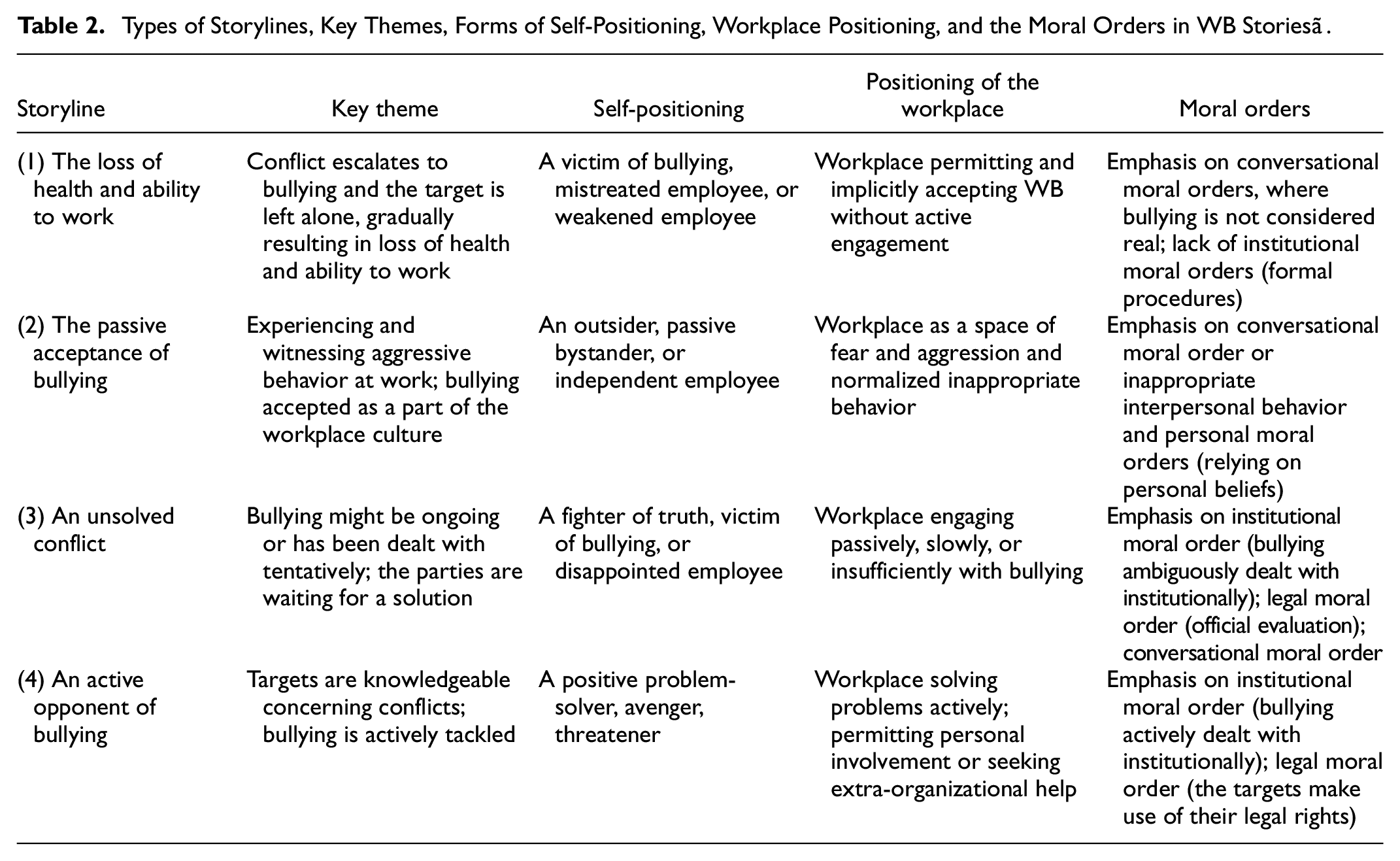
Each storyline describes the varying relationships between the bully and the target through different narrative conventions or plots. The storylines were developed based on the narrator’s perspective of the WB process, including its progression and conclusion. These diverse storylines illustrate the dynamics of WB in terms of self-positioning, other-positioning, and workplace positioning. Next, we present our findings according to the types of storylines, emphasizing the various forms of relational self-positioning and the portrayal of the workplace or work community within each storyline. We conclude the presentation of each storyline by emphasizing the role of moral orders within the respective storyline.
Storyline of Loss of Health and Ability to Work
This WB storyline centers around well-being at work, where the bullied position themselves as either victims of bullying, mistreated, or weakened employees. The targets may describe experiences of bullying in school or previous workplaces, suffering from different types of behavioral disorders and balancing between sick leave and work periods. These descriptions highlight the loss of personal agency due to the distressing nature of the bullying process, which can lead to nervous breakdowns, burnout, depression, or other severe symptoms of stress. Although the storyline initially presents a positive outlook, it ultimately concludes with the targets’ diminishing willpower and decreasing resistance to bullying. The storyline entails descriptions of malignant positioning (Sabat, 2003), incorporating various forms of aggression—such as verbal and nonverbal—as well as isolation, neglect, intimidation, humiliation, withholding of valuable information, lack of control, and attempts to portray the employee as incompetent within the work community.
In one of the WB stories, the course of events is described in the following manner: I came from a bigger company, and I was more experienced and qualified. I looked for a couple of years, but then the supervisor became incompetent, and the situation turned out to be completely uncontrollable. There were two perpetrators—two 50-year-old women—who, in each case, supported each other. Information was constrained, my work and actions were controlled, joking was common, others’ behavior was dismissive and disrespectful, I was humiliated in meetings, showed unpleasant facial expressions, left out, denigrated, etc. The manager was not able and did not dare to tackle things, leadership was bad, and bullies took over the role of the boss. Eventually, the boss began humiliating me and questioning my actions. (Narrative 94)
The excerpt above aptly portrays the characteristic of this storyline with a positive beginning that gradually transforms into a negative experience. Here, the target positions themselves as a victim of bullying, subjected to control, disrespect, and accusations from others. The construction of this position is in relation to two perpetrators and their supervisors who engage in malignant positioning. Malignant positioning serves the purpose of justifying negative actions against bullied colleagues and making the process socially acceptable within the work community. As a consequence of sustained malignant positioning, the bullied individual may experience the deprivation of rights and responsibilities within the work community. This is evidenced through concrete manifestations of humiliation—such as the loss of a designated workspace, unfounded allegations, ridicule during meetings, deterioration of reputation as a colleague, and accusations of mental instability, inadequate skills, or poor work performance. Consequently, the workplace is portrayed as an environment that fosters bullying, wherein the target has the right to seek assistance, but the workplace itself bears no duty to act or provide guidance in resolving the issue.
This storyline specifically focuses on the target’s attempt to cope with WB independently, without any assistance from colleagues, occupational healthcare officers, supervisors, or a shop steward. Initially, the target may exhibit a fighting spirit for rights and justice, despite the inherent power imbalance. However, eventually, the target succumbs to the malignant positioning emanating from a manager or colleagues. The process may involve intimidation, and the bullies might even acknowledge resorting to violence against the bullied individual: I tried returning to work, and during the first day, I was invited to the managers’ room. I was told that if I say anything about past events to anyone, all assignments will be taken away from me. I was told that no one was going to do anything about me being subjected to violence. Threats continued for a while, and I was allowed to return to work. I immediately went on sick leave again. (Narrative 106)
The extract above illustrates the target’s self-positioning as a mistreated employee controlled by others in the workplace. In this case, bullying has taken place in the past and the target is currently attempting to recover and cope with the situation. However, the managers’ continued malignant positioning made it unbearable. It is common to observe recurring cycles of bullying without any consequences, thereby leading to the domination of the negative storyline and positioning the target as a weak and unworthy employee and reinforcing the victimization. Moreover, the target moves from a position of a fighter of rights and justice to a victim of bullying. Simultaneously, the target’s health may deteriorate, evidenced by increased sleep problems, declining mental well-being, and a higher frequency of extended sick leave periods.
In certain cases, the target may have attempted to defend their position in the workplace, but WB is not taken seriously by the management or other authorities, such as occupational health care officials or shop stewards: I had a nervous breakdown due to the constant lying, commenting and gossiping behind my back. I went to occupational health [and] got a referral to the psychiatrist. I reported the bullying to the supervisor, [but] no measures [were taken]. (Narrative 104)
Here, the target positions themselves as a mistreated employee, as their concerns have not been taken seriously, implicitly referring to the bully, while positioning the supervisor as someone who permits the continuation of the bullying process. Consequently, the workplace is depicted as an organization that fails to fulfil its responsibility to address bullying. The prevailing negative storyline, combined with the inability to reposition oneself and the absence of impartial parties, exacerbates the burden placed on the bullied individual, weakening them. In summary, the target’s position frequently transitions from that of a respected colleague to a troublesome employee, prone to errors and inefficiency.
The impaired agency of the target and the lack of support or acceptance for their perspective in a problematic situation are crucial factors. When the management in the work community fails to recognize bullying and takes no action to address the situation, it further undermines the target’s faith in receiving fair treatment. Consequently, the locally established conversational moral order becomes the sole determinant of the rights and responsibilities of the bully and the bullied individual in the workplace. While this moral order is typically regarded as temporary in daily life (van Langenhove, 2017), it gains dominance in shaping the discourse regarding rights, responsibilities, and personal characteristics in the loss of health and agency storyline. Legal or institutional moral orders are not present in this storyline, thereby allowing the bully to exploit the power imbalance and impede any potential repositioning.
Storyline of Passive Acceptance of Bullying
This storyline centers around narrators’ descriptions of finding themselves in a chaotic workplace setting, where they perceive themselves as outsiders, passive bystanders, or independent employees within their work community, which is close to victimization (Aquino & Lemertz, 2004). WB often commences upon an employee’s entry into the work community, characterized by direct acts of malignant positioning and aggressive behavior. Those who are bullied are unable to reposition themselves in relation to the malignant positioning.
In this storyline, a new employee enters an unfamiliar work community dominated by a local conversational moral order, often created by the manager, which does not pay attention to the employee’s status. A supervisor, colleague, or group of co-workers act freely without any restrictions from the management. Bullying not only affects the targets but often also all members of the work community. Consequently, conflict spreads to the entire work community, particularly if the community is small.
The bullying began when the new supervisor came to the work community. The supervisor’s behavior was completely inappropriate. He was in constant rage every morning. He does not greet us and was constantly screaming, swearing, nullifying professional skills, insulting and so on, even in consultation with customers. He would typically blurt out, “Are you so fucking stupid that nothing goes to your cabbage?” (Narrative 115)
In the above extract, the target positions themselves as an outsider and a witness to bullying behavior in relation to a supervisor who is positioned as behaving completely inappropriately. Despite aggressive behavior, the bullied employee often retains their ability to act and work, but they see no prospects for change to occur soon. Due to the stressful malignant positioning, the bullied employee distances themselves from the workplace culture and adheres to a personal moral order that guides their actions. Consequently, the workplace is once again positioned as a community that implicitly tolerates bullying and inappropriate conduct. Nevertheless, the target often expresses a desire to continue working in the same place or, if necessary, consider seeking new employment or pursuing further education. This indicates that the direct malevolent positioning does not entirely define their identity and the individual lives in accordance with their personal moral order, which is based on various cultural moral orders.
In this storyline, descriptions regarding the power dynamics in the workplace are often addressed. One-sided power dynamics can pose challenges in effectively managing organizational activities. The stories entail descriptions in which instructions are constantly changing, open lying is common, and constant shouting burdens the employees. However, the conflict situation prevents the targets from altering the circumstances.
Then, it started to happen. One person could not withstand the most recent arrival, but began back talking and squawk, and did it so willingly, slowly, and deviously that the victim did not know anything about it for the first couple of years! Of course, he was surprised when the job was quite chaotic for him; things did not go well; nobody taught, helped, or explained; and all kinds of strange things happened all the time. Shifts were done with a small number of employees, but it was a good basis for the bully, who produced all kinds of fairy tales and was so convincing and credible that everything went through whatever he invented to hurt his victim. (Narrative 132)
In the extract above, the narrator assumes the position of an outsider and passive bystander as they witness an episode of WB. The target is positioned as a mistreated victim in relation to the bully. However, the bullying is reinforced by others who are positioned here as helpers to the bully (e.g., “nobody taught, helped, or explained”). Additionally, the workplace is regarded as one that enables bullying. Consequently, the workplace is positioned as a chaotic environment for the target, which reinforces bullying. From the target’s perspective, the passive acceptance of the bullying storyline does not have a separate final or concluding stage: the target often continues their work, although resignation and a change of job may be contemplated. This decision may take many months or even years.
I was removed from a job that was promised to be made into a permanent employment half a year after my apprenticeship ended. My contract was never regularized, despite all promises and the position was given to my boss’s relative and their good friend. I was criticized openly by the boss as “sluggish and unproductive” and I was forced to hand over customers and assignments to these two as they plead to “specialization,” even though I already had too few assignments. I started to question the solutions for why assignments were taken from me. I was bullied, my mental health and professional skills were called into question, and my religious beliefs were criticized too. I was deliberately made into a “troublemaker” not suitable for the work community. (Narrative 159)
The above extract highlights the third type of self-positioning in this storyline, as the target positions themselves as an excluded employee who is also forcefully positioned as a “troublemaker” in the work community. The position is constructed in relation to the overly critical manager, who openly criticizes the target and retaliates against their attempts to question such behavior by taking away their assignments and questioning their professional competence. Even though the target actively pursues corrective actions, they end up in a situation in which they are positioned as an excluded employee. Here, the workplace is positioned as an environment that enables incrimination and active pursuits to correct mistreatment are not taken seriously.
In this storyline, a local conversational moral order is established by workplace bullies, which unilaterally defines rules, rights, and duties, without open discussions. Unlike the other storylines, the work community in this storyline lacks an institutional or legal moral order that would set boundaries for bullying or aggressive behavior toward employees or provide support for the victims of workplace bullying. Consequently, those who are bullied perceive the work organization as chaotic, governed by inept leaders or a powerful group of individuals within the organization. In terms of rights and duties, these employees are regarded as having limited or no legal status. The bullied individuals are left with two options: either accepting malignant positioning and inappropriate actions as normal aspects of the workplace or considering resignation.
Storyline of an Unresolved Conflict
This storyline (n = 41) focuses on the final stage of WB, where individuals await a resolution from their supervisor or the upper management, lacking definite information regarding the course of treatment. The targets of bullying not only perceive bullying as a past occurrence but also as an ongoing and significant aspect of their lives. The storyline revolves around actors who position themselves as fighters of truth, victims of bullying, and disappointed employees who influence the unfolding of events. Conflicting perspectives on work-related rights and duties exist between the parties involved in the conflict. The targets demonstrate their ability to challenge the bully and criticize inappropriate behavior. Moreover, the targets typically seek assistance from multiple authorities, such as occupational health care officials, upper management, shop stewards, or trade union lawyers. This recognition of WB as an official problem within the work organization implies that it has not been fully addressed legally and institutionally.
The bullied may have brought up the matter several times with their supervisor, but the issue is not appropriately addressed at the workplace, evidence of bullying is insufficient, or the process is just beginning.
My boss is a great person and has intervened, but not in a way that would have brought front the bullying. I don’t blame them because the bully is hard to identify. We were dragged to a conversation together, but to no avail, because the representative of the employer and the occupational health care did not notice the constant lying and manipulation of my bully. The situation is further complicated by the fact that my co-worker claims me to be the bully. When each sticks to their own argument, the employer announced inability to do anything, when there is no evidence and urged us both to look in the mirror. (Narrative 164)
Here, the employer’s inability to intervene is associated with a situation where both the bully and the bullied claim to be victims. The matter has not been addressed in accordance with the desired outcome of the target, who positions themselves as an advocate for rights and justice, despite also being accused of bullying. The target’s self-positioning is constructed in relation to the bully, who perceives themselves as a victim of bullying, and the manager, who has been unable to effectively resolve the situation. Despite the circumstances, the target remains proactive and perseveres in seeking support and justice. Consequently, the workplace is depicted as a community that regards WB as an issue rooted in interpersonal relationships and is expected to be resolved by the individuals involved.
This storyline does not differ significantly from other narratives, such as the loss of health and ability to work storyline. Conflict within the work community has previously led to issues in worker interactions, possibly persisting for several years. Notably, despite the presence of a bully and a target, both individuals remain employed in the same workplace, even if the target lacks work assignments. Changes occur without prior notification, thereby resulting in the removal of rights and duties without undergoing proper institutional procedures.
My assignment was moved abroad without consulting me. When I first wondered, the HR manager said that I could always give up if I did not like it. There has not been a denunciation, and I will not resign myself. New people have been recruited to the workplace, and there are jobs that are relevant to my work, but they are not offered to me. My supervisor is also a chief steward. (Narrative 82)
Here, the targets position themselves as isolated from the workplace due to their lack of control over events and the presence of unbalanced power relations. New jobs or assignments were not offered, and the supervisor assumes a dual role within the organization, thereby freezing the conflict. In this storyline, the target is unable to reposition themselves in relation to the bully. Additionally, occupational health officials may have disregarded the significance of workplace bullying, despite the target having made multiple complaints. The dynamics of this storyline suggest that something or someone impedes or halts the resolution of the bullying situation, thereby causing anxiety for the target.
Further, in the storyline of unresolved conflict, bullying is typically treated seriously but often concludes with an ambiguous or inconclusive outcome, which proves disappointing for the target. In most of the stories, the WB incident has caused significant stress and raised doubts regarding employees’ ability to assert their rights and the organization’s capacity to effectively intervene in bullying cases, particularly when clear evidence is lacking or the bully denies any wrongdoing.
The supervisors and occupational health care (as well as I) suspect that I was bullied because of jealousy (long work experience, etc.). Now the case is closed as for the occupational health, but I have not had my superiors participate in the aftercare, although the matter has been talked about and they have been positive about it. Right now, I feel somewhat betrayed, and I think about it 24/7. I have contacted the trade union and other authorities who urge supervisors to do their part. (Narrative 2)
In the above description, the bullied person balances between two opposite positions: a fighter of rights and justice and a betrayed or disappointed employee. The dynamics of self-positioning are related to a lack of final decision on who has acted wrongly and what the consequences of bullying are. The workplace is depicted as a community where the issue of bullying remains unresolved. In this storyline, the targets often describe feeling disappointed by the institutional practices and inactivity of officials, although the bullying case may have contradictory features. Some facts may support the targets’ views, while others may be against them.
The role of moral orders in this storyline differs from that in the other storylines. Those bullied may have engaged in discussions about the bullying incidents with their supervisors and other responsible authorities. This indicates that the bullied have countered the actions of the bully and repositioned the case. Consequently, this suggests that legal, moral, and institutional orders are functioning effectively, as the organization has implemented anti-bullying policies (e.g., Hodgins et al., 2020) and addresses bullying officially within the organization, rather than considering it a part of conversational moral orders established through interactions between the bully and the target. The targets can defend their rights, and the manager and authorities handle bullying incidents. However, the targets are uncertain about their future, lack trust in the justice system, and may be skeptical with regard to their ability to assert their rights and express their perspectives on workplace events. Consequently, they perceive that the legal, moral, and institutional orders do not offer them sufficient support, despite their active efforts to seek assistance from various individuals throughout the bullying process.
Storyline of an Active Opponent in Bullying
In this storyline (n = 9), the targets maintain agency throughout the bullying process. They resist the adversary by leveraging their knowledge of WB-related issues and their skills in handling them. Consequently, they possess the capability of repositioning themselves and challenge the negative narrative crafted by the bully. This storyline distinguishes itself from others, as the targets are not abandoned by others in the bullying situation. Instead, they are empowered to seek institutional measures to address bullying, express their perspectives, or actively protest against the bully and their allies. Consequently, the targets are positioned as positive problem-solvers, avengers, or agents of change, and the storyline centers on the social change within the workplace brought about by this positioning.
As mentioned earlier, the targets take an active role in defending their rights and duties, lodging complaints regarding bullying to their managers or supervisors. It is imperative for this process that the manager is proactive and recognizes the significance of engaging in official discussions with both conflicting parties.
I mentioned the matter to him [supervisor]. I wanted to continue discussing what had happened while he was on sick leave. This led to a meeting with my own boss and Bigmouth’s superior. I insisted that Bigmouth should be there because of his attitude problem, having assumed the right to say inappropriate things to people and called this the workplace culture. I recorded the conversation using the voice recorder on my phone. I said what happened and made it clear that it was not over. I also wanted to be sure of what could be done in the future and that there was no need for me to listen to Bigmouth’s shouting. In a previous meeting, Bigmouth had not admitted his wrong attitude and had apologized and behaved in a bitter way about the issue. No agreement was reached at the meeting, but Bigmouth’s boss promised to discuss the case with him. Fortunately, the shop steward changed. I was able to discuss the situation with him too. As a solution, he suggested that the work community would discuss the problem. Two weeks later, Bigmouth came to chat with me, saying he was sorry and would change his behavior. (Narrative 161)
This extract highlights the target’s positioning as a proactive problem-solver in WB. The target positions themselves in response to their boss’s inappropriate behavior. While WB is addressed and taken seriously, the target’s personal skills enable them to effectively handle the issue, such as by documenting official conversations. This example highlights the active efforts of the bullied individual to reshape the moral orders of the workplace, thereby aiming to prevent future instances of bullying.
The target possesses information pertaining to managing and preparing for workplace bullying (WB). The active role of a problem-solver within the professional community produces favorable outcomes. Furthermore, informing a supervisor or occupational health authorities about incidents of bullying initiates an evaluation of the case and subsequent actions. Additionally, the opposition’s attempts to impede the target’s actions do not reduce their capacity to readjust and assert themselves. Moreover, the work community might already possess awareness regarding the problematic behavior exhibited by the alleged bully.
In this storyline, the target does not lose their official rights or duties at work but may voluntarily quit after getting a new job. From the target’s perspective, the official process leads to a positive result—the bully is formally held accountable for their actions due to the target’s initiative. In a few cases, this process may cause changes in the entire work community; however, the supervisor and other parties involved in WB must address the issue at the workplace.
I got into working ability assessment through an employment agency and talked about my management, and also showed my work history to the doctor who wondered greatly. Then things began to happen. The manager was sacked and got a taste of one’s own medicine. I hope I don’t have to deal with that person ever again—he’s like air to me. (Narrative 65)
The extract above illustrates self–other positioning in which the target positions themselves as an avenger in relation to the bully and a winner in a stressful struggle for rights. This example demonstrates how the official authorities responsible for dealing with WB have legal and institutional power to end the bullying process, even though it demands difficult measures against the bully.
One of the stories following this storyline focuses on both individual and collective positioning in WB. The following example demonstrates positioning that does not only focus on the actions of the target but also on colleagues who support the target; the sudden changes in the workplace end the bullying by chance.
Almost exactly a year ago, I was leaving my long-term job because of bullying. I was allowed to “be at peace” on sick leave for 8 months, for my bully supervisor, of course, had no desire to resolve the situation and take the risk that I would return to work! Luckily, during the sick leave, the management of the house changed completely, and my co-workers started talking to the new management on my behalf. The new leader made organizational changes, and I got rid of my bully supervisor and two co-workers who were responsible for the mess. (Narrative 166)
Here, the target positions themselves as a lucky employee who benefitted from changes in the workplace and the help received from their colleagues. This example highlights the interpersonal and relational nature of the WB process, where other members of the workplace can actively engage in ending the bullying. Consequently, this results in new arrangements within the workplace, wherein the target must no longer cooperate with the bullies.
Considering the moral orders, the active opponent in bullying storyline differs from other storylines in certain aspects. First, while the conversational moral orders that emerge during interactional positioning serve as the origin of WB, other moral orders also play a crucial role in the process of repositioning and counter-positioning. Consequently, the malignant positioning (Sabat, 2003) adopted by the bully is questioned by both the target and the organization, thereby incorporating legal, and institutional orders within WB. Thus, the conversational moral order is not the sole guiding force in the process; rather, the institutional rules and rights associated with an organization’s anti-bullying policies also contribute to this. Second, because of the management’s involvement, the validity of negative storylines produced by the bully is challenged, and the bully may even admit to engaging in malignant positioning during bullying-related meetings. In other words, the bully’s positioning fails, while the bullied succeeds in transitioning from a negative to a positive positioning.
Discussion and Conclusion
In this article, we considered WB from the perspective of the PT as a relational phenomenon, of which the targets of bullying have formed their own understanding, and which is based on moral orders typical for the targets’ workplaces. In the first storyline, the loss of health and ability to work, the bullied lose their ability to work due to malignant positioning and their rights to defend or act against the opponents; they are not supported by legal, moral, or institutional orders. The second storyline, the passive acceptance of bullying, depicts events in which the targets are not able to defend themselves by repositioning or fighting against the bully and instead come to accept bullying as an inherent part of the workplace. In the third storyline, an unsolved conflict, WB is not fully dealt with at work and both parties wait for the management’s decision regarding bullying, rights to act, and duties. Lastly, in the fourth storyline, an active opponent in bullying, the targets actively seek a positive resolution, assert their rights and duties, and successfully hold the bully accountable for their misconduct. This outcome is facilitated by the support of legal, moral, and institutional orders.
The positioning analysis of WB stories broadens the relational and interpersonal approaches established by Aquino and Lamertz (2004). Our study reveals that the phases of WB can have varying forms and interaction dynamics, depending on the role of power and positioning within each storyline. The phases of the WB process identified in the storylines are in alignment with Lutgen-Sandvik’s (2008) findings on pre-bullying, bullying, and post-bullying phases of WB. However, the post-bullying phase is absent from the third storyline. The examination of these bullying storylines sheds light on two crucial issues. First, according to the PT, individuals possess distinct rights and duties within the workplace or may entirely lack such rights and duties. If bullying persists, an asymmetrical power relationship emerges between the bully and the target, thereby signifying relational powerlessness (Hodson et al., 2006). In situations of imbalanced power relations, the bully exerts control over actions, while the target becomes dependent on resources. This power imbalance facilitates the occurrence of bullying (Hodgins & McNamara, 2019b; Patterson et al., 2018). Second, from the perspective of the PT, WB occurs within the context of moral orders that legitimize the use of power and may position the bullied individual as professionally inadequate and unskilled. Consequently, an analysis of moral orders becomes crucial for comprehending the narrative content of WB stories as subjective descriptions of the bullying process (Zabrodska et al., 2016).
This study demonstrates that targets employ various positioning strategies to address WB. Coping strategies are a consequence of the stress reactions caused by workplace bullying. The individual forms of coping strategies may range from avoidance to active confrontation (Karatuna, 2015; Lewis, 2006; Simons & Sauer, 2013). Contrary to viewing coping as an individual personality trait, the PT suggests that the forms of positioning are contingent upon the target’s position in the moral order, their ability to counter-position, and the interaction dynamics between the bully and the target. In our study, the first and fourth storylines serve as examples of active confrontation, which result in either negative or positive outcomes. On the other hand, the second and third storylines exemplify passive acceptance of bullying. Nevertheless, all the storylines encompassed more concrete forms of positioning, such as maintaining distance, developing resilience, or reporting bullying incidents to a manager. As stated by MacIntosh et al. (2010), WB invariably alters the meaning of work, as demonstrated by the content of the various storylines described here.
Further, the findings of our study highlight the diverse processual pathways of WB. While organizations are rarely held responsible, targets actively strive to find constructive solutions to bullying (Lewis, 2006). WB commonly occurs within conversational moral orders that involve co-workers, managers, and employees. The official process of WB is seldom guided by the organization’s legal, moral, and institutional orders. If conflicts go unnoticed or remain confined to conversational or personal moral orders, they can escalate into bullying situations where targets have minimal opportunities to defend their rights and duties. Hodson et al. (2006) posit that job insecurity and organizational chaos commonly lead to bullying, as particularly depicted in the second storyline. The first two storylines of WB illustrate how targets lose their rights and duties when managers or the entire organization evade open discussions on interpersonal conflicts and bullying. Managers play a central role in preventing, permitting, or participating in the mistreatment of others (Woodrow & Guest, 2017). Only in the active opponent in bullying storyline did targets actively participate in bullying, thereby demonstrating a heightened awareness of dealing with WB and achieving success in their struggle, which aligns with Karatuna’s (2015) findings. Numerous bullying cases reported in this study were left unaddressed by the respective organizations due to inactivity, lack of evidence, or unwillingness to confront the issue. This observation confirms Lewis’ (2006) assertion that the identification and recognition of WB may pose challenges for targets and organizations alike.
Our findings are similar to other studies on WB based on sense-making research and a narrative approach, which conceptualize WB as a dynamic process driven by active agency (Ng et al., 2020). Congruent with Zabrodska et al. (2016), our findings highlighted the destabilization of the target’s identity at the onset of WB, which was evident in all storylines, but it was particularly emphasized in the loss of health and ability to work storyline. Tye-Williams and Krone (2015) also found similar results in their study on WB stories, although the role of narrative agency was not a focus of our research. Nonetheless, their classification of bullying stories into chaos, report, and quest narratives aligns with our analysis, as these narrative types are present in all four storylines. In alignment with Vickers’ (2007) analysis of a bullying story, the bullying process in our study impacted the targets’ self-identity, inducing fear and caution, particularly in the first storyline.
Our study has a few limitations. First, a challenge in analyzing WB is the absence of perspectives from both the targets and perpetrators involved in the same hostile interactions that evolve into bullying. This limitation is also present in our study as well as in the study conducted by Zabrodska et al. (2016). Although our research includes descriptions from targets regarding the development of WB in their workplace, it is practically unfeasible to conduct naturalistic research on WB. Consequently, interaction studies are predominantly reliant on narratives provided by targets or actors. Second, our research does not encompass the perspectives of third parties involved in bullying cases, as demonstrated in the study by Baillien et al. (2009). This limitation arises due to the nature of our data, which relies on online stories. Nonetheless, it is possible to interpret these online bullying stories as representative of typical WB scenarios, unveiling common communicative dynamics and recurring patterns of WB positioning resulting from power imbalances. Halkier (2011) argues that positioning analysis as a method aims to generate analytical generalizations regarding repetitive interaction patterns or practices, which aligns with this interpretation.
We suggest two key areas for future research on WB, which have received little attention thus far. First, our study does not say much about the role of management and other authorities in dealing with WB. Although constructive leadership is considered best practice in WB, the question of management’s role is more complicated (Woodrow & Guest, 2017). However, our analysis reveals that in numerous cases, managers were not willing to deal with bullying and did not allocate time to organize meetings on WB or considered them unnecessary. All these reasons to neglect WB need more attention. According to Woodrow and Guest (2017), managers should be placed at the centre of the bullying process. Second, our study underlines the role of bystander behavior in WB. In our study, the targets were often alone in their experiences of bullying without getting any support from co-workers, although co-workers are considered to play a crucial role in the development of and intervention of negative workplace dynamics (Lutgen-Sandvik, 2006). Without collective support, targets have few options to choose from. Therefore, bystanders are now considered a part of the problem and, therefore, also as a possible part of the solution of WB (Ng et al., 2020). However, further studies are needed highlighting the relational aspects of bystander behavior in acceptance of WB, and the role of employees’ rights and duties enabling or restraining bystanders becoming a part of the solution of WB.
Footnotes
Declaration of Conflicting Interests
The author(s) declared no potential conflicts of interest with respect to the research, authorship, and/or publication of this article.
Funding
The author(s) received no financial support for the research, authorship, and/or publication of this article.

Data Availability Statement
Data sharing not applicable to this article as no datasets were generated or analyzed during the current study.