



Abstract
Based on Roemer’s theory of inequality of opportunity, this study constructs a multi-dimensional analytical framework consisting of family background, school climate, and individual efforts to explore the influence mechanism and contribution of these three factors on academic performance. By using linear regression models and Shapley value decomposition methods, the study analyzes the questionnaire data of 3,011 Chinese college students. The teacher-student relationship in the school climate has the highest contribution (29.12%). The total contribution of external environmental factors composed of family and school exceeds 70%, indicating that the phenomenon of opportunity inequality in academic performance is significant; the moderation analysis indicates that individual effort strengthens the positive effects of family background (t = 2.094, p < .05) and school climate (t = 3.666, p < .01) on academic performance. Additionally, the heterogeneity analysis reveals differences across urban-rural areas, gender, and school levels. The research suggests that educational equity requires joint actions from society, schools, and other key stakeholders to compensate for and/or lessen the negative effects of adverse environments, and at the same time, reward and encourage student academic performance.
Keywords
Introduction
Educational equity has become a deeply rooted value worldwide (Appels et al., 2023), serving as one of the core mechanisms for promoting social mobility globally (Best, 2024; Brown et al., 2013). It is a cutting-edge topic of common concern in disciplines such as education, sociology, and economics. Academic performance is a crucial indicator for measuring educational equity (Kelly, 2015; Nachbauer & Kyriakides, 2020), which is not only influenced by the students’ own abilities and qualities (He et al., 2024), but also affected by environmental factors such as family (Coleman, 1968), school (Zysberg & Schwabsky, 2021), and community (Ruiz et al., 2018). Due to the significant systemic impact of the complex external environment on individual growth and development (Niere et al., 2020), researchers have gradually begun to explore the interactive effects among family, society, school, and individuals (Epstein et al., 2018). With the continuous deepening of research on educational equity, researchers have found that the relative contributions of various factors in the formation of academic achievement lack refined integration studies and quantitative measurements (Payandeh et al., 2013), which has restricted the provision of more equitable educational opportunities in practice.
With the continuous deepening of discussions on the connotation of the concept of “fairness” in fields such as political philosophy, economics, and social welfare, in the research on educational equity, researchers have gradually shifted from focusing on outcome fairness to emphasizing process fairness. Roemer’s (1998) theory of inequality of opportunity (IOp) has gradually been applied to educational research. IOp not only establishes a significant relationship between environment and outcomes, but more importantly, it helps us identify the variables affecting academic performance by measuring the degree of inequality and providing an “environment–effort” theoretical analysis framework for educational equity research.
In this context, this study posits three core research questions:
How significant is the influence of environmental factors such as family background and school climate on students’ academic performance?
Under the condition of controlling for the interaction effects of variables, what are the differences in the degrees of contribution of each dimension factor in academic performance?
To what extent can individual effort change the return rate of academic performance brought about by external environmental factors?
This study is based on the global context of unequal opportunities so a multi-dimensional analytical framework that includes family background, school climate, and individual efforts was constructed. A multiple linear regression model was used to analyze the influence of each variable on academic performance, and the Shapley value decomposition method was employed to quantify the relative contribution of different factors to students’ academic outcomes. Furthermore, moderation effect testing was employed to explore the interaction effects between individual effort and the external environment. It is hoped this theoretical framework operationalized through this data analysis strategy could reveal the mechanism of unequal opportunities in the environment–effort interaction relationship. This study provides a new methodological paradigm combining regression analysis and contribution decomposition for research on educational inequality, and can promote the evolution of educational equity ecosystems toward a direction where “effort has fair rewards,” providing new analytical dimensions and intervention paths for social mobility in China.
Literature
Inequality of Opportunity
Distinguishing between morally acceptable and unacceptable inequalities is one of the important debates in political philosophy (Young, 2001). Since 1958, there has been a lot of discussion in this field (Rawls, 1958). Because it involves real-world issues such as social welfare distribution, economists have begun to pay attention to how to measure opportunity equality to achieve more just social welfare distribution. Roemer’s (1993, 1998) method and related concepts, which are a modification of resource egalitarianism (Dworkin, 1981), have had a significant impact on the development of this field.
Roemer’s (1998) theory of opportunity inequality (IOp) stems from the criticism of traditional egalitarianism. Its core underpinning lies in distinguishing the heterogeneity between circumstantial inequality caused by environmental factors and acceptable inequality caused by differences in an individual’s effort. He argued that the essence of opportunity equality is to eliminate the unfair influence of environmental factors on the outcome, and to make the final achievements mainly determined by the accountable individual efforts. He classified the population by environment and measured the individual responsibility in the unequal results based on the percentile distribution of efforts within the same type. By 2012, Roemer transformed the abstract concept of opportunity equality into an operational policy tool. His environment–effort theoretical framework has become the benchmark for global research on opportunity inequality.
The environmental factors in education exhibit significant multi-dimensionality. IOp incorporates these factors into a unified framework. By analyzing the contributions of different environmental dimensions to academic performance, it is possible to identify key intervention targets. IOp not only focuses on the direct impact of the environment on the outcome, but also emphasizes how the environment shapes effort. This analysis of the environment–effort interaction aligns with the realistic dynamics of educational inequality (Roemer & Trannoy, 2016). Previous studies have mostly demonstrated the existence and changes of inequality through significant correlations between environmental variables and outcome variables. IOp provides a unique perspective, which can disentangle the harmful or unsustainable parts of outcome inequality and thereby measure the degree of inequality more accurately, which makes the use of IOp to measure environment–effort interaction on academic performance of Chinese college students a novel analytical approach.
Influencing Factors of Academic Achievement
Family Background
Family is not an objectively fixed and uniformly defined entity; rather, it is a fluid, complex social construct. It is usually regarded as the cornerstone of social stability, fulfilling functions such as emotional support, child rearing, and economic cooperation (Reshef, 2013). The traditional concept of family is essentially an ideological tool, and it is necessary to be cautious about its concealment of diverse realities and subtle maintenance of inequality. Family research should focus on how individuals construct and experience family meaning, as well as how different family types adapt to social changes (Bernardes, 1999). Since Coleman (1968) pointed out the significant correlation between family background and academic achievement, researchers have found that factors such as family culture (Bourdieu & Passeron, 1979), family socioeconomic status, family structure, and family environment (Hattie, 2008) all have substantial impacts on academic performance. Likewise, studies have confirmed that in China, family background influences students’ educational attainment and educational equity (Jin et al., 2024; Li & Qiu, 2018), and family socioeconomic status also significantly affects academic achievement (Liu et al., 2020). As the exploration of the relationship between family background and academic performance has gradually deepened, researchers have focused on the mediating role of school atmosphere (Alhosani et al., 2017) and individual initiative (Weiser & Riggio, 2010). However, in the field of educational sociology, due to the limitations of research methods, the strength of the influence of family background on students’ academic performance has not yet been adequately studied.
School Climate
After controlling for factors such as family background, schools continue to play a significant role in educational equity (Borman & Dowling, 2010). School climate, as the core characteristic of the educational organization environment, has been developed and refined since the 1960s (Halpin & Croft, 1962) and has remained a research focus in the fields of education and psychology. School climate is a psychological, emotional, and cultural environment jointly constructed by administrators, teachers, and students, which influences the cognition, emotions, and behaviors of all the school’s stakeholders through values, interpersonal relationships, and behavioral norms. It encompasses physical environments (e.g., buildings and facilities), social environments (e.g., teacher-student relationships and peer relationships), and academic environment elements (e.g., teaching quality and teacher qualifications; Kutsyuruba et al., 2015). Previous studies have confirmed that school climate has had a positive correlation with students’ academic performance (Dulay & Karadağ, 2017). A positive school climate is not only an important indicator for measuring educational quality but also a key factor for improving students’ academic performance and abilities (Shindler et al., 2016). However, due to sample size and methodological differences, current research on school climate and students’ academic performance is mostly correlational, with an ill-defined causal mechanism, and the effect intensity and moderating factors still need to be further investigated.
Individual Efforts
Almost anything worth doing takes effort, so it is no surprise that effort has played such a central role in how researchers, theoreticians, instructors, and even students think about student learning and achievement (Dunlosky et al., 2020). Individual efforts typically include elements such as study time investment, learning motivation, strategy selection, and persistence (Muenks & Miele, 2017). Individual effort is an important driving force for achieving academic success, but its effect is moderated by environmental support, strategy adaptability, and psychological cognition. In terms of the relationship between environment and effort, an individual’s effort is a response to the environment and is to some extent determined by the environment (Roemer, 1998).
Students’ awareness of effort is also influenced by the values of family members (M. Jin et al., 2024), while family support can amplify the effect of effort (Menges et al., 2017). Similarly, high-quality teachers in schools can also stimulate the motivation for effort (Turhan et al., 2019). In IOp, one the one hand, the educational achievement disparity caused by external environmental factors such as family background and school climate are a possible external harbinger to unequal academic outcomes. On the other hand, effort as an individual behavior characteristic that a person can be responsible for and is something that an individual to some extent can control and change. That is, academic performance disparities caused by effort are understandable.
Method
Measurement
The study employed a five-point Likert scale for measurement, with 1 indicating strong disagreement and 5 indicating strong agreement. According to the research design, the dependent variable, academic performance (AA), was measured by the ranking of the average grade point (GPA) in the class. The study also incorporated self-reported scores in specialized courses (PG) and general education courses (GG) for robustness checks. Additionally, based on the variable design of related studies (Berkowitz et al., 2016; Lasso et al., 2019; Payandeh et al., 2013; Roemer & Trannoy, 2016; Weiser & Riggio, 2010), the family background (FB) section in the questionnaire measured the urban-rural status of the family’s household registration (FB1; 1 = rural, 2 = urban), the marital status of parents (FB2; 1 = intact, 2 = divorced), the number of siblings (FB3), the father’s educational attainment (FB4), the mother’s educational attainment (FB5), family expectations (FB6), family social status (FB7), and family economic conditions (FB8). The school climate (SC) section measured educational activities (SC1), teacher-student relationship (SC2), and classmate relationship (SC3). The individual effort (IE) section measured learning engagement (IE1), learning methods (IE2), and effort awareness (IE3).
Pretest of Measurements
After the draft of the research questionnaire was completed, four researchers specializing in higher education and four researchers in educational sociology were invited to evaluate the validity of the questionnaire. Both face validity and content validity were assessed during this review. The experts examined whether the questionnaire items were clear, understandable, and appeared appropriate for measuring teachers’ digital competence (face validity). They also judged the extent to which the items were relevant and representative of the constructs being studied (content validity). Based on their feedback, several items were revised for clarity and precision, some redundant questions were removed, and additional items were added to better capture certain aspects of digital competence. These expert-recommended modifications helped the questionnaire more accurately and comprehensively measure the constructs under study.
The pretest was conducted in October 2024 using offline paper questionnaires. We recruited 128 college students to take the pretest to measure the questionnaire’s internal consistency and reliability. The results showed that the Cronbach α coefficient of the questionnaire was .832 (>.8), indicating a high level of questionnaire reliability. The absolute values of standardized loading coefficients were all greater than 0.6 and were statistically significant, meaning that the questionnaire showed good internal consistency and reliability for the constructs under study.
Data Collection
This study was conducted in China. Data were collected using offline paper questionnaires. Convenience sampling and random stratified sampling (Hedt & Pagano, 2011) were utilized for questionnaire distribution. The main study was conducted from November 2024 to April 2025, with a total of 3,200 questionnaires distributed, and 3,011 valid questionnaires were retrieved, an effective retrieval rate of 94.09%.
Because family background variables—such as the urban-rural status of household registration, family structure, and parents’ educational attainment, all of which are unordered multi-category variables—are typically treated as control variables in most educational research, the researchers in this study believed that the strict validity assumptions for these variables could be relaxed (Hoogerheide et al., 2012). Therefore, during the reliability and validity tests, these categorical variables were excluded, and family expectations (FB6) was treated as a separate dimension, while family social status (FB7) and family economic conditions (FB8) were tested as a common dimension. The collinearity analysis showed that all included variables had VIF values below 2 and tolerance values above 0.2, indicating no multicollinearity issues. The commonality values corresponding to all research variables were higher than 0.4, indicating that the information could be effectively extracted from the data. The KMO value was 0.829 (>0.6), meaning that the data can effectively extract information. Moreover, the explained variance ratio of the four factors were 20.910%, 20.641%, 16.051%, and 11.104%, and the explained cumulative variance rate after rotation was 68.705% (>50%), both of which indicate that the information of the research variables can be effectively extracted from the data. The descriptive statistical results of the research variables are detailed in Table 1.
Descriptive Statistical Analysis of Variables.

Data Analyses
This study used the Shapley value decomposition to decompose the influence coefficients of college students’ academic performance, and explore the contribution degrees of the independent variables: family background, school climate, and individual efforts. Using Stata 18 software, multiple linear regression was used to examine which independent variable (e.g. family background, school climate, individual efforts) would significantly affect the academic performance of college students. Six models were constructed to explain the impact effect of the independent variables. Shapley value decomposition combines traditional regression equation decomposition with Shapley value, which can decompose the inequality of the target variable into determining contributing factors and quantify each regression variable’s contribution to the dependent variable’s inequality (Michiels et al., 2024). Additionally, within the “environment-effort” theoretical framework, to better examine the interaction effects among family background, school climate, and individual effort, moderation analysis was also employed to investigate whether the impact of family background and school climate on academic performance is moderated by the individual effort variable.
Results
Baseline Regression on the Determinants of Academic Performance
Before measuring the contribution and interaction effects of family background, school climate, and individual efforts on academic performance among Chinese college students, it was necessary to clarify the influence of each variable on academic performance. Table 2 shows the results of the multiple linear regression analysis of these models.
Baseline Regression on the Determinants of Academic Performance.

Note. Dependent variable = Academic performance. Excluding the F-values, the values in parentheses are t-values.
p < .05 **p < .01.
Model 1 examined the influence of family structure factors such as parents’ marital status, household registration type, and the number of siblings on college students’ academic performance. Parents’ marital status (β = −.159, t = −4.155, p < .01) had a significant negative impact on academic performance. Household registration type (β = .105, t = 3.382, p = .001 < .01) had a significant positive impact on academic performance. These results suggest that when parents’ marriage breaks down, it will have a negative impact on their children’s academic performance, which also confirms the conclusion of other researchers (Lui et al., 2020). Finally, the number of siblings did not have an impact on academic achievement.
Model 2 examined the influence of parents’ educational attainment on college students’ academic performance. In this model, the father’s educational attainment (β = .012, t = 1.084, p = .278 > .05) did not have an impact on academic performance. The mother’s educational attainment (β = .068, t = 6.231, p < .01) had a significant positive impact on academic performance, which again aligned with the significant impact of the mother’s educational attainment on children’s education acquisition found in the literature (Sengonul, 2022).
Model 3 indicated that the family expectation period (β = .106, t = 8.379, p < .01) had a significant positive impact on academic performance.
Model 4 included all independent variables of the family background dimension. When the model added the two independent variables—family social status (β = .137, t = 10.882, p = .01) and economic conditions (β = .119, t = 9.425, p = .01)—that had a significant positive impact on academic performance, parents’ marital status (β = −.052, t = −1.446, p = .148 > .05) no longer had an impact on academic performance.
These findings from Models 1 to 6 suggest that high family social economic status can provide support for children in terms of educational resources, social support, economic pressure, and nutritional health (Fan, 2012), which can eliminate some of the academic performance differences caused by family structure factors.
Model 5 demonstrates the impact of the campus atmosphere on academic performance. The diverse educational and teaching activities (β = −.044, t = −2.303, p = .021 < .05) had a significant negative effect on academic achievement. The teacher-student relationship (β = .238, t = 14.042, p < .01) had a significant positive impact on academic achievement, while the peer relationship (β = −.014, t = −0.799, p = .425 > .05) did not have a significant impact on academic achievement. These results indicate that in the measurement system where GPA is the standard for academic performance, participation in extracurricular activities unrelated to course learning can enhance students’ qualities and literacy, but not all extracurricular activities can promote the improvement of GPA (Kulp et al., 2019). Similarly, not all types of peer relationships can promote the improvement of GPA. If peers have poorer academic performance, then one’s own academic performance may also become worse (Wentzel et al., 2021).
Model 6 demonstrates the impact of individual effort on academic performance. Learning engagement (β = .130, t = 6.614, p < .01) and learning methods (β = .087, t = 4.702, p < .01) both had significant positive impacts on academic achievement. However, students’ self-awareness of their learning efforts—that is, their perceived recognition of the time and energy they invest in studying—did not show a statistically significant effect (β = .008, t = 0.409, p = .682 > .05). These results indicate that in the process of achieving academic performance, individual behavior is more important than their cognitive recognition of the importance of effort. This model demonstrates the influence of family background, school climate, and individual efforts on academic performance. It is worth noting that the urban-rural status of family registration showed a significant positive impact in all models. This additional result suggests that differences in academic performance between urban and rural students exist, with students from urban backgrounds generally achieving higher academic outcomes. These disparities may reflect underlying advantages associated with urban environments, such as better educational resources and support systems. Such findings are consistent with previous research in the literature (Zhao, 2022).
Degree of Contribution of Each Variable
Using the Shapley value decomposition technique, the degree of contribution of all the variables with significant influence were ranked. The results are shown in Figure 1. The Shapley value decomposition results indicate that for the academic performance of college students, the contribution degrees of the teacher-student relationship (SC2), family social status (FB7), study engagement (IE1), and family economic conditions (FB8) are 29.12%, 17.64%, 17.48%, and 14.50% respectively, which rank as the top four among all the influencing factors. The contribution degrees of learning methods (IE2), mother’s educational attainment (FB5), family expectations (FB6), educational activities (SC1), family urban-rural status (FB1), and classmate relationship (SC3) are 8.52%, 6.78%, 2.74%, 1.31%, 1.21%, and 0.70% respectively, ranking from 5th to 10th among the influencing variables. This ranking is mostly consistent with Hattie’s (2008) meta-analysis report ranking for academic performance. In Visible Learning: A Synthesis of over 800 Meta-Analyses Relating to Achievement, the teacher-student relationship ranks 11th out of 138 factors, placing it above the home environment (31st), family socioeconomic status (32nd), and peer influences (41st).

The Shapley decomposition results of each variable.
This study further conducted a Shapley decomposition of each variable, as detailed in Table 3. The results show that at the higher education level, the contribution of family background to academic performance (41.17%) is higher than that of the school atmosphere (31.69%) and individual effort (27.15%). These differences might also be caused by the different number of influencing factors included in the grouping.
Shapley Group Decomposition Results of Each Factor.
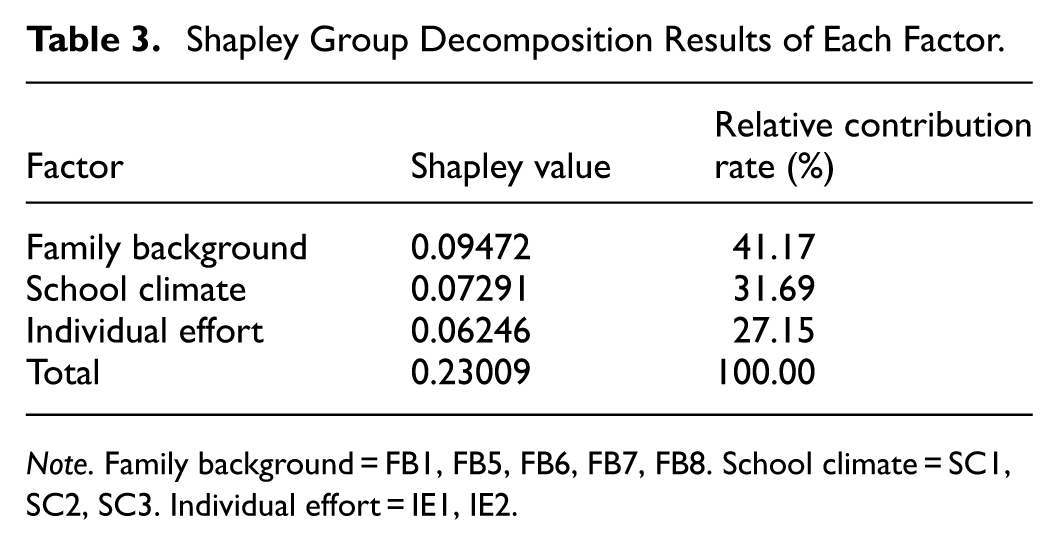
Note. Family background = FB1, FB5, FB6, FB7, FB8. School climate = SC1, SC2, SC3. Individual effort = IE1, IE2.
Moderation Analysis
To examine whether individual effort serves as a moderator in the process of external environmental influences on Chinese college students’ academic achievement, this study conducted moderation analysis with individual effort as the moderating variable. Using the significant variables from Baseline Regression Model 6 as main effects, the analysis followed methodological steps including data standardization and centering, dummy variable generation, and interaction term construction. Detailed results are presented in Table 4.
The Moderating Effect of Individual Effort in the Influence of External Environment on Academic Achievement.

Note. Dependent variable = Academic performance. Excluding the F-values, the values in parentheses are t-values.
p < .05. **p < .01.
The interaction term between family background and individual effort demonstrated statistical significance (t = 2.094, p = .036 < .05), indicating that individual effort as a moderator strengthens the positive impact of family background on academic achievement. Similarly, the interaction term between school climate and individual effort also showed significant results (t = 3.666, p < .05), suggesting that when school climate influences academic achievement, the moderating effect of individual effort varies significantly across different levels, thereby amplifying the positive effect of school climate on academic performance.
Robustness Checks
To mitigate potential biases arising from measurement errors in the data, robustness checks were conducted, with results presented in Table 5. The study employed an alternative dependent variable approach by replacing the original academic achievement (AA) in the baseline regression with specialized course grades (PG) and general education course grades (GG) for robustness testing. The baseline regression results remained robust after adjusting the variables.
Results of Robustness Checks.
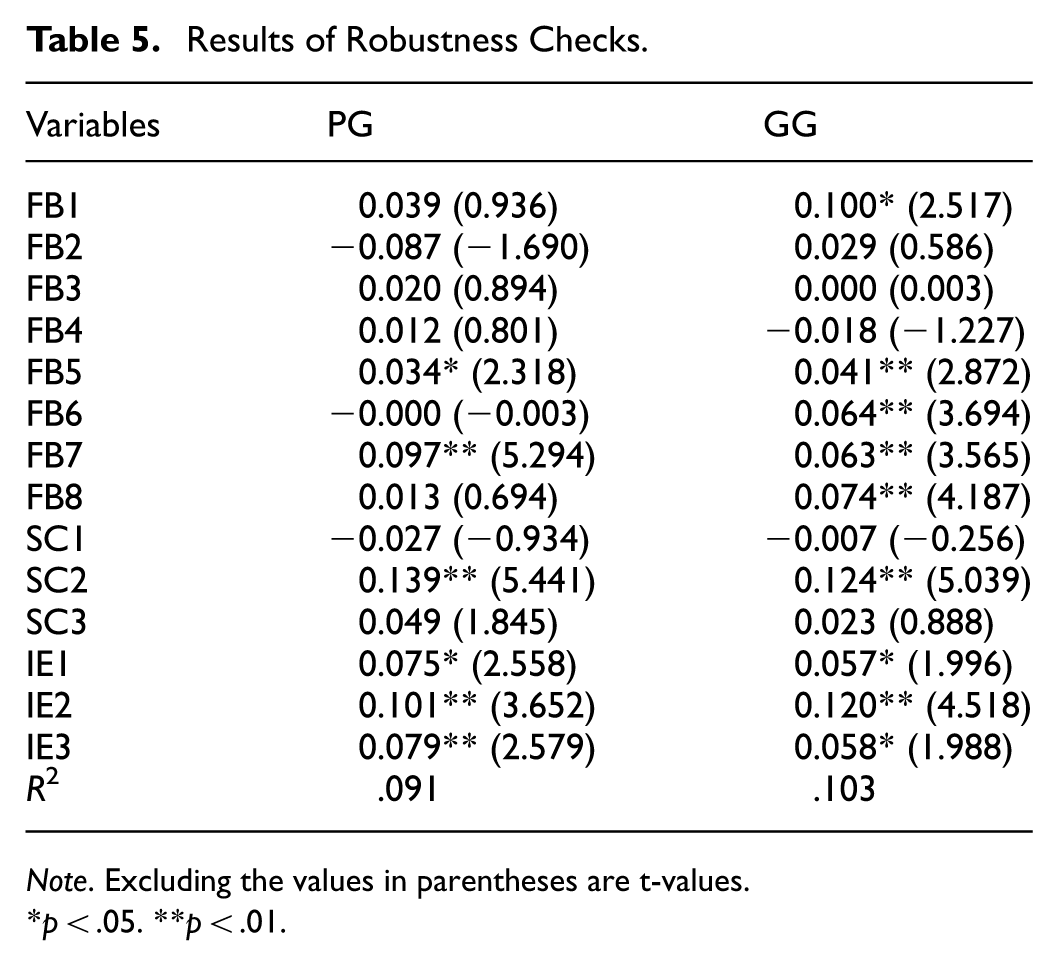
Note. Excluding the values in parentheses are t-values.
p < .05. **p < .01.
Analysis of Heterogeneous Effects
To more clearly demonstrate the heterogeneous effects of various factors on Chinese college students’ academic achievement across different student groups, the study conducted subgroup analyses based on student characteristics—including gender, urban-rural background, and educational level. Through regression coefficient difference tests and Chow Tests, all three grouping variables were found to induce structural changes in the model. Subsequent grouped regressions were performed, with detailed results presented in Table 6.
Results of Heterogeneity Analysis.

Note. Dependent variable = Academic performance. The values in parentheses are t-values.
p < .05. **p < .01.
In the gender difference analysis, significant disparities were observed between male and female students in dimensions including father’s education level, mother’s education level, family expectations, educational activities, and peer relationships. Father’s education level significantly influenced male students’ academic achievement (B = 0.032, t = 2.025, p = .043 < .05), whereas mother’s education level had a significant impact on female students’ academic performance (B = 0.062, t = 4.884, p < .01). This heterogeneity suggests that within family contexts, fathers exert greater influence on sons while mothers show stronger effects on daughters, consistent with findings from other research (Minello & Blossfeld, 2017).
In the urban-rural disparity analysis, Chinese college students with rural household registration and those with urban household registration exhibited significant differences in father’s education level, family expectations, educational activities, and learning methods. Notably, rural students’ academic achievement was significantly and negatively affected by campus educational activities (B = −0.084, t = −3.394, p = .000 < .01), suggesting that rural students are more susceptible to being distracted by the diverse educational activities offered by schools, which consequently impacts adversely their academic performance.
Within China’s educational context, rural students—constrained by familial backgrounds and school conditions—must engage in intensive study efforts during secondary education to secure quality higher education opportunities. Upon entering university, their educational deficits drive them to seek cultural capital compensation. It appears that this phenomenon could underscore the persistent inequality in China’s higher education access process.
In the school-level disparity analysis, significant differences were observed between bachelor’s degree students and vocational college students across dimensions including mother’s education level, family expectations, family social status, educational activities, learning engagement, and learning methods. The significant effects of learning engagement (B = 0.018, t = 5.243, p < .01) and learning methods (B = 0.095, t = 4.429, p < .001) on bachelor’s students’ academic achievement indicate measurable disparities in individual effort between vocational and undergraduate students in China.
Although both higher vocational education and regular bachelor’s programs constitute part of China’s higher education system, vocational education occupies the bottom tier of the educational hierarchy and faces considerable social prejudice (Wang & Wang, 2023). It is possible that this results in inherent disparities between the student sources of these two educational tracks, where access to higher education opportunities is passively filtered through family cultural capital and socioeconomic conditions—creating fundamental background differences between the two groups.
Discussion
Conclusions
First, Shapley value decomposition reveals that family background (41.17% contribution) and school climate (31.69% contribution) jointly account for over 70% (72.86%) of the total variance in academic achievement, demonstrating significant opportunity inequality in Chinese college students’ educational attainment. This finding aligns with Roemer’s (1998) theory of inequality of opportunity, which emphasizes the dominant influence of environmental factors as non-responsibility variables on academic outcomes. However, moderation analysis indicates that individual effort can amplify the positive effects of family background and school climate on achievement, suggesting that effort behaviors may partially compensate for environmental disadvantages thereby providing a possible policy intervention pathway for promoting educational equity.
Second, the teacher-student relationship (SC2) demonstrates the highest contribution (29.12%) among all influencing factors, with baseline regression revealing its significant positive impact on academic achievement (B = 0.238, p < .01), which validates the pivotal mediating role of teacher behavior in higher education. This finding aligns with Hattie’s (2008) meta-analysis, demonstrating that affective bonds between teachers and students can translate into cognitive behaviors that enhance students’ sense of belonging. Moreover, the school climate’s total contribution of 31.69% underscores schools as an intervenable environmental factor with potential to compensate for family background disadvantages.
Third, among individual effort factors, learning engagement (IE1) shows a contribution of 17.48%, comparable to family social status (17.64%) and economic conditions (14.50%), all of which challenge the external determinism perspective. However, moderation analysis reveals that effort amplifies environmental influences (p < .05), demonstrating a dynamic “environment-effort” interaction. Heterogeneity analysis further indicates that the effect of effort varies across groups: rural students’ academic achievement is more susceptible to negative impacts from educational activities (B = −0.084, p < .01), while bachelor’s students demonstrate greater reliance on learning methods compared to vocational college students (B = 0.095, p < .01). These findings suggest that education policies, while rewarding effort, need to be designed to also target compensatory measures for different groups to balance the weights of environmental factors and individual effort.
Practical Implications
The practical value of this study lies in three aspects.
First, this study promotes the establishment of an empirical understanding of academic performance in Chinese society. College students’ acquisition of academic performance is neither a completely unequal model of opportunity nor a completely unequal model of effort. It is a complex and dynamic model within the “environment–effort” framework. This novel conceptualization can help Chinese society better recognize the growth and maturation patterns of college students. On the one hand, the excessive educational competition pressure brought about by the current meritocracy trend in Chinese society can be alleviated. On the other hand, the stigma attached to those who fail in academic competition can be removed. In East Asian Confucian societies, the dream of ascending to a higher social class through examinations has always inspired Chinese people. In China, successful people believe that their success is the result of their efforts and struggles, while ignoring that environmental factors may have helped them succeed. Successful people tend to look down on those who have failed, considering them lazy and unambitious. We believe this strict meritocracy ideology that espouses success can only be achieved through effort not only deprives the less successful people of their dignity but also makes the competition on the path to success increasingly intense and the pressure of failure greater. As Sandel (2021) said, meritocracy hinders social mobility, promotes social division and class opposition, erodes democratic politics, and ultimately leads to the rise of populism. We further believe excessive competition in Chinese education is caused by the Confucian meritocratic ideology of education and human development and the misunderstanding of competition (Kai, 2012). The results of this study showed that the contribution degrees of each factor shown by the Shapley value decomposition can enable people to better understand the contribution of each factor in Chinese educational competition, providing a more objective basis for viewing individual development in the overly competitive Chinese education framework.
Second, the results of this study promote the formation of a more equitable atmosphere for achieving academic success within Chinese tertiary schools. IOp is designed to better measure individual responsibility in unequal outcomes (Roemer, 1998), and thereby facilitate more fair social welfare distribution. Our research has demonstrated through empirical methods the contributions of families, schools, and individual students in educational attainment. Based on these results, universities can carry out targeted educational reforms to improve the fairness of the school climate and promote fair academic achievement for all students. This fair educational environment is one that separates individual student characteristics from social background characteristics, allowing those students who can overcome educational opportunity inequality and obtain higher education opportunities to have their social background characteristics have as little influence as possible on their academic achievement in higher education (Smith, 2015). This would require schools to avoid pursuing the elite education concept in curriculum design, and to expand the scope and content of general education courses as much as possible, so students from disadvantaged family cultural capital and economic capital groups can use the curriculum to make up for their human capital shortcomings and social background weaknesses. These reforms would also require teachers to efficiently utilize classroom time, spending more effort on classroom management, classroom cohesion, and guiding students’ classroom behaviors, to construct a knowledge transmission model for the majority of student groups, and allowing students in disadvantaged environmental positions to also participate in the open teacher-student relationship in Chinese colleges and universities.
Third, the results of this study can help students better understand the “environment–effort” influence mechanism for personal growth and success. The essence of equal opportunities is to compensate for environmental differences and recognize differences in effort. In a fair environment where both society and schools can form a compensatory background to address differences and reward efforts and contributions, individuals should also operate within the framework of the “environment–effort” influence mechanism. Chinese college students should compensate for and surpass their disadvantaged backgrounds and strive to explore a lifelong development path that suits them, which would require more equitable campus environments and perhaps better teacher mentoring. College students also need to be aware of the significant influence of the external environment and avoid the simplistic “man over nature” mindset. Especially for students from disadvantaged SES backgrounds or those who graduated from non-elite universities, they should carefully break down the external environment, identify the main external factors that constrain their growth, and then isolate or compensate for them to reduce the impact of the external environment.
To help student understand the environment–effort influence mechanism for personal growth and success, Chinese colleges and universities should offer early-stage interventions that guide students in recognizing the key external constraints highlighted by this research—such as socioeconomic disadvantage, limited peer networks, or unsupportive school climates—and equip them with practical, evidence-based strategies to manage or compensate for these challenges. For instance, orientation programs can be designed to include sessions that introduce students to the mechanisms through which external factors influence academic performance, thereby fostering critical reflection and early adaptation of coping strategies to deal with the new challenges of university studies so they can achieve academic success. In addition, mentorship schemes that pair first-year students with experienced peers or staff can serve to model effective coping strategies, facilitate access to institutional resources, and create a sense of belonging. Furthermore, the integration of academic self-regulation training into the curriculum can enhance students’ ability to navigate institutional demands, particularly for those who may not have acquired such skills prior to university enrollment.
Finally, college students also need to understand the great value of individual initiative. Especially in the current Chinese higher education and social environment, the social fairness mechanism and upward social mobility channels remain intact, and effort factors can still influence educational attainment. This education reality requires college students not only to have a correct understanding of effort but also to have the behavioral characteristics of effort, combining an awareness of the value of education as a long-term investment with practical actions to break the constraints of existing environmental factors in the Chinese higher education landscape.
Limitations
This study is based on the theory of opportunity inequality and explores the impact of family background, school climate, and individual efforts on academic performance, revealing the unequal mechanisms for obtaining educational achievements among Chinese college students. However, the study has certain limitations in variable handling and theoretical selection. Due to the data collection requirements, some independent variables were simplified in the study. For example, GPA was used to measure academic performance. This strictly summative approach to quantifying academic performance may have overlooked other nuanced formative factors that can affect academic outcomes. It is recommended that future research integrate more factors to better measure academic performance. Additionally, the study is based on Roemer’s theory of opportunity inequality, which originated from Western social welfare analysis. In the context of Chinese Confucian culture, socio-cultural factors like the social awareness of effort and family responsibility may have different connotations to the “environment–effort” framework. In-depth cross-cultural exploration in future research is recommended to explore these important influences on academic performance among college students.
Footnotes

Ethical Considerations
The questionnaire and methods of this study were approved by the Academic Committee of Department of General Education in Tourism College of Zhejiang (Grant No. ZLYGGJXBXS-2024-001, Approval Date: September 9, 2024). This survey was conducted in strict accordance with the academic ethics guidelines of Tourism College of Zhejiang and the ethical principles outlined in the Declaration of Helsinki.
Consent to Participate
This survey was conducted in the form of a paper questionnaire. All participants completed the paper-based questionnaire between November 4, 2024 and February 26, 2025. At the beginning of the questionnaire, we provided a detailed explanation of the research purpose and the academic ethical guidelines. After obtaining the informed consent of each respondent, we would allow the participants to fill out the questionnaire, and they also had the right to exit the questionnaire at any time during the answering process.
Funding
The authors disclosed receipt of the following financial support for the research, authorship, and/or publication of this article: This article is supported by the [Major Humanities and Social Sciences Research Projects in Zhejiang higher education institutions], Grant Number: 2024QN134.
Declaration of Conflicting Interests
The authors declared no potential conflicts of interest with respect to the research, authorship, and/or publication of this article.
Data Availability Statement
All data included in this study are available upon request by contact with the corresponding author.*