




Abstract
Shadow education helps students become academically competitive. Currently, little is known about whether shadow education can effectively fulfill either remedial or enrichment purposes in China. Using the nationally representative data from the China Education Panel Survey (CEPS) collected in 2013 and 2014, this paper explored the opportunity gap in shadow education and its impact on Chinese eighth-grade students’ mathematics and English reading performance. This study further examined how this effect differs by students’ prior performance and school ranks by hierarchical linear modeling (HLM). The results show that affluent socioeconomic resources and parental pressure predicted larger chances of students using shadow education. On average, supplementary tutoring had a positive effect on academic achievement. After re-estimating the effect by groups, this study found that students disadvantaged by prior knowledge and quality of schooling benefited more from supplementary tutoring. The findings suggest that the expansion of shadow education may contribute to social reproduction within the current education system.
Introduction
Shadow education or supplementary tutoring, indicating various forms of supplementary educational activities paralleling formal schooling, has become a worldwide phenomenon in the last two decades (Baker et al., 2001; Bray, 2011; Byun, 2010). Shadow education has three signal characteristics: first, the tutoring is fee-based; second, the tutoring takes place outside regular school hours; third, the tutoring is only concerned with academic subjects taught in mainstream schools, such as readings and mathematics (Bray & Kwok, 2003; Entrich, 2015, 2020; Entrich & Byun, 2021; Entrich & Lauterbach, 2020b; Zhang & Bray, 2020). Prior literature suggests that students participate in shadow education for different purposes based on school performance. High-performing students seek competitive advantages from shadow education to enlarge their opportunities of entering top-tier universities, which is for enrichment purposes. On the other hand, low-achieving students use it to improve their performance to meet the academic demands of mainstream schools, which is for remedial purposes (Bray & Kobakhidze, 2014; Entrich, 2018; Entrich & Lauterbach, 2020b; Mori & Baker, 2010). Thus, shadow education is possibly utilized to enlarge or narrow the existing achievement gap, which is still inconclusive.
In China, although recent reforms have tried to lighten the academic burden on middle school students (Grade 7–9), the competition for access to high school (Grade 10–12) is still fierce. According to the Statistical Bulletin on The Development of National Education published by the Ministry of Education (MOE), the annual high school entrance examinees were more than 14 million in the past 5 years, and the high school enrollment rate was 57% in 2020. Even fewer students got access to high-performing high schools to enlarge their chances of enrolling in top-tier universities, also known as the “Double First-Class” program, whose average acceptance rate was 6.2% in 2021. As a result, more than 40% of Chinese middle school students used supplementary education to seek competitive advantages or keep up with their peers in the meritocratic educational system (Wang, 2018; Zhang & Bray, 2015). The average per student expenditure on supplementary education was approximately 5,600 yuan ($836), while per capita disposable income was about 26,000 yuan ($3,881) in 2017.
Although shadow education has the potential to be a remedy for low-achieving students lacking appropriate school resources, the distribution of expenditure on shadow education is highly skewed in China. Individuals whose family consumption ranked in the top 25% in China spent 6 times more on children’s supplementary courses than those from the lowest quartile (Wang, 2018). This situation evokes public concerns that the widespread use of shadow education exacerbates social inequity by distributing educational resources to affordable families and whether it imposes an intolerable academic and financial burden on students and their parents (Heyneman, 2011). Meanwhile, parents’ choices of investing in shadow education are not necessarily based on a rational assessment of the cost and benefits. Those choices may result from parental anxiety about lagging behind rather than a rational choice when observing their children’s peers using shadow education or learning the exaggerated importance and urgency of out-of-school tutoring from TV and social media advertisements (Entrich & Byun, 2021). The educational “arms race” among students has disrupted the educational system and has caused confusion and dissatisfaction among many Chinese families (Dawson, 2010).
A plethora of studies have examined the distribution of opportunities for students to receive shadow education and its heterogeneous impact on the various subjects taught in mainstream schools (Bodovski et al., 2019; Bray, 2014; Choi & Park, 2016; Dawson, 2010; Entrich, 2014; Zhang & Bray, 2018; Zhao, 2015). However, those findings were based on the assumption that parents invest in shadow education because it is necessary for children’s education. Few studies examined whether parents consider children’s needs in decision-making and whether the parental pressure from anxiety about the future predicts students’ participation in shadow education. Additionally, limited research investigated to what extent shadow education can either enhance high-performing students’ academic performance or improve low-achieving students’ school competitiveness in the context of China.
Theoretical Background
Opportunity Gap and Rational Choice in Shadow Education
Shadow education is designed to increase students’ academic performance or their chances of obtaining high-quality educational resources (Baker et al., 2001; Bray, 1999). It includes educational activities such as fee-charging private tutoring and cram schools that help students behind in school catch up or provide academic enrichment to high-performing students (Bodovski et al., 2019; Entrich, 2014; Zhang & Bray, 2020). As an instrument for improving academic competence, shadow education may have a long-term effect on social inequality by distributing its access according to students’ affordability instead of actual needs.
The traditional model for understanding the relationship between shadow education and society stems from human capital theory and social reproduction theory (Mori & Baker, 2010). Improving capacities by education is a way to invest in human capital, which consists of useful skills and knowledge that people possess to maximize labor market success (Byun et al., 2018; Goldin, 2016; Mori & Baker, 2010). Mainstream schools provide opportunities for students with the willingness and capacity to perform well (Blumberg & Pringle, 1982; Rossi & Gilmartin, 1980). Shadow education, on the other hand, provides families with a parallel way to maintain or elevate students’ social class by increasing their likelihood of access to highly selective universities (Bodovski et al., 2019; Entrich & Lauterbach, 2020a, 2020b). It is self-evident in a context characterized by a high-stakes test educational system like those of East Asian countries. However, given that the financial burden regarding supplementary tutoring is totally on families, the participation opportunities and the quality of shadow education may heavily depend on students’ family socioeconomic background (Choi & Park, 2016). As a result, the rapid expansion of shadow education may work as an instrument to enable the transmission of social privilege across generations that contributes to social reproduction (Byun, 2014; Jansen et al., 2023).
Empirical research has supported both theories by indicating that family socioeconomic status and parental involvement in children’s education positively predict students’ likelihood of access to shadow education. Using the China Education Panel Survey (CEPS) baseline data, some researchers pointed out that higher parental income and education levels contribute to a greater chance of children’s participation in supplementary tutoring (Li & Xue, 2016). Lin (2018) found that family structure is related to the odds of investment in shadow education. Children from two-parent or single-child families are more likely to use shadow education because parents in such families afford relatively more time and money on children’s education (Kim et al., 2020; Lin, 2018). Studies conducted in the United States, Germany, and South Korea, also echoed those findings (Byun, 2014; Entrich & Byun, 2021; Entrich & Lauterbach, 2020a). Examining the data from PISA 2012 in 65 societies, Entrich (2020) concluded that an educational system characterized with higher educational institutional differentiation offers ground for the socioeconomic status (SES) gap in shadow education access. Focusing on school-level predictors, some scholars suggested that high-performing schools, usually attended by high-SES students, make high curriculum demands on students, which also become the incentives to utilize shadow education (Entrich & Lauterbach, 2020b). Stevenson and Baker (1992) examined longitudinal data of Japanese high school students and found that students’ prior performance and high school location and reputation affect participation in shadow education. Entrich and Byun (2021) extended this finding by indicating that students who attended selective and highly selective colleges participate in more supplementary learning activities compared to their otherwise similar counterparts.
In addition to the traditional human capital and social reproduction theory, a new perspective of neo-institutionalism argues that the increasing use of shadow education is motivated by the logic and culture brought by schooled society that spreads worldwide (Baker, 2014; Mori & Baker, 2010). In addition to making a decision solely based on the rationale of cost-benefit analysis, parents may agree that shadow education is an essential supplement to formal education by observing the choices of their otherwise similar peers. In this case, the social culture constructs parental recognition of the importance of education (diploma). Parents’ future aspirations affect their educational involvement, including investing in supplementary tutoring (Park et al., 2011). The pressure from parents’ educational expectations may further influence children’s recognition of the need to use shadow education (Entrich, 2015). Thus, the perceived pressure from parents should be considered as a factor determining students’ participation in shadow education. Notably, investing in supplementary education can relieve parents’ anxiety about their children’s education regardless of its academic effectiveness (Guill et al., 2020).
Shadow Education for Remedial and Enrichment Purposes
Institutions providing shadow education offer adequate assistance for students to improve competence in examinable subjects (Byun, 2014). Many studies mentioned that shadow education may exacerbate educational inequity (Bodovski et al., 2019; Huang, 2013). This conclusion is mainly based on two assumptions: 1) shadow education effectively improves academic performance; 2) it is primarily used as an enrichment rather than a remedial strategy by students and their parents.
The existing literature agrees that the impact of shadow education varies among heterogeneous student groups and contexts. From the perspectives of the rational choice theory and the model of school learning, shadow education better performs the remedial function by offering disadvantaged students additional high-quality learning resources and prolonging their time actually spent on learning (Carroll, 1963; Entrich, 2018). Examining the data of seventh grade students in China, researchers pointed out that the effect size of shadow education is larger for low-achieving students with relatively slim chances to participate in supplementary tutoring (Song & Xue, 2018; Xue, 2016). Based on the 2012 Programme for International Student Assessment (PISA) data, Byun et al. (2018) found that students mainly use shadow education to address their academic deficiencies. Shadow education in Germany and Japan also provides remedial support to students, reducing the SES achievement gap instead of widening inequalities (Entrich, 2014, 2018; Entrich & Lauterbach, 2020b). By contrast, a study based on the data from Shanghai indicates that shadow education provides chances for students from elite schools to seek competitive advantages (Zhang & Bray, 2018). Similarly, East Asian American students use supplementary education for enrichment purposes and academically benefit from it in the United States (Byun & Park, 2012). Using fixed-effect models to examine the international data from Trends in International Mathematics and Science Study (TIMSS), Huang (2013) found that specific subjects vary the effectiveness of shadow education as a remedial or enrichment strategy. For example, supplementary tutoring in mathematics is more effective for enrichment than for remedial purposes.
There are three possible explanations for the controversial findings: first, shadow education only has a placebo effect in specific contexts (Guill et al., 2020; T. Liu & Wang, 2018; Loyalka & Zakharov, 2016; Sun & Tang, 2019). Similar to structured extracurricular activities, shadow education is no more than a consumption behavior or a relief for parental anxiety about children’s after-school schedules (Tan et al., 2022). Second, different types of shadow education have heterogeneous effects on varied subjects (Buchmann et al., 2010; Byun, 2014; Entrich, 2018). Cram schools take advantage of the self-developed curriculum and assessment tools to have a larger effect on Korean middle school students’ mathematics performance than other shadow education forms, including individual tutoring and online tutoring (Byun, 2014). Shadow education significantly improves participants’ mathematics test scores rather than performance in reading tests (Huang, 2013; Zhao, 2015). Third, while remedial and enrichment purposes coexist in some contexts, shadow education may not consistently fulfill both functions (Bray & Kobakhidze, 2014; Huang, 2013). Researchers’ definitions of enrichment and remedial focus on the whole education system (Bray & Kobakhidze, 2014). They consider that shadow education for remedial purposes should be utilized by students who have problems to catch up with classmates or are from low-performing schools (Zhang & Bray, 2016). By contrast, shadow education for enrichment purposes is supposed to enhance the academic performance of students who are already above the average level or from high-performing schools (Entrich, 2014; Entrich & Byun, 2021). The realization of either function, to some extent, depends on the characteristics of the local educational system.
Current Study and Research Hypothesis
This study is designed to clarify whether shadow education can exacerbate education inequity. It is still unknown who enjoys the opportunities of participating in shadow education and to what extent shadow education fulfills remedial or enrichment purposes in the context of China. Three hypotheses were developed to construct an analytic framework shown in Figure 1. First, in addition to family backgrounds and school characteristics, neo-institutionalism argues that the pressure from parental aspirations may affect children’s participation in shadow education (Byun, 2014; Entrich & Lauterbach, 2020b; Mori & Baker, 2010):
Hypothesis 1: Students’ characteristics, including family SES, prior test scores, educational pressure from parents, and school rank, positively predict their participation in shadow education. In other words, shadow education is mainly utilized by advantaged students, which is not needs-oriented.

Analytic framework for investigating the opportunity gap and the heterogeneous impact of shadow education.
Second, there are two competing theories concerning shadow education’s academic effects. First, shadow education has no more than a placebo effect, which relieves parents’ and students’ academic anxiety (Guill et al., 2020). Second, as fee-based educational support paralleling formal schooling, shadow education should take advantage of supplementary courses to prepare students for school exams, especially mathematics tests (Byun, 2014; Zhao, 2015). Our second hypothesis is constructed following the second theory:
Hypothesis 2: Shadow education can positively affect students’ academic performance as an additional learning form to secure or improve students’ competence in mainstream schools.
Our third hypothesis focuses on the effectiveness of shadow education as an enrichment or remedial strategy. Shadow education offers extra educational support additional to the provision by mainstream schooling rather than replace it (Bray & Kwok, 2003). Students should make rational choices on supplementary courses based on their specific demands and academically benefit from shadow education. Therefore, the third hypothesis is framed as follows:
Hypothesis 3: Shadow education fulfills both enrichment and remedial purposes. Specifically, shadow education can maintain or improve advantaged students’ academic competence and help disadvantaged students catch up with their counterparts.
This article aims to fill the research gap by making three contributions to the literature. First, we investigated nationally representative data from China, whose educational system is characterized by high-stakes examinations and the extensive use of shadow education. Second, we added the perspective of neo-institutionalism to estimate the rationale behind families’ decisions on shadow education participation. Third, we provided evidence concerning shadow education’s conditional fulfillment of remedial or enrichment purposes. These findings can be used as a reference in countries characterized by fierce academic competition.
Data and Methods
Data
The data used in the present study were drawn from the baseline (2013-2014) and follow-up (2014–2015) dataset of the China Education Plane Survey (CEPS), which were administrated by the National Survey Research Center at the Renmin University of China. The CEPS was used to investigate the influence of family, school, and community on individuals’ educational outcomes. A total of 9,431 students from 112 schools and 28 cities participated in both surveys. They were at seventh grade in the baseline survey and eighth grade in the follow-up survey.
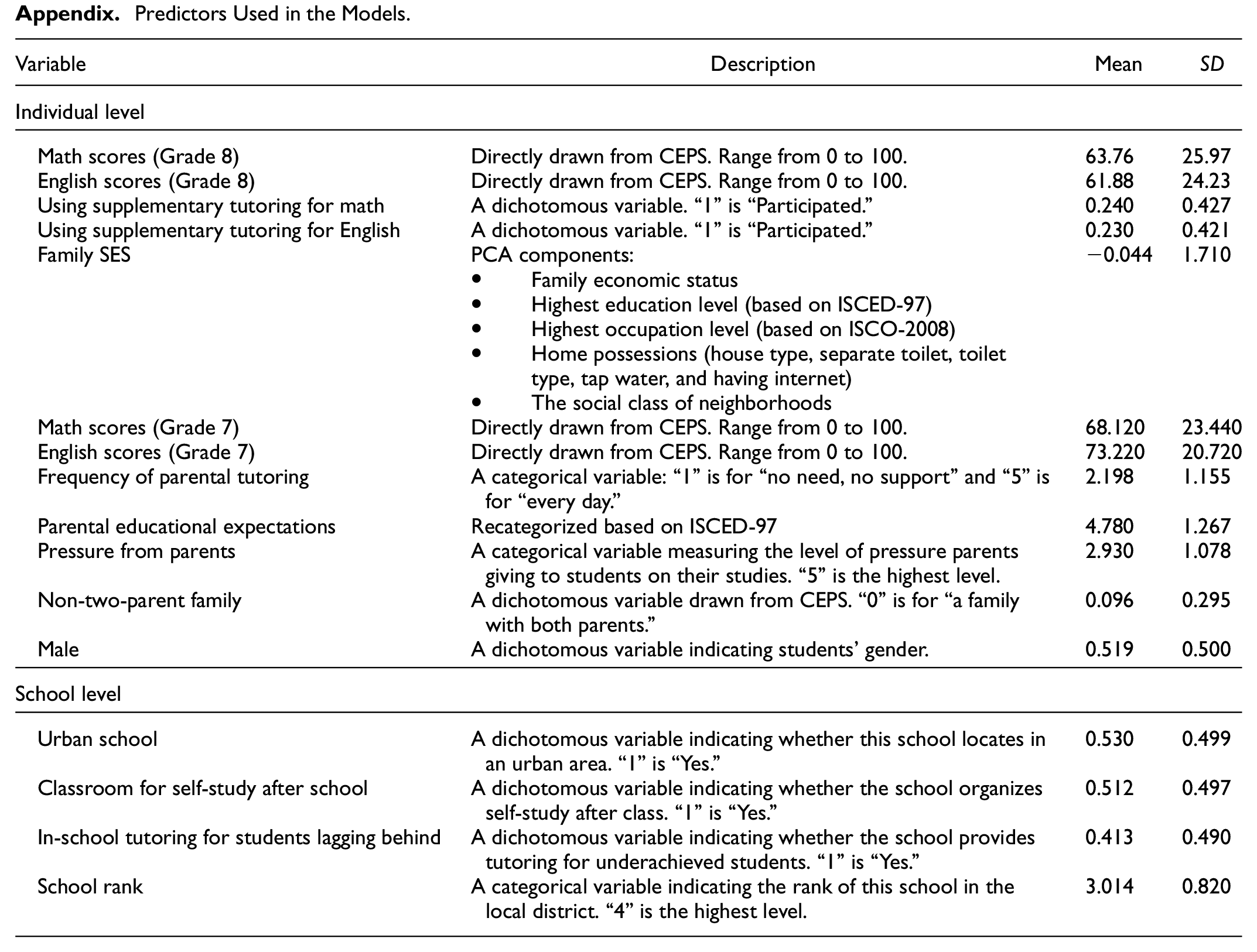
We used the follow-up dataset and part of the baseline dataset in the current study. After checking the missing patterns of all variables used in our models, we found that different variables were responsible for the missing cases. The variable of “neighbourhoods’ social class” contains the most missing values, which is 497 cases. When the missing data is less than 10%, multiple imputations are always reasonably utilized to improve the reliability of findings (Graham, 2009; Manly & Wells, 2015; Royston, 2005). Thus, we used Stata 16 to apply multiple imputation techniques to reduce the potential bias caused by missing data. The strategy of multiple imputations, then deletion (MID) was used in the imputation process (Von Hippel, 2007). According to MID, outcome variables, consisting of mathematics and English reading test scores in Grade 7 and 8, should be included in the imputation models. However, cases with imputed outcome variables are excluded from the analysis. Additionally, predictors and control variables regarding students’ family backgrounds and school characteristics were added to the imputation models. After imputed 50 times, the final analytic sample of our study included 8,960 observations. The variable description and descriptive statistics are shown in the Appendix.
Measures
Academic Performance
We used eighth grade students’ unstandardized math and English test scores from the follow-up dataset to represent their academic performance, which was the dependent variable. We also controlled for students’ baseline performance (seventh grade test scores) in the analytic process to isolate the unique effects of their accumulated prior knowledge. The Chinese central government published the National Curriculum Standards of Compulsory Education to standardize the curriculum content in each province from Grade 1 to Grade 9. To ensure consistency of education quality around China, the MOE further published an announcement (360A26-05-2011-0007-1) in 2011 to require that academic proficiency tests in the stage of compulsory education be strictly set according to the National Curriculum Standards. Thus, after we transformed the test scores into the centesimal system, the test scores should be comparable across the sampled schools in this database.
In contrast with prior research, we employed the reading performance of foreign language (English) rather than first language (Chinese) as the outcome variable for two reasons. First, the content of Chinese tests mainly consists of subjective questions, which makes the scoring criterion much more flexible than the other tests. Second, prior studies in the context of China have proved that supplementary education has little impact on students’ Chinese achievement (D. Liu & Yao, 2018; Zhao, 2015). Therefore, the current research does not further investigate the relationship between shadow education and Chinese performance.
Shadow Education Participation
In the CEPS, students reported whether they participated in shadow education after school for specific subjects. Those supplementary activities have three characteristics: first, they are not provided by mainstream schools during school hours. Second, those activities are provided for financial gains paid by parents. Third, the supplementary courses focus on academic subjects, including mathematics and English reading. We generated a dichotomous variable indicating whether a student engaged in supplementary tutoring in mathematics as the predictor to estimate the effects of shadow education on mathematics achievement. A dichotomous variable assessing English tutoring was generated to estimate students’ English test scores.
Educational Pressure From Parents
Parents may feel pressure to ensure children’s academic success and provide them with the same educational resources as their peers (Nelson, 2010). The unfulfilled expectations may frustrate them and increase their anxiety. This situation motivates parents to provide the “best” to their children, particularly by getting them access to fee-based supplementary tutoring outside school hours, which then places pressure on students to perform well in school (Cucchiara, 2013; Mori & Baker, 2010). The CEPS provide a variable to measure educational pressure from parents perceived by students. We used this variable to indicate parents’ stress and motivation to make an extra investment in their children’s education.
School Rank
The school administrators sampled in the CEPS reported their school rankings based on average performance and reputation in local districts. We recategorized this variable into four levels, with “1” the lowest level. This variable indicates education quality and educational resources provided by a school. It may affect students’ participation in shadow education in two ways (Byun et al., 2018; Entrich & Byun, 2021; Stevenson & Baker, 1992): first, relatively low-quality school education may increase the motivation for shadow education to improve students’ competitiveness. Second, students from top-tier middle schools may face more severe peer academic competition, and they need to seek out-of-school learning to maintain competence. Moreover, students from high-performing schools already have obtained high-quality education from mainstream schooling, which may affect the effectiveness of offering them additional resources to boost their academic performance (Hanushek, 1997).
Control Variables
Extensive covariates of student and school characteristics are controlled in the estimation models. Similar to existing literature, this study controlled variables of family structure and parental involvement, which are associated with shadow education access and academic performance (Jansen et al., 2023; Lin, 2018). The study isolated the effects of school location related to the availability of supplementary resources (Stevenson & Baker, 1992). Moreover, students’ learning schedule outside school hours may affect their decision on shadow education and test performance. Thus, we also included the covariates of self-study after school and school-organized tutoring, as described in Appendix.
Analytical Procedures
This study implemented three analytical strategies to answer the research questions. We first estimated multilevel logistic models to predict students’ participation in shadow education in specific subjects. Given the CEPS data nested within schools, the models consisted of two levels. The first level included variables indicating student and family characteristics, and the school factors were on the second level.
Next, we employed hierarchical linear modeling (HLM) to predict the students’ mathematics and English reading test scores in the eighth grade to estimate the overall impact of shadow education. The models included the independent variable of supplementary tutoring in a specific subject and extensive covariates to estimate the parameters more accurately. Considering that students’ present achievement might depend on their previous knowledge, we used lagged dependent variables to avoid autocorrelation. We calculated the sandwich estimator of variance for all HLM models in this study for the robustness check.
Although HLM adequately addresses the nested nature of data, it did not allow us to examine how the heterogeneous impact of shadow education is varied by students’ background factors. This study re-estimated the parameters using seventh grade test scores quartiles (first quartile is the lowest) and school rank (four levels, “1” is the lowest) to examine the heterogeneous effect of shadow education. To seek academic competitiveness, students utilize shadow education for only two reasons: they want to either catch up with their counterparts or maintain their advantages (Bodovski et al., 2019; Zhang & Bray, 2016). Therefore, we categorized students from the bottom two performance quartiles or school ranks into the group of using shadow education as a remedial strategy. Students from the top two performance quartiles or school ranks are in the enrichment group. The comparison of the results estimated in this step indicated which group of students received the largest edge in educational success conferred by shadow education.
Results
Socioeconomic Status, Prior Performance, Parental Pressure, and the Use of Shadow Education
Table 1 presents the coefficients and odds ratios of two-level logistics models. The first two columns show the model predicting students’ participation in supplementary tutoring in mathematics. The third and fourth columns show the estimates predicting engagement in supplementary tutoring in English. Individual and school-level factors are included in the estimation process.
Coefficients and Odds Ratio for Using Supplementary Tutoring by Subject.

Note. Standard errors in parentheses.
p < .05. **p < .01. ***p < .001.
The results show that students’ family SES consistently predicted the odds of participation in shadow education in mathematics and English. Educational pressure from parents was positively associated with the probability of involvement in mathematics tutoring. One-unit higher pressure from parents predicted increased odds of using mathematics tutoring by 9.1%. Intuitively, frequent parental tutoring should reduce students’ demands for fee-based supplementary education. However, the estimation models suggest otherwise. The frequency of parental tutoring was positively associated with students’ pursuit of shadow education. Students from urban schools or schools without organized self-study after school hours were also more likely to participate in shadow education. Surprisingly, students’ prior performance and school rankings significantly predicted students’ likelihood of participating in shadow education for both subjects. Those results suggest that students with a better prior performance from higher-quality mainstream schools are more motivated to purchase supplementary tutoring from the private sector as an enrichment strategy.
The Overall Impact of Shadow Education on Academic Performance
This study further investigated the effect of shadow education on students’ mathematics and English test scores by using two-level hierarchical linear models. The results are shown in Table 2. Models 1-3 in Table 2 present the estimated effects on the mathematics score. Including shadow education in mathematics as the only predictor, Model 1 found that tutoring in this subject was associated with higher test scores. Specifically, shadow education participants achieved scores that were 4.01 points higher than those of non-participants. We added students’ mathematics scores in Grade 7 to Model 2 to isolate the effect of students’ prior knowledge. The results show that the previous mathematics score partially explained the predictive relation reported in Model 1. After holding this variable constant, supplementary tutoring in mathematics significantly improved students’ test scores by 2.03 points. Model 3 added students’ socio-demographic characteristics and school covariates into the estimation model. After statistically controlling for students’ background factors, the results show that using shadow education was still significantly associated with an increase of 1.51 points on eighth grade mathematics tests.
Multilevel Models Predicting Test Performance From Students’ Background Characteristics.

Note. Standard errors in parentheses.
p < .05. **p < .01. ***p < .001.
Models 4–6 in Table 2 estimate the impact of English tutoring on test scores. As with the results above, English reading test scores were significantly and positively associated with students’ engagement in supplementary tutoring with or without controlling for student and school confounders. Overall, the results presented in Table 2 indicate that shadow education had a consistent and positive effect on eighth grade students’ school performance in China.
The Academic Effect of Shadow Education by Student Performance Quartiles and School Ranks
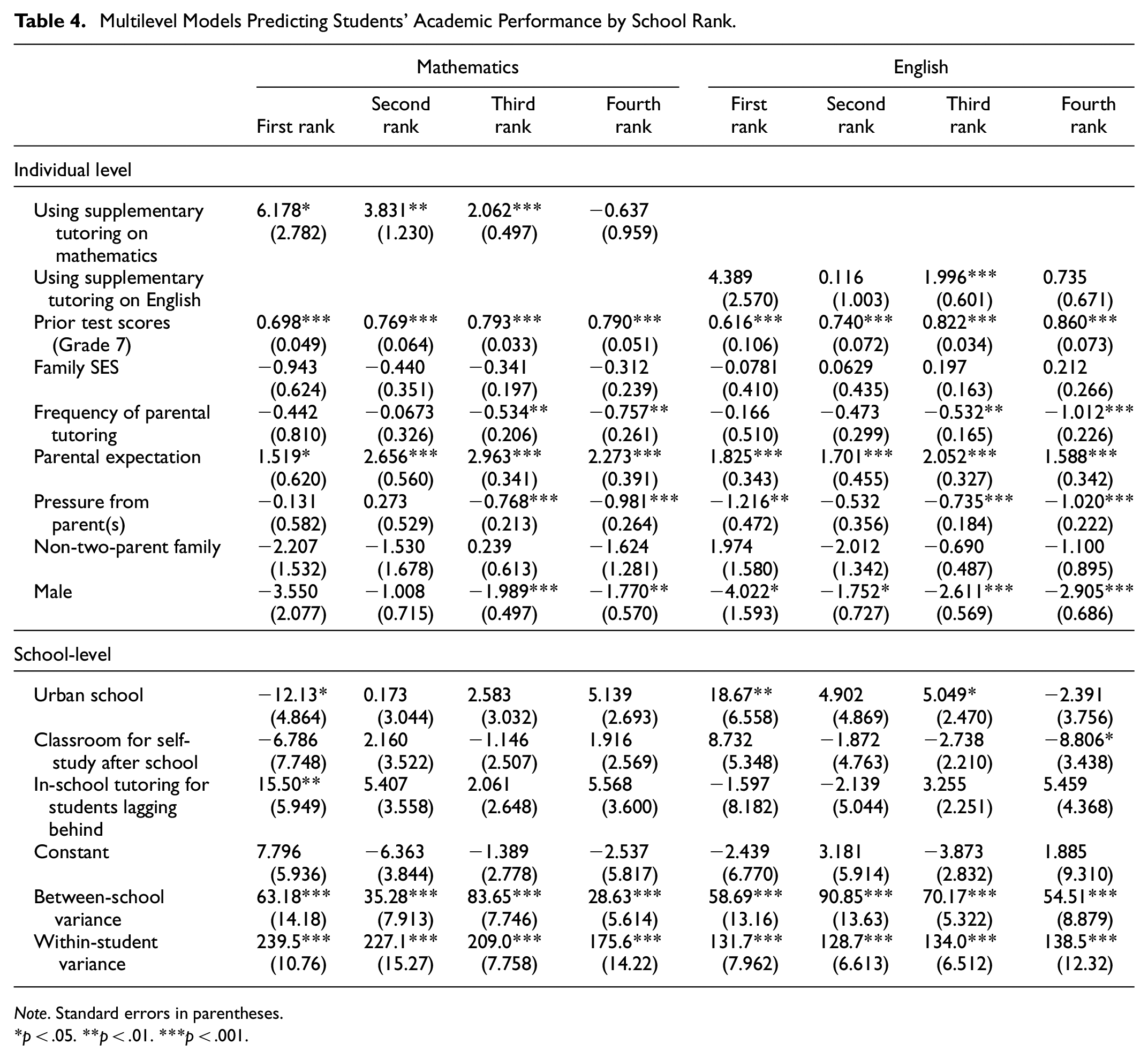
The heterogeneous impact of shadow education may affect its effectiveness in fulfilling either remedial or enrichment purposes. As such, we re-estimate the effect of shadow education on mathematics and English test scores across student performance quartiles and school ranks. Table 3 presents the results by students’ seventh grade performance quartiles. The lowest quarter of observations is included in the first quartile. Table 4 displays the results by school ranks. The fourth school rank indicates the highest-performing schools in local districts.
Multilevel Models Predicting Students’ Academic Performance by Seventh-Grade Performance Quartiles.

Note. Standard errors in parentheses.
p < .05. **p < .01. ***p < .001.
Multilevel Models Predicting Students’ Academic Performance by School Rank.
Note. Standard errors in parentheses.
p < .05. **p < .01. ***p < .001.
The results of Table 3 show that shadow education significantly improved the mathematics performance of students from the lowest quartile and the English test scores of students from the first and second quartiles. Specifically, taking supplementary mathematics courses increased 6.60 points in mathematics test scores in the first quartile, significant at the .001 level. English tutoring significantly improved eighth grade students’ test scores by 2.23 points in the first quartile and 1.93 in the second quartile. The results indicate that shadow education was an effective remedial strategy for struggling students in both subjects.
According to Table 4, the magnitude of the effect of shadow education on students’ test scores was inconsistent across school ranks. Supplementary tutoring was significantly and positively associated with the mathematics performance of students except for those from the highest-performing schools. Although it is not significant, the coefficient of using mathematics tutoring turned to be negative in schools of the fourth rank. The positive relationship between engaging in shadow education and English achievement was significant only in the third school rank. The mixed results indicate that mathematics tutoring consistently and substantially helps students as a remedial strategy. Students from the most elite schools failed to utilize shadow education for enrichment purposes.
Discussion
We summarize the findings of our analysis of the CEPS data with respect to the stated hypothesis. Concerning the first hypothesis, the supplementary education participants are mainly high-SES and high-performing students studying in higher-quality schools. Parental pressure positively correlates with students’ participation in mathematics tutoring rather than English tutoring. School organized self-study restrains students’ demand for supplementary tutoring by prolonging school hours. The findings indicate that the opportunities for using shadow education are not equally distributed among students based on their real needs. Advantaged socioeconomic and academic positions and sufficient unstructured time after school motivate families’ pursuit of shadow education. Thus, shadow education is generally utilized as an enrichment strategy in China.
Regarding the second hypothesis, although the effect size is not large, shadow education facilitates students’ academic performance on mathematics and English tests. The positive relationship between access to shadow education and school performance is because extended studies and practices may prepare the students better for the tests in both subjects. Mathematics tutoring helps participants to exercise the acquired knowledge and improve their proficiencies in solving mathematical problems. As a second language in China, English vocabulary breadth and depth have considerable predictive power on students’ scores on multiple-choice reading comprehension and summary writing (Li & Kirby, 2015). Both types of questions are the primary components of high-stakes English tests in secondary education and have relatively objective answers. Thus, supplementary education can effectively improve participants’ English achievement by teaching students memorization and test-taking skills.
Our findings partially support the third hypothesis by indicating that shadow education effectively works as a remedial rather than an enrichment strategy. The findings present that supplementary courses cannot enrich the corresponding performance of students whose mathematics test scores were above the lowest quartile or English scores above the second quartile. It is possibly attributed to students’ weekday schedules. In the context of China, students spend most of their study time at mainstream schools and on related schoolwork. High achievers hardly enrich or extend their knowledge by supplementary education because they are overqualified for current studies and have limited time for further improvement. By contrast, low-achieving students may not fully digest the knowledge obtained in school. Extra tutoring outside school can provide an educational supplement to their schooling, which would improve their test performance.
Similarly, the findings show that students from the highest performing schools hardly used shadow education to fulfill enrichment purposes. It is possibly attributed to the overlapped services provided by formal schooling and supplementary tutoring. Precisely, shadow education, to some extent, compensates for the disadvantages in educational facilities and teacher quality in formal schooling. This compensation should help to improve the competitiveness of students from relatively disadvantaged schools. Considering advantaged students have low demands on out-of-school educational resources, the effects of shadow education may not be visible to them.
Several limitations of our study should be addressed in future research. First, we did not include shadow education expenditure as a covariate in the estimating model because no reliable indicator represented this information. This confounding factor can partially explain the quality of supplementary tutoring received by students, which may further moderate the effects of shadow education reported in our study. Second, we did not adequately address the potential selection bias in the data, which prevented us from drawing a causal inference on the relationship between shadow education and academic performance. Given that self-selection processes may work in opposite directions (Huang, 2013), future studies can employ a regression discontinuity design to address this problem after the CEPS publishes new waves of data. Third, although the difficulty level of school tests should be consistent across the country due to the official requirements, the results based on a uniform national test can be more robust. It is currently unavailable in China. Fourth, we did not examine the impact of different types of shadow education on students’ test scores. Due to the Covid-19 pandemic, students have widely used online tutoring because of its convenience and lower cost. Online courses change the traditional way of guidance and mode of teacher-student communication. After the data is available, future research needs to investigate the differences between online and offline shadow education.
Overall, this study contributes to understanding the opportunity gap in the use of shadow education and its heterogeneous effects on students with different purposes. Combining the findings, it is essential to acknowledge that the decision-making concerning the use of shadow education is not always based on a rational process. Parental anxiety related to children’s education is widespread in Chinese society, especially among middle-class families (Lin, 2018). The anxiety translates into perceived pressure motivating parents’ pursuit of shadow education. Those families may not want to spend so much time and money on shadow education. However, they cannot risk a chance of maintaining educational advantages, particularly since shadow education has become a part of the culture of education (Mori & Baker, 2010). As such, shadow education plays the role of a placebo for advantaged students and parents by giving them a sense of proficiency in the knowledge taught in formal schooling. Parents obtain satisfaction of psychological needs from shadow education through providing children with the same level of educational services enjoyed by their counterparts.
Our findings suggest that the expansion of shadow education may lead to social reproduction within the current education system. Those parents who can afford supplemental tutoring tend to seek additional assistance for their children’s future educational success regardless of whether their children need such support. Along with the growth of using supplementary tutoring, parents are “forced” to match the extra educational resources gained by the other students. Given that shadow education is not a panacea for all students, this pattern of tutoring not only increases the burden on students but also inflates the price of supplementary tutoring. Less affluent families with substantial demands cannot get access to on-the-market educational resources because of the irrational use of shadow education, which in turn reproduces social inequity.
Meanwhile, the findings indicate that shadow education in China works better for remedial rather than enrichment purposes. Supplementary tutoring can mitigate the educational disadvantages of students with a weak knowledge base or experiencing low-quality schooling. Considering that family investment in shadow education is not based on rational choices completely, governments should intervene by taking advantage of shadow education to offset defects in the schooling process. The Chinese government published the Opinions on Regulating Supplementary Schools (ORSS) in 2018 and the Opinions on Ease the Burden of Excessive Homework and Off-Campus Tutoring for Students Undergoing Compulsory Education (also known as the “Double Reduction,” policy) in 2021 to restore an equal educational environment by prohibiting shadow education for any purposes. Both moves, to some extent, reduce the inequity brought by the irrational use of shadow education but neglect its function of compensating for acquired disadvantages. As such, this situation may undermine the endeavors of creating healthy competition within the formal educational system.
Instead of forbidding shadow education, our findings suggest that the government should fill the gap in shadow education opportunities by, for example, providing underachieving individuals and students from low-performing schools with vouchers for remedial tutoring or allowing low-performing schools to organize self-study outside regular school hours. The current educational system of China adopts high-stakes tests as the selection criterion for entering upper-level education. It is impossible to eliminate disparities among schools immediately to promote education equity. Thus, providing affordable supplementary tutoring or prolonging school hours may partially facilitate an equal environment in the educational system. Furthermore, the adaptation of the policy tools will unconsciously advertise the actual function of shadow education, which may relieve the anxiety and “arms race” among students and parents and help them make more rational choices in supplementary tutoring.
Footnotes
Appendix
Predictors Used in the Models.
| Variable | Description | Mean | SD |
|---|---|---|---|
| Individual level | |||
| Math scores (Grade 8) | Directly drawn from CEPS. Range from 0 to 100. | 63.76 | 25.97 |
| English scores (Grade 8) | Directly drawn from CEPS. Range from 0 to 100. | 61.88 | 24.23 |
| Using supplementary tutoring for math | A dichotomous variable. “1” is “Participated.” | 0.240 | 0.427 |
| Using supplementary tutoring for English | A dichotomous variable. “1” is “Participated.” | 0.230 | 0.421 |
| Family SES | PCA components: • Family economic status • Highest education level (based on ISCED-97) • Highest occupation level (based on ISCO-2008) • Home possessions (house type, separate toilet, toilet type, tap water, and having internet) • The social class of neighborhoods |
−0.044 | 1.710 |
| Math scores (Grade 7) | Directly drawn from CEPS. Range from 0 to 100. | 68.120 | 23.440 |
| English scores (Grade 7) | Directly drawn from CEPS. Range from 0 to 100. | 73.220 | 20.720 |
| Frequency of parental tutoring | A categorical variable: “1” is for “no need, no support” and “5” is for “every day.” | 2.198 | 1.155 |
| Parental educational expectations | Recategorized based on ISCED-97 | 4.780 | 1.267 |
| Pressure from parents | A categorical variable measuring the level of pressure parents giving to students on their studies. “5” is the highest level. | 2.930 | 1.078 |
| Non-two-parent family | A dichotomous variable drawn from CEPS. “0” is for “a family with both parents.” | 0.096 | 0.295 |
| Male | A dichotomous variable indicating students’ gender. | 0.519 | 0.500 |
| School level | |||
| Urban school | A dichotomous variable indicating whether this school locates in an urban area. “1” is “Yes.” | 0.530 | 0.499 |
| Classroom for self-study after school | A dichotomous variable indicating whether the school organizes self-study after class. “1” is “Yes.” | 0.512 | 0.497 |
| In-school tutoring for students lagging behind | A dichotomous variable indicating whether the school provides tutoring for underachieved students. “1” is “Yes.” | 0.413 | 0.490 |
| School rank | A categorical variable indicating the rank of this school in the local district. “4” is the highest level. | 3.014 | 0.820 |
Declaration of Conflicting Interests
The author(s) declared no potential conflicts of interest with respect to the research, authorship, and/or publication of this article.
Funding
The author(s) disclosed receipt of the following financial support for the research, authorship, and/or publication of this article: This study was supported by funding from Social Science Planning Project of Shandong Province (22CSZJ30) awarded to Minda Tan.

Data Availability Statement
Data sharing not applicable to this article as no datasets were generated or analyzed during the current study.