




Abstract
Continuous exposure to media coverage of catastrophic events is an important cause of vicarious traumatization among users. There is a lack of systematic and in-depth research on the impact of personality traits on vicarious traumatization and the role that recommendation systems (a key feature of today’s Internet) play in it. This study investigated the relationship between personality traits, recommendation system, and vicarious traumatization based on the China Eastern Airlines MU5735 plane crash. The partial least square structural equation modeling method was used to test the data collected through an online survey (1,497 valid samples of Chinese college students). The findings revealed that (1) Recommendation system significantly influences some college users to develop vicarious traumatization. (2) Users with high extraversion, agreeableness, and neuroticism are prone to vicarious traumatization. (3) Users high in extraversion, agreeableness, neuroticism, and openness are prone to vicarious traumatization under the influence of recommendation system. (4) Users with high conscientiousness are not prone to vicarious traumatization. The study found recommendation system usage is an important factor contributing to vicarious traumatization in users. This paper offers several implications for psychological assistance.
Keywords
Introduction
On March 21, 2022, a passenger plane MU5735 of China Eastern Airlines crashed in Teng County, Wuzhou, Guangxi, killing all 132 passengers and crew members in total (Choi, 2022). After the crash, various media outlets carried out follow-up reports. Previous studies have found that users overexposed to media information about catastrophic events are prone to vicarious traumatization (Huang et al., 2022; C. Liu & Liu, 2020). Some public health experts have called attention to the potential for vicarious traumatization in the users as a result of the crash (Lei & Han, 2022). It has been suggested that media coverage of the accident resulted in a significant number of users experiencing symptoms of vicarious traumatization (Qiu et al., 2022).
Literature Review
Mediated Contact and Vicarious Traumatization
Vicarious traumatization was first discovered by professional psychotherapists, who were influenced by the interaction between the client and the therapist over a long period of time, and developed a phenomenon similar to trauma, that is, the therapist was also traumatized (McCann & Pearlman, 1990). Scholars noted that this is a psychological abnormality triggered by people’s indirect exposure to traumatic events (Aafjes-van Doorn et al., 2020; Li et al., 2020). Past research has found that people experience symptoms of vicarious traumatization, often out of sympathy and empathy for the person who experienced the accident/disaster and their trauma, which in turn leads to severe psychological distress and even psychotic break (Sinclair & Hamill, 2007). Some people experience symptoms of vicarious traumatization after witnessing a large number of brutal, destructive scenes where the damage exceeds their psychological and emotional tolerance limits (Silver et al., 2013). The widespread use of digital communication technology has greatly increased the speed of dissemination of breaking news. When a sudden catastrophic event occurs, people can quickly access relevant information through various media (Haddow & Haddow, 2023). The issue of vicarious traumatization caused by media dissemination of disaster information has attracted the attention of many researchers. Scholars found that people being continuously exposed to media coverage of violence are easy to have Post-Traumatic Stress Disorder (PTSD) or acute stress symptoms (Fallahi & Lesik, 2009; Holman et al., 2014; Pfefferbaum et al., 2000). Other scholars found that continued media coverage of mass violence exacerbated viewer anxiety and distress (R. R. Thompson et al., 2019; Van Overmeire et al., 2023). C. Liu and Liu (2020) found that exposure to media coverage of the COVID-19 could trigger vicarious traumatization. Based on the above studies, it can be found that people’s continuous exposure to catastrophic messages in the media is significantly associated with the development of vicarious traumatization or related symptoms.
Recommendation system is an important function of deeply embedded Internet media and it’s embedded in platforms (Ko et al., 2022) such as social media, online video, search engines. The recommendation system continuously pushes similar information to users based on the pre-defined principles of the media platform and the user’s browsing history (Roy & Dutta, 2022), and it has become an important factor influencing people’s information exposure (Gillespie et al., 2014; Willson, 2017). Based on the above findings, we can speculate that during sudden disaster events, media coverage of the event and other information related to the disaster event will flood to users under the role of recommendation system, which will trigger vicarious traumatization. However, no research has been done on the relationship between recommendation system and vicarious traumatization, and there is a lack of direct empirical evidence on the relationship between the two.
Association of Personality Traits, Recommendation System Usage, and Vicarious Traumatization
Past research has found that some people are more likely than others to experience vicarious traumatization as a result of ongoing exposure to media messages about catastrophic events (Bakhshi et al., 2021; Huang et al., 2022; Jeronimus et al., 2019). Therefore, it is important to examine the antecedents of vicarious traumatization, because they can be incorporated into the design and implementation of more bespoke accurate prevention and intervention strategies. Personality traits refer to individual differences in patterns of thinking, feeling, and behavior traits (Major et al., 2000). Personality trait differences associated with the production of vicarious traumatization. Huang et al. (2022) found that students with high conscientiousness, agreeableness, neuroticism were prone to media-induced vicarious traumatization. Bakhshi et al. (2021) reported that students with high neuroticism and low extraversion were more likely to develop vicarious traumatization.
Meanwhile, Markus (2004) argued that individual behavior is decided by potential personality traits, and free from social experience or roles. Previous research has found that personality traits are significant predictors of individual information processing behavioral characteristics and the consequences they trigger (Boyle et al., 2008; Brand et al., 2016). Recommendation system is widely embedded in mainstream Internet applications, but it is an optional feature and many factors influence whether users use it or not (Choi et al., 2011; Yang, 2021). In addition, in March 2022, the Internet Information Office of China issued “Internet information service algorithm recommendation management provisions,” which require algorithm recommendation service providers to provide users with non-personalized recommendations or the option to easily turn off the algorithm (Creemers et al., 2022). In reality, some individuals will choose to turn this feature on and some will not (Karumur et al., 2018), so we believe that a user’s personality traits are also a predictor of whether or not he or she will use a recommendation system.
Based on the above research results, it can be speculated that users with different personality traits will have different preferences for using the recommendation system (Boyle et al., 2008; Brand et al., 2016), which will affect the presentation of media content to users and thus produce different communication effects on them. When a disaster occurs, reports and related information about the disaster will appear on various media platforms, and the recommendation system may be an important factor leading to vicarious traumatization among media users (Gillespie et al., 2014; Willson, 2017). However, the relationship between personality traits, the use of recommendation systems, and the influence of vicarious traumatization has rarely been fully and systematically discussed, and direct empirical research in this area is scarce. The lack of research in this area is not conducive to a proper understanding of the impact of recommendation systems on users’ vicarious traumatization in the current new media environment.
Research Questions
With the aim of filling the current research gap, we conducted a study based on the following three questions in the context of the China Eastern Airlines MU5735 air disaster:
Does recommendation system usage lead to vicarious traumatization of users?
What personality traits are more likely to lead to vicarious traumatization?
Does and how does the use of recommendation system affect the emergence of vicarious traumatization in users with different personality traits?
Aim of the Study
Exploring the impact of personality traits on vicarious traumatization in Chinese college students: the mediating role of recommendation system usage. The study is expected to have the following aims: First, to extend vicarious traumatization research by exploring the effects of personality traits and the use of recommendation system on vicarious traumatization. Second, enrich existing theories about the mechanisms of vicarious traumatization triggering. Third, provide practical implications for the prevention of new media-induced vicarious traumatization, especially in the context of China.
Methodology
Participants
College students are high-frequency users of the Internet and social media (CNNIC, 2024). As individuals in early adulthood, their cognitive processing and emotional regulation capacities remain underdeveloped (Blanchard et al., 2004). Such developmental characteristics make them vulnerable to online information (Pat-Horenczyk et al., 2021), and this susceptibility may ultimately lead to vicarious traumatization triggered by media exposure (Turnbull et al., 2020).
Accordingly, this study was conducted with current college students. The sample data collection for the formal research was entrusted to the WJX (www.wjx.com), a professional online survey platform. Many studies employing WJX to conduct questionnaires have been recognized and published by reputable academic journals (Zhang et al., 2020; Zhu et al., 2022).
Material
Personality Traits
Costa and McCrace (1985) proposed the Big Five Personality Inventory (see Table 1 for details). The Big Five Personality Inventory are often used in studies on information behavior of people (Irfan & Ahmad, 2022). The present study using the Big Five personality traits simplified scale proposed by Gerlitz and Schupp (2005). Considering that it reduces the burden on respondents (Smith et al., 2021), and has been shown to be applicable in Chinese contexts (Huang et al., 2022; Meng & Leung, 2021).
Definitions of the Big Five Personality Traits.

Vicarious Traumatization
For the vicarious traumatization measure, this study used the Vicarious Traumatization Scale proposed by Vrklevski and Franklin (2008), which consists of seven items. The scale has been used in an vicarious traumatization study with users in mainland China (C. Liu & Liu, 2020).
Recommendation System Usage
For the recommendation system usage, this study adapted the scale used by Lee and Lee (2009) in a study of users’ intention to use personalized recommendation systems for mainland China, which consisted of three items.
The study consisted of a questionnaire consisting of the three scales mentioned above (see Appendix 1 for details), and all questions in the questionnaire were scored on a five-point Likert scale (1 = strongly disagree; 5 = strongly agree).
Study Process
The study was approved by the Ethics Committee of Guangxi University (approval number: GXU-2022-246). The study was conducted in two stages:
(1) Pre-study stage. We first invited translation professionals to convert the original English scale into Chinese, and one crisis communication expert and one psychology expert jointly reviewed whether the word expressions were appropriate and accurate. Then, a pre-study was conducted for 30 college students at Guangxi University. The results showed that the Cronbach’s α values of all the measures were above the threshold of .7.
(2) Formal study stage. We commissioned WJX questionnaire platform to conduct the questionnaire survey. All respondents read the informed consent form about the purpose and content of the study and voluntary participation in the study before filling out the questionnaire. We set a filter question: Have you paid attention to the reports and information about the crash of China Eastern Airlines MU5735? Data were collected from March 23 to April 10, 2022. A total of 1,516 questionnaires were collected during this period, and 1,497 valid samples were obtained after excluding incomplete responses and those that were too short (within 1 min).
Statistical Analysis
The partial least squares structural equation (PLS-SEM) method was used in this study for two reasons (Hair et al., 2022; Nunnally & Bernstein, 1994): First, this study is exploratory and the PLS-SEM is suitable for exploratory studies; second, PLS-SEM is more suitable for exploring the prediction of influence relationships between variables. Data analysis and model validation were conducted using SmartPLS 3.2.9 software.
Results
Sample Characteristics
There were 1,497 valid samples in this study. Table 2 shows the overall demographic profile of the participants.
Demographic Profile of the Participants.

Males comprised 45.2% (n = 676) of the sample, while females comprised 54.8% (n = 821). Regarding age, the majority of participants (n = 1,349, 90.1%) were in the range of 18 to 24 years old, followed by 7.9% (n = 119) in the range of 25 to 29 years old. 1% (n = 15) were under 18 years old, and 1% (n = 14) were 30 years old and above. In terms of education, undergraduate students comprised 77.2% of the sample (n = 1,155), graduate students comprised 15.8% (n = 236), and junior college and below comprised 7% (n = 106). In terms of residential area, other cities in China had the highest proportion with 47.5% (n = 711), followed by within Guangxi (except Wuzhou) with 32.2% (n = 482). As well as route cities (Kunming, Guangzhou) with 12.3% (n = 184), and Wuzhou, Guangxi with 8% (n = 120).
Measurement Model
To test the measurement model, reliability, convergent validity, and discriminant validity were checked (Hair et al., 2019). In this study, Cronbach’s α and composite reliability (CR) values were used for reliability testing. As shown in Table 3, all Cronbach’s α values ranged from .662 to .885, which is above the threshold of 0.6. CR values ranged from 0.85 to 0.91, which is above the threshold of 0.7, indicating that internal consistency reliability and composite reliability are satisfactory.
Reliability and Validity Analysis.
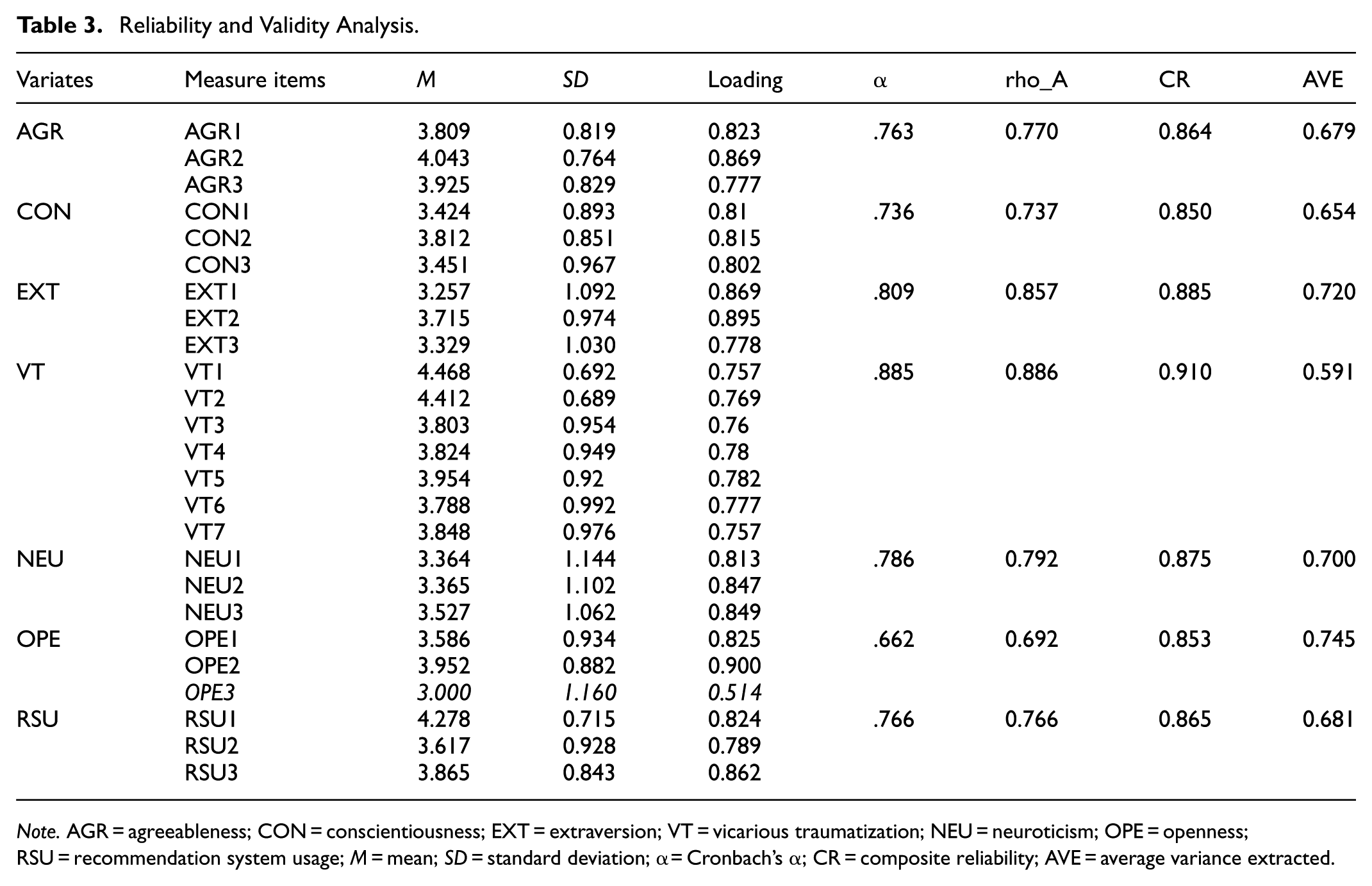
Note. AGR = agreeableness; CON = conscientiousness; EXT = extraversion; VT = vicarious traumatization; NEU = neuroticism; OPE = openness; RSU = recommendation system usage; M = mean; SD = standard deviation; α = Cronbach’s α; CR = composite reliability; AVE = average variance extracted.
The Average Variance Extracted (AVE) and item loadings were used to assess convergent validity (Gefen et al., 2000). As shown in Table 3, the AVE values for each variable ranged from 0.591 to 0.745, which were above the threshold of 0.5. In addition, the Loading of OPE3 (0.514), which measures openness, was below 0.7, so we removed this measure (see Table 3 in italics). After deleting OPE3, all remaining measures had a loading above 0.7. Thus, indicating good convergent validity.
The discriminant validity was assessed using the Fornell and Larcker (1981) criterion. As shown in Table 4, the values on the diagonal line (bolded font) are the square root planting of AVE for each variable, and they are all greater than the correlation coefficients of all other variables, which indicates that the scale has good discriminant validity.
Assessment of Discriminant Validity (Fornell-Larker Criterion).

Note. The diagonal elements (in bold) are the square root of variance shared between the AVE, whereas the off-diagonal elements are correlations among constructs.
Structural Mode
We tested the path coefficient (β) and the significance of the relationship between personality traits (extraversion, agreeableness, neuroticism, openness, and conscientiousness), recommendation system usage, and vicarious traumatization in this section. The results were as follows (see Figure 1 for details):
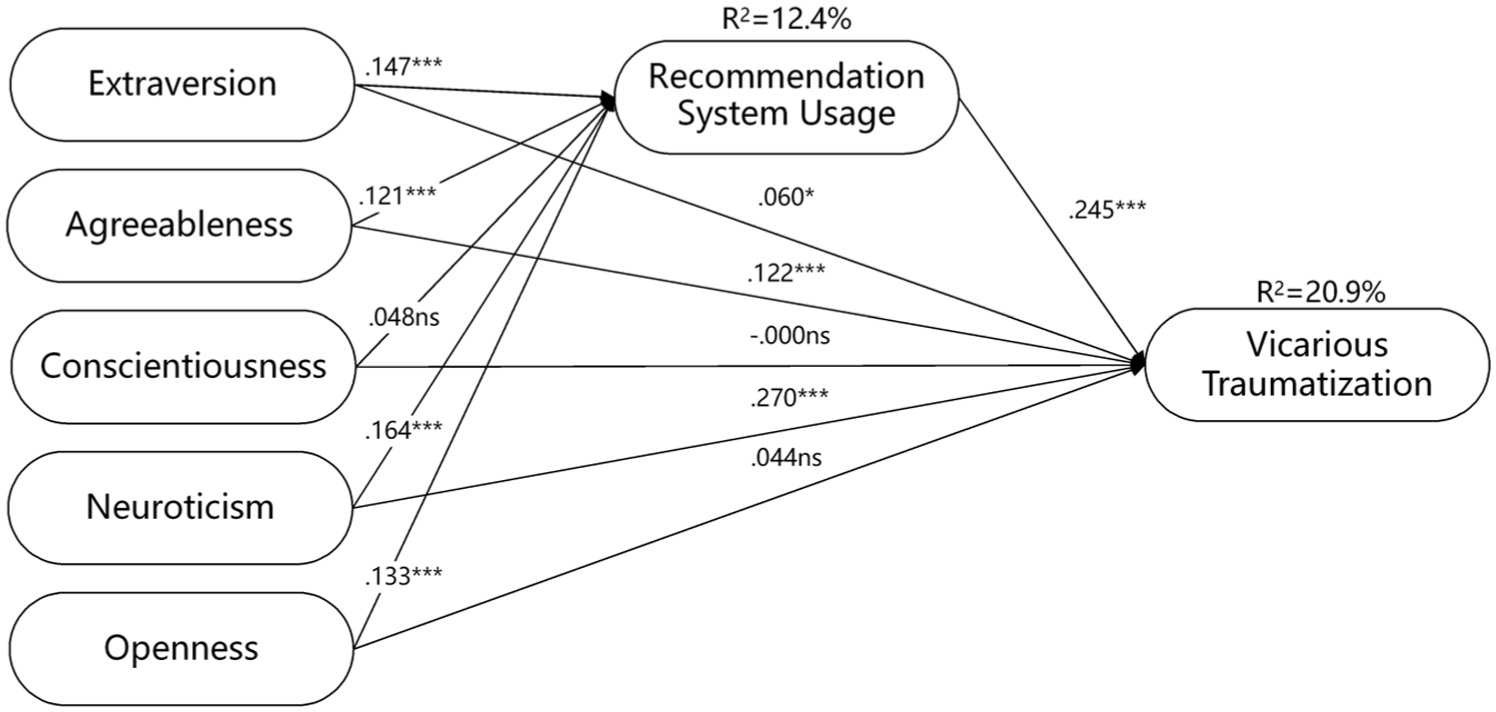
Test results of structural model.
Extraversion, agreeableness, and neuroticism in personality traits were significantly and positively correlated with vicarious traumatization (β = .060, p < .1; β = .122, p < .001; β = .270, p < .001). The relationship between the effects of openness, conscientiousness and vicarious traumatization in terms of personality traits was not significant (β = .044, p > .1; β = −.000, p > .1).
There was a significant positive relationship between extraversion, agreeableness, neuroticism, and openness in terms of personality traits and recommendation system usage (β = .147, p < .001; β = .121, p < .001; β = .164, p < .001; β = .113, p < .001). Conscientiousness had no significant effect relationship with recommendation system usage (β = .048, p > .1).
There was a significant positive relationship between recommendation system usage and vicarious traumatization (β = .245, p < .001).
After testing the coefficient of determination (R2), the percentage of variance for personality traits (extraversion, openness, agreeableness, neuroticism, and conscientiousness) used by the recommendation system is 12.4%. The percentage of variance between vicarious traumatization and recommendation system usage and personality traits was 20.9%.
Mediation effects test
This study analyzed the mediation effects according to Baron and Kenny (1986), using the Boostrapping method. The results of the test are as follows (See Table 5 for details):
Analysis of the Mediating Effect of Recommendation System Usage on Personality Traits and Vicarious Traumatization.

Note. ns = non-significant.
p < 0.01. ***p < .001.
First, the recommendation system usage in the relationship between extraversion and vicarious traumatization has an indirect effects value of 0.036 and a t-value of 4.203, which are significant, indicating a mediating effect. A VAF value of 37.5% indicates that recommendation system usage has a partially mediating effect.
Second, the recommendation system usage in the relationship between openness and vicarious traumatization has an indirect effect value of 0.028 and a t-value of 3.539, which are significant, indicating a mediating effect. A VAF value of 38.9% indicates that recommendation system usage has a partially mediating effect.
Third, the recommendation system usage in the relationship between agreeableness and vicarious traumatization has an indirect effect value of 0.030 and a T-value of 3.450, which are significant, indicating a mediating effect. A VAF value of 19.7% indicates that recommendation system usage has a weak mediating effect.
Fourth, the recommendation system usage in the relationship between neuroticism and vicarious traumatization has an indirect effect value of 0.040 and a T-value of 4.814, which are significant, indicating a mediating effect. The VAF value of 12.9% indicates that recommendation system usage has a weak mediating effect.
Fifth, the recommendation system usage did not have a significant mediating effect between uses with conscientiousness personality and vicarious traumatization.
Discussion
This study explored the influential relationships between personality traits (extraversion, agreeableness, neuroticism, openness, and conscientiousness), recommendation system usage, and vicarious traumatization based on the MU5735 air disaster. Specifically, the following three questions were answered:
Does Recommendation System Usage Lead to Vicarious Traumatization in Users?
These data suggest a significant positive correlation between the use of recommender systems and “vicarious traumatization” (i.e., there was a significant positive correlation between the development of virtual trauma in college students and the use of recommender systems in this plane crash). The rationale for this is that recommender systems are characterized by pushing large amounts of homogeneous information to users on a consistent basis (Roy & Dutta, 2022). After a sudden catastrophic event, recommendation system can push various forms of information or reports related to the catastrophic event to users continuously and frequently (R. R. Thompson et al., 2019). This may result in “supernormal stimulus,” which can even surpass direct visual exposure in impact, thereby leading to the production of vicarious traumatization (Ahern et al., 2004). Previous research has also illustrated that continuous and high exposure to disaster-related information is an important trigger of vicarious traumatization (C. Liu & Liu, 2020; Xu & Liu, 2021).
What Personality Traits are More Likely to Lead to Vicarious Traumatization?
The results showed that agreeableness and neuroticism were significantly and positively related to vicarious traumatization, extraversion was weakly and positively related to vicarious traumatization, and openness and conscientiousness were not significantly related to vicarious traumatization. This result is consistent with what Huang et al. (2022) have examined. Specifically:
High agreeableness users are prone to vicarious traumatization. Previous research has shown that people with high agreeableness are kind, considerate, and compassionate (E. R. Thompson, 2008), and are prone to empathize with the serious misfortunes experienced by others, which in turn leads to their own vicarious traumatization (Maguire & Byrne, 2017). Thus, users who are high in agreeableness are prone to vicarious traumatization when exposed to large amounts of information related to air crashes.
Users with high neuroticism are prone to vicarious traumatization. People with high neuroticism react to stressors and handle stress less well than the average person. They are prone to interpret ordinary situations as irredeemably difficult, and tend to fall into negative psychological states such as anxiety, fear, and depression (E. R. Thompson, 2008). Previous research has also noticed that individuals high in neuroticism are prone to vicarious traumatization exposure to traumatic material (Bakhshi et al., 2021; Maltby et al., 2010). Therefore, users with high neuroticism traits are prone to vicarious traumatization after exposure to extensive traumatic information online, such as air crash-related scenes.
Extraversion is weakly and positively correlated with vicarious traumatization. That is, users with high extraversion may also be more likely to develop vicarious traumatization. To be specific, people high in extraversion have the ability to understand others (Costa & McCrae, 1992), which makes them susceptible to vicarious traumatization when exposed to traumatic material (Jeronimus et al., 2019). Also, individuals high in extraversion tend to have positive, optimistic characteristics (Costa & McCrae, 1992). Therefore, when users with high extraversion are exposed to a large amount of traumatizing information related to air crashes on the Internet, they are prone to develop vicarious traumatization in themselves due to their understanding of the pain experienced by the victims of air crashes and their families. However, the positive and optimistic character traits of extraversion traits can help reduce this alternative traumatization experience.
Openness and conscientiousness were not significantly related to vicarious traumatization. The reasons analyzed from the study are that the people of emotionality with high openness has stronger emotional balance ability than ordinary people (Pacini & Epstein, 1999); people with high conscientiousness are behaviorally and psychologically (Hogan & Ones, 1997; Komulainen et al., 2014), they are able to recover quickly from the impact of negative information (Javaras et al., 2012). Therefore, users with these two personality traits are not prone to vicarious traumatization. This finding is consistent with Jeronimus et al. (2019).
Does and How Does the Use of Recommendation System Affect the Emergence of Vicarious Traumatization in Users with Different Personality Traits?
The results showed that recommendation system usage mediated the relationship between extraversion, openness, agreeableness, and neuroticism traits and vicarious traumatization. Recommendation system usage did not mediate the relationship between conscientiousness and vicarious traumatization.
First, the results showed that personality traits were significantly associated with recommendation system usage. Extraversion, openness, agreeableness, and neuroticism were significantly and positively associated with recommendation system usage, that is, users with high levels of extraversion, openness, agreeableness, and neuroticism were more likely to use recommendation system. People with high extraversion and openness have a strong spirit of exploration and are curious about new things (Gocłowska et al., 2019), and tend to have a positive and inclusive attitude toward the use of new technologies (Venkatesh et al., 2014), therefore, people with high extraversion and openness are more likely to use recommendation system (Roccas et al., 2002). For one thing, recommendation system is often advertised by technology promoters as an important technology that enables the use of software to provide personalized services to users and enhance the user experience goodwill, and for another, recommendation systems are often a recommended or even default feature in current Internet applications (websites, search engines, APPs). People with high agreeableness tend to use recommendation system out of compliance with recommendations. The influence of neuroticism on technology usage is controversial in scientific research (McElroy et al., 2007). Furthermore, previous studies have also found that high neuroticism are significantly correlated with technology usage (Kwee-Meier et al., 2016). The relationship between conscientiousness and the effect of recommendation system usage was not significant. The reasons inferred from the study are that people with high conscientiousness are meticulous, cautious, thoughtful, autonomous and self-disciplined (E. R. Thompson, 2008), and confident in their judgment (McCrae & Costa, 2003). The negative effects caused by the use of recommendation system are also of concern to scholars, and industry personnel (Milano et al., 2020; Zuiderveen Borgesius et al., 2016). Therefore, we hypothesize that people with high conscientiousness are more cautious about the use of such technologies that may affect their decisions. This finding is in line with Lacroux and Martin-Lacroux (2022) study. Based on the above discussion, we conclude that users with high extraversion, openness, agreeableness, and neuroticism are more likely to choose to use recommendation system. Because of this, after an air crash, users with the recommendation algorithm turned on will receive more concentrated, continuous, and high-frequency information about various news reports, extreme visual content (gory/wreckage images), and emotional narratives (sensational content, victim stories) related to the crash than users without the algorithm, who will be more susceptible to vicarious trauma.
Further, the research suggested that recommendation system usage mediated the relationship between extraversion, openness, agreeableness, neuroticism, and vicarious traumatization. As discussed in the previous paragraph, users high in extraversion, openness, agreeableness, and neuroticism were more likely to use recommendation system and to be influenced by the disaster messages pushed by recommendation system. Previous research has found that people high in extraversion, agreeableness trust recommendation system more and are also susceptible to the information they push (Lacroux & Martin-Lacroux, 2022). People with high openness are easily emotional and imaginative and are easily influenced by the content of information (Weibel et al., 2010). People high in neuroticism are emotionally unstable, easily stressed, tense and sad, and prone to vicarious traumatization when they are continuously and highly exposed to disaster reports in the media (Yamauchi et al., 2022). The use of recommendation system causes users with high extraversion, openness, agreeableness, and neuroticism to receive various forms of coverage or information related to disaster events on a consistent and high frequency basis (C. Liu & Liu, 2020; R. R. Thompson et al., 2019), which leads to vicarious traumatization (Ahern et al., 2004). In summary, recommendation system usage significantly contributes to the production of vicarious traumatization in users with high extraversion, openness, agreeableness, and neuroticism. Based on previous research findings (Huang et al., 2022; C. Liu & Liu, 2020), without the use of recommendation system, users high in extraversion and openness were not susceptible to vicarious traumatization.
Recommendation system usage did not mediate the relationship between conscientiousness and vicarious traumatization. As discussed earlier, people with high conscientiousness do not have a high preference for recommendation system usage and are therefore not susceptible to vicarious traumatization.
Conclusion
This study explored the influential relationship between personality traits, recommendation algorithm usage, and vicarious traumatization based on a sample of Chinese college students against the backdrop of the China Eastern Airlines MU5735 plane crash. The study found that Users with high extraversion, agreeableness, and neuroticism traits are prone to vicarious traumatization. Recommendation algorithms can significantly promote vicarious traumatization in users with high extroversion, pleasantness, neuroticism, and openness traits. Users with high conscientiousness are not prone to vicarious traumatization. Recommendation algorithms can significantly promote vicarious traumatization in users with high extroversion, agreeableness, neuroticism, and openness traits. Users with high conscientiousness are not prone to vicarious traumatization.
The results of the study have several implications for psychological assistance. First, users who are vulnerable to the occurrence of vicarious traumatization can be identified based on personality traits, so that targeted psychological assistance can be provided in time; second, targeted psychological assistance strategies can be designed based on personality traits; third, technology providers should avoid vicarious traumatization triggered by the recommendation system as much as possible by optimizing the recommendation system and providing necessary hints.
Limitations and Future Directions
As with any research, this study has been limited in some ways.
(1) This study is based on an online questionnaire survey conducted in mainland China based on the China Eastern Airlines MU5735 air disaster, and the results may have limited explanatory power. In the future, studies in different countries and regions based on different disaster situations may be considered.
(2) The sample of this study was limited to university students and was collected through convenience sampling, which also limited the generalization of the results of our study. Therefore, future studies may try to collect data from different occupations, age groups, educational backgrounds, etc.
(3) All data were obtained in self-reported form and may be subjectively biased. Future studies can try to use different types of data (e.g., experimental data, web-based text data) to improve the validity of the results.
Footnotes
Appendix
Questionnaire on personality traits, vicarious traumatization, and recommendation system usage.

|
|
|
|
| (1) I am outgoing and sociable. |
| (2) I am an active, enthusiastic person. |
| (3) I have an assertive personality. |
|
|
| (1) I am helpful and unselfish with others. |
| (2) I have a forgiving nature. |
| (3) I am considerate and kind to almost everyone. |
|
|
| (1) I do a thorough job. |
| (2) I am a reliable worker. |
| (3) I make plans and follows through with them. |
|
|
| (1) I worry a lot. |
| (2) I can be moody. |
| (3) I get nervous easily. |
|
|
| (1) I always come up with original ideas. |
| (2) I feel curious about many different things. |
| (3) I am sophisticated in art, music or literature. |
|
|
| (1) I have been exposed to sad news and experiences about the MU5735 aircraft flight accident through the media. |
| (2) When reading/watching the information in the media about the MU5735 aircraft flight accident, I felt sad and upset. |
| (3) When I read/watched the media information about the MU5735 aircraft flight accident, it was hard for me to maintain a positive and optimistic attitude. |
| (4) I find myself thinking about these sad messages about the MU5735 aircraft flight accident. |
| (5) Sometimes I feel helpless because I cannot help the victims, the families of the victims of the MU5735 aircraft flight accident |
| (6) Sometimes I feel very depressed (deeply emotionally in a negative state of mind) when reading/watching the media about the MU5735 aircraft flight accident. |
| (7) I have read/watched the news in the media about the MU5735 aircraft flight accident and I find it very difficult to come to terms with this. |
|
|
| (1) I use recommendation system when browsing information/video. |
| (2) I use the recommendation system. |
| (3) I frequently use recommendation system to help me choose the information/video to browse. |
Acknowledgements
I sincerely thank everyone whose support and guidance made this work possible.

Ethical Considerations
This study was approved by the Medical Ethics Committee of Guangxi University (GXU-2022-247).
Funding
The authors received no financial support for the research, authorship, and/or publication of this article.
Declaration of Conflicting Interests
The authors declared no potential conflicts of interest with respect to the research, authorship, and/or publication of this article.
Data Availability Statement
The data presented in this study can be provided upon request to the corresponding author. For ethical reasons, these data cannot be made public.