




Abstract
Bullying and cyberbullying are social problems that affect a growing number of adolescent students at an international level. Emotional competence is known to play a major role among those involved in these bullying behaviors. For this reason, developing a program that stimulates these competences can favor positive interrelationships between students and improve coexistence at school, the well-being, and quality of life of young people. The objective of this study is to evaluate the effectiveness of the ÆMO program, which focuses on enhancing emotional literacy and regulation, in reducing bullying and cyberbullying and improving the school climate. The study design was quasi-experimental with a pretest and posttest, in which 374 (52.14% female) Spanish students (aged 13 to 17 years) from 4 high schools participated, being assigned to an experimental (174 students) or control group (200 students). All students completed self-administered questionnaires on bullying, cyberbullying, and school climate before and after the intervention to identify possible changes in these variables caused by the program. After 5 months of intervention, the results showed a statistically significant reduction in bullying, peer victimization, cyberbullying, and cybervictimization behaviors in the experimental group. Similarly, a statistically significant improvement was found in school climate factors only in this group. In conclusion, the results of this study demonstrated that the ÆMO program is effective in reducing bullying and cyberbullying, and at the same time, in improving school climate.
Introduction
Bullying and cyberbullying have become major public health concerns for youth and schools worldwide, displaying a rising prevalence (Zhu et al., 2021). In a recent report created by the World Health Organization (WHO, 2020) from 45 countries in 2017/2018, 10% and 6% of the adolescent students, respectively, reported having suffered or perpetrated bullying at least two or three times over the previous 2 months. These percentages were even higher in the case of cyberbullying, reaching 13% for cybervictimization and 10% for cyberbullying perpetration (Inchley et al., 2020). Given the increase in bullying and cyberbullying, several interventions have been developed to address these issues, although some of them have certain limitations in terms of effectiveness (Cantone et al., 2015). Recent meta-analyses have suggested that anti-bullying programs reduce bullying perpetration rates by approximately 19% to 20% and decrease bullying victimization rates by approximately 15% to 16% (Gaffney, Ttofi, et al., 2019). Anti-cyberbullying programs have been shown to reduce cyberbullying perpetration by approximately 10% to 15% and cyberbullying victimization by approximately 14% (Gaffney, Farrington, et al., 2019).
Although numerous programs are aimed at preventing and intervening in these two forms of peer bullying (Della Cioppa et al., 2015; Machimbarrena et al., 2018), most of them have focused solely and specifically on preventing bullying and school victimization, such as, Olweus and Limber’s Bullying Prevention program (Olweus & Limber, 2010) and Fox and Boulton’s Social Skills Training (Fox & Boulton, 2003). Over recent decades, however, other programs have been created to reduce bullying, and they have proven useful in also reducing cyberbullying. This is the case with the Kiva program (Williford et al., 2013) and the ViSC Social Competence program (Gradinger et al., 2015), and vice versa, for example, The Media Heroes Cyberbullying Prevention program (Chaux et al., 2016) and Cyberprogram 2.0 (Garaigordobil & Martínez-Valderrey, 2014). Although limited, these types of programs reveal the close relationship between both problems and the need to address them jointly, since they are considered group processes that involve all members of the classroom (Tanrikulu, 2018). However, scientific evidence on the effectiveness of interventions against bullying and cyberbullying remain scarce (Gaffney, Ttofi, et al., 2019).
In this sense, a systematic review analyzing the effectiveness of programs aimed at the prevention and intervention of bullying and cyberbullying in secondary school students in Spain concluded that the programs are based on different explanatory models of said problems, use instruments that do not coincide, and focus their interventions on specific objectives on different focuses, ranging from the victim to the classmates living together in a specific classroom, or even the entire educational community (Estévez et al., 2019). Given this limitation, this study focuses on EI (Emotional Intelligence), which has been shown to have an impact on improving well-being and reducing aggressive behavior (Gutiérrez-Cobo et al., 2017; Quintana-Orts et al., 2021).
Prior works have suggested that deficits in EI may be key factors involved in situations of bullying and cyberbullying (Méndez et al., 2019; Quintana-Orts et al., 2021). In the case of aggressors, in both traditional bullying and cyberbullying, it has been observed that they have more difficulties in the dimensions of understanding and regulating emotions (Cañas, Estévez, León-Moreno, & Musitu, 2020). Likewise, there are multiple benefits in the literature supporting the integration of emotional skill learning into formal education during adolescence (Postigo-Zegarra et al., 2019). For this reason, different anti-bullying and cyberbullying interventions have focused on highlighting IE, among other factors, as a major component of their effectiveness (Chamizo-Nieto et al., 2020; Chicote-Beato et al., 2024; Imuta et al., 2022).To date, however, few programs are aimed at simultaneously intervening in schools to address bullying and cyberbullying through the development of emotional competences.
The ÆMO Program: Emotional Literacy (in Spanish “Alfabetización Emocional”)
With regard to the information presented in the previous paragraphs, the design of the ÆMO program arises from the demand of professionals in the educational field for a new intervention program in emotional education to reduce school violence and promote a culture of positive school coexistence. After the request for collaboration by the teachers with the CEFIRE (Spanish initials for Center of Training, Innovation and Resources for Teachers) of reference, in this case in Elda (Alicante), their proposal was considered and the posed questions were answered. A collaboration agreement was reached together with the Department of Health Psychology of the authors’ reference university. In this way, the ÆMO program is developed through a school teaching innovation project, with the aim of developing, applying, and evaluating a development program from the perspective of emotional education, to promote socio-emotional development in students, and to stimulate coexistence in the center, well-being and quality of life of the educational community. In short, the ÆMO program was designed to promote the emotional literacy and regulation of students.
The ÆMO program follows the model of Salovey and Mayer (1990). It has been the theoretical approach with the greatest scientific impact and has served as the basis for a significant amount of research, providing valuable contributions in the educational field (Arteaga-Cedeño & Martín Antón, 2024). According to this model, EI involves the ability to accurately perceive, appraise, and express emotions, the ability to access and/or generate feelings that facilitate thinking, the ability to understand emotions and emotional knowledge, and the ability to regulate emotions that promote emotional and intellectual growth (Mayer and Salovey, 1997). In this sense, those with a well-developed EI tend to be more aware of their own emotions and can effectively manage and express these emotions (Mayer et al., 2008; Mayer et al., 2004). They report positive relationships with others and are less likely to have negative interactions with close friends (Lopes et al., 2003). The fact that the model is based on EI makes it possible to address the mechanisms underlying bullying and cyberbullying.
The ÆMO Program Sessions Description
The ÆMO program follows the theoretical model of IE of Mayer and Salovey (1997), including recognition, understanding, labeling, expression, and regulation of emotions, but with taking a universal intervention approach. This involves not only the student body, but also the entire educational community. One of the most important aspects for the proper implementation of the ÆMO program is teacher training. Teachers are the main agents involved in emotional education in schools, and without their proper training, it is impossible to educate on emotions. In each of the 10 sessions of the program, which will be presented below, a script is included for the educational staff specifying and detailing all of the activities of the ÆMO program. The sessions are structured according to the following general outline and sequencing:
In the first session of the intervention, the program is presented to the students, and the benefits of EI on daily life are explained. In this session, the objectives, content, and methodology of the work to be carried out are explained.
From the second to the ninth sessions, independent sessions are proposed to educate on each of the basic emotions to be treated in the ÆMO program: joy, fear, anger, and sadness. Each of these emotions is worked on in a monographic way in two sessions. In the first session, the emotional awareness of the emotion to be worked on at each moment is considered. In the second, the different emotional management strategies of the emotion treated at a cognitive, behavioral, and emotional level are addressed in an experiential and participatory way.
In the last and tenth session, the didactic path followed in the previous sessions is summarized and the lessons learned are detailed. The aim is to highlight the important points of the previous sessions and resolve any pending doubts and questions.
This study aims to analyze the effectiveness of the ÆMO program in reducing bullying and cyberbullying and in promoting school climate. In line with the results of previous research on this topic, it is expected to conclude that this program, based on emotional literacy, is effective not only in reducing bullying and cyberbullying, but also in improving school and teacher climate (Ferrer-Cascales et al., 2019).
Materials and Methods
Population and Sample
Participants were 374 youths, of which 52.14% (n = 195) were female and 47.86% (n = 179) male from four secondary schools in the province of Alicante (Spain). Participants ranged in age from 13 to 17 years at the beginning of the program, with a mean age of 14.79 (SD = 0.94). To determine the sample size, G*Power software was used. It found that the study sample size meets the requirements necessary to achieve the desired power and avoid bias due to insufficient sample size. Thus, a minimum of 102 individuals (51 in each group) was needed according to the G-power software, based on an effect size of d = 0.5, an α error of 5%, and a power of 80%. From the total sample, selected through convenience sampling (see Procedure), 174 students were assigned to the experimental group and 200 to the control group. The assignment of the control and experimental groups was carried out through the self-selection of the tutors in each classroom. That is, the students of those tutors wishing to participate in the intervention and train in the ÆMO program were assigned to the control group. On the contrary, the students of those tutors who did not volunteer became the control group. The distribution of the sample according to gender, grade, and condition may be consulted in the following table (see Table 1). There were no significant differences between groups in terms of gender (χ2 = .463, df = 1, p = .49) or grade (χ2 = 5.51, df = 2, p = .07).
Distribution of the Sample According to Group (Condition), Grade, and Gender.

Instruments
School Social Climate
The California School Climate and Safety Survey (CSCSS; Furlong & Morrison, 1994; Rosenblatt & Furlong, 1997), in its Spanish version (adapted by Trianes et al., 2006) was used to assess the students’ perception of the school climate relative to the school and the teachers. Students have described 14 situations related to their school, six situations related to teacher climate (related to academic demands, justice, and student-teacher relationships), and eight related to school climate (related to relationships between peers, ability to help, and feeling of well-being). The 5-point Likert response scale ranged from 1 (never) to 5 (many times). In this study, the global scale had a Cronbach’s alpha of .83, and the values obtained were .72 for school climate and .78 for teacher climate.
Bullying/Victimization
The Multimodal School Interaction Questionnaire (CMIE-IV; Caballo et al., 2012) is a 36-item, self-report measure that contains five subscales measure the frequency of various behaviors as constituting bullying over the last 2 months. The 4-point Likert response scale ranged from 1 (never) to 4 (many times). This study only included two subscales assessing bully behavior (10 items) and peer victimization (10 items). There was good internal consistency of the sample analyzed for each factor was good: bullying behavior (α = .89); and peer victimization (α = .75).
Cyberbullying/Cybervictimization
The E-Victimization Scale (E-VS) and E-Bullying Scale (E-BS; Lam & Li, 2013), in their Spanish version (adapted by Ferrer-Cascales et al., 2019), identify cyberbullies and cybervictims. The E-VS has 5 items, while the E-BS includes 6-items. Students must indicate how often (from 0 to 6 or more times) they have experienced (E-VS) or perpetrated (E-BS) cyberbullying over the last 7 days. To make this scale available to the Spanish population, the international standards published by the International Test Commission were followed, using the translation-retro-translation process (Muñiz et al., 2013). The internal consistency for E-VS was α = .89 and for E-BS was α = .87.
Study Design
This is a quasi-experimental pretest-posttest research design with control and experimental groups. It was a non-invasive, quasi-experimental design using anonymous, self-administered questionnaires, minimizing any physical or psychological risk. The intervention focused on emotional skills, which are known to promote well-being rather than cause harm.
The program led to reduced bullying and improved school climate, directly benefiting participants. At a societal level, it offers evidence to support effective, preventive interventions in schools. These positive impacts clearly outweigh the minimal risks involved.
Procedure
The ÆMO program arises from the demand of professionals in the educational field through the CEFIRE of Elda (Alicante) for a new intervention program in emotional education. After the request, the proposal was considered and the posed questions were answered, reaching a collaboration agreement with the Department of Health Psychology of the University of reference of the authors. The study procedure was approved by the Research Ethics Committee of the authors’ university of reference and by the Educational Steering Committee of the participating schools (reference number: UA2015-1013).
Informed consent was obtained in accordance with ethical guidelines for research with minors. Written informed consent was requested from both the students and their legal guardians prior to participation. Participants were informed of the purpose of the study, the voluntary nature of their involvement, the confidentiality of their responses, and their right to withdraw at any time with no consequences. This process ensured that participation was fully informed and consensual. Data collection was carried out using self-administered surveys completed by adolescents in the experimental (EG) and control group (CG) both in the phase before the application of the Program (T1) and 5 months later (T2), although only EG students and teachers received the intervention. To guarantee the anonymity of the students, in T1 they were asked to create a code that only they would know and that they would once again recall for the questionnaire in T2.
Data Analysis
The first analysis performed was a t-test to analyze possible differences in baseline EG and CG. Effect sizes were also calculated for each pair of variables using Cohen’s (1988) definitions. In addition, the percentage change between scores from T1 to T2 was calculated following this formula [(T2−T1/T1)]*100. To test the assumptions of normality and homogeneity of variances, necessary for the means comparisons, the Kolmogorov-Smirnov test and Bartlett’s test were used, respectively. The values of both tests scored above 0.05, suggesting the normality of the data distribution and the homogeneity of variances. A repeated measures ANOVA of “moment” (T1 pre-intervention vs. T2 post-intervention) with “condition” (EG participants vs. CG participants) as a between-subjects factor was also conducted to analyze the effectiveness of the intervention in terms of reducing bullying and cyberbullying, as well as, improving school climate. For significant results, the partial eta-squared was reported as a measure of effect size (Richardson, 2011). For univariate between-subjects tests, robust tests of equality of means were calculated using Welch’s F when variances were heterogeneous. In addition, an analysis of covariance (ANCOVA) was performed to control for the effect of age, grade, and gender of participants as covariate variables to evaluate of the effectiveness of the ÆMO program. All statistical analyses performed in this study were conducted using SPSS (International Business Machines Corporation (IBM), Armonk, NY, USA) Statistics for Windows, Version 28.0, with a p < .05 being considered significant. Descriptive values are expressed as mean and standard deviation (M and SD, respectively).
Results
Descriptive Analysis of EG and CG at T1 and T2 and Percentage Change for Bullying, Cyberbullying and School Climate
Firstly, the differences between CG and EG at baseline were analyzed in order to understand the status of the variables studied prior to the implementation of the intervention and to identify any possible differences prior to the application of the program that could affect the interpretation of the results. For bullying and cyberbullying behavior, analyses showed no significant differences between EG and CG on the baseline scores (T1) for bullying behavior (t = 0.61, p = .55; Cohen’s d = 0.06), victimization (t = 0.53, p = .60; Cohen’s d = 0.05), cyberaggression (t = 0.68, p = .49; Cohen’s d = 0.17), or cybervictimization (t = 0.30, p = .77; Cohen’s d = 0.02). Regarding the social school climate, no differences were found between groups on school climate (t = 0.71, p = .48; Cohen’s d = 0.08) or teacher climate (t = 0.66, p = .51; Cohen’s d = 0.07) for the baseline scores (T1).
The results regarding the impact of the ÆMO program on the prevalence of the different variables revealed distinct percentage variations in the control group and the experimental group. Table 2 shows that a significant reduction in the prevalence of bullying/victimization and cyberbullying/cybervictimization over time was only found in the experimental group, while school climate and teacher climate increased significantly in this same group.
Mean and Standard Deviation (T1–T2) and Percentage Change by Groups (Condition).

Note. EG = Experimental group (n = 174); CG = Control group (n = 200).
Effectiveness of the Program on Bullying Reduction
The results obtained revealed a significant effect of the group*time interaction on bullying behavior (F(1,372) = 10.65; p = .00; η2 = .028) and victimization (F(1,372) = 54.69; p = .00; η2 = .128). As the effect size revealed, the variance explained by the ÆMO program was small for bullying and moderately-high for victimization. However, the values of both scales were significantly reduced from T1 to T2. It should be noted that the benefits of the intervention were only observed for students participating in the ÆMO program (see Figure 1).

Interaction effects of experimental and control groups and time (T1–T2) on Bully behavior (left) and Peer victimization (right).
Effectiveness of the Program on Cyberbullying Reduction
As for cyberbullying, cyberbullying behavior (F(1,372) = 46.68; p = .00; η2 = .111) and cybervictimization (F(1,372) = 25.83; p = .00; η2 = .064) showed statistically significant group*time interaction effects, with moderate-high and moderate-moderate effect sizes respectively. As can be seen in Figure 2, in the control group the scores increased on both scales from T1 to T2 (p > .00). However, in the experimental group, the scores were significantly lower in the T2 phase, revealing the the program’s effectiveness in this group.
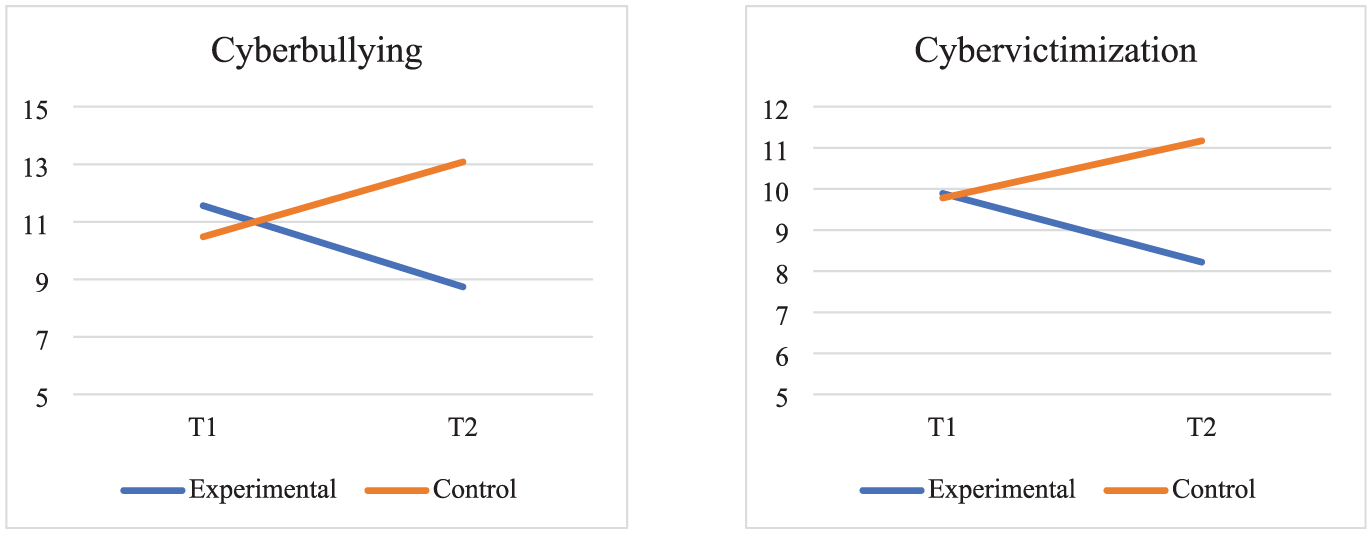
Interaction effects of experimental and control groups and time (T1–T2) on Cyberbullying (left) and Cybervictimization (right).
Effectiveness of the Program on School Climate Improvement
Differences in school climate showed a statistically significant effect of the interaction group*time on school climate (F(1,372) = 8.65; p = .03; η2 = .023) and teacher climate (F(1,372) = 29.71; p = .00; η2 = .074), with small and moderate effect sizes respectively. Only the experimental group significantly increased its scores on the two school climate subscales in T2 as compared to T1, with significant differences being found between groups at this time (p = .00; Figure 3).

Interaction effects of experimental and control groups and time (T1–T2) on Classroom climate (left) and Teacher climate (right).
Of the bullying behaviors analyzed, the interaction group*gender in EG at T2 showed a significant effect on bully behavior (F(2,174) = 3.52; p = .03; η2 = .04), with a small effect size. In other words, the ÆMO program was effective in reducing victimization, cybervictimization, and cyberbullying regardless of group and gender except for bullying behavior. In the latter, the data suggest that the program was less effective, especially for 9th-grade girls and 10th-grade boys (Figure 4).

Interaction effects of grade and gender in bully behavior in experimental group at T2.
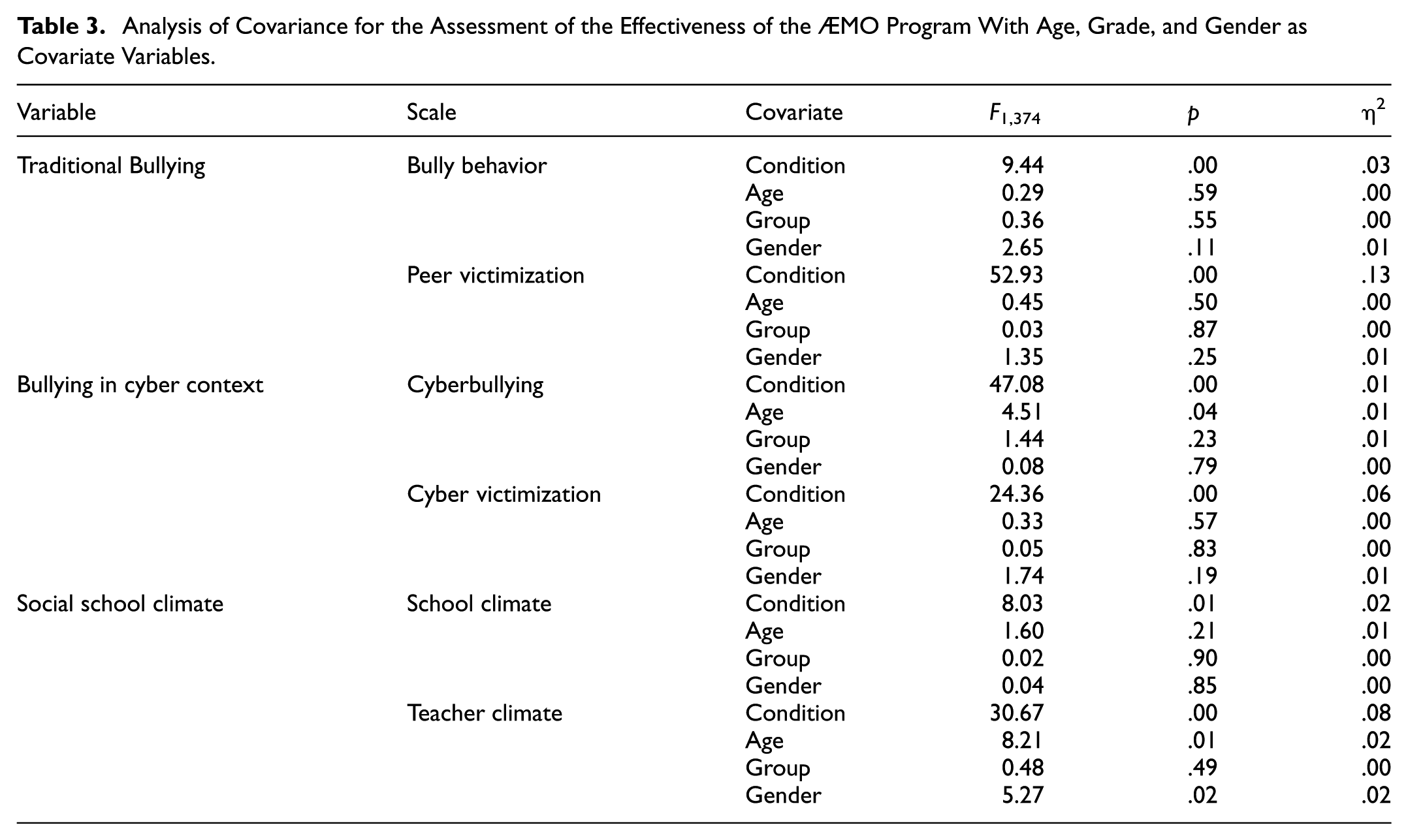
The results of the Repeated Measures ANCOVA to control for the effects of age, grade and gender on the program are shown below (see Table 3). Although the age covariates were significant for the cyberbullying variable, and age and gender covariates for teacher climate, the effectiveness of the ÆMO program is maintained for all variables. However, a decrease in effect size is observed for each of the variables studied.
Analysis of Covariance for the Assessment of the Effectiveness of the ÆMO Program With Age, Grade, and Gender as Covariate Variables.
Discussion
This study aimed to analyze the effectiveness of the ÆMO program on reducing bullying and cyberbullying and improving school climate in a sample of Spanish adolescents. The results show that the Spanish ÆMO program can be effective in reducing bullying and cyberbullying rates in the classroom and improving school climate rates, including school climate and teacher climate.
The ÆMO program is an emotional literacy and emotional regulation intervention based on the perspective of emotional intelligence and positive psychology. The objective of this program is to promote personal growth and positive coexistence within the educational center, through the development of socio-emotional skills such as the ability to perceive, express, facilitate, understand, and regulate one’s own and others’ emotions. This Program proposes starting to work working on emotional awareness, which is considered an essential skill for the acquisition of other more complex ones as emotional regulation, empathy, and social competencies. This allows participants to establish positive, satisfying and healthy interpersonal relationships among those involved (Albaladejo-Blázquez et al., 2016).
Despite the scarcity of bullying and cyberbullying prevention programs based on emotional literacy and emotional regulation, evidence shows that addressing adolescents’ socio-emotional skills is an important factor in preventing bullying behaviors (Arató et al., 2020). Generally, several studies have associated the profile of the aggressor and cyberbully with deficits in empathy and in the ability to understand and feel the vicarious emotions of others (Brewer et al., 2015; Gianesini and Brighi, 2015). However, there are hardly any references to studies that analyze emotional intelligence in aggressors in a multidimensional way, and even fewer in cyberbullying. Considering the components of EI, the scarce literature on the subject indicates that aggressors and cyberbullies show low levels of emotional clarity and emotional repair (Cañas, Estévez, León-Moreno, & Musitu, 2020; Casas et al., 2015). Estévez et al. (2019) observed that bullies showed deficits in the ability to regulate emotions. On the other hand, the results of other studies revealed that bullies have a low capacity to recognize and understand the emotions of others, something directly related to lower emotional attention abilities (Lomas et al., 2012; Schokman et al., 2014). In line with the findings of the studies presented, it is not surprising that bullying and cyberbullying levels were moderately reduced after the implementation of the ÆMO program in classrooms, given that the development of socio-emotional skills seems to play an essential role in relationships, promoting positive interpersonal and social skills (Wang et al., 2019), as well as the regulation of aggression (Nasaescu et al., 2018).This study also observed a moderate decrease in victimization and cybervictimization in the classrooms where the program was implemented. In fact, the results of various previous studies indicate that victims and cybervictims report problems in the dimensions of EI, such as heightened emotional attention, lower emotional clarity or understanding, along with poorer self-regulation of their own emotions (Cañas, Estévez, Martínez-Monteagudo, & Delgado, 2020; Estévez et al., 2019). Accordingly, other studies conclude that greater emotional clarity and reparation often decrease the likelihood of becoming a victim of bullying and cyberbullying (León-del-Barco et al., 2020; Segura et al., 2020). These data are consistent with empirical evidence that the emotional imbalance characteristic of victims and cybervictims prevents them from focusing on choosing and utilizing adaptive coping strategies (Estévez et al., 2019).
Based on these results from these previous studies, it is reasonable to assume that the effectiveness of the ÆMO program in addressing and reducing bullying and cyberbullying within the educational context is based on the promotion of EI in adolescents. As outlined throughout the study, the program is grounded in the EI model proposed by Mayer and Salovey (1997), a framework that emphasizes the perception, understanding and regulation of emotions as core competencies. In this regard, the observed outcomes not only support the practical utility of the program but also strengthen the explanatory power of the theoretical model by demonstrating its applicability in the field of school violence prevention. Therefore, this program appears to have a positive effect on all forms of victimization by fostering socioemotional skills related to emotional management, which may play a relevant role not only in preventing antisocial behavior in aggressors (Garaigordobil, 2017), as previously noted, but also in reducing withdrawal and avoidance behaviors in victims.In summary, the observed reduction in cyberbullying and cybervictimization in the experimental group can be considered an indicator of the effectiveness of the ÆMO program in reducing this type of behavior among the adolescents studied. However, this effectiveness may be enhanced by the results of the control group, since, in contrast, the scores in this group were increasing. In line with the available literature, higher (cyber)bullying and (cyber)victimization at T2 versus T1 is the natural increasing trend followed by bullying behavior when these acts are not adequately addressed (Ferrer-Cascales et al., 2019).
Regarding school social climate, this research shows that the ÆMO program also has a positive impact on school and teacher climate. Very few programs aimed at reducing bullying and cyberbullying have also shown their effectiveness on school social climate (Ferrer-Cascales et al., 2019). In this research, the program’s effectiveness is likely determined by the effect of emotional literacy and emotional regulation on improving school climate. Recent research has shown that students’ social-emotional competence has a positive impact on social relations and school climate (González et al., 2022). However, this relationship may be bidirectional, as positive teacher-student interactions, school engagement, and even peer behavior promote adolescents’ socioemotional development (Wong et al., 2021), while decreasing peer victimization and aggression (Sullivan et al., 2021). This relationship could, in turn, explain the reduction in victimization and aggression in the traditional and cyber context in the experimental study group discussed above.
Finally, according to the results of the univariate factor analysis, this program was effective, albeit moderately, in reducing victimization, cyberaggression, and cybervictimization in all grades and genders. However, this was not the case for the role of aggressor, where higher levels of bullying were observed in 9th-grade girls and 10th-grade boys at T2. Currently, there is scarce literature analyzing differences in the effectiveness of anti-bullying programs considering the interaction of grade and gender. Available studies analyze both factors separately, indicating that, in general, and regarding grade, bullying increases after the transition to middle school, and decreases thereafter (Ryoo et al. 2015). Other studies have indicated that a decrease in bullying behavior occurs with increasing age (Benítez-Sillero et al., 2021; Del Rey et al., 2018). Along these lines, other studies more consistent with the results of this study are those that have analyzed the moderating effect of age on the effects of bullying and cyberbullying prevention programs. Although there are many empirically validated programs in this regard for secondary school students (Machimbarrena & Garaigordobil, 2018), a meta-analysis conducted by Yeager et al. (2015) showed that the effect of the programs is greater when they are implemented with students below seventh grade than with students in eighth grade and above. This suggests that early adolescence may represent a more sensitive period for intervention, where socioemotional learning can be more effectively internalized and translated into behavioral change.
From a developmental perspective, adolescence represents a complex life stage that can hinder the effectiveness of these prevention programs. As students advance in age, several developmental and contextual factors may diminish the impact of preventive programs. Older adolescents usually exhibit an increased autonomy, more critical reasoning and resistance to adult authority, which may be related to a reduced receptivity to structured interventions, especially when the prosocial behaviors promoted by such interventions are perceived as conflicting with peer dynamics or the pursuit of social status and popularity (Guy et al., 2019; Laninga-Wijnen et al., 2023). In this regard, several studies have highlighted social status as an important factor in behavioral differences between grades. Van der Ploeg et al. (2020) observed that students who bully tend to gain status among their classmates, however, this only appears to occur with students in higher grades. For students in lower grades, bullying led to a lower social status. In addition, not only is bullying less prevalent in the lower grades of secondary school, but it appears that bullying prevention policies have a stronger beneficial effect on the lower grades as compared to the upper grades of secondary education (Nikolaou, 2017). In line with these results, emotional development should also be taken into account since various studies have indicated that girls perform better than boys on emotional intelligence-ability. This is especially evident upon reaching adolescence (D’Amico, 2013; D’Amico & Geraci, 2022). This may explain why the program revealed a greater effectiveness in girls in the upper grade as compared to boys.
Regarding gender, several studies have pointed out that bullying behavior is more frequently perpetrated among boys due to their higher levels of moral disengagement. They have also added that this disengagement is also observed to a greater extent among students in higher grades (Douglass et al., 2016), coinciding with the findings of this study. Other studies have justified the increase in bullying among boys due to the need for dominance in their peer group (Solomontos-Kountouri et al., 2016). Moreover, regarding bullying behavior prevention programs, a meta-analysis performed by Kennedy (2020) concluded that the programs appeared to have greater effectiveness in the most common physical and relational forms of bullying in boys, as compared to the verbal forms, which were more common in girls. According to the EI analysis, the lower effectiveness of the program on boys could be related to cultural factors. D’Amico and Geraci (2022) concluded that females are more likely to share their emotions with peers and to listen to the emotional problems of others, which may result in a greater ability to tune in to others. In contrast, males are less inclined to share emotions with others and to participate in the personal and social construction of emotional consensus. This could be an obstacle to the effectiveness of this program, which focuses on EI and positive psychology, as it requires active engagement with one’s own emotions and those of others. If boys are culturally or socially conditioned to suppress emotional expression, they may be less receptive to the core components of the intervention, thereby limiting its impact on their emotional development and related behavioral outcomes, such as aggression and empathy, as previously demonstrated (Chaplin, 2015). Therefore, these findings, when extrapolated to the results of this study, may explain the reduction of bullying behaviors in 10th-grade girls and 9th-grade boys following program implementation (T2). A section should be dedicated to the covariate variables of this study given that they appear to influence cyberbullying behavior and the perception of the climate based on the relationship with teachers.
Research on the influence of age on cyberbullying behavior has been quite mixed. On the one hand, some studies have reported that the rates of cyberbullying increase constantly with age (Pichel et al., 2021). Other studies, however, have found that rates of cyberbullying in early adolescents were higher than in other older age groups (Wright & Wachs, 2023). In line with the importance of gender and age in the teaching climate, previous studies have pointed out that adolescent girls have better relationships with teachers than boys (Cañas, Estévez, Martínez-Monteagudo, & Delgado, 2020). Regarding age, other studies have concluded that the quality of the student-teacher relationship decreases with increasing student age (García-Moya et al., 2018). This could be related to the fact that as adolescents advance through the grades, the number of teachers increases substantially, thus decreasing their relationships with these teachers (Magro et al., 2023).
Strengths, Limitations, and Future Research
This study has made an important advance in the understanding of the effectiveness of anti-bullying programs based on emotional literacy and emotional regulation to reduce problems such as bullying and cyberbullying. Moreover, given its quasi-experimental design, it permits the assessment of its effectiveness in reducing these problems. However, some limitations should be noted. The first of these limitations stems from the inherent social desirability bias associated with the use of self-report measures. For future studies, parent and teacher reports should be considered to help cross-check adolescents’ self-reported attitudes and behaviors, while using other triangulation or observational methods to assess and confirm the effects of the program. Secondly, this study only takes into account two evaluation periods (pre- and post-intervention). Although some programs in the literature have demonstrated their effectiveness by measuring their immediate effect (at approximately 6 months or less; Blanc et al., 2024; Castillo et al., 2013; Del Rey et al., 2019), they may fail to determine the sustainability of the behavioral changes derived from the intervention over the long-term. It would be advisable to include longitudinal follow-up immediately after the intervention (at 6 months and 1 year after the end of the intervention) in order to assess the long-term effects on the reduction of the problems under study. The assignment of the control and experimental groups is also a limitation, since the “available or convenience sampling” derived from the teacher’s motivation to participate in the intervention may bias the results. In future studies, it would be interesting to apply statistical and methodological adjustments such as adjusted weights, propensity score matching, and sensitivity analyses that consider the differences between the convenience sample and the general population to minimize selection bias and improve the robustness of the results.
On the other hand, the study participants may also be a limitation when generalizing the results obtained at a cultural level, since they are adolescent students from a specific locality in Spain. The results of this program could vary due to cultural differences in the acceptability of bullying and cyberbullying within society, as well as due to the different instruments available for its assessment. In the future, this issue may be addressed by replicating and adapting the study to other cultural contexts and age ranges. Differences in program effectiveness between the 9th-grade girl and 10th-grade boy subgroups could suggest the need to adapt the intervention in the upper grades. It may be necessary to adjust the intervention with activities that are focused on addressing external factors, such as friends or social media, which are the most influential factors at this stage in their behavior and emotions. It may also be useful to address the cultural factor influencing the different styles adopted by girls and boys when sharing and managing their emotions. A final limitation is the covariate variables, especially age and gender, which appear to interfere with the application of the ÆMO program. Therefore, future studies should further analyze the effect these sociodemographic variables might have as moderators of the program. Finally, the effect size of the results ranged from small to moderate. However, in line with previous research, the trend of intervention programs against bullying and cyberbullying tends to be positive but without large effects (Menesini, 2019; Zych et al., 2015). In terms of practical implications, the modest effect of the program indicates that it has a positive, albeit small, impact on the variables it addresses and, in the context implemented. Nevertheless, this indicator is an opportunity to adjust and improve the program presented.
Conclusions
Emotional literacy and emotional regulation are fundamental to the development of socio-emotional skills in young people, as well as an anti-bullying climate in schools. It is worth noting the urgency of developing and implementing effective interventions in schools since bullying and cyberbullying are currently some of the main public health problems affecting adolescents and their families. This research suggests that the ÆMO program, based on the promotion of EI in adolescents, may be an effective and useful intervention program to be implemented in schools, in order to prevent and reduce bullying and cyberbullying. This program could provide useful strategies for educators and professionals to effectively intervene and help reduce bullying and cyberbullying.
Footnotes
Acknowledgements
The authors are grateful for the collaboration of CEFIRE from Elda for providing the precise and necessary support to the teachers who have been part of this innovation program. Also, they would like to show their gratitude to the educational centers participating in the project: management teams, teachers, guidance counselors and family members, for their favorable disposition and efficient collaboration both in the study and implementation of the innovation program, counselors and families, for their favorable disposition and efficient collaboration both in the study and in the implementation of the program.
ORCID iDs

Ethical Considerations
All procedures performed in the present study were conducted in accordance with the ethical standards of the University of Alicante’s Research Ethics Committee, which formally approved the study (Reference number: UA2015-1013), and with the guidelines of the Educational Steering Committee of the participating centers. The study also complied with the principles stated in the latest version of the Declaration of Helsinki (WMA, Helsinki, 2024).
Consent to Participate
Informed consent was obtained from all participants and their legal guardians following ethical approval.
Funding
The authors disclosed receipt of the following financial support for the research, authorship, and/or publication of this article: This study has been funded by ASSOCIACIÓ CIDEQ (CIDEQ1-18TPA).
Declaration of Conflicting Interests
The authors declared no potential conflicts of interest with respect to the research, authorship, and/or publication of this article.
Data Availability Statement
The data and material will be available from the corresponding author on reasonable requests.*