Abstract
Cyberbullying is commonly presented as affecting K-12 populations. Current research suggests cyberbullying continues in college. A diverse sample of 613 university students was surveyed to study their cyberbullying experiences in high school and college. Nineteen percent of the sample reported being a victim of cyberbullying in college and 35% of this subsample reported being cyberbullied in high school. Additional findings and practical implications are presented.
Cyberbullying has been extensively studied among pre-adolescent and adolescent populations in secondary education (Berson, Berson, & Ferron, 2002; Smith & Yoon, 2013; Ybarra & Mitchell, 2004a, 2004b). The occurrence and characteristics of this phenomenon among college student populations are largely unknown (Smith & Yoon, 2013; Ybarra & Mitchell, 2007).
Cyberbullying victimization online has gradually become a focus of concern due to reported incidents of suicide linked to bullying online (El-Ghobashy, 2010; Schwartz, 2010), the White House Summit on Bullying’s concerns about cyberbullying in college (White House, 2011), and recent publications reporting college students being targets of online smear campaigns that included racist, sexist, homophobic remarks, or threats of physical violence (Gilroy, 2013).
High school and college students continue to be the population that utilizes the Internet and social media most often including email, cell phones, instant messaging, and chat rooms (Boyd, 2008; Bryant, Sanders-Jackson, & Smallwood, 2006; Palfrey & Gasser, 2008). Recent studies indicate that 83% of adults 18 to 29 use the Internet while attending college and 90% reported being members of social media websites (Duggan & Brenner, 2013; Lampe, Ellison, & Steinfield, 2006). This extensive use of technology and social outlets provides useful media for bullying to take place (Gilroy, 2013; Mishna, Cook, Gadalla, Daciuk, & Solomon, 2010).
Despite national attention, reported cases, and access to media, there has been minimal research on cyberbullying among college students. A recent search conducted by the authors using Academic Search Premier, JSTOR, PsycINFO, ScienceDirect, and Web of Science found very few studies regarding cyberbullying in college. Furthermore, these studies provided no implications for college counselors preparing for, responding to, or providing education on the topic of cyberbullying in post-secondary settings. In addition, there were no studies on the continuation of cyberbullying from high school to college.
Cyberbullying
Due to the recency of cyberbullying, there is a lack of consensus about definition of terms (Kowalski, Limber, & Agatston, 2008). Indeed, the need for an integrative definition of cyberbullying is crucial for both conceptual and operational clarity. For the purposes of this study, the following definitions were used: Cyberbullying is any behavior performed through electronic or digital media by individuals or groups who repeatedly communicate hostile or aggressive messages intended to inflict harm or discomfort on others (Smith et al., 2008; Tokunaga, 2010). A cyberbully is a person who uses electronic means to intentionally harass others. A victim of cyberbullying is a person who has experienced harassment or threats through electronic means (Hinduja & Patchin, 2008).
Cyberbullying manifests through four primary forms: chat rooms, instant messaging, emails, and text messaging (Diamanduros, Downs, & Jenkins, 2008; Finn, 2004; Raskauskas & Stoltz, 2007; Smith et al., 2008; Willard, 2004). Lack of supervision and the anonymity provided by these electronic forms makes it easy to be both a cyberbully and a victim (Diamanduros et al., 2008).
Cyberbullying Among College Populations
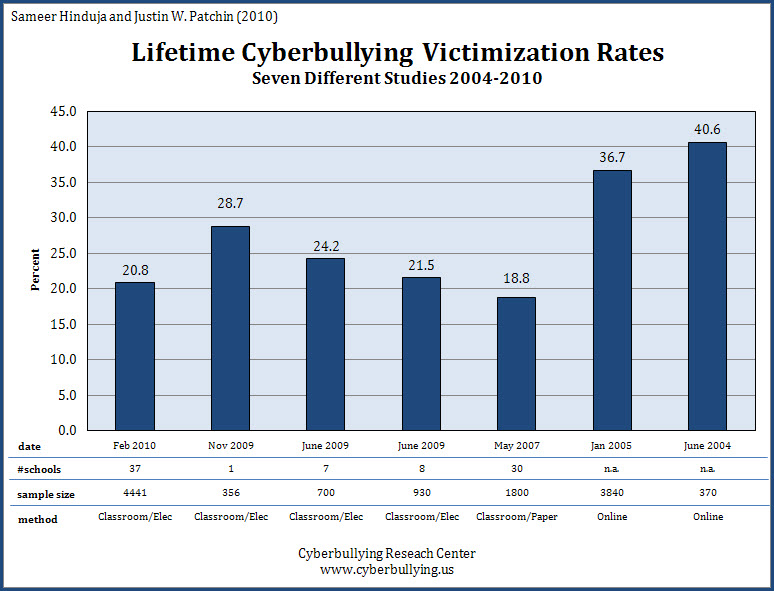
Cyberbullying among K-12 populations has been reported as ranging from 9% to 42% (Kowalski & Limber, 2007; Li, 2007). There are a variety of research studies conducted on cyberbullying that focus on K-12 student populations, focused primarily on pre-adolescents and adolescents (Juvonen & Gross, 2008; Li, 2007). These studies demonstrated a decrease in bullying overall from elementary to secondary school, a finding that suggest further decreases in bullying from secondary school to college. One of the few studies reviewing the frequency, characteristics, and psychological effects of cyberbullying on college populations found a positive correlation between being a bully in elementary school, high school, and college (Chapell et al., 2006). Chapell et al. (2006) reported that more than 40% of participants who reported being either bullies or victims of bullies in elementary school and high school, continued to maintain this role in college. In addition, research regarding bullying in the workplace found that adults who had been bullies in childhood had the potential to be bullies in the workplace as well (Harvey, Heames, Richey, & Leonard, 2006). These findings suggest some stability of the bullying role and its presence in adulthood.
According to the few research studies available to date, the prevalence of cyberbullying among college populations ranges from 10% (Smith & Yoon, 2013) to 28.7% (Hinduja & Patchin, 2010). Finn (2004) found that 10% to 15% of the 339 college students surveyed reported experiencing cyberbullying via instant messaging. The study did not explore diversity of the sample. A study conducted in Turkey by Dilmac (2009) surveyed 666 university students and found that about 22% reported experiencing cyberbullying. This study highlighted the prevalence of cyberbullying in college on an international level. Zacchilli and Valerio (2011) conducted two studies on college students. Study 1 surveyed 1,272 freshmen and Study 2 surveyed 76 freshmen and 34 seniors. The results of Study 1 indicated that less than 1% of the students reported experiencing cyberbullying. In Study 2, about 9% of the sample reported being a victim of cyberbullying, whereas 3.6% reported being a cyberbully. MacDonald and Roberts-Pittman (2010) surveyed 439 college students and found that 21% of the sample reported being cyberbullied, 38% reported knowing someone who had been cyberbullied, and 8% reported cyberbullying someone. Reported frequencies of cyberbullying were partitioned from the overall data set focused on traditional bullying behaviors. Walker, Sockman, and Koehn (2011) found that 11% of college students surveyed had experienced cyberbullying with more than 40% knowing someone who had been cyberbullied. Finally, a recent study by Smith and Yoon (2013) summarized the findings from 276 responses out of 16,986 randomly chosen emails. About 10% of the respondents reported being cyberbullied in college and 25% reported observing another student being cyberbullied. The small number of returned responses limited the significance of this study.
The variations in sample size, methodologies, and findings among the limited research available suggests a need for additional studies reporting on the frequency and characteristics of cyberbullying among college students (Lindsay & Krysik, 2012; Molluzzo & Lawler, 2012; Schenk & Fremouw, 2012).
Emotional and Psychological Impact of Cyberbullying
The psychological effects of cyberbullying seem to cause equal or more emotional damage than traditional bullying due to the wider audience and impact of the Internet (Gilroy, 2013). A meta-analysis of 33 studies conducted by Nakamoto and Schwartz (2009) revealed a significant negative association between peer victimization and academic achievement in high school students, as measured by grades, student achievement scores, or teacher ratings of academic achievement. Additional studies indicate that bullied and cyberbullied children and adolescents more frequently than their peers want to avoid attending school, have issues with substance abuse, delinquency, depression, and receive poorer grades similar to their cyberbully-victim peers (Eisenberg, Neumark-Sztainer, & Perry, 2003; Kowalski & Limber, 2013; Mitchell, Ybarra, & Finkelhor, 2007; Ybarra, Espelage, & Mitchell, 2007; Ybarra & Mitchell, 2007).
Gender, Ethnicity, and Cyberbullying
Research has found a lack of consensus regarding gender differences in cyberbullying victimization in middle and high school. Some studies reported an equal amount of cyberbullying experienced by males and females (Hinduja & Patchin, 2008; Li, 2006; 2007). Other studies found girls more likely to be victims of cyberbullying, whereas a Turkish study found boys to be the victims of cyberbullying more often (Aricak et al., 2008; Smith et al., 2008; Vandebosch & Van Cleemput, 2008; Wang, Iannotti, & Nansel, 2009). Similarly, there are controversial findings regarding gender differences for the bully (Li, 2007; Slonje & Smith, 2008). The impact of ethnicity on cyberbullying experiences of victims and bullies were also found to be contradictory. A survey study on a college sample found that 60% of victims and 70% of bullies were White (Li, 2007). An intercultural study comparing Chinese and Canadian students found the former reported higher instances of being the victims of cyberbullying while the latter reported more instances of being the perpetrator of cyberbullying (Li, 2008). In spite of their limitations and variations in outcome, these studies identified the presence of cyberbullying in college and denoted a need for further research.
The Present Study
The purpose of this study is to contribute to the current knowledge base by investigating the prevalence of cyberbullying in a large sample of college students from diverse backgrounds and to determine the relationship between cyberbullying in high school and college. Given the potential presence and impact of cyberbullying, the exploration of students’ attitudes toward cyberbullying prevention training was included. The study addressed the following research questions:
Method
Context and Participants
Similar to other studies, this research used survey data from a convenience sample of university students from a large, urban, southeastern university (Hustinx, Meijs, Handy, & Cnaan, 2012; Lindsay & Krysik, 2012). The study, approved by the university’s Institutional Review Board, included only students who were currently enrolled. Participants included 613 college students. A total of 604 completed surveys out of 613 were used in the study. Demographics of the respondents were as follows: 459 females and 149 males (5 did not report gender); 56% (n = 338) European American, 10% (n = 60) African American, 14% (n = 85) Hispanic, and 18% (n = 109) Asian and Other (6 did not report their ethnicity); between the ages of 21 and 59 with the age categories being 21 to 24 (60%), 25 to 29 (27%), and 30 and older (11%).
Research Procedures
Surveys were distributed in seven undergraduate courses accepted by most colleges’ programs as part of their general curriculum. After receiving consent from each instructor, a member of the research team visited each classroom, read the participant’s informed consent form, and distributed the surveys. The surveys were distributed at the beginning of each class included a copy of the informed consent form. Students were informed that participation in the study was optional and anonymous. Participants did not receive any rewards for participation in the study. Research team members did not report any incidences of participants declining to participate, thus reducing the possibility of respondent self-selection (Hustinx et al., 2012). Completed surveys were collected for data analysis.
Measures
The College Cyberbullying Survey consisted of 23 questions developed for the purposes of this study. Two senior faculty experts in adolescent behavior in schools and college reviewed and approved the questionnaire. The survey was separated into two sections including demographic information and questions regarding cyberbullying experiences. The following independent variables were included in the first section of the questionnaire to explain possible differences in cyberbullying experiences: gender, ethnicity, grade point average, membership to social networks, and chat room use. Section 2 of the questionnaire consisted of 14 questions that inquired about cyberbullying experiences such as number of times cyberbullying was experienced in high school, number of times cyberbullying was experienced in college, source of cyberbullying, whether they participated in cyberbullying, and the electronic mediums used by cyberbullies to harass victims. Individuals interested in obtaining a copy of the survey may contact the authors.
Analysis
A series of Pearson’s chi-square tests were used to analyze the data. This statistics was used due to the nominal nature of the data and to investigate any possible relationships among the variables. Lebanon (2009) indicates, “Pearson’s Chi-Square is generally considered the standard method for the multinomial case and is often more accurate than the alternatives” (p. 1).
Results
After an analysis of the data regarding each research question, some relations were determined and are indicated below.
Research Question 1: To What Extent Do College Students Experience Cyberbullying?
Analysis of the data collected indicated that 31.3% (n = 189) of the respondents were victims of cyberbullying during high school and 19% (n = 115) were victims during college. Cyberbullying experiences of college students ranged from 0 to 10+ times during high school with 24% (n = 145) reporting being bullied 1 to 3 times; 4% (n = 25), 4 to 6 times; and 2% (n = 13), 7 to 10+ times. Cyberbullying experiences of the college students currently ranged from 0 to 10+ times with 14% (n = 85) reporting being bullied 1 to 3 times; 2.6% (n = 18), 4 to 6 times; and 2% (n = 12), 7 to 10+ times. In addition, 28% of these participants reported having a friend who had currently experienced cyberbullying. These results indicate a significant number of college students who have been affected directly by cyberbullying or know someone who has.
Of the 19% of college cyberbully victims, 30% reported that the reported cyberbullying was based on sexuality, 10% reported it was based on race/ethnicity, 8% reported it was based on gender, and 62% placed the type of cyberbullying that took place under the “Other” category.
Research Question 2: To What Extent Were Victims of Cyberbullying During High School Also Victims During College?
A statistically significant association was found between cyberbullying in high school and cyberbullying in college (χ2 = 132.46, p < .0001) with approximately 35% (n = 93) of the victims of cyberbullying in college also experiencing cyberbullying in high school, which accounted for approximately 15% of the total sample.
Research Question 3: To What Extent Were Victims of Cyberbullying Also Cyberbullies?
Approximately 5% (n = 33) of the total sample reported being a cyberbully in college and 40% of this subsample reported being victims of cyberbullying as well. Approximately 3% of the subsample of participants who reported being victims of cyberbullying in college reported being cyberbullies as well.
Research Question 4: Are There Differences in the Frequency of Cyberbullying Based on Gender, Age, Ethnicity, and Frequency of Time on Electronic Mediums?
Gender
Cyberbullying in college differed by gender, 15.5% of the females surveyed reported being cyberbullied compared with 3.6% of the males surveyed. Although there were 3 times more females in the sample as males, the frequency of cyberbullying in the female populations remained disproportionately high, with cyberbullying in college being reported 5 times more by females in the sample.
Age
An analysis of the sample that experienced cyberbullying in college only found that 58% (n = 76) of the participants who reported being cyberbullied in college were between the ages of 20 and 25, 37% (n = 48) were between 26 and 29, and 5% (n = 7) were 30 and over. Reported frequencies demonstrate that, in this study, participants between the ages of 20 and 25 were 10 times more likely to report cyberbullying than participants 30 and over.
Ethnicity
Approximately 56% (n = 74) of the participants who reported being cyberbullied in college were European American, 12% (n = 16) were Hispanic American, 12% (n = 16) were African American, and 19% (n = 25) were Asian American or Other. To account for the disproportionate number of European American participants, a Pearson chi-square analysis was conducted using frequency of cyberbullying experienced in college and ethnicity. Analysis indicated that Asian Americans experienced cyberbullying 4 times or more (32%; n = 8) more frequently than African American (18%), Hispanic American (18%), or European American (15%).
Frequency of time on electronic medium
Past research has linked the amount of time spent on the computer to an increased risk of experiencing cyberbullying. An analysis of frequency of cyberbullying experiences and computer use found no significant relationship between these variables in this study. This outcome may be due to the majority of the participants spending significant computer use and high membership in social networks, creating a ceiling effect. Similarly, increases in reported computer proficiency did not indicate an increase in reports of cyberbullying in college. Again, this outcome can be related to the high skills level observed in this study, with 51% of the total sample reporting having advanced skills using computers. The frequency of time on the computer reported by participants experiencing cyberbullying in college ranged from 1 to 7+ hr daily, with 45% of respondents reporting 3 to 4 hr; 25%, 1 to 2 hr; 19%, 5 to 6 hr; and 9%, 7+ hr.
In addition, 93% of participants belonged to some form of social network, with around 70% belonging to two or more social website. In spite of these social websites being an environment in which cyberbullying may take place, there was no evidence that belonging to a social network increased incidence of cyberbullying.
Research Question 5: Which Mediums Did Cyberbullying Occur the Most and by Who?
Approximately 46.1% of the victims reported text messaging as the most frequent medium for cyberbullying, followed by 43.5% reporting email, and 36.2% websites. Also, 44% of students cyberbullied in college reported being bullied by a fellow student, 42% reported being cyberbullied by friends, 22.6% by a boyfriend or girlfriend, 22.6% by someone unknown to them, and 5.3% reported being cyberbullied by a co-worker. It is important to note that 40.4% of the victims indicated they were cyberbullied by multiple sources involving various combinations of the abovementioned sources of cyberbullying.
Research Question 6: What Was the Direct Psychological Effect and Action Taken Following Cyberbullying?
Cyberbullying seemed to have several direct psychological effects in this sample. Approximately 45% of the participants who reported experiencing cyberbullying reported feeling angry, 41% felt sad, 32% reported experiencing an increase in stress, and 9% reported experiencing a loss of productivity. Only 6% reported experiencing no effects.
Research Question 7: To What Extent Would College Students Favor Education on Cyberbullying?
Approximately 77% of the total sample favored education on cyberbullying, which indicates participants feel there is a need for more education on this type of bullying. In addition, approximately 38.5% (n = 235) of participants indicated they had given their phone number to someone unknown over the Internet, which denotes a need for more education regarding Internet safety.
Discussion
This study provides further evidence that cyberbullying is a phenomenon observed beyond K-12 school settings. Although there is an observed decrease in the number of cyberbully victims from high school to college, approximately 19% of college students reported being a victim of cyberbullying. This prevalence of cyberbullying in college is similar to and in some cases higher than previously reported rates of cyberbullying in high school and college (Finn, 2004; MacDonald & Roberts-Pittman, 2010; Smith et al., 2008; Walker et al., 2011; Zacchilli & Valerio, 2011). Furthermore, 50% of the college students who reported being victims of cyberbullying in the current study also reported experiencing cyberbullying in high school. The evidence indicates that cyberbullying continues from high school to college.
Approximately 5% of the college students participating in this study self-identified as cyberbullies. Past research in high school students has reported approximately 15% of their samples as self-identified cyberbullies (Aricak et al., 2008; Li, 2007). This noticeable discrepancy may be a result of the increased age and maturity of the participants or a decrease in the number of participants willing to admit they have participated in cyberbullying. Also, knowledge of the negative social perception of cyberbullies may impact participants’ willingness to report cyberbullying activities.
Together, this data suggest that cyberbullying is a significant issue among college students with the potential to affect their psychological well-being and mental health.
Psychological Impact
Although the participants of this study may be more emotionally mature than high school victims of cyberbullying, college victims still reported significant psychological effects of cyberbullying. College students indicated cyberbullying made them sad, angry or upset, and caused an increase in stress indicating the psychological impact of cyberbullying does not dissipate as the victim matures. These findings confirm results from previous studies, which indicate cyberbullying can be a catalyst for impaired mental health, psychological distress, provokes fear, and in extreme cases increases risk factors associated with suicide among college populations (Dilmac, 2009; Hartwell-Walker, 2010; Lindsay & Krysik, 2012; Zacchilli & Valerio, 2011).
Differences in Gender, Ethnicity, and Age
Different than previous research (Walker et al., 2011), females were the primary victims in this study. The frequency of cyberbullying experiences differed among ethnic groups. Similar to previous research (Goebert, Else, Matsu, Chung-Do, & Chang, 2011), a higher percentage of participants, who identified as Asian American or Other reported higher frequencies of cyberbullying than any other ethnic group. The difference in reported incidences of cyberbullying among ethnic groups was troubling, but not surprising. Research conducted among high school populations have found cyberbullying to be more prevalent among multiethnic populations and to have a significant impact on the well-being and self-esteem of Asian American and Pacific Islander youth (Goebert et al., 2011).
Regarding cyberbullying and age, the results of this study showed that college students between the ages of 20 and 25 were more likely to report cyberbullying than college students 30 years of age and older.
Sources and Mediums of Cyberbullying
A significant percentage of participants (40%) in this study reported experiencing cyberbullying from multiple known sources from inside or outside college, including friends, significant others, and/or co-workers. The primary electronic medium was cell phone–based texting. Few participants used chat rooms, which were frequently mentioned in previous studies.
Education on Cyberbullying
A majority of the respondents in this study favor education on cyberbullying. These findings are similar to a recent study conducted by Molluzzo and Lawler (2012) in which more than 80% of the study participants favored further education on online harassment.
The results of this study highlight the reported frequency, characteristics, and psychological impact of cyberbullying in a large and diverse sample of college students. These findings were similar to the findings of previous research in some areas; however, the discrepancies indicate the importance of conducting research solely focused on the phenomenon of cyberbullying, as suggested by MacDonald and Roberts-Pittman (2010). Also, longitudinal studies are needed to illustrate psychological impact and the possibility of the delayed effects on academic achievement over time. The increase in college students’ use of many electronic mediums during their education and the evidence of cyberbullying behavior occurring in college via these mediums highlights the importance of educating this population on the prevalence and impact of aggressive electronic communication and the potential dangers of cyberbullying.
Strengths and Limitations of the Research
Strengths of this study include its specific focus on cyberbullying, large and diverse sample, and high response rate. The study also expanded the research knowledge regarding the relationship between frequency of cyberbullying and age, and the continuity of cyberbullying experiences from high school to college.
Among the limitations of this study is the potential lack of knowledge about cyberbullying among college students, which may result in misinterpretation of these behavior and subsequent low numbers of reported incidents. Also, many students reported that they had been bullied in high school but not in college; however, they reported the effects of cyberbullying from both high school and college. Their responses may indicate that the students did not report the cyberbullying but did report its consequences. Also, the study uses a measure created by the authors. Future research may develop a standardized measure of the prevalence of cyberbullying. In addition, it is important to note that the study was conducted on a convenience sample at one institution. Random sampling of college students from multiple institutions may be used to gain further understanding of this phenomenon in college students across the nation.
Implications for Future Research and Practice
Cyberbullying represent an aggressive form of communication that utilizes electronic medium and provoke negative mental health consequences. Zacchilli and Valerio (2011) indicated a need for further research investigating the emotional impact of cyberbullying on college populations. Cyberbullying seemed to be most prevalent among Asian Americans in this sample, but this finding also varies across studies. Clearly, further research within the area of ethnicity and the prevalence of cyberbullying seems necessary due to variability in findings (Lindsay & Krysik, 2012). Similarly, variations in the relationship between cyberbullying and age have been observed across studies (Beran & Li, 2005; Juvonen & Gross, 2008; Katzer, Fetchenhauer, & Belschak, 2009; Smith et al., 2008; Varjas, Henrich, & Meyers, 2009; Wolak, Mitchell, & Finkelhor, 2007; Ybarra & Mitchell, 2004a). Wide variations among research findings indicate a need for further research to determine the nature of the relationship between age and cyberbullying. In addition, research regarding the relationship of cyberbullying, mental health, and academic achievement should be pursued to clarify possible differences among racial and cultural groups in college. It is important for future research to take place to further understand this phenomenon in college, determine effective ways to promote awareness of cyberbullying, and inform college students about how to deal with this form of bullying and its harmful effects.
Practical Implications
In an effort to prevent the transition of cyberbullying from K-12 settings to college, colleges and universities must implement programmatic changes to advocate for awareness of this phenomenon. The results of this study indicate that 75% of the college students sampled favor education on this topic. Student affairs personnel could collaborate with high school counselors to incorporate information on the existence of cyberbullying in college settings into campus visits and new student orientation sessions. Due to the negative consequences of this phenomenon, which in extreme cases can result in suicide, campus counseling centers should provide workshops to educate students about the psychological impact of cyberbullying. In addition, individual and group sessions may help victims and cyberbullies improve self-esteem and develop healthier ways to communicate and respond to online victimization. Campus administrators should consider allotting financial resources to cyberbullying education and promote healthy ways to communicate and deal with conflict. Campus policies should be developed to deal with the instances of cyberbullying on college campuses. In addition, education on cyberbullying could be integrated into undergraduate introductory courses such as freshmen seminars, human relations courses, and college experience courses.
Professors in student affairs, counseling education, educational leadership, and higher education could prepare secondary school counselors-in-training to provide information and educational workshops on cyberbullying for students and parents. In addition, counselor educators, college counselors, and other professionals could research the impact of education on cyberbullying on the prevalence of cyberbullying in college. The results of these studies would help improve efforts to reduce the likelihood of cyberbullying among college students. Future research on cyberbullying, its types, causes, mediums, and psychological correlates is needed to aid in the development of innovative methods of prevention, education, and interventions.
Footnotes
Declaration of Conflicting Interests
The author(s) declared no potential conflicts of interest with respect to the research, authorship, and/or publication of this article.
Funding
The author(s) received no financial support for the research and/or authorship of this article.