




Abstract
Investing in professional capital is essential for nurturing the social and emotional development of students. This study, conducted in secondary schools in Eastern Ethiopia, aimed to examine the relationship between teachers’ perceived professional capital and students’ social-emotional learning (SEL). Employing a correlational research design with Confirmatory Factor Analysis (CFA) and Structural Equation Modeling (SEM) using AMOS 23.0, the study involved 294 teachers and 112 students from 29 schools. Participants were selected through a rigorous three-stage random sampling process. Using 36 questionnaire items, the measurement model demonstrated robust reliability (Cronbach’s alpha values ranged from .81 to .95) and validity. Results indicated that teachers’ human and social capital significantly influenced students’ SEL outcomes, highlighting the pivotal role of teacher quality and supportive professional relationships in fostering positive SEL. In conclusion, the study underscores the critical importance of investing in teacher professional capital development programs that enhance educators’ knowledge and social networks to effectively support students’ SEL and overall development. The findings also suggest that future research could further explore the complex dynamics linking teacher professional capital and students’ socio-emotional learning outcomes, thereby advancing understanding and informing targeted educational interventions.
Plain Language Summary
Investing in teacher professional capital—human (knowledge, skills), social (collaborative networks), and decisional (judgment)—is essential for fostering students’ social-emotional learning (SEL). A study in Eastern Ethiopia schools found that teachers’ human and social capital strongly influence SEL, while decisional capital had less impact. The results emphasize the need for programs that improve teacher expertise and relationships to better support students’ SEL and overall growth.
Introduction
Social and Emotional Learning (SEL) has emerged as a global foundational component of modern education, with implementations spanning diverse contexts from Western to African settings, including Ethiopia (Mahoney et al., 2021; Shi et al., 2025). According to the Collaborative for Academic, Social, and Emotional Learning (CASEL), SEL is the process through which individuals acquire and apply the knowledge, attitudes, and skills necessary to manage emotions, set and achieve positive goals, show empathy for others, establish positive relationships, and make responsible decisions (CASEL, 2015, 2020). The significance of SEL lies in fostering supportive relationships that make learning more engaging and meaningful, promoting educational equity and excellence through partnerships among schools, families, and communities, and cultivating environments of trust and collaboration (CASEL, 2015, 2020). Empirical evidence indicates that effective SEL programs lead to substantial improvements in students’ social competence, behavior, and academic performance, with meta-analyses reporting an 11-percentile-point increase in academic achievement (Melnick et al., 2017). Moreover, SEL interventions have been shown to reduce risky behaviors such as substance use, violence, and school dropout when implemented as part of sustained educational initiatives (CASEL, 2015). SEL programs enhance five core competencies: self-awareness, self-management, social awareness, relationship skills, and responsible decision-making (CASEL, 2015, 2020; Weissberg et al., 2015; Yoder, 2014). These competencies contribute to short-term benefits such as increased self-efficacy, confidence, empathy, and connection to school, and reduced conduct problems and emotional distress, as well as long-term outcomes including higher graduation rates, greater readiness for further education and careers, positive relationships, improved mental health, and active citizenship (CASEL, 2020; Hawkins et al., 2008; Weissberg et al., 2015). Schools play a critical role in nurturing key social-emotional competencies such as tolerance, respect, and understanding, with teachers being pivotal in realizing this educational vision (Jennings et al., 2020). Therefore, integrating SEL within educational settings is essential for promoting student growth and development, improving classroom climates, increasing graduation rates, and enhancing students’ social and career readiness skills (Martinez, 2016).
Successful implementation of SEL in schools is significantly influenced by teachers’ professional capital (Hargreaves & Fullan, 2012). Drawing on the theoretical framework of Hargreaves and Fullan (2012), professional capital is conceptualized as the synergistic combination of three interrelated forms of capital—human, social, and decisional—that empower teachers to effectively foster SEL. Human capital refers to the individual SEL-related knowledge, pedagogical skills, and professional expertise that teachers possess (Darling-Hammond et al., 2017; Hargreaves & Fullan, 2012). Social capital encompasses the collective capacity, trust, and professional networks among teachers that facilitate the sharing of best practices and resources related to SEL (Hargreaves & Fullan, 2012; Leana, 2011). Decisional capital denotes the professional wisdom and judgment—refined through experience, reflection, and collaboration—that enable teachers to make contextually appropriate decisions when implementing SEL strategies and addressing students’ socio-emotional needs (Darling-Hammond et al., 2017; Hargreaves & Fullan, 2012). Furthermore, in this study, professional capital is defined as the systematic development and integration of human capital (teachers’ knowledge, skills, and competencies), social capital (networks, relationships, and collaborative practices), and decisional capital (the ability to make informed judgments by integrating experience and evidence; Hargreaves & Fullan, 2012, 2013). These domains of professional capital are hypothesized to predict students’ SEL outcomes, reflecting teachers’ overall professional capacity.
While the relationship between teacher quality and student academic achievement is well documented globally (e.g., Hattie, 2018), the specific mechanisms linking the holistic concept of teacher professional capital to students’ SEL remain underexplored, particularly in sub-Saharan Africa. Most research on SEL and professional capital originates from Western, high-income contexts (e.g., Fullan et al., 2015; Greenberg, 2023). The existing literature, predominantly from North American and European settings, has established strong correlations between teacher quality, collaborative cultures, and positive student outcomes (Hargreaves & Fullan, 2012; Leana, 2011). However, this global evidence cannot be directly applied to the Ethiopian context, where educational systems often face resource constraints, large class sizes, and a historical emphasis on rote academic achievement over holistic development (MoE, 2018). Furthermore, the interplay among the three domains of professional capital—human, social, and decisional—remains underexplored in the Ethiopian context. It is unclear whether these domains function independently, synergistically, or if some exert only indirect effects on SEL. The Ethiopian educational landscape, with its unique socio-cultural dynamics, recent policy shifts toward moral education (MoE, 2023), and historical emphasis on academic rigor (MoE, 2018), presents a distinct and compelling context. This study addresses a critical gap by examining whether the established domains of professional capital—human, social, and decisional—exhibit similar predictive power for SEL in a non-Western, Eastern Ethiopian context, thereby assessing their cross-cultural validity and informing context-specific educational interventions. It critically investigates whether this integrated professional capital model (human, social, and decisional) significantly influences students’ SEL in a highly under-researched setting, addressing gaps in both professional capital and SEL research. Thus, this study tested the following hypotheses:
Conceptual Framework for the Study
This study is grounded in Hargreaves and Fullan’s (2012) Professional Capital Theory, which emphasizes the transformation of teaching and learning through strategic investment in three interconnected forms of capital: human capital (individual knowledge, skills, and talents of educators), social capital (collaborative culture, trust, and professional networks among educators), and decisional capital (professional judgment and expertise developed through experience and reflection for effective decision-making in complex contexts). This framework was chosen over other models—such as those focusing solely on teacher self-efficacy (e.g., Tschannen-Moran & Hoy, 2001), professional development hours, or broader school climate theories—because of its holistic and systemic approach. Unlike models such as the Job Demands-Resources model, which primarily address teacher burnout, Professional Capital Theory captures the multifaceted nature of effective teaching by integrating individual competence, collaborative networks, and practical wisdom (Hargreaves & Fullan, 2012). This makes it particularly suitable for implementing SEL, which requires not only individual teacher skills but also a supportive professional culture and the ability to adapt practices to students’ needs (Schonert-Reichl, 2017). The conceptual model (Figure 1) illustrates how these three forms of capital—human, social, and decisional—are interrelated yet distinct predictors of students’ SEL outcomes.

Conceptual model of the study.
Social and Emotional Learning
The principal goal of the Collaborative for Academic, Social, and Emotional Learning (CASEL) is to promote Social and Emotional Learning (SEL) as a means to enhance citizenship, health, and academic performance by integrating evidence-based SEL practices into educational systems (Weissberg et al., 2015). CASEL’s framework identifies five core competencies—self-awareness, self-management, social awareness, relationship skills, and responsible decision-making—as essential for both academic and personal achievement (Borowski, 2019; CASEL, 2018, 2020; Weissberg et al., 2015). These competencies are interconnected and support individual development, psychological well-being, and constructive social relationships, thereby enhancing performance across academic and social contexts (Borowski, 2019; CASEL, 2018, 2020; Melnick et al., 2017; Schonert-Reichl et al., 2017; Weissberg et al., 2015).
Self-awareness is a core indicator of students’ SEL that involves accurately identifying one’s feelings, thoughts, and values, and understanding how they influence behavior (CASEL, 2020). It encompasses emotion recognition, self-perception, acknowledgment of strengths, self-confidence, and self-efficacy, which collectively support personal and professional growth (Borowski, 2019; CASEL, 2018, 2020; Melnick et al., 2017; Weissberg et al., 2015; Yoder, 2014). Self-management is a core competency of SEL that involves effectively regulating one’s emotions, thoughts, and behaviors across various situations. It includes skills such as self-discipline, self-motivation, impulse control, stress management, and organizational abilities, which work in tandem with self-awareness to support personal and academic success (Borowski, 2019; CASEL, 2018, 2020; Melnick et al., 2017; Weissberg et al., 2015).
Social awareness is another indicator of students’ SEL that entails understanding social norms, recognizing community resources, appreciating diversity, and demonstrating empathy. It fosters inclusive, positive environments and involves perspective-taking and consideration of others’ experiences (Borowski, 2019; CASEL, 2018, 2020; Melnick et al., 2017; Yoder, 2014). Relationship skills, as an indicator of students’ SEL, involve effective communication, active listening, cooperation, conflict resolution, and building and maintaining healthy, supportive relationships, which are critical for positive social interactions and overall social development (Borowski, 2019; CASEL, 2020; Yoder, 2014). Responsible decision-making, as a core indicator of SEL, refers to the ability to make constructive, ethical, and respectful choices regarding behavior and social interactions by considering safety, social norms, consequences, and ethical standards (CASEL, 2020). This competency promotes well-being and social connectedness through problem identification, scenario analysis, problem solving, reflection, and ethical reasoning (Borowski, 2019; CASEL, 2018, 2020; Schonert-Reichl et al., 2017; Weissberg et al., 2015).
The ultimate goal of SEL is to develop socially and emotionally competent students capable of thriving in an increasingly complex world. Effective implementation requires comprehensive teacher preparation, administrative support, ongoing professional development, and systemic strategies that integrate SEL with academic instruction (Greenberg, 2023; Weissberg et al., 2015). Coordinated approaches at the school, home, and community levels are necessary to enhance students’ skills and create supportive learning environments (Jones & Bouffard, 2012; Merrell & Gueldner, 2010; Weissberg et al., 2015). In sum, the integrated SEL framework developed by CASEL promotes the development of these five core competencies through explicit instruction and positive learning environments, highlighting the importance of teachers’ professional capital—comprising human, social, and decisional capital—in fostering effective SEL among students (Borowski, 2019; CASEL, 2015, 2020; Melnick et al., 2017; Weissberg et al., 2015).
Professional Capital in Teaching
Hargreaves and Fullan (2012) proposed the concept of professional capital, which refers to the systematic development and integration of three types of capital—human, social, and decisional—within the teaching profession. The professional capital model emphasizes collaborative responsibility, evidence-based practices, and transparency with stakeholders, aiming to transform education by strategically investing in these capitals for the benefit of all involved (Hargreaves & Fullan, 2012, 2013).
Human capital represents the knowledge, skills, competencies, and experiences that educators acquire through training and education. It is crucial for enhancing teaching quality and improving student outcomes (Hargreaves & Fullan, 2012; Leana, 2011; Sell, 2015). Developing human capital involves ongoing professional learning and development, supported by cooperative learning strategies and positive organizational environments (Hargreaves & Fullan, 2012; ILO, 2012; Voight & Nation, 2016). Continuous professional engagement fosters teachers’ expertise, enabling them to implement effective pedagogical practices that support students’ SEL.
Social capital in education refers to the relationships, trust, and collaborative networks among teachers that facilitate shared goals, knowledge exchange, and mutual support (Fullan, 2016; Häuberer, 2011; Hargreaves & Fullan, 2012). It is associated with higher teaching quality and student achievement, as collaboration and trust allow educators to share accountability, reflect on practice, and learn from one another (Leana, 2011; Sell, 2015). Professional learning communities, mentoring, and school meetings are key mechanisms for fostering social capital, which, in turn, reinforces the development of decisional capital (Hargreaves & Fullan, 2012).
Decisional capital is the capacity to make informed, context-sensitive judgments by integrating professional knowledge with evidence and experience (Hargreaves & Fullan, 2012). It enables teachers to navigate complex classroom situations and improve decision-making through reflection, practice, and collaborative learning (Fullan, 2016; Hargreaves & Fullan, 2012). Professional autonomy and empowerment are critical for developing decisional capital, as they allow teachers to make key instructional decisions and interventions tailored to their students’ needs (Nolan & Molla, 2017; OECD, 2016).
Investing in professional capital—human, social, and decisional—is essential for reforming education and enhancing students’ SEL outcomes. This investment requires a long-term commitment from teachers, educational leaders, and policymakers, alongside the creation of supportive school environments that facilitate professional growth (Hargreaves & Fullan, 2012, 2013; Herzog, 2016). Professional capital fosters a collaborative and supportive school culture, thereby enhancing teaching effectiveness and strengthening educational systems (Hargreaves & Fullan, 2012; Leana, 2011; Siegel, 2012). Teachers’ professional competencies, particularly their social and emotional abilities, are critical for the effective implementation of SEL programs (Greenberg, 2023).
In this study, the operationalization of professional capital is directly linked to SEL outcomes. Human capital is reflected in teachers’ knowledge of SEL frameworks (e.g., CASEL’s five competencies) and their ability to model and explicitly teach these skills. Social capital manifests in professional learning communities where teachers collaboratively design SEL lesson plans, monitor student progress, and provide emotional support, creating a cohesive and consistent SEL environment (García-Perez et al., 2023). Decisional capital is exercised when teachers adapt SEL curricula to be culturally relevant, respond to classroom conflicts as teachable moments, or select targeted interventions for students based on professional judgment. Collectively, the integration of human, social, and decisional capital equips teachers to enhance student SEL, foster positive school cultures, and improve overall educational outcomes.
Association Between Teachers’ Professional Capital and Students’ SEL
The connection between professional capital and the CASEL SEL framework is both conceptual and practical. The five CASEL competencies—self-awareness, self-management, social awareness, relationship skills, and responsible decision-making—are not merely curricular content; they are cultivated through daily classroom interactions and the broader school climate (CASEL, 2020). Teachers’ professional capital—comprising human, social, and decisional capital—plays a central role in fostering these competencies (Hargreaves & Fullan, 2012). Human capital reflects teachers’ understanding of SEL concepts and pedagogical strategies (Hargreaves & Fullan, 2012; Leana, 2011; Sell, 2015). Teachers’ human capital enables explicit instruction of SEL skills, such as modeling self-management and self-awareness, and facilitates the integration of SEL principles into classroom practices (Durlak et al., 2011; Sintayehu & Wondifraw, 2024; Weissberg et al., 2015). Ongoing professional development and training strengthen teachers’ human capital, deepening their understanding of SEL theories and providing opportunities to apply knowledge in classroom contexts (Greenberg, 2023; Jennings et al., 2020).
Social capital fosters a cohesive, school-wide culture supportive of SEL (Fullan, 2016; Hargreaves & Fullan, 2012; Leana, 2011). Through collaborative planning, mentoring, and professional learning communities, teachers collectively design SEL lesson plans, discuss student progress, and provide emotional support, ensuring consistency in SEL implementation across classrooms (García-Perez et al., 2023; Jennings et al., 2020; Yoder, 2014). Teachers’ social and emotional competencies allow them to recognize individual student differences, bridge these differences, and cultivate positive classroom environments that promote empathy, relationship skills, and social awareness (Borowski, 2019; CASEL, 2018; Feshbach, 2008; Yoder, 2014). Strong social capital enhances teachers’ capacity to model prosocial behaviors and create emotionally supportive classrooms, which are crucial for SEL development (Gest et al., 2014; Neal et al., 2011; Schonert-Reichl, 2017).
Decisional capital as a capacity of teachers to make informed, context-sensitive decisions by integrating professional knowledge with experience and evidence (Fullan, 2016; Hargreaves & Fullan, 2012; Nolan & Molla, 2017) allows them to adapt SEL strategies in real time, respond to students’ unique emotional and social needs, and implement culturally relevant interventions (Greenberg, 2023). For example, teachers exercise decisional capital when they address classroom conflicts as teachable SEL moments or select targeted strategies for students facing challenges, thereby fostering responsible decision-making and self-regulation (Davis et al., 2021; Greenberg, 2023; Schonert-Reichl, 2017). Professional autonomy and empowerment further enhance decisional capital, enabling teachers to exercise judgment and tailor instruction to optimize SEL outcomes (OECD, 2016).
The interplay between human, social, and decisional capital creates the conditions for high-quality SEL to flourish. Human capital equips teachers with the knowledge to teach SEL explicitly, social capital ensures consistent reinforcement and a supportive school-wide ethos, and decisional capital allows for responsive and contextually appropriate teaching (Darling-Hammond et al., 2017; Schonert-Reichl, 2017). Collectively, professional capital fosters a positive school climate that promotes students’ social and emotional competencies, as well as collaborative learning and community engagement (Cohen & Brown, 2013; Fullan et al., 2015; Hargreaves & Fullan, 2012).
Teachers’ social-emotional competence, well-being, and beliefs about their efficacy are crucial for effective SEL implementation. Teachers who are confident in their ability to impact students, demonstrate positive attitudes toward SEL, and engage in collaborative networks are more likely to implement SEL effectively (Collie et al., 2015; Durlak & DuPre, 2008; Hattie, 2018; Lendrum et al., 2013). Conversely, teacher stress, burnout, or lack of support can hinder SEL delivery, especially in contexts with trauma-exposed students (Jennings et al., 2020). Mindfulness-based professional development and strategies to enhance teachers’ well-being have been shown to improve classroom interactions and SEL instruction (Jennings et al., 2020).
In this study, SEL was measured using indicators derived from CASEL’s (2020) five core competencies, recently validated in the Ethiopian context by Sintayehu and Wondifraw (2024). Each competency conceptually aligns with teachers’ professional capital domains. Human capital supports explicit instruction of self-awareness and self-management skills. Social capital fosters a school-wide environment of trust, respect, and collaboration, which underpins students’ social awareness and relationship skills. Decisional capital enables teachers to make informed, real-time judgments that guide students’ responsible decision-making in complex social situations (Davis et al., 2021; Greenberg, 2023). Thus, teachers’ professional capital—human, social, and decisional—directly enables the cultivation of students’ SEL competencies, highlighting the essential role of teacher development, collaborative networks, and professional judgment in promoting social-emotional growth.
Despite a growing body of literature on SEL and teacher development, several critical gaps persist, which this research aims to address. First, there is a pronounced geographical and contextual imbalance. The vast majority of empirical studies on professional capital and SEL are situated in Western, high-income countries (Greenberg, 2023; Weissberg et al., 2015). The applicability of these findings to Eastern African contexts like Ethiopia, with distinct socio-cultural and educational dynamics, is largely unknown. This study provides one of the first empirical tests of the professional capital model in relation to SEL in this region. Second, while the theoretical links between human and social capital and student achievement are well-documented (Leana, 2011), their specific, direct effects on socio-emotional learning outcomes are less clear and sometimes contradictory. For example, the role of decisional capital is particularly ambiguous (Ikoma, 2016); some research posits its direct importance (Hargreaves & Fullan, 2012), while other evidence implies its effects are primarily mediated through collaborative practices and teacher self-efficacy (a component of human capital; Nolan & Molla, 2017). Third, previous studies have often examined these capitals in isolation or as dyads (Ikoma, 2016; Leana, 2011), failing to capture the holistic, interactive nature of the professional capital framework. By simultaneously modeling the effects of human, social, and decisional capital on SEL, this study moves beyond a fragmented view to test an integrated model, thereby offering a more comprehensive understanding of their collective and individual contributions. In summary, the theoretical proposition from Hargreaves and Fullan (2012) is that these three forms of capital are interdependent. However, for the purpose of empirically testing their unique contributions, this study’s hypotheses isolate their direct effects on student SEL outcomes. This allows for a critical examination of which elements of professional capital are most pivotal in the specific context of Eastern Ethiopian secondary schools.
Therefore, this study is necessitated by the need to: (a) contextualize the global discourse on professional capital and SEL within the under-researched Eastern Ethiopian secondary school system; (b) clarify the direct and potentially differential effects of the three professional capital domains on SEL; and (c) address the contradictory findings regarding the potency of decisional capital by empirically testing its significance within a full structural model. By doing so, it aims to inform targeted, context-sensitive professional development strategies that can enhance both teaching quality and students’ holistic development.
The conceptual model (Figure 1) integrates CASEL’s (2020) SEL framework with Hargreaves and Fullan’s (2012) professional capital domains, positing direct paths from each capital to SEL outcomes. H1 posits that human capital (teachers’ knowledge and skills) positively influences students’ SEL. This hypothesis is supported by evidence showing that skilled teachers are more effective in delivering SEL instruction and managing emotions (Greenberg et al., 2017; Hamer et al., 2024). Teachers with strong SEL knowledge and competencies (human capital) are better equipped to provide explicit instruction, model SEL behaviors, and design pedagogically sound learning activities that directly promote students’ self-awareness, self-management, and other SEL skills (Collie et al., 2015). H2 posits that social capital (teachers’ networks and relationships) positively influences students’ SEL. Collaborative and trusting professional environments foster empathy and support, as evidenced by studies in developing contexts showing reduced dropout rates through shared practices (Wang et al., 2016). It is hypothesized that strong professional networks and trust (social capital) enable a consistent, school-wide SEL culture.
When teachers collaborate, they reinforce common language and strategies, providing students with a coherent and supportive environment that promotes social awareness and relationship skills (Leana, 2011). H3 posits that decisional capital (teachers’ judgment and decision-making) positively influences students’ SEL. Adaptive and context-sensitive decisions are expected to enhance the fit and effectiveness of SEL programs, although this effect may be moderated in resource-limited settings such as Ethiopia (Fullan et al., 2015; OECD, 2024). Teachers’ accumulated knowledge, experience, and professional judgment (decisional capital) enable them to make critical, in-the-moment decisions—such as mediating conflicts, differentiating SEL instruction, or responding to students’ emotional needs—that directly impact the quality and effectiveness of the SEL support students receive (Hargreaves & Fullan, 2012).
Methodology
Research Design
To assess the direct effect of teachers’ professional capital components (human, social, and decisional capital) on students’ SEL, the study employed a correlational research design. This design utilized factor analyses—specifically Exploratory Factor Analysis (EFA) and Confirmatory Factor Analysis (CFA)—and an advanced correlational statistical approach known as Structural Equation Modeling (SEM) with latent variables, which is commonly used in educational research (Creswell, 2015). The main purposes of correlational research are explanation and prediction (Creswell & Creswell, 2018), as it examines the degree of relationship between the three elements of professional capital in teaching and students’ SEL in secondary schools in Eastern Ethiopia.
Research Subjects
A total of 406 individuals, comprising 294 teachers and 112 students, participated in the study. The gender distribution indicated that 239 (59%) of the participants were male and 167 (41%) were female. Participants were selected using a three-stage random sampling technique from 29 secondary schools serving students in grades 9 to 12, located in Eastern Ethiopia. They were informed that participation was entirely voluntary and that, to address ethical concerns, their responses would remain anonymous. Furthermore, participants orally provided informed consent to the researchers. As shown in Table 1, the demographic characteristics of the participants reflect key features of the broader population of secondary schools in Eastern Ethiopia. The teacher sample represented a range of teaching experiences, while both teacher and student samples included a mix of genders and urban/rural school locations. The distribution of students across grade levels was relatively even. The multi-stage random sampling procedure and the balanced demographic profiles support the representativeness of the sample for the study region, thereby enhancing the generalizability of the findings within this context (Etikan et al., 2016).
Demographic Characteristics of Participants.

To justify the adequacy of our sample for SEM, we conducted a post-hoc power analysis using Soper’s (2025) calculator. Considering 36 observed indicators, 4 latent factors, an effect size of .30, and a significance level of .05, the analysis showed that our sample of 406 participants yielded a statistical power exceeding .99—well above the recommended .80 benchmark—demonstrating sufficient power for the tested model.
Measurement Scales
A comprehensive questionnaire adapted from Yoder (2014) and newly contextualized for use in secondary schools in Eastern Ethiopia by Sintayehu and Wondifraw (2024) was used in this study to assess students’ SEL. The scale consisted of 12 validated items with a Cronbach’s alpha (α) value of .91, indicating high internal consistency reliability. The SEL indicators included self-awareness, social awareness, relationship (social) skills, and responsible decision-making, each comprising three observed items (Sintayehu & Wondifraw, 2024). Higher scores on the scale, ranging from 1 (strongly disagree) to 5 (strongly agree), indicated stronger SEL competencies.
The national professional standard for Ethiopian teachers served as the contextual foundation for adapting the perceived teacher professional capital measurement tool from Hargreaves and Fullan’s (2012) Teacher Professional Capital Survey Inventory. The construct of professional capital was operationalized using three first-order factors: decisional capital, social capital, and human capital. Teachers’ decisional capital, social capital, and human capital were measured using 4 items (α = .81), 16 items (α = .95), and 4 items (α = .83), respectively, all demonstrating high internal consistency reliability for the subscales. Higher ratings on the 5-point Likert scale, ranging from 1 (“strongly disagree”) to 5 (“strongly agree”), reflected higher levels of teacher professional capital.
The high Cronbach’s alpha values (ranging from α = .81 to .95) indicate excellent internal consistency reliability for all scales, showing that the items within each construct were highly correlated and measured the same underlying concept (Tavakol & Dennick, 2011). All items were retained, as they contributed to the high reliability and conceptual coherence of the scales; no items were removed solely based on reliability analysis.
Results of Confirmatory Factor Analysis (CFA)
A Confirmatory Factor Analysis (CFA) was conducted using AMOS version 23.0 (Arbuckle, 2012) to validate the factorial structure of the measurement model—that is, to confirm that the questionnaire items loaded onto their intended theoretical constructs (human, social, decisional capital, and SEL). The model’s goodness of fit was evaluated using a set of standard indices (Byrne, 2016; Hu & Bentler, 1999): the relative chi-square (χ2/df ≤ 5.0), the Comparative Fit Index (CFI ≥ .90), the Tucker–Lewis Index (TLI ≥ .90), the Root Mean Square Error of Approximation (RMSEA ≤ .08), and the Standardized Root Mean Square Residual (SRMR ≤ .08). To assess the threat of common method bias, Harman’s single-factor test was performed. An exploratory factor analysis forcing all items into a single factor revealed that the single factor accounted for only 38.2% of the variance, which is below the 50% threshold, suggesting that common method bias is not a pervasive issue in this dataset (Podsakoff et al., 2003). The initial model showed an acceptable fit; however, high modification indices suggested correlations between error terms for items within the same subscale (e.g., two items related to “trust” in the social capital scale). After correlating these theoretically justifiable error terms, the final, revised model demonstrated excellent fit: χ2/df = 2.532, CFI = .926, TLI = .917, RMSEA = .062, SRMR = .045—all meeting the established thresholds (Byrne, 2016; Hu & Bentler, 1999). These results support the construct validity of the measurement model (Figure 2).

Final simplified measurement model with standardized estimates.
Table 2 presents the standardized and unstandardized factor loadings obtained from the final, simplified measurement model. The unstandardized factor loadings (B) ranged from .83 to .97 (p < .001), while the standardized factor loadings (β) ranged from .69 to .86. As shown in Table 2, the critical ratios (t-values) ranged from 12.78 to 18.24, and the corresponding standard errors (SE) ranged from .05 to .07.
Standardized and Unstandardized Factor Loadings for Simplified Measurement Model.

Measurement Model Validity and Reliability Measures
To establish the construct validity of the measurement instruments, we assessed content, convergent, and discriminant validity (Taherdoost, 2016). Content validity was ensured through a thorough review of the literature and adaptation of scales by educational experts to fit the Ethiopian context. Furthermore, in line with Hair et al. (2019), each construct’s maximum reliability (MR) and composite reliability (CR) exceeded .7, ranging from .81 to .95, demonstrating good construct reliability. Convergent validity, a key aspect of construct validity, was evaluated using the Average Variance Extracted (AVE) for each construct, which ranged from .51 to .63—above the .5 cutoff recommended by Hair et al. (2019). Discriminant validity, another component of construct validity, was confirmed as the square root of the AVE for each construct (ranging from .714 to .793) exceeded its correlations with all other constructs (ranging from .489 to .707). These results, as illustrated in Table 3, indicate that each construct is distinct from the others. Overall, the measurement model demonstrated good reliability and validity, as evidenced by CR and MR values above .7, AVE values above .5, and confirmation of discriminant validity.
Measurement Model Validity and Reliability Measures.

Note. Square roots of AVEs are reported along diagonal in bold.
p < .001.
Results
Preliminary Descriptive Analysis
Prior to the main analysis, the data were screened to ensure they met the key assumptions for Structural Equation Modeling (SEM). Assessment of normality indicated that skewness values ranged from −.84 to −.35 and kurtosis values ranged from −.26 to 1.12 for all study variables, which fall within the acceptable ranges of −2 to +2 and −7 to +7, respectively, suggesting no severe departure from univariate normality (Byrne, 2016; Collier, 2020). Multicollinearity was examined by inspecting the correlation coefficients among the predictor latent variables (see Table 4), which ranged from .41 to .64. Since all correlations were below the critical threshold of .85, multicollinearity was not considered a concern for the SEM analysis (Kline, 2023). Finally, linearity was assessed through visual inspection of bivariate scatterplots, which indicated generally linear relationships among the variables. As theoretically predicted, the Pearson correlation coefficients among the latent variables, presented in Table 4, showed that all variables were significantly related to one another at the .001 level. All coefficients were classified as medium (r > .3) or large (r > .5), in accordance with Cohen (1988).
Descriptive Statistics and Correlation Coefficients.
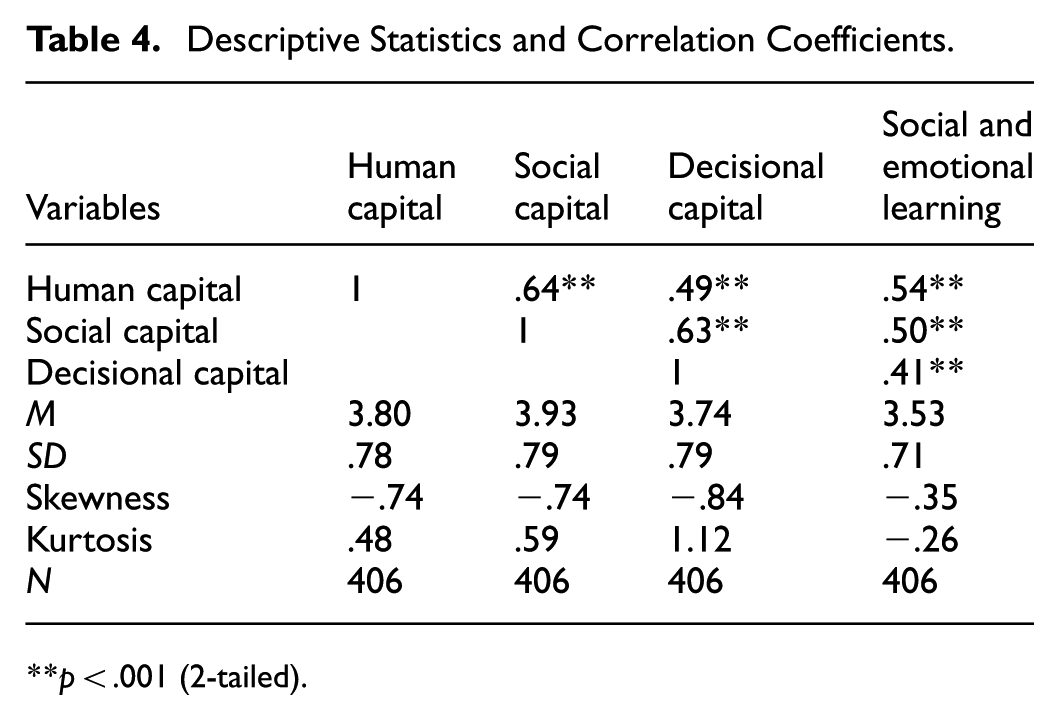
p < .001 (2-tailed).
Table 4 indicates moderate to strong positive associations between students’ social and emotional learning and decisional capital (r = .41, p < .001), social capital (r = .50, p < .001), and human capital (r = .56, p < .001). The relationship between teacher human capital and decisional capital was moderately positive (r = .49, p < .001), while human capital was strongly positively associated with social capital (r = .64, p < .001). Additionally, there was a significant positive correlation between decisional capital and teacher social capital (r = .63, p < .001).
Results of Structural Equation Modeling
After establishing a valid measurement model, we proceeded to Structural Equation Modeling (SEM) to test the hypothesized causal relationships among the latent constructs. The structural model specifically examined the direct effects of teachers’ human, social, and decisional capital on students’ SEL. The results indicated that H1 (human capital → SEL) and H2 (social capital → SEL) were supported, whereas H3 (decisional capital → SEL) was not statistically significant. The structural model fit indices (χ2/df = 2.53, CFI = .93, SRMR = .045, RMSEA = .062, TLI = .92) demonstrated an acceptable fit to the data (see Figure 3).

Standardized estimates for direct effects on social and emotional learning.
To address concerns regarding statistical power, a post-hoc power analysis was conducted using G*Power software (Faul et al., 2009). With an alpha level of .05, a sample size of 406, and an observed R2 of .46 for the structural model, the achieved statistical power was calculated to be greater than .99. This far exceeds the conventional threshold of .80, indicating that the study had more than adequate power to detect the significant effects observed for human and social capital (Cohen, 1988). Table 5 presents the unstandardized and standardized regression coefficients obtained from the SEM analysis with latent variables.
Standardized and Unstandardized Coefficients for SEM Analysis.

The standardized regression results of the final structural model, presented in Table 5, indicated that teachers’ human capital had a significantly positive direct effect on students’ social and emotional learning (β = .47). Similarly, the unstandardized coefficient (B = .40) indicated a statistically significant and positive direct effect of teachers’ human capital on students’ social and emotional learning, t = 5.793, p < .001. The Cohen’s ƒ2 value of .204 indicated a medium-to-large direct effect of teachers’ human capital on students’ SEL, based on Cohen’s (1988) guidelines for effect size interpretation.
In a similar vein, the standardized regression results also indicated a statistically significant and positive direct effect of teachers’ social capital on students’ social and emotional learning (β = .17, p < .05). The unstandardized regression coefficient (B = .14) further confirmed this positive effect, t = 2.017, p = .044. The Cohen’s ƒ2 value of .04 indicated a small-to-medium direct effect of teachers’ social capital on students’ social and emotional learning (Cohen, 1988).
By contrast, the standardized and unstandardized regression coefficients (β = .11, B = .11) indicated that the direct effect of teachers’ decisional capital on students’ social and emotional learning was not statistically significant, t = 1.517, p = .129. The Cohen’s ƒ2 value of .02 suggested a small effect size for the direct effect of teachers’ decisional capital on students’ social and emotional learning, according to Cohen’s (1988) guidelines.
Overall, the standardized regression weights indicated that teachers’ human capital (β = .47), social capital (β = .17), and decisional capital (β = .11) had direct effects of varying strength on students’ social and emotional learning in secondary schools of Eastern Ethiopia. Furthermore, the squared multiple correlation (R2 = .46) demonstrated that the three domains of teacher professional capital (human, social, and decisional) together explained 46% of the variance in students’ social and emotional learning (see Table 5).
Discussion
The findings revealed that teachers’ professional capital—comprising human, social, and decisional dimensions—had varying degrees of influence on students’ SEL. Teachers’ human capital, which encompasses their knowledge, skills, and professional competence, showed a strong and meaningful positive effect (H1), indicating that students’ SEL improves when teachers possess higher levels of expertise and pedagogical capability. The medium-to-large effect size demonstrates that the impact of teachers’ human capital on students’ SEL is not only statistically significant but also educationally meaningful in practice (Cohen, 1988). Teachers’ social capital also demonstrated a positive but more moderate influence (H2), suggesting that strong professional relationships, collaboration, and trust among teachers contribute to a supportive learning environment that fosters students’ socio-emotional growth, reflecting a small-to-medium practical effect (Cohen, 1988). In contrast, teachers’ decisional capital, referring to their professional judgment and autonomy in decision-making, did not show a significant direct effect on students’ SEL (H3), though it reveals small practical effect (Cohen, 1988). Overall, the combined influence of the three forms of professional capital accounted for a substantial proportion (46%) of the variation in students’ SEL, highlighting the collective importance of teacher expertise, collaboration, and professional capacity in promoting students’ social and emotional development. This represents a moderate practical effect size (Cohen, 1988), suggesting that while teacher professional capital plays a significant role, other factors also contribute to students’ SEL.
The finding that teachers’ human capital exerts a substantial and positive influence on students’ SEL aligns with an extensive body of research emphasizing the pivotal role of teacher quality in shaping students’ academic and social-emotional outcomes (e.g., Davis et al., 2021; Hargreaves & Fullan, 2012; Jennings et al., 2020; Lendrum et al., 2013). Hargreaves and Fullan (2012) and Leana (2011) argue that teachers’ human capital—comprising qualifications, professional expertise, and pedagogical knowledge—directly translates into more effective classroom interactions and enhanced student learning experiences. Similarly, Sell (2015) and Uba and Chinonyerem (2017) highlight that teachers who are well-trained and experienced in SEL integration foster supportive, inclusive, and emotionally safe learning environments that nurture students’ socio-emotional growth. Jennings et al. (2020) further emphasize that teachers’ professional knowledge and competencies are critical in facilitating SEL instruction that is intentional, responsive, and aligned with students’ developmental needs. This finding is consistent with Durlak and DuPre’s (2008) meta-analysis, which demonstrated that the fidelity and success of SEL program implementation depend heavily on teachers’ knowledge, skills, and motivation. Hattie (2018) also underscores the broader principle that teacher quality is the single most influential in-school factor affecting student outcomes—an idea that extends naturally to SEL as a core educational domain. Lendrum et al. (2013) and Davis et al. (2021) support the conclusion that teachers with higher levels of human capital are better positioned to integrate SEL principles into academic instruction, model emotional regulation, and manage classroom relationships effectively. Their studies affirm that SEL success depends not only on curriculum design but also on teachers’ capacity and well-being—both fundamental aspects of human capital. The strong positive effect of teachers’ human capital on students’ SEL underscores the need for teacher preparation programs and in-service professional development to focus on enhancing teachers’ pedagogical knowledge, SEL competencies, and instructional expertise. Training programs should provide teachers with practical strategies for integrating SEL into academic instruction, modeling emotional regulation, and managing classroom relationships effectively.
The finding also reveals that teachers’ social capital has a significant and positive direct effect on students’ social and emotional learning (SEL). This implies that when teachers maintain strong professional relationships, collaborate effectively with colleagues, and engage constructively with their school communities, students tend to demonstrate higher levels of socio-emotional competence. Teachers who are embedded in supportive professional networks are better positioned to model positive relationships, foster collaboration, and create emotionally safe classroom environments that nurture students’ social and emotional growth. This finding aligns with previous evidence on the relationship between teachers’ social-emotional competence and students’ SEL (Davis et al., 2021; Feshbach, 2008; Greenberg, 2023; Jennings, 2015; Yoder, 2014). Teachers who demonstrate empathy, self-awareness, and emotional regulation serve as role models, enabling students to internalize and practice similar competencies. Hargreaves and Fullan (2012) and Häuberer (2011) stress that teachers’ social capital—encompassing collegial trust, collaboration, and networks within and beyond schools—enables them to share knowledge, reflect on practice, and collectively address instructional and socio-emotional challenges. Such professional interdependence builds a culture of mutual support, which positively affects student learning environments. Similarly, Leana (2011) and Herzog (2016) emphasize that teachers who collaborate effectively and trust one another develop collective efficacy, enhancing their shared capacity to meet students’ diverse academic and emotional needs. Siegel (2012) extends this notion by linking relational connectedness to teachers’ ability to foster emotional safety and resilience among students.
By collaborating within schools and engaging with local communities, teachers create integrated systems of support that reinforce students’ sense of belonging and emotional security (Antinluoma et al., 2018; Cohen & Brown, 2013; Fullan et al., 2015; Greenberg, 2023). Research consistently indicates that high-ability teachers with strong social capital achieve higher student performance gains, while those with weaker relational networks tend to produce lower outcomes (Leana, 2011). This reinforces the idea that professional collaboration and social connectedness are not merely desirable traits but essential conditions for high-quality teaching and learning. Teachers’ social capital thus functions as a bridge between individual competence and collective professional capacity, both of which are fundamental to successful SEL implementation. Borowski (2019) and CASEL (2018) emphasize that teachers who understand how their own emotions and behaviors affect classroom dynamics are better equipped to build authentic relationships and create emotionally supportive environments. This social connectedness, a core element of teachers’ social capital, enhances students’ engagement, cooperation, and emotional well-being. Taken together, these studies affirm that teachers’ social capital—manifested through trust-based relationships, collaboration, and community ties—creates fertile ground for effective SEL. It not only strengthens teachers’ collective ability to address students’ needs but also models the very competencies that SEL aims to develop in learners (Borowski, 2019; CASEL, 2020; Fullan et al., 2015; Hargreaves & Fullan, 2012; Jennings et al., 2020; Leana, 2011). The positive, albeit moderate, influence of teachers’ social capital suggests that fostering collaborative professional environments is equally important. Teacher training should emphasize building collegial networks, promoting trust-based collaboration, and engaging in professional learning communities, as these social interactions enable teachers to share best practices, reflect on challenges, and collectively support students’ socio-emotional growth.
However, the non-significant direct effect of teachers’ decisional capital on SEL presents a critical finding that warrants deeper interpretation. Contrary to our hypothesis (H3), it suggests that the ability to make sound professional judgments does not, by itself, directly translate into improved student SEL outcomes in this context. This result contrasts with the theoretical emphasis Hargreaves and Fullan (2012) place on decisional capital as a core pillar of professional capital in teaching. However, it aligns with emerging evidence suggesting that its influence is often more indirect and context-dependent (Ikoma, 2016; Nolan & Molla, 2017).
The non-significant direct effect of decisional capital on students’ SEL provides an important insight that challenges simplistic assumptions about teacher autonomy and decision-making power. Teachers’ ability to make effective decisions depends on their accumulated knowledge and skills (human capital) and the professional support they receive from colleagues and institutional structures (social capital). For instance, a teacher’s judgment about how to handle students’ emotional distress is likely informed by training in SEL pedagogy and by shared experiences with peers in professional learning communities (Fullan et al., 2015; Ikoma, 2016; Nolan & Molla, 2017). Hence, decisional capital functions as an integrative capacity that builds on and amplifies other forms of capital rather than acting as an independent determinant of SEL.
In the Ethiopian secondary school context, systemic and structural constraints may further explain the weak direct effect. The education system’s centralized curriculum, large class sizes, and high-stakes examination culture (MoE, 2018) could limit teachers’ autonomy to make context-sensitive decisions related to socio-emotional development. This context-dependent limitation is consistent with global evidence suggesting that teacher decision-making yields stronger outcomes when supported by autonomy, collaboration, and competence (OECD, 2016). Decisional capital is not an innate trait but a form of capital that grows through collegial engagement, professional learning, and supportive leadership (Fullan, 2016; Hargreaves & Fullan, 2012). Without these enabling conditions, its direct influence remains minimal. Furthermore, the non-significant direct effect may be explained by the nature of decisional capital itself, which Hargreaves and Fullan (2012) describe as a form of capital that develops through practice and is often applied in conjunction with other forms of capital (human and social capital). Thus, its true contribution is likely mediated rather than direct, warranting further research using mediation models to capture these dynamic pathways. This non-significant direct effect of decisional capital highlights that teacher autonomy and professional judgment alone are insufficient to improve SEL outcomes without supportive structures. Therefore, teacher training should integrate opportunities for collaborative decision-making, mentorship, and reflective practice, allowing teachers to apply their judgment in conjunction with social and human capital. For SEL curriculum development, these findings indicate that curricula should not only provide structured SEL content but also include embedded professional development components that enhance teachers’ knowledge, facilitate collaboration, and support decision-making in classroom contexts. Thus, holistic professional capital development—simultaneously targeting human, social, and decisional capacities—will ensure that teachers are equipped to create emotionally supportive, inclusive, and developmentally appropriate learning environments, ultimately maximizing the impact of SEL interventions on students.
The overall findings reveal that the combined influence of human, social, and decisional capital accounts for 46% of the variation in students’ social and emotional learning (SEL), demonstrating a moderate practical effect and underscoring the collective importance of these professional capital dimensions in promoting student SEL outcomes (Cohen, 1988). This interconnectedness suggests that decisional capital development relies heavily on social interactions and professional collaboration, while enhancements in human capital often occur within collaborative learning environments (Fullan et al., 2015; Hargreaves & Fullan, 2012). To effectively foster SEL, a comprehensive and integrated approach addressing all three forms of capital alongside targeted professional development in SEL competencies is necessary (Fullan, 2016; Greenberg, 2023; Weissberg et al., 2015). Investing holistically in human, social, and decisional capital through sustained professional development and supportive school environments is crucial for advancing students’ social and emotional well-being and overall academic success (Greenberg, 2023; Hargreaves & Fullan, 2012, 2013). These results imply that teacher preparation programs should design holistic models that integrate human, social, and decisional capital to support comprehensive SEL facilitation. Schools need to establish supportive environments where professional expertise, collaboration, and autonomy can thrive together. Policymakers and school leaders should invest in sustained, context-sensitive professional development and foster a culture that values SEL as integral to academic success. Finally, SEL curricula should be flexible, co-developed with teachers to reflect local realities, and include ongoing reflective and collaborative processes to strengthen decisional capacity.
Furthermore, the results of the study provide valuable insights into the relationship between teacher professional capital (human, social, and decisional capital) and students’ social and emotional learning in secondary schools in Eastern Ethiopia. The findings suggest that the teachers’ human capital, which encompasses their qualifications, expertise, and teaching experience, was found to have the strongest positive effect on students’ social and emotional learning. This highlights the crucial role of teacher knowledge and skills in fostering students’ socio-emotional development. Similarly, teachers’ social capital, representing their professional networks and relationships, also exhibited a significant positive impact on students’ social and emotional learning, albeit to a lesser extent compared to human capital. However, the study found that the direct effect of teachers’ decisional capital, related to their ability to make effective instructional decisions, was not statistically significant on students’ social and emotional learning outcomes. This suggests that while decisional capital may contribute to overall teaching effectiveness, its influence on socio-emotional learning may be less pronounced compared to human and social capital, because the development of decisional capital often relies on social interactions and collective professional experiences, linking closely to social capital (Hargreaves & Fullan, 2012).
Despite its valuable empirical contribution, this study has some limitations. First, its cross-sectional correlational design limits causal inference. Therefore, future longitudinal or experimental studies, such as pre–post professional development interventions, are needed to establish causality and explore developmental trajectories. Given the non-significant direct effect of decisional capital on SEL, future research should also investigate potential indirect pathways, such as mediation or moderation through human or social capital. Second, the geographic and cultural specificity of the sample—secondary schools in Eastern Ethiopia—may restrict generalizability. Thus, testing this model in other contexts is recommended to assess cross-contextual validity. Third, reliance on quantitative self-report measures may raise concerns about social desirability bias; therefore, a mixed-methods approach incorporating qualitative interviews and classroom observations would provide a richer understanding of how professional capital influences SEL practices. Finally, while the model explains 46% of the variance in SEL, other factors—such as school leadership, parental involvement, and student characteristics—are also likely to contribute, indicating that teacher-level factors alone offer only a partial view of the broader SEL ecosystem.
Conclusion
The study shows that teachers’ professional capital—human, social, and decisional—significantly influences students’ social and emotional learning (SEL), explaining 46% of the variation with a moderate effect. Teachers’ human capital has a strong positive impact, highlighting that investment in teacher knowledge, skills, and well-being supports both academic achievement and holistic student development. Similarly, teachers’ social capital enhances SEL by fostering collaborative networks, trust, and emotionally supportive classroom environments. In contrast, decisional capital does not have a significant direct effect, reflecting its interdependence on human and social capital and the need for supportive institutional contexts. To strengthen SEL outcomes, teacher education should build pedagogical and SEL expertise, promote professional learning communities, and provide collaborative decision-making opportunities. Policymakers and school leaders should invest in context-sensitive professional development and cultivate school cultures that value competence, collaboration, and informed autonomy. SEL curricula should be flexible, co-created with teachers, and incorporate reflective and collaborative practices. Future research should explore how decisional capital indirectly affects SEL, consider contextual moderators, and assess the long-term impact of professional capital interventions on student SEL.
Footnotes

Funding
The authors received no financial support for the research, authorship, and/or publication of this article.
Declaration of Conflicting Interests
The authors declared no potential conflicts of interest with respect to the research, authorship, and/or publication of this article.
Data Availability Statement
Data available upon request.